

The Four-Dimensional Symptom Questionnaire (4DSQ): a validation study of a multidimensional self-report questionnaire to assess distress, depression, anxiety and somatization
Open accessThe DOI matches its Crossref record; 53 of the 54 references it cites were found in a registry or an index.
Abstract
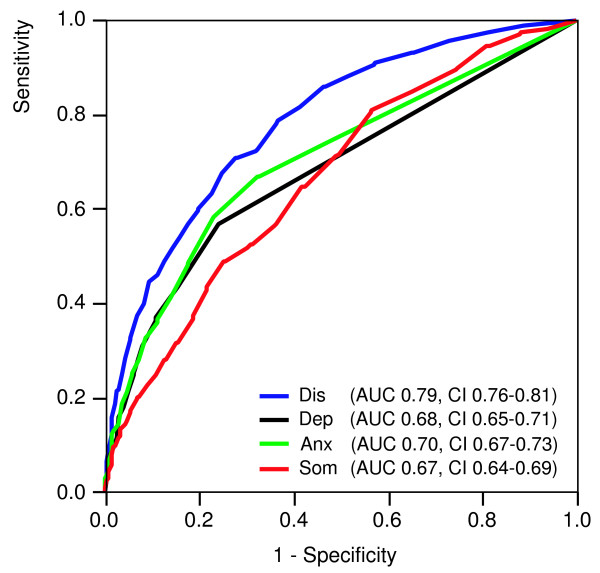
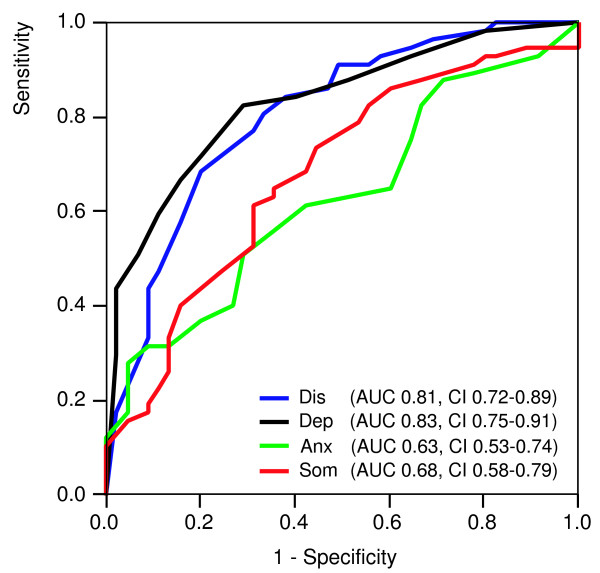
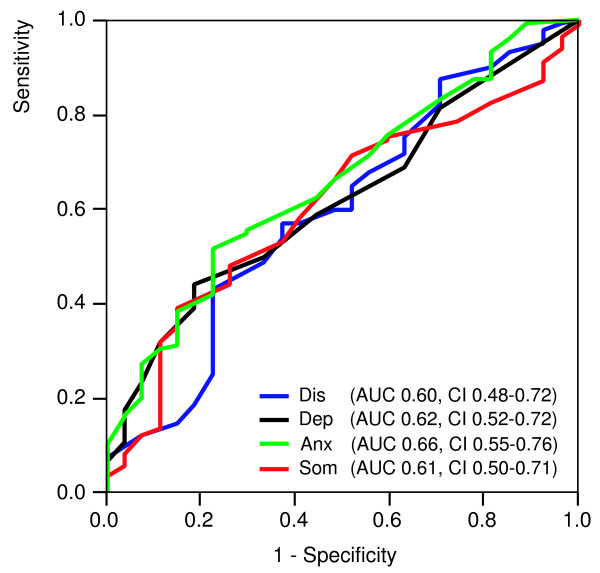
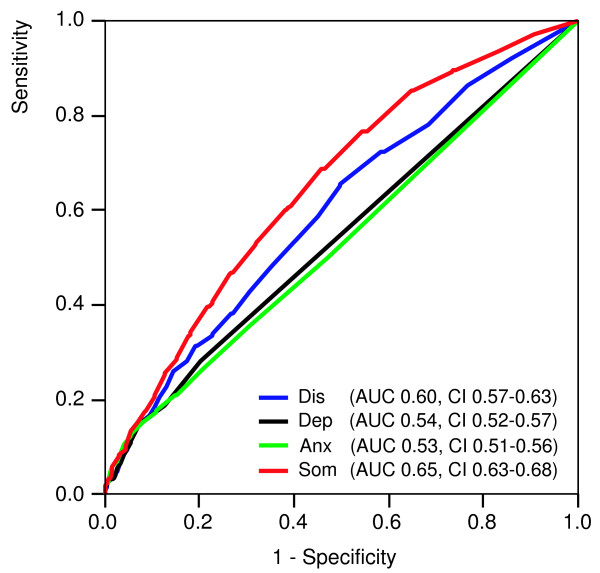
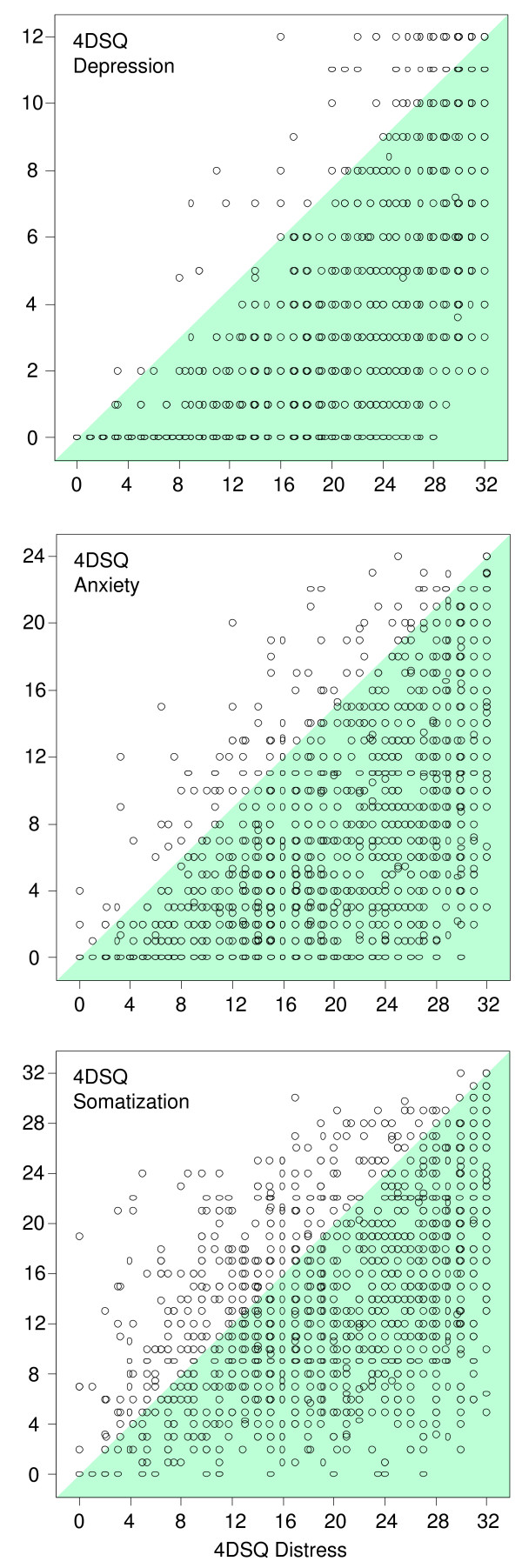
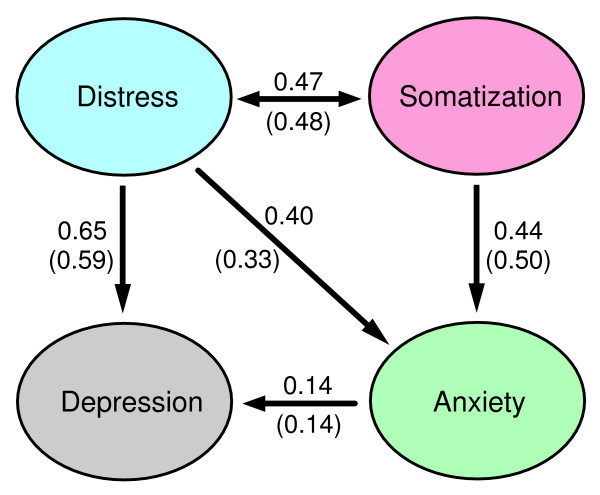
BACKGROUND: The Four-Dimensional Symptom Questionnaire (4DSQ) is a self-report questionnaire that has been developed in primary care to distinguish non-specific general distress from depression, anxiety and somatization. The purpose of this paper is to evaluate its criterion and construct validity. METHODS: Data from 10 different primary care studies have been used. Criterion validity was assessed by comparing the 4DSQ scores with clinical diagnoses, the GPs' diagnosis of any psychosocial problem for Distress, standardised psychiatric diagnoses for Depression and Anxiety, and GPs' suspicion of somatization for Somatization. ROC analyses and logistic regression analyses were used to examine the associations. Construct validity was evaluated by investigating the inter-correlations between the scales, the factorial structure, the associations with other symptom questionnaires, and the associations with stress, personality and social functioning. The factorial structure of the 4DSQ was assessed through confirmatory factor analysis (CFA). The associations with other questionnaires were assessed with Pearson correlations and regression analyses. RESULTS: Regarding criterion validity, the Distress scale was associated with any psychosocial diagnosis (area under the ROC curve [AUC] 0.79), the Depression scale was associated with major depression (AUC = 0.83), the Anxiety scale was associated with anxiety disorder (AUC = 0.66), and the Somatization scale was associated with the GPs' suspicion of somatization (AUC = 0.65). Regarding the construct validity, the 4DSQ scales appeared to have considerable inter-correlations (r = 0.35-0.71). However, 30-40% of the variance of each scale was unique for that scale. CFA confirmed the 4-factor structure with a comparative fit index (CFI) of 0.92. The 4DSQ scales correlated with most other questionnaires measuring corresponding constructs. However, the 4DSQ Distress scale appeared to correlate with some other depression scales more than the 4DSQ Depression scale. Measures of stress (i.e. life events, psychosocial problems, and work stress) were mainly associated with Distress, while Distress, in turn, was mainly associated with psychosocial dysfunctioning, including sick leave. CONCLUSION: The 4DSQ seems to be a valid self-report questionnaire to measure distress, depression, anxiety and somatization in primary care patients. The 4DSQ Distress scale appears to measure the most general, most common, expression of psychological problems.
Overview
The claims and statistics of this paper haven’t been checked yet.
Free: it reads the open-access text and checks the first 5 claims that cite a source we can check. Create a free account to check every claim.
Integrity signals
Registry
Cites
Statistics
Figures
Verification
Claims the paper makes
The claims and statistics of this paper haven’t been checked yet.
Free: it reads the open-access text and checks the first 5 claims that cite a source we can check. Create a free account to check every claim.
Self-check
Percentages, sums and reported differences re-computed from the paper’s own numbers.
The self-check needs the paper’s full text.
Citations
Cites
Diagnostic and Statistical Manual of Mental Disorders
Williams, J. B. W., & First, M. (2013) · Encyclopedia of Social Work · doi:10.1093/acrefore/9780199975839.013.104 · Cited by 109,519
The Hospital Anxiety and Depression Scale
Zigmond, A. S., & Snaith, R. P. (1983) · Acta Psychiatrica Scandinavica · doi:10.1111/j.1600-0447.1983.tb09716.x · Cited by 47,139
An inventory for measuring depression
BECK, A. T. (1961) · Archives of General Psychiatry · doi:10.1001/archpsyc.1961.01710120031004 · Cited by 38,032
(1970) · Cited by 24,983
Depression and quality of life in older persons: A review
Sivertsen, H., Bjørkløf, G. H., Engedal, K., Selbæk, G., & Helvik, A.-S. (2015) · Dementia and Geriatric Cognitive Disorders · doi:10.1159/000437299 · Cited by 14,152
A self-rating depression scale
ZUNG, W. W. K. (1965) · Archives of General Psychiatry · doi:10.1001/archpsyc.1965.01720310065008 · Cited by 9,813
EQS : structural equations program manual
Bentler, P. M. (1989) · Medical Entomology and Zoology · Cited by 9,669
Cognitive Therapy for Depression: (675542012-001)
(2012) · PsycEXTRA Dataset · doi:10.1037/e675542012-001 · Cited by 9,663
Pearlin, L. I., & Schooler, C. (1978) · Journal of Health and Social Behavior · doi:10.2307/2136319 · Cited by 7,791 · cited 3×
“Study F included the Neuroticism scale of the NEO Five Factor Inventory (NEO-FFI) [46], studies B and C a measure of mastery [47], and study H a measure of trait anxiety [41].”
MethodScoville, W. B. (1949) · Journal of neurosurgery · doi:10.3171/jns.1949.6.1.0065 · Cited by 7,380
Hanley, J. A., & McNeil, B. J. (1983) · Radiology · doi:10.1148/radiology.148.3.6878708 · Cited by 7,016
Pearlin, L. I., & Schooler, C. (1978) · PubMed · Cited by 6,764
(1988) · NFER-Nelson eBooks · Cited by 5,560
Cognitive Therapy of Depression
HOLLON, S. D., & BECK, A. T. (1979) · Cognitive-Behavioral Interventions · doi:10.1016/b978-0-12-404480-7.50012-5 · Cited by 4,685
Tripartite model of anxiety and depression: psychometric evidence and taxonomic implications
Clark, L. A., & Watson, D. (1991) · Journal of Abnormal Psychology · doi:10.1037/0021-843x.100.3.316 · Cited by 4,601
SCL-90: an outpatient psychiatric rating scale--preliminary report.
Derogatis, L. R., Lipman, R. S., & Covi, L. (1973) · PubMed · Cited by 4,563
(1994) · Medical Entomology and Zoology · Cited by 4,156
Structured Clinical Interview for DSM-IV Axis I Disorders
Spitzer, R. L., First, M. B., & Gibbon, M. (1997) · Medical Entomology and Zoology · Cited by 4,086
Karasek, R. A., Brisson, C., Kawakami, N., Houtman, I. L. D., Bongers, P. M., & Amick, B. C. (1998) · Journal of Occupational Health Psychology · doi:10.1037//1076-8998.3.4.322 · Cited by 3,189
Mendelson, G. (1995) · Australian & New Zealand Journal of Psychiatry · doi:10.3109/00048679509064964 · Cited by 2,858
Aaronson, N. K., Muller, M., Cohen, P. D. A., Essink-Bot, M.-L., Fekkes, M., Sanderman, R., Sprangers, M. A. G., te Velde, A., & Verrips, E. (1998) · Journal of Clinical Epidemiology · doi:10.1016/s0895-4356(98)00097-3 · Cited by 2,276
Assessing health status and quality-of-life instruments: Attributes and review criteria
Lohr, K. N. (2002) · Quality of Life Research · doi:10.1023/a:1015291021312 · Cited by 2,269
SPINHOVEN, P., ORMEL, J., SLOEKERS, P. P. A., KEMPEN, G. I. J. M., SPECKENS, A. E. M., & HEMERT, A. M. V. (1997) · Psychological Medicine · doi:10.1017/s0033291796004382 · Cited by 2,158 · cited 3×
“We used the Symptom Checklist (SCL-90) Depression scale [31,32] from study C, the Hospital Anxiety and Depression Scale (HADS) Depression scale [33,34] and the Self-rating Depression Scale of Zung (SDS) [35,36] from study D, and the Beck Depression Inventory (BDI) [37,38] from study F to compare with the 4DSQ Depressi…”
MethodThe structure of human personality
Eysenck, H. J. (1953) · Medical Entomology and Zoology · Cited by 1,322
Detecting anxiety and depression in general medical settings.
Goldberg, D., Bridges, K., Duncan-Jones, P., & Grayson, D. (1988) · BMJ · doi:10.1136/bmj.297.6653.897 · Cited by 1,210
Somatization: the concept and its clinical application
(1988) · American Journal of Psychiatry · doi:10.1176/ajp.145.11.1358 · Cited by 1,079 · cited 2×
“However, some of these people will also experience bodily symptoms (somatization) to some degree, due to a certain tendency [12].”
BackgroundDohrenwend, B. P. (1980) · Archives of General Psychiatry · doi:10.1001/archpsyc.1980.01780240027003 · Cited by 948
SCL-90. Handleiding bij een multidimensionele psychopathologie-indicator
Arrindell, W. A., & Ettema, J. H. (2003) · Research portal (Tilburg University) · Cited by 624
A questionnaire to assess premonitory symptoms of myocardial infarction
Appels, A., Höppener, P., & Mulder, P. (1987) · International Journal of Cardiology · doi:10.1016/0167-5273(87)90029-5 · Cited by 386
van der Klink, J. J. L., Blonk, R. W. B., Schene, A. H., & van Dijk, F. J. H. (2003) · Occupational and Environmental Medicine · doi:10.1136/oem.60.6.429 · Cited by 378
Schiff, A. A. (1978) · British Journal of Psychiatry · doi:10.1192/s0007125000003640 · Cited by 299
(2003) · Europe PMC (PubMed Central) · Cited by 255
“Unexplained” Somatic Symptoms, Functional Syndromes, and Somatization: Do We Need a Paradigm Shift?
Sharpe, M., & Carson, A. (2001) · Annals of Internal Medicine · doi:10.7326/0003-4819-134-9_part_2-200105011-00018 · Cited by 210
Appels, A., & Mulder, P. (1989) · Journal of Psychosomatic Research · doi:10.1016/0022-3999(89)90088-3 · Cited by 190
Dimensions of neuroses seen in primary-care settings
Goldberg, D. P., Bridges, K., Duncan–Jones, P., & Grayson, D. (1987) · Psychological Medicine · doi:10.1017/s0033291700025022 · Cited by 178
Functional somatic symptoms and syndromes
Mayou, R., & Farmer, A. (2002) · BMJ · doi:10.1136/bmj.325.7358.265 · Cited by 178 · cited 2×
“Various mechanisms may contribute to somatization, including sensitisation of the brain to bodily sensations [13], physiological abnormalities in the nervous and endocrine systems [14], heightened awareness of bodily sensations [15], and inappropriate illness beliefs and sickness behaviour [16].”
BackgroundTerluin *, B., Rhenen, W. V., Schaufeli, W. B., & De Haan, M. (2004) · Work & Stress · doi:10.1080/0267837042000297535 · Cited by 167
Self-citationStress, the Brain and Depression
Praag, H. M. V., Kloet, E. R. D., & Os, J. V. (2004) · Cambridge University Press eBooks · doi:10.1017/cbo9780511544422 · Cited by 150
The Concepts of Mild Depression
Snaith, R. P. (1987) · British Journal of Psychiatry · doi:10.1192/bjp.150.3.387 · Cited by 145
(1985) · University of Groningen research database (University of Groningen / Centre for Information Technology) · Cited by 118
Sensitization and subjective health complaints
Eriksen, H. R., & Ursin, H. (2002) · Scandinavian Journal of Psychology · doi:10.1111/1467-9450.00286 · Cited by 109
Hierarchical patterns in the distribution of psychiatric symptoms
Sturt, E. (1981) · Psychological Medicine · doi:10.1017/s0033291700041283 · Cited by 96
The report of the Chief Medical Officer’s CFS/ME working group: what does it say and will it help?
Sharpe, M. (2002) · Clinical Medicine · doi:10.7861/clinmedicine.2-5-427 · Cited by 75
Treatment of anxiety disorders in primary care practice: a randomised controlled trial.
van Boeijen, C. A., van Oppen, P., van Balkom, A. J. L. M., Visser, S., Kempe, P., Blankenstein, N., & van Dyck, R. (2005) · Europe PMC (PubMed Central) · Cited by 65
Replicated Factor Structure of the Beck Depression Inventory
LOUKS, J., HAYNE, C., & SMITH, J. (1989) · The Journal of Nervous and Mental Disease · doi:10.1097/00005053-198908000-00004 · Cited by 51
Medically unexplained symptoms and syndromes
Wessley, S., Ismail, K., & Sharpe, M. (2002) · Clinical Medicine · doi:10.7861/clinmedicine.2-6-501 · Cited by 50
Saris, W. E. (1999) · SAGE Publications Ltd eBooks · doi:10.4135/9780857029027.d124 · Cited by 47
Terluin, B., van Hout, H. P. J., van Marwijk, H., Adèr, H. J., van der Meer, K., de Haan, M., & van Dyck, R. (2002) · General Hospital Psychiatry · doi:10.1016/s0163-8343(02)00211-6 · Cited by 22
Self-citationImproved detection of depression in primary care through severity evaluation.
Nease, D. E., Klinkman, M. S., & Volk, R. J. (2002) · PubMed · Cited by 20
Managing mental health problems: a practical guide for primary care
(1999) · Medical Education · doi:10.1046/j.1365-2923.1999.0414b.x · Cited by 8
Research methodology in the life, behavioural and social sciences
Adèr, H. J., & Mellenbergh, G. J. (1999) · Cited by 7
Self-citationFour-Dimensional Symptom Questionnaire (4DSQ)
Terluin, B. (2021) · Springer eBooks · doi:10.1007/978-3-319-69909-7_1082-2 · Cited by 4
Self-citationManaging Mental Health Problems: A Practical Guide for Primary Care
Lipsitt, D. R. (1999) · American Journal of Psychiatry · doi:10.1176/ajp.156.11.1831 · Cited by 3
Research works printed but not linked: 14
- Terluin B: De Vierdimensionale Klachtenlijst (4DKL). Een vragenlijst voor het meten van distress, depressie, angst en somatisatie [The Four-Dimensional Symptom Questionnaire (4DSQ). A questionnaire to measure distress, depression, anxiety, and somatization]. Huisarts Wet. 1996, 39: 538-547.
- Terluin B: Overspanning onderbouwd. Een onderzoek naar de diagnose surmenage in de huisartspraktijk [Nervous breakdown substantiated. A study of the general practitioner's diagnosis of surmenage]. 1994, Utrecht, Universiteit Utrecht
- Terluin B, Gill K, Winnubst JAM: Hoe zien huisartsen surmenage? [General practitioners' perception of "nervous breakdown"]. Huisarts Wet. 1992, 35: 311-315.
- Romeijnders ACM, Vriezen JA, Van der Klink JJL, Hulshof CTJ, Terluin B, Flikweert S, Baart PC: Landelijke Eerstelijns Samenwerkings Afspraak Overspanning [National Primary Care Collaboration Agreement on Nervous Breakdown]. Huisarts Wet. 2005, 48: 20-23.
- Bentler P, Wu E: EQS for Windows user's guide. 1995, Encino, Multivariate Software
- Dijkstra P: De zelfbeoordelingsschaal voor depressie van Zung [The self-rating depression scale of Zung]. Stemming en ontstemming. Theorie en praktijk bij de diagnostiek van depressies. Edited by: Van Praag HM and Rooymans HGM. 1974, Amsterdam, Erven Bohn, 98-120.
- Beck AT, Steer RA: Beck Anxiety Inventory manual. 1993, San Antonio TX, Psychological Corporation, 2nd
- Van der Ploeg HM, Defares PB, Spielberger CD: Handleiding bij de Zelf-Beoordelings Vragenlijst (ZBV). Een Nederlandstalige bewerking van de Spielberger State-Trait Anxiety Inventory STAI-DY [Manual of the Self-Assessment Questionnaire. A Dutch adaptation of the Spielberger State-Trait Anxiety Inventory STAI-DY]. 1980, Lisse, Swets & Zeitlinger
- Hosman CMH: Psychosociale problematiek en hulpzoeken. Een sociaal-epidemiologische studie ten behoeve van de preventieve geestelijke gezondheidszorg [Psychosocial problems and seeking help. A socio-epidemiological study for the preventive mental health care]. 1983, Nijmegen, Katholieke Universiteit Nijmegen
- Ormel J: Moeite met leven of een moeilijk leven. Een vervolgonderzoek naar de invloed van psychosociale belasting op het welbevinden van driehonderd Nederlanders [A troublesome life, or trouble with living. A follow-up study of the influence of psycosocial stress on the well-being of threehundred Dutch inhabitants]. 1980, Groningen, Rijksuniversiteit Groningen
- Hoekstra HA, Ormel J, De Fruyt F: De NEO-PI-R/NEO-FFI; Big Five persoonlijkheidsvragenlijsten. Handleiding [Manual of the Dutch version of the NEO-PI-R/NEO-FFI]. 1996, Lisse, Swets en Zeitlinger
- Costa PT, McCrae RR: Revised NEO Personality Inventory (NEO-PI-R) and NEO Five Factor Inventory (NEO-FFI): professional manual. 1992, Odessa FL, Psychological Assessment Resources
- Van der Zee KL, Sanderman R: Het meten van de gezondheidstoestand met de RAND-36. Een handleiding [Measuring the health status with the RAND-36. A manual]. 1993, Groningen, Noordelijk Centrum voor Gezondheidsvraagstukken
- Terluin B: Factoranalyse van drie klachtenlijsten [Factor analysis of three symptom questionnaires]. Tijdschrift voor psychosomatische fysiotherapie. 1999, 4: 25-31.
Cited by
The Netherlands Study of Depression and Anxiety (NESDA): rationale, objectives and methods
Penninx, B. W. J. H., Beekman, A. T. F., Smit, J. H., Zitman, F. G., Nolen, W. A., Spinhoven, P., Cuijpers, P., De Jong, P. J., Van Marwijk, H. W. J., Assendelft, W. J. J., et al. (2008) · International Journal of Methods in Psychiatric Research · doi:10.1002/mpr.256 · Cited by 927
Self-citationBurnout Assessment Tool (BAT)—Development, Validity, and Reliability
Schaufeli, W. B., Desart, S., & De Witte, H. (2020) · International Journal of Environmental Research and Public Health · doi:10.3390/ijerph17249495 · Cited by 759
“The BAT does not include a subscale for depressed mood, but we recommend using the 6-item depression subscale from the 4-DSQ [32].”
BackgroundMethodInfluentialRivas, C., Ramsay, J., Sadowski, L., Davidson, L. L., Dunne, D., Eldridge, S., Hegarty, K., Taft, A., & Feder, G. (2015) · Cochrane Database of Systematic Reviews · doi:10.1002/14651858.cd005043.pub3 · Cited by 392
van Dessel, N., den Boeft, M., van der Wouden, J. C., Kleinstäuber, M., Leone, S. S., Terluin, B., Numans, M. E., van der Horst, H. E., & van Marwijk, H. (2014) · Cochrane Database of Systematic Reviews · doi:10.1002/14651858.cd011142.pub2 · Cited by 302
Self-citationSchäfer, I., Hansen, H., Schön, G., Höfels, S., Altiner, A., Dahlhaus, A., Gensichen, J., Riedel-Heller, S., Weyerer, S., Blank, W. A., et al. (2012) · BMC Health Services Research · doi:10.1186/1472-6963-12-89 · Cited by 296
“gender, age, marital status, household type, education, autonomy at former occupation, home ownership, morbidity measured by 46 diagnosis groups, the four subscales of the Four-Dimensional Symptom Questionnaire [26], the Geriatric Depression Scale [27], the Clinical Dementia Rating Scale [28], the Barthel Index [29],…”
MethodInfluential
Metadata
- Authors
- Terluin, B., van Marwijk, H. W., Adèr, H. J., de Vet, H. C., Penninx, B. W., Hermens, M. L., van Boeijen, C. A., van Balkom, A. J., van der Klink, J. J., & Stalman, W. A.
- Affiliations
- Amsterdam Public Health (NL)
- Amsterdam UMC Location Vrije Universiteit Amsterdam (NL)
- Corresponding author
- Terluin, Berend
- Venue
- BMC Psychiatry
- Published
- 2006-08-22
- Volume
- 6
- Issue
- 1
- Pages
- 34-34
- ISSN
- 1471-244X (ISSN-L)
- PMC
- PMC1590008
- OpenAlex
- W2115145758
- Cited by
- 469
- References
- 54
- Citations by year
- 2026: 16 · 2025: 10 · 2024: 25 · 2023: 30 · 2022: 32 · 2021: 36 · 2020: 27 · 2019: 21 · 2018: 26 · 2017: 42 · 2016: 37 · 2015: 35 · 2014: 24 · 2013: 22 · 2012: 18
- FWCI
- 15.95
- Type
- journal article
- Language
- en
- Open access
- gold
- doi.org
- Licence
- cc-by
- creativecommons.org/licenses/by/2.0 (tdm)
- Locations
- BMC Psychiatry (publishedVersion, cc-by)
- Europe PMC (PubMed Central) (publishedVersion, cc-by)
- PubMed (publishedVersion)
- Pure Amsterdam UMC (publishedVersion, other-oa)
- Amsterdam UMC (VU Amsterdam) - Institutional Repository (publishedVersion, other-oa)
- VU Research Portal (publishedVersion, other-oa)
- Data Archiving and Networked Services (DANS) (submittedVersion, other-oa)
- Digital Academic REpository of VU University Amsterdam (Vrije Universiteit Amsterdam) (submittedVersion)
- UvA-DARE (University of Amsterdam) (submittedVersion, cc-by)
- DOAJ (DOAJ: Directory of Open Access Journals) (submittedVersion)
- Data Archiving and Networked Services (DANS) (submittedVersion)
- Funders
- ZonMw (22000113)
- Nederlandse Organisatie voor Wetenschappelijk Onderzoek
- Topics
- Social Sciences › Psychology › Experimental and Cognitive Psychology › Anxiety, Depression, Psychometrics, Treatment, Cognitive Processes
- Health Sciences › Medicine › Psychiatry and Mental health › Psychosomatic Disorders and Their Treatments
- Social Sciences › Decision Sciences › Management Science and Operations Research › Psychometric Methodologies and Testing
- Keywords
- Four-Dimensional Symptom Questionnaire, distress, depression, anxiety, somatization, psychosomatic symptoms, primary care, questionnaire validation, criterion validity, construct validity, psychosocial problems, sick leave, occupational stress, life events, psychosocial functioning, self-report questionnaire, factor structure, psychometric properties, general practitioner diagnosis, social functioning
- MeSH terms
- Anxiety, Depression, Family Practice, Humans, Psychiatric Status Rating Scales, Surveys and Questionnaires, Somatoform Disorders, Stress, Psychological, Reproducibility of Results
About these checks
Registry, retraction, Cites and statistics results are computed, not judged, with one exception: a printed reference that no index lists is read once by a model before it counts as a citation error. Claims are extracted by a model and kept only when their quote appears verbatim in the text; each cited source is then checked, with a model’s help, for whether it says what the claim relies on. Those verdicts can be wrong — read the claim’s quote and the cited source before relying on one.
Statistics and arithmetic are recomputed, not judged.
Confidence bands are shown only for fields calibrated on our annotated test set. None is calibrated yet, so no band is shown.
What counts as a claim ›How we measure confidence ›How we check this ›
Are you an author, or do you see a problem with this page? Request a review
Data sources
Bibliographic data: Semantic Scholar, OpenAlex, Crossref.
Contains information from the Semantic Scholar Academic Graph Datasets, made available under the ODC Attribution License (ODC-BY 1.0).
Semantic Scholar’s data is described in: Kinney, R., et al. (2023). The Semantic Scholar Open Data Platform. arXiv:2301.10140.
