

Perceived connections between information and communication technology use and mental symptoms among young adults – A qualitative study
Open accessThe DOI matches its Crossref record; 61 of the 62 references it cites were found in a registry or an index.
Abstract
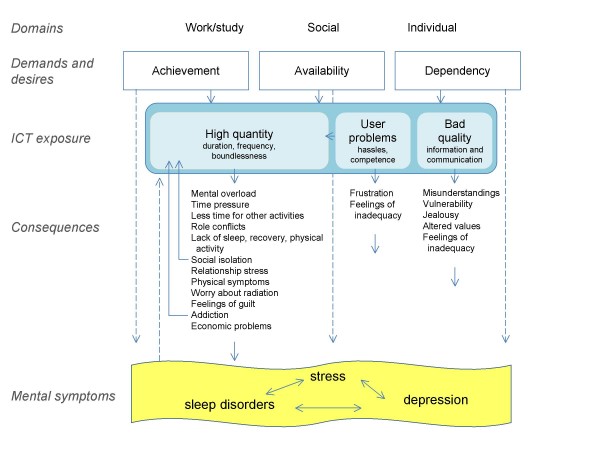
BACKGROUND: Prospective associations have been found between high use of information and communication technology (ICT) and reported mental symptoms among young adult university students, but the causal mechanisms are unclear. Our aim was to explore possible explanations for associations between high ICT use and symptoms of depression, sleep disorders, and stress among young adults in order to propose a model of possible pathways to mental health effects that can be tested epidemiologically. METHODS: We conducted a qualitative interview study with 16 women and 16 men (21-28 years), recruited from a cohort of university students on the basis of reporting high computer (n = 28) or mobile phone (n = 20) use at baseline and reporting mental symptoms at the one-year follow-up. Semi-structured interviews were performed, with open-ended questions about possible connections between the use of computers and mobile phones, and stress, depression, and sleep disturbances. The interview data were analyzed with qualitative content analysis and summarized in a model. RESULTS: Central factors appearing to explain high quantitative ICT use were personal dependency, and demands for achievement and availability originating from the domains of work, study, social life, and individual aspirations. Consequences included mental overload, neglect of other activities and personal needs, time pressure, role conflicts, guilt feelings, social isolation, physical symptoms, worry about electromagnetic radiation, and economic problems. Qualitative aspects (destructive communication and information) were also reported, with consequences including vulnerability, misunderstandings, altered values, and feelings of inadequacy. User problems were a source of frustration. Altered ICT use as an effect of mental symptoms was reported, as well as possible positive effects of ICT on mental health. CONCLUSIONS: The concepts and ideas of the young adults with high ICT use and mental symptoms generated a model of possible paths for associations between ICT exposure and mental symptoms. Demands for achievement and availability as well as personal dependency were major causes of high ICT exposure but also direct sources of stress and mental symptoms. The proposed model shows that factors in different domains may have an impact and should be considered in epidemiological and intervention studies.
Overview
The claims and statistics of this paper haven’t been checked yet.
Free: it reads the open-access text and checks the first 5 claims that cite a source we can check. Create a free account to check every claim.
Integrity signals
Registry
Cites
Statistics
Figures
Verification
Claims the paper makes
The claims and statistics of this paper haven’t been checked yet.
Free: it reads the open-access text and checks the first 5 claims that cite a source we can check. Create a free account to check every claim.
Claims other papers make about this one
Each is checked against this paper’s own text: does it say what the citing paper says it does?
The cited source says what the claim attributes to it.
In the citing paper
“Together, these features and user experiences contribute not only to increased time devoted to social media use [18], but also importantly to evolving social norms around expected availability and the urgency of online interactions [7,8,19], presenting unique implications for mental health and sleep.”
From Understanding Links Between Social Media Use, Sleep and Mental Health: Recent Progress and Current Challenges (2019) · cites this paper as [19]
The cited source says what the claim attributes to it.
In the citing paper
“In addition, being far from the device can be a stressful state for many because of the awareness that their contacts, both personal and professional, will feel displeasure and/or offense at being ignored (Thomée, Dellve, Harenstam, & Hagberg, 2010).”
From Is smartphone addiction really an addiction? (2018) · cites this paper as Thomée, Dellve, Harenstam, & Hagberg, 2010
Self-check
Percentages, sums and reported differences re-computed from the paper’s own numbers.
The self-check needs the paper’s full text.
Citations
Cites
Three Approaches to Qualitative Content Analysis
Hsieh, H.-F., & Shannon, S. E. (2005) · Qualitative Health Research · doi:10.1177/1049732305276687 · Cited by 44,601 · cited 2×
“A stepwise conventional qualitative content analysis [11,12] of the data was performed by the main author (also the interviewer).”
MethodGraneheim, U. H., & Lundman, B. (2004) · Nurse Education Today · doi:10.1016/j.nedt.2003.10.001 · Cited by 20,772 · cited 1×
“A stepwise conventional qualitative content analysis [11,12] of the data was performed by the main author (also the interviewer).”
MethodInternet Addiction: The Emergence of a New Clinical Disorder
YOUNG, K. S. (1998) · CyberPsychology & Behavior · doi:10.1089/cpb.1998.1.237 · Cited by 5,513
Internet paradox: A social technology that reduces social involvement and psychological well-being?
Kraut, R., Patterson, M., Lundmark, V., Kiesler, S., Mukophadhyay, T., & Scherlis, W. (1998) · American Psychologist · doi:10.1037/0003-066x.53.9.1017 · Cited by 4,793 · cited 1×
“Whether computer use or internet use can lead to depression has been the subject of debate; studies have shown mixed results [8,49-51].”
ResultMental health of young people: A global public-health challenge
Patel, V., Flisher, A. J., Hetrick, S., & McGorry, P. (2007) · The Lancet · doi:10.1016/s0140-6736(07)60368-7 · Cited by 3,126 · cited 1×
“Mental disorders account for a large proportion of the disease burden in young people in all societies, and are a global public health challenge [3].”
BackgroundUtility of a new procedure for diagnosing mental disorders in primary care. The PRIME-MD 1000 study
Spitzer, R. L. (1994) · JAMA · doi:10.1001/jama.272.22.1749 · Cited by 2,635
Kraut, R., Kiesler, S., Boneva, B., Cummings, J., Helgeson, V., & Crawford, A. (2002) · Journal of Social Issues · doi:10.1111/1540-4560.00248 · Cited by 2,202 · cited 2×
“Whether computer use or internet use can lead to depression has been the subject of debate; studies have shown mixed results [8,49-51].”
BackgroundResultDistracted and confused? Selective attention under load
Lavie, N. (2005) · Trends in Cognitive Sciences · doi:10.1016/j.tics.2004.12.004 · Cited by 2,102 · cited 1×
“Distractions and dual-tasking are demanding on working memory [22,23]; similarly, the participants in our study said that expected immediacy of communications, as evidenced by reminders and demands for explanations of any unavailability, added to mental over-load and feelings of guilt.”
BackgroundPsychosocial work environment and mental health—a meta-analytic review
Stansfeld, S., & Candy, B. (2006) · Scandinavian Journal of Work, Environment & Health · doi:10.5271/sjweh.1050 · Cited by 1,875 · cited 1×
“Social support is a factor that promotes health and buffers the negative effects of high psychosocial demands [20,21], and could be considered a positive aspect of ICT use.”
BackgroundUtility of a New Procedure for Diagnosing Mental Disorders in Primary Care: The PRIME-MD 1000 Study
Spitzer, R. L. (1994) · JAMA · doi:10.1001/jama.1994.03520220043029 · Cited by 1,873 · cited 1×
“Mental symptom items were: Have you continuously, for more than 7 days, during the past 12 months experienced: 1) stress (defined as a situation in whic ha person feels tense, restless, nervous or anxious, or is unable to sleep at night because his/her mind is troubled)? (adapted from the QPS Nordic [63]) 2a) little i…”
Background
Research works printed but not linked: 7
- StatisticsSweden Health and Medical care 1980-2005 LE Living conditions 2006 Stockholm, Sweden [In Swedish and parts in English]
- Socialstyrelsen Status report 2007: Public health and social conditions 2008 Stockholm, Sweden: The national board of healthand welfare [In Swedish]
- StatisticsSweden Use of computers and the Internet by private persons in 2007 2007 http://www.scb.se In Swedish and parts in English
- Karasek R Theorell T Healthy work 1990 New York: Basic Books
- Jonsdottir IH Stress, exercise and consequences for memory function and affective disorders Neurology & Cognitive Neuroscience 2006 6 1 2 6
- Medierådet Ungar & medier 2008 [Youth & media 2008] 2008 Stockholm: The Swedish media council [in Swedish]
- Kecklund G Åkerstedt T The psychometric properties of the Karolinska Sleep Questionnaire J Sleep Res 1992 1 Suppl 1 113
Cited by
Items 101–181 of 181
Self-reported sleep disorders/disturbances associated with physical symptoms and usage of computers
Korpinen, L. H., & Pääkkönen, R. J. (2013) · International Journal of Industrial Ergonomics · doi:10.1016/j.ergon.2013.05.004 · Cited by 6
Evaluation of a Brief Intervention to Reduce Mobile Phone Use in College Students
Piper, B. J., Daily, S. M., Martin, S. L., & Martin, M. W. (2022) · Guthrie Journal · doi:10.1101/19009241 · Cited by 7
“There is a behavioral component to wireless technology use that may increase unintentional injury and mental health issues [21].”
BackgroundHow Mobile Devices Affect Students According To Teachers' Beliefs
CUMAOĞLU, G. K. (2015) · Journal of International Education Research (JIER) · doi:10.19030/jier.v11i4.9456 · Cited by 11
Mishima, K., KUROKAWA, M., Onishi, A., YOSHITAKE, K., HONJO, M., Hashimoto, M., & Yoshida, T. (2016) · The Japanese Journal of Educational Psychology · doi:10.5926/jjep.64.518 · Cited by 5
Barati, M., Moloudi, G., Karimi, F., Afshari, M., Mohammadi, Y., & Etesamifard, T. (2016) · Avicenna Journal of Neuro Psych Physiology · doi:10.5812/ajnpp.12514 · Cited by 6
Yılmaz, H., & Göz, E. (2023) · Ağrı - The Journal of The Turkish Society of Algology · doi:10.14744/agri.2023.48657 · Cited by 13
Veiga, M. G., Felizi, R. T., Fernandes, C. E., & de Oliveira, E. (2022) · Revista Brasileira Ginecologia e Obstetrícia · doi:10.1055/s-0042-1744289 · Cited by 6
Testing, revision and application of the social anxiety scale for Chinese social media users
Wang, Y., Zhang, H., & Bao, S. (2024) · Frontiers in Psychology · doi:10.3389/fpsyg.2024.1378093 · Cited by 4
Sende, C., Souček, R., & Ebner, K. (2025) · Computers in Human Behavior Reports · doi:10.1016/j.chbr.2025.100619 · Cited by 6
“It’s Not Real Life”: Liminality and Summer Camp Employment
Povilaitis, V., Sibthorp, J., & Warner, R. P. (2021) · Journal of Adolescent Research · doi:10.1177/07435584211055980 · Cited by 6
“…of loneliness (Twenge et al., 2019, 2021) and that high amounts of smartphone use have also been associated with anxiety (Skierkowski & Wood, 2012), depression (Pantic et al., 2012), stress (Farahani et al., 2011), and a pressure to be constantly available and accessible (Thomée et al., 2010).”
BackgroundJoshi, S. C. (2023) · Psychology Research and Practice · doi:10.37155/2972-3086-0202-5 · Cited by 7
Hidden in plain sight? Sustained attention is the source of both educational and spiritual practice
Buttarazzi, G. F., & Sinha, S. (2025) · Cogent Education · doi:10.1080/2331186x.2025.2535884 · Cited by 6
“:3) ee et al., 2010).”
The Prevalence and Risk Factors of Sleep Disorders Among Adolescent in Junior High School
Theodorus, D., Windiani, I. G. A. T., Adnyana, I. G. A. N. S., & Soetjiningsih, I. (2020) · American Journal of Pediatrics · doi:10.11648/j.ajp.20200604.12 · Cited by 4
“Another mechanism is related to physical discomfort, such as muscle aches and headaches, which can be caused by by prolonged use of the media [25].”
BackgroundStress and Frustration Effects on Use of ICT for Research by Undergraduates in Ogun State, Nigeria
Adegbore, A. M., & Adeniji, O. S. (2015) · Journal of Ergonomics · doi:10.4172/2165-7556.1000143 · Cited by 4
“A high proportion of information and communication technology users seem to report momentary and sometimes persistent feelings of frustration [4].”
BackgroundTHE UBIQUITY OF ICTS: MENTAL HEALTH RISKS REINFORCED BY COVID-19 CRISIS
Maeneja, R., & Abreu, A. M. (2020) · Psicologia Saúde & Doenças · doi:10.15309/20psd210303 · Cited by 10
Scott, H., & Cleland Woods, H. (2025) · The Oxford Handbook of Sleep and Sleep Disorders · doi:10.1093/oxfordhb/9780197602751.013.11 · Cited by 3
Homo smartphonus: Psychological Aspects of Smartphone Use—A Literature Review
Sorokowski, P., & Sobczak, M. (2025) · Multimodal Technologies and Interaction · doi:10.3390/mti9080083 · Cited by 4
Noorbehbahani, F., Zaremohzzabieh, Z., Esfahani, H. H., Bajoghli, S., & Moosivand, M. (2024) · Advances in human and social aspects of technology book series · doi:10.4018/979-8-3693-3350-1.ch014 · Cited by 6
Rahman, T. U., Jan, Z., Alam, A., & Ali, R. (2024) · Digital Health · doi:10.1177/20552076241295797 · Cited by 9
Future of Work and Its Implication on Employee Well-Being in the 4IR Era
Abe, E. N., Abe, I. I., & Adisa, O. (2020) · Advances in human resources management and organizational development book series · doi:10.4018/978-1-7998-3347-5.ch008 · Cited by 3
Is the Technology Era Aging You? A Review of the Physiologic and Psychologic Toll of Technology Use
McKesey, J., & Fabi, S. G. (2022) · Dermatologic Surgery · doi:10.1097/dss.0000000000003535 · Cited by 3
“It can also lead to neglect of other activities, physical symptoms, time pressure, and conflicts of one’s personal role in relationships and society.(63) Unfortunately, stress physically ages us as well as worsens cognitive function, increases mind wandering, and decreases the ability to focus.”
BackgroundCeco, G., Taşkın, S., Uygun, E. G., Erus, S. M., & Satıcı, S. A. (2024) · Applied Research in Quality of Life · doi:10.1007/s11482-024-10404-y · Cited by 5
“In other words, it is defined as cognitive, emotional, and physiological arousal to notifications from social media or social media use (Thomee et al., 2010).”
Garbarino, S., & Costa, G. (2014) · Springer eBooks · doi:10.1007/978-88-470-5388-5_14 · Cited by 4
“2 % of ICT workers experienced quite often sleep disorders/disturbances [71].”
BackgroundBelal, M., Luong, N., Aledavood, T., & Kulshrestha, J. (2026) · Journal of Medical Internet Research · doi:10.2196/78775 · Cited by 9
“How: the type and pattern of internet behaviors— such as usage volume [14,48], temporal rhythms [49], and content categories (eg, social media, productivity, entertainment, or shopping)—may influence stress in different ways [21,50-52].”
Influentialالإجهاد الرقمي المدرک لدى طلبة الجامعات السعودية: البنية العاملية وفروق ديموغرافية
محمد, م. ع. ا. ع. ر., & خليوي, أ. ب. ف. ب. (2022) · Maǧallaẗ Kulliyyaẗ Al-Tarbiyyaẗ Ǧāmiʻaẗ Al-Minufiyyaẗ /Maǧallaẗ Kulliyyaẗ Al-Tarbiyyaẗ Ǧāmiʻaẗ Al-Minufiyyaẗ · doi:10.21608/muja.2022.243337 · Cited by 3
White, E., & Chen‐Wilson, J. (2023) · Counselling and Psychotherapy Research · doi:10.1002/capr.12732 · Cited by 3
Faryabi, R., Domari, A. A., Vazirinasab, H., Ardaneh, M., Daneshi, S., & Hamidi, A. (2024) · The Open Public Health Journal · doi:10.2174/0118749445304093240516113739 · Cited by 2
Call Me Maybe: Effects of Notification Modality on Visual Sustained Attention
Nason, K., & Wilbiks, J. M. P. (2025) · Multisensory Research · doi:10.1163/22134808-bja10147 · Cited by 4
Association between Sleep Duration, Use of Electronic Devices and Obesity in Medical Students
Mishra, T., Bose, M., Behera, P., Mohapatra, D., Meher, A., Panda, P., & Mohanty, M. (2021) · Universal Journal of Public Health · doi:10.13189/ujph.2021.090613 · Cited by 3
“The other cause by which there is sleep impairment is physical discomfort such as musculoskeletal pain and headache because of the prolonged use of electronic devices (like mobile phones and computer games) [11].”
BackgroundHatha Yoga: efeito da prática nos níveis de ansiedade e depressão em estudantes universitários
Rodrigues, J., Lunardi, M., Bertoli, J., Biduski, G. M., & Freitas, C. D. L. R. (2021) · Extensio Revista Eletrônica de Extensão · doi:10.5007/1807-0221.2021.e72676 · Cited by 10
«På skalaen som er meg, er det ikke plass til minuspoeng»
Gjellesvik, K. B., & Madsen, O. J. (2021) · Nordisk tidsskrift for ungdomsforskning · doi:10.18261/issn.2535-8162-2021-02-04 · Cited by 2
Ali, L. (2013) · Gothenburg University Publications Electronic Archive (Gothenburg University) · Cited by 3
Is social media use related to sleep quality, self-esteem, anxiety and depression in adolescence?
Scott, H. (2015) · e-space (Manchester Metropolitan University) · Cited by 2
Evaluation of a Brief Intervention to Reduce Cell Phone UsePreprint
Piper, B. J., Daily, S. M., Martin, S. L., & Martin, M. W. (2020) · Preprints.org · doi:10.20944/preprints202001.0137.v1 · Cited by 1
“You never know who’s watching”: how technology is shaping practice for social service professionals
Clary, P. C. (2014) · K-State Research Exchange (Kansas State University) · Cited by 3
Gosztonyi, M. (2024) · Social Psychology and Society · doi:10.17759/sps.2024150208 · Cited by 1
İşler, A. C., & Dalkıran, M. (2025) · Chronobiology International · doi:10.1080/07420528.2025.2579142 · Cited by 2
“Additionally, physical discomforts such as musculoskeletal pain and headaches-potentially stemming from excessive media use-have also been implicated in sleep disturbances (Thomee et al. 2010).”
Ghosh, K., Umer, S., Rout, R. K., & Fimiani, G. (2026) · Multimedia Tools and Applications · doi:10.1007/s11042-026-21292-9 · Cited by 1
“Mental health disorders, which affect thoughts, emotions, behaviors, and overall psychological well-being, can disrupt daily life, relationships, and coping abilities [8].”
Gal, N., Wang, A. L. M., Franco, A., Chaix, B., & Birenboim, A. (2026) · Social Science & Medicine · doi:10.1016/j.socscimed.2026.119337 · Cited by 3
What is constant connectivity? The affordances that underlie potential communication
Ross, M. Q., & Bayer, J. (2026) · Annals of the International Communication Association · doi:10.1093/anncom/wlag040 · Cited by 1
Influence of mental rotation of objects on psychophysiological functions of women
Chikina, L., Fedorchuk, S. V., Трушина, В. А., Pi, I., & Макарчук, М. Ю. (2012) · Fìzìologìčnij žurnal · doi:10.15407/fz58.05.036 · Cited by 1
Shah, M. (2021) · Journal of Development and Social Sciences · doi:10.47205/jdss.2021(2-iii)19 · Cited by 1
Frequency of Smart Phone Usage in Medical Students and its Association with Academic Performance
Ali, H. H., Imran, M., & Noori, Y. (2019) · INTERNATIONAL JOURNAL OF ENDORSING HEALTH SCIENCE RESEARCH (IJEHSR) · doi:10.29052/ijehsr.v7.i3.2019.154-161 · Cited by 3
Future of Work and Its Implication on Employee Well-Being in the 4IR Era
Abe, E. N., Abe, I. I., & Adisa, O. (2021) · IGI Global eBooks · doi:10.4018/978-1-6684-2405-6.ch001 · Cited by 3
Examination of the relationship between the use of electronic devices with sleep and depression
Kuzay, D., & Babaoğlu, Ü. T. (2021) · Acibadem Universitesi Saglik Bilimleri Dergisi · doi:10.31067/acusaglik.840842 · Cited by 2
THE IMPACT OF SOCIAL MEDIA USE AND CONTENT ON THE YOUNGER GENERATION'S MENTAL HEALTH IN INDONESIA
Maurizka, S., & Fitriani, P. W. H. A. W. R. (2021) · IADIS International Conference Information Systems · doi:10.33965/is2021_202103l017 · Cited by 2
Demirci, B., Kılıç, Ö., & Özhasar, Y. (2021) · Journal of Business Research - Turk · doi:10.20491/isarder.2021.1338 · Cited by 2
Mobile DNA and Sleep QualityPreprint
Amez, S., Denecker, F., Ponnet, K. S., Marez, L. D., & Baert, S. (2022) · SSRN Electronic Journal · doi:10.2139/ssrn.4114354 · Cited by 1
Mobile Phone Handsets Industry Greatly Influence the Teenagers: The Positive Aspects
Agarwal, S., & Bhagoliwal, P. (2016) · IRA-International Journal of Management & Social Sciences · doi:10.21013/jmss.v4.n3.p5
A Framework for Domain-Driven Development of Personal Health Informatics Technologies
Murnane, E. L. (2017) · eCommons (Cornell University) · doi:10.7298/x4cr5rbr · Cited by 2
“Another area of research is more concerned with the psychological risks of excessive use, which studies from around the world have found can include anxiety, depression, guilt, stress, and worry, often due to the wearing strain of a perceived expectation to be constantly available [319, 484].”
BackgroundDay time sleepiness in medical undergraduates: social media the culprit?
Lakshmi, V., Jindal, M., & Nanda, B. (2018) · International Journal of Advances in Medicine · doi:10.18203/2349-3933.ijam20183400
“Prolonged use of media can cause physical discomfort, such as muscle pain and headaches, which can negatively affect sleep.(16) Several studies found that TV, video games, cell phones, music, computers, and social media were significantly related to difficulty in falling asleep because of stimulation.”
BackgroundChallenges of Health Sustainability in IT-ITES Industry in India
Bhattacharyya, R. (2020) · Springer eBooks · doi:10.1007/978-981-15-4206-0_14
Venkatesh, A. (2020) · International Journal of Current Science Research and Review · doi:10.47191/ijcsrr/v3-i12-07 · Cited by 1
Media use and associated characteristics in early and late adolescence
Godinho, J. (2012) · Portuguese National Funding Agency for Science, Research and Technology (RCAAP Project by FCT) · doi:10.34626/x78x-cx73
Social Media and Depression: EMU Students’ Use of Instagram
Jideonwo, C. L. (2019) · Eastern Mediterranean University Institutional Repository (Eastern Mediterranean University) · Cited by 2
Geopathogenic zones, mobile phones and their influence on human organism, animals and trees
Duranková, S., Kalavsky, R., & Bernasovská, J. (2021) · Heritage and Sustainable Development · doi:10.37868/hsd.v3i2.61
Apolo, V. A. T. (2022) · Gredos (University of Salamanca) · doi:10.14201/gredos.149561 · Cited by 3
Titilope, A. O. (2018) · IGI Global eBooks · doi:10.4018/978-1-5225-7666-2.ch016
“Spillover” Work via Technology: Organizational Antecedents and Health Impacts
Hellemans, C., & Vayre, É. (2022) · Wiley eBooks · doi:10.1002/9781119988434.ch1 · Cited by 2
Impact of Use of Social Media on Adolescent's Mental Health in a Tier 2 City—A Cross-Sectional Study
Sohane, A., Ghanghoriya, P. K., & Tiwari, A. (2022) · International Journal of Recent Surgical and Medical Sciences · doi:10.1055/s-0042-1743450 · Cited by 2
D’Souza, M., Kiran, K., Mamata, K., Kumari, S., Dynaneshwari, L., Shweta, M., & Vishakha, M. (2022) · Nursing Journal of India · doi:10.48029/nji.2017.cviii405
Turner, P. (2023) · Human-computer interaction series · doi:10.1007/978-3-031-32454-3_5
A Review Study of Mobile Phone Addiction and Sleep Quality and Anxiety in College Students
Yao, Y. (2023) · Lecture Notes in Education Psychology and Public Media · doi:10.54254/2753-7048/29/20231465
Domínguez-Lara, S., Sánchez‐Villena, A. R., Aranda, M., Gutiérrez, V. F., & Domingo, M. G. (2023) · African journal of rhetoric · doi:10.21134/haaj.v23i2.769 · Cited by 8
الإسهام النسبي للإجهاد الرقمي و قلق التحصيل في التنبؤ بالإندماج الأكاديمي لطلاب جامعة حلوان
اللیثى, أ. ح. م., & رياض, س. ع. (2023) · مجلة دراسات تربوية واجتماعية · doi:10.21608/jsu.2023.337673
Zulkifli, A. F., & Danis, A. (2024) · The European Journal of Social & Behavioural Sciences · doi:10.15405/ejsbs.341
سويفي, غ. (2023) · Dirāsāt fi Al-Ṭufūlaẗ wa Al-Tarbiyyaẗ /Dirāsāt fi Al-Ṭufūlaẗ wa Al-Tarbiyyaẗ · doi:10.21608/dftt.2024.231462.1180
The Digital Generation: An Analysis of the Seminal Impact of Internet Usage on Children
Shukla, M., Waghmode, M., & Bhosale, Y. N. (2024) · Journal of Engineering Education Transformations · doi:10.16920/jeet/2024/v37is2/24041 · Cited by 1
Xie, W., Wang, L., & Yang, L. (2024) · SSRN Electronic Journal · doi:10.2139/ssrn.4791416
Cataldo, I., Sforza, M., Franceschini, C., Marelli, S., Ferini‐Strambi, L., Plazzi, G., Billieux, J., Schimmenti, A., & Musetti, A. (2025) · Behaviour and Information Technology · doi:10.1080/0144929x.2025.2484394
“Specifically, engaging in online behaviours and exposure to screen brightness and blue light have been suggested to delay sleep onset and foster sleep disturbances (Cain and Gradisar 2010; Chang et al. 2015; Thomee et al. 2010).”
Yahyaei, S., Garkaz, O., Paryab, S., Mahdavi, S., Ramezani, S., & Pourheidari, M. (2025) · Journal of Archives in Military Medicine · doi:10.5812/jamm-159796
Babakhani, D., Shojaei, A., zad, E. P., & Foroughi, A. (2025) · Research Square · doi:10.21203/rs.3.rs-6680798/v1
Shah, A., Almourad, M. B., Ali, S., Alam, A., & Rahman, T. U. (2025) · Human Behavior and Emerging Technologies · doi:10.1155/hbe2/4428860 · Cited by 1
Li, W., & Zhang, X. (2025) · Child & Family Social Work · doi:10.1111/cfs.70110
Feng, S., Liu, K., Qin, Z., He, H., Bu, W., Liu, R., Sun, Y., & Chen, S. (2026) · International Journal of Behavioral Development · doi:10.1177/01650254251413161
Digital stress and well-being among Peruvian adolescents during the COVID-19 pandemic
Lopez, D. E. M., Foster, K. T., & Magis‐Weinberg, L. (2026) · Computers in Human Behavior Reports · doi:10.1016/j.chbr.2026.100997 · Cited by 2
Nagel, A., & Kruse, F. (2026) · Children · doi:10.3390/children13030405 · Cited by 2
“Constant availability predicts higher stress and depressive symptoms [29], while social pressures to remain reachable contribute to feeling overwhelmed [18].”
Yang, K., Kwon, S., & Lee, S. (2026) · International Journal of Sports Science & Coaching · doi:10.1177/17479541261475061
In Favor of Digital Detox: Developing the Attitude Toward Digital Detox Scale
Winkler, S., Eckmann, L., Bornemann, T., & Landwehr, J. R. (2026) · Psychology and Marketing · doi:10.1002/mar.70256
Nighttime Social Media Usage and Sleep Quality among Youth in District Chakwal, Pakistan
Huzaifa, M. T., Mirza, F. I., & Sabah, A. N. U. (2025) · journal of social sciences review · doi:10.62843/jssr.v6i4.772
Metadata
- Authors
- Thomée, S., Dellve, L., Härenstam, A., & Hagberg, M.
- Affiliations
- University of Gothenburg (SE)
- Corresponding author
- Thomée, Sara
- Venue
- BMC Public Health
- Published
- 2010-02-12
- Volume
- 10
- Issue
- 1
- Pages
- 66-66
- ISSN
- 1471-2458 (ISSN-L)
- PMC
- PMC2836296
- OpenAlex
- W2145535267
- Cited by
- 181
- References
- 62
- Citations by year
- 2026: 8 · 2025: 16 · 2024: 14 · 2023: 22 · 2022: 23 · 2021: 18 · 2020: 13 · 2019: 13 · 2018: 8 · 2017: 7 · 2016: 9 · 2015: 8 · 2014: 7 · 2013: 8 · 2012: 5
- FWCI
- 15.55
- Type
- journal article
- Language
- en
- Open access
- gold
- doi.org
- Licence
- cc-by
- creativecommons.org/licenses/by/2.0 (tdm)
- Locations
- BMC Public Health (publishedVersion, cc-by)
- PubMed Central (publishedVersion, cc-by)
- PubMed (publishedVersion)
- Borås Academic Digital Archive (University of Borås) (submittedVersion)
- DOAJ (DOAJ: Directory of Open Access Journals) (submittedVersion, cc-by-sa)
- Funders
- Forskningsrådet för Arbetsliv och Socialvetenskap
- Topics
- Social Sciences › Sociology and Political Science › Impact of Technology on Adolescents
- Social Sciences › Psychology › Social Psychology › Technostress in Professional Settings
- Social Sciences › Gender Studies › Gender and Technology in Education
- Keywords
- ICT use, psychiatric symptoms, depression, sleep disorders, stress, young adults, university students, computer use, mobile phone use, cognitive overload, social isolation, role conflict, guilt, causal pathways, mental health
- MeSH terms
- Adult, Communication, Computers, Depression, Female, Follow-Up Studies, Humans, Interviews as Topic, Male, Mental Health, Sleep Wake Disorders, Stress, Psychological, Students, Sweden, Universities, Qualitative Research, Cell Phone, Young Adult
About these checks
Registry, retraction, Cites and statistics results are computed, not judged, with one exception: a printed reference that no index lists is read once by a model before it counts as a citation error. Claims are extracted by a model and kept only when their quote appears verbatim in the text; each cited source is then checked, with a model’s help, for whether it says what the claim relies on. Those verdicts can be wrong — read the claim’s quote and the cited source before relying on one.
Statistics and arithmetic are recomputed, not judged.
Confidence bands are shown only for fields calibrated on our annotated test set. None is calibrated yet, so no band is shown.
What counts as a claim ›How we measure confidence ›How we check this ›
Are you an author, or do you see a problem with this page? Request a review
Data sources
Bibliographic data: Semantic Scholar, OpenAlex, Crossref.
Contains information from the Semantic Scholar Academic Graph Datasets, made available under the ODC Attribution License (ODC-BY 1.0).
Semantic Scholar’s data is described in: Kinney, R., et al. (2023). The Semantic Scholar Open Data Platform. arXiv:2301.10140.
