

Perceived connections between information and communication technology use and mental symptoms among young adults – A qualitative study
Open accessThe DOI matches its Crossref record; 61 of the 62 references it cites were found in a registry or an index.
Abstract
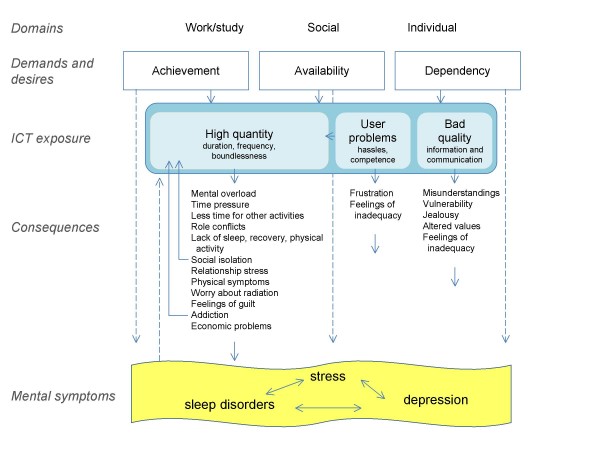
BACKGROUND: Prospective associations have been found between high use of information and communication technology (ICT) and reported mental symptoms among young adult university students, but the causal mechanisms are unclear. Our aim was to explore possible explanations for associations between high ICT use and symptoms of depression, sleep disorders, and stress among young adults in order to propose a model of possible pathways to mental health effects that can be tested epidemiologically. METHODS: We conducted a qualitative interview study with 16 women and 16 men (21-28 years), recruited from a cohort of university students on the basis of reporting high computer (n = 28) or mobile phone (n = 20) use at baseline and reporting mental symptoms at the one-year follow-up. Semi-structured interviews were performed, with open-ended questions about possible connections between the use of computers and mobile phones, and stress, depression, and sleep disturbances. The interview data were analyzed with qualitative content analysis and summarized in a model. RESULTS: Central factors appearing to explain high quantitative ICT use were personal dependency, and demands for achievement and availability originating from the domains of work, study, social life, and individual aspirations. Consequences included mental overload, neglect of other activities and personal needs, time pressure, role conflicts, guilt feelings, social isolation, physical symptoms, worry about electromagnetic radiation, and economic problems. Qualitative aspects (destructive communication and information) were also reported, with consequences including vulnerability, misunderstandings, altered values, and feelings of inadequacy. User problems were a source of frustration. Altered ICT use as an effect of mental symptoms was reported, as well as possible positive effects of ICT on mental health. CONCLUSIONS: The concepts and ideas of the young adults with high ICT use and mental symptoms generated a model of possible paths for associations between ICT exposure and mental symptoms. Demands for achievement and availability as well as personal dependency were major causes of high ICT exposure but also direct sources of stress and mental symptoms. The proposed model shows that factors in different domains may have an impact and should be considered in epidemiological and intervention studies.
Overview
The claims and statistics of this paper haven’t been checked yet.
Free: it reads the open-access text and checks the first 5 claims that cite a source we can check. Create a free account to check every claim.
Integrity signals
Registry
Cites
Statistics
Figures
Verification
Claims the paper makes
The claims and statistics of this paper haven’t been checked yet.
Free: it reads the open-access text and checks the first 5 claims that cite a source we can check. Create a free account to check every claim.
Claims other papers make about this one
Each is checked against this paper’s own text: does it say what the citing paper says it does?
The cited source says what the claim attributes to it.
In the citing paper
“Together, these features and user experiences contribute not only to increased time devoted to social media use [18], but also importantly to evolving social norms around expected availability and the urgency of online interactions [7,8,19], presenting unique implications for mental health and sleep.”
From Understanding Links Between Social Media Use, Sleep and Mental Health: Recent Progress and Current Challenges (2019) · cites this paper as [19]
The cited source says what the claim attributes to it.
In the citing paper
“In addition, being far from the device can be a stressful state for many because of the awareness that their contacts, both personal and professional, will feel displeasure and/or offense at being ignored (Thomée, Dellve, Harenstam, & Hagberg, 2010).”
From Is smartphone addiction really an addiction? (2018) · cites this paper as Thomée, Dellve, Harenstam, & Hagberg, 2010
Self-check
Percentages, sums and reported differences re-computed from the paper’s own numbers.
The self-check needs the paper’s full text.
Citations
Cites
Three Approaches to Qualitative Content Analysis
Hsieh, H.-F., & Shannon, S. E. (2005) · Qualitative Health Research · doi:10.1177/1049732305276687 · Cited by 44,601 · cited 2×
“A stepwise conventional qualitative content analysis [11,12] of the data was performed by the main author (also the interviewer).”
MethodGraneheim, U. H., & Lundman, B. (2004) · Nurse Education Today · doi:10.1016/j.nedt.2003.10.001 · Cited by 20,772 · cited 1×
“A stepwise conventional qualitative content analysis [11,12] of the data was performed by the main author (also the interviewer).”
MethodInternet Addiction: The Emergence of a New Clinical Disorder
YOUNG, K. S. (1998) · CyberPsychology & Behavior · doi:10.1089/cpb.1998.1.237 · Cited by 5,513
Internet paradox: A social technology that reduces social involvement and psychological well-being?
Kraut, R., Patterson, M., Lundmark, V., Kiesler, S., Mukophadhyay, T., & Scherlis, W. (1998) · American Psychologist · doi:10.1037/0003-066x.53.9.1017 · Cited by 4,793 · cited 1×
“Whether computer use or internet use can lead to depression has been the subject of debate; studies have shown mixed results [8,49-51].”
ResultMental health of young people: A global public-health challenge
Patel, V., Flisher, A. J., Hetrick, S., & McGorry, P. (2007) · The Lancet · doi:10.1016/s0140-6736(07)60368-7 · Cited by 3,126 · cited 1×
“Mental disorders account for a large proportion of the disease burden in young people in all societies, and are a global public health challenge [3].”
BackgroundUtility of a new procedure for diagnosing mental disorders in primary care. The PRIME-MD 1000 study
Spitzer, R. L. (1994) · JAMA · doi:10.1001/jama.272.22.1749 · Cited by 2,635
Kraut, R., Kiesler, S., Boneva, B., Cummings, J., Helgeson, V., & Crawford, A. (2002) · Journal of Social Issues · doi:10.1111/1540-4560.00248 · Cited by 2,202 · cited 2×
“Whether computer use or internet use can lead to depression has been the subject of debate; studies have shown mixed results [8,49-51].”
BackgroundResultDistracted and confused? Selective attention under load
Lavie, N. (2005) · Trends in Cognitive Sciences · doi:10.1016/j.tics.2004.12.004 · Cited by 2,102 · cited 1×
“Distractions and dual-tasking are demanding on working memory [22,23]; similarly, the participants in our study said that expected immediacy of communications, as evidenced by reminders and demands for explanations of any unavailability, added to mental over-load and feelings of guilt.”
BackgroundPsychosocial work environment and mental health—a meta-analytic review
Stansfeld, S., & Candy, B. (2006) · Scandinavian Journal of Work, Environment & Health · doi:10.5271/sjweh.1050 · Cited by 1,875 · cited 1×
“Social support is a factor that promotes health and buffers the negative effects of high psychosocial demands [20,21], and could be considered a positive aspect of ICT use.”
BackgroundUtility of a New Procedure for Diagnosing Mental Disorders in Primary Care: The PRIME-MD 1000 Study
Spitzer, R. L. (1994) · JAMA · doi:10.1001/jama.1994.03520220043029 · Cited by 1,873 · cited 1×
“Mental symptom items were: Have you continuously, for more than 7 days, during the past 12 months experienced: 1) stress (defined as a situation in whic ha person feels tense, restless, nervous or anxious, or is unable to sleep at night because his/her mind is troubled)? (adapted from the QPS Nordic [63]) 2a) little i…”
Background
Research works printed but not linked: 7
- StatisticsSweden Health and Medical care 1980-2005 LE Living conditions 2006 Stockholm, Sweden [In Swedish and parts in English]
- Socialstyrelsen Status report 2007: Public health and social conditions 2008 Stockholm, Sweden: The national board of healthand welfare [In Swedish]
- StatisticsSweden Use of computers and the Internet by private persons in 2007 2007 http://www.scb.se In Swedish and parts in English
- Karasek R Theorell T Healthy work 1990 New York: Basic Books
- Jonsdottir IH Stress, exercise and consequences for memory function and affective disorders Neurology & Cognitive Neuroscience 2006 6 1 2 6
- Medierådet Ungar & medier 2008 [Youth & media 2008] 2008 Stockholm: The Swedish media council [in Swedish]
- Kecklund G Åkerstedt T The psychometric properties of the Karolinska Sleep Questionnaire J Sleep Res 1992 1 Suppl 1 113
Cited by
Woods, H. C., & Scott, H. (2016) · Journal of Adolescence · doi:10.1016/j.adolescence.2016.05.008 · Cited by 1,302
Thomée, S., Härenstam, A., & Hagberg, M. (2011) · BMC Public Health · doi:10.1186/1471-2458-11-66 · Cited by 1,269
“, among the subjects participants in [11]).”
InfluentialSelf-citationIs smartphone addiction really an addiction?
Panova, T., & Carbonell, X. (2018) · Journal of behavioral addictions · doi:10.1556/2006.7.2018.49 · Cited by 976
Sleep and use of electronic devices in adolescence: results from a large population-based study
Hysing, M., Pallesen, S., Stormark, K. M., Jakobsen, R., Lundervold, A. J., & Sivertsen, B. (2015) · BMJ Open · doi:10.1136/bmjopen-2014-006748 · Cited by 678
Cheever, N. A., Rosen, L. D., Carrier, L. M., & Chavez, A. (2014) · Computers in Human Behavior · doi:10.1016/j.chb.2014.05.002 · Cited by 589
Smartphone addiction, daily interruptions and self-reported productivity
Duke, É., & Montag, C. (2017) · Addictive Behaviors Reports · doi:10.1016/j.abrep.2017.07.002 · Cited by 466
“Earlier work by Thomée et al. (2011; 2010) seems to support the idea of technostress.”
BackgroundResultInterplay between social media use, sleep quality, and mental health in youth: a systematic review
Alonzo, R., Hussain, J., Stranges, S., & Anderson, K. K. (2021) · Sleep Medicine Reviews · doi:10.1016/j.smrv.2020.101414 · Cited by 456
Information and communication technology use, work intensification and employee strain and distress
Chesley, N. (2014) · Work, Employment and Society · doi:10.1177/0950017013500112 · Cited by 311
“Investigation of links between technological innovation and more stressful work environments are also global (e.g. Coklar and Sahin, 2011; Thomee et al., 2010), and these concerns have been intensified by the recent recession (Houdmont et al., 2012).”
BackgroundFossum, I. N., Nordnes, L. T., Storemark, S. S., Bjorvatn, B., & Pallesen, S. (2014) · Behavioral Sleep Medicine · doi:10.1080/15402002.2013.819468 · Cited by 306
“Further, prolonged use of media can cause physical discomfort, such as muscular pain and headache, which can negatively affect sleep (Thomée et al., 2010).”
BackgroundThe association between smartphone use, stress, and anxiety: A meta‐analytic review
Vahedi, Z., & Saiphoo, A. (2018) · Stress and Health · doi:10.1002/smi.2805 · Cited by 280
Constantly connected–The effects of smart-devices on mental health
Harwood, J., Dooley, J. J., Scott, A. J., & Joiner, R. (2014) · Computers in Human Behavior · doi:10.1016/j.chb.2014.02.006 · Cited by 236
“It is also likely that being highly involved further increases depression and stress, as previous research has found that the greatest contribution to depression, stress and sleep disturbances is the perceived expectation that individuals should be available around the clock (Thomee et al., 2010; Thomee et al., 2011).”
ResultSteele, R. G., Hall, J. A., & Christofferson, J. L. (2020) · Clinical Child and Family Psychology Review · doi:10.1007/s10567-019-00300-5 · Cited by 227
“Availability Stress Distress (including guilt and anxiety) resulting from beliefs about others’ expectations that the individual respond and be available by digital means Mobile entrapment (Baron 2008; Hall and Baym 2012); Mobile maintenance expectations (Hall and Baym 2012); Accessibility stress/availability demands…”
BackgroundResultInfluentialCorrelates of social media fatigue and academic performance decrement: A large cross-sectional study
Malik, A., Dhir, A., Kaur, P., & Johri, A. (2020) · Information Technology & People · doi:10.1108/itp-06-2019-0289 · Cited by 211
Panova, T., & Lleras, A. (2016) · Computers in Human Behavior · doi:10.1016/j.chb.2015.12.062 · Cited by 195
Levenson, J. C., Shensa, A., Sidani, J. E., Colditz, J. B., & Primack, B. A. (2017) · Sleep · doi:10.1093/sleep/zsx113 · Cited by 177
MacFarlane, B., & Kushner, J. (2023) · Effective Use of Social Media in Public Health · doi:10.1016/b978-0-323-95630-7.00010-x · Cited by 172
Orzech, K. M., Grandner, M. A., Roane, B. M., & Carskadon, M. A. (2016) · Computers in Human Behavior · doi:10.1016/j.chb.2015.08.049 · Cited by 167
Thomée, S., Härenstam, A., & Hagberg, M. (2012) · BMC Psychiatry · doi:10.1186/1471-244x-12-176 · Cited by 164
“, among the subjects participants in [11]).”
BackgroundMethodInfluentialSelf-citationMedia use and depression: exposure, household rules, and symptoms among young adolescents in the USA
Bickham, D. S., Hswen, Y., & Rich, M. (2015) · International Journal of Public Health · doi:10.1007/s00038-014-0647-6 · Cited by 134
“The stress of constant connectedness afforded by mobile phones has been identified by young adults as a potential mechanism linking their use to depression (Thomée et al. 2010).”
BackgroundInfluentialTechnostress Research: A Nurturing Ground for Measurement Pluralism?
University of Applied Sciences Upper Austria, Fischer, T., Riedl, R., & University of Applied Sciences Upper Austria and University of Linz (2017) · Communications of the Association for Information Systems · doi:10.17705/1cais.04017 · Cited by 127
Media devices in pre-school children: the recommendations of the Italian pediatric society
Bozzola, E., Spina, G., Ruggiero, M., Memo, L., Agostiniani, R., Bozzola, M., Corsello, G., & Villani, A. (2018) · Italian Journal of Pediatrics · doi:10.1186/s13052-018-0508-7 · Cited by 129
“Another mechanism relates to physical discomfort, such as muscular pain and headache, caused by prolonged media use and inappropriate neck posture during activities such as game playing [26].”
BackgroundGirela-Serrano, B. M., Spiers, A. D. V., Ruotong, L., Gangadia, S., Toledano, M. B., & Di Simplicio, M. (2024) · European Child & Adolescent Psychiatry · doi:10.1007/s00787-022-02012-8 · Cited by 123
A socioeconomic related 'digital divide' exists in how, not if, young people use computers
Harris, C., Straker, L., & Pollock, C. (2017) · PLOS ONE · doi:10.1371/journal.pone.0175011 · Cited by 124
Problematic Gaming and Sleep: A Systematic Review and Meta-Analysis
Kristensen, J. H., Pallesen, S., King, D. L., Hysing, M., & Erevik, E. K. (2021) · Frontiers in Psychiatry · doi:10.3389/fpsyt.2021.675237 · Cited by 176
“Prolonged gaming may also negatively affect sleep by creating physical discomforts such as muscular pain and headache (31).”
BackgroundScott, H., & Woods, H. C. (2019) · Current Sleep Medicine Reports · doi:10.1007/s40675-019-00148-9 · Cited by 105
Texting while stressed: Implications for students’ burnout, sleep, and well-being.
Murdock, K. K. (2013) · Psychology of Popular Media Culture · doi:10.1037/ppm0000012 · Cited by 115
“When young adults lose access to texting or even contemplate a lack of access, they report feeling disconnected, discombobulated, and anxious (Skierkowski & Wood, 2012; Thomée et al., 2010).”
BackgroundIdentifying drivers for bedtime social media use despite sleep costs: the adolescent perspective
Scott, H., Biello, S., & Woods, H. (2018) · doi:10.31234/osf.io/2xb36 · Cited by 90
“By enabling 24/7 interactions, social media platforms can facilitate competition between social interactions and sufficient, good quality sleep, with incoming alerts and perceived social expectations of 24/7 availability presenting unique challenges for sleep compared to other forms of technology.(6) Indeed, children…”
BackgroundIdentifying drivers for bedtime social media use despite sleep costs: The adolescent perspective
Scott, H., Biello, S. M., & Woods, H. C. (2019) · Sleep Health · doi:10.1016/j.sleh.2019.07.006 · Cited by 87
Jniene, A., Errguig, L., Hangouche, A. J. E., Rkain, H., Aboudrar, S., Ftouh, M. E., & Dakka, T. (2019) · BioMed Research International · doi:10.1155/2019/7012350 · Cited by 117
“A study showed the most obvious aspect connecting mobile phone use with sleep disturbances was being awakened at night by phone calls or messages [42].”
BackgroundRod, N. H., Dissing, A. S., Clark, A., Gerds, T. A., & Lund, R. (2018) · PLOS ONE · doi:10.1371/journal.pone.0204811 · Cited by 83
Panova, T., Carbonell, X., Chamarro, A., & Puerta-Cortés, D. X. (2020) · Behaviour & Information Technology · doi:10.1080/0144929x.2019.1633405 · Cited by 83
“Punyanunt-Carter 2012, Panova and Lleras 2016), a decrease in mindful living (Thomée et al. 2010), sleep disturbances (Thomée, Härenstam, and Hagberg 2011;”
BackgroundInfluentialPagano, M., Bacaro, V., & Crocetti, E. (2023) · Computers in Human Behavior · doi:10.1016/j.chb.2023.107813 · Cited by 74
Depression screening using mobile phone usage metadata: a machine learning approach
Razavi, R., Gharipour, A., & Gharipour, M. (2020) · Journal of the American Medical Informatics Association · doi:10.1093/jamia/ocz221 · Cited by 74
“11 19 For example, depressed users have been found to make fewer calls and browse the internet on their mobile phones less frequently.”
BackgroundHebden, L., Balestracci, K., McGeechan, K., Denney-Wilson, E., Harris, M., Bauman, A., & Allman-Farinelli, M. (2013) · Trials · doi:10.1186/1745-6215-14-75 · Cited by 68
Lindsay, M., Messing, J. T., Thaller, J., Baldwin, A., Clough, A. S., Bloom, T., Eden, K., & Glass, N. E. (2013) · Journal of Technology in Human Services · doi:10.1080/15228835.2013.861784 · Cited by 79
Social Media Use and Sleep Disturbance among Adolescents: A Cross-Sectional Study
Pirdehghan, A., Khezmeh, E., & Panahi, S. (2021) · Iranian Journal of Psychiatry · doi:10.18502/ijps.v16i2.5814 · Cited by 36
“production (41), and the stress of availability (42) in social media use can be considered as the most important reasons for increasing risk of depression by excessive use of social media.”
BackgroundMedia Use during Adolescence: The Recommendations of the Italian Pediatric Society
Bozzola, E., Spina, G., Ruggiero, M., Vecchio, D., Caruso, C., Bozzola, M., Staiano, A. M., Agostiniani, R., Del Vecchio, A., Banderali, G., et al. (2019) · Italian Journal of Pediatrics · doi:10.1186/s13052-019-0725-8 · Cited by 65
Cell phones: the psychosocial risks.
Sansone, R. A., & Sansone, L. A. (2013) · Europe PMC (PubMed Central) · Cited by 101
Adolescent perceptions of sleep and influences on sleep behaviour: A qualitative study
Godsell, S., & White, J. (2019) · Journal of Adolescence · doi:10.1016/j.adolescence.2019.03.010 · Cited by 62
López-Fernández, O., Kuss, D. J., Pontes, H. M., Griffiths, M. D., Dawes, C., Justice, L. V., Männikkö, N., Kääriäinen, M., Rumpf, H., Bischof, A., et al. (2018) · International Journal of Environmental Research and Public Health · doi:10.3390/ijerph15061213 · Cited by 73
“Both are associated with an extraverted personality, as indicated by previous research [14] because individuals with the extraversion trait are sensitive to social cues and peer pressure, which involves being prone to risk behaviours when using mobile phones constantly, even when their use is banned.”
BackgroundGe, Y., Xin, S., Luan, D., Zou, Z., Bai, X., Liu, M., & Gao, Q. (2019) · Addictive Behaviors · doi:10.1016/j.addbeh.2019.106224 · Cited by 78
Azhari, A., Toms, Z., Pavlopoulou, G., Esposito, G., & Dimitriou, D. (2022) · Acta Psychologica · doi:10.1016/j.actpsy.2022.103706 · Cited by 58
Khetawat, D., & Steele, R. G. (2023) · Clinical Child and Family Psychology Review · doi:10.1007/s10567-023-00440-9 · Cited by 85
“…(Baron, 2008), Mobile maintenance expectations (Hall & Baym, 2012), Perpetual mobile availability (Kneidinger-Müller, 2017), Accessibility stress (Thomée et al., 2010), Continuous connectedness (Lupinacci, 2021), Social pressure (Halfmann & Rieger, 2019) Approval stress Social comparison (Fox &…”
BackgroundThurik, R., Benzari, A., Fisch, C. O., Mukerjee, J., & Torrès, O. (2023) · Entrepreneurship and Regional Development · doi:10.1080/08985626.2023.2165713 · Cited by 79
“In a qualitative study of young adults, Thomée et al. (2010) found that higher use of ICT may lead to higher loneliness .”
BackgroundSustainable information practice: An ethnographic investigation
Nathan, L. P. (2012) · Journal of the American Society for Information Science and Technology · doi:10.1002/asi.22726 · Cited by 55
Seo, J.-H., Kim, J. H., Yang, K. I., & Hong, S. B. (2016) · Sleep Medicine · doi:10.1016/j.sleep.2016.06.022 · Cited by 54
Xie, Y. J., Cheung, D. S. K., Loke, A. Y., Nogueira, B. O. C. L., Liu, M., Leung, A. Y. M., Tsang, A. S. M., Leong, C. S., & Molassiotis, A. (2020) · Journal of Medical Internet Research · doi:10.2196/18095 · Cited by 49
“Long-time use of electronic devices may lead to physical discomforts such as muscular pain and headache, which could result in sleep problems [31].”
Khan, A., McLeod, G., Hidajat, T. J., & Edwards, E. J. (2023) · Journal of Medical Systems · doi:10.1007/s10916-023-02005-3 · Cited by 68
“Fourth, the current study included only a few variables to adjust the relationship between PSU and psychological outcomes, when there may be other variables that could potentially mediate the relationships [22, 45].”
BackgroundToo Much or Too Little Messaging? Situational Determinants of Guilt About Mobile Messaging
Halfmann, A., Meier, A., & Reinecke, L. (2020) · Journal of Computer-Mediated Communication · doi:10.1093/jcmc/zmaa018 · Cited by 44
Measurements of Radiofrequency Radiation with a Body-Borne Exposimeter in Swedish Schools with Wi-Fi
Hedendahl, L. K., Carlberg, M., Koppel, T., & Hardell, L. (2017) · Frontiers in Public Health · doi:10.3389/fpubh.2017.00279 · Cited by 38
Effects of limiting digital screen use on well-being, mood, and biomarkers of stress in adults
Pedersen, J., Rasmussen, M. G. B., Sørensen, S. O., Mortensen, S. R., Olesen, L. G., Brage, S., Kristensen, P. L., Puterman, E. M., & Grøntved, A. (2022) · npj Mental Health Research · doi:10.1038/s44184-022-00015-6 · Cited by 47
Computer use at work is associated with self-reported depressive and anxiety disorder
Kim, T., Kang, M., Yoo, M., Lee, D., & Hong, Y. (2016) · Annals of Occupational and Environmental Medicine · doi:10.1186/s40557-016-0146-8 · Cited by 37
“Moreover, several studies about the relationship between daily computer use and mental health among students and young adults have indicated that high use of computers or internet addiction increased pathologic symptoms such as depression, sleep disturbances, and insomnia [20 – 22].”
BackgroundHiltunen, P., Leppänen, M. H., Ray, C., Määttä, S., Vepsäläinen, H., Koivusilta, L. K., Sajaniemi, N. K., Erkkola, M., & Roos, E. (2020) · Sleep Medicine · doi:10.1016/j.sleep.2020.11.008 · Cited by 65
Leisure time computer use and overweight development in young adults – a prospective study
Thomée, S., Lissner, L., Hagberg, M., & Grimby‐Ekman, A. (2015) · BMC Public Health · doi:10.1186/s12889-015-2131-5 · Cited by 43
“These two were chosen because they were the dominating leisure pastimes by the computer that emerged in a qualitative interview study about computer use and potential mental health effects [49].”
BackgroundSelf-citationScreen time and mental health in college students: Time in nature as a protective factor
Deyo, A. G., Wallace, J., & Kidwell, K. M. (2023) · Journal of American College Health · doi:10.1080/07448481.2022.2151843 · Cited by 58
“22 The existing reviews 8,9,24 and theoretical papers 14,15 on the benefits of time in nature have focused on the role of nature on stress reduction.”
MacKenzie, M. D., Scott, H., Reid, K., & Gardani, M. (2022) · Sleep Medicine Reviews · doi:10.1016/j.smrv.2022.101626 · Cited by 32
Are you awake? Mobile phone use after lights out
Saling, L. L., & Haire, M. (2016) · Computers in Human Behavior · doi:10.1016/j.chb.2016.08.006 · Cited by 37
Arrona‐Palacios, A. (2017) · Journal of Adolescence · doi:10.1016/j.adolescence.2017.10.009 · Cited by 29
Joshi, S. C., Woodward, J., & Woltering, S. (2022) · Current Psychology · doi:10.1007/s12144-022-03830-4 · Cited by 53
“Of note was the fact that college students are engaged with their cell phones day and night (Perrin & Atske, 2021; Thomée et al., 2010).”
BackgroundAydemır, Ö., & İçelli, İ. (2012) · Springer eBooks · doi:10.1007/978-1-4614-4391-9_8 · Cited by 45
Smartphones and Varsity Athletes: A Complicated Relationship
DesClouds, P., & Durand‐Bush, N. (2021) · Frontiers in Sports and Active Living · doi:10.3389/fspor.2020.560031 · Cited by 41
“This is consistent with the literature that points to mobile phones causing increased stress, pressure, and overload particularly through constant access to information, connexion, and demands (Thomée et al., 2010).”
“Everybody’s responsibility”: Conceptualization of youth mental health in Kenya
Tamburrino, I., Getanda, E. M., O’Reilly, M. J., & Vostanis, P. (2018) · Journal of Child Health Care · doi:10.1177/1367493518814918 · Cited by 35
Social, Ethical, and Moral Issues in Smart Tourism Development in Destinations
Pan, B., Lin, M. S., Liang, Y., Akyildiz, A., & Park, S. Y. (2021) · Journal of Smart Tourism · doi:10.52255/smarttourism.2021.1.1.3 · Cited by 36
“Previous research on young adults revealed that frequent use of ICT, specifically mobile phones, is linked to symptoms of depression, sleep disorders, and stress (Thomée, Dellve, Härenstam, & Hagberg, 2010; Thomée, Härenstam, & Hagberg, 2011).”
Social media use and depression, anxiety, and stress in Latinos: A correlational study
Franco, J. A., & Carrier, L. M. (2020) · Human Behavior and Emerging Technologies · doi:10.1002/hbe2.205 · Cited by 32
Hashemi, S., Ghazanfari, F., Ebrahimzadeh, F., Ghavi, S., & Badrizadeh, A. (2022) · BMC Psychiatry · doi:10.1186/s12888-022-04419-8 · Cited by 42
“The use of mobile phones and other informational and communicational technologies has become as an important part of people’s lifestyle [3, 4].”
BackgroundVedova, A. M. D., Covolo, L., Muscatelli, M., Loscalzo, Y., Giannini, M., & Gelatti, U. (2022) · Computers in Human Behavior · doi:10.1016/j.chb.2022.107243 · Cited by 35
Marino, C., Musetti, A., Vieno, A., Manari, T., & Franceschini, C. (2022) · Addictive Behaviors · doi:10.1016/j.addbeh.2022.107380 · Cited by 27
Secular changes in sleep duration among Australian adults, 1992–2006
Bin, Y. S., Marshall, N. S., & Glozier, N. (2011) · The Medical Journal of Australia · doi:10.5694/mja11.10302 · Cited by 26
Kim, S., & Lee, K. (2021) · Neuropsychiatric Disease and Treatment · doi:10.2147/ndt.s339412 · Cited by 27
The Chinese version of the Digital Stress Scale: Evaluation of psychometric properties
Xie, P., Mu, W., Li, Y., Li, X., & Wang, Y. (2022) · Current Psychology · doi:10.1007/s12144-022-03156-1 · Cited by 30
The impact of technostress on organizational functioning
Bencsik, A., & Juhász, T. (2023) · Problems and Perspectives in Management · doi:10.21511/ppm.21(1).2023.20 · Cited by 25
Wang, Y., Ren, X., Liu, X., & Zhu, T. (2021) · JMIR mhealth and uhealth · doi:10.2196/19046 · Cited by 24
“For example, traditional communication behaviors (eg, making calls, sending SMS text messages) have been shown to be associated with depressive symptoms in many studies [23,27,28].”
BackgroundZhang, C., Dai, B., & Lin, L. (2023) · Psychology Research and Behavior Management · doi:10.2147/prbm.s413162 · Cited by 31
“The first explanation suggests that digital stress may play a mediating role in the association between digital media use and psychosocial functioning.(6,8,10,11) The second explanation suggests that digital stress may play a moderating role in the association between digital media use and psychosocial outcomes.”
BackgroundAssociation between screen time exposure, anxiety, and sleep quality in adolescents
Santiago, F. L., da Silva, A. O., Silva, R. I. D. S., Melo, W. V. D. C., Filho, E. D. A. R., Pirauá, A. L. T., Farah, B. Q., & de Oliveira, L. M. F. T. (2022) · Salud Mental · doi:10.17711/sm.0185-3325.2022.017 · Cited by 33
“Sedentary behavior comprises low energy demand actions performed in a sitting, reclining, or lying position during the wakefulness (Tremblay et al., 2011).”
BackgroundHalfmann, A., Meier, A., & Reinecke, L. (2023) · Journal of Media Psychology Theories Methods and Applications · doi:10.1027/1864-1105/a000381 · Cited by 27
Nighttime cell phone use and sleep quality in young adults
Joshi, S. C., Woodward, J., & Woltering, S. (2021) · Sleep and Biological Rhythms · doi:10.1007/s41105-021-00345-6 · Cited by 25
“The feeling of constant connectivity was also found as one of the key reasons that compelled young adults to be available “around the clock,” even after going to bed at night [36].”
Characteristics associated with media use in early adolescence
Godinho, J., Araújo, J., Barros, H., & Ramos, E. (2014) · Cadernos de Saúde Pública · doi:10.1590/0102-311x00100313 · Cited by 16
Chen, M., Padmapriya, N., Chua, X. H., Escobosa, L. L. T., Tay, A. E., Tai, B. C., Petrunoff, N., & Müller‐Riemenschneider, F. (2024) · BMC Public Health · doi:10.1186/s12889-024-19608-1 · Cited by 27
“For instance, the constant availability of smartphones may instill a perceived obligation to remain accessible at all times and increase social comparison, fostering feelings of stress, depression and loneliness [65, 66].”
BackgroundLogan, A. C., & Selhub, E. M. (2013) · Cited by 79
Panova, T., & Carbonell, X. (2022) · Studies in neuroscience, psychology and behavioral economics · doi:10.1007/978-3-031-04772-5_3 · Cited by 18
Yıldırım, M., Öztürk, A., & Solmaz, F. (2022) · Psihologija · doi:10.2298/psi220412027y · Cited by 14
Angelini, F., & Gini, G. (2025) · Frontiers in Digital Health · doi:10.3389/fdgth.2025.1497222 · Cited by 25
Ali, L., Krevers, B., & Skärsäter, I. (2015) · Issues in Mental Health Nursing · doi:10.3109/01612840.2014.1002644 · Cited by 17
Linking Virtual and Real-life Environments: Scrutinizing Ubiquitous Learning Scenarios
Moser, S. (2016) · Advances in educational technologies and instructional design book series · doi:10.4018/978-1-5225-1692-7.ch011 · Cited by 16
Schuster, A. M., Cotten, S. R., & Meshi, D. (2022) · Journal of Adult Development · doi:10.1007/s10804-022-09426-3 · Cited by 19
Engaging in the good with technology: a framework for examining positive technology use
Villamil, A., & Heshmati, S. (2023) · Frontiers in Psychology · doi:10.3389/fpsyg.2023.1175740 · Cited by 25
“Most of the recent research on technology has demonstrated several negative outcomes from extensive technology use, such as dependency, loneliness, issues involving privacy, social comparison, hate speech, anxiety, body dysmorphia, depression, and abuse (Thomée et al., 2010; Assimakopoulos et al., 2017; Laaksonen et a…”
BackgroundExploring Digital Stress of Finnish Adolescents and Their Parents
Siakas, D., Siakas, N., Siakas, K. V., & Λαμπρόπουλος, Γ. (2024) · Children · doi:10.3390/children11121472 · Cited by 17
Fox, K. A., Nick, E. A., Nesi, J. L., Telzer, E. H., & Prinstein, M. J. (2023) · Journal of Clinical Child & Adolescent Psychology · doi:10.1080/15374416.2023.2261543 · Cited by 14
“…evidence, qualitative data, and public discourse suggest a pervasive sense of pressure among youth to be constantly available and responsive to others via digital means, which may cause guilt, distress, and isolation (De Groote & Van Ouytsel, 2022; Thomée et al., 2010; Winstone et al., 2022).”
Titilope, A. O. (2014) · International Journal of Information and Communication Technology Education · doi:10.4018/ijicte.2014040101 · Cited by 9
Ye, Y., Wang, H., Ye, L., & Gao, H. (2024) · International Journal of Mental Health Promotion · doi:10.32604/ijmhp.2024.049606 · Cited by 13
“…expectation of immediate replies, which may make users feel the need to stay online, experiencing pressure and guilt when unable to respond immediately [73], triggering the fear of missing out (FOMO) [74], thereby increasing pre-sleep psychological activity and negatively impacting sleep quality.”
Backgroundde Oliveira, I. F. R., Pereira, N. G., Monteiro, L. F., de Rezende, L. M. T., de Lira, C. A. B., Monfort-Pañego, M., da Costa, W. P., Noll, P. R. E. S., & Noll, M. A. (2025) · Heliyon · doi:10.1016/j.heliyon.2025.e42029 · Cited by 11
Problematic mobile phone use. Review of literature
Demkow, M., & Jakubczyk, A. (2019) · Alcoholism and Drug Addiction · doi:10.5114/ain.2019.91003 · Cited by 9
Asma, N., & Husain, W. (2020) · Insights on the Depression and Anxiety · doi:10.29328/journal.ida.1001020 · Cited by 10
“This mental state may also lead to a feeling of dependency [28] as Sanjay Dixit [29], a researcher in India, call it “nomo-phobia”.”
BackgroundInformation overload and sleep disorders
Pchelina, P. V., Sursaev, V. A., & Poluektov, M. G. (2022) · Meditsinskiy sovet = Medical Council · doi:10.21518/2079-701x-2022-16-11-54-60 · Cited by 10
PARENTAL ATTACHMENT, SMARTPHONE ADDICTION AND STRESS AMONG UNDERGRADUATE STUDENTS
Tan, P. S., & Arshat, Z. (2019) · International Journal of Education Psychology and Counseling · doi:10.35631/ijepc.4320015 · Cited by 10
“Thomée et al. (2010) propose that the pressure to be always available is associated with greater smartphone use, and this pressure is associated with feelings of guilt, stress and depression.”
BackgroundSánchez‐Villena, A. R., Domínguez-Lara, S., Aranda, M., Gutiérrez, V. F., & Domingo, M. G. (2021) · African journal of rhetoric · doi:10.21134/haaj.v21i2.572 · Cited by 12
Halfmann, A., Wolfers, L. N., & Meeus, A. (2024) · Mobile Media & Communication · doi:10.1177/20501579241252098 · Cited by 7
“This adds to the notion that expectations of ubiquitous availability have negative mental health consequences when they are not met (e.g., Hall, 2017; Thomée et al., 2010).”
Navigating child and adolescent mental health in the digital age
Iorio, G. D., Esposito, D., Romano, S., Panvino, F., Altomonte, B., Conte, G., Casini, M. P., Terrinoni, A., Calderoni, D., Andò, R., et al. (2025) · Frontiers in Psychiatry · doi:10.3389/fpsyt.2025.1514806 · Cited by 10
Sakellariou, C. N. (2023) · PLoS ONE · doi:10.1371/journal.pone.0294591 · Cited by 9
Li, X., & Chan, M. (2024) · Behaviour and Information Technology · doi:10.1080/0144929x.2024.2369631 · Cited by 7
“Specifically, compulsive checking driven by the pressures of staying connected engenders various strains, such as a low sense of achievement, wherein individuals may feel unfulfilled or inadequate due to their excessive reliance on checking behaviours (Thomée et al. 2010).”
Metadata
- Authors
- Thomée, S., Dellve, L., Härenstam, A., & Hagberg, M.
- Affiliations
- University of Gothenburg (SE)
- Corresponding author
- Thomée, Sara
- Venue
- BMC Public Health
- Published
- 2010-02-12
- Volume
- 10
- Issue
- 1
- Pages
- 66-66
- ISSN
- 1471-2458 (ISSN-L)
- PMC
- PMC2836296
- OpenAlex
- W2145535267
- Cited by
- 181
- References
- 62
- Citations by year
- 2026: 8 · 2025: 16 · 2024: 14 · 2023: 22 · 2022: 23 · 2021: 18 · 2020: 13 · 2019: 13 · 2018: 8 · 2017: 7 · 2016: 9 · 2015: 8 · 2014: 7 · 2013: 8 · 2012: 5
- FWCI
- 15.55
- Type
- journal article
- Language
- en
- Open access
- gold
- doi.org
- Licence
- cc-by
- creativecommons.org/licenses/by/2.0 (tdm)
- Locations
- BMC Public Health (publishedVersion, cc-by)
- PubMed Central (publishedVersion, cc-by)
- PubMed (publishedVersion)
- Borås Academic Digital Archive (University of Borås) (submittedVersion)
- DOAJ (DOAJ: Directory of Open Access Journals) (submittedVersion, cc-by-sa)
- Funders
- Forskningsrådet för Arbetsliv och Socialvetenskap
- Topics
- Social Sciences › Sociology and Political Science › Impact of Technology on Adolescents
- Social Sciences › Psychology › Social Psychology › Technostress in Professional Settings
- Social Sciences › Gender Studies › Gender and Technology in Education
- Keywords
- ICT use, psychiatric symptoms, depression, sleep disorders, stress, young adults, university students, computer use, mobile phone use, cognitive overload, social isolation, role conflict, guilt, causal pathways, mental health
- MeSH terms
- Adult, Communication, Computers, Depression, Female, Follow-Up Studies, Humans, Interviews as Topic, Male, Mental Health, Sleep Wake Disorders, Stress, Psychological, Students, Sweden, Universities, Qualitative Research, Cell Phone, Young Adult
About these checks
Registry, retraction, Cites and statistics results are computed, not judged, with one exception: a printed reference that no index lists is read once by a model before it counts as a citation error. Claims are extracted by a model and kept only when their quote appears verbatim in the text; each cited source is then checked, with a model’s help, for whether it says what the claim relies on. Those verdicts can be wrong — read the claim’s quote and the cited source before relying on one.
Statistics and arithmetic are recomputed, not judged.
Confidence bands are shown only for fields calibrated on our annotated test set. None is calibrated yet, so no band is shown.
What counts as a claim ›How we measure confidence ›How we check this ›
Are you an author, or do you see a problem with this page? Request a review
Data sources
Bibliographic data: Semantic Scholar, OpenAlex, Crossref.
Contains information from the Semantic Scholar Academic Graph Datasets, made available under the ODC Attribution License (ODC-BY 1.0).
Semantic Scholar’s data is described in: Kinney, R., et al. (2023). The Semantic Scholar Open Data Platform. arXiv:2301.10140.
