

Perceived connections between information and communication technology use and mental symptoms among young adults – A qualitative study
Open accessThe DOI matches its Crossref record; 61 of the 62 references it cites were found in a registry or an index.
Abstract
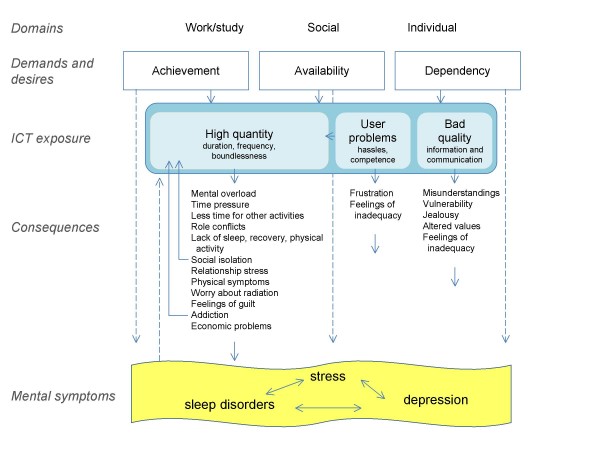
BACKGROUND: Prospective associations have been found between high use of information and communication technology (ICT) and reported mental symptoms among young adult university students, but the causal mechanisms are unclear. Our aim was to explore possible explanations for associations between high ICT use and symptoms of depression, sleep disorders, and stress among young adults in order to propose a model of possible pathways to mental health effects that can be tested epidemiologically. METHODS: We conducted a qualitative interview study with 16 women and 16 men (21-28 years), recruited from a cohort of university students on the basis of reporting high computer (n = 28) or mobile phone (n = 20) use at baseline and reporting mental symptoms at the one-year follow-up. Semi-structured interviews were performed, with open-ended questions about possible connections between the use of computers and mobile phones, and stress, depression, and sleep disturbances. The interview data were analyzed with qualitative content analysis and summarized in a model. RESULTS: Central factors appearing to explain high quantitative ICT use were personal dependency, and demands for achievement and availability originating from the domains of work, study, social life, and individual aspirations. Consequences included mental overload, neglect of other activities and personal needs, time pressure, role conflicts, guilt feelings, social isolation, physical symptoms, worry about electromagnetic radiation, and economic problems. Qualitative aspects (destructive communication and information) were also reported, with consequences including vulnerability, misunderstandings, altered values, and feelings of inadequacy. User problems were a source of frustration. Altered ICT use as an effect of mental symptoms was reported, as well as possible positive effects of ICT on mental health. CONCLUSIONS: The concepts and ideas of the young adults with high ICT use and mental symptoms generated a model of possible paths for associations between ICT exposure and mental symptoms. Demands for achievement and availability as well as personal dependency were major causes of high ICT exposure but also direct sources of stress and mental symptoms. The proposed model shows that factors in different domains may have an impact and should be considered in epidemiological and intervention studies.
Overview
The claims and statistics of this paper haven’t been checked yet.
Free: it reads the open-access text and checks the first 5 claims that cite a source we can check. Create a free account to check every claim.
Integrity signals
Registry
Cites
Statistics
Figures
Verification
Claims the paper makes
The claims and statistics of this paper haven’t been checked yet.
Free: it reads the open-access text and checks the first 5 claims that cite a source we can check. Create a free account to check every claim.
Claims other papers make about this one
Each is checked against this paper’s own text: does it say what the citing paper says it does?
The cited source says what the claim attributes to it.
In the citing paper
“Together, these features and user experiences contribute not only to increased time devoted to social media use [18], but also importantly to evolving social norms around expected availability and the urgency of online interactions [7,8,19], presenting unique implications for mental health and sleep.”
From Understanding Links Between Social Media Use, Sleep and Mental Health: Recent Progress and Current Challenges (2019) · cites this paper as [19]
The cited source says what the claim attributes to it.
In the citing paper
“In addition, being far from the device can be a stressful state for many because of the awareness that their contacts, both personal and professional, will feel displeasure and/or offense at being ignored (Thomée, Dellve, Harenstam, & Hagberg, 2010).”
From Is smartphone addiction really an addiction? (2018) · cites this paper as Thomée, Dellve, Harenstam, & Hagberg, 2010
Self-check
Percentages, sums and reported differences re-computed from the paper’s own numbers.
The self-check needs the paper’s full text.
Citations
Cites
Three Approaches to Qualitative Content Analysis
Hsieh, H.-F., & Shannon, S. E. (2005) · Qualitative Health Research · doi:10.1177/1049732305276687 · Cited by 44,601 · cited 2×
“A stepwise conventional qualitative content analysis [11,12] of the data was performed by the main author (also the interviewer).”
MethodGraneheim, U. H., & Lundman, B. (2004) · Nurse Education Today · doi:10.1016/j.nedt.2003.10.001 · Cited by 20,772 · cited 1×
“A stepwise conventional qualitative content analysis [11,12] of the data was performed by the main author (also the interviewer).”
MethodInternet Addiction: The Emergence of a New Clinical Disorder
YOUNG, K. S. (1998) · CyberPsychology & Behavior · doi:10.1089/cpb.1998.1.237 · Cited by 5,513
Internet paradox: A social technology that reduces social involvement and psychological well-being?
Kraut, R., Patterson, M., Lundmark, V., Kiesler, S., Mukophadhyay, T., & Scherlis, W. (1998) · American Psychologist · doi:10.1037/0003-066x.53.9.1017 · Cited by 4,793 · cited 1×
“Whether computer use or internet use can lead to depression has been the subject of debate; studies have shown mixed results [8,49-51].”
ResultMental health of young people: A global public-health challenge
Patel, V., Flisher, A. J., Hetrick, S., & McGorry, P. (2007) · The Lancet · doi:10.1016/s0140-6736(07)60368-7 · Cited by 3,126 · cited 1×
“Mental disorders account for a large proportion of the disease burden in young people in all societies, and are a global public health challenge [3].”
BackgroundUtility of a new procedure for diagnosing mental disorders in primary care. The PRIME-MD 1000 study
Spitzer, R. L. (1994) · JAMA · doi:10.1001/jama.272.22.1749 · Cited by 2,635
Kraut, R., Kiesler, S., Boneva, B., Cummings, J., Helgeson, V., & Crawford, A. (2002) · Journal of Social Issues · doi:10.1111/1540-4560.00248 · Cited by 2,202 · cited 2×
“Whether computer use or internet use can lead to depression has been the subject of debate; studies have shown mixed results [8,49-51].”
BackgroundResultDistracted and confused? Selective attention under load
Lavie, N. (2005) · Trends in Cognitive Sciences · doi:10.1016/j.tics.2004.12.004 · Cited by 2,102 · cited 1×
“Distractions and dual-tasking are demanding on working memory [22,23]; similarly, the participants in our study said that expected immediacy of communications, as evidenced by reminders and demands for explanations of any unavailability, added to mental over-load and feelings of guilt.”
BackgroundPsychosocial work environment and mental health—a meta-analytic review
Stansfeld, S., & Candy, B. (2006) · Scandinavian Journal of Work, Environment & Health · doi:10.5271/sjweh.1050 · Cited by 1,875 · cited 1×
“Social support is a factor that promotes health and buffers the negative effects of high psychosocial demands [20,21], and could be considered a positive aspect of ICT use.”
BackgroundUtility of a New Procedure for Diagnosing Mental Disorders in Primary Care: The PRIME-MD 1000 Study
Spitzer, R. L. (1994) · JAMA · doi:10.1001/jama.1994.03520220043029 · Cited by 1,873 · cited 1×
“Mental symptom items were: Have you continuously, for more than 7 days, during the past 12 months experienced: 1) stress (defined as a situation in whic ha person feels tense, restless, nervous or anxious, or is unable to sleep at night because his/her mind is troubled)? (adapted from the QPS Nordic [63]) 2a) little i…”
BackgroundSleep disturbance and psychiatric disorders: A longitudinal epidemiological study of young Adults
Breslau, N., Roth, T., Rosenthal, L., & Andreski, P. (1996) · Biological Psychiatry · doi:10.1016/0006-3223(95)00188-3 · Cited by 1,831 · cited 1×
“Furthermore, sleep disorders are a predictor of major depression onset, with an odds ratio of nearly 4, according to a prospective study of young adults [61].”
BackgroundPsychological Predictors of Problem Mobile Phone Use
Bianchi, A., & Phillips, J. G. (2005) · CyberPsychology & Behavior · doi:10.1089/cpb.2005.8.39 · Cited by 1,514 · cited 1×
“Constructs such as internet addiction, problematic internet use, and compulsive internet use have been previously discussed [29], as has the term “ problem mobile phone use ” [30].”
BackgroundPsychosocial models of the role of social support in the etiology of physical disease.
Cohen, S. (1988) · Health Psychology · doi:10.1037/0278-6133.7.3.269 · Cited by 1,273
Involvement in traditional and electronic bullying among adolescents.
Raskauskas, J., & Stoltz, A. D. (2007) · Developmental Psychology · doi:10.1037/0012-1649.43.3.564 · Cited by 1,017 · cited 1×
“The internet can also be a medium for bullying via email and web pages, as can mobile phones via text messages and the misuse of picture-taking abilities [54].”
BackgroundRelations among loneliness, social anxiety, and problematic Internet use
Caplan, S. E. (2007) · CyberPsychology & Behavior · doi:10.1089/cpb.2006.9963 · Cited by 948 · cited 1×
“Caplan [28] concluded that social anxiety rather than loneliness explains the preference for online social interaction.”
BackgroundValidity of a single-item measure of stress symptoms
Elo, A.-L., Leppänen, A., & Jahkola, A. (2003) · Scandinavian Journal of Work, Environment & Health · doi:10.5271/sjweh.752 · Cited by 900 · cited 1×
“(4)Mental symptom items were: Have you continuously, for more than 7 days, during the past 12 months experienced: 1) stress (defined as a situation in which a person feels tense, restless, nervous or anxious, or is unable to sleep at night because his/her mind is troubled)? (adapted from the QPS Nordic [63]) 2a) littl…”
Psychiatric features of individuals with problematic internet use
Shapira, N. A., Goldsmith, T. D., Keck, P. E., Khosla, U. M., & McElroy, S. L. (2000) · Journal of Affective Disorders · doi:10.1016/s0165-0327(99)00107-x · Cited by 898 · cited 2×
“Other researchers have discussed psychological factors, such as the role of the internet in relation to mental health [8,9], and psychiatric features, such as addiction to the internet [10].”
BackgroundA review on cognitive impairments in depressive and anxiety disorders with a focus on young adults
Castaneda, A. E., Tuulio-Henriksson, A., Marttunen, M., Suvisaari, J., & Lönnqvist, J. (2008) · Journal of Affective Disorders · doi:10.1016/j.jad.2007.06.006 · Cited by 752 · cited 1×
“Psychosocial function in young adults is affected by depression [44], and cognitive impairments are common [45].”
BackgroundLoneliness and social uses of the Internet
Morahan-Martin, J., & Schumacher, P. (2003) · Computers in Human Behavior · doi:10.1016/s0747-5632(03)00040-2 · Cited by 733 · cited 1×
“Morahan-Martin et al [27] found support for the position that loneliness leads to increased internet use; lonely individuals were more likely than their non-lonely counter-parts to use the internet for social interaction and emotional support.”
BackgroundWork stress precipitates depression and anxiety in young, working women and men
MELCHIOR, M., CASPI, A., MILNE, B. J., DANESE, A., POULTON, R., & MOFFITT, T. E. (2007) · Psychological Medicine · doi:10.1017/s0033291707000414 · Cited by 691 · cited 1×
“This also applies to young adults; in a prospective study, previously healthy young adults who were exposed to high psychological demands at work had a twofold risk of developing major depressive disorder and generalized anxiety disorder [16].”
BackgroundExcessive Computer Game Playing: Evidence for Addiction and Aggression?
Grüsser, S. M., Thalemann, R., & Griffiths, M. D. (2007) · CyberPsychology & Behavior · doi:10.1089/cpb.2006.9956 · Cited by 615 · cited 1×
“Grusser et al [32] found only weak evidence for the assumption that aggression is related to excessive gaming, but concluded that there is addictive potential in gaming.”
Backgroundvan den Eijnden, R. J. J. M., Meerkerk, G.-J., Vermulst, A. A., Spijkerman, R., & Engels, R. C. M. E. (2008) · Developmental Psychology · doi:10.1037/0012-1649.44.3.655 · Cited by 562 · cited 2×
“Studies have shown prospective associations between chatting or instant messaging and perceived stress, depression, and compulsive internet use [6,24].”
BackgroundProblematic Internet use or Internet addiction?
Yellowlees, P. M., & Marks, S. (2007) · Computers in Human Behavior · doi:10.1016/j.chb.2005.05.004 · Cited by 456 · cited 2×
“Constructs such as internet addiction, problematic internet use, and compulsive internet use have been previously discussed [29], as has the term “ problem mobile phone use ” [30].”
BackgroundSleep duration and health in young adults
Steptoe, A. (2006) · Archives of Internal Medicine · doi:10.1001/archinte.166.16.1689 · Cited by 425
Relation between depression and sociodemographic factors
Akhtar-Danesh, N., & Landeen, J. (2007) · International Journal of Mental Health Systems · doi:10.1186/1752-4458-1-4 · Cited by 398 · cited 1×
“Gender, socio-demographic factors, general health, and major life events, as well as individual factors such as coping skills, are all related to the incidence of depression [46-48] among young people.”
BackgroundMobile telephones, distracted attention, and pedestrian safety
Nasar, J., Hecht, P., & Wener, R. (2008) · Accident Analysis & Prevention · doi:10.1016/j.aap.2007.04.005 · Cited by 382 · cited 1×
“Furthermore, mobile phone use has been found to distract attention and affect driving and pedestrian safety [25].”
BackgroundRoberts, R. E., Roberts, C. R., & Duong, H. T. (2008) · Journal of Adolescent Health · doi:10.1016/j.jadohealth.2007.09.016 · Cited by 346 · cited 1×
“Insomnia affects psychosocial functioning and increases subsequent risks for somatic health problems, interpersonal problems, and psychological problems in adolescents [59].”
BackgroundChronic psychosocial stress at work and risk of depression: evidence from prospective studies
Siegrist, J. (2008) · European Archives of Psychiatry and Clinical Neuroscience · doi:10.1007/s00406-008-5024-0 · Cited by 316
The Relationship between Internet Activities and Depressive Symptoms in a Sample of College Freshmen
Morgan, C., & Cotten, S. R. (2003) · CyberPsychology & Behavior · doi:10.1089/109493103321640329 · Cited by 312 · cited 1×
“Whether computer use or internet use can lead to depression has been the subject of debate; studies have shown mixed results [8,49-51].”
ResultPunamäki, R., Wallenius, M., Nygård, C., Saarni, L., & Rimpelä, A. (2007) · Journal of Adolescence · doi:10.1016/j.adolescence.2006.07.004 · Cited by 298 · cited 1×
“Intensive ICT use which negatively affects sleeping habits has been associated with poor perceived health among adolescents [56].”
BackgroundThomée, S., Eklöf, M., Gustafsson, E., Nilsson, R., & Hagberg, M. (2007) · Computers in Human Behavior · doi:10.1016/j.chb.2004.12.007 · Cited by 284 · cited 3×
“The study concluded that ICT use may have an impact on mental health but that the causal mechanisms are unclear [6].”
BackgroundSelf-citationLewinsohn, P. M., Rohde, P., Seeley, J. R., Klein, D. N., & Gotlib, I. H. (2003) · Journal of Abnormal Psychology · doi:10.1037/0021-843x.112.3.353 · Cited by 271 · cited 1×
“Psychosocial function in young adults is affected by depression [44], and cognitive impairments are common [45].”
BackgroundPunnett, L., & Bergqvist, U. (1997) · Gothenburg University Publications Electronic Archive (Gothenburg University) · Cited by 263
Predicting Compulsive Internet Use: It's All about Sex!
Meerkerk, G.-J., Eijnden, R. J. J. M. V. D., & Garretsen, H. F. L. (2006) · CyberPsychology & Behavior · doi:10.1089/cpb.2006.9.95 · Cited by 257 · cited 1×
“Another study [35] found erotica to be the best prospective predictor of compulsive internet use.”
BackgroundVan Voorhees, B. W., Paunesku, D., Kuwabara, S. A., Basu, A., Gollan, J., Hankin, B. L., Melkonian, S., & Reinecke, M. (2008) · Journal of Adolescent Health · doi:10.1016/j.jadohealth.2007.11.135 · Cited by 253
Internet-Based Mental Health Interventions
Ybarra, M. L., & Eaton, W. W. (2005) · Mental Health Services Research · doi:10.1007/s11020-005-3779-8 · Cited by 241 · cited 1×
“For a review of internet-based mental health interventions, see Ybarra and Eaton [52].”
BackgroundUsers Divided? Exploring the Gender Gap in Internet Use
Shaw, L. H., & Gant, L. M. (2002) · CyberPsychology & Behavior · doi:10.1089/109493102321018150 · Cited by 215 · cited 1×
“There are gender differences in ICT usage [62], as well as in prevalence of mental symptoms [1].”
Background(1976) · Progress in Brain Research · doi:10.1016/s0079-6123(08)60974-7 · Cited by 213
Physical Activity, Sedentary Index, and Mental Disorders in the SUN Cohort Study
SANCHEZ-VILLEGAS, A., ARA, I., GUILLÉN-GRIMA, F., BES-RASTROLLO, M., VARO-CENARRUZABEITIA, J. J., & MARTÍNEZ-GONZÁLEZ, M. A. (2008) · Medicine & Science in Sports & Exercise · doi:10.1249/mss.0b013e31816348b9 · Cited by 204 · cited 1×
“A high level of sedentary leisure activities negatively affects mental health [39], while physical activity has positive effects on mental health and is acknowledged as a possible complementary treatment for depression and stress-related disorders [39,40].”
BackgroundPossible Broad Impacts of Long Work Hours
CARUSO, C. C. (2006) · Industrial Health · doi:10.2486/indhealth.44.531 · Cited by 203 · cited 1×
“Long work hours in general have a broad impact, leading to less time for sleep and recovery, longer exposure to work-place hazards and demands, and less time to attend to private life and family [18].”
BackgroundPerformance-based self-esteem : A driving force in burnout processes and its assessment
Hallsten, L., Josephson, M., & Torgén, M. (2005) · Gothenburg University Publications Electronic Archive (Gothenburg University) · Cited by 179
Association between duration of daily VDT use and subjective symptoms
Nakazawa, T., Okubo, Y., Suwazono, Y., Kobayashi, E., Komine, S., Kato, N., & Nogawa, K. (2002) · American Journal of Industrial Medicine · doi:10.1002/ajim.10133 · Cited by 165 · cited 1×
“Whether computer use or internet use can lead to depression has been the subject of debate; studies have shown mixed results [8,49-51].”
ResultOccupational Stress in Human Computer Interaction.
Smith, M. J., Conway, F. T., & Karsh, B. (1999) · Industrial Health · doi:10.2486/indhealth.37.157 · Cited by 143 · cited 1×
“User problems, including technical frustrations and competence problems, are associated with stress [36] and were a cause of irritation in our study, adding to workload and causing more time to be spent at the computer than planned.”
BackgroundBell, V. (2007) · Journal of Mental Health · doi:10.1080/09638230701482378 · Cited by 141 · cited 2×
“Other researchers have discussed psychological factors, such as the role of the internet in relation to mental health [8,9], and psychiatric features, such as addiction to the internet [10].”
BackgroundCoping strategies, stressful life events, problem behaviors, and depressed affect
Rafnsson, F. D., Jonsson, F. H., & Windle, M. T. (2006) · Anxiety Stress & Coping · doi:10.1080/10615800600679111 · Cited by 137 · cited 1×
“Gender, socio-demographic factors, general health, and major life events, as well as individual factors such as coping skills, are all related to the incidence of depression [46-48] among young people.”
BackgroundArnetz, B. B. (1996) · Journal of Occupational & Environmental Medicine · doi:10.1097/00043764-199601000-00017 · Cited by 105 · cited 1×
“The IT work field, with its limitless work hours and tight deadlines, is known to be stressful [17].”
BackgroundExcessive texting in pathophysiology of first carpometacarpal joint arthritis
Ming, Z., Pietikainen, S., & Hänninen, O. (2006) · Pathophysiology · doi:10.1016/j.pathophys.2006.09.001 · Cited by 101 · cited 1×
“Computer use and mobile phone use have been associated with musculoskeletal complaints [37,38], which in turn can have a negative effect on mental health.”
BackgroundKlingberg, T. (2000) · Progress in brain research · doi:10.1016/s0079-6123(00)26009-3 · Cited by 96 · cited 1×
“Distractions and dual-tasking are demanding on working memory [22,23]; similarly, the participants in our study said that expected immediacy of communications, as evidenced by reminders and demands for explanations of any unavailability, added to mental over-load and feelings of guilt.”
BackgroundFamily life stress and insomnia symptoms in a prospective evaluation of young adults.
Bernert, R. A., Merrill, K. A., Braithwaite, S. R., Van Orden, K. A., & Joiner, T. E. (2007) · Journal of Family Psychology · doi:10.1037/0893-3200.21.1.58 · Cited by 93 · cited 1×
“Other factors associated with insomnia and depression among young adults are negative family life stress and academic stress [58].”
BackgroundHillert, L., Åkerstedt, T., Lowden, A., Wiholm, C., Kuster, N., Ebert, S., Boutry, C., Moffat, S. D., Berg, M., & Arnetz, B. B. (2008) · Bioelectromagnetics · doi:10.1002/bem.20379 · Cited by 91 · cited 1×
“Exposure to electromagnetic fields due to ICT use is currently not known to have any major health effects [41], though there is some inconsistency in the published results [42].”
ResultBaldaro, B., Tuozzi, G., Codispoti, M., Montebarocci, O., Barbagli, F., Trombini, E., & Rossi, N. (2004) · Stress and Health · doi:10.1002/smi.1015 · Cited by 88 · cited 1×
“An evaluation of the short-term physiological and psychological effects of playing violent videogames, compared to non-violent games, revealed effects on arterial pressure and state of anxiety, but not on measures of hostility [33].”
BackgroundPsychological factors associated with self-reported sensitivity to mobile phones
Rubin, G. J., Cleare, A. J., & Wessely, S. C. (2007) · Journal of Psychosomatic Research · doi:10.1016/j.jpsychores.2007.05.006 · Cited by 88 · cited 1×
“Perceived electrosensitivity is associated with reporting symptoms of depression and worse general health than controls [43].”
BackgroundBan, D. J., & Lee, T. J. (2001) · Journal of Korean Medical Science · doi:10.3346/jkms.2001.16.4.475 · Cited by 87 · cited 1×
“In a study of Korean university students, 30% reported insufficient sleep and of these about a third pointed to visual media including computers as the primary reason [57].”
BackgroundMitchell, K. J., & Wells, M. (2007) · Social Science & Medicine · doi:10.1016/j.socscimed.2007.05.015 · Cited by 76 · cited 1×
“A study among mental health professionals in the USA revealed that when clients presented problematic internet use as a primary problem, this most likely included use of pornography [34].”
BackgroundKimata, H. (2003) · European Journal of Clinical Investigation · doi:10.1046/j.1365-2362.2003.01177.x · Cited by 73 · cited 1×
“Frequently-ringing mobile phones have been shown to enhance allergic responses in patients with atopic eczema or dermatitis syndrome [26], implying that the exposure related to availability is stressful.”
BackgroundTechno-stress. A psychophysiological study of employees with VDU-associated skin complaints.
Berg, M., Arnetz, B. B., Lidén, S., Eneroth, P. H. E., & Kallner, A. (1992) · PubMed · Cited by 68
The internet and suicide: A double-edged tool
Tam, J., Tang, W. S., & Fernando, D. (2007) · European Journal of Internal Medicine · doi:10.1016/j.ejim.2007.04.009 · Cited by 57 · cited 1×
“On the other hand, the internet also provides information and advice on suicide methods, enables interaction with other people contemplating suicide, and can provide the means to suicide via online shopping [53].”
BackgroundThe use of information technology among young adults—experience, attitudes and health beliefs
Gustafsson, E., Dellve, L., Edlund, M., & Hagberg, M. (2003) · Applied Ergonomics · doi:10.1016/s0003-6870(03)00082-6 · Cited by 46 · cited 1×
“In a qualitative study, Gustafsson et al [5] explored young adults ’ experience, attitudes, and health beliefs in relation to information technology use and found that they perceived both opportunities and risks, including risks to physical and psychosocial health.”
BackgroundSelf-citationRecent Research on EMF and Health Risks
Feychting, M., Ahlbom, A., Juutilainen, J., Veyret, B., Vainio, H., Kheifets, L., Auvinen, A. P., & Saunders, R. (2007) · STM:n Hallinnonalan avoin julkaisuarkisto (Julkari) · Cited by 16
Coggon, D. (2003) · Scandinavian Journal of Work Environment & Health · doi:10.5271/sjweh.750 · Cited by 5
(2000) · doi:10.1002/1098-240x(200008)23:4<334::aid-nur9>3.0.co;2-g · cited 3×
“The process focused on a low level of interpretation of the manifest content, closely following the dic-tums of the subjects [13].”
BackgroundMethod
Research works printed but not linked: 7
- StatisticsSweden Health and Medical care 1980-2005 LE Living conditions 2006 Stockholm, Sweden [In Swedish and parts in English]
- Socialstyrelsen Status report 2007: Public health and social conditions 2008 Stockholm, Sweden: The national board of healthand welfare [In Swedish]
- StatisticsSweden Use of computers and the Internet by private persons in 2007 2007 http://www.scb.se In Swedish and parts in English
- Karasek R Theorell T Healthy work 1990 New York: Basic Books
- Jonsdottir IH Stress, exercise and consequences for memory function and affective disorders Neurology & Cognitive Neuroscience 2006 6 1 2 6
- Medierådet Ungar & medier 2008 [Youth & media 2008] 2008 Stockholm: The Swedish media council [in Swedish]
- Kecklund G Åkerstedt T The psychometric properties of the Karolinska Sleep Questionnaire J Sleep Res 1992 1 Suppl 1 113
Cited by
Woods, H. C., & Scott, H. (2016) · Journal of Adolescence · doi:10.1016/j.adolescence.2016.05.008 · Cited by 1,302
Thomée, S., Härenstam, A., & Hagberg, M. (2011) · BMC Public Health · doi:10.1186/1471-2458-11-66 · Cited by 1,269
“, among the subjects participants in [11]).”
InfluentialSelf-citationIs smartphone addiction really an addiction?
Panova, T., & Carbonell, X. (2018) · Journal of behavioral addictions · doi:10.1556/2006.7.2018.49 · Cited by 976
Sleep and use of electronic devices in adolescence: results from a large population-based study
Hysing, M., Pallesen, S., Stormark, K. M., Jakobsen, R., Lundervold, A. J., & Sivertsen, B. (2015) · BMJ Open · doi:10.1136/bmjopen-2014-006748 · Cited by 678
Cheever, N. A., Rosen, L. D., Carrier, L. M., & Chavez, A. (2014) · Computers in Human Behavior · doi:10.1016/j.chb.2014.05.002 · Cited by 589
Metadata
- Authors
- Thomée, S., Dellve, L., Härenstam, A., & Hagberg, M.
- Affiliations
- University of Gothenburg (SE)
- Corresponding author
- Thomée, Sara
- Venue
- BMC Public Health
- Published
- 2010-02-12
- Volume
- 10
- Issue
- 1
- Pages
- 66-66
- ISSN
- 1471-2458 (ISSN-L)
- PMC
- PMC2836296
- OpenAlex
- W2145535267
- Cited by
- 181
- References
- 62
- Citations by year
- 2026: 8 · 2025: 16 · 2024: 14 · 2023: 22 · 2022: 23 · 2021: 18 · 2020: 13 · 2019: 13 · 2018: 8 · 2017: 7 · 2016: 9 · 2015: 8 · 2014: 7 · 2013: 8 · 2012: 5
- FWCI
- 15.55
- Type
- journal article
- Language
- en
- Open access
- gold
- doi.org
- Licence
- cc-by
- creativecommons.org/licenses/by/2.0 (tdm)
- Locations
- BMC Public Health (publishedVersion, cc-by)
- PubMed Central (publishedVersion, cc-by)
- PubMed (publishedVersion)
- Borås Academic Digital Archive (University of Borås) (submittedVersion)
- DOAJ (DOAJ: Directory of Open Access Journals) (submittedVersion, cc-by-sa)
- Funders
- Forskningsrådet för Arbetsliv och Socialvetenskap
- Topics
- Social Sciences › Sociology and Political Science › Impact of Technology on Adolescents
- Social Sciences › Psychology › Social Psychology › Technostress in Professional Settings
- Social Sciences › Gender Studies › Gender and Technology in Education
- Keywords
- ICT use, psychiatric symptoms, depression, sleep disorders, stress, young adults, university students, computer use, mobile phone use, cognitive overload, social isolation, role conflict, guilt, causal pathways, mental health
- MeSH terms
- Adult, Communication, Computers, Depression, Female, Follow-Up Studies, Humans, Interviews as Topic, Male, Mental Health, Sleep Wake Disorders, Stress, Psychological, Students, Sweden, Universities, Qualitative Research, Cell Phone, Young Adult
About these checks
Registry, retraction, Cites and statistics results are computed, not judged, with one exception: a printed reference that no index lists is read once by a model before it counts as a citation error. Claims are extracted by a model and kept only when their quote appears verbatim in the text; each cited source is then checked, with a model’s help, for whether it says what the claim relies on. Those verdicts can be wrong — read the claim’s quote and the cited source before relying on one.
Statistics and arithmetic are recomputed, not judged.
Confidence bands are shown only for fields calibrated on our annotated test set. None is calibrated yet, so no band is shown.
What counts as a claim ›How we measure confidence ›How we check this ›
Are you an author, or do you see a problem with this page? Request a review
Data sources
Bibliographic data: Semantic Scholar, OpenAlex, Crossref.
Contains information from the Semantic Scholar Academic Graph Datasets, made available under the ODC Attribution License (ODC-BY 1.0).
Semantic Scholar’s data is described in: Kinney, R., et al. (2023). The Semantic Scholar Open Data Platform. arXiv:2301.10140.
