

The DOI matches its Crossref record; 39 of the 40 references it cites were found in a registry or an index.
The effect of 12 weeks of aerobic, resistance or combination exercise training on cardiovascular risk factors in the overweight and obese in a randomized trial
Open accessAbstract
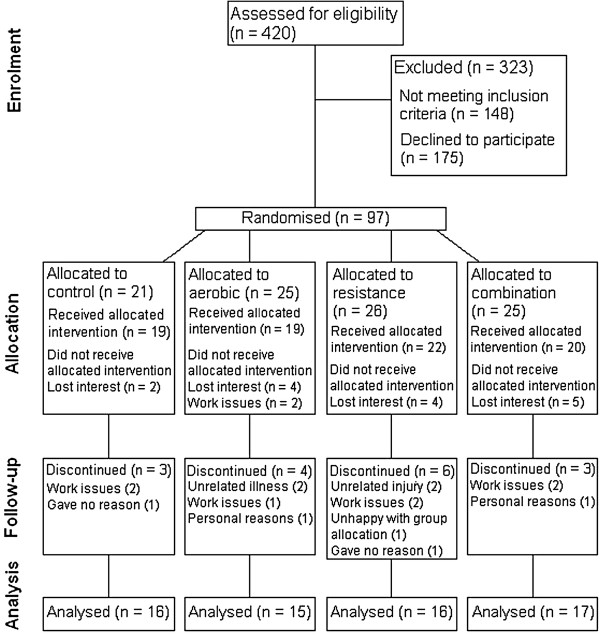
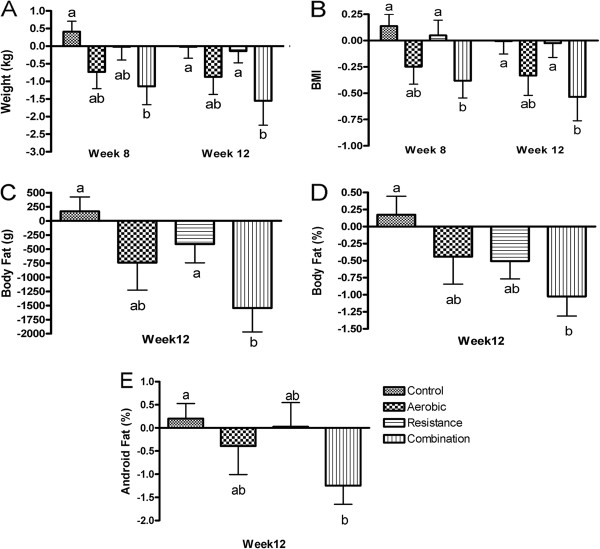
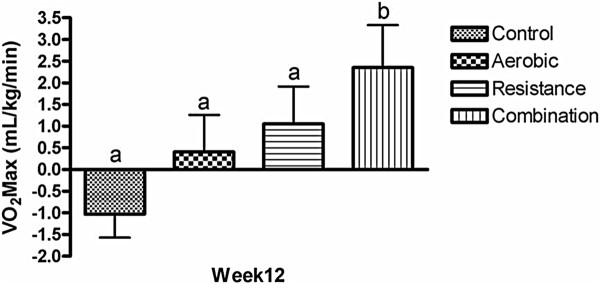
Background: Evidence suggests that exercise training improves CVD risk factors. However, it is unclear whether health benefits are limited to aerobic training or if other exercise modalities such as resistance training or a combination are as effective or more effective in the overweight and obese. The aim of this study is to investigate whether 12 weeks of moderate-intensity aerobic, resistance, or combined exercise training would induce and sustain improvements in cardiovascular risk profile, weight and fat loss in overweight and obese adults compared to no exercise. Methods: Twelve-week randomized parallel design examining the effects of different exercise regimes on fasting measures of lipids, glucose and insulin and changes in body weight, fat mass and dietary intake. Participants were randomized to either: Group 1 (Control, n = 16); Group 2 (Aerobic, n = 15); Group 3 (Resistance, n = 16); Group 4 (Combination, n = 17). Data was analysed using General Linear Model to assess the effects of the groups after adjusting for baseline values. Within-group data was analyzed with the paired t-test and between-group effects using post hoc comparisons. Results: Significant improvements in body weight (−1.6%, p = 0.044) for the Combination group compared to Control and Resistance groups and total body fat compared to Control (−4.4%, p = 0.003) and Resistance (−3%, p = 0.041). Significant improvements in body fat percentage (−2.6%, p = 0.008), abdominal fat percentage (−2.8%, p = 0.034) and cardio-respiratory fitness (13.3%, p = 0.006) were seen in the Combination group compared to Control. Levels of ApoB48 were 32% lower in the Resistance group compared to Control (p = 0.04). Conclusion: A 12-week training program comprising of resistance or combination exercise, at moderate-intensity for 30 min, five days/week resulted in improvements in the cardiovascular risk profile in overweight and obese participants compared to no exercise. From our observations, combination exercise gave greater benefits for weight loss, fat loss and cardio-respiratory fitness than aerobic and resistance training modalities. Therefore, combination exercise training should be recommended for overweight and obese adults in National Physical Activity Guidelines. This clinical trial was registered with the Australian New Zealand Clinical Trials Registry (ANZCTR), registration number: ACTRN12609000684224.
Overview
The claims and statistics of this paper haven’t been checked yet.
Run the check — free, no account needed. It reads the open-access text and checks the sources it cites.
Integrity signals
Registry
Cites
Statistics
Figures
Verification
Claims the paper makes
The claims and statistics of this paper haven’t been checked yet.
Run the check — free, no account needed. It reads the open-access text and checks the sources it cites.
Claims other papers make about this one
Each is checked against this paper’s own text: does it say what the citing paper says it does?
The check wasn’t confident either way, so it gives no verdict — never disputed.
In the citing paper
“This contradiction may reflect that most exercise interventions that elicit reductions in blood pressure have been at least 12 weeks long [ 30 , 33 – 35 ].”
From Comparative effectiveness of aerobic, resistance, and combined training on cardiovascular disease risk factors: A randomized controlled trial (2019) · cites this paper as [34]
Experimental — accuracy not yet measuredIn the citing paper
“These results are consistent with those of previous publications, demonstrating the beneficial effects of ET, RT, and CT on body composition, skeletal muscle strength, and cardiorespiratory fitness (36–38).”
From Combined Training Enhances Skeletal Muscle Mitochondrial Oxidative Capacity Independent of Age (2015) · cites this paper as [38]
Self-check
Percentages, sums and reported differences re-computed from the paper’s own numbers.
The self-check needs the paper’s full text.
Citations
Cites
European Guidelines for Obesity Management in Adults
Yumuk, V., Tsigos, C., Fried, M., Schindler, K., Busetto, L., Micic, D., & Toplak, H. (2015) · Obesity Facts · doi:10.1159/000442721 · Cited by 3,432
Correct Homeostasis Model Assessment (HOMA) Evaluation Uses the Computer Program
Lévy, J., Matthews, D. R., & Hermans, M. P. (1998) · Diabetes Care · doi:10.2337/diacare.21.12.2191 · Cited by 2,023
(1957) · PubMed · Cited by 1,778
Effects of the amount and intensity of exercise on plasma lipoproteins
Kraus, W. E., Houmard, J. A., Duscha, B. D., Knetzger, K. J., Wharton, M. B., McCartney, J. S., Bales, C. W., Henes, S., Samsa, G. P., Otvos, J. D., et al. (2002) · New England Journal of Medicine · doi:10.1056/nejmoa020194 · Cited by 1,554
Williams, M. A., Haskell, W. L., Ades, P. A., Amsterdam, E. A., Bittner, V., Franklin, B. A., Gulanick, M., Laing, S. T., & Stewart, K. J. (2007) · Circulation · doi:10.1161/circulationaha.107.185214 · Cited by 1,211
Wei, M. (1999) · JAMA · doi:10.1001/jama.282.16.1547 · Cited by 1,168
Church, T. S., Blair, S. N., Cocreham, S., Johannsen, N., Johnson, W., Kramer, K., Mikus, C. R., Myers, V., Nauta, M., Rodarte, R. Q., et al. (2010) · JAMA · doi:10.1001/jama.2010.1710 · Cited by 944
Church, T. S., Earnest, C. P., Skinner, J. S., & Blair, S. N. (2007) · JAMA · doi:10.1001/jama.297.19.2081 · Cited by 756
Exercise Capacity and the Risk of Death in Women: The St James Women Take Heart Project
Gulati, M., Pandey, D. K., Arnsdorf, M. F., Lauderdale, D. S., Thisted, R. A., Wicklund, R. H., Al-Hani, A. J., & Black, H. R. (2003) · Circulation · doi:10.1161/01.cir.0000091080.57509.e9 · Cited by 739
Slentz, C. A., Duscha, B. D., Johnson, J. L., Ketchum, K., Aiken, L. B., Samsa, G. P., Houmard, J. A., Bales, C. W., & Kraus, W. E. (2004) · Archives of Internal Medicine · doi:10.1001/archinte.164.1.31 · Cited by 656
(2009) · Nutrition Reviews · doi:10.1111/j.1753-4887.2008.00136.x · Cited by 593
Determination of the exercise intensity that elicits maximal fat oxidation
ACHTEN, J., GLEESON, M., & JEUKENDRUP, A. E. (2002) · Medicine & Science in Sports & Exercise · doi:10.1097/00005768-200201000-00015 · Cited by 551 · cited 1×
“In our study, a moderateintensity of 60% of estimated HRR was used for aerobic exercise to target greater fat oxidation rather than cardiorespiratory fitness improvements per se [35].”
Weiss, E. P., Racette, S. B., Villareal, D. T., Fontana, L., Steger-May, K., Schechtman, K. B., Klein, S., & Holloszy, J. O. (2006) · The American Journal of Clinical Nutrition · doi:10.1093/ajcn/84.5.1033 · Cited by 353
Johnson, J. L., Slentz, C. A., Houmard, J. A., Samsa, G. P., Duscha, B. D., Aiken, L. B., McCartney, J. S., Tanner, C. J., & Kraus, W. E. (2007) · The American Journal of Cardiology · doi:10.1016/j.amjcard.2007.07.027 · Cited by 347
Davidson, L. E., Hudson, R., Kilpatrick, K., Kuk, J. L., McMillan, K., Janiszewski, P. M., Lee, S., Lam, M., & Ross, R. (2009) · Archives of Internal Medicine · doi:10.1001/archinternmed.2008.558 · Cited by 297
Dietschy, J. M. (1998) · Journal of Nutrition · doi:10.1093/jn/128.2.444s · Cited by 247
O’Leary, V. B., Marchetti, C. M., Krishnan, R. K., Stetzer, B. P., González, F., & Kirwan, J. P. (2005) · Journal of Applied Physiology · doi:10.1152/japplphysiol.01336.2005 · Cited by 235
Polak, J., Klimčáková, E., Moro, C., Viguerie, N., Berlan, M., Hejnová, J., Richterova, B., Kraus, I., Langin, D., & Štich, V. (2006) · Metabolism · doi:10.1016/j.metabol.2006.06.008 · Cited by 224
Role of fat oxidation in the long-term stabilization of body weight in obese women
Schutz, Y., Tremblay, A., Weinsier, R. L., & Nelson, K. (1992) · American Journal of Clinical Nutrition · doi:10.1093/ajcn/55.3.670 · Cited by 197
Abdominal Adiposity and Cardiometabolic Risk: Do We Have All the Answers?
Haffner, S. M. (2007) · The American Journal of Medicine · doi:10.1016/j.amjmed.2007.06.006 · Cited by 191
Dumortier, M., Brandou, F., Pérez‐Martin, A., Fédou, C., Mercier, J. G., & Brun, J. ‐. (2003) · Diabetes & Metabolism · doi:10.1016/s1262-3636(07)70065-4 · Cited by 185
Physical activity, cardiorespiratory fitness, and adiposity: contributions to disease risk
LaMonte, M. J., & Blair, S. N. (2006) · Current Opinion in Clinical Nutrition & Metabolic Care · doi:10.1097/01.mco.0000241662.92642.08 · Cited by 171
Pal, S., Ho, N., Santos, C., Dubois, P., Mamo, J. C. L., Allister, E. M., & Croft, K. D. (2003) · Journal of Nutrition · doi:10.1093/jn/133.3.700 · Cited by 165
Self-citationThe effects of aerobic and resistance exercises in obese women
Sarsan, A., Ardıç, F., Özgen, M., Topuz, O., & Sermez, Y. (2006) · Clinical Rehabilitation · doi:10.1177/0269215506070795 · Cited by 125
Treuth, M. S., Hunter, G. R., Weinsier, R. L., & Kell, S. H. (1995) · Journal of Applied Physiology · doi:10.1152/jappl.1995.78.6.2140 · Cited by 120
Pal, S., Khossousi, A., Binns, C. W., Dhaliwal, S. S., & Ellis, V. (2010) · British Journal Of Nutrition · doi:10.1017/s0007114510003132 · Cited by 116
Self-citationEffects of resistance versus endurance training on serum adiponectin and insulin resistance index.
Ahmadizad, S., Haghighi, A. H., & Hamedinia, M. R. (2007) · European Journal of Endocrinology · doi:10.1530/eje-07-0223 · Cited by 115
Estimation of LDL cholesterol based on the Friedewald formula and on apo B levels
Bairaktari, E. T., Hatzidimou, K., Tzallas, C. S., Vini, M. P., Katsaraki, A., Tselepis, A. D., Elisaf, M., & Tsolas, O. (2000) · Clinical Biochemistry · doi:10.1016/s0009-9120(00)00162-4 · Cited by 95
Effects of the amount of exercise on body weight, body composition and measures of central obesity
Slentz, C. A., Duscha, B. D., & Johnson, J. L. (2004) · ACC Current Journal Review · doi:10.1016/j.accreview.2004.03.059 · Cited by 74
Quantitation of apoB-48 and apoB-100 by gel scanning or radio-iodination.
Zilversmit, D. B., & Timothy, S. H. E. A. (1989) · Journal of Lipid Research · doi:10.1016/s0022-2275(20)38247-x · Cited by 71
Resistance, Aerobic, and Combination Training on Vascular Function in Overweight and Obese Adults
Ho, S. S., Radavelli‐Bagatini, S., Dhaliwal, S. S., Hills, A. P., & Pal, S. (2012) · Journal of Clinical Hypertension · doi:10.1111/j.1751-7176.2012.00700.x · Cited by 67
Self-citationSigal, R. J., Kenny, G. P., Boulé, N. G., Wells, G. A., Prud'homme, D., Fortier, M., Reid, R. D., Tulloch, H., Coyle, D., Phillips, P., et al. (2007) · Annals of Internal Medicine · doi:10.7326/0003-4819-147-6-200709180-00005 · Cited by 48
Effects of Submaximal Exercise on High-Density Lipoprotein-Cholesterol Subfractions
Park, D. H., & Ransone, J. W. (2003) · International Journal of Sports Medicine · doi:10.1055/s-2003-39505 · Cited by 42
Acute exercise improves postprandial cardiovascular risk factors in overweight and obese individuals
Ho, S. S., Dhaliwal, S. S., Hills, A. P., & Pal, S. (2010) · Atherosclerosis · doi:10.1016/j.atherosclerosis.2010.10.015 · Cited by 37
Self-citationExercise management : concepts and professional practice
MACKINNON, L. T., Ritchie, C., Hooper, S., & Abernethy, P. J. (2003) · Human Kinetics eBooks · Cited by 30
LITTLEWOOD, R. (2002) · Clinical Nutrition · doi:10.1054/clnu.2002.0580 · Cited by 30
Obesity trends in older Australians
Bennett, S. A., Magnus, P., & Gibson, D. M. (2004) · Cited by 29
Adiposity does not hinder the fitness response to exercise training in obese women.
Blake, A., Miller, W. C., & Brown, D. A. (2000) · PubMed · Cited by 26
Franklin, A. L., Gulanick, M., Laing, S. T., Stewart, K. J., Williams, M. A., Haskell, W. L., Ades, P. A., Amsterdam, E. A., & Bittner, V. (2012) · Cited by 4
Research works printed but not linked: 2
- Physical Activity Guidelines Advisory Committee: Physical Activity Guidelines Advisory Committee Report. 2008, U.S. Department of Health and Human Services, Washington, DC
- National Health and Medical Research Council: National Physical Activity Guidelines for Australians. 1999, Australian Government Publishing Service, Canberra
Cited by
Sorted by citations
Lin, X., Zhang, X., Guo, J., Roberts, C. K., McKenzie, S., Wu, W., Liu, S., & Song, Y. (2015) · Journal of the American Heart Association · doi:10.1161/jaha.115.002014 · Cited by 758
Chen, H., Chung, Y., Chen, Y., Ho, S., & Wu, H. (2017) · Journal of the American Geriatrics Society · doi:10.1111/jgs.14722 · Cited by 317
Self-citationSchroeder, E. C., Franke, W. D., Sharp, R. L., & Lee, D.-C. (2019) · PLoS ONE · doi:10.1371/journal.pone.0210292 · Cited by 295
Heinrich, K. M., Patel, P. M., O’Neal, J. L., & Heinrich, B. S. (2014) · BMC Public Health · doi:10.1186/1471-2458-14-789 · Cited by 317
Dynamic Resistance Training as Stand‐Alone Antihypertensive Lifestyle Therapy: A Meta‐Analysis
MacDonald, H. V., Johnson, B. T., Huedo-Medina, T. B., Livingston, J. M., Forsyth, K. C., Kraemer, W. J., Farinatti, P., & Pescatello, L. S. (2016) · Journal of the American Heart Association · doi:10.1161/jaha.116.003231 · Cited by 289
Metadata
- Authors
- Ho, S. S., Dhaliwal, S. S., Hills, A. P., & Pal, S.
- Affiliations
- Curtin University (AU)
- Griffith University (AU)
- Corresponding author
- Pal, Sebely
- Venue
- BMC Public Health
- Published
- 2012-08-28
- Volume
- 12
- Issue
- 1
- Pages
- 704-704
- ISSN
- 1471-2458 (ISSN-L)
- PMC
- PMC3487794
- OpenAlex
- W2166899416
- Cited by
- 341
- References
- 40
- Citations by year
- 2026: 24 · 2025: 30 · 2024: 30 · 2023: 34 · 2022: 41 · 2021: 23 · 2020: 24 · 2019: 18 · 2018: 21 · 2017: 21 · 2016: 24 · 2015: 23 · 2014: 14 · 2013: 12 · 2012: 2
- FWCI
- 39.77
- Type
- journal article
- Language
- en
- Open access
- gold
- doi.org
- Licence
- Locations
- BMC Public Health (publishedVersion, cc-by)
- PubMed Central (publishedVersion, cc-by)
- PubMed (publishedVersion)
- eCite Digital Repository (University of Tasmania) (submittedVersion)
- DOAJ (DOAJ: Directory of Open Access Journals) (submittedVersion)
- eSpace (Curtin University) (submittedVersion, cc-by)
- Figshare (submittedVersion, cc-by)
- Griffith Research Online (submittedVersion, cc-by)
- Funders
- Curtin University of Technology
- Topics
- Health Sciences › Medicine › Physiology (medical) › Cardiovascular and exercise physiology
- Health Sciences › Medicine › Public Health, Environmental and Occupational Health › Physical Activity and Health
- Health Sciences › Medicine › Endocrinology, Diabetes and Metabolism › Diabetes, Cardiovascular Risks, and Lipoproteins
- Keywords
- exercise training, aerobic exercise, resistance training, cardiovascular risk factors, overweight, obesity, weight loss, fat loss, cardiorespiratory fitness, apolipoprotein B-48, lipids, insulin, abdominal fat, body composition, dietary intake, physical activity guidelines, moderate-intensity exercise, brief intervention, sex differences, age differences, ethnic differences, socioeconomic status
- MeSH terms
- Adult, Aged, Blood Glucose, Body Weight, Cardiovascular Diseases, Exercise Therapy, Female, Humans, Insulin, Lipids, Male, Middle Aged, Obesity, Physical Fitness, Risk Factors, Time Factors, Exercise, Body Mass Index, Overweight, Apolipoprotein B-48, Resistance Training
About these checks
Registry, retraction, Cites and statistics results are computed, not judged, with one exception: a printed reference that no index lists is read once by a model before it counts as a citation error. Claims are extracted by a model and kept only when their quote appears verbatim in the text; each cited source is then checked, with a model’s help, for whether it says what the claim relies on. Those verdicts can be wrong — read the claim’s quote and the cited source before relying on one.
Statistics and arithmetic are recomputed, not judged.
Confidence bands are shown only for fields calibrated on our annotated test set. None is calibrated yet, so no band is shown.
What counts as a claim ›How we measure confidence ›How we check this ›
Are you an author, or do you see a problem with this page? Request a review
