

Effectiveness of home visiting programs on child outcomes: a systematic review
Open accessThe DOI matches its Crossref record; 35 of the 37 references it cites were found in a registry or an index.
Abstract
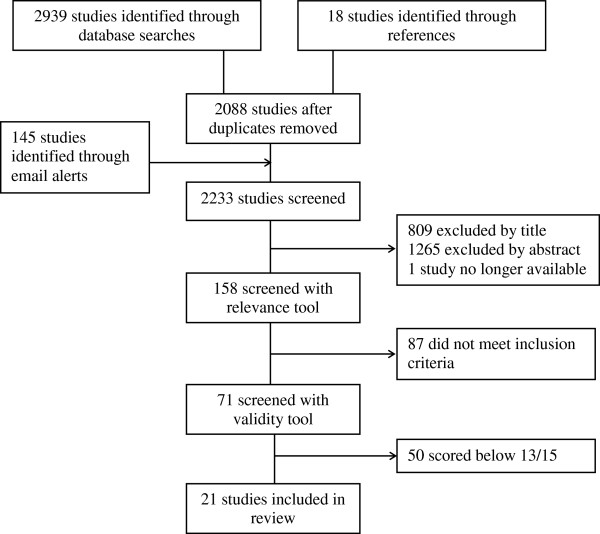
BACKGROUND: The effectiveness of paraprofessional home-visitations on improving the circumstances of disadvantaged families is unclear. The purpose of this paper is to systematically review the effectiveness of paraprofessional home-visiting programs on developmental and health outcomes of young children from disadvantaged families. METHODS: A comprehensive search of electronic databases (e.g., CINAHL PLUS, Cochrane, EMBASE, MEDLINE) from 1990 through May 2012 was supplemented by reference lists to search for relevant studies. Through the use of reliable tools, studies were assessed in duplicate. English language studies of paraprofessional home-visiting programs assessing specific outcomes for children (0-6 years) from disadvantaged families were eligible for inclusion in the review. Data extraction included the characteristics of the participants, intervention, outcomes and quality of the studies. RESULTS: Studies that scored 13 or greater out of a total of 15 on the validity tool (n = 21) are the focus of this review. All studies are randomized controlled trials and most were conducted in the United States. Significant improvements to the development and health of young children as a result of a home-visiting program are noted for particular groups. These include: (a) prevention of child abuse in some cases, particularly when the intervention is initiated prenatally; (b) developmental benefits in relation to cognition and problem behaviours, and less consistently with language skills; and (c) reduced incidence of low birth weights and health problems in older children, and increased incidence of appropriate weight gain in early childhood. However, overall home-visiting programs are limited in improving the lives of socially high-risk children who live in disadvantaged families. CONCLUSIONS: Home visitation by paraprofessionals is an intervention that holds promise for socially high-risk families with young children. Initiating the intervention prenatally and increasing the number of visits improves development and health outcomes for particular groups of children. Future studies should consider what dose of the intervention is most beneficial and address retention issues.
Overview
The claims and statistics of this paper haven’t been checked yet.
Free: it reads the open-access text and checks the first 5 claims that cite a source we can check. Create a free account to check every claim.
Integrity signals
Registry
Cites
Statistics
Figures
Verification
Claims the paper makes
The claims and statistics of this paper haven’t been checked yet.
Free: it reads the open-access text and checks the first 5 claims that cite a source we can check. Create a free account to check every claim.
Self-check
Percentages, sums and reported differences re-computed from the paper’s own numbers.
The self-check needs the paper’s full text.
Citations
Cites
Encyclopedia on Early Childhood Development
Munakata, Y., Michaelson, L., Barker, J. E., & Chevalier, N. (2013) · Cited by 825
Sweet, M. A., & Appelbaum, M. I. (2004) · Child Development · doi:10.1111/j.1467-8624.2004.00750.x · Cited by 798
Grantham-McGregor, S. M., Powell, C. A., Walker, S. P., & Himes, J. H. (1991) · The Lancet · doi:10.1016/0140-6736(91)90001-6 · Cited by 685
Support for breastfeeding mothers
Britton, C., McCormick, F. M., Renfrew, M. J., Wade, A., & King, S. E. (2007) · Cochrane Database of Systematic Reviews · doi:10.1002/14651858.cd001141.pub3 · Cited by 567
Programs for parents of infants and toddlers: recent evidence from randomized trials
Olds, D. L., Sadler, L., & Kitzman, H. (2007) · Journal of Child Psychology and Psychiatry · doi:10.1111/j.1469-7610.2006.01702.x · Cited by 548 · cited 1×
“There are a number of systematic reviews and metaanalyses that explore the effectiveness of HV programs with disadvantaged families [4-7], many of which focus on the prevention of child maltreatment [8-10].”
BackgroundMacLeod, J., & Nelson, G. (2000) · Child Abuse & Neglect · doi:10.1016/s0145-2134(00)00178-2 · Cited by 394
Jorde, R., Sneve, M., Torjesen, P. A., Figenschau, Y., Hansen, J.-B., & Grimnes, G. (2010) · Nutrition Journal · doi:10.1186/1475-2891-9-1 · Cited by 323
Randomized trial of a statewide home visiting program: impact in preventing child abuse and neglect
Duggan, A., McFarlane, E., Fuddy, L., Burrell, L., Higman, S. M., Windham, A., & Sia, C. (2004) · Child Abuse & Neglect · doi:10.1016/j.chiabu.2003.08.007 · Cited by 300
Elkan, Kendrick, Hewitt, Robinson, Tolley, Blair, Dewey, Williams, & Brummell (2000) · Health Technology Assessment · doi:10.3310/hta4130 · Cited by 297 · cited 1×
“There are a number of systematic reviews and metaanalyses that explore the effectiveness of HV programs with disadvantaged families [4-7], many of which focus on the prevention of child maltreatment [8-10].”
BackgroundNair, P., Schuler, M. E., Black, M. M., Kettinger, L., & Harrington, D. (2003) · Child Abuse & Neglect · doi:10.1016/s0145-2134(03)00169-8 · Cited by 285
The effectiveness of early childhood home visitation in preventing violence
Bilukha, O., Hahn, R. A., Crosby, A., Fullilove, M. T., Liberman, A., Moscicki, E., Snyder, S., Tuma, F., Corso, P., Schofield, A., et al. (2005) · American Journal of Preventive Medicine · doi:10.1016/j.amepre.2004.10.004 · Cited by 269
Geeraert, L., Van den Noortgate, W., Grietens, H., & Onghena, P. (2004) · Child Maltreatment · doi:10.1177/1077559504264265 · Cited by 237
Johnson, Z., Howell, F., & Molloy, B. (1993) · BMJ · doi:10.1136/bmj.306.6890.1449 · Cited by 230
Psychosocial Stimulation Improves the Development of Undernourished Children in Rural Bangladesh
Hamadani, J. D., Huda, S. N., Khatun, F., & Grantham-McGregor, S. M. (2006) · The Journal of Nutrition · doi:10.1093/jn/136.10.2645 · Cited by 227
A cognitive approach to child abuse prevention.
Bugental, D. B., Ellerson, P. C., Lin, E. K., Rainey, B., Kokotovic, A., & O'Hara, N. (2002) · Journal of Family Psychology · doi:10.1037/0893-3200.16.3.243 · Cited by 203
Duggan, A., Fuddy, L., Burrell, L., Higman, S. M., McFarlane, E., Windham, A., & Sia, C. (2004) · Child Abuse & Neglect · doi:10.1016/j.chiabu.2003.08.008 · Cited by 194
Healthy Families New York (HFNY) randomized trial: Effects on early child abuse and neglect
DuMont, K., Mitchell-Herzfeld, S., Greene, R., Lee, E., Lowenfels, A., Rodriguez, M., & Dorabawila, V. (2008) · Child Abuse & Neglect · doi:10.1016/j.chiabu.2007.07.007 · Cited by 191
A Randomized Clinical Trial of Home Intervention for Children With Failure to Thrive
Black, M. M., Dubowitz, H., Hutcheson, J., Berenson-Howard, J., & Starr, R. H. (1995) · Pediatrics · doi:10.1542/peds.95.6.807 · Cited by 191
Impact of a statewide home visiting program on parenting and on child health and development
Caldera, D., Burrell, L., Rodriguez, K., Crowne, S. S., Rohde, C. A., & DUGGAN, A. K. (2007) · Child Abuse & Neglect · doi:10.1016/j.chiabu.2007.02.008 · Cited by 161
Reducing Low Birth Weight Through Home Visitation
Lee, E., Mitchell-Herzfeld, S. D., Lowenfels, A. A., Greene, R., Dorabawila, V., & Dumont, K. A. (2009) · American Journal of Preventive Medicine · doi:10.1016/j.amepre.2008.09.029 · Cited by 123
Randomized Trial of Comprehensive Prenatal Care for Low-Income Women: Effect on Infant Birth Weight
McLaughlin, F. J., Altemeier, W. A., Christensen, M. J., Sherrod, K. B., Dietrich, M. S., & Stern, D. T. (1992) · Pediatrics · doi:10.1542/peds.89.1.128 · Cited by 109
le Roux, I. M., le Roux, K., Comulada, W. S., Greco, E. M., Desmond, K. A., Mbewu, N., & Rotheram-Borus, M. J. (2010) · Nutrition Journal · doi:10.1186/1475-2891-9-56 · Cited by 99
An experimental evaluation of in-home child abuse prevention services
Barth, R. P. (1991) · Child Abuse & Neglect · doi:10.1016/0145-2134(91)90021-5 · Cited by 88
Interventions for caregivers of persons with dementia: a systematic review.
Peacock, S., & Forbes, D. A. (2003) · PubMed · Cited by 88
Self-citationSupport for breastfeeding mothers
Sikorski, J., Renfrew, M. J., Pindoria, S., & Wade, A. (2002) · Cochrane Database of Systematic Reviews · doi:10.1002/14651858.cd001141.pub2 · Cited by 78
Duggan, A. K., Berlin, L. J., Cassidy, J., Burrell, L., & Tandon, S. D. (2009) · Journal of Consulting and Clinical Psychology · doi:10.1037/a0015709 · Cited by 76
A cost-effectiveness evaluation of a home visit program for adolescent mothers
Aracena, M., Krause, M., Pérez, C., Méndez, M. J., Salvatierra, L., Soto, M., Pantoja, T., Navarro, S., Salinas, A., Farah, C., et al. (2009) · Journal of Health Psychology · doi:10.1177/1359105309340988 · Cited by 69
Kelley, S. J. (2003) · Child Abuse & Neglect · doi:10.1016/s0145-2134(03)00161-3 · Cited by 66
Prevalence and Early Identification of Language Delays Among At-Risk Three Year Olds
King, T. M., ROSENBERG, L. A., Fuddy, L. J., McFarlane, E., Sia, C. C. J., & DUGGAN, A. K. (2005) · Journal of Developmental & Behavioral Pediatrics · doi:10.1097/00004703-200508000-00006 · Cited by 65
Support for breastfeeding mothers
Sikorski, J., Renfrew, M. J., Pindoria, S., & Wade, A. (2002) · Cochrane Database of Systematic Reviews · doi:10.1002/14651858.cd001141 · Cited by 55
A RCT of peer-mentoring for first-time mothers in socially disadvantaged areas (The MOMENTS Study)
Cupples, M. E., Stewart, M. C., Percy, A., Hepper, P., Murphy, C., & Halliday, H. L. (2011) · Archives of Disease in Childhood · doi:10.1136/adc.2009.167387 · Cited by 54
Scheiwe, A., Hardy, R., & Watt, R. G. (2010) · Maternal and Child Nutrition · doi:10.1111/j.1740-8709.2009.00231.x · Cited by 54
Forbes, D. A. (1998) · PubMed · Cited by 52
Three-Year Developmental Outcomes in Children with Prenatal Alcohol and Drug Exposure
Kartin, D., Grant, T. M., Streissguth, A. P., Sampson, P. D., & Ernst, C. C. (2002) · Pediatric Physical Therapy · doi:10.1097/00001577-200214030-00004 · Cited by 36
Home Visiting Programs and Their Impact on Young Children
Zercher, C., & Spiker, D. (2004) · Cited by 17
Research works printed but not linked: 1
- Necoechea DM Children at-risk for poor school readiness: The effect of an early intervention home visiting program on children and parents [dissertation] 2007 Riverside: University of California
Cited by
Nurturing care: Promoting early childhood development
Britto, P. R., Lye, S. J., Proulx, K., Yousafzai, A. K., Matthews, S. G., Vaivada, T., Perez-Escamilla, R., Rao, N., Ip, P., Fernald, L. C. H., et al. (2017) · The Lancet · doi:10.1016/s0140-6736(16)31390-3 · Cited by 1,796
Mersky, J. P., Topitzes, J., & Reynolds, A. J. (2013) · Child Abuse & Neglect · doi:10.1016/j.chiabu.2013.07.011 · Cited by 729
Lifetime Prevalence of Investigating Child Maltreatment Among US Children
Kim, H., Wildeman, C., Jonson-Reid, M., & Drake, B. (2017) · American Journal of Public Health · doi:10.2105/ajph.2016.303545 · Cited by 640
Robling, M., Bekkers, M.-J., Bell, K., Butler, C. C., Cannings-John, R., Channon, S., Martin, B. C., Gregory, J. W., Hood, K., Kemp, A., et al. (2016) · The Lancet · doi:10.1016/s0140-6736(15)00392-x · Cited by 338
Williams, P. G., Lerner, M. A., COUNCIL ON EARLY CHILDHOOD, COUNCIL ON SCHOOL HEALTH, Sells, J., Alderman, S. L., Hashikawa, A., Mendelsohn, A., McFadden, T., Navsaria, D., et al. (2019) · Pediatrics · doi:10.1542/peds.2019-1766 · Cited by 179
“Home visiting by nurses has been shown consistently to reduce rates of childhood injury, to increase fathers’ involvement, to reduce family welfare dependency, and to improve school readiness.(69,70) Housing subsidies have resulted in improved neighborhood safety and reduced exposure to violence.”
Metadata
- Authors
- Peacock, S., Konrad, S., Watson, E., Nickel, D., & Muhajarine, N.
- Affiliations
- University of Saskatchewan (CA)
- Corresponding author
- Peacock, Shelley
- Venue
- BMC Public Health
- Published
- 2013-01-09
- Volume
- 13
- Issue
- 1
- Pages
- 17-17
- ISSN
- 1471-2458 (ISSN-L)
- PMC
- PMC3546846
- OpenAlex
- W2102101140
- Cited by
- 392
- References
- 37
- Citations by year
- 2026: 20 · 2025: 20 · 2024: 26 · 2023: 34 · 2022: 45 · 2021: 26 · 2020: 43 · 2019: 27 · 2018: 43 · 2017: 23 · 2016: 31 · 2015: 28 · 2014: 19 · 2013: 6
- FWCI
- 3.37
- Type
- journal article
- Language
- en
- Open access
- gold
- doi.org
- Licence
- cc-by
- creativecommons.org/licenses/by/2.0 (tdm)
- Locations
- BMC Public Health (publishedVersion, cc-by)
- Europe PMC (PubMed Central) (publishedVersion, cc-by)
- PubMed Central (publishedVersion, cc-by)
- PubMed (publishedVersion)
- HARVEST (University of Saskatchewan) (submittedVersion)
- DOAJ (DOAJ: Directory of Open Access Journals) (submittedVersion)
- Topics
- Health Sciences › Medicine › Pediatrics, Perinatology and Child Health › Child and Adolescent Health
- Health Sciences › Medicine › Pediatrics, Perinatology and Child Health › Maternal and Neonatal Healthcare
- Health Sciences › Nursing › Nutrition and Dietetics › Child Nutrition and Water Access
- Keywords
- home visits, disadvantaged families, child development, child health outcomes, child abuse prevention, prenatal intervention, low birth weight, cognitive development, behavioral problems, language skills, intervention dosage, intervention retention
- MeSH terms
- Child, Child, Preschool, House Calls, Humans, Infant, Program Evaluation, Randomized Controlled Trials as Topic, Outcome Assessment, Health Care, Vulnerable Populations
About these checks
Registry, retraction, Cites and statistics results are computed, not judged, with one exception: a printed reference that no index lists is read once by a model before it counts as a citation error. Claims are extracted by a model and kept only when their quote appears verbatim in the text; each cited source is then checked, with a model’s help, for whether it says what the claim relies on. Those verdicts can be wrong — read the claim’s quote and the cited source before relying on one.
Statistics and arithmetic are recomputed, not judged.
Confidence bands are shown only for fields calibrated on our annotated test set. None is calibrated yet, so no band is shown.
What counts as a claim ›How we measure confidence ›How we check this ›
Are you an author, or do you see a problem with this page? Request a review
Data sources
Bibliographic data: Semantic Scholar, OpenAlex, Crossref.
Contains information from the Semantic Scholar Academic Graph Datasets, made available under the ODC Attribution License (ODC-BY 1.0).
Semantic Scholar’s data is described in: Kinney, R., et al. (2023). The Semantic Scholar Open Data Platform. arXiv:2301.10140.
