

The DOI matches its Crossref record; 50 of the 50 references it cites were found in a registry or an index.
Organizational stressors associated with job stress and burnout in correctional officers: a systematic review
Open accessAbstract
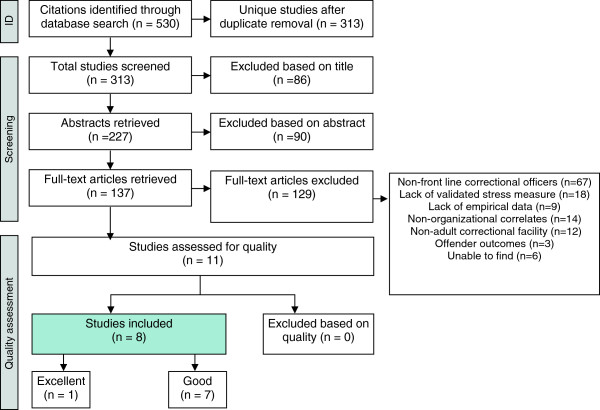
Background: In adult correctional facilities, correctional officers (COs) are responsible for the safety and security of the facility in addition to aiding in offender rehabilitation and preventing recidivism. COs experience higher rates of job stress and burnout that stem from organizational stressors, leading to negative outcomes for not only the CO but the organization as well. Effective interventions could aim at targeting organizational stressors in order to reduce these negative outcomes as well as COs’ job stress and burnout. This paper fills a gap in the organizational stress literature among COs by systematically reviewing the relationship between organizational stressors and CO stress and burnout in adult correctional facilities. In doing so, the present review identifies areas that organizational interventions can target in order to reduce CO job stress and burnout. Methods: A systematic search of the literature was conducted using Medline, PsycINFO, Criminal Justice Abstracts, and Sociological Abstracts. All retrieved articles were independently screened based on criteria developed a priori. All included articles underwent quality assessment. Organizational stressors were categorized according to Cooper and Marshall’s (1976) model of job stress. Results: The systematic review yielded 8 studies that met all inclusion and quality assessment criteria. The five categories of organizational stressors among correctional officers are: stressors intrinsic to the job, role in the organization, rewards at work, supervisory relationships at work and the organizational structure and climate. The organizational structure and climate was demonstrated to have the most consistent relationship with CO job stress and burnout. Conclusions: The results of this review indicate that the organizational structure and climate of correctional institutions has the most consistent relationship with COs’ job stress and burnout. Limitations of the studies reviewed include the cross-sectional design and the use of varying measures for organizational stressors. The results of this review indicate that interventions should aim to improve the organizational structure and climate of the correctional facility by improving communication between management and COs.
Overview
The claims and statistics of this paper haven’t been checked yet.
Run the check — free, no account needed. It reads the open-access text and checks the sources it cites.
Integrity signals
Registry
Cites
Statistics
Figures
Verification
Claims the paper makes
The claims and statistics of this paper haven’t been checked yet.
Run the check — free, no account needed. It reads the open-access text and checks the sources it cites.
Claims other papers make about this one
Each is checked against this paper’s own text: does it say what the citing paper says it does?
The cited source says what the claim attributes to it.
In the citing paper
“For example, correctional work involves a hierarchical, rank-informed, relationship between different staff and the administration, and that organizational structure arguably facilitates stress, job dissatisfaction, and even burnout [23,24,25,26].”
From Canadian Public Safety Personnel and Occupational Stressors: How PSP Interpret Stressors on Duty (2020) · cites this paper as [26]
Self-check
Percentages, sums and reported differences re-computed from the paper’s own numbers.
The self-check needs the paper’s full text.
Citations
Cites
Maslach, C., Schaufeli, W. B., & Leiter, M. P. (2001) · Annual Review of Psychology · doi:10.1146/annurev.psych.52.1.397 · Cited by 12,852
Job Demands, Job Decision Latitude, and Mental Strain: Implications for Job Redesign
Karasek, R. A. (1979) · Administrative Science Quarterly · doi:10.2307/2392498 · Cited by 12,597
Adverse health effects of high-effort/low-reward conditions.
Siegrist, J. (1996) · Journal of Occupational Health Psychology · doi:10.1037/1076-8998.1.1.27 · Cited by 5,713
Organizational Behavior: Affect in the Workplace
Brief, A. P., & Weiss, H. M. (2002) · Annual Review of Psychology · doi:10.1146/annurev.psych.53.100901.135156 · Cited by 1,797
The Experience of Work-Related Stress across Occupations
Johnson, S., Cooper, C., Cartwright, S., Donald, I., Taylor, P., & Millet, C. (2005) · Journal of Managerial Psychology · doi:10.1108/02683940510579803 · Cited by 1,540
COOPER, C. L., & MARSHALL, J. (1976) · Journal of Occupational Psychology · doi:10.1111/j.2044-8325.1976.tb00325.x · Cited by 1,201 · cited 10×
“Workplace stress and burnout affects between 19% and 30% of employees in the general working population [1-3].”
BackgroundInfluentialOrganizational determinants of job stress
Parker, D. F., & DeCotiis, T. A. (1983) · Organizational Behavior and Human Performance · doi:10.1016/0030-5073(83)90145-9 · Cited by 915
Maslach C, Schaufeli W, Leiter M. Job burnout. Annu Rev Psychol 2001; 52: 397-422.
Dedić, G. (2002) · Vojnosanitetski pregled · Cited by 855
AN EXAMINATION OF COMPETING VERSIONS OF THE PERSON-ENVIRONMENT FIT APPROACH TO STRESS.
Edwards, J. R. (1996) · Academy of Management Journal · doi:10.2307/256782 · Cited by 799
Occupational stress: Its causes and consequences for job performance.
Motowidlo, S. J., Packard, J. S., & Manning, M. R. (1986) · Journal of Applied Psychology · doi:10.1037/0021-9010.71.4.618 · Cited by 670
Research works printed but not linked: 5
- Finn P: Correctional officer stress: a cause for concern and additional help. Federal Probation. 1998, 62 (2): 65-74.
- Brown PW: Probation officer burnout. Federal Probation. 1987, 51: 17-
- Finn P, Tomz JE: Developing a law enforcement stress program for officers and their families. Issues and Practices in Criminal Justice. 1996, Washington, DC: National Institute of Justice
- World Health Organization: Mental health promotion in prisons: Report on a WHO meeting. 1998, The Hague, Netherlands: World Health Organization
- Dussault J, Jauvin N, Vezina M, Bourbonnais R: Preventing violence among employees of the same work organization: Evaluation of a participatory intervention. Collection Etudes et Recherches. 2012, Montreal: IRSST Publications
Cited by
Sorted by citations
Police stressors and health: a state-of-the-art review
Violanti, J. M., Charles, L. E., McCanlies, E., Hartley, T. A., Baughman, P., Andrew, M. E., Fekedulegn, D., Ma, C. C., Mnatsakanova, A., & Burchfiel, C. M. (2017) · Policing: An International Journal of Police Strategies & Management · doi:10.1108/pijpsm-06-2016-0097 · Cited by 360
Burnout and Workload Among Health Care Workers: The Moderating Role of Job Control
Portoghese, I., Galletta, M., Coppola, R., Finco, G., & Campagna, M. (2014) · Safety and Health at Work · doi:10.1016/j.shaw.2014.05.004 · Cited by 341
Purba, A., & Demou, E. (2019) · BMC Public Health · doi:10.1186/s12889-019-7609-0 · Cited by 328
Seidler, A., Thinschmidt, M., Deckert, S., Then, F., Hegewald, J., Nieuwenhuijsen, K., & Riedel-Heller, S. G. (2014) · Journal of Occupational Medicine and Toxicology · doi:10.1186/1745-6673-9-10 · Cited by 326
Assessing the Relative Impact of Diverse Stressors among Public Safety Personnel
Carleton, R. N., Afifi, T. O., Taillieu, T., Turner, S., Mason, J. E., Ricciardelli, R., McCreary, D. R., Vaughan, A. D., Anderson, G. S., Krakauer, R. L., et al. (2020) · International Journal of Environmental Research and Public Health · doi:10.3390/ijerph17041234 · Cited by 225
“As such, researchers need to extend prior research [13,31,37] by focusing on both overall mean and item-level associations so that the latter can be targeted for modification (e.”
Background
Metadata
- Authors
- Finney, C., Stergiopoulos, E., Hensel, J., Bonato, S., & Dewa, C. S.
- Affiliations
- Centre for Addiction and Mental Health (CA)
- Corresponding author
- Dewa, Carolyn S
- Venue
- BMC Public Health
- Published
- 2013-01-29
- Volume
- 13
- Issue
- 1
- Pages
- 82-82
- ISSN
- 1471-2458 (ISSN-L)
- PMC
- PMC3564928
- OpenAlex
- W2079771075
- Cited by
- 429
- References
- 50
- Citations by year
- 2026: 35 · 2025: 37 · 2024: 37 · 2023: 35 · 2022: 53 · 2021: 36 · 2020: 42 · 2019: 35 · 2018: 22 · 2017: 26 · 2016: 30 · 2015: 26 · 2014: 12 · 2013: 3
- FWCI
- 3.10
- Type
- journal article
- Language
- en
- Open access
- gold
- doi.org
- Licence
- Locations
- BMC Public Health (publishedVersion, cc-by)
- Europe PMC (PubMed Central) (publishedVersion, cc-by)
- PubMed Central (publishedVersion, cc-by)
- PubMed (publishedVersion)
- TSpace (University of Toronto) (submittedVersion)
- DOAJ (DOAJ: Directory of Open Access Journals) (submittedVersion)
- eScholarship (California Digital Library) (submittedVersion)
- eScholarship (California Digital Library) (submittedVersion, cc-by)
- Funders
- Centre for Addiction and Mental Health
- Public Health Agency of Canada
- Ontario Ministry of Health and Long-Term Care
- Canadian Institutes of Health Research
- Topics
- Social Sciences › Psychology › Social Psychology › Stress and Burnout Research
- Health Sciences › Medicine › Public Health, Environmental and Occupational Health › Workplace Health and Well-being
- Health Sciences › Medicine › Public Health, Environmental and Occupational Health › Occupational Health and Burnout
- Keywords
- correctional officers, occupational stress, burnout, organizational stressors, organizational climate, organizational structure, supervisory relationship, management-employee communication
- MeSH terms
- Workforce, Adult, Burnout, Professional, Crowding, Humans, Interprofessional Relations, Personnel Staffing and Scheduling, Prisons, Stress, Psychological, Organizational Culture, Occupational Health, Police, Workload, Professional Role
About these checks
Registry, retraction, Cites and statistics results are computed, not judged, with one exception: a printed reference that no index lists is read once by a model before it counts as a citation error. Claims are extracted by a model and kept only when their quote appears verbatim in the text; each cited source is then checked, with a model’s help, for whether it says what the claim relies on. Those verdicts can be wrong — read the claim’s quote and the cited source before relying on one.
Statistics and arithmetic are recomputed, not judged.
Confidence bands are shown only for fields calibrated on our annotated test set. None is calibrated yet, so no band is shown.
What counts as a claim ›How we measure confidence ›How we check this ›
Are you an author, or do you see a problem with this page? Request a review
