

The DOI matches its Crossref record; 66 of the 67 references it cites were found in a registry or an index.
Do low-income neighbourhoods have the least green space? A cross-sectional study of Australia’s most populous cities
Open accessAbstract
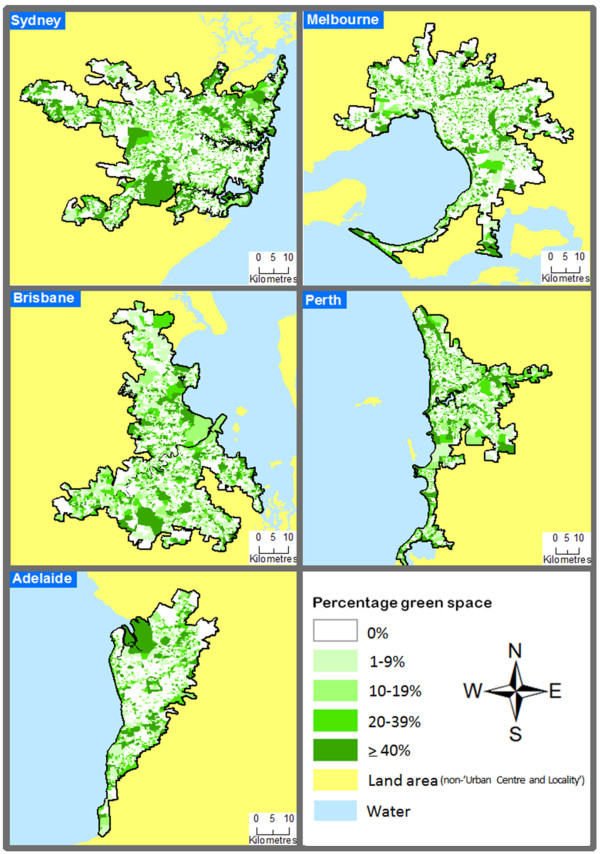
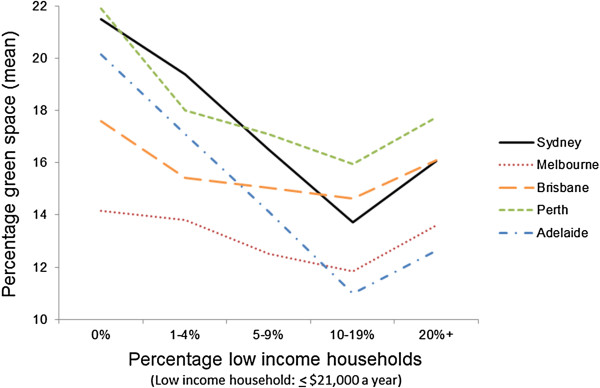
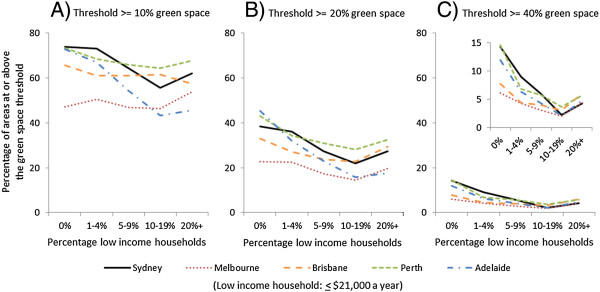
BACKGROUND: An inequitable distribution of parks and other 'green spaces' could exacerbate health inequalities if people on lower incomes, who are already at greater risk of preventable diseases, have poorer access. METHODS: The availability of green space within 1 kilometre of a Statistical Area 1 (SA1) was linked to data from the 2011 Australian census for Sydney (n = 4.6 M residents); Melbourne (n = 4.2 M); Brisbane (n = 2.2 M); Perth (n = 1.8 M); and Adelaide (n = 1.3 M). Socioeconomic circumstances were measured via the percentage population of each SA1 living on < $21,000 per annum. Negative binomial and logit regression models were used to investigate association between the availability of green space in relation to neighbourhood socioeconomic circumstances, adjusting for city and population density. RESULTS: Green space availability was substantively lower in SA1s with a higher percentage of low income residents (e.g. an incidence rate ratio of 0.82 (95% confidence interval (95% CI) 0.75, 0.89) was observed for SA1s containing ≥20% versus 0-1% low income residents). This association varied between cities (p < 0.001). Adelaide reported the least equitable distribution of green space, with approximately 20% greenery in the most affluent areas versus 12% availability in the least affluent. Although Melbourne had a smaller proportion of SA1s in the top quintile of green space availability (13.8%), the distribution of greenery was the most equitable of all the cities, with only a 0.5% difference in the availability of green space between SA1s containing 0-1% low income households versus those with ≥20%. Inequity of access, however, was reported across all cities when using logit regression to examine the availability of at least 20% (odds ratio 0.74, 95% CI 0.59, 0.93) or 40% (0.45, 0.29, 0.69) green space availability in the more disadvantaged versus affluent neighbourhoods. CONCLUSION: Affirmative action on green space planning is required to redress the socioeconomic inequity of access to this important public health resource.
Overview
The claims and statistics of this paper haven’t been checked yet.
Run the check — free, no account needed. It reads the open-access text and checks the sources it cites.
Integrity signals
Registry
Cites
Statistics
Figures
Verification
Claims the paper makes
The claims and statistics of this paper haven’t been checked yet.
Run the check — free, no account needed. It reads the open-access text and checks the sources it cites.
Claims other papers make about this one
Each is checked against this paper’s own text: does it say what the citing paper says it does?
The source backs part of the claim, not all of it — or backs it for a different population, condition or comparison.
In the citing paper
“This may be particularly important for children and adolescents from low socioeconomic backgrounds, who typically engage in greater amounts of ST [48–51] and are also less likely to live in green neighbourhoods [52].”
From Psychological impacts of “screen time” and “green time” for children and adolescents: A systematic scoping review (2020) · cites this paper as [52]
Experimental — accuracy not yet measured
Self-check
Percentages, sums and reported differences re-computed from the paper’s own numbers.
The self-check needs the paper’s full text.
Citations
Cites
Principles of geographical information systems
BURROUGH, P. A., & McDonnell, R. A. (1998) · Cited by 4,082
A Note on Robust Variance Estimation for Cluster‐Correlated Data
Williams, R. L. (2000) · Biometrics · doi:10.1111/j.0006-341x.2000.00645.x · Cited by 2,501
Aesthetic and affective response to natural environment
Ulrich, R. S. (1983) · Behavior and the Natural Environment · doi:10.1007/978-1-4613-3539-9_4 · Cited by 2,241
Tracking restoration in natural and urban field settings
Hartig, T., Evans, G. W., Jamner, L. D., Davis, D. S., & Gärling, T. (2003) · Journal of Environmental Psychology · doi:10.1016/s0272-4944(02)00109-3 · Cited by 2,118
Effect of exposure to natural environment on health inequalities: an observational population study
Mitchell, R., & Popham, F. (2008) · The Lancet · doi:10.1016/s0140-6736(08)61689-x · Cited by 2,099
A systematic review of evidence for the added benefits to health of exposure to natural environments
Bowler, D. E., Buyung-Ali, L. M., Knight, T. M., & Pullin, A. S. (2010) · BMC Public Health · doi:10.1186/1471-2458-10-456 · Cited by 1,993
Green space, urbanity, and health: how strong is the relation?
Maas, J., Verheij, R. A., Groenewegen, P. P., de Vries, S., & Spreeuwenberg, P. (2006) · Journal of Epidemiology and Community Health · doi:10.1136/jech.2005.043125 · Cited by 1,976
The health benefits of urban green spaces: a review of the evidence
Lee, A. C., & Maheswaran, R. (2010) · Journal of Public Health · doi:10.1093/pubmed/fdq068 · Cited by 1,583
Giles‐Corti, B., Broomhall, M. H., Knuiman, M. W., Collins, C. G., Douglas, K., Ng, K., Lange, A., & Donovan, R. J. (2005) · American Journal of Preventive Medicine · doi:10.1016/j.amepre.2004.10.018 · Cited by 1,523
Self-citationThompson Coon, J., Boddy, K., Stein, K., Whear, R., Barton, J., & Depledge, M. H. (2011) · Environmental Science & Technology · doi:10.1021/es102947t · Cited by 1,391
Research works printed but not linked: 8
- The Scottish Government: Good places, better health in Scotland. 2008, The Scottish Government: Edinburgh
- Department of Sustainability and Environment: Victorian Planning Provisions. 2013, Melbourne: Victorian State Government
- Western Australian Planning Commission: Liveable neighbourhoods: a Western Australian Government Sustainable Cities Initiative. 2004, Western Australian Planning Commission: Perth, WA
- Australian Bureau of Statistics: 3218.0 - Regional Population Growth, Australia, 2011: Population estimates and Australia’s new statistical geography. 2012, Canberra: Australian Bureau of Statistics
- Australian Bureau of Statistics: Australian Statistical Geography Standard (ASGS): Volume 4 - Significant Urban Areas, Urban Centres and Localities, Section of State. 2011, Canberra: Australian Bureau of Statistics
- Australian Bureau of Statistics: Australian Statistical Geography Standard (ASGS): Volume 1 - Main Structure and Greater Capital City Statistical Areas. 2011, Canberra:
- Australian Bureau of Statistics: Information paper, Draft Mesh Blocks. 2005, Canberra: Australian Bureau of Statistics
- Pink B: Technical Paper: Socio-Economic Indexes for Areas (SEIFA). 2011, Australian Bureau of Statistics: Canberra
Cited by
Sorted by citations
Items 101–200 of 350
Building a predictive machine learning model of gentrification in Sydney
Thackway, W., Ng, M. K. M., Lee, C. L., & Pettit, C. J. (2023) · Cities · doi:10.1016/j.cities.2023.104192 · Cited by 37
Gao, S., Zhai, W., & Fu, X. (2023) · Frontiers in Public Health · doi:10.3389/fpubh.2023.1055720 · Cited by 38
Sanders, T., Feng, X., Fahey, P. P., Lonsdale, C., & Astell‐Burt, T. (2015) · Journal of Obesity · doi:10.1155/2015/194838 · Cited by 35
Self-citationDipeolu, A. A., Ibem, E. O., Fadamiro, J. A., Omoniyi, S. S., & Aluko, O. R. (2021) · Cities · doi:10.1016/j.cities.2021.103378 · Cited by 37
Residential greenness-related DNA methylation changes
Jeong, A., Eze, I. C., Vienneau, D., de Hoogh, K., Keidel, D., Rothe, T., Burdet, L., Holloway, J. W., Jarvis, D., Kronenberg, F., et al. (2021) · Environment International · doi:10.1016/j.envint.2021.106945 · Cited by 36
Can green space quantity and quality help prevent postpartum weight gain? A longitudinal study
Feng, X., & Astell‐Burt, T. (2019) · Journal of Epidemiology & Community Health · doi:10.1136/jech-2018-211133 · Cited by 34
Self-citationLanza, K., Stone, B., & Haardörfer, R. (2019) · Preventive Medicine · doi:10.1016/j.ypmed.2019.01.022 · Cited by 33
Biodiversity promotes urban ecosystem functioning
Weiskopf, S. R., Lerman, S. B., Isbell, F., & Morelli, T. L. (2024) · Ecography · doi:10.1111/ecog.07366 · Cited by 41
Putra, I. G. N. E., Astell‐Burt, T., Cliff, D. P., Vella, S. A., & Feng, X. (2021) · Journal of Environmental Psychology · doi:10.1016/j.jenvp.2021.101579 · Cited by 33
Self-citationRoodsari, E. N., & Hoseini, P. (2021) · Environment Development and Sustainability · doi:10.1007/s10668-021-01970-4 · Cited by 32
Chenyang, D., Maruthaveeran, S., & Shahidan, M. F. (2022) · Urban forestry & urban greening · doi:10.1016/j.ufug.2022.127696 · Cited by 32
Built Environments and Cardiovascular Health
Chandrabose, M., den Braver, N. R., Owen, N. G., Sugiyama, T., & Hadgraft, N. T. (2022) · Journal of Cardiopulmonary Rehabilitation and Prevention · doi:10.1097/hcr.0000000000000752 · Cited by 32
Jamalishahni, T., Turrell, G., Foster, S. A., Davern, M. T., & Villanueva, K. (2023) · BMC Public Health · doi:10.1186/s12889-023-15433-0 · Cited by 34
Wellbeing and blue‐green space in post‐pandemic cities: Drivers, debates and departures
Dobson, J. (2021) · Geography Compass · doi:10.1111/gec3.12593 · Cited by 34
Is urban green space associated with lower mental healthcare expenditure?
Astell‐Burt, T., Navakatikyan, M., Eckermann, S. D., Hackett, M. L., & Feng, X. (2021) · Social Science & Medicine · doi:10.1016/j.socscimed.2021.114503 · Cited by 38
Self-citationCui, Q., Huang, Y., Yang, G., & Chen, Y. (2022) · International Journal of Environmental Research and Public Health · doi:10.3390/ijerph19159611 · Cited by 31
Pineda-Pinto, M., Frantzeskaki, N., Chandrabose, M., Cantis, P. H., McPhearson, T., Nygaard, C. A., & Raymond, C. M. (2022) · Urban Policy and Research · doi:10.1080/08111146.2022.2093184 · Cited by 31
Aamodt, G., Nordh, H., & Nordbø, E. C. A. (2023) · Urban forestry & urban greening · doi:10.1016/j.ufug.2023.127894 · Cited by 33
Centring justice in conceptualizing and improving access to urban nature
Langhans, K. E., Echeverri, A., Daws, S. C., Moss, S., Anderson, C. B., Chaplin‐Kramer, R., Hendershot, J. N., Liu, L., Mandle, L., Nguyen, O., et al. (2023) · People and Nature · doi:10.1002/pan3.10470 · Cited by 37
Maintaining experiences of nature as a city grows
Sushinsky, J. R., Rhodes, J. R., Shanahan, D. F., Possingham, H. P., & Fuller, R. A. (2017) · Ecology and Society · doi:10.5751/es-09454-220322 · Cited by 31
Increasing contribution of urban greenery to residential real estate valuation over time
Teo, H. C., Fung, T. K., Song, X. P., Belcher, R. N., Siman, K., Chan, I. Z. W., & Koh, L. P. (2023) · Sustainable Cities and Society · doi:10.1016/j.scs.2023.104689 · Cited by 30
Persson, Å., Eriksson, C., & Lõhmus, M. (2018) · Landscape and Urban Planning · doi:10.1016/j.landurbplan.2018.08.001 · Cited by 31
Neighbourhood greenness and income of occupants in four German areas: GINIplus and LISAplus
Markevych, I., Maier, W., Fuertes, E., Lehmann, I., Berg, A. V., Bauer, C., Koletzko, S., Berdel, D., Sugiri, D., Standl, M., et al. (2016) · Urban forestry & urban greening · doi:10.1016/j.ufug.2016.11.011 · Cited by 29
City Children’s Nature Knowledge and Contact: It Is Not Just About Biodiversity Provision
Freeman, C., Stein, A., Hand, K. L., & van Heezik, Y. (2017) · Environment and Behavior · doi:10.1177/0013916517732108 · Cited by 29
Demographic biases in engagement with nature in a tropical Asian city
Richards, D. R., Fung, T. K., Leong, R., Sachidhanandam, U., Drillet, Z., & Edwards, P. J. (2020) · PLoS ONE · doi:10.1371/journal.pone.0231576 · Cited by 29
Kelly, D., Davern, M. T., Farahani, L. M., Higgs, C., & Maller, C. J. (2021) · Cities · doi:10.1016/j.cities.2021.103442 · Cited by 30
Li, A., Mansour, A., & Bentley, R. (2023) · Health & Place · doi:10.1016/j.healthplace.2023.103103 · Cited by 30
Urban green space quality and older adult recreation: an international comparison
Shuvo, F. K., Feng, X., & Astell‐Burt, T. (2020) · Cities & Health · doi:10.1080/23748834.2020.1766781 · Cited by 28
Self-citationBerry, M. S., Rung, J. M., Crawford, M. C., Yurasek, A. M., Ferreiro, A. V., & Almog, S. (2021) · Behavioural Processes · doi:10.1016/j.beproc.2021.104344 · Cited by 31
Public health benefits from urban horticulture in the global north: A scoping review and framework
Cruz-Piedrahita, C., Howe, C., & de Nazelle, A. J. (2020) · Global Transitions · doi:10.1016/j.glt.2020.10.001 · Cited by 27
Subiza‐Pérez, M., García‐Baquero, G., Babarro, I., Anabitarte, A., Delclòs‐Alió, X., Vich, G., Roig-Costa, O., Miralles‐Guasch, C., Lertxundi, N., & Ibarluzea, J. M. (2021) · Environmental Research · doi:10.1016/j.envres.2021.111192 · Cited by 28
Li, X., Chen, W. Y., Hu, F. Z. Y., & Cho, F. H. T. (2021) · Landscape and Urban Planning · doi:10.1016/j.landurbplan.2021.104250 · Cited by 27
Zhang, Z., Martin, K. L., Stevenson, K. T., & Yao, Y. (2021) · Urban forestry & urban greening · doi:10.1016/j.ufug.2021.127434 · Cited by 29
Georgiou, M., Tieges, Z., Morison, G., Smith, N., & CHASTIN, S. F. M. (2022) · Scientific Reports · doi:10.1038/s41598-022-17089-z · Cited by 26
Ahmed, N., Lee, J., Liu, D., Kan, Z., & Wang, J. (2023) · Urban forestry & urban greening · doi:10.1016/j.ufug.2023.128123 · Cited by 26
Do larger cities enjoy better green space accessibility? Evidence from China
Chen, Y., Rosa, D. L., Yue, W., Xu, Z., & Zhuo, Y. (2024) · Environmental Impact Assessment Review · doi:10.1016/j.eiar.2024.107544 · Cited by 27
Wang, J., Ulibarrí, N., Scott, T. A., & Davis, S. J. (2023) · Environmental Science & Policy · doi:10.1016/j.envsci.2023.05.003 · Cited by 26
Moving from risk to resilience in psychosis research
Thakkar, K. N., McCleery, A., Minor, K. S., Lee, J., Humpston, C. S., Chopik, W. J., Burt, S. A., Pearson, A. L., Ungar, M. T., & Park, S. (2023) · Nature Reviews Psychology · doi:10.1038/s44159-023-00205-9 · Cited by 27
Cobbold, A., Crane, M. A., Knibbs, L. D., Hanigan, I., Greaves, S. P., & Rissel, C. E. (2022) · The Journal of Climate Change and Health · doi:10.1016/j.joclim.2022.100137 · Cited by 26
Trees, Climate Change, and Health: An Urban Planning, Greening and Implementation Perspective
Woodward, A. J., Hinwood, A. L., Bennett, D. W., Grear, B., Vardoulakis, S., Lalchandani, N. K., Lyne, K., & Williams, C. (2023) · International Journal of Environmental Research and Public Health · doi:10.3390/ijerph20186798 · Cited by 25
Beneficial Health Outcomes of Natural Green Infrastructure in Cities
McKinney, M. L., & VerBerkmoes, A. (2020) · Current Landscape Ecology Reports · doi:10.1007/s40823-020-00051-y · Cited by 30
Zhang, Y., Zhao, J., Mavoa, S., & Smith, M. (2024) · Cities · doi:10.1016/j.cities.2024.104972 · Cited by 32
Self-citationAlderton, A., O’Connor, M., Badland, H. M., Gunn, L., Boulangé, C., & Villanueva, K. (2022) · International Journal of Environmental Research and Public Health · doi:10.3390/ijerph19116780 · Cited by 28
Self-citationStevens, H. R., Graham, P. L., Beggs, P. J., & Ossola, A. (2024) · International Journal of Biometeorology · doi:10.1007/s00484-023-02613-1 · Cited by 26
Green infrastructure in western Washington and Oregon: Perspectives from a regional summit
Jayakaran, A. D., Moffett, K. B., Padowski, J. C., Townsend, P. A., & Gaolach, B. (2020) · Urban forestry & urban greening · doi:10.1016/j.ufug.2020.126654 · Cited by 23
Rieves, E. S., Reid, C. E., Carlson, K., & Li, X. (2024) · Landscape and Urban Planning · doi:10.1016/j.landurbplan.2024.105080 · Cited by 24
Obesity and Natural Spaces in Adults and Older People: A Systematic Review
Teixeira, A. S., Gabriel, R., Quaresma, L. F. E. S., Alencoão, A., Martinho, J., & Moreira, H. (2021) · Journal of Physical Activity and Health · doi:10.1123/jpah.2020-0589 · Cited by 21
Tree canopy, pediatric asthma, and social vulnerability: An ecological study in Connecticut
Lee, S., Baek, J., Kim, S. W., & Newman, G. (2022) · Landscape and Urban Planning · doi:10.1016/j.landurbplan.2022.104451 · Cited by 22
Liáng, L., Anderson, R. G., Shiflett, S. A., & Jenerette, G. D. (2017) · Environmental Research Letters · doi:10.1088/1748-9326/aa7b21 · Cited by 23
Liu, R., Pan, X., Xia, Z., Gou, J., Han, J., Cao, K., Wang, D., & Xue, C. (2025) · Habitat International · doi:10.1016/j.habitatint.2025.103318 · Cited by 22
"Sowing and Growing" Life Skills Through Garden-Based Learning to Reengage Disengaged Youth
Truong, S., Gray, T. L., & Ward, K. S. (2016) · LEARNing Landscapes · doi:10.36510/learnland.v10i1.738 · Cited by 26
Environmental inequity in hilly neighborhood using multi-source data from a health promotion view
Sun, P., & Lu, W. (2021) · Environmental Research · doi:10.1016/j.envres.2021.111983 · Cited by 22
Quantification of urban greenery using hemisphere-view panoramas with a green cover index
Zhang, Y., Li, S., Fu, X. Y., & Dong, R. (2021) · Ecosystem Health and Sustainability · doi:10.1080/20964129.2021.1929502 · Cited by 20
Žuvela-Aloise, M. (2016) · International Journal of Biometeorology · doi:10.1007/s00484-016-1230-z · Cited by 20
Ascencio, E. J., Barja, A., Benmarhnia, T., & Carrasco‐Escobar, G. (2023) · Environmental Research Letters · doi:10.1088/1748-9326/acdca9 · Cited by 21
Markevych, I., Zhao, T., Fuertes, E., Marcon, A., Dadvand, P., Vienneau, D., García‐Aymerich, J., Nowak, D., de Hoogh, K., Jarvis, D., et al. (2023) · Environment International · doi:10.1016/j.envint.2023.108036 · Cited by 20
Bolanis, D., Vergunst, F., Mavoa, S., Schmelefske, E., Khoury, B., Turecki, G., Orri, M., & Geoffroy, M. (2023) · The Science of The Total Environment · doi:10.1016/j.scitotenv.2023.167451 · Cited by 19
Self-citationGreen Space and Apartment Prices: Exploring the Effects of the Green Space Ratio and Visual Greenery
Lee, J.-W., Lee, S., Kim, H. G., Jo, H.-K., & Park, S.-R. (2023) · Land · doi:10.3390/land12112069 · Cited by 18
More People, More Active, More Often for Heart Health – Taking Action on Physical Activity
Shilton, T., Bauman, A. E., Beger, B., Chalkley, A. E., Champagne, B. M., Elings-Pers, M., Giles‐Corti, B., Goenka, S., Miller, M. R., Milton, K. E., et al. (2024) · Global Heart · doi:10.5334/gh.1308 · Cited by 28
Self-citationPhillips, T., Wells, N. M., Brown, A. H., Tralins, J., & Bonter, D. N. (2023) · People and Nature · doi:10.1002/pan3.10433 · Cited by 24
Underestimations of the income-based ecological footprint inequality
Andretti, B., Vieites, Y., Ramos, G., Elmor, L. R. C., & Andrade, E. B. (2024) · Climatic Change · doi:10.1007/s10584-024-03719-0 · Cited by 17
Economic evaluations of urban green and blue space interventions: A scoping review
Tate, C., Ngan, T. T., Longo, A., Barry, J., Taylor, T., O’Neill, C., & Hunter, R. F. (2024) · Ecological Economics · doi:10.1016/j.ecolecon.2024.108217 · Cited by 18
Yi, L., Rifas‐Shiman, S. L., Jimenez, M. P., Lin, P. D., Süel, E., Hystad, P., Larkin, A., Hankey, S., Zhang, W., Klompmaker, J. O., et al. (2024) · Environmental Research · doi:10.1016/j.envres.2024.120459 · Cited by 18
Zhang, X., Zhou, S., Lin, R., & Su, L. (2020) · International Journal of Environmental Research and Public Health · doi:10.3390/ijerph17238955 · Cited by 19
Quality Green Space Supporting Health, Wellbeing and Biodiversity: A Literature Review
Davern, M. T., Farrar, A., Kendal, D., & Giles‐Corti, B. (2024) · RMIT Research Repository (RMIT University Library) · doi:10.25439/rmt.27394302 · Cited by 17
Self-citationThe Socio-Spatial Distribution and Equity of Access to Urban Parks: A Case Study of Bengaluru, India
Bhor, N., & Mayavel, D. (2024) · Challenges · doi:10.3390/challe15020020 · Cited by 19
Azadgar, A., Luciani, G., & Nyka, L. (2024) · Land Use Policy · doi:10.1016/j.landusepol.2024.107454 · Cited by 17
Wells, N. M. (2021) · Nebraska Symposium on Motivation/The Nebraska symposium on motivation · doi:10.1007/978-3-030-69020-5_7 · Cited by 16
Müller, H., Rehn-Groenendijk, J., & Wasmer, A. (2023) · Frontiers in Psychology · doi:10.3389/fpsyg.2023.1112209 · Cited by 20
Nature Rx: Nature prescribing in general practice
Ivers, R. G., & Astell‐Burt, T. (2023) · Australian Journal of General Practice · doi:10.31128/ajgp-01-23-6671 · Cited by 17
Self-citationEvaluation of the level of park space service based on the residential area demand
Tong, A., Xu, L., Ma, Q., Shi, Y., Mao, F., Lu, Z., & Wu, Y. (2024) · Urban forestry & urban greening · doi:10.1016/j.ufug.2024.128214 · Cited by 16
Baranyi, G., Buchanan, C. R., Conole, E. L. S., Backhouse, E. V., Maniega, S. M., Hernández, M. D. C. V., Bastin, M. E., Wardlaw, J. M., Deary, I. J., Cox, S. R., et al. (2024) · Molecular Psychiatry · doi:10.1038/s41380-024-02591-9 · Cited by 18
Neighborhood Greenery as a Predictor of Outdoor Crimes between Low and High Income Neighborhoods
Kim, Y.-J., & Kim, E. J. (2020) · International Journal of Environmental Research and Public Health · doi:10.3390/ijerph17051470 · Cited by 16
Jiang, Y., Zhuo, B. M. K., Guo, B., Zeng, P., Guo, Y., Chen, G., Wei, J., He, R., Li, Z., Zhang, X., et al. (2022) · The Science of The Total Environment · doi:10.1016/j.scitotenv.2022.155393 · Cited by 15
Cross-City Convergence in Urban Green Space Coverage in China
Wang, Y., Chen, X., Zhang, Z., Xue, B., & Lu, C. (2019) · Sustainability · doi:10.3390/su11174707 · Cited by 16
Characterising urban green space density and footpath-accessibility in models of BMI
Carthy, P., Lyons, S., & Nolan, A. (2020) · BMC Public Health · doi:10.1186/s12889-020-08853-9 · Cited by 15
Fan, Y., & Cheng, Y. (2022) · Local Environment · doi:10.1080/13549839.2022.2113866 · Cited by 15
Keith, R. J., Given, L. M., Martin, J. M., & Hochuli, D. F. (2022) · Current Research in Ecological and Social Psychology · doi:10.1016/j.cresp.2022.100066 · Cited by 19
Greenspace exposure is conducive to the resilience of public sentiment during the COVID-19 pandemic
Song, L., Zhang, A., & Zhi, H. (2023) · Health & Place · doi:10.1016/j.healthplace.2023.103096 · Cited by 17
Guinaudeau, B. P., Brink, M., Schäffer, B., & Schlaepfer, M. A. (2023) · Sustainability · doi:10.3390/su152416886 · Cited by 17
Gyanwali, S., Karki, S., Jang, K. M., Crawford, T. W., Zhang, M., & Kim, J. (2024) · Journal of Geographical Systems · doi:10.1007/s10109-024-00448-x · Cited by 18
Lee, D. H., Chamberlain, B. C., & Park, H.-Y. (2025) · Land · doi:10.3390/land14030517 · Cited by 17
Ngan, T. T., Wang, R., Tate, C., Green, M. A., Mitchell, R., Hunter, R. F., & O’Neill, C. (2024) · Journal of Epidemiology & Community Health · doi:10.1136/jech-2024-222485 · Cited by 15
Csomós, G., Farkas, J. Z., & Kovács, Z. (2024) · Habitat International · doi:10.1016/j.habitatint.2024.103054 · Cited by 14
Uchiyama, Y., Kyan, A., Sato, M., Ushimaru, A., Minamoto, T., Kiyono, M., Harada, K., & Takakura, M. (2024) · Journal of Environmental Management · doi:10.1016/j.jenvman.2024.122676 · Cited by 14
Jacobs, J., Backholer, K., Strugnell, C., Allender, S. E., & Nichols, M. S. (2020) · Journal of Community Health · doi:10.1007/s10900-020-00851-7 · Cited by 14
Subiza‐Pérez, M., García‐Baquero, G., Fernández‐Somoano, A., Galán, I. R., González, L., Delgado-Saborit, J. M., Guxens, M., Fossati, S., Vrijheid, M., Fernandes, A. P., et al. (2023) · Health & Place · doi:10.1016/j.healthplace.2023.103104 · Cited by 14
Which Green Space Metric Best Predicts a Lowered Odds of Type 2 Diabetes?
Mazumdar, S., Chong, S., Astell‐Burt, T., Feng, X., Morgan, G. G., & Jalaludin, B. B. (2021) · International Journal of Environmental Research and Public Health · doi:10.3390/ijerph18084088 · Cited by 14
Self-citationHe, Y., Jørgensen, A., Sun, Q., Corcoran, A., & Alfaro-Simmonds, M. J. (2022) · International Journal of Environmental Research and Public Health · doi:10.3390/ijerph192214906 · Cited by 17
Socio-economic disparities in greenspace quality: insights from the city of Melbourne
Ghanem, A., & Edirisinghe, R. K. (2023) · Smart and Sustainable Built Environment · doi:10.1108/sasbe-11-2022-0247 · Cited by 13
Wang, Y., Desha, C., Caldera, S., & Beer, T. (2024) · Sustainability · doi:10.3390/su16030988 · Cited by 17
Costa, M. S., Almeida, D. Q., Silva, J. P., Barros, H., Ribeiro, A. I., & Leão, T. I. C. (2024) · Cities & Health · doi:10.1080/23748834.2024.2313927 · Cited by 19
Evaluating Urban Green Space Inequity to Promote Distributional Justice in Portland, Oregon
Elderbrock, E., Russel, K. C., Ko, Y., Budd, E. L., Gonen, L., & Enright, C. (2024) · Land · doi:10.3390/land13060720 · Cited by 16
Badakhshan, B., Sharifi, A., & Karami, T. (2025) · Applied Geography · doi:10.1016/j.apgeog.2025.103562 · Cited by 14
Ali, M. J., Rahaman, A., & Arafat, M. Y. (2025) · Habitat International · doi:10.1016/j.habitatint.2025.103408 · Cited by 15
Mann, E. M., Heesch, K. C., Rachele, J. N., Burton, N. W., & Turrell, G. (2022) · BMC Public Health · doi:10.1186/s12889-022-12905-7 · Cited by 13
Hosokawa, R., & Katsura, T. (2020) · International Journal of Environmental Research and Public Health · doi:10.3390/ijerph17155491 · Cited by 18
Rosario, L. D., Astell‐Burt, T., Olsen, J. R., Thompson, S. M., Mitchell, R., & Feng, X. (2025) · Environmental Research · doi:10.1016/j.envres.2025.122278 · Cited by 11
Self-citationDemographic and spatial variables associated with spending time in nature during COVID-19 lockdowns
van Eeden, L. M., Francis, L., Squires, Z. E., Hames, F., Bekessy, S. A., Smith, L. D. G., & Hatty, M. A. (2023) · Urban forestry & urban greening · doi:10.1016/j.ufug.2023.127895 · Cited by 11
Olcoń, K., Destry, P., Astell‐Burt, T., & Allan, J. (2023) · Environmental Advances · doi:10.1016/j.envadv.2023.100393 · Cited by 19
Self-citation
Metadata
- Authors
- Astell-Burt, T., Feng, X., Mavoa, S., Badland, H. M., & Giles-Corti, B.
- Affiliations
- Western Sydney University (AU)
- The University of Melbourne (AU)
- Venue
- BMC Public Health
- Published
- 2014-03-31
- Volume
- 14
- Issue
- 1
- Pages
- 292-292
- ISSN
- 1471-2458 (ISSN-L)
- PMC
- PMC4005631
- OpenAlex
- W2149511701
- Cited by
- 351
- References
- 67
- Citations by year
- 2026: 19 · 2025: 42 · 2024: 55 · 2023: 43 · 2022: 40 · 2021: 53 · 2020: 31 · 2019: 19 · 2018: 16 · 2017: 18 · 2016: 8 · 2015: 6 · 2014: 1
- FWCI
- 7.23
- Type
- journal article
- Language
- en
- Open access
- gold
- doi.org
- Licence
- Locations
- BMC Public Health (publishedVersion, cc-by)
- Europe PMC (PubMed Central) (publishedVersion, cc-by)
- PubMed Central (publishedVersion, cc-by)
- PubMed (publishedVersion)
- Minerva Access (University of Melbourne) (submittedVersion, cc-by)
- Research Online (University of Wollongong) (submittedVersion)
- RMIT Research Repository (RMIT University Library) (submittedVersion)
- Figshare (submittedVersion)
- St Andrews Research Repository (St Andrews Research Repository) (submittedVersion, cc-by)
- Funders
- National Heart Foundation of Australia
- National Health and Medical Research Council (1004900)
- Topics
- Social Sciences › Urban Studies › Urban Green Space and Health
- Social Sciences › Sociology and Political Science › Environmental Justice and Health Disparities
- Social Sciences › Health › Health disparities and outcomes
- Keywords
- green spaces, parks, low-income neighbourhoods, green space accessibility, health disparities, urban vegetation, green space planning, Australian cities, population density
- MeSH terms
- Australia, Cities, Cross-Sectional Studies, Environment Design, Plants, Poverty Areas, Residence Characteristics, Socioeconomic Factors, Urban Population, Logistic Models
About these checks
Registry, retraction, Cites and statistics results are computed, not judged, with one exception: a printed reference that no index lists is read once by a model before it counts as a citation error. Claims are extracted by a model and kept only when their quote appears verbatim in the text; each cited source is then checked, with a model’s help, for whether it says what the claim relies on. Those verdicts can be wrong — read the claim’s quote and the cited source before relying on one.
Statistics and arithmetic are recomputed, not judged.
Confidence bands are shown only for fields calibrated on our annotated test set. None is calibrated yet, so no band is shown.
What counts as a claim ›How we measure confidence ›How we check this ›
Are you an author, or do you see a problem with this page? Request a review
