

The DOI matches its Crossref record; 66 of the 67 references it cites were found in a registry or an index.
Do low-income neighbourhoods have the least green space? A cross-sectional study of Australia’s most populous cities
Open accessAbstract
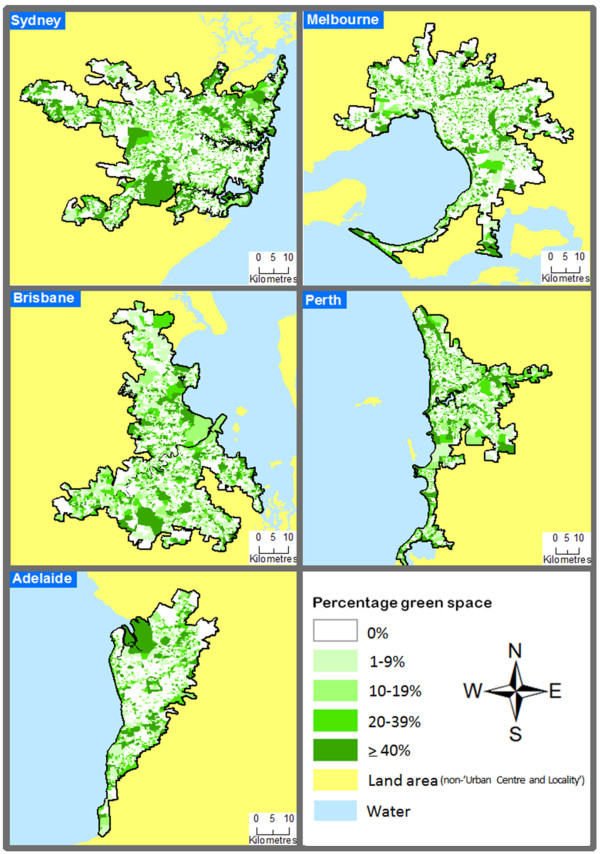
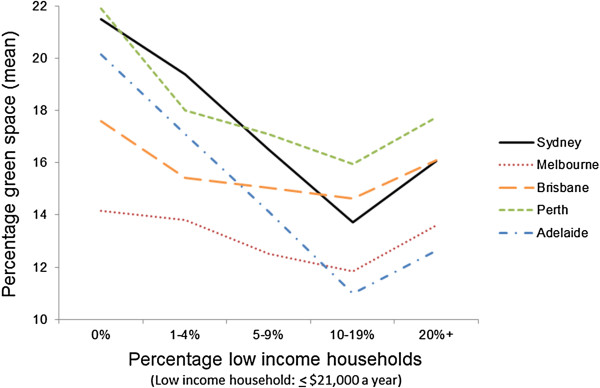
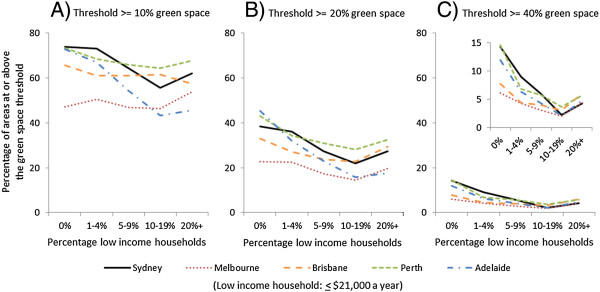
BACKGROUND: An inequitable distribution of parks and other 'green spaces' could exacerbate health inequalities if people on lower incomes, who are already at greater risk of preventable diseases, have poorer access. METHODS: The availability of green space within 1 kilometre of a Statistical Area 1 (SA1) was linked to data from the 2011 Australian census for Sydney (n = 4.6 M residents); Melbourne (n = 4.2 M); Brisbane (n = 2.2 M); Perth (n = 1.8 M); and Adelaide (n = 1.3 M). Socioeconomic circumstances were measured via the percentage population of each SA1 living on < $21,000 per annum. Negative binomial and logit regression models were used to investigate association between the availability of green space in relation to neighbourhood socioeconomic circumstances, adjusting for city and population density. RESULTS: Green space availability was substantively lower in SA1s with a higher percentage of low income residents (e.g. an incidence rate ratio of 0.82 (95% confidence interval (95% CI) 0.75, 0.89) was observed for SA1s containing ≥20% versus 0-1% low income residents). This association varied between cities (p < 0.001). Adelaide reported the least equitable distribution of green space, with approximately 20% greenery in the most affluent areas versus 12% availability in the least affluent. Although Melbourne had a smaller proportion of SA1s in the top quintile of green space availability (13.8%), the distribution of greenery was the most equitable of all the cities, with only a 0.5% difference in the availability of green space between SA1s containing 0-1% low income households versus those with ≥20%. Inequity of access, however, was reported across all cities when using logit regression to examine the availability of at least 20% (odds ratio 0.74, 95% CI 0.59, 0.93) or 40% (0.45, 0.29, 0.69) green space availability in the more disadvantaged versus affluent neighbourhoods. CONCLUSION: Affirmative action on green space planning is required to redress the socioeconomic inequity of access to this important public health resource.
Overview
The claims and statistics of this paper haven’t been checked yet.
Run the check — free, no account needed. It reads the open-access text and checks the sources it cites.
Integrity signals
Registry
Cites
Statistics
Figures
Verification
Claims the paper makes
The claims and statistics of this paper haven’t been checked yet.
Run the check — free, no account needed. It reads the open-access text and checks the sources it cites.
Claims other papers make about this one
Each is checked against this paper’s own text: does it say what the citing paper says it does?
The source backs part of the claim, not all of it — or backs it for a different population, condition or comparison.
In the citing paper
“This may be particularly important for children and adolescents from low socioeconomic backgrounds, who typically engage in greater amounts of ST [48–51] and are also less likely to live in green neighbourhoods [52].”
From Psychological impacts of “screen time” and “green time” for children and adolescents: A systematic scoping review (2020) · cites this paper as [52]
Experimental — accuracy not yet measured
Self-check
Percentages, sums and reported differences re-computed from the paper’s own numbers.
The self-check needs the paper’s full text.
Citations
Cites
Principles of geographical information systems
BURROUGH, P. A., & McDonnell, R. A. (1998) · Cited by 4,082
A Note on Robust Variance Estimation for Cluster‐Correlated Data
Williams, R. L. (2000) · Biometrics · doi:10.1111/j.0006-341x.2000.00645.x · Cited by 2,501
Aesthetic and affective response to natural environment
Ulrich, R. S. (1983) · Behavior and the Natural Environment · doi:10.1007/978-1-4613-3539-9_4 · Cited by 2,241
Tracking restoration in natural and urban field settings
Hartig, T., Evans, G. W., Jamner, L. D., Davis, D. S., & Gärling, T. (2003) · Journal of Environmental Psychology · doi:10.1016/s0272-4944(02)00109-3 · Cited by 2,118
Effect of exposure to natural environment on health inequalities: an observational population study
Mitchell, R., & Popham, F. (2008) · The Lancet · doi:10.1016/s0140-6736(08)61689-x · Cited by 2,099
A systematic review of evidence for the added benefits to health of exposure to natural environments
Bowler, D. E., Buyung-Ali, L. M., Knight, T. M., & Pullin, A. S. (2010) · BMC Public Health · doi:10.1186/1471-2458-10-456 · Cited by 1,993
Green space, urbanity, and health: how strong is the relation?
Maas, J., Verheij, R. A., Groenewegen, P. P., de Vries, S., & Spreeuwenberg, P. (2006) · Journal of Epidemiology and Community Health · doi:10.1136/jech.2005.043125 · Cited by 1,976
The health benefits of urban green spaces: a review of the evidence
Lee, A. C., & Maheswaran, R. (2010) · Journal of Public Health · doi:10.1093/pubmed/fdq068 · Cited by 1,583
Giles‐Corti, B., Broomhall, M. H., Knuiman, M. W., Collins, C. G., Douglas, K., Ng, K., Lange, A., & Donovan, R. J. (2005) · American Journal of Preventive Medicine · doi:10.1016/j.amepre.2004.10.018 · Cited by 1,523
Self-citationThompson Coon, J., Boddy, K., Stein, K., Whear, R., Barton, J., & Depledge, M. H. (2011) · Environmental Science & Technology · doi:10.1021/es102947t · Cited by 1,391
Research works printed but not linked: 8
- The Scottish Government: Good places, better health in Scotland. 2008, The Scottish Government: Edinburgh
- Department of Sustainability and Environment: Victorian Planning Provisions. 2013, Melbourne: Victorian State Government
- Western Australian Planning Commission: Liveable neighbourhoods: a Western Australian Government Sustainable Cities Initiative. 2004, Western Australian Planning Commission: Perth, WA
- Australian Bureau of Statistics: 3218.0 - Regional Population Growth, Australia, 2011: Population estimates and Australia’s new statistical geography. 2012, Canberra: Australian Bureau of Statistics
- Australian Bureau of Statistics: Australian Statistical Geography Standard (ASGS): Volume 4 - Significant Urban Areas, Urban Centres and Localities, Section of State. 2011, Canberra: Australian Bureau of Statistics
- Australian Bureau of Statistics: Australian Statistical Geography Standard (ASGS): Volume 1 - Main Structure and Greater Capital City Statistical Areas. 2011, Canberra:
- Australian Bureau of Statistics: Information paper, Draft Mesh Blocks. 2005, Canberra: Australian Bureau of Statistics
- Pink B: Technical Paper: Socio-Economic Indexes for Areas (SEIFA). 2011, Australian Bureau of Statistics: Canberra
Cited by
Sorted by citations
Items 201–300 of 350
Browne‐Yung, K., Ziersch, A. M., & Baum, F. E. (2016) · Urban Policy and Research · doi:10.1080/08111146.2016.1138855 · Cited by 12
Validating and measuring public open space is not a walk in the park
Daker, M., Pieters, J., & Coffee, N. T. (2016) · Australian Planner · doi:10.1080/07293682.2016.1139605 · Cited by 12
Williams, P. C., Alhasan, D. M., Krafty, R. T., Coutts, C., Miles-Richardson, S. R., & Jackson, C. L. (2022) · Health & Place · doi:10.1016/j.healthplace.2022.102812 · Cited by 10
Gangwisch, M., Ludwig, S., & Matzarakis, A. (2024) · Atmosphere · doi:10.3390/atmos15010125 · Cited by 11
Gangwisch, M., & Matzarakis, A. (2024) · Environment International · doi:10.1016/j.envint.2024.108718 · Cited by 11
Zhang, Z., Stevenson, K. T., & Martin, K. L. (2021) · Urban forestry & urban greening · doi:10.1016/j.ufug.2021.127323 · Cited by 11
From contest to context: urban green space and public policy
Dobson, J. (2018) · People Place and Policy Online · doi:10.3351/ppp.2018.3824435278 · Cited by 11
Lin, J.-S., Leung, J. C. S., Yu, B. W. M., Woo, J., Kwok, T. C. Y., & Lau, K. K. (2021) · Environmental Research · doi:10.1016/j.envres.2021.110830 · Cited by 12
Jang, K. M., & Kim, J. (2025) · Social Science Research · doi:10.1016/j.ssresearch.2025.103142 · Cited by 12
Ordóñez, C., Wheeler, M. A., Raynor, K. E., Panza, L., Seely, H., & Adamovic, M. (2022) · Urban forestry & urban greening · doi:10.1016/j.ufug.2022.127754 · Cited by 10
Simultaneous Inequity of Elderly Residents in Melbourne Metropolitan
Bokhari, A., & Sharifi, F. (2023) · Sustainability · doi:10.3390/su15032189 · Cited by 10
Practical strategies to manage obesity in type 2 diabetes
Rodbard, H. W., Barnard-Kelly, K. D., Pfeiffer, A. F. H., Mauersberger, C., Schnell, O., & Giorgino, F. (2024) · Diabetes Obesity and Metabolism · doi:10.1111/dom.15556 · Cited by 10
A quantitative analysis of inequality of urban cultural space distribution in Xi’an
Wang, S., Zhang, Y., Xu, Y., & Yan, S. (2019) · Science China Technological Sciences · doi:10.1007/s11431-018-9433-x · Cited by 10
Oh, J. I., Kim, H., & Sohn, D. (2019) · Local Environment · doi:10.1080/13549839.2019.1703661 · Cited by 10
The GREENH-City interventional research protocol on health in all policies
Porcherie, M., Vaillant, Z., Faure, E., Rican, S., Simos, J., Cantoreggi, N., Héritage, Z., Gall, A. R. L., Cambon, L., Diallo, T., et al. (2017) · BMC Public Health · doi:10.1186/s12889-017-4812-8 · Cited by 10
Subiza‐Pérez, M., Krenz, K., Watmuff, A., Yang, T., Gilbody, S. M., Vaughan, L., Wright, J., & McEachan, R. (2024) · Urban forestry & urban greening · doi:10.1016/j.ufug.2024.128241 · Cited by 9
Greenspace Morphology and Preterm Birth: A State-Wide Study in Georgia, United States (2001–2016)
Wang, H., Huang, X., Hao, H., & Chang, H. H. (2024) · Environmental Health Perspectives · doi:10.1289/ehp14571 · Cited by 9
In and out of place: Diverse experiences and perceived exclusion in UK greenspace settings
Palmer, A. K., Riley, M., Clément, S., Evans, K. L., Jones, L., Brockett, B., & Opara, V. (2025) · Environment and Planning E Nature and Space · doi:10.1177/25148486251316124 · Cited by 11
Monitoring temporal changes in large urban street trees using remote sensing and deep learning
Velasquez-Camacho, L., van Doorn, N. S., Preisler, H. K., Etxegarai, M., Alàs, O., Castro, J. M. G., & de‐Miguel, S. (2025) · PLoS ONE · doi:10.1371/journal.pone.0326562 · Cited by 9
Ordóñez, C., Kendal, D., Davern, M. T., & Conway, T. M. (2024) · Environmental Research · doi:10.1016/j.envres.2024.118445 · Cited by 10
How densely populated and green are the places we live in? A study of the ten largest US cities
Orsi, F. (2018) · Land Use Policy · doi:10.1016/j.landusepol.2018.05.015 · Cited by 11
Zhang, L., & Wu, Z. (2021) · Journal of Asian Architecture and Building Engineering · doi:10.1080/13467581.2021.1906257 · Cited by 9
Noël, T., & Dardenne, B. (2022) · International Journal of Environmental Research and Public Health · doi:10.3390/ijerph19116778 · Cited by 10
Childhood neighborhoods and cause-specific adult mortality in Sweden 1939–2015
Hedefalk, F., van Dijk, I. K., & Dribe, M. (2023) · Health & Place · doi:10.1016/j.healthplace.2023.103137 · Cited by 8
Su, Y., Xu, H., & Zhang, X. (2024) · Land · doi:10.3390/land13070945 · Cited by 8
Almeida, L. F. F., Barreto, S. M., de Souza, R. C. F., Cardoso, L. D. O., & Giatti, L. (2021) · Health & Place · doi:10.1016/j.healthplace.2021.102699 · Cited by 9
Gender bias in the planning industry and planning outcomes
Sahama, I., Wyeth, S., & Pojani, D. (2021) · Australian Planner · doi:10.1080/07293682.2021.2017994 · Cited by 11
van den Bosch, M. A., Brauer, M. D., Burnett, R. T., Davies, H., Davis, Z., Guhn, M., Jarvis, I., Nesbitt, L., Oberlander, T. F., Rugel, E. J., et al. (2018) · BMJ Open · doi:10.1136/bmjopen-2018-026954 · Cited by 9
Oswald, T. K., & Langmaid, G. R. (2021) · Health Promotion Journal of Australia · doi:10.1002/hpja.560 · Cited by 7
Changes and Disparities in Nature Access During the COVID-19 Pandemic
Flint, H. B., Wagner, C. H., & Watson, K. B. (2022) · Frontiers in Sustainable Cities · doi:10.3389/frsc.2022.709982 · Cited by 7
Martinescu, E., Cruz, T. D. D., Etienne, T. W., & Krouwel, A. P. M. (2022) · Acta Politica · doi:10.1057/s41269-022-00246-7 · Cited by 6
Crowdsourced cycling data applications to estimate noise pollution exposure during urban cycling
Wogan, R., & Kennedy, J. F. (2024) · Heliyon · doi:10.1016/j.heliyon.2024.e27918 · Cited by 6
Wai, C. Y., Tariq, M. A. U. R., Muttil, N., & Chau, H.-W. (2025) · Land · doi:10.3390/land14050958 · Cited by 6
How Green are Romania’s Cities? A Quarter - Century of Green Area Policy
Păcurar, B.-N. (2017) · Journal of Settlements and Spatial Planning · doi:10.24193/jssp.2017.1.06 · Cited by 6
Improving access to greenspaces in the Mediterranean city of Faro
Pinto, V., Martins, C., Rodrigues, J. I. D. J., & Rosa, M. P. (2020) · AIMS environmental science · doi:10.3934/environsci.2020014 · Cited by 6
Green Street Design Approach to Realize Green City. Case Study: Medan City
Fachrudin, H. T., Karolina, R., Fachrudin, K. A., & Faris, D. M. (2023) · Future Cities and Environment · doi:10.5334/fce.176 · Cited by 6
Pritchard, T., Feng, X., Walsan, R., & Astell‐Burt, T. (2024) · Urban forestry & urban greening · doi:10.1016/j.ufug.2024.128448 · Cited by 5
Self-citationDesigualdad en la dotación de áreas verdes en el municipio de Monterrey: una injusticia ambiental
Zapata, A. M. C. (2023) · región y sociedad · doi:10.22198/rys2023/35/1784 · Cited by 7
Cranney, L., Grunseit, A. C., van Nassau, F., Milat, A., & Cleland, V. J. (2025) · Qualitative Health Research · doi:10.1177/10497323241307202 · Cited by 5
Ye, J., Chen, Z., & Dong, J. (2025) · Ecological Indicators · doi:10.1016/j.ecolind.2025.113973 · Cited by 5
Nambazo, O., & Nazombe, K. (2024) · PLoS ONE · doi:10.1371/journal.pone.0307518 · Cited by 5
Urban green space, social equity and human wellbeing
Stewart, N. (2020) · Elsevier eBooks · doi:10.1016/b978-0-12-820730-7.00007-0 · Cited by 10
Venkatraman, T. M., Honeyford, K., Ram, B., van Sluijs, E. M. F., Costelloe, C., & Saxena, S. K. (2021) · Journal of Public Health · doi:10.1093/pubmed/fdab138 · Cited by 5
“Surviving the City”. Nature as an Architecture Design Strategy for a More Resilient Urban Ecosystem
Ingaramo, R., & Negrello, M. (2023) · The urban book series · doi:10.1007/978-3-031-28772-5_12 · Cited by 5
Phogole, B., & Yessoufou, K. (2023) · Sustainability · doi:10.3390/su151914508 · Cited by 5
Song, I., & Luan, H. (2023) · Applied Geography · doi:10.1016/j.apgeog.2023.103127 · Cited by 5
Exploring the Relationships between Mini Urban Green Space Layout and Human Activity
Cheng, S., Zhang, D., Wang, Y., & Zhang, X. (2024) · Land · doi:10.3390/land13060871 · Cited by 7
Zaldo-Aubanell, Q., Serra, I., Bach, A., Knobel, P., López, F. C. I., Belmonte, J., Daunis‐i‐Estadella, P., & Maneja, R. (2021) · The Science of The Total Environment · doi:10.1016/j.scitotenv.2021.150308 · Cited by 5
Xian, Z., Nakaya, T., Sabel, C. E., Okubo, R., Liu, K., Zhang, J., & Tabuchi, T. (2025) · Cities · doi:10.1016/j.cities.2025.106458 · Cited by 4
Zhang, Y., Li, Z., Mandic, S., Astell‐Burt, T., Hipp, J. A., Fainu, H. M., Zhao, J., & Smith, M. (2025) · Landscape and Urban Planning · doi:10.1016/j.landurbplan.2025.105498 · Cited by 4
Self-citationAsadi, M., & Nastaran, M. (2024) · Cities & Health · doi:10.1080/23748834.2024.2321417 · Cited by 4
Strengthening Health-Resilience Nexus Through Sustainable Urban Design in Brisbane, Australia
Cheshmehzangi, A., He, B., & Zuo, T. (2025) · Urban sustainability · doi:10.1007/978-981-96-5538-0_10 · Cited by 4
Robinson, T., Dhamrait, G. K., Murray, K., Boruff, B. J., Duncan, J., Schipperijn, J., & Christian, H. E. (2024) · Health & Place · doi:10.1016/j.healthplace.2024.103178 · Cited by 4
Rogers, A. E., Schenkelberg, M. A., Stoepker, P., Westmark, D., Srivastava, D., & Dzewaltowski, D. A. (2024) · Preventive Medicine Reports · doi:10.1016/j.pmedr.2024.102656 · Cited by 5
Sielaff, H., Bundschuh, L., Moritz, L., Taubmann, C., Badack, J., Weinhold, K., & Hübscher, M. (2024) · Moravian Geographical Reports · doi:10.2478/mgr-2024-0003 · Cited by 4
Dong, Z. ‘., & Miller, E. J. (2024) · Canadian Journal of Regional Science · doi:10.7202/1111344ar · Cited by 4
Marcilla-Toribio, I., Bizzozero‐Peroni, B., Notario‐Pacheco, B., Cekrezi, S., Fernández-Pérez, M., Perez-Moreno, A., Díez‐Fernández, A., & Martínez-Andrés, M. (2025) · Public health reviews · doi:10.3389/phrs.2025.1608163 · Cited by 5
Hoseini, P., Mohseni, P., Veeroja, P., & Foliente, G. (2025) · Applied Sciences · doi:10.3390/app15073940 · Cited by 4
Yequan, H., Mingze, C. H. E. N., & Cai, Y. (2025) · Urban forestry & urban greening · doi:10.1016/j.ufug.2025.128939 · Cited by 5
Informal green spaces providing ecosystem services to solve the green space paradox
Liu, T., Yang, Y. J., & Zhang, Y. (2025) · Urban Ecosystems · doi:10.1007/s11252-025-01765-9 · Cited by 4
Mangone, G. (2018) · Ecopsychology · doi:10.1089/eco.2018.0054 · Cited by 4
Inégalités sociétales et exposome urbain
Deguen, S., Vasseur, P., & Kihal, W. (2022) · médecine/sciences · doi:10.1051/medsci/2021149 · Cited by 4
Sociodemographic Variations in the Availability of Urban Green Spaces in an Older Swedish Population
Mattisson, K., Axmon, A., Carlsson, G., Fänge, A. M., Lethin, C., & Stroh, E. (2022) · International Journal of Environmental Research and Public Health · doi:10.3390/ijerph191912651 · Cited by 7
Al-Ahmad, M., Postolache, R.-G., Timofte, I. A., & Vorovencii, I. (2025) · IEEE Journal of Selected Topics in Applied Earth Observations and Remote Sensing · doi:10.1109/jstars.2025.3614809 · Cited by 3
Demand-Led Optimization of Urban Park Services
Tong, A., Qian, X., Xu, L., Wu, Y., Ma, Q., Shi, Y., Mao, F., & Lu, Z. (2023) · Forests · doi:10.3390/f14122371 · Cited by 3
Processes underpinning survival in gay men living with HIV and a history of suicidality
Handlovsky, I., Ferlatte, O., Kia, H., Knight, R., Broom, A. F., & Oliffe, J. L. (2022) · Sociology of Health & Illness · doi:10.1111/1467-9566.13500 · Cited by 3
Biodiversity and Human Health: A Scoping Review and Case Studies on Underrepresented LinkagesPreprint
Robinson, J. M., Breed, A. C., Camargo, A., Redvers, N., & Breed, M. F. (2022) · Preprints.org · doi:10.20944/preprints202210.0275.v1 · Cited by 2
Rosario, L. D., Astell‐Burt, T., Navakatikyan, M., Olsen, J. R., Caryl, F., Lin, B. B., Jalaludin, B. B., de Leeuw, E., Mitchell, R., & Feng, X. (2025) · medRxiv · doi:10.1101/2025.04.09.25325554 · Cited by 3
Self-citationZhang, B., & Jiang, T. (2025) · Scientific Reports · doi:10.1038/s41598-025-13757-y · Cited by 3
Chen, W., & Lai, J. H. K. (2025) · Building and Environment · doi:10.1016/j.buildenv.2025.113791 · Cited by 3
Measuring perceived green volume for quantifying urban green exposure
Zhang, Y., Sun, Z., Ji, J. S., Li, X., & Yang, J. (2025) · Urban forestry & urban greening · doi:10.1016/j.ufug.2025.129231 · Cited by 2
Measuring changes in urban green space equity before and during COVID-19: A case study of Beijing
Gao, X., Zhao, Y., Jiao, R., & Xia, C. (2025) · Urban forestry & urban greening · doi:10.1016/j.ufug.2025.129239 · Cited by 2
Does socioeconomic position and gender affect human-nature interactions?
Tiscareno-Osorno, X., Hossaini, J., Chabursky, S., Sayed, N., Temizarabacı, İ., Haehl, W., & Beckmann, J. (2022) · Journal of Public Health · doi:10.1007/s10389-022-01762-8 · Cited by 2
Individual and Neighborhood Level Predictors of Children’s Exposure to Residential Greenspace
Hazlehurst, M. F., Hajat, A., Szpiro, A. A., Tandon, P. S., Kaufman, J. D., Loftus, C. T., Bush, N. R., LeWinn, K. Z., Hare, M. E., Sathyanarayana, S., et al. (2024) · Journal of Urban Health · doi:10.1007/s11524-024-00829-z · Cited by 4
Arisha, A. R. (2024) · Advances in Science, Technology & Innovation/Advances in science, technology & innovation · doi:10.1007/978-3-031-54911-3_14 · Cited by 2
Kondo, M. C., Adlakha, D., Marselle, M. R., Odell, N. E., Olcoń, K., Deutsch, K., Feng, X., Hipp, J. A., & Astell‐Burt, T. (2025) · Health & Social Care in the Community · doi:10.1155/hsc/6635387 · Cited by 2
Self-citationHaensch, J., Wheeler, S. A., Rogers, D., & Fluin, J. (2024) · Australasian Journal of Environmental Management · doi:10.1080/14486563.2024.2378216 · Cited by 2
Analysis of Organisational and Economic Support of Urban Parks in Ukraine
Vernihorova, N. (2021) · Scientific Bulletin of Mukachevo State University Series “Economics” · doi:10.52566/msu-econ.8(2).2021.90-100 · Cited by 2
Vegetation Delight? Greenness and Reduced Risk of Nonaccidental Death
Arnold, C. (2016) · Environmental Health Perspectives · doi:10.1289/ehp.124-a169 · Cited by 2
Csomós, G., & Farkas, J. Z. (2024) · Journal of Urban Design · doi:10.1080/13574809.2024.2374735 · Cited by 1
Valente, B., de Araújo, B. A. P., Pereira, R., Ribeiro, A. I., Barros, H., & Santos, S. (2025) · Environment International · doi:10.1016/j.envint.2025.109452 · Cited by 2
Reid, R. A., Mavoa, S., Gilmartin‐Thomas, J., Foster, S. A., & Rachele, J. N. (2025) · Journal of Epidemiology & Community Health · doi:10.1136/jech-2025-223924 · Cited by 1
Self-citationSpurrier, P., Knibbs, L. D., Mazumdar, S., Lazarevic, N., & Lal, A. (2025) · Environmental Research · doi:10.1016/j.envres.2025.122450 · Cited by 2
Jiang, Y., Xia, X., & Liu, X. (2025) · Journal of Environmental Management · doi:10.1016/j.jenvman.2025.126952 · Cited by 2
Pi‐Sunyer, B. P., Bignardi, G., García‐Baquero, G., Dadvand, P., Vrijheid, M., Guxens, M., Esplugues, A., Delgado-Saborit, J. M., Ibarluzea, J. M., Blakemore, S., et al. (2025) · Scientific Reports · doi:10.1038/s41598-025-22753-1 · Cited by 1
Montiel, C., Comtois-Cabana, D., Bélanger, M. F., & Doré, I. (2025) · Journal of Physical Activity and Health · doi:10.1123/jpah.2025-0349 · Cited by 1
Galalizadeh, S., Morrison‐Saunders, A., Silberstein, R. P., Blake, D., Horwitz, P., & Zahedi, F. F. S. (2025) · Urbanization, sustainability and society. · doi:10.1108/uss-05-2025-0026 · Cited by 1
Ahrens, J., White, M., Jeram, S., Ристовска, Г., Koning, J., Gudi-Mindermann, H., Tönnies, J., Czwikla, G., Weber, M., & Bolte, G. (2026) · BMC Public Health · doi:10.1186/s12889-026-26449-7 · Cited by 1
Takele, W. W., Lim, S. S., Dalli, L. L., Beare, R. A., Adhinugraha, K. M., Taniar, D., Wang, S., & Boyle, J. A. (2026) · BMC Public Health · doi:10.1186/s12889-026-26778-7 · Cited by 1
van de Geest, J. D. S., Cuenca, V.-C., Schoonmade, L. J., Cereijo, L., Mora, D. J., Meijer, P., & Lakerveld, J. (2026) · International Journal of Behavioral Nutrition and Physical Activity · doi:10.1186/s12966-026-01912-1 · Cited by 2
Asociación entre determinantes socioeconómicos y exposición al humo ambiental del tabaco en niños
Fernández-Álvarez, I., Pérez‐Ríos, M., & Montes, A. (2019) · Gaceta Sanitaria · doi:10.1016/j.gaceta.2018.12.007 · Cited by 1
Kent, J., & Thompson, S. M. (2019) · Routledge eBooks · doi:10.4324/9781315524573-11 · Cited by 1
Kent, J., & Thompson, S. M. (2020) · Springer eBooks · doi:10.1007/978-981-15-4386-9_13 · Cited by 1
The luxury effect in urban aquatic ecosystems: exploring drivers of change
Marques, P., Chin, A. T. M., Ruppert, J. L. W., & Mandrak, N. E. (2024) · Urban Ecosystems · doi:10.1007/s11252-024-01549-7 · Cited by 1
Climate Change and Heat Stress
Fiamingo, M. E., & Hazari, M. S. (2024) · Elsevier eBooks · doi:10.1016/b978-0-323-95488-4.00141-8 · Cited by 1
van Eeden, L. M., Possingham, H. P., Milfont, T. L., Klebl, C., & Fielding, K. S. (2025) · Global Environmental Psychology · doi:10.5964/gep.10927 · Cited by 1
Myers, Z. (2019) · Springer eBooks · doi:10.1007/978-981-32-9923-8_2 · Cited by 1
Nature in Mental Health Recovery Processes
Trangsrud, L. K. J. (2021) · Springer eBooks · doi:10.1007/978-3-030-12852-4_29-1 · Cited by 1
Jiaqing, O., & Chang, L. (2021) · Springer eBooks · doi:10.1007/978-3-030-12852-4_96-1 · Cited by 1
Metadata
- Authors
- Astell-Burt, T., Feng, X., Mavoa, S., Badland, H. M., & Giles-Corti, B.
- Affiliations
- Western Sydney University (AU)
- The University of Melbourne (AU)
- Venue
- BMC Public Health
- Published
- 2014-03-31
- Volume
- 14
- Issue
- 1
- Pages
- 292-292
- ISSN
- 1471-2458 (ISSN-L)
- PMC
- PMC4005631
- OpenAlex
- W2149511701
- Cited by
- 351
- References
- 67
- Citations by year
- 2026: 19 · 2025: 42 · 2024: 55 · 2023: 43 · 2022: 40 · 2021: 53 · 2020: 31 · 2019: 19 · 2018: 16 · 2017: 18 · 2016: 8 · 2015: 6 · 2014: 1
- FWCI
- 7.23
- Type
- journal article
- Language
- en
- Open access
- gold
- doi.org
- Licence
- Locations
- BMC Public Health (publishedVersion, cc-by)
- Europe PMC (PubMed Central) (publishedVersion, cc-by)
- PubMed Central (publishedVersion, cc-by)
- PubMed (publishedVersion)
- Minerva Access (University of Melbourne) (submittedVersion, cc-by)
- Research Online (University of Wollongong) (submittedVersion)
- RMIT Research Repository (RMIT University Library) (submittedVersion)
- Figshare (submittedVersion)
- St Andrews Research Repository (St Andrews Research Repository) (submittedVersion, cc-by)
- Funders
- National Heart Foundation of Australia
- National Health and Medical Research Council (1004900)
- Topics
- Social Sciences › Urban Studies › Urban Green Space and Health
- Social Sciences › Sociology and Political Science › Environmental Justice and Health Disparities
- Social Sciences › Health › Health disparities and outcomes
- Keywords
- green spaces, parks, low-income neighbourhoods, green space accessibility, health disparities, urban vegetation, green space planning, Australian cities, population density
- MeSH terms
- Australia, Cities, Cross-Sectional Studies, Environment Design, Plants, Poverty Areas, Residence Characteristics, Socioeconomic Factors, Urban Population, Logistic Models
About these checks
Registry, retraction, Cites and statistics results are computed, not judged, with one exception: a printed reference that no index lists is read once by a model before it counts as a citation error. Claims are extracted by a model and kept only when their quote appears verbatim in the text; each cited source is then checked, with a model’s help, for whether it says what the claim relies on. Those verdicts can be wrong — read the claim’s quote and the cited source before relying on one.
Statistics and arithmetic are recomputed, not judged.
Confidence bands are shown only for fields calibrated on our annotated test set. None is calibrated yet, so no band is shown.
What counts as a claim ›How we measure confidence ›How we check this ›
Are you an author, or do you see a problem with this page? Request a review
