

A prospective study of cumulative job stress in relation to mental health.
Open accessThe DOI matches its Crossref record; 35 of the 38 references it cites were found in a registry or an index.
Abstract
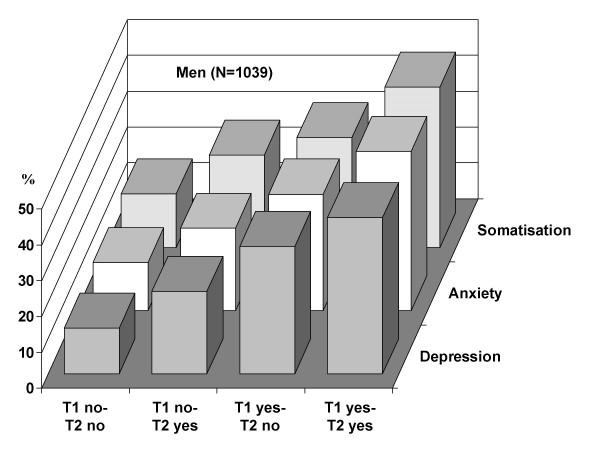
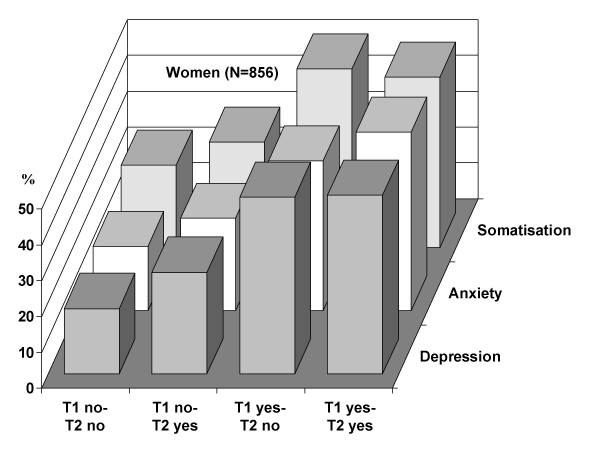
Background: This study tests associations between psychosocial stress at work measured by the effort-reward imbalance model in a dynamic perspective, and multiple indicators of poor mental health, in a prospective design. Methods: 1986 male and female employees from four Belgian enterprises were followed-up over one year within the framework of the Somstress study. Based on two consecutive measurements, an index of cumulative job stress was constructed and its associations with five indicators of mental health were studied, excluding caseness at entry (for depression, anxiety, somatisation, chronic fatigue and psychotropic drug consumption respectively). Taking into account the longitudinal design, four categories of job stress are defined: 1) employees free from stress at both measures, 2) job stress present at first measure but not at the second one, 3) recent onset of job stress as evidenced by second measure 4) workers exposed to stress at both measures. Multivariate logistic regression with appropriate adjustments was applied. Results: In bivariate analysis, a clear graded association of cumulative job stress with all five mental health indicators is observed, both in men and women. In multivariate logistic regression analysis, recent onset of stress is strongly associated with poor mental health among men (odds ratios ranging from 1.8 to 4.6), while cumulative stress shows strongest effects on mental health in women (odds ratios ranging from 1.4 to 7.1). Conclusion: Cumulative experience and recent onset of job stress in terms of high effort spent and low reward received is associated with elevated risk of all five indicators of poor mental health at follow-up in a large cohort of employees.
Overview
The claims and statistics of this paper haven’t been checked yet.
Free: it reads the open-access text and checks the first 5 claims that cite a source we can check. Create a free account to check every claim.
Integrity signals
Registry
Cites
Statistics
Figures
Verification
Claims the paper makes
The claims and statistics of this paper haven’t been checked yet.
Free: it reads the open-access text and checks the first 5 claims that cite a source we can check. Create a free account to check every claim.
Claims other papers make about this one
Each is checked against this paper’s own text: does it say what the citing paper says it does?
The cited source says what the claim attributes to it.
In the citing paper
“No statistically significant difference between subgroups of men and women was found.16 18 25”
From Work-related psychosocial risk factors for stress-related mental disorders: an updated systematic review and meta-analysis (2020) · cites this paper as [18]
The cited source says what the claim attributes to it.
In the citing paper
“Six cohort studies16 18 19 24 25 demonstrate that there is moderate-quality evidence that effort-reward imbalance increases the incidence of SRD, with a pooled OR of 1.91 (95% CI 1.70 to 2.15) (see table 3 and figure 2).”
From Work-related psychosocial risk factors for stress-related mental disorders: an updated systematic review and meta-analysis (2020) · cites this paper as [18]
The cited source says what the claim attributes to it.
In the citing paper
“Moreover, job stress has been associated with mental health symptoms including anxiety, depression, and somatization (Godin et al., 2005; Mark and Smith, 2012), as well as physical health effects such as increased disease risk, weight gain, and poor sleep (Bosma et al., 1998; Kivimäki et al., 2006; Knudsen et al., 2007).”
From Mental and physical training with meditation and aerobic exercise improved mental health and well-being in teachers during the COVID-19 pandemic (2022) · cites this paper as Godin et al., 2005
Self-check
Percentages, sums and reported differences re-computed from the paper’s own numbers.
The self-check needs the paper’s full text.
Citations
Cites
Karasek, R. A., Brisson, C., Kawakami, N., Houtman, I. L. D., Bongers, P. M., & Amick, B. C. (1998) · Journal of Occupational Health Psychology · doi:10.1037//1076-8998.3.4.322 · Cited by 3,189
The measurement of effort–reward imbalance at work: European comparisons
Siegrist, J., Starke, D., Chandola, T., Godin, I., Marmot, M., Niedhammer, I., & Peter, R. (2004) · Social Science & Medicine · doi:10.1016/s0277-9536(03)00351-4 · Cited by 2,268
Self-citationHemingway, H., & Marmot, M. (1999) · BMJ · doi:10.1136/bmj.318.7196.1460 · Cited by 1,340
Reviewing the effort–reward imbalance model: drawing up the balance of 45 empirical studies
van Vegchel, N., de Jonge, J., Bosma, H., & Schaufeli, W. (2005) · Social Science & Medicine · doi:10.1016/j.socscimed.2004.06.043 · Cited by 929
Work stress and risk of cardiovascular mortality: prospective cohort study of industrial employees
Kivimaki, M. (2002) · BMJ · doi:10.1136/bmj.325.7369.857 · Cited by 902
Two alternative job stress models and the risk of coronary heart disease.
Bosma, H., Peter, R., Siegrist, J., & Marmot, M. (1998) · American Journal of Public Health · doi:10.2105/ajph.88.1.68 · Cited by 831
Self-citationWork characteristics predict psychiatric disorder: prospective results from the Whitehall II Study.
Stansfeld, S. A., Fuhrer, R., Shipley, M. J., & Marmot, M. G. (1999) · Occupational and Environmental Medicine · doi:10.1136/oem.56.5.302 · Cited by 800
Is job strain a major source of cardiovascular disease risk?
Belkic, K., Landsbergis, P. A., Schnall, P. L., & Baker, D. (2004) · Scandinavian Journal of Work, Environment & Health · doi:10.5271/sjweh.769 · Cited by 749
Ferrie, J. E., Shipley, M. J., Stansfeld, S. A., & Marmot, M. G. (2002) · Journal of Epidemiology and Community Health · doi:10.1136/jech.56.6.450 · Cited by 530
Kumari, M., Head, J., & Marmot, M. (2004) · Archives of Internal Medicine · doi:10.1001/archinte.164.17.1873 · Cited by 378
Research works printed but not linked: 6
- 2. International Labor Organisation Bureau for Workers' Activities: Labour Market Trends and Globalization's Impact on Them Geneva: Inter- national Labor Organisation; 2004.
- 3. Merllié D, Paoli P: Dix ans de conditions de travail dans l'Union européenne Dublin: Fondation Européenne pour l'amélioration des conditions de vie et de travail; 2000.
- 6. Schnall P, Belkic K, Landsbergis P, Baker D, (Eds): The workplace and cardiovascular disease. Occup Med: State of the Arts Reviews 2000, 15:1-334.
- 16. Schwartz J: Imputation of job characteristic scores. Occup Med, State of the Art Reviews 2000, 15:172-175.
- 23. Godin I, Desmarez P, Kittel F: Stress and job precarity: classifi- cation index of economic sectors. Arch Public Health 2002, 60:143-151.
- 27. Derogatis L: Administration, Scoring and Procedures Manual -I for the R(evised) version Baltimore: John Hopkins University School of Medicine; 1977.
Cited by
Psychosocial work environment and mental health—a meta-analytic review
Stansfeld, S., & Candy, B. (2006) · Scandinavian Journal of Work, Environment & Health · doi:10.5271/sjweh.1050 · Cited by 1,875
A systematic review including meta-analysis of work environment and depressive symptoms
Theorell, T., Hammarström, A., Aronsson, G., Träskman Bendz, L., Grape, T., Hogstedt, C., Marteinsdottir, I., Skoog, I., & Hall, C. (2015) · BMC Public Health · doi:10.1186/s12889-015-1954-4 · Cited by 982
Bonde, J. P. E. (2008) · Occupational and Environmental Medicine · doi:10.1136/oem.2007.038430 · Cited by 919
Work Stress and Employee Health: A Multidisciplinary Review
Ganster, D. C., & Rosen, C. C. (2013) · Journal of Management · doi:10.1177/0149206313475815 · Cited by 831
Psychosocial work environment and stress-related disorders, a systematic review
Nieuwenhuijsen, K., Bruinvels, D., & Frings-Dresen, M. (2010) · Occupational Medicine · doi:10.1093/occmed/kqq081 · Cited by 696
The Relation between Work-related Psychosocial Factors and the Development of Depression
Netterstrom, B., Conrad, N., Bech, P., Fink, P., Olsen, O., Rugulies, R., & Stansfeld, S. (2008) · Epidemiologic Reviews · doi:10.1093/epirev/mxn004 · Cited by 467
Rugulies, R., Aust, B., & Madsen, I. E. (2017) · Scandinavian Journal of Work, Environment & Health · doi:10.5271/sjweh.3632 · Cited by 372
Siegrist, J., Wahrendorf, M., von dem Knesebeck, O., Jurges, H., & Borsch-Supan, A. (2007) · The European Journal of Public Health · doi:10.1093/eurpub/ckl084 · Cited by 379
Self-citationChronic psychosocial stress at work and risk of depression: evidence from prospective studies
Siegrist, J. (2008) · European Archives of Psychiatry and Clinical Neuroscience · doi:10.1007/s00406-008-5024-0 · Cited by 316
Self-citationBad Jobs, Bad Health? How Work and Working Conditions Contribute to Health Disparities
Burgard, S. A., & Lin, K. Y. (2013) · American Behavioral Scientist · doi:10.1177/0002764213487347 · Cited by 314
Jonsdottir, I. H., Rödjer, L., Hadzibajramovic, E., Börjesson, M., & Ahlborg, G. (2010) · Preventive Medicine · doi:10.1016/j.ypmed.2010.07.019 · Cited by 280
Health and the psychosocial environment at work
(2005) · Social Determinants of Health · doi:10.1093/acprof:oso/9780198565895.003.06 · Cited by 234
van der Molen, H. F., Nieuwenhuijsen, K., Frings-Dresen, M. H. W., & de Groene, G. (2020) · BMJ Open · doi:10.1136/bmjopen-2019-034849 · Cited by 226
The effects of shift work on physical and mental health
Vogel, M., Braungardt, T., Meyer, W., & Schneider, W. (2012) · Journal of Neural Transmission · doi:10.1007/s00702-012-0800-4 · Cited by 198
Fearon, A. M., Cook, J. L., Scarvell, J. M., Neeman, T., Cormick, W., & Smith, P. N. (2014) · The Journal of Arthroplasty · doi:10.1016/j.arth.2012.10.016 · Cited by 189
Work stress and reduced health in young physicians: prospective evidence from Swiss residents
Buddeberg-Fischer, B., Klaghofer, R., Stamm, M., Siegrist, J., & Buddeberg, C. (2008) · International Archives of Occupational and Environmental Health · doi:10.1007/s00420-008-0303-7 · Cited by 188
Self-citationGiorgi, G., Arcangeli, G., Perminiene, M., Lorini, C., Ariza-Montes, A., Fiz-Perez, J., Di Fabio, A., & Mucci, N. (2017) · Frontiers in Psychology · doi:10.3389/fpsyg.2017.02166 · Cited by 162
Clays, E., De Bacquer, D., Leynen, F., Kornitzer, M., Kittel, F., & De Backer, G. (2007) · Scandinavian Journal of Work, Environment & Health · doi:10.5271/sjweh.1140 · Cited by 156
Self-citationDjourova, N. P., Rodríguez, I., Tordera, N., & Abate, G. B. (2019) · Journal of Leadership & Organizational Studies · doi:10.1177/1548051819849002 · Cited by 203
Siegrist, J., & Dragano, N. (2008) · Bundesgesundheitsblatt - Gesundheitsforschung - Gesundheitsschutz · doi:10.1007/s00103-008-0461-5 · Cited by 206
Self-citationTwo models of job stress and depressive symptoms: Results from a population-based study
Dragano, N., He, Y., Moebus, S., Jöckel, K., Erbel, R. M., Siegrist, J., & Study, F. T. H. N. R. (2007) · Social Psychiatry and Psychiatric Epidemiology · doi:10.1007/s00127-007-0267-z · Cited by 139
Self-citationBaumann, M., Spitz, É., Guillemin, F., Ravaud, J., Choquet, M., Falissard, B., Chau, N., & Lorhandicap group (2007) · International Journal of Health Geographics · doi:10.1186/1476-072x-6-50 · Cited by 155
Stansfeld, S. A., Clark, C., Caldwell, T., Rodgers, B., & Power, C. (2008) · Occupational and Environmental Medicine · doi:10.1136/oem.2007.036640 · Cited by 132
Lin, H., Probst, J. C., & Hsu, Y. (2010) · Journal of Clinical Nursing · doi:10.1111/j.1365-2702.2010.03216.x · Cited by 131
Stress and depression in the employed population.
Shields, M. E. (2006) · PubMed · Cited by 124
Post-Secondary Stress and Mental Well-Being: A Scoping Review of the Academic Literature
Linden, B., & Stuart, H. L. (2020) · Canadian Journal of Community Mental Health · doi:10.7870/cjcmh-2020-002 · Cited by 157
Wang, J., Patten, S. B., Currie, S., Sareen, J., & Schmitz, N. (2012) · American Journal of Epidemiology · doi:10.1093/aje/kwr473 · Cited by 115
Effort–reward imbalance, sleep disturbances and fatigue
Fahlén, G., Knutsson, A., Peter, R., Åkerstedt, T., Nordin, M., Alfredsson, L. S., & Westerholm, P. J. M. (2005) · International Archives of Occupational and Environmental Health · doi:10.1007/s00420-005-0063-6 · Cited by 113
Burnout Syndrome in an International Setting
Carod-Artal, F. J., & Vázquez-Cabrera, C. (2012) · Springer eBooks · doi:10.1007/978-1-4614-4391-9_2 · Cited by 163
Stress Level, Health Behaviors, and Quality of Life in Employees Joining a Wellness Center
Clark, M. M., Warren, B. A., Hagen, P. T., Johnson, B. D., Jenkins, S. M., Werneburg, B. L., & Olsen, K. D. (2011) · American Journal of Health Promotion · doi:10.4278/ajhp.090821-quan-272 · Cited by 115
Saijo, Y., Ueno, T., & Hashimoto, Y. (2008) · American Journal of Industrial Medicine · doi:10.1002/ajim.20571 · Cited by 92
Rugulies, R., Aust, B., Madsen, I. E. H., Burr, H., Siegrist, J., & Bultmann, U. (2013) · The European Journal of Public Health · doi:10.1093/eurpub/cks071 · Cited by 92
Self-citationEffort-reward imbalance and overcommitment at work,associations with police burnout
Violanti, J. M., Mnatsakanova, A., Andrew, M. E., Allison, P., Gu, J. K., & Fekedulegn, D. (2018) · Police Quarterly · doi:10.1177/1098611118774764 · Cited by 91
Kouvonen, A. M., Kivimäki, M., Virtanen, M., Heponiemi, T., Elovainio, M. J., Pentti, J., Linna, A., & Vahtera, J. (2006) · BMC Public Health · doi:10.1186/1471-2458-6-24 · Cited by 97
Carroll, A., York, A., Fynes‐Clinton, S., O’Connor, E. S., Flynn, L. M., Bower, J., Forrest, K., & Ziaei, M. (2021) · Frontiers in Psychology · doi:10.3389/fpsyg.2021.689628 · Cited by 150
Psychological distress and coping styles in teachers: A preliminary study
Stapleton, P., Garby, S., & Sabot, D. (2020) · Australian Journal of Education · doi:10.1177/0004944120908960 · Cited by 113
Psychosocial working conditions and depressive symptoms among Swedish employees
Hanson, L. L. M., Theorell, T., Bech, P., Rugulies, R., Burr, H., Hyde, M., Oxenstierna, G., & Westerlund, H. (2009) · International Archives of Occupational and Environmental Health · doi:10.1007/s00420-009-0406-9 · Cited by 98
Linden, B., Boyes, R., & Stuart, H. L. (2021) · BMC Public Health · doi:10.1186/s12889-021-10622-1 · Cited by 124
Derycke, H., Vlerick, P., Burnay, N., Decleire, C., D’Hoore, W., Hasselhorn, H. M., & Braeckman, L. (2010) · Journal of Occupational and Organizational Psychology · doi:10.1348/096317909x477594 · Cited by 105
The delayed effects of chronic unpredictable stress on anxiety measures
Matuszewich, L., Karney, J. J., Carter, S., Janasik, S. P., O'Brien, J. L., & Friedman, R. D. (2006) · Physiology & Behavior · doi:10.1016/j.physbeh.2006.12.006 · Cited by 95
Air pollution: impact and interventions
Gautam, D., & Bolia, N. B. (2020) · Air Quality Atmosphere & Health · doi:10.1007/s11869-019-00784-8 · Cited by 92
Rau, R., Morling, K., & Rösler, U. (2010) · Work & Stress · doi:10.1080/02678371003661164 · Cited by 101
Sun, J., Wang, S., Zhang, J.-Q., & Li, W. (2007) · Work & Stress · doi:10.1080/02678370701742748 · Cited by 79
Wu, H. L., Ge, C., Sun, W., Wang, J. N., & Wang, L. (2011) · Research in Nursing & Health · doi:10.1002/nur.20449 · Cited by 79
Musculoskeletal pain and effort-reward imbalance- a systematic review
Koch, P., Schablon, A., Latza, U., & Nienhaus, A. (2014) · BMC Public Health · doi:10.1186/1471-2458-14-37 · Cited by 91
Igic, I., Keller, A. C., Elfering, A., Tschan, F., Kälin, W., & Semmer, N. K. (2017) · Journal of Applied Psychology · doi:10.1037/apl0000225 · Cited by 81
Arial, M., Gonik, V., Wild, P. P., & Danuser, B. (2009) · International Archives of Occupational and Environmental Health · doi:10.1007/s00420-009-0500-z · Cited by 88
Zurlo, M. C., Pes, D., & Siegrist, J. (2010) · International Archives of Occupational and Environmental Health · doi:10.1007/s00420-010-0512-8 · Cited by 79
Self-citationAfastamento do trabalho por transtornos mentais e comportamentais entre profissionais de enfermagem
Oliveira, D. M., Alencar, N. M. B. D. M., Costa, J. P., Fernandes, M. A., Gouvéia, M. T. D. O., & Santos, J. D. M. (2019) · Revista CUIDARTE · doi:10.15649/cuidarte.v10i2.631 · Cited by 64
Hinz, A., Zenger, M., Brähler, E., Spitzer, S., Scheuch, K., & Seibt, R. (2014) · Stress and Health · doi:10.1002/smi.2596 · Cited by 76
Sun, Y., Song, H., Liu, H., Mao, F., Sun, X., & Cao, F. (2020) · International Journal of Social Psychiatry · doi:10.1177/0020764020972131 · Cited by 85
Job stress and depressive symptoms among Japanese fire fighters
Saijo, Y., Ueno, T., & Hashimoto, Y. (2007) · American Journal of Industrial Medicine · doi:10.1002/ajim.20460 · Cited by 64
Fatigue and burnout in police officers: the mediating role of emotions
Aleksandra Basinska, B., Wiciak, I., & Maria Dåderman, A. (2014) · Policing: An International Journal of Police Strategies & Management · doi:10.1108/pijpsm-10-2013-0105 · Cited by 63
Effort-reward Imbalance and Health in a Globalized Economy
Siegrist, J. (2008) · Cited by 107
Self-citationVirtanen, M., Koskinen, S. V. P., Mika Kivimaki, B., Honkonen, T., Vahtera, J., Ahola, K., & Lönnqvist, J. (2008) · Occupational and Environmental Medicine · doi:10.1136/oem.2007.033159 · Cited by 75
Effort-reward imbalance in academic employees: Examining different reward systems.
Kinman, G. (2019) · International Journal of Stress Management · doi:10.1037/str0000128 · Cited by 80
Seibt, R., & Kreuzfeld, S. (2021) · International Journal of Environmental Research and Public Health · doi:10.3390/ijerph18041535 · Cited by 92
Wege, N., Li, J., & Siegrist, J. (2018) · International Archives of Occupational and Environmental Health · doi:10.1007/s00420-018-1293-8 · Cited by 65
Self-citationAnsiedade e depressão entre profissionais de enfermagem que atuam em blocos cirúrgicos
Schmidt, D. R. C., Dantas, R. A. S., & Marziale, M. H. P. (2011) · Revista da Escola de Enfermagem da USP · doi:10.1590/s0080-62342011000200026 · Cited by 56
Beauregard, N., Marchand, A., & Blanc, M.-E. (2011) · BMC Public Health · doi:10.1186/1471-2458-11-439 · Cited by 56
Casini, A., Godin, I., Clays, E., & Kittel, F. (2013) · European Journal of Public Health · doi:10.1093/eurpub/cks183 · Cited by 72
Self-citationFactors associated with occupational stress among Chinese doctors: a cross-sectional survey
Wu, H. L., Zhao, Y. W., Wang, J., & Wang, L. (2009) · International Archives of Occupational and Environmental Health · doi:10.1007/s00420-009-0456-z · Cited by 55
Salavecz, G., Chandola, T., Pikhart, H., Dragano, N., Siegrist, J., Jöckel, K.-H., Erbel, R., Pajak, A., Malyutina, S., Kubinova, R., et al. (2010) · Journal of Epidemiology and Community Health · doi:10.1136/jech.2008.075978 · Cited by 53
Self-citationStrazdins, L. M., D'Souza, R. M., Clements, M., Broom, D. H., Rodgers, B., & Berry, H. L. (2010) · Journal of Epidemiology & Community Health · doi:10.1136/jech.2009.093732 · Cited by 63
Matthews, K., & Nazroo, J. Y. (2020) · The Journals of Gerontology Series B · doi:10.1093/geronb/gbaa146 · Cited by 88
Davies, S., Hood, S. D., Argyropoulos, S. V., Morris, K., Bell, C., Witchel, H. J., Jackson, P., Nutt, D. J., & Potokar, J. P. (2006) · Journal of Clinical Psychopharmacology · doi:10.1097/01.jcp.0000227704.79740.c0 · Cited by 58
Working hours and depressive symptoms: the role of job stress factors
Yoon, Y., Ryu, J., Kim, H., Kang, C.-W., & Jung‐Choi, K. (2018) · Annals of Occupational and Environmental Medicine · doi:10.1186/s40557-018-0257-5 · Cited by 62
du Prel, J., & Peter, R. (2014) · International Archives of Occupational and Environmental Health · doi:10.1007/s00420-014-0967-0 · Cited by 57
Job characteristics: their relationship to job satisfaction, stress and depression
Steyn, R., & Vawda, N. B. M. (2014) · Journal of Psychology in Africa · doi:10.1080/14330237.2014.906076 · Cited by 60
Rafiei, S., Souri, S., Nejatifar, Z., & Amerzadeh, M. (2024) · Scientific Reports · doi:10.1038/s41598-024-66357-7 · Cited by 80
Healing and/or breaking? The mental health implications of repeated economic insecurity
Watson, B., & Osberg, L. S. (2017) · Social Science & Medicine · doi:10.1016/j.socscimed.2017.06.042 · Cited by 56
Taking Time Seriously: A Call to Action in Mental Health Research
George, L. K. (2014) · Journal of Health and Social Behavior · doi:10.1177/0022146514542434 · Cited by 54
Berufliche Gratifikationskrisen und depressive Störungen: Aktuelle Forschungsevidenz
Siegrist, J. (2012) · Der Nervenarzt · doi:10.1007/s00115-012-3667-6 · Cited by 68
Self-citationBellingrath, S., Rohleder, N., & Kudielka, B. M. (2013) · Biological Psychology · doi:10.1016/j.biopsycho.2012.12.003 · Cited by 45
Occupation, work organisation conditions and the development of chronic psychological distress
Marchand, A., & Blanc, M.-È. (2011) · Work · doi:10.3233/wor-2011-1254 · Cited by 73
Effort-Reward Imbalance for Learning is Associated with Fatigue in School Children
Fukuda, S., Yamano, E., Joudoi, T., Mizuno, K., Tanaka, M., Kawatani, J., Takano, M., Tomoda, A., Imai-Matsumura, K., Miike, T., et al. (2010) · Behavioral Medicine · doi:10.1080/08964281003774919 · Cited by 46
Iennaco, J. D., Cullen, M. R., Cantley, L. F., Slade, M. D., Fiellin, M. G., & Kasl, S. V. (2009) · American Journal of Epidemiology · doi:10.1093/aje/kwp359 · Cited by 54
Ansiedade e depressão entre profissionais de enfermagem que atuam em blocos cirúrgicos
Schmidt, D. R. C., Dantas, R. A. S., & Marziale, M. H. P. (2011) · Redalyc (Universidad Autónoma del Estado de México) · Cited by 46
Arbeitsstress, Gesundheit und Lebenszufriedenheit junger Ärztinnen und Ärzte
Buddeberg‐Fischer, B., Stamm, M., Buddeberg, C., Bauer, G. F., Hämmig, O., & Klaghofer, R. (2008) · DMW - Deutsche Medizinische Wochenschrift · doi:10.1055/s-0028-1100936 · Cited by 45
Li, J., Weigl, M., Glaser, J., Petru, R., Siegrist, J., & Angerer, P. (2013) · American Journal of Industrial Medicine · doi:10.1002/ajim.22246 · Cited by 51
Self-citationJob satisfaction and stress among healthcare workers in public hospitals in Qatar
Yehya, A., Sankaranarayanan, A., Al‐Khal, A., Naemi, H. A., Al-Meer, N., Khan, A., & Ghuloum, S. (2018) · Archives of Environmental & Occupational Health · doi:10.1080/19338244.2018.1531817 · Cited by 61
Burnout, psychosomatic symptoms and job satisfaction among Dutch nurse anaesthetists: a survey
MEEUSEN, V., VAN DAM, K., BROWN‐MAHONEY, C., VAN ZUNDERT, A., & KNAPE, H. (2010) · Acta Anaesthesiologica Scandinavica · doi:10.1111/j.1399-6576.2010.02213.x · Cited by 43
Workplace Design Contributions to Mental Health and Well-Being
Veitch, J. A. (2011) · A Nudge Too Far? A Nudge at All? On Paying People to Be Healthy · doi:10.12927/hcpap.2011.22409 · Cited by 81
Hoedeman, R., Krol, B., Blankenstein, N., Koopmans, P. C., & Groothoff, J. W. (2009) · BMC Public Health · doi:10.1186/1471-2458-9-440 · Cited by 48
Romswinkel, E. V., König, H. ‐., & Hajek, A. (2018) · Journal of Affective Disorders · doi:10.1016/j.jad.2018.08.005 · Cited by 44
Association between bullying at work and mental disorders: gender differences in the Italian people
Nolfe, G., Petrella, C., Zontini, G., Uttieri, S., & Nolfe, G. (2009) · Social Psychiatry and Psychiatric Epidemiology · doi:10.1007/s00127-009-0155-9 · Cited by 48
Tehrani, H., Rakhshani, T., Zadeh, D. S., Hosseini, S. M., & Bagheriyan, S. (2013) · Iranian Red Crescent Medical Journal · doi:10.5812/ircmj.1917 · Cited by 38
Lassalle, M., Chastang, J., & Niedhammer, I. (2015) · Journal of Psychiatric Research · doi:10.1016/j.jpsychires.2015.02.019 · Cited by 37
Buapetch, A., Lagampan, S., Faucett, J. A., & Kalampakorn, S. (2008) · Journal of Occupational Health · doi:10.1539/joh.l8017 · Cited by 46
Job insecurity and mental health in Canada
Watson, B., & Osberg, L. S. (2018) · Applied Economics · doi:10.1080/00036846.2018.1441516 · Cited by 67
Pradhan, R. K., Panigrahy, N. P., & Jena, L. K. (2020) · Business Perspectives and Research · doi:10.1177/2278533720923484 · Cited by 67
Aboa-Éboulé, C., Brisson, C., Blanchette, C., Maunsell, E., Bourbonnais, R., Abdous, B., Vézina, M., Milot, A., & Dagenais, G. R. (2011) · Psychosomatic Medicine · doi:10.1097/01.psy.0000399790.82499.d7 · Cited by 43
Schaafsma, F. G., Hulsegge, G., de Jong, M., Overvliet, J., van Rossum, E. F. C., & Nieuwenhuijsen, K. (2021) · Journal of Occupational Health · doi:10.1002/1348-9585.12189 · Cited by 49
Do I Just Look Stressed or am I Stressed? Work-related Stress in a Sample of Italian Employees
Giorgi, G., Pérez, J., Cupelli, V., Mucci, N., & Arcangeli, G. (2013) · Industrial Health · doi:10.2486/indhealth.2012-0164 · Cited by 38
A Life Course Perspective on Work Stress and Health
Wahrendorf, M., & Chandola, T. (2016) · Aligning perspectives on health, safety and well-being · doi:10.1007/978-3-319-32937-6_3 · Cited by 39
Adeolu, J., Yussuf, O. B., & Popoola, O. A. (2016) · Europe PMC (PubMed Central) · Cited by 34
Bethge, M., & Radoschewski, F. M. (2011) · International Journal of Public Health · doi:10.1007/s00038-011-0304-2 · Cited by 34
Park, K. C., Lee, K. J., Park, J. B., Min, K. B., & Lee, K. W. (2008) · Korean Journal of Occupational and Environmental Medicine · doi:10.35371/kjoem.2008.20.3.215 · Cited by 34
Prins, S. J., McKetta, S. C., Platt, J., Muntaner, C., Keyes, K. M., & Bates, L. M. (2018) · American Journal of Industrial Medicine · doi:10.1002/ajim.22935 · Cited by 38
Chichra, A., Abhijnhan, A., & Tharyan, P. (2019) · Journal of Postgraduate Medicine · doi:10.4103/jpgm.jpgm_489_18 · Cited by 49
Metadata
- Authors
- Godin, I., Kittel, F., Coppieters, Y., & Siegrist, J.
- Affiliations
- Université Libre de Bruxelles (BE)
- Venue
- BMC Public Health
- Published
- 2005-06-15
- Volume
- 5
- Issue
- 1
- Pages
- 67-67
- ISSN
- 1471-2458 (ISSN-L)
- PMC
- PMC1177967
- OpenAlex
- W1574656592
- Cited by
- 315
- References
- 38
- Citations by year
- 2026: 6 · 2025: 7 · 2024: 9 · 2023: 8 · 2022: 12 · 2021: 22 · 2020: 16 · 2019: 15 · 2018: 16 · 2017: 16 · 2016: 11 · 2015: 13 · 2014: 20 · 2013: 23 · 2012: 16
- FWCI
- 33.69
- Type
- journal article
- Language
- en
- Open access
- gold
- doi.org
- Licence
- Locations
- BMC Public Health (publishedVersion, cc-by)
- Europe PMC (PubMed Central) (publishedVersion, cc-by)
- PubMed Central (publishedVersion, cc-by)
- PubMed (publishedVersion)
- Dépôt institutionnel de l'Université libre de Bruxelles (Université Libre de Bruxelles) (submittedVersion, other-oa)
- DOAJ (DOAJ: Directory of Open Access Journals) (submittedVersion)
- Funders
- Services Fédéraux des Affaires Scientifiques, Techniques et Culturelles
- Topics
- Health Sciences › Medicine › Public Health, Environmental and Occupational Health › Workplace Health and Well-being
- Health Sciences › Medicine › Public Health, Environmental and Occupational Health › Employment and Welfare Studies
- Health Sciences › Medicine › Public Health, Environmental and Occupational Health › Occupational Health and Burnout
- Keywords
- effort-reward imbalance, mental health, depression, anxiety, somatization, chronic fatigue, psychotropic drug use, sex differences, occupational stress
- MeSH terms
- Achievement, Adult, Belgium, Educational Status, Physical Exertion, Female, Humans, Job Satisfaction, Male, Mental Health, Middle Aged, Organizational Innovation, Prospective Studies, Reward, Risk Factors, Stress, Psychological, Work Schedule Tolerance, Occupational Health, Workload
About these checks
Registry, retraction, Cites and statistics results are computed, not judged, with one exception: a printed reference that no index lists is read once by a model before it counts as a citation error. Claims are extracted by a model and kept only when their quote appears verbatim in the text; each cited source is then checked, with a model’s help, for whether it says what the claim relies on. Those verdicts can be wrong — read the claim’s quote and the cited source before relying on one.
Statistics and arithmetic are recomputed, not judged.
Confidence bands are shown only for fields calibrated on our annotated test set. None is calibrated yet, so no band is shown.
What counts as a claim ›How we measure confidence ›How we check this ›
Are you an author, or do you see a problem with this page? Request a review
Data sources
Bibliographic data: Semantic Scholar, OpenAlex, Crossref.
Contains information from the Semantic Scholar Academic Graph Datasets, made available under the ODC Attribution License (ODC-BY 1.0).
Semantic Scholar’s data is described in: Kinney, R., et al. (2023). The Semantic Scholar Open Data Platform. arXiv:2301.10140.
