

Overweight and obesity in urban Africa: A problem of the rich or the poor?
Open accessThe DOI matches its Crossref record; 47 of the 47 references it cites were found in a registry or an index.
Abstract
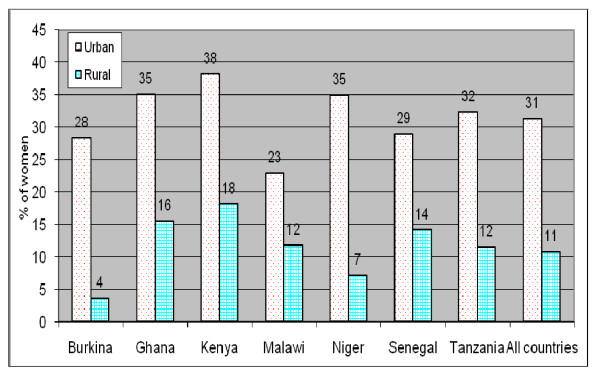
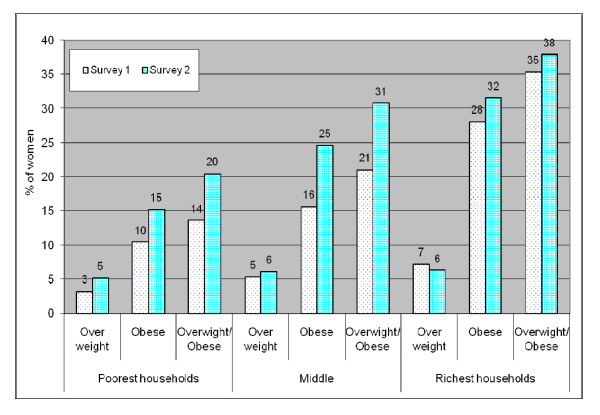
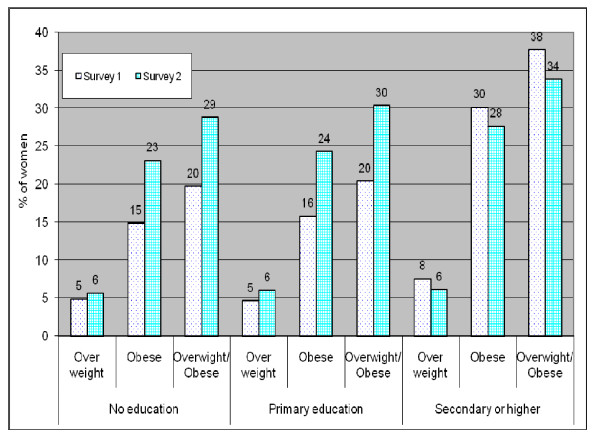
BACKGROUND: Obesity is a well recognized risk factor for various chronic diseases such as cardiovascular diseases, hypertension, and type 2 diabetes mellitus. The aim of this study was to shed light on the patterns of overweight and obesity in sub-Saharan Africa, with special interest in differences between the urban poor and the urban non-poor. The specific goals were to describe trends in overweight and obesity among urban women; and examine how these trends vary by education and household wealth. METHODS: The paper used Demographic and Health Surveys data from seven African countries where two surveys had been carried out with an interval of at least 10 years between them. Among the countries studied, the earliest survey took place in 1992 and the latest in 2005. The dependent variable was body mass index coded as: Not overweight/obese; Overweight; Obese. The key covariates were time lapse between the two surveys; woman's education; and household wealth. Control variables included working status, age, marital status, parity, and country. Multivariate ordered logistic regression in the context of the partial proportional odds model was used. RESULTS: Descriptive results showed that the prevalence of urban overweight/obesity increased by nearly 35% during the period covered. The increase was higher among the poorest (+50%) than among the richest (+7%). Importantly, there was an increase of 45-50% among the non-educated and primary-educated women, compared to a drop of 10% among women with secondary education or higher. In the multivariate analysis, the odds ratio of the variable time lapse was 1.05 (p < 0.01), indicating that the prevalence of overweight/obesity increased by about 5% per year on average in the countries in the study. While the rate of change in urban overweight/obesity did not significantly differ between the poor and the rich, it was substantially higher among the non-educated women than among their educated counterparts. CONCLUSION: Overweight and obesity are on the rise in Africa and might take epidemic proportions in the near future. Like several other public health challenges, overweight and obesity should be tackled and prevented early as envisioned in the WHO Global strategy on diet, physical activity and health.
Overview
The claims and statistics of this paper haven’t been checked yet.
Free: it reads the open-access text and checks the first 5 claims that cite a source we can check. Create a free account to check every claim.
Integrity signals
Registry
Cites
Statistics
Figures
Verification
Claims the paper makes
The claims and statistics of this paper haven’t been checked yet.
Free: it reads the open-access text and checks the first 5 claims that cite a source we can check. Create a free account to check every claim.
Claims other papers make about this one
Each is checked against this paper’s own text: does it say what the citing paper says it does?
In the citing paper
“African families are classified as families that include multiple caregivers [13] such as grandparents and other extended family members (aunts, uncles, brothers, and sisters)”
From Digital Health Technologies for Maternal and Child Health in Africa and Other Low- and Middle-Income Countries: Cross-disciplinary Scoping Review With Stakeholder Consultation (2023) · doi:10.2196/42161 · cites this paper as [13]
Self-check
Percentages, sums and reported differences re-computed from the paper’s own numbers.
The self-check needs the paper’s full text.
Citations
Cites
Lopez, A. D., Mathers, C. D., Ezzati, M., Jamison, D. T., & Murray, C. J. (2006) · The Lancet · doi:10.1016/s0140-6736(06)68770-9 · Cited by 5,630
Filmer, D., & Pritchett, L. H. (2001) · Demography · doi:10.1353/dem.2001.0003 · Cited by 5,238
Filmer, D., & Pritchett, L. H. (2001) · Demography · doi:10.2307/3088292 · Cited by 2,972
Global Burden of Disease and Risk Factors
(2006) · World Bank, Washington, DC eBooks · doi:10.1596/978-0-8213-6262-4 · Cited by 2,605
Global strategy on diet, physical activity and health
Samuelson, G. (2004) · Food & Nutrition Research · doi:10.3402/fnr.v48i2.1503 · Cited by 2,319
Generalized Ordered Logit/Partial Proportional Odds Models for Ordinal Dependent Variables
Williams, R. (2006) · The Stata Journal: Promoting communications on statistics and Stata · doi:10.1177/1536867x0600600104 · Cited by 2,118
Global strategy on diet, physical activity and health
Samuelson, G. (2004) · Scandinavian Journal of Nutrition · doi:10.1080/11026480410034349 · Cited by 1,720
Preventing chronic diseases: a vital investment
Vita-Finzi, L., & Who, G. E. (2005) · Cited by 1,679
The nutrition transition: worldwide obesity dynamics and their determinants
Popkin, B. M., & Gordon-Larsen, P. (2004) · International Journal of Obesity · doi:10.1038/sj.ijo.0802804 · Cited by 1,538 · cited 1×
“With increasing urbanization, there might be a shift of the obesity burden to sections of the poor urban population who may not have the knowledge or financial resources to adopt healthier lifestyles [28-30].”
BackgroundCohen, B. (2004) · World Development · doi:10.1016/j.worlddev.2003.04.008 · Cited by 846
Partial Proportional Odds Models for Ordinal Response Variables
Peterson, B., & Harrell, F. E. (1990) · Applied Statistics · doi:10.2307/2347760 · Cited by 813
Ezzati, M., Vander Hoorn, S., Lawes, C. M. M., Leach, R., James, W. P. T., Lopez, A. D., Rodgers, A., & Murray, C. J. L. (2005) · PLoS Medicine · doi:10.1371/journal.pmed.0020133 · Cited by 634
The Nutrition Transition: An Overview of World Patterns of Change
Popkin, B. M. (2004) · Nutrition Reviews · doi:10.1111/j.1753-4887.2004.tb00084.x · Cited by 605
Regression models for ordinal responses: a review of methods and applications
Ananth, C. (1997) · International Journal of Epidemiology · doi:10.1093/ije/26.6.1323 · Cited by 593
Rural-urban interactions: a guide to the literature
Tacoli, C. (1998) · Environment and Urbanization · doi:10.1177/095624789801000105 · Cited by 570
Who Global Strategy on Diet, Physical Activity and Health
Waxman, A. (2004) · Food and Nutrition Bulletin · doi:10.1177/156482650402500310 · Cited by 548
Obesity in women from developing countries
Martorell, R., Kettel Khan, L., Hughes, M., & Grummer-Strawn, L. (2000) · European Journal of Clinical Nutrition · doi:10.1038/sj.ejcn.1600931 · Cited by 386
Where does the black population of South Africa stand on the nutrition transition?
Bourne, L. T., Lambert, E. V., & Steyn, K. (2002) · Public Health Nutrition · doi:10.1079/phn2001288 · Cited by 299
Neighborhood Risk Factors for Obesity
Lopez, R. P. (2007) · Obesity · doi:10.1038/oby.2007.251 · Cited by 281 · cited 1×
“While low socioeconomic economic status and poor neighborhoods have been associated with a higher prevalence of obesity and chronic diseases in developed countries [17,18], studies in Africa have demonstrated by contrast a strong positive relationship between obesity and high socioeconomic status [14,19,20].”
BackgroundPrevalence and time trends in obesity among adult West African populations: a meta‐analysis
Abubakari, A. R., Lauder, W., Agyemang, C., Jones, M., Kirk, A., & Bhopal, R. S. (2008) · Obesity Reviews · doi:10.1111/j.1467-789x.2007.00462.x · Cited by 259
Sodjinou, R., Agueh, V., Fayomi, B., & Delisle, H. (2008) · BMC Public Health · doi:10.1186/1471-2458-8-84 · Cited by 235
Sundquist, K., Malmström, M., & Johansson, S.-E. (2004) · Journal of Epidemiology and Community Health · doi:10.1136/jech.58.1.71 · Cited by 224
Sobngwi, E. (2004) · International Journal of Epidemiology · doi:10.1093/ije/dyh044 · Cited by 202
Socio-Economic Differentials in Child Mortality in Developing Countries.
Frank], [. (1986) · Population and Development Review · doi:10.2307/1973126 · Cited by 194
Association between socioeconomic status and adiposity in urban Cameroon
Fezeu, L., Minkoulou, E., Balkau, B., Kengne, A.-P., Awah, P., Unwin, N., Alberti, G. K., & Mbanya, J.-C. (2006) · International Journal of Epidemiology · doi:10.1093/ije/dyi214 · Cited by 178
Kamadjeu, R. M., Edwards, R., Atanga, J. S., Kiawi, E. C., Unwin, N., & Mbanya, J.-C. (2006) · BMC Public Health · doi:10.1186/1471-2458-6-228 · Cited by 162
Sociodemographic variations in obesity among Ghanaian adults
Amoah, A. G. (2003) · Public Health Nutrition · doi:10.1079/phn2003506 · Cited by 158
Obesity and regional fat distribution in Kenyan populations: Impact of ethnicity and urbanization
Christensen, D. L., Eis, J., Hansen, A. W., Larsson, M. W., Mwaniki, D. L., Kilonzo, B., Tetens, I., Boit, M. K., Kaduka, L. U., Borch‐Johnsen, K., et al. (2008) · Annals of Human Biology · doi:10.1080/03014460801949870 · Cited by 153
Non-industrialised countries and affluence
Fall, C. H. D. (2001) · British Medical Bulletin · doi:10.1093/bmb/60.1.33 · Cited by 142
The epidemiology of obesity in ghana.
Biritwum, R. B., Gyapong, J. O., & Mensah, G. P. (2005) · PubMed Central · Cited by 140
Burkitt, D. P. (1980) · Elsevier eBooks · doi:10.1016/b978-0-433-15351-1.50013-4 · Cited by 129
Heliövaara, M., & Aromaa, A. (1981) · Journal of Epidemiology and Community Health · doi:10.1136/jech.35.3.197 · Cited by 123
Agyemang, C. O., Owusu‐Dabo, E., de Jonge, A., Martins, D., Ogedegbe, G. G., & Stronks, K. (2008) · Public Health Nutrition · doi:10.1017/s1368980008003510 · Cited by 113
Emerging Disease Burdens and the Poor in Cities of the Developing World
Campbell, T., & Campbell, A. (2007) · Journal of Urban Health · doi:10.1007/s11524-007-9181-7 · Cited by 106
Physical activity and cardiovascular risk factors in a developing population
Forrest, K. Y. Z., Bunker, C. H., Kriska, A. M., Ukoli, F. A. M., Huston, S. L., & Marković, N. (2001) · Medicine & Science in Sports & Exercise · doi:10.1097/00005768-200109000-00025 · Cited by 105
Villamor, E., Msamanga, G., Urassa, W. K., Petraro, P., Spiegelman, D. L., Hunter, D. J., & Fawzi, W. W. (2006) · American Journal of Clinical Nutrition · doi:10.1093/ajcn/83.6.1387 · Cited by 89
Overweight and obesity among urban Sahraoui women of South Morocco.
Rguibi, M. A., & Belahsen, R. (2004) · PubMed · Cited by 73
Body Size and Blood Pressure: An Analysis of Africans and the African Diaspora
Cappuccio, F. P., Kerry, S., Adeyemo, A., Luke, A. H., Amoah, A. G. B., Bovet, P., Connor, M., Forrester, T., Gervasoni, J., Kaki, G. K., et al. (2008) · Epidemiology · doi:10.1097/ede.0b013e31815c4d2c · Cited by 70
Urbanization and obesity in The Gambia: a country in the early stages of the demographic transition
Siervo, M., GREY, P., Nyan, O. A., & Prentice, A. M. (2005) · European Journal of Clinical Nutrition · doi:10.1038/sj.ejcn.1602337 · Cited by 65
Asfaw, A. (2006) · Journal of Public Health Policy · doi:10.1057/palgrave.jphp.3200089 · Cited by 64
A pilot study on body image, attractiveness and body size in Gambians living in an urban community
Siervo, M., GREY, P., Nyan, O. A., & Prentice, A. M. (2006) · Eating and Weight Disorders - Studies on Anorexia Bulimia and Obesity · doi:10.1007/bf03327758 · Cited by 64
Nutritional variation and cardiovascular risk factors in Tanzania--rural-urban difference.
Njelekela, M. A., Sato, T., Nara, Y., Miki, T., Kuga, S., Noguchi, T., Kanda, T., Yamori, M., Ntogwisangu, J., Masesa, Z., et al. (2003) · PubMed · Cited by 60
Rapid increases in obesity in Jamaica, compared to Nigeria and the United States
Durazo-Arvizu, R. A., Luke, A., Cooper, R. S., Cao, G., Dugas, L., Adeyemo, A., Boyne, M., & Forrester, T. (2008) · BMC Public Health · doi:10.1186/1471-2458-8-133 · Cited by 49
Njelekela, M. A., Kuga, S., Nara, Y., Ntogwisangu, J., Masesa, Z., Mashalla, Y., Ikeda, K., Mtabaji, J., Yamori, Y., & Tsuda, K. (2002) · Journal of Nutritional Science and Vitaminology · doi:10.3177/jnsv.48.352 · Cited by 36
Nyaruhucha, C. N., Achen, J. H., Msuya, J. M., Shayo, N., & Kulwa, K. B. M. (2004) · East African Medical Journal · doi:10.4314/eamj.v80i2.8648 · Cited by 34
Kuga, S., Njelekela, M. A., Noguchi, T., Kanda, T., Yamori, M., Sato, T., Miki, T., Ikeda, K., Nara, Y., & Mtabaji, J. (2002) · Clinical and Experimental Pharmacology and Physiology · doi:10.1046/j.1440-1681.29.s4.4.x · Cited by 21
Nutritional status of an urban community in Zimbabwe.
Mathe, S., Hl, M., & Rt, M. (1985) · PubMed · Cited by 6
Research works printed but not linked: 3
- United Nations: World Urbanization Prospectus: The 2005 Revision. New York: United Nations, Department of Economic and Social Affairs, Population Division; 2006.
- UNFPA: The State of the World Population 1996. Changing Places: Population, Development and the Urban Poor. New York: United Nations; 1996.
- UN: United Nations Millennium Declaration. Fifty-fifth Ses- sion of the United Nations General Assembly. New York: United Nations; 2000.
Cited by
Global patterns of cancer incidence and mortality rates and trends
Jemal, A., Center, M. M., DeSantis, C., & Ward, E. M. (2010) · Cancer Epidemiology, Biomarkers & Prevention · doi:10.1158/1055-9965.epi-10-0437 · Cited by 2,778
Obesity and socioeconomic status in developing countries: a systematic review
Dinsa, G. D., Goryakin, Y., Fumagalli, E., & Suhrcke, M. (2012) · Obesity Reviews · doi:10.1111/j.1467-789x.2012.01017.x · Cited by 805
“Obesity is by far higher among urban dwellers even in low-income countries (6), likely because of a more sedentary lifestyle.”
BackgroundDiabetes in sub-Saharan Africa
Mbanya, J. C. N., Motala, A. A., Sobngwi, E., Assah, F. K., & Enoru, S. T. (2010) · The Lancet · doi:10.1016/s0140-6736(10)60550-8 · Cited by 775
Educational attainment and obesity: a systematic review
Cohen, A. K., Rai, M., Rehkopf, D. H., & Abrams, B. (2013) · Obesity Reviews · doi:10.1111/obr.12062 · Cited by 596
“(39,147), Malaysia (195), Mali (39), Mexico (39,63,69,70,103,104,196,197), Morocco (39,198,199), Namibia (39), Netherlands (41,50,200–204), New”
InfluentialDiabetes in sub-Saharan Africa: from clinical care to health policy
Atun, R., Davies, J. I., Gale, E. A. M., Bärnighausen, T., Beran, D., Kengne, A. P., Levitt, N. S., Mangugu, F. W., Nyirenda, M. J., Ogle, G. D., et al. (2017) · The Lancet Diabetes & Endocrinology · doi:10.1016/s2213-8587(17)30181-x · Cited by 543
Metadata
- Authors
- Ziraba, A. K., Fotso, J. C., & Ochako, R.
- Affiliations
- African Population and Health Research Center (KE)
- Corresponding author
- Ziraba, Abdhalah K
- Venue
- BMC Public Health
- Published
- 2009-12
- Volume
- 9
- Issue
- 1
- Pages
- 465-465
- ISSN
- 1471-2458 (ISSN-L)
- PMC
- PMC2803188
- OpenAlex
- W1989483002
- Cited by
- 433
- References
- 47
- Citations by year
- 2026: 21 · 2025: 11 · 2024: 18 · 2023: 28 · 2022: 28 · 2021: 38 · 2020: 26 · 2019: 34 · 2018: 28 · 2017: 32 · 2016: 31 · 2015: 43 · 2014: 26 · 2013: 24 · 2012: 24
- FWCI
- 14.79
- Type
- journal article
- Language
- en
- Open access
- gold
- doi.org
- Licence
- cc-by
- creativecommons.org/licenses/by/2.0 (tdm)
- Locations
- BMC Public Health (publishedVersion, cc-by)
- PubMed Central (publishedVersion, cc-by)
- PubMed (publishedVersion)
- LSHTM Research Online (London School of Hygiene and Tropical Medicine) (acceptedVersion)
- DOAJ (DOAJ: Directory of Open Access Journals) (submittedVersion)
- Funders
- London School of Hygiene and Tropical Medicine
- African Population and Health Research Center
- Topics
- Health Sciences › Medicine › Public Health, Environmental and Occupational Health › Obesity, Physical Activity, Diet
- Health Sciences › Nursing › Nutrition and Dietetics › Nutrition, Health and Food Behavior
- Health Sciences › Medicine › Endocrinology, Diabetes and Metabolism › Diabetes, Cardiovascular Risks, and Lipoproteins
- Keywords
- overweight, obesity, urban women, sub-Saharan Africa, household wealth, educational attainment, body mass index trends, urban poverty, chronic disease risk factors
- MeSH terms
- Africa, Educational Status, Employment, Female, Humans, Income, Male, Obesity, Urban Health, Prevalence, Multivariate Analysis, Logistic Models, Overweight
About these checks
Registry, retraction, Cites and statistics results are computed, not judged, with one exception: a printed reference that no index lists is read once by a model before it counts as a citation error. Claims are extracted by a model and kept only when their quote appears verbatim in the text; each cited source is then checked, with a model’s help, for whether it says what the claim relies on. Those verdicts can be wrong — read the claim’s quote and the cited source before relying on one.
Statistics and arithmetic are recomputed, not judged.
Confidence bands are shown only for fields calibrated on our annotated test set. None is calibrated yet, so no band is shown.
What counts as a claim ›How we measure confidence ›How we check this ›
Are you an author, or do you see a problem with this page? Request a review
Data sources
Bibliographic data: Semantic Scholar, OpenAlex, Crossref.
Contains information from the Semantic Scholar Academic Graph Datasets, made available under the ODC Attribution License (ODC-BY 1.0).
Semantic Scholar’s data is described in: Kinney, R., et al. (2023). The Semantic Scholar Open Data Platform. arXiv:2301.10140.
