

Comparing lumbo-pelvic kinematics in people with and without back pain: a systematic review and meta-analysis
Open accessThe DOI matches its Crossref record; 93 of the 96 references it cites were found in a registry or an index; 3 of the 29 sources its claims cite were checked for support.
Abstract
BACKGROUND: Clinicians commonly examine posture and movement in people with the belief that correcting dysfunctional movement may reduce pain. If dysfunctional movement is to be accurately identified, clinicians should know what constitutes normal movement and how this differs in people with low back pain (LBP). This systematic review examined studies that compared biomechanical aspects of lumbo-pelvic movement in people with and without LBP. METHODS: MEDLINE, Cochrane Central, EMBASE, AMI, CINAHL, Scopus, AMED, ISI Web of Science were searched from inception until January 2014 for relevant studies. Studies had to compare adults with and without LBP using skin surface measurement techniques to measure lumbo-pelvic posture or movement. Two reviewers independently applied inclusion and exclusion criteria, and identified and extracted data. Standardised mean differences and 95% confidence intervals were estimated for group differences between people with and without LBP, and where possible, meta-analyses were performed. Within-group variability in all measurements was also compared. RESULTS: The search identified 43 eligible studies. Compared to people without LBP, on average, people with LBP display: (i) no difference in lordosis angle (8 studies), (ii) reduced lumbar ROM (19 studies), (iii) no difference in lumbar relative to hip contribution to end-range flexion (4 studies), (iv) no difference in standing pelvic tilt angle (3 studies), (v) slower movement (8 studies), and (vi) reduced proprioception (17 studies). Movement variability appeared greater for people with LBP for flexion, lateral flexion and rotation ROM, and movement speed, but not for other movement characteristics. Considerable heterogeneity exists between studies, including a lack of detail or standardization between studies on the criteria used to define participants as people with LBP (cases) or without LBP (controls). CONCLUSIONS: On average, people with LBP have reduced lumbar ROM and proprioception, and move more slowly compared to people without LBP. Whether these deficits exist prior to LBP onset is unknown.
Overview
CoChat Summary
TL;DR
This systematic review and meta-analysis of 43 studies found that, on average, people with low back pain have reduced lumbar range of motion, slower lumbar movement, and poorer lumbar proprioception than people without low back pain, but no average difference in lordosis, lumbar-versus-hip contribution at end-range flexion, or standing pelvic tilt. Considerable between-study heterogeneity and variable case/control definitions limit interpretation.
Key findings
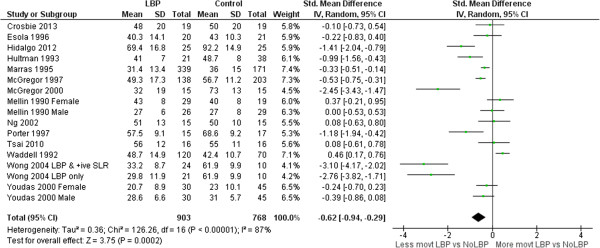
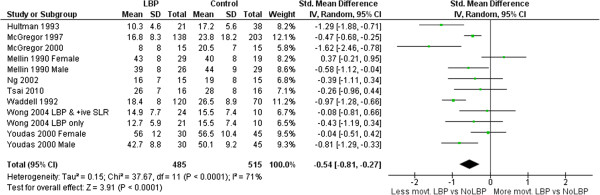
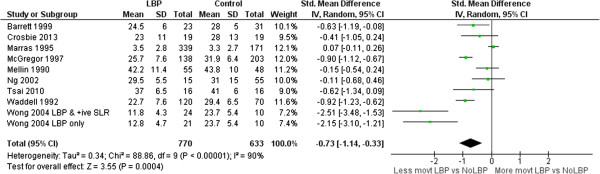
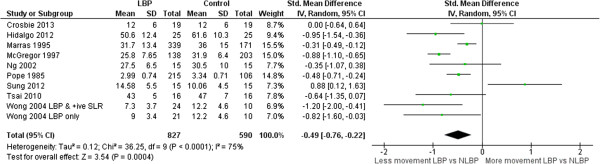
- Pooled analyses showed reduced lumbar ROM in people with LBP versus NoLBP: flexion SMD −0.62 (95% CI −0.94 to −0.29, p < 0.01), extension SMD −0.54 (−0.81 to −0.27, p < 0.01), lateral flexion SMD −0.73 (−1.14 to −0.33, p < 0.01), and rotation SMD −0.49 (−0.76 to −0.22, p = 0.04).
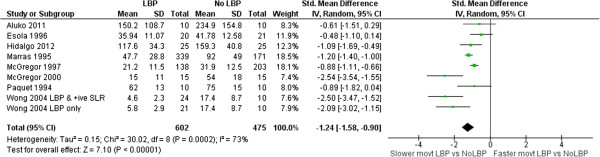
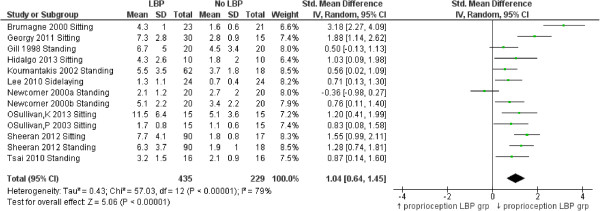
- People with LBP moved more slowly (SMD −1.24, 95% CI −1.58 to −0.90, p < 0.0001) and had poorer proprioception on repositioning accuracy (SMD 1.04, 95% CI 0.64 to 1.45, p < 0.0001).
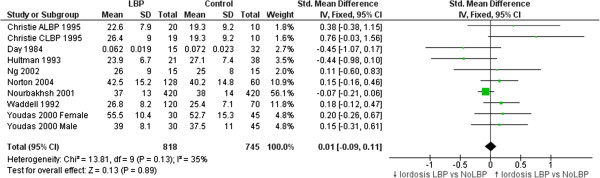
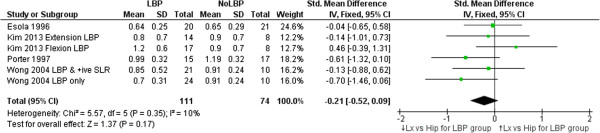
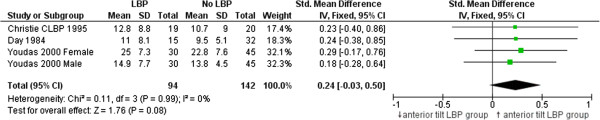
- No significant pooled differences were found for lordosis angle (SMD 0.01, 95% CI −0.09 to 0.11, p = 0.89), lumbar versus hip end-range flexion ROM (SMD −0.21, 95% CI −0.52 to 0.09, p = 0.17), or standing pelvic tilt angle (SMD 0.24, 95% CI −0.03 to 0.50, p = 0.08).
- Within-group variability was significantly greater in the LBP group for flexion, lateral flexion, rotation, and speed/acceleration, with coefficient-of-variation ratios of 1.31 (1.13–1.51), 1.31 (1.17–1.48), 1.20 (1.02–1.40), and 1.28 (1.13–1.46), respectively.
Methods
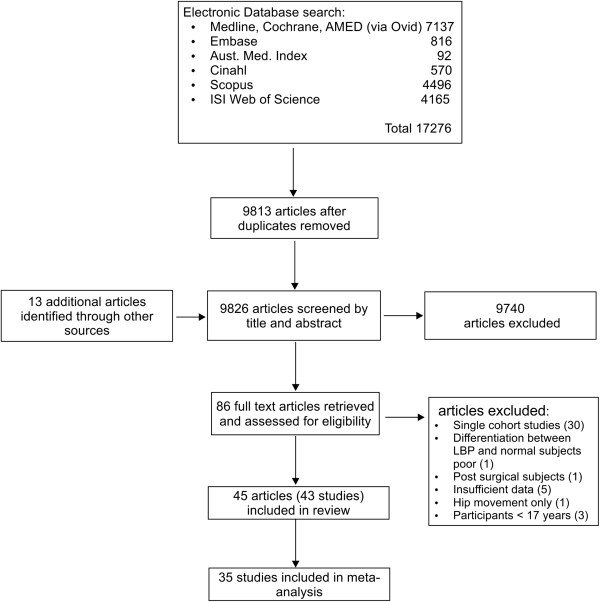
- Systematic review and meta-analysis; eight databases (MEDLINE, Cochrane Central, EMBASE, AMI, CINAHL, Scopus, AMED, ISI Web of Science) were searched from inception until January 2014, yielding 43 eligible studies (45 articles).
- Inclusion required adults >17 years, non-invasive skin-surface measurement, same procedures for LBP and NoLBP groups, and at least one lumbo-pelvic kinematic measure; no specific LBP or control definitions were required.
- Standardised mean differences and 95% confidence intervals were pooled using RevMan, with random-effects models where heterogeneity was indicated; within-group variability was compared using sample-size-weighted coefficients of variation, and Pearson’s r examined effect size versus study quality.
Limitations
- The authors state that they treated people with LBP as a homogeneous group, that findings do not show whether movement changes cause or result from LBP or improve outcomes, that only English-language articles were included, and that broad inclusion criteria likely weakened between-group differences.
- The authors also note considerable heterogeneity across studies, including variable definitions of LBP and NoLBP, and no studies blinded assessors to group status.
- Evident from the text: quality assessment showed only 37% of studies reported standardised movement instructions, 2% reported trained assessors, 17% used the same assessors for both groups, and 0% blinded assessors, which the authors identify as exposing studies to random or systematic error.
Model-written summary. Check it against the paper before relying on it.
Integrity signals
Registry
Cites
Statistics
Figures
Verification
Claims the paper makes
2 Valid · 1 Not valid · 15 Not checked · 61 Own results and interpretations
The cited sources support only part of this claim — read each source’s verdict below.
In the paper
“Astfalk et al. [85] found no differences in average lumbar flexion angle in sitting (reflecting pelvic tilt position) when comparing adolescents with and without LBP (125.3 ± 19.8° vs 130.6° ± 15.7 respectively).”
§ Comparing lumbo-pelvic kinematics in people with and without back pain: a systematic review and meta-analysis > Discussion > Pelvic tilt angle, position and range
What the sources say
- Partly supportedcites [85] Astfalck RG O'Sullivan PB Straker LM Smith AJ Burnett A Caneiro JP Dankaerts W Sitting postures and trunk muscle activity in adolescents with and without nonspecific chronic low back pain: an analysis based on subclassification Spine 2010 35 14 1387 1395 20195206 sourceExperimental — accuracy not yet measured
The Spinal Kinematics section (p. 4) reports no significant difference in sitting spinal posture between adolescents with and without chronic low back pain before the pain group was subdivided. It does not report the cited values of 125.3 ± 19.8° and 130.6 ± 15.7°; it also reports lumbar-angle differences after subgrouping, so the no-difference finding applies to the overall group comparison. (LLM, conf=0.88)
plain- Asserted: passes — The authors put it forward as true.
- Checkable: passes — It can be checked against evidence.
- Load-bearing: passes — The paper’s conclusions depend on it.
- Based: passes — The paper gives a reason why it holds.
- Partly supported
A result the paper reports from its own data — it cites no other source for it, so there is none to check. The quote shows it is in the paper.
In the paper
“A post-hoc meta-analysis of three studies that compared genders indicated that women had greater lordosis angles than men (SMD = 0.92, 95% CI 0.8 to 1.05, p < 0.01).”
§ Comparing lumbo-pelvic kinematics in people with and without back pain: a systematic review and meta-analysis > Results > Movement characteristics
hedgedstates an association- Asserted: passes — The authors put it forward as true.
- Checkable: passes — It can be checked against evidence.
- Load-bearing: unclear — It is unclear whether the paper’s conclusions depend on it.
- Based: passes — The paper gives a reason why it holds.
A result the paper reports from its own data — it cites no other source for it, so there is none to check. The quote shows it is in the paper.
In the paper
“(i) no difference in lordosis angle (8 studies)”
- Also stated in: § Movement characteristics · plain
“The pooled difference (SMD = 0.01, 95% CI -0.09 to 0.11, p = 0.89) was not significant.”
- Also stated in: § Proprioception · plain
“Lordosis*, n = 8 | 0.01 (-0.09 to 0.11), p = 0.89”
§ Comparing lumbo-pelvic kinematics in people with and without back pain: a systematic review and meta-analysis > Abstract > Results
plainn = 8- Asserted: passes — The authors put it forward as true.
- Checkable: passes — It can be checked against evidence.
- Load-bearing: passes — The paper’s conclusions depend on it.
- Based: passes — The paper gives a reason why it holds.
- Also stated in: § Movement characteristics · plain
A result the paper reports from its own data — it cites no other source for it, so there is none to check. The quote shows it is in the paper.
In the paper
“(vi) reduced proprioception (17 studies)”
- Also stated in: § Proprioception · boosted
“A consistent, large and significant reduction in ability to accurately re-position the spine at pre-specified angles for people with LBP compared to those without LBP is shown in Figure 10 (SMD = 1.04, 95% CI 0.64 to 1.45, p < 0.01).”
- Also stated in: § Proprioception · plain
“Proprioception (re-position accuracy)§, n = 12 | 1.04 (0.64 to 1.45), p < 0.0001”
§ Comparing lumbo-pelvic kinematics in people with and without back pain: a systematic review and meta-analysis > Abstract > Results
boostedstates an associationn = 12 ·- Asserted: passes — The authors put it forward as true.
- Checkable: passes — It can be checked against evidence.
- Load-bearing: passes — The paper’s conclusions depend on it.
- Based: passes — The paper gives a reason why it holds.
- Also stated in: § Proprioception · boosted
A result the paper reports from its own data — it cites no other source for it, so there is none to check. The quote shows it is in the paper.
In the paper
“(v) slower movement (8 studies)”
- Also stated in: § Speed/Acceleration · boosted
“A large, significant effect of slower movement in the LBP group was evident (SMD -1.46 95% CI -1.96 to -1.02, p < .01).”
- Also stated in: § Proprioception · plain
“Speed/Acceleration‡, n = 8 | -1.24 (-1.58 to -0.90), p < 0.0001”
§ Comparing lumbo-pelvic kinematics in people with and without back pain: a systematic review and meta-analysis > Abstract > Results
boostedstates an associationn = 8 ·- Asserted: passes — The authors put it forward as true.
- Checkable: passes — It can be checked against evidence.
- Load-bearing: passes — The paper’s conclusions depend on it.
- Based: passes — The paper gives a reason why it holds.
- Also stated in: § Speed/Acceleration · boosted
34 more claims
Create a free account to see all 79 claims and to verify the 2 references still open.
- It may state two separate claims as one. 32
- Probably not a substantial claim. 14
Self-check
Percentages, sums and reported differences re-computed from the paper’s own numbers.
Each contradiction between two passages listed here was confirmed by an independent check.
Rated major: it would touch a result — a value a result rests on, reported and recomputed p-values on opposite sides of the significance level, two passages that conflict with no sign which is right, or a cited work retracted before this paper was published.
In the paper
§ Comparing lumbo-pelvic kinematics in people with and without back pain: a systematic review and meta-analysis > Results > Speed/Acceleration
“A large, significant effect of slower movement in the LBP group was evident (SMD -1.46 95% CI -1.96 to -1.02, p < .01).”
§ Comparing lumbo-pelvic kinematics in people with and without back pain: a systematic review and meta-analysis > Results > Proprioception
“| Speed/Acceleration‡, n = 8 | -1.24 (-1.58 to -0.90), p < 0.0001 |”
Rated major: it would touch a result — a value a result rests on, reported and recomputed p-values on opposite sides of the significance level, two passages that conflict with no sign which is right, or a cited work retracted before this paper was published.
In the paper
§ Comparing lumbo-pelvic kinematics in people with and without back pain: a systematic review and meta-analysis > Results > Lumbar spine versus hip contribution to flexion/extension
“Esola et al. [34] (SMD = -0.86, 95% CI -1.51 to -0.22) and Porter et al. [52] (SMD = -0.71 95% CI -1.43 to 0.00) both found significant reductions of lumbar contribution to mid-range flexion but not at end range.”
§ Comparing lumbo-pelvic kinematics in people with and without back pain: a systematic review and meta-analysis > Discussion > Lumbar versus hip contribution to movement
“This finding is supported by McClure et al. [40], Esola et al. [34] and Porter et al. [52] who all reported relatively greater lumbar through-range contribution in people with LBP on flexion movement.”
Rated minor: it would not touch a result — a value no result rests on, a p-value that stays on the same side of the significance level, or a conflict that is clerical, resolved elsewhere in the paper, or outside its own findings.
In the paper
§ Comparing lumbo-pelvic kinematics in people with and without back pain: a systematic review and meta-analysis > Discussion > Differences in variability between people with and without LBP
“Our assessment of differences in variability between people with and without LBP for nine movement characteristics demonstrated significantly greater variability for four movement characteristics”
§ Comparing lumbo-pelvic kinematics in people with and without back pain: a systematic review and meta-analysis > Results > Differences in variability between groups
“Table 3 presents a summary of the within group variability in movements pooled across studies. Significantly greater variability for people with LBP compared to people without LBP was observed on four of the eight measures: flexion, lateral flexion, rotation and speed/acceleration.”
Rated minor: it would not touch a result — a value no result rests on, a p-value that stays on the same side of the significance level, or a conflict that is clerical, resolved elsewhere in the paper, or outside its own findings.
In the paper
§ Comparing lumbo-pelvic kinematics in people with and without back pain: a systematic review and meta-analysis > Results > Search yield
“No studies attempted blinding of assessors to group status, and only one study reported standardizing instructions to participants.”
§ Comparing lumbo-pelvic kinematics in people with and without back pain: a systematic review and meta-analysis > Results > Search yield
“| 8. | Was a system for standardising movement instructions reported? | 37% |”
Citations
Cites
Preferred Reporting Items for Systematic Reviews and Meta-Analyses: the PRISMA statement
Moher, D., Liberati, A., Tetzlaff, J., Altman, D. G., & for the PRISMA Group (2009) · BMJ · doi:10.1136/bmj.b2535 · Cited by 83,823
Measuring inconsistency in meta-analyses
Higgins, J. P. T., Thompson, S. G., Deeks, J. J., & Altman, D. G. (2003) · BMJ · doi:10.1136/bmj.327.7414.557 · Cited by 63,139 · cited 1×
“A random effects model was used for pooling where fixed effects modeling indicated statistical heterogeneity of the data (Mantel-Haenszel method), as determined by chi-squared and I(2) statistics; otherwise the results of fixed effects modeling was reported [25,26].”
MethodPreferred reporting items for systematic reviews and meta-analyses: The PRISMA statement
Moher, D., Liberati, A., Tetzlaff, J., Altman, D. G., & the PRISMA Group* (2009) · Annals of Internal Medicine · doi:10.7326/0003-4819-151-4-200908180-00135 · Cited by 37,554
Towards complete and accurate reporting of studies of diagnostic accuracy: The STARD Initiative.
Bossuyt, P. M., Reitsma, J. B., Bruns, D. E., Gatsonis, C. A., Glasziou, P. P., Irwig, L. M., Lijmer, J. G., Moher, D., Rennie, D., de Vet, H. C. W., et al. (2003) · Annals of Internal Medicine · doi:10.7326/0003-4819-138-1-200301070-00010 · Cited by 3,219
Towards Complete and Accurate Reporting of Studies of Diagnostic Accuracy: The STARD Initiative
Bossuyt, P. M., Reitsma, J. B., Bruns, D. E., Gatsonis, C. A., Glasziou, P. P., Irwig, L. M., Lijmer, J. G., Moher, D., Rennie, D., & de Vet, H. C. W. (2003) · Radiology · doi:10.1148/radiol.2261021292 · Cited by 3,215
Towards complete and accurate reporting of studies of diagnostic accuracy: the STARD initiative
Bossuyt, P. M., Reitsma, J. B., Bruns, D. E., Gatsonis, C. A., Glasziou, P. P., Irwig, L. M., Lijmer, J. G., Moher, D., Rennie, D., & de Vet, H. C. W. (2003) · BMJ · doi:10.1136/bmj.326.7379.41 · Cited by 3,215
Davis, H. S. (1966) · JAMA: The Journal of the American Medical Association · doi:10.1001/jama.1966.03100200106038 · Cited by 1,719
Diagnosis and Treatment of Movement Impairment Syndromes
Sahrmann, S. A. (2001) · Cited by 1,257
O’Sullivan, P. (2005) · Manual Therapy · doi:10.1016/j.math.2005.07.001 · Cited by 985
Evaluation of QUADAS, a tool for the quality assessment of diagnostic accuracy studies
Whiting, P. F., Weswood, M. E., Rutjes, A. W., Reitsma, J. B., Bossuyt, P. N., & Kleijnen, J. (2006) · BMC Medical Research Methodology · doi:10.1186/1471-2288-6-9 · Cited by 769 · cited 1×
“assessment tools [20-22].”
Research works printed but not linked: 4
- McKenzie R May S Lumbar Spine, Mechanical Diagnosis and Therapy 2003 2 Waikanae, New Zealand: Spinal Publications Ltd
- Schober P The lumbar vertebral column and back ache Munch Med Wochenschr 1937 84 336
- The NCBI Handbook (internet) 2013 2 Betheseda (MD): National Centre for Biotechnology Information (US) http://www.ncbi.nlm.nih.gov/mesh
- The Cochrane Collaboration Review Manager (RevMan) (computer program). Version 5.2 2012 Copenhagen: The Nordic Cochrane Centre, The Cochrane Collaboration
Cited by
Items 101–200 of 407
Baker, S. A., Billmire, D. A., Bilodeau, R. A., Emmett, D., Gibbons, A. K., Mitchell, U. H., Bowden, A. E., & Fullwood, D. T. (2023) · Pain Medicine · doi:10.1093/pm/pnad017 · Cited by 19
van Dijk, M., Smorenburg, N. T. A., Visser, B., Heerkens, Y. F., & der Sanden, M. W. G. N. (2017) · BMC Musculoskeletal Disorders · doi:10.1186/s12891-017-1649-3 · Cited by 20
“Given the multidimensionality of MQ [12, 13, 26, 42], the variety of ways in which AHCPs observe and interpret MQ, the implicit objectification of AHCPs and the growing integration of functional movement in NS-LBP management [7, 9, 22, 44], we endorse the need to develop a suitable method for measuring and evaluating…”
BackgroundMethodMasaki, M., Ikezoe, T., Yanase, K., Ji, X., Umehara, J., Aoyama, J., Minami, S., Fukumoto, Y., Watanabe, Y., Kimura, M., et al. (2019) · Clinical Spine Surgery A Spine Publication · doi:10.1097/bsd.0000000000000793 · Cited by 19
Rose-Dulcina, K., Vuillerme, N., Tabard-Fougère, A., Dayer, R., Dominguez, D. E., Armand, S., & Genevay, S. (2018) · JMIR Research Protocols · doi:10.2196/resprot.9224 · Cited by 24
“With regards to biomechanical factors, nonspecific chronic LBP patients exhibited kinematic and muscle activity impairments [28,29].”
BackgroundBailes, A. H., Johnson, M. E., Roos, R., Clark, W. W., Cook, H. A., McKernan, G., Sowa, G., Cham, R., & Bell, K. M. (2024) · Sensors · doi:10.3390/s24206580 · Cited by 18
“In low back pain (LBP), it is important to measure spine movement to evaluate symptom provocation and inform treatment decisions [1–6].”
BackgroundDinosaurs among us causing chaos and confusion
Meakins, A. (2015) · British Journal of Sports Medicine · doi:10.1136/bjsports-2015-095282 · Cited by 17
Cury, A. C., Pinto, R. Z., Madaleno, F. O., & Resende, R. A. (2021) · Brazilian Journal of Physical Therapy · doi:10.1016/j.bjpt.2021.01.003 · Cited by 21
Phan, T. C., Pranata, A., Farragher, J. B., Bryant, A. L., Nguyen, H. T., & Chai, R. (2022) · Sensors · doi:10.3390/s22176694 · Cited by 21
Bazrgari, B., & Xia, T. (2017) · Journal of Pain Research · doi:10.2147/jpr.s139185 · Cited by 20
“Kinematic methods, such as postural sway, lumbar range of motion, and lumbopelvic rhythm, in studying LBP have been systematically reviewed recently by Laird et al.(26) In addition, Gombatto et al(27) systematically reviewed lumbar kinematic characteristics in LBP patients during walking.”
McDowell, C., Smyk, M., & Sung, P. S. (2018) · Journal of Electromyography and Kinesiology · doi:10.1016/j.jelekin.2018.09.005 · Cited by 19
Postural Variabilities Associated with the Most Comfortable Sitting Postures: A Preliminary Study
Chen, Y., Chan, Y.-C., & Zhang, L.-P. (2021) · Healthcare · doi:10.3390/healthcare9121685 · Cited by 16
The impact of breast support garments on fit, support and posture of larger breasted women
Haworth, L., May, K., Janssen, J., Selfe, J., & Chohan, A. (2022) · Applied Ergonomics · doi:10.1016/j.apergo.2022.103701 · Cited by 17
Hartley, T., Hicks, Y., Davies, J. L., Cazzola, D., & Sheeran, L. (2024) · PLoS ONE · doi:10.1371/journal.pone.0302899 · Cited by 23
Effects of volitional spine stabilization on lifting task in recurrent low back pain population
Haddas, R., Yang, J., & Lieberman, I. H. (2016) · European Spine Journal · doi:10.1007/s00586-016-4586-1 · Cited by 16
“In addition, it was shown that abdominal muscle activation was correlated with the ST activity [17, 40].”
BackgroundResultMotor control of the spine in pregnancy-related lumbopelvic pain: A systematic review
Desgagnés, A., Patricio, P., Bérubé, N., et al. (2022) · Clinical Biomechanics · doi:10.1016/j.clinbiomech.2022.105716 · Cited by 15
Extraction of Lumbar Spine Motion Using a 3-IMU Wearable Cluster
Moon, K. S., Gombatto, S. P., Phan, K., & Öztürk, Y. (2022) · Sensors · doi:10.3390/s23010182 · Cited by 16
“Understandably, human lumbopelvic coordination would be difficult to conduct in one-directional movement [28].”
BackgroundLudwig, O., Fröhlich, M., & Schmitt, E. (2016) · Cogent Medicine · doi:10.1080/2331205x.2016.1262094 · Cited by 22
Movahed, M., Salavati, M., Sheikhhoseini, R., Arab, A. M., & O’Sullivan, K. (2019) · Journal of Bodywork and Movement Therapies · doi:10.1016/j.jbmt.2019.01.012 · Cited by 17
Santonja‐Medina, F., Santonja-Renedo, S., Cejudo, A., Ayala, F., Ferrer, V., Pastor, A., Collazo-Diéguez, M., Ferrán, O. R., Andújar, P., & de Baranda, P. S. (2020) · Symmetry · doi:10.3390/sym12060927 · Cited by 15
Non-intrusive RF sensing for early diagnosis of spinal curvature syndrome disorders
Mustafa, A., Ullah, F., Rehman, M. U., Khan, M. B., Tanoli, S. A. K., Ullah, M. K., Umar, H., & Chong, K. T. (2023) · Computers in Biology and Medicine · doi:10.1016/j.compbiomed.2023.106614 · Cited by 16
Rowley, K. M., Smith, J. A., & Kulig, K. (2019) · Journal of Orthopaedic and Sports Physical Therapy · doi:10.2519/jospt.2019.8756 · Cited by 14
Peak sagittal plane spine kinematics in female gymnasts with and without a history of low back pain
Pimentel, R. E., Potter, M. N., Carollo, J. J., Howell, D. R., & Sweeney, E. A. (2020) · Clinical Biomechanics · doi:10.1016/j.clinbiomech.2020.105019 · Cited by 16
Tajali, S., Roozbehfar, N., Mehravar, M., Goharpey, S., & Gayem, K. (2021) · Physiotherapy Theory and Practice · doi:10.1080/09593985.2021.1913775 · Cited by 13
Haslam, C., Bertschy, K., Cruwys, T., Griffin, J., & Johnson, D. B. (2022) · Disability and Rehabilitation · doi:10.1080/09638288.2022.2057602 · Cited by 17
Kim, W.-D., & Shin, D. (2023) · Healthcare · doi:10.3390/healthcare11060893 · Cited by 27
“Differences between the left and right pelvic tilt can affect the mobility and balance of the trunk and lower extremities [43].”
BackgroundCaeyenberghs, K., Pijnenburg, M., Goossens, N., Janssens, L., & Brumagne, S. (2016) · American Journal of Neuroradiology · doi:10.3174/ajnr.a5020 · Cited by 16
Bayartai, M.-E., Ferreira, P. H., Pappas, E., Pinheiro, M. B., Dambadarjaa, B., Khuyagbaatar, E., & Sullivan, J. (2020) · Musculoskeletal Science and Practice · doi:10.1016/j.msksp.2020.102253 · Cited by 16
“The heritability estimates from this study may have been affected by the samples age (Dreischarf et al., 2014) and presence of people with disc degeneration, which reduce lumbar mobility (Lao et al., 2015).”
BackgroundCorrelations between body postures and musculoskeletal pain in guitar players
Portnoy, S., Cohen, S., & Ratzon, N. Z. (2022) · PLoS ONE · doi:10.1371/journal.pone.0262207 · Cited by 13
“Therefore, the reduced mobility of the trunk might be related to lower back pain, as demonstrated in previous studies [29,30].”
ResultKinel, E., Roncoletta, P., Pietrangelo, T., & D’Amico, M. (2022) · Journal of Clinical Medicine · doi:10.3390/jcm11030546 · Cited by 13
“[14], in their review, showed a reduced lumbar range of movement and proprioception in a population with LBP.”
BackgroundFirouzabadi, A., Arjmand, N., Zhang, T., et al. (2024) · Journal of Biomechanics · doi:10.1016/j.jbiomech.2024.111954 · Cited by 13
Pan, F., Firouzabadi, A., Zander, T., & Schmidt, H. (2019) · Journal of Biomechanics · doi:10.1016/j.jbiomech.2019.109505 · Cited by 16
Meinke, A., Peters, R., Knols, R. H., Swanenburg, J., & Karlen, W. (2022) · JMIR Serious Games · doi:10.2196/31685 · Cited by 20
“Examples of movement differences such as the limitations in range of motion (ROM) of the lumbar spine were found in all movement planes [14] and limited ROM of the trunk in the frontal plane but not in the sagittal plane seem to precede the occurrence of LBP [15].”
BackgroundDiagnostic value of trunk flexion–extension testing in old chronic low back pain patients
Kienbacher, T., Fehrmann, E., Habenicht, R., Oeffel, C., Kollmitzer, J., Mair, P., & EBENBICHLER, G. R. (2016) · European Spine Journal · doi:10.1007/s00586-016-4758-z · Cited by 14
Sung, P. S., & Danial, P. (2018) · Annals of Biomedical Engineering · doi:10.1007/s10439-017-1972-8 · Cited by 13
A prospective study of lumbo-pelvic coordination in patients with non-chronic low back pain
Shojaei, I., Salt, E. G., & Bazrgari, B. (2019) · Journal of Biomechanics · doi:10.1016/j.jbiomech.2019.07.050 · Cited by 15
“, exhibiting smaller peak velocity or acceleration) compared to people without LBP (Laird et al., 2014).”
BackgroundInfluentialGrande‐Alonso, M., Muñoz‐García, D., Cuenca‐Martínez, F., Delgado-Sanz, L., Prieto-Aldana, M., Touche, R. L., & Gil‐Martínez, A. (2020) · PeerJ · doi:10.7717/peerj.8756 · Cited by 13
“…in this population, it has been observed that individuals with chronic low back pain (CLBP) can present functional alterations, such as changes in dynamic stability or range of motion, physical alterations and somatosensory disturbances (Sadler et al., 2017; Laird et al., 2014; Tong et al., 2017).”
BackgroundSubjective and Objective Measures in Assessing Neck Disability and Pain in Head and Neck Cancer
Magaña, L. C., Murati, S., Riffitts, M., et al. (2021) · The Laryngoscope · doi:10.1002/lary.29488 · Cited by 13
“Velocity remains an understudied, but novel, measure that has been shown to be potentially more predictive of disability in the lumbar spine.(24) It is theorized that the ROM is predominantly determined based on anatomical constraints, whereas velocity is strongly influenced by behavior and pain.”
BackgroundExploring Virtual Doppelgangers as Movement Models to Enhance Voluntary Imitation
Kammler-Sücker, K. I., Löffler, A., Kleinböhl, D., & Flor, H. (2021) · IEEE Transactions on Neural Systems and Rehabilitation Engineering · doi:10.1109/tnsre.2021.3120795 · Cited by 14
Chang, R. P., Smith, A. J., Kent, P. M., Saraceni, N., Hancock, M. J., O’Sullivan, P., & Campbell, A. (2022) · BMC Musculoskeletal Disorders · doi:10.1186/s12891-022-05866-w · Cited by 13
“Clinicians commonly assess movement with visual analysis to identify patterns of dysfunction and to monitor change [5, 37].”
BackgroundSelf-citationMueller, J., Niederer, D., Tenberg, S., Oberheim, L., Moesner, A., & Mueller, S. (2022) · BMC Sports Science Medicine and Rehabilitation · doi:10.1186/s13102-022-00586-z · Cited by 13
Alshehre, Y. M., Alkhathami, K. M., Brizzolara, K. J., Weber, M. D., & Wang-Price, S. S. (2023) · International Journal of Sports Physical Therapy · doi:10.26603/001c.68075 · Cited by 20
“Participants were excluded from the study if they have had or reported any of the following: (1) serious spinal conditions, such as fracture, infection, or tumor; (2) signs of nerve root compression; (3) a history of lower extremity or lumbar spine surgery; (4) a history of hip, knee, or ankle pain in the previous two…”
BackgroundQuantitative evaluation of linked rigid-body representations of the trunk
Kudo, S., Fujimoto, M., Sato, T., et al. (2018) · Gait & Posture · doi:10.1016/j.gaitpost.2018.04.046 · Cited by 12
Yamashita, H., Nishigami, T., Mibu, A., Tanaka, K., Manfuku, M., Fukuhara, H., Yoshino, K., Seto, Y., & Wand, B. M. (2019) · Pain Practice · doi:10.1111/papr.12815 · Cited by 13
Christe, G., Rochat, V., Jolles, B. M., & Favre, J. (2019) · Journal of Orthopaedic Research® · doi:10.1002/jor.24575 · Cited by 12
“Second, and in association with previous research, the smaller angles at the lower and upper lumbar joints support the hypothesis of reduced spinal motion in patients with CLBP during functional activities.(3,10,11,16) Interestingly, it seems that patients with CLBP move with less amplitudes of motion during functiona…”
ResultRiipinen, P., Holmes, M. M., Ogilvie, S., Newell, D., Byfield, D. C., & du Rose, A. (2022) · Musculoskeletal Care · doi:10.1002/msc.1637 · Cited by 15
Herrero, P., Ríos-Asín, I., Lapuente‐Hernández, D., Espallargas, L. P., Calvo, S., & Gil-Calvo, M. (2023) · Sensors · doi:10.3390/s23187695 · Cited by 12
“Recently, some reviews have been performed to analyze the use of sensors in patients with LBP from different approaches, such as (i) the analysis of the relationship between the sitting time and the immediate increase in perceived LBP [10], (ii) the applicability for assessing spine movement [9], (iii) the comparison…”
BackgroundFanuscu, A., Öz, M., Aslıyüce, Y. Ö., Turhan, E., & Ülger, Ö. (2024) · Clinical Journal of Pain · doi:10.1097/ajp.0000000000001245 · Cited by 21
“54 A 2017 study found that spinal stabilization exercises reduced pain and disability but did not signi fi cantly affect lumbar mobility.”
Johnson, M. E., LeVasseur, C. M., Gale, T. H., Megherhi, S., Shoemaker, J., Pellegrini, C., Gray, E. C., Smith, P., & Anderst, W. J. (2024) · Journal of Biomechanics · doi:10.1016/j.jbiomech.2024.112356 · Cited by 12
Saraceni, N., Campbell, A., Kent, P. M., Ng, L., Straker, L. M., & O’Sullivan, P. (2022) · Ergonomics · doi:10.1080/00140139.2022.2036819 · Cited by 12
“Similarly, some evidence suggests variability of movement is related to pain (Laird et al. 2014).”
BackgroundMethodInfluentialSelf-citationAdded value of motion capture technology for occupational health and safety innovations
Winiarski, S., Molek-Winiarska, D., Chomątowska, B., Sipko, T., & Dyvak, M. (2021) · Human Technology · doi:10.14254/1795-6889.2021.17-3.4 · Cited by 11
“However, people did show differentiation in terms of the lumbar spine's range of motion in all directions, its velocity, and worsened proprioception during movement relocation (Laird et al., 2014).”
BackgroundCao, B., Zhou, X., Zhang, S.-P., Zhu, Q., Kong, L., & Fang, M. (2022) · PubMed Central · Cited by 10
Robinault, L., Niazi, I. K., Kumari, N., Amjad, I., Menard, V., & Haavik, H. (2023) · Brain Sciences · doi:10.3390/brainsci13060946 · Cited by 20
“Most of the current classification models that work do so using questionnaire data, or variables in general, that are categorical at the time of acquisition [21,29].”
BackgroundMethodInfluentialCrasto, C., Montes, A. M., Carvalho, P. J., & Carral, J. M. C. (2020) · Musculoskeletal Science and Practice · doi:10.1016/j.msksp.2020.102245 · Cited by 18
Kammler-Sücker, K. I., Löffler, A., & Flor, H. (2023) · Virtual Reality · doi:10.1007/s10055-023-00800-4 · Cited by 10
“The movements were adapted from recent studies on pain-related movement kinematics (Laird et al. 2014) and expectancies (Klinger et al. 2017; Schmitz et al. 2019): lateral flexion of the spine (“bending sideward”, BS ), spinal rotation in the horizontal plane ( RH ) and picking up a crate with…”
BackgroundBagwell, J. J., Avila, E. L., Reynolds, N., Smith, J. A., Valenzuela, K. A., & Katsavelis, D. (2024) · Gait & Posture · doi:10.1016/j.gaitpost.2024.02.004 · Cited by 10
Kazi, O., Jan, K., Vogel, M. J., Wright-Chisem, J. I., Danilkowicz, R. M., Knapik, D. M., & Nho, S. J. (2024) · Arthroscopy The Journal of Arthroscopic and Related Surgery · doi:10.1016/j.arthro.2024.03.044 · Cited by 10
Task-Specific Perceived Harmfulness Predicts Protective Movement Behaviour in Chronic Low Back Pain
Matheve, T., Timmermans, A. A. A., Danneels, L. A., & Baets, L. D. (2024) · Journal of Clinical Medicine · doi:10.3390/jcm13175025 · Cited by 11
“This confirms previous research, showing that reduced movement velocity in (chronic) LBP populations is present [29], but also depends on CLBP-subgroups [32].”
MethodInfluentialRetailleau, M., & Colloud, F. (2020) · Journal of Biomechanics · doi:10.1016/j.jbiomech.2020.109782 · Cited by 13
Lena, O., Todri, J., Todri, A., Azorín, L. F., Fuentes, J. M., Papajorgji, P. J., Sánchez, S. H., Castejón-Castejón, M., Garzón, M. C. L., & Gil, J. L. M. (2022) · Journal of Sport Rehabilitation · doi:10.1123/jsr.2021-0047 · Cited by 11
Christe, G., Jolles, B. M., & Favre, J. (2022) · Gait & Posture · doi:10.1016/j.gaitpost.2022.04.008 · Cited by 11
Christe, G., Benaïm, C., Lüthi, F., Jolles, B. M., & Favre, J. (2022) · Pain Practice · doi:10.1111/papr.13191 · Cited by 12
Pro-inflammatory cytokines in patients with low back pain: A comparative study
Slouma, M., Kharrat, L., Tezegdenti, A., Métoui, L., Ghazouani, E., Dhahri, R., Gharsallah, I., & Louzir, B. (2023) · Reumatología Clínica (English Edition) · doi:10.1016/j.reumae.2022.07.002 · Cited by 17
Monie, A. P., Price, R. I., Lind, C. R. P., & Singer, K. P. (2015) · Clinical Biomechanics · doi:10.1016/j.clinbiomech.2015.04.004 · Cited by 10
“Assessing lumbar spine movement in the clinical setting to investigate dysfunction and tomonitor changes in spinal movement characteristics of individuals over time, is routine clinical practice (Ha et al., 2013; Laird et al., 2014; Lyle et al., 2005; Maitland, 1997).”
BackgroundKluszczyński, M., Wąsik, J., Ortenburger, D. E., Zarzycki, D., & Siwik, P. (2016) · Polish Annals of Medicine · doi:10.1016/j.poamed.2016.10.001 · Cited by 11
Šarabon, N., Vreček, N., Höfer, C., et al. (2021) · Life · doi:10.3390/life11030226 · Cited by 10
Sense of effort is distorted in people with chronic low back pain
Coppieters, M. W., Andersen, J., Selbæk, H., Herland, K., Ajja, R., Markussen, H., & Hodges, P. W. (2021) · Musculoskeletal Science and Practice · doi:10.1016/j.msksp.2021.102376 · Cited by 16
“Deficits in proprioception are commonly reported in people with low back pain (LBP), although a few studies have failed to show deficits (Laird et al., 2014; Tong et al., 2017).”
BackgroundRelationships among lumbar hip motion angle, perceptual awareness, and low back pain in young adults
Miyachi, R., Sano, A., Tanaka, N., Tamai, M., & Miyazaki, J. (2021) · Journal of Physical Therapy Science · doi:10.1589/jpts.33.880 · Cited by 14
Harsted, S., Mieritz, R. M., Brønfort, G., & Hartvigsen, J. (2016) · Chiropractic & Manual Therapies · doi:10.1186/s12998-016-0092-0 · Cited by 12
“On average people with LBP have reduced lumbar ROM [30].”
Sung, P. S., & Maxwell, M. J. (2017) · Journal of Biomechanics · doi:10.1016/j.jbiomech.2017.06.001 · Cited by 10
Chang, R., Smith, A., Kent, P. M., et al. (2023) · Journal of Orthopaedic and Sports Physical Therapy · doi:10.2519/jospt.2023.12023 · Cited by 9
Self-citationWeiniger, S., & Schilaty, N. D. (2024) · Frontiers in Neuroscience · doi:10.3389/fnins.2024.1359594 · Cited by 11
“Meta-analysis studies show reduced proprioception in low back pain sufferers compared to controls (Laird et al., 2014).”
BackgroundSakai, Y., Morita, Y., Kawai, K., Fukuhara, J., Ito, T., Yamazaki, K., Watanabe, T., Wakao, N., & Matsui, H. (2024) · PLoS ONE · doi:10.1371/journal.pone.0306898 · Cited by 10
“Some studies have suggested a significant relationship between proprioception and LBP [9, 10], while others have reported insufficient evidence [11].”
BackgroundSung, P. S., & Park, M. S. (2022) · Gait & Posture · doi:10.1016/j.gaitpost.2022.07.260 · Cited by 9
Pro-inflammatory cytokines in patients with low back pain: A comparative study
Slouma, M., Kharrat, L., Tezegdenti, A., Métoui, L., Ghazouani, E., Dhahri, R., Gharsallah, I., & Louzir, B. (2022) · Reumatología Clínica · doi:10.1016/j.reuma.2022.07.002 · Cited by 14
Shareghi, B., Mohaddes, M., & Kärrholm, J. (2020) · Journal of Orthopaedic Research® · doi:10.1002/jor.24759 · Cited by 9
Niewiadomy, P., Szuścik-Niewiadomy, K., Kuszewski, M., Kurpas, A., & Kochan, M. (2021) · Journal of Bodywork and Movement Therapies · doi:10.1016/j.jbmt.2021.05.008 · Cited by 13
Finger-Floor Distance Is Not a Valid Parameter for the Assessment of Lumbar Mobility
Becker, L. A., Schömig, F., Cordes, L. M.-S., Duda, G. N., Pumberger, M., & Schmidt, H. (2023) · Diagnostics · doi:10.3390/diagnostics13040638 · Cited by 10
“, our results show reduced lumbar mobility in subjects with LBP [2].”
BackgroundResultMulti-segment spine range of motion in dancers with and without recent low back pain.
Swain, C. T. V., Bradshaw, E., Ekegren, C., Orishimo, K., Kremenic, I., Liederbach, M., & Hagins, M. (2019) · Gait & Posture · doi:10.1016/j.gaitpost.2019.02.012 · Cited by 9
Monie, A. P., Barrett, C., Price, R. I., Lind, C. R. P., & Singer, K. P. (2015) · Manual Therapy · doi:10.1016/j.math.2015.05.004 · Cited by 9
“Assessing lumbar spine movement in the clinical setting to investigate dysfunction and tomonitor changes in a patient's spinal movement characteristics over time is routine clinical practice (Maitland, 1997; Ha et al., 2013; Laird et al., 2014).”
BackgroundMeasuring Lumbar Motion Angle With a Small Accelerometer: A Reliability Study
Miyachi, R., Sano, A., Tanaka, N., Tamai, M., & Miyazaki, J. (2022) · Journal of Chiropractic Medicine · doi:10.1016/j.jcm.2022.02.010 · Cited by 8
Sung, P. S., Lee, D., & Hosmer, E. E. (2022) · Gait & Posture · doi:10.1016/j.gaitpost.2022.12.001 · Cited by 8
Ibrahim, A., Keblawy, M. A. E., Howeidy, M. S., Elkeblawy, M. M., Grase, M. O., & Aneis, Y. M. (2023) · Physiotherapy Quarterly · doi:10.5114/pq.2023.125167 · Cited by 10
Bakar, F. A., Staal, J. B., van Cingel, R. E. H., Saito, H., Ostelo, R., & van Dieën, J. H. (2023) · PLoS ONE · doi:10.1371/journal.pone.0286895 · Cited by 11
“Furthermore, larger between-subjects variance of trunk kinematics in populations with LBP compared to those without LBP [87] has been reported.”
BackgroundChriste, G., Benaïm, C., Jolles, B. M., & Favre, J. (2024) · European Journal of Pain · doi:10.1002/ejp.2245 · Cited by 10
Stief, F., Meurer, A., Wienand, J., Rauschmann, M., & Rickert, M. (2017) · Gait & Posture · doi:10.1016/j.gaitpost.2017.12.019 · Cited by 9
Kaarbø, M. B., Haugstad, G. K., Stubhaug, A., & Wojniusz, S. (2018) · Scandinavian Journal of Pain · doi:10.1515/sjpain-2018-0028 · Cited by 11
“We are thus in need for instruments that can provide us with a standardised evaluation of movement quality and breathing pattern, that are easy to perform and implement in clinical practise [7, 15].”
BackgroundBernardes, J. M., Gómez-Salgado, J. C., Ruíz-Frutos, C., et al. (2019) · Safety Science · doi:10.1016/j.ssci.2019.01.031 · Cited by 8
Veeger, T. T. J., van Trigt, B., Hu, H., Bruijn, S. M., & van Dieën, J. H. (2020) · The Spine Journal · doi:10.1016/j.spinee.2020.07.007 · Cited by 8
Lumbopelvic Biomechanics in Patients with Lumbar Disc Herniation—Prospective Cohort Study
Kuligowski, T., & Sipko, T. (2021) · Symmetry · doi:10.3390/sym13040602 · Cited by 8
Acasio, J. C., Butowicz, C. M., Dearth, C. L., Bazrgari, B., & Hendershot, B. D. (2022) · Journal of Biomechanics · doi:10.1016/j.jbiomech.2022.111028 · Cited by 11
Bibrowicz, K., Szurmik, T., Lipowicz, A. M., Walaszek, R., & Mitas, A. W. (2022) · Journal of Back and Musculoskeletal Rehabilitation · doi:10.3233/bmr-200176 · Cited by 8
“The literature also describes the correlation between pelvic tilt and injuries of the cruciate ligaments [21], the stability of the standing position [2] and the functional condition of the ham-strings [22].”
Moissenet, F., Armand, S., & Genevay, S. (2023) · Scientific Reports · doi:10.1038/s41598-023-33504-5 · Cited by 13
Wattananon, P., Kongoun, S., Chohan, A., & Richards, J. (2023) · Journal of Biomechanics · doi:10.1016/j.jbiomech.2023.111601 · Cited by 9
Lee, A., Dionicio, P., Farcas, E., Godino, J., Patrick, K., Wyckoff, E., Loh, K. J., & Gombatto, S. P. (2024) · JMIR Human Factors · doi:10.2196/55246 · Cited by 14
“These movement patterns of the low back region can be characterized by evaluating the angle, velocity, and acceleration [16] and can assist in LBP diagnosis, treatment, and prevention.”
BackgroundEriksrud, O., Federolf, P., & Cabri, J. (2019) · Frontiers in Psychology · doi:10.3389/fpsyg.2019.00756 · Cited by 9
“Patients with low back pain (LBP) have an altered lumbopelvofemoral rhythm (Laird et al., 2014) commonly assessed in standing flexion movements.”
Backgroundde Medeiros, R. C. D. S. C., dos Santos, Í. K., de Oliveira, A. L. V., et al. (2021) · International Journal of Environmental Research and Public Health · doi:10.3390/ijerph18115675 · Cited by 8
“This tool is based on other studies with the same population that used the Cochrane criteria for observational studies [24,25].”
MethodMiñambres-Martín, D., Martín‐Casas, P., López‐de‐Uralde‐Villanueva, I., Fernández‐de‐las‐Peñas, C., Valera‐Calero, J. A., & Plaza‐Manzano, G. (2022) · International Journal of Environmental Research and Public Health · doi:10.3390/ijerph19063743 · Cited by 10
“, including biological conditions, measuring instruments, and positions) and the clinical relevance is limited [30].”
BackgroundDynamic segmental kinematics of the lumbar spine during diagnostic movements
McMullin, P., Emmett, D., Gibbons, A., Clingo, K. A., Higbee, P., Sykes, A., Fullwood, D. T., Mitchell, U. H., & Bowden, A. E. (2023) · Frontiers in Bioengineering and Biotechnology · doi:10.3389/fbioe.2023.1209472 · Cited by 9
“Diagnostic movements were chosen based on previously published literature including uniplanar movements (Kondratek et al., 2007; Laird et al., 2014), combined movements (Edwards, 1979; Monie et al.”
MethodSpinopelvic parameters in greater trochanteric pain syndrome: a retrospective case-control study
Canetti, R., Vincent, B. D. S., Vieira, T. D., et al. (2019) · Skeletal Radiology · doi:10.1007/s00256-019-03359-x · Cited by 7
Wernli, K., Tan, J.-S., O’Sullivan, P., Smith, A. J., Campbell, A., & Kent, P. M. (2021) · JOSPT Cases · doi:10.2519/josptcases.2021.10231 · Cited by 8
Self-citation
Metadata
- Authors
- Laird, R. A., Gilbert, J., Kent, P., & Keating, J. L.
- Affiliations
- Monash University (AU)
- University of Southern Denmark (DK)
- Corresponding author
- Laird, Robert A
- Venue
- BMC Musculoskeletal Disorders
- Published
- 2014-07-10
- Volume
- 15
- Issue
- 1
- Pages
- 229-229
- ISSN
- 1471-2474 (ISSN-L)
- PMC
- PMC4096432
- OpenAlex
- W2010688137
- Cited by
- 443
- References
- 96
- Citations by year
- 2026: 30 · 2025: 49 · 2024: 52 · 2023: 50 · 2022: 58 · 2021: 48 · 2020: 36 · 2019: 37 · 2018: 26 · 2017: 28 · 2016: 20 · 2015: 9
- FWCI
- 2.54
- Type
- journal article
- Language
- en
- Open access
- gold
- doi.org
- Licence
- Locations
- BMC Musculoskeletal Disorders (publishedVersion, cc-by)
- PubMed Central (publishedVersion, cc-by)
- PubMed (publishedVersion)
- University of Southern Denmark Research Portal (University of Southern Denmark) (publishedVersion)
- eSpace (Curtin University) (submittedVersion, cc-by)
- Topics
- Health Sciences › Health Professions › Physical Therapy, Sports Therapy and Rehabilitation › Musculoskeletal pain and rehabilitation
- Health Sciences › Medicine › Orthopedics and Sports Medicine › Spine and Intervertebral Disc Pathology
- Health Sciences › Medicine › Obstetrics and Gynecology › Pregnancy-related medical research
- Keywords
- low back pain, lumbar range of motion, lumbar lordosis, pelvic tilt, lumbar proprioception, movement speed, movement variability
- MeSH terms
- Biomechanical Phenomena, Humans, Lordosis, Lumbar Vertebrae, Pelvis, Posture, Proprioception, Chi-Square Distribution, Range of Motion, Articular, Low Back Pain
About these checks
Registry, retraction, Cites and statistics results are computed, not judged, with one exception: a printed reference that no index lists is read once by a model before it counts as a citation error. Claims are extracted by a model and kept only when their quote appears verbatim in the text; each cited source is then checked, with a model’s help, for whether it says what the claim relies on. Those verdicts can be wrong — read the claim’s quote and the cited source before relying on one.
The claim verdicts this report counts are experimental: their accuracy is not yet measured.
A language model drew the claims from the paper on 2026-10-04, under version 3 of the claim definition (model deepseek-v4.1-flash, prompt extract-v3).
A second model labelled each claim on 2026-10-04 (model jev-1.13-20260917, definition revision gold-guideline-v0.2).
Cited sources are checked with a language model’s help (gpt-6-sol).
Statistics and arithmetic are recomputed, not judged.
Confidence bands are shown only for fields calibrated on our annotated test set. None is calibrated yet, so no band is shown.
What counts as a claim ›How we measure confidence ›How we check this ›
Are you an author, or do you see a problem with this page? Request a review
Data sources
Bibliographic data: Semantic Scholar, OpenAlex, Crossref.
Contains information from the Semantic Scholar Academic Graph Datasets, made available under the ODC Attribution License (ODC-BY 1.0).
Semantic Scholar’s data is described in: Kinney, R., et al. (2023). The Semantic Scholar Open Data Platform. arXiv:2301.10140.
