

Comparing lumbo-pelvic kinematics in people with and without back pain: a systematic review and meta-analysis
Open accessThe DOI matches its Crossref record; 93 of the 96 references it cites were found in a registry or an index; 3 of the 29 sources its claims cite were checked for support.
Abstract
BACKGROUND: Clinicians commonly examine posture and movement in people with the belief that correcting dysfunctional movement may reduce pain. If dysfunctional movement is to be accurately identified, clinicians should know what constitutes normal movement and how this differs in people with low back pain (LBP). This systematic review examined studies that compared biomechanical aspects of lumbo-pelvic movement in people with and without LBP. METHODS: MEDLINE, Cochrane Central, EMBASE, AMI, CINAHL, Scopus, AMED, ISI Web of Science were searched from inception until January 2014 for relevant studies. Studies had to compare adults with and without LBP using skin surface measurement techniques to measure lumbo-pelvic posture or movement. Two reviewers independently applied inclusion and exclusion criteria, and identified and extracted data. Standardised mean differences and 95% confidence intervals were estimated for group differences between people with and without LBP, and where possible, meta-analyses were performed. Within-group variability in all measurements was also compared. RESULTS: The search identified 43 eligible studies. Compared to people without LBP, on average, people with LBP display: (i) no difference in lordosis angle (8 studies), (ii) reduced lumbar ROM (19 studies), (iii) no difference in lumbar relative to hip contribution to end-range flexion (4 studies), (iv) no difference in standing pelvic tilt angle (3 studies), (v) slower movement (8 studies), and (vi) reduced proprioception (17 studies). Movement variability appeared greater for people with LBP for flexion, lateral flexion and rotation ROM, and movement speed, but not for other movement characteristics. Considerable heterogeneity exists between studies, including a lack of detail or standardization between studies on the criteria used to define participants as people with LBP (cases) or without LBP (controls). CONCLUSIONS: On average, people with LBP have reduced lumbar ROM and proprioception, and move more slowly compared to people without LBP. Whether these deficits exist prior to LBP onset is unknown.
Overview
CoChat Summary
TL;DR
This systematic review and meta-analysis of 43 studies found that, on average, people with low back pain have reduced lumbar range of motion, slower lumbar movement, and poorer lumbar proprioception than people without low back pain, but no average difference in lordosis, lumbar-versus-hip contribution at end-range flexion, or standing pelvic tilt. Considerable between-study heterogeneity and variable case/control definitions limit interpretation.
Key findings
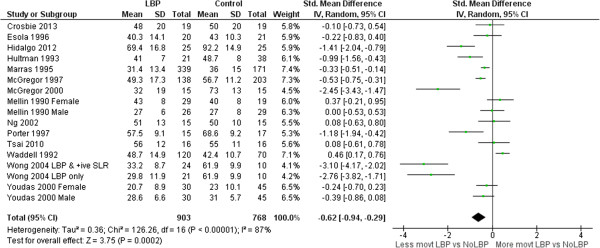
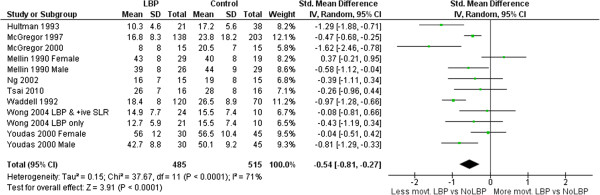
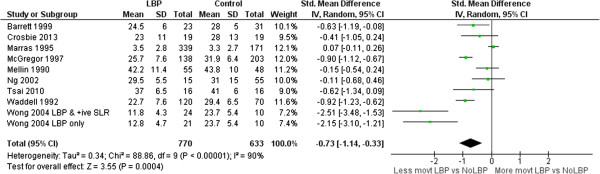
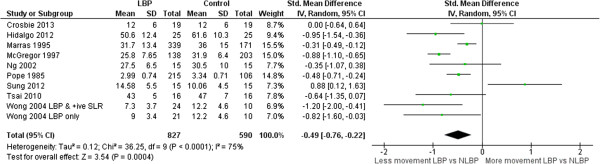
- Pooled analyses showed reduced lumbar ROM in people with LBP versus NoLBP: flexion SMD −0.62 (95% CI −0.94 to −0.29, p < 0.01), extension SMD −0.54 (−0.81 to −0.27, p < 0.01), lateral flexion SMD −0.73 (−1.14 to −0.33, p < 0.01), and rotation SMD −0.49 (−0.76 to −0.22, p = 0.04).
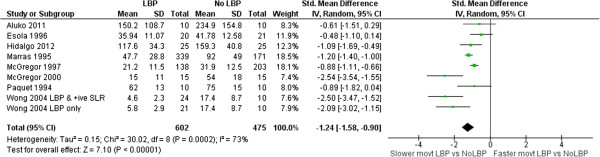
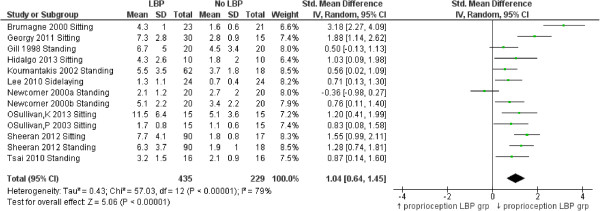
- People with LBP moved more slowly (SMD −1.24, 95% CI −1.58 to −0.90, p < 0.0001) and had poorer proprioception on repositioning accuracy (SMD 1.04, 95% CI 0.64 to 1.45, p < 0.0001).
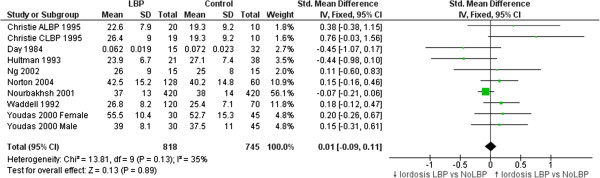
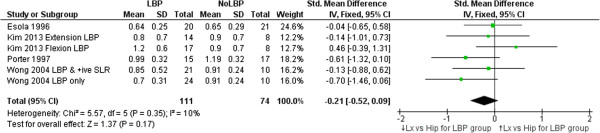
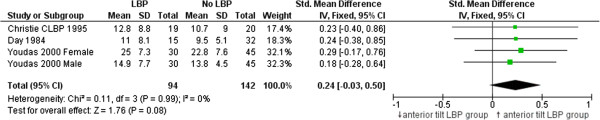
- No significant pooled differences were found for lordosis angle (SMD 0.01, 95% CI −0.09 to 0.11, p = 0.89), lumbar versus hip end-range flexion ROM (SMD −0.21, 95% CI −0.52 to 0.09, p = 0.17), or standing pelvic tilt angle (SMD 0.24, 95% CI −0.03 to 0.50, p = 0.08).
- Within-group variability was significantly greater in the LBP group for flexion, lateral flexion, rotation, and speed/acceleration, with coefficient-of-variation ratios of 1.31 (1.13–1.51), 1.31 (1.17–1.48), 1.20 (1.02–1.40), and 1.28 (1.13–1.46), respectively.
Methods
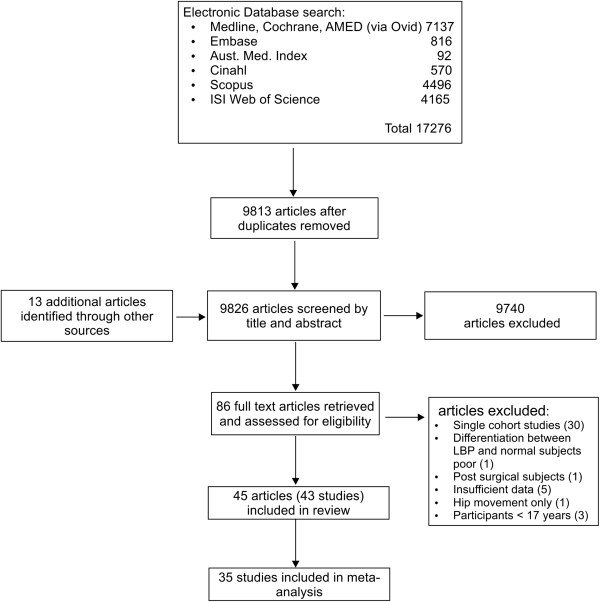
- Systematic review and meta-analysis; eight databases (MEDLINE, Cochrane Central, EMBASE, AMI, CINAHL, Scopus, AMED, ISI Web of Science) were searched from inception until January 2014, yielding 43 eligible studies (45 articles).
- Inclusion required adults >17 years, non-invasive skin-surface measurement, same procedures for LBP and NoLBP groups, and at least one lumbo-pelvic kinematic measure; no specific LBP or control definitions were required.
- Standardised mean differences and 95% confidence intervals were pooled using RevMan, with random-effects models where heterogeneity was indicated; within-group variability was compared using sample-size-weighted coefficients of variation, and Pearson’s r examined effect size versus study quality.
Limitations
- The authors state that they treated people with LBP as a homogeneous group, that findings do not show whether movement changes cause or result from LBP or improve outcomes, that only English-language articles were included, and that broad inclusion criteria likely weakened between-group differences.
- The authors also note considerable heterogeneity across studies, including variable definitions of LBP and NoLBP, and no studies blinded assessors to group status.
- Evident from the text: quality assessment showed only 37% of studies reported standardised movement instructions, 2% reported trained assessors, 17% used the same assessors for both groups, and 0% blinded assessors, which the authors identify as exposing studies to random or systematic error.
Model-written summary. Check it against the paper before relying on it.
Integrity signals
Registry
Cites
Statistics
Figures
Verification
Claims the paper makes
2 Valid · 1 Not valid · 15 Not checked · 61 Own results and interpretations
The cited sources support only part of this claim — read each source’s verdict below.
In the paper
“Astfalk et al. [85] found no differences in average lumbar flexion angle in sitting (reflecting pelvic tilt position) when comparing adolescents with and without LBP (125.3 ± 19.8° vs 130.6° ± 15.7 respectively).”
§ Comparing lumbo-pelvic kinematics in people with and without back pain: a systematic review and meta-analysis > Discussion > Pelvic tilt angle, position and range
What the sources say
- Partly supportedcites [85] Astfalck RG O'Sullivan PB Straker LM Smith AJ Burnett A Caneiro JP Dankaerts W Sitting postures and trunk muscle activity in adolescents with and without nonspecific chronic low back pain: an analysis based on subclassification Spine 2010 35 14 1387 1395 20195206 sourceExperimental — accuracy not yet measured
The Spinal Kinematics section (p. 4) reports no significant difference in sitting spinal posture between adolescents with and without chronic low back pain before the pain group was subdivided. It does not report the cited values of 125.3 ± 19.8° and 130.6 ± 15.7°; it also reports lumbar-angle differences after subgrouping, so the no-difference finding applies to the overall group comparison. (LLM, conf=0.88)
plain- Asserted: passes — The authors put it forward as true.
- Checkable: passes — It can be checked against evidence.
- Load-bearing: passes — The paper’s conclusions depend on it.
- Based: passes — The paper gives a reason why it holds.
- Partly supported
A result the paper reports from its own data — it cites no other source for it, so there is none to check. The quote shows it is in the paper.
In the paper
“A post-hoc meta-analysis of three studies that compared genders indicated that women had greater lordosis angles than men (SMD = 0.92, 95% CI 0.8 to 1.05, p < 0.01).”
§ Comparing lumbo-pelvic kinematics in people with and without back pain: a systematic review and meta-analysis > Results > Movement characteristics
hedgedstates an association- Asserted: passes — The authors put it forward as true.
- Checkable: passes — It can be checked against evidence.
- Load-bearing: unclear — It is unclear whether the paper’s conclusions depend on it.
- Based: passes — The paper gives a reason why it holds.
A result the paper reports from its own data — it cites no other source for it, so there is none to check. The quote shows it is in the paper.
In the paper
“(i) no difference in lordosis angle (8 studies)”
- Also stated in: § Movement characteristics · plain
“The pooled difference (SMD = 0.01, 95% CI -0.09 to 0.11, p = 0.89) was not significant.”
- Also stated in: § Proprioception · plain
“Lordosis*, n = 8 | 0.01 (-0.09 to 0.11), p = 0.89”
§ Comparing lumbo-pelvic kinematics in people with and without back pain: a systematic review and meta-analysis > Abstract > Results
plainn = 8- Asserted: passes — The authors put it forward as true.
- Checkable: passes — It can be checked against evidence.
- Load-bearing: passes — The paper’s conclusions depend on it.
- Based: passes — The paper gives a reason why it holds.
- Also stated in: § Movement characteristics · plain
A result the paper reports from its own data — it cites no other source for it, so there is none to check. The quote shows it is in the paper.
In the paper
“(vi) reduced proprioception (17 studies)”
- Also stated in: § Proprioception · boosted
“A consistent, large and significant reduction in ability to accurately re-position the spine at pre-specified angles for people with LBP compared to those without LBP is shown in Figure 10 (SMD = 1.04, 95% CI 0.64 to 1.45, p < 0.01).”
- Also stated in: § Proprioception · plain
“Proprioception (re-position accuracy)§, n = 12 | 1.04 (0.64 to 1.45), p < 0.0001”
§ Comparing lumbo-pelvic kinematics in people with and without back pain: a systematic review and meta-analysis > Abstract > Results
boostedstates an associationn = 12 ·- Asserted: passes — The authors put it forward as true.
- Checkable: passes — It can be checked against evidence.
- Load-bearing: passes — The paper’s conclusions depend on it.
- Based: passes — The paper gives a reason why it holds.
- Also stated in: § Proprioception · boosted
A result the paper reports from its own data — it cites no other source for it, so there is none to check. The quote shows it is in the paper.
In the paper
“(v) slower movement (8 studies)”
- Also stated in: § Speed/Acceleration · boosted
“A large, significant effect of slower movement in the LBP group was evident (SMD -1.46 95% CI -1.96 to -1.02, p < .01).”
- Also stated in: § Proprioception · plain
“Speed/Acceleration‡, n = 8 | -1.24 (-1.58 to -0.90), p < 0.0001”
§ Comparing lumbo-pelvic kinematics in people with and without back pain: a systematic review and meta-analysis > Abstract > Results
boostedstates an associationn = 8 ·- Asserted: passes — The authors put it forward as true.
- Checkable: passes — It can be checked against evidence.
- Load-bearing: passes — The paper’s conclusions depend on it.
- Based: passes — The paper gives a reason why it holds.
- Also stated in: § Speed/Acceleration · boosted
34 more claims
Create a free account to see all 79 claims and to verify the 2 references still open.
- It may state two separate claims as one. 32
- Probably not a substantial claim. 14
Self-check
Percentages, sums and reported differences re-computed from the paper’s own numbers.
Each contradiction between two passages listed here was confirmed by an independent check.
Rated major: it would touch a result — a value a result rests on, reported and recomputed p-values on opposite sides of the significance level, two passages that conflict with no sign which is right, or a cited work retracted before this paper was published.
In the paper
§ Comparing lumbo-pelvic kinematics in people with and without back pain: a systematic review and meta-analysis > Results > Speed/Acceleration
“A large, significant effect of slower movement in the LBP group was evident (SMD -1.46 95% CI -1.96 to -1.02, p < .01).”
§ Comparing lumbo-pelvic kinematics in people with and without back pain: a systematic review and meta-analysis > Results > Proprioception
“| Speed/Acceleration‡, n = 8 | -1.24 (-1.58 to -0.90), p < 0.0001 |”
Rated major: it would touch a result — a value a result rests on, reported and recomputed p-values on opposite sides of the significance level, two passages that conflict with no sign which is right, or a cited work retracted before this paper was published.
In the paper
§ Comparing lumbo-pelvic kinematics in people with and without back pain: a systematic review and meta-analysis > Results > Lumbar spine versus hip contribution to flexion/extension
“Esola et al. [34] (SMD = -0.86, 95% CI -1.51 to -0.22) and Porter et al. [52] (SMD = -0.71 95% CI -1.43 to 0.00) both found significant reductions of lumbar contribution to mid-range flexion but not at end range.”
§ Comparing lumbo-pelvic kinematics in people with and without back pain: a systematic review and meta-analysis > Discussion > Lumbar versus hip contribution to movement
“This finding is supported by McClure et al. [40], Esola et al. [34] and Porter et al. [52] who all reported relatively greater lumbar through-range contribution in people with LBP on flexion movement.”
Rated minor: it would not touch a result — a value no result rests on, a p-value that stays on the same side of the significance level, or a conflict that is clerical, resolved elsewhere in the paper, or outside its own findings.
In the paper
§ Comparing lumbo-pelvic kinematics in people with and without back pain: a systematic review and meta-analysis > Discussion > Differences in variability between people with and without LBP
“Our assessment of differences in variability between people with and without LBP for nine movement characteristics demonstrated significantly greater variability for four movement characteristics”
§ Comparing lumbo-pelvic kinematics in people with and without back pain: a systematic review and meta-analysis > Results > Differences in variability between groups
“Table 3 presents a summary of the within group variability in movements pooled across studies. Significantly greater variability for people with LBP compared to people without LBP was observed on four of the eight measures: flexion, lateral flexion, rotation and speed/acceleration.”
Rated minor: it would not touch a result — a value no result rests on, a p-value that stays on the same side of the significance level, or a conflict that is clerical, resolved elsewhere in the paper, or outside its own findings.
In the paper
§ Comparing lumbo-pelvic kinematics in people with and without back pain: a systematic review and meta-analysis > Results > Search yield
“No studies attempted blinding of assessors to group status, and only one study reported standardizing instructions to participants.”
§ Comparing lumbo-pelvic kinematics in people with and without back pain: a systematic review and meta-analysis > Results > Search yield
“| 8. | Was a system for standardising movement instructions reported? | 37% |”
Citations
Cites
Preferred Reporting Items for Systematic Reviews and Meta-Analyses: the PRISMA statement
Moher, D., Liberati, A., Tetzlaff, J., Altman, D. G., & for the PRISMA Group (2009) · BMJ · doi:10.1136/bmj.b2535 · Cited by 83,823
Measuring inconsistency in meta-analyses
Higgins, J. P. T., Thompson, S. G., Deeks, J. J., & Altman, D. G. (2003) · BMJ · doi:10.1136/bmj.327.7414.557 · Cited by 63,139 · cited 1×
“A random effects model was used for pooling where fixed effects modeling indicated statistical heterogeneity of the data (Mantel-Haenszel method), as determined by chi-squared and I(2) statistics; otherwise the results of fixed effects modeling was reported [25,26].”
MethodPreferred reporting items for systematic reviews and meta-analyses: The PRISMA statement
Moher, D., Liberati, A., Tetzlaff, J., Altman, D. G., & the PRISMA Group* (2009) · Annals of Internal Medicine · doi:10.7326/0003-4819-151-4-200908180-00135 · Cited by 37,554
Towards complete and accurate reporting of studies of diagnostic accuracy: The STARD Initiative.
Bossuyt, P. M., Reitsma, J. B., Bruns, D. E., Gatsonis, C. A., Glasziou, P. P., Irwig, L. M., Lijmer, J. G., Moher, D., Rennie, D., de Vet, H. C. W., et al. (2003) · Annals of Internal Medicine · doi:10.7326/0003-4819-138-1-200301070-00010 · Cited by 3,219
Towards Complete and Accurate Reporting of Studies of Diagnostic Accuracy: The STARD Initiative
Bossuyt, P. M., Reitsma, J. B., Bruns, D. E., Gatsonis, C. A., Glasziou, P. P., Irwig, L. M., Lijmer, J. G., Moher, D., Rennie, D., & de Vet, H. C. W. (2003) · Radiology · doi:10.1148/radiol.2261021292 · Cited by 3,215
Towards complete and accurate reporting of studies of diagnostic accuracy: the STARD initiative
Bossuyt, P. M., Reitsma, J. B., Bruns, D. E., Gatsonis, C. A., Glasziou, P. P., Irwig, L. M., Lijmer, J. G., Moher, D., Rennie, D., & de Vet, H. C. W. (2003) · BMJ · doi:10.1136/bmj.326.7379.41 · Cited by 3,215
Davis, H. S. (1966) · JAMA: The Journal of the American Medical Association · doi:10.1001/jama.1966.03100200106038 · Cited by 1,719
Diagnosis and Treatment of Movement Impairment Syndromes
Sahrmann, S. A. (2001) · Cited by 1,257
O’Sullivan, P. (2005) · Manual Therapy · doi:10.1016/j.math.2005.07.001 · Cited by 985
Evaluation of QUADAS, a tool for the quality assessment of diagnostic accuracy studies
Whiting, P. F., Weswood, M. E., Rutjes, A. W., Reitsma, J. B., Bossuyt, P. N., & Kleijnen, J. (2006) · BMC Medical Research Methodology · doi:10.1186/1471-2288-6-9 · Cited by 769 · cited 1×
“assessment tools [20-22].”
Research works printed but not linked: 4
- McKenzie R May S Lumbar Spine, Mechanical Diagnosis and Therapy 2003 2 Waikanae, New Zealand: Spinal Publications Ltd
- Schober P The lumbar vertebral column and back ache Munch Med Wochenschr 1937 84 336
- The NCBI Handbook (internet) 2013 2 Betheseda (MD): National Centre for Biotechnology Information (US) http://www.ncbi.nlm.nih.gov/mesh
- The Cochrane Collaboration Review Manager (RevMan) (computer program). Version 5.2 2012 Copenhagen: The Nordic Cochrane Centre, The Cochrane Collaboration
Cited by
Items 201–300 of 407
Zawadka, M., Smółka, J., Skublewska‐Paszkowska, M., Łukasik, E., Jabłoński, M., & Gawda, P. (2022) · Ergonomics · doi:10.1080/00140139.2022.2061051 · Cited by 10
“…be that people with LBP should be classified into subgroups by the pain provoked by movement (flexion/extension), As was suggested by Kim et al. (2013) and Laird et al. (2014) lower movement speed is commonly seen in people with LBP and has been linked to a fear of movement (Thomas et al. 2008).”
BackgroundThiry, P., Nocent, O., Buisseret, F., Bertucci, W., Thévenon, A., & Simoneau-Buessinger, É. (2022) · Entropy · doi:10.3390/e24040437 · Cited by 11
“A systematic review and meta-analysis of 43 studies analysed and compared lumbopelvic kinematics in participants with and without LBP [12].”
BackgroundShokouhyan, S. M., Davoudi, M., Hoviattalab, M., Abedi, M., Bervis, S., Parnianpour, M., Brumagne, S., & Khalaf, K. A. (2022) · Frontiers in Bioengineering and Biotechnology · doi:10.3389/fbioe.2022.1078805 · Cited by 7
Bayartai, M.-E., Taulaniemi, A., Tokola, K., Vähä‐Ypyä, H., Parkkari, J. P., Husu, P., Kankaanpaa, M. J., Vasankari, T. J., Bauer, C. M., & Luomajoki, H. A. (2023) · Journal of Electromyography and Kinesiology · doi:10.1016/j.jelekin.2023.102744 · Cited by 9
Gombatto, S. P., Bailey, B., Bari, M., Bouchekara, J., Holmes, A. J., Lenz, S., Simmonds, K., Vonarb, A., Whelehon, K., Batalla, C. R., et al. (2024) · Physical Therapy · doi:10.1093/ptj/pzad185 · Cited by 11
la Cruz, S. P. (2024) · Sports · doi:10.3390/sports12070190 · Cited by 6
A Critical Review of Trunk and Hip Exercise Prescription: Applying Evidence for a Modern Approach
Short, S., Short, G., Lehman, G., Friesen, J., & Johnson, B. (2025) · International Journal of Sports Physical Therapy · doi:10.26603/001c.129972 · Cited by 8
Koo, S. H., Cho, H.-S., Song, J., Lee, G., Cho, Y., Chang, S., Choi, Y., Kim, Y. C., Chung, J., & Park, Y. (2025) · Fashion and Textiles · doi:10.1186/s40691-025-00445-8 · Cited by 7
“In older women, age-related muscle weakness and hormonal changes lead to decreased lumbopelvic mobility, which in turn restricts lower limb movement and results in functional limitations in daily life (Laird et al., 2014; Suzuki et al., 2016).”
Miyachi, R., Tanaka, M., Morikoshi, N., Yoshizawa, T., & Nishimura, T. (2022) · Journal of Bodywork and Movement Therapies · doi:10.1016/j.jbmt.2022.02.014 · Cited by 6
Gordon, S., Kind, O., Singh, G., Wood, A., & Gallina, A. (2022) · Musculoskeletal Science and Practice · doi:10.1016/j.msksp.2022.102713 · Cited by 5
Lathlean, T. J. H., Ramachandran, A. K., Sim, S., & Whittle, I. R. (2024) · Journal of Clinical Neuroscience · doi:10.1016/j.jocn.2024.110877 · Cited by 9
“The level of neurophysiological skill, number of personnel, type and location of equipment required and levels of supervision required to perform prospective clinical trials that incorporate sEMG as an outcome measure will be significant [29].”
InfluentialEllapen, T. J., Strydom, G. L., & Swanepoel, M. (2017) · Boloka Institutional Repository (North-west University) · Cited by 6
Haddas, R., Samocha, Y., & Yang, J. (2019) · Global Spine Journal · doi:10.1177/2192568219885898 · Cited by 7
Starzec‐Proserpio, M., & Vandyken, C. (2022) · Physiotherapy Theory and Practice · doi:10.1080/09593985.2022.2069618 · Cited by 10
Assessing Time-Varying Lumbar Flexion–Extension Kinematics Using Automated Pose Estimation
Goncharow, P. N., & Beaudette, S. M. (2022) · Journal of Applied Biomechanics · doi:10.1123/jab.2022-0041 · Cited by 6
Sharma, H., Karan, S. S., Agrawal, A. K., & Vemuri, K. (2022) · Biomedical Signal Processing and Control · doi:10.1016/j.bspc.2022.104517 · Cited by 9
Rum, L., Russo, Y., Vannozzi, G., & Macaluso, A. (2023) · Human Movement Science · doi:10.1016/j.humov.2023.103094 · Cited by 6
Eddine, H. K., Saleh, S., Hajjar, J., Harati, H., Nasser, Z., Desoutter, A., Ahmar, E. A., & Estephan, E. (2023) · Heliyon · doi:10.1016/j.heliyon.2023.e18952 · Cited by 6
“It has been demonstrated to be a strong mechano-morphological predictor of some lumbar pathologies [10], and a potential determinant in lower back pain (LBP) [11].”
BackgroundInfluentialSpinal fusion without instrumentation – Experimental animal study
Reitmaier, S., Schuelke, J., Schmidt, H., Volkheimer, D., Ignatius, A. A., & Wilke, H. (2017) · Clinical Biomechanics · doi:10.1016/j.clinbiomech.2017.04.008 · Cited by 6
“Low back pain patients were shown to have reduced lumbar RoM compared to asymptomatic people (Laird et al. 2014).”
BackgroundSung, P. S., Schalk, B. M., Latuszek, N., & Hosmer, E. E. (2019) · Gait & Posture · doi:10.1016/j.gaitpost.2019.10.040 · Cited by 6
Wattananon, P., Sinsurin, K., & Somprasong, S. (2019) · Hong Kong Physiotherapy Journal · doi:10.1142/s1013702520500043 · Cited by 8
“This systematic review also demonstrated consistent ̄ndings for reduced lumbar velocity during this task.(11) Researchers interpreted slow lumbar velocity as an indicator of coping strategy to minimize excessive lumbar motion.”
BackgroundDevecchi, V., Gallina, A., Heneghan, N. R., Rushton, A., & Falla, D. (2019) · BMJ Open · doi:10.1136/bmjopen-2019-033276 · Cited by 7
Effects of dual-task conditions on cervical spine movement variability
Niederer, D., Vogt, L., Vogel, J., & Banzer, W. B. (2017) · Journal of Back and Musculoskeletal Rehabilitation · doi:10.3233/bmr-169699 · Cited by 6
“However, the definitive allocation of the CV and its dual-task triggered changes in either noise in sensory and motor processing [1] or sensori-motor integration functional features of the neuromuscular system [2] nevertheless still be of particular interest.”
Alcaraz-Clariana, S., García-Luque, L., Garrido-Castro, J. L., Carmona-Pérez, C., Rodrigues‐de‐Souza, D. P., Pineda, M. L. L., & Alburquerque‐Sendín, F. (2024) · Journal of Biomechanics · doi:10.1016/j.jbiomech.2024.112438 · Cited by 5
Jordán-López, J., Arguisuelas, M. D., Doménech, J., Peñalver-Barrios, M. L., Miragall, M., Herrero, R., Baños, R., Amer-Cuenca, J. J., & Lisón, J. F. (2025) · Journal of NeuroEngineering and Rehabilitation · doi:10.1186/s12984-025-01664-2 · Cited by 5
“Finally, a meta-analysis investigated the coefficient of variance among patients with and without LBP during lumbar flexion, extension, rotation, and inclination movements and concluded that lumbar flexion was the most affected movement in the presence of LBP [8].”
Effect of Limited Ankle Dorsiflexion on Lower Limbs and Trunk Kinematics During Squatting
Zawadka, M., Smółka, J., Skublewska‐Paszkowska, M., Łukasik, E., & Gawda, P. (2025) · Journal of Manipulative and Physiological Therapeutics · doi:10.1016/j.jmpt.2025.10.050 · Cited by 6
Three-Dimensional Spinal and Pelvic Alignment as Determinants of Anticipatory Core Muscle Activation
Abdellatif, M. M., Moustafa, I. M., Alsubiheen, A. M., Aldaihan, M. M., & Khowailed, I. A. (2025) · Journal of Clinical Medicine · doi:10.3390/jcm14238432 · Cited by 8
“Systematic reviews also demonstrate that altered lumbopelvic kinematics are associated with impaired movement coordination and increased compensatory muscle overuse [18].”
Kinematic comparison between people with and without low back pain during functional activities
Dambadarjaa, B., Khuyagbaatar, B., Bayartai, M.-E., Purevsuren, T., Shambaljamts, T., & Kim, Y. H. (2024) · Journal of Mechanical Science and Technology · doi:10.1007/s12206-024-2208-0 · Cited by 6
Frasie, A., Massé‐Alarie, H., Bielmann, M., Gauthier, N., Roudjane, M., Pagé, I., Gosselin, B. J., Roy, J., Messaddeq, Y., & Bouyer, L. J. (2024) · Sensors · doi:10.3390/s24144510 · Cited by 5
Beange, K. H. E., Chan, A. D. C., & Graham, R. B. (2024) · Journal of Biomechanics · doi:10.1016/j.jbiomech.2024.112415 · Cited by 5
Tufail, M., Lee, H., Moon, Y., Kim, H., & Kim, K. (2022) · Applied Sciences · doi:10.3390/app12094687 · Cited by 6
Trunk Alignment in Physically Active Young Males with Low Back Pain
Plandowska, M., Kędra, A., Kędra, P., et al. (2022) · Journal of Clinical Medicine · doi:10.3390/jcm11144206 · Cited by 5
“Similar findings were reported in other studies [18,19].”
BackgroundResultGouteron, A., Moissenet, F., Tabard-Fougère, A., Rose-Dulcina, K., Genevay, S., Laroche, D., & Armand, S. (2024) · Scientific Reports · doi:10.1038/s41598-024-72924-9 · Cited by 6
Takahashi, Y., & Yamaji, T. (2020) · Journal of Physical Therapy Science · doi:10.1589/jpts.32.233 · Cited by 6
Wattananon, P., Silfies, S. P., & Wang, H.-K. (2021) · Journal of Back and Musculoskeletal Rehabilitation · doi:10.3233/bmr-200308 · Cited by 5
Pfluegler, G., Klinger, M., Ley, C., Luedtke, K., Schüßler, B., & Sturma, A. (2025) · BMJ Open · doi:10.1136/bmjopen-2024-091206 · Cited by 5
“12 Similarly, the Movement Quality Model posits that movement quality is influenced by an interactive process involving multidimensional factors, including spatial and temporal aspects.”
Abdel-aziem, A. A., & Elzaki, A. A. (2022) · International Journal of Therapy and Rehabilitation · doi:10.12968/ijtr.2021.0003 · Cited by 5
Aranceta-Garza, A., Russo, A., D’Emanuele, S., et al. (2021) · Frontiers in Physiology · doi:10.3389/fphys.2021.743730 · Cited by 4
Zawadka, M., Smółka, J., Skublewska‐Paszkowska, M., Łukasik, E., Zieliński, G., & Gawda, P. (2023) · Acta of Bioengineering and Biomechanics · doi:10.37190/abb-02211-2023-03 · Cited by 4
“Despite the fact that the spine can be excessively flexed during sitting and lifting tasks, less spine mobility was also observed in people with LBP in other research, which can be related to different LBP sub-types [16], [17].”
BackgroundGarcía-Dopico, N., Terrasa, J. L., González‐Roldán, A. M., Roldán, O. V., & Sitges, C. (2024) · Journal of Pain · doi:10.1016/j.jpain.2024.01.349 · Cited by 4
Lumbar Paravertebral Muscle Pain Management Using Kinesitherapy and Electrotherapeutic Modalities
Silişteanu, S. C., Antonescu, E., DUICA, L. C., Totan, M., Cucu, A. I., & Costea, A. I. (2024) · Healthcare · doi:10.3390/healthcare12080853 · Cited by 23
“…to pain or pain-related suffering, and on the other hand, the effect of root compression on the severity of paraspinal muscle degeneration, and is characterized by low mobility of the lumbar spine [14,15], the impairment of muscle contraction [15] and the inability to achieve trunk flexion [16,17].”
BackgroundThe Components of Lumbar Motor Control Are Not Inter-related.
Miyachi, R., Nagamori, Y., Kanazawa, Y., & Yamazaki, T. (2024) · PubMed Central · Cited by 4
Miyachi, R., Nagamori, Y., Kanazawa, Y., Kitagawa, T., & Yamazaki, T. (2025) · Human Movement Science · doi:10.1016/j.humov.2025.103321 · Cited by 4
How reproducible do we stand and sit? Indications for a reliable sagittal spinal assessment
Pan, F., Zander, T., Reitmaier, S., Bashkuev, M., & Schmidt, H. (2019) · Clinical Biomechanics · doi:10.1016/j.clinbiomech.2019.08.011 · Cited by 7
Elliott, B. J., Hookway, N., Tate, B. M., et al. (2021) · Gait & Posture · doi:10.1016/j.gaitpost.2021.02.012 · Cited by 4
Hwang, L.-K., & Kim, S.-Y. (2022) · Physical Therapy Korea · doi:10.12674/ptk.2022.29.1.37 · Cited by 4
Skallerud, A., Brumbaugh, A., Fudalla, S., Parker, T., Robertson, K., & Pepin, M.-E. (2022) · Journal of Dance Medicine & Science · doi:10.12678/1089-313x.091522f · Cited by 6
Ranjbar, P., Davarian, S., Mohammadi, M., Ghotbi, N., & Rezaeian, T. (2023) · Journal of Bodywork and Movement Therapies · doi:10.1016/j.jbmt.2023.04.027 · Cited by 6
Early Clinical Results of Intervertebral Joint Stabilization by Injectable Load-Sharing Polymers
Hedman, T. P., Yu, J., Singh, H., et al. (2023) · Journal of Pain Research · doi:10.2147/jpr.s413104 · Cited by 4
Widerström, B., Olofsson, N., Boström, C., & Rasmussen-Barr, E. (2016) · Manual Therapy · doi:10.1016/j.math.2016.01.002 · Cited by 5
Bayartai, M.-E., Tringali, G., Micheli, R. D., Danielewicz, A. L., & Sartório, A. (2024) · Journal of Clinical Medicine · doi:10.3390/jcm13185614 · Cited by 3
“Reduced lumbar flexibility is also associated with LBP [43].”
BackgroundErol, E., Burak, M., & Elbasan, B. (2025) · Journal of Back and Musculoskeletal Rehabilitation · doi:10.1177/10538127241309343 · Cited by 5
“24 In addition, studies show that proprioception, 25 endurance, 26 and low back awareness 27 decrease while disability increases 28 in individuals with LBP.”
Ippersiel, P., Côté‐Picard, C., Roy, J., & Massé‐Alarie, H. (2025) · European Journal of Pain · doi:10.1002/ejp.70006 · Cited by 4
“Motor behaviours, including ROM and muscle relaxation (FRP ratios), were similar to healthy individuals (Gouteron et al. 2022; Laird et al. 2014; Thomas et al. 1998).”
3D motion capture data into a kinematic composite score for assessing musculoskeletal impairments
Archibeck, E. S., Halvorson, R. T., Silvestros, P., et al. (2025) · Journal of Biomechanics · doi:10.1016/j.jbiomech.2025.112725 · Cited by 3
“For example, in chronic low back pain (LBP) patients, the highest prevalent MSK condition globally (Wu et al., 2020), lumbar range of motion and higher order trunk kinematics (maximum velocity, acceleration) are frequently studied (Laird et al., 2014; Lehman, 2004; Poitras et al., 2000).”
Chen, Y., & Zhang, L.-P. (2025) · Applied Sciences · doi:10.3390/app15137239 · Cited by 7
Lumbopelvic Kinematics During Functional Tasks in a Chronic Low Back Pain Observational Cohort
Bell, K. M., Roos, R. E., Alfikri, Z. F., Anderst, W. J., Bailes, A. H., Clark, W. W., Cook, H. A., Darwin, J., Johnson, M. E., McKernan, G., et al. (2025) · JOR Spine · doi:10.1002/jsp2.70117 · Cited by 4
Wade, L., McGuigan, M. P., McKay, C. D., et al. (2022) · BMJ Open · doi:10.1136/bmjopen-2022-066959 · Cited by 3
Williams, A. C. D. C., Buono, R. A., Gold, N., Olugbade, T., & Bianchi‐Berthouze, N. (2023) · European Journal of Pain · doi:10.1002/ejp.2195 · Cited by 3
“Movement characteristics between people with and without low back pain overlap but vary substantially (Knechtle et al., 2021; Laird et al., 2014; Laird et al., 2019) in speed, range, flexion-relaxation response, and lum-bo-pelvic synchrony (Laird et al., 2018), inside and outside clinic settings…”
BackgroundBrandt, M., Danneels, L. A., Meirezonne, H., Oosterwijck, J. V., Willems, T. M., & Matheve, T. (2024) · Musculoskeletal Science and Practice · doi:10.1016/j.msksp.2024.102953 · Cited by 5
González-de-la-Flor, Á., García-Arrabé, M., Fernández-Pardo, T. E., & Cotteret, C. (2024) · European Journal of Physical and Rehabilitation Medicine · doi:10.23736/s1973-9087.24.08378-3 · Cited by 4
Miyachi, R., Nishimura, T., Noguchi, M., Goda, A., Takeda, H., Takeshima, E., Kanazawa, Y., Imai, T., & Tanaka, W. (2025) · Journal of Functional Morphology and Kinesiology · doi:10.3390/jfmk10010030 · Cited by 4
“The reason for no significant difference in lumbar proprioception could be due to sample size, and this result is consistent with that of previous studies [37], which showed that proprioception-based control is less likely to occur when the sympathetic nervous system is dominant.”
What Is the Association between an Anteriorly Tilted Pelvis and Trendelenburg Gait?
Paul, Y., Swanepoel, M., Ellapen, T. J., Barnard, M., Hammill, H. V., Müller, R. W., & Williams, J. (2018) · Open Journal of Orthopedics · doi:10.4236/ojo.2018.812048 · Cited by 4
“Lower back pain (LBP) is a common, painful and costly medical condition adversely impacting society, which can be traced backed to Imhotep (2800 BC) [1] [2].”
BackgroundInfluentialDíaz, J. G., Montes, J. V., & Díez, M. E. R. (2020) · Rehabilitación · doi:10.1016/j.rh.2020.02.003 · Cited by 3
Miyachi, R., Sano, A., Tanaka, N., Tamai, M., & Miyazaki, J. (2022) · The Journal of Medical Investigation · doi:10.2152/jmi.69.38 · Cited by 3
“(10) reported that individuals with LBP had decreased proprioception due to repositioning compared with individuals without LBP.”
BackgroundHow do people with chronic low back pain pick a pencil off the floor?
Kendell, M., Smith, A. J., O’Sullivan, P., Beales, D. J., Chan, J., Li, K. M., McMullan, M., Smith, K., & Rabey, M. I. (2022) · Physiotherapy Theory and Practice · doi:10.1080/09593985.2022.2120374 · Cited by 3
“This heterogeneity supports a previous description of high movement variability among people with CLBP (Laird, Gilbert, Kent, and Keating, 2014) and highlights the importance of individualized movement evaluation.”
BackgroundResultInfluentialHipervigilância postural e percepção da postura correta sentada em indivíduos com e sem dor lombar
de Oliveira, E. L., Coutinho, P. F. F., Braga, U. M., et al. (2022) · Revista Brasileira de Ortopedia · doi:10.1055/s-0042-1756154 · Cited by 3
Expressed Beliefs about the Cause of Pain in a Pediatric Population: A Qualitative Study
Fernández, L. M., Salvat, I., & Adillón, C. (2023) · Children · doi:10.3390/children10061007 · Cited by 9
Functional analysis of postural spinal and pelvic parameters using static and dynamic spinometry
Bode, T., Zoroofchi, S., Vettorazzi, E., et al. (2024) · Heliyon · doi:10.1016/j.heliyon.2024.e29239 · Cited by 3
“It has been shown in previous studies that dynamic testing is more informative about the risk of back pain than static testing methods [ [48]], making dynamic spinometry particularly interesting for clinicians.”
ResultWas stimmt nicht mit der Osteopathie?
Thomson, O. P., & MacMillan, A. (2023) · Osteopathische Medizin · doi:10.1016/s1615-9071(23)00074-6 · Cited by 3
Stępień, A., Guzek, K., Rekowski, W., et al. (2016) · Advances in Rehabilitation · doi:10.1515/rehab-2015-0047 · Cited by 3
“other musculoskeletal system disorders [4, 5, 6, 7, 8, 9] and Parkinson’s disease [10] as well as in scoliotic youth [11].”
BackgroundInfluentialMuthuri, S. G., Pavlova, A. V., Saunders, F. R., Hardy, R., Gregory, J. S., Barr, R. J., Martin, K. R., Adams, J. E., Kuh, D. J., Aspden, R. M., et al. (2018) · Scientific Reports · doi:10.1038/s41598-018-34628-9 · Cited by 3
Pain and functional limitation among rural female Gambian head-load carriers a cross-sectional study
Hiestand-Saho, M., Sidibeh, P., & Ernst, M. J. (2020) · European Journal of Physiotherapy · doi:10.1080/21679169.2020.1788637 · Cited by 3
“Considering the current sample, performance tests for the lower back might be considered [39].”
BackgroundWhat are the back beliefs of NHS employees, and does manual handling training influence them
Nolan, D., Sharpe, N., O’Sullivan, K., Stephenson, J. R., O’Sullivan, P., & Lucock, M. P. (2021) · European Journal of Physiotherapy · doi:10.1080/21679169.2021.1873417 · Cited by 4
“While this needs further investigation, there is a building body of literature supporting that people with persistent LBP unhelpfully protect and guard their back, mov‐ ing more cautiously than people without LBP [24,25].”
BackgroundDevecchi, V., Falla, D., Cabral, H. V., & Gallina, A. (2021) · Systematic Reviews · doi:10.1186/s13643-021-01831-1 · Cited by 5
Saito, H., Takasaki, H., Watanabe, Y., Kutsuna, T., Futohashi, T., Kubo, M., Kusumoto, Y., & Tiba, H. (2020) · medRxiv · doi:10.1101/2020.04.07.20053538 · Cited by 2
Ho-A-Tham, N., Ting-A-Kee, B., Struyf, N., Mello, J. D. A., Dankaerts, W., & Vanlandewijck, Y. (2023) · Quality of Life Research · doi:10.1007/s11136-023-03363-8 · Cited by 5
Chen, Z., Tirosh, O., Han, J., Adams, R. D., El‐Ansary, D., & Pranata, A. (2024) · Frontiers in Bioengineering and Biotechnology · doi:10.3389/fbioe.2024.1351913 · Cited by 2
Kongoun, S., Klahan, K., Rujirek, N., Vachalathiti, R., Richards, J., & Wattananon, P. (2024) · Scientific Reports · doi:10.1038/s41598-024-72128-1 · Cited by 5
“Although kinematic studies demonstrated differences in the quality of movement during trunk flexion, a systematic review showed differences in movement speed which would influence kinematic patterns 13 .”
BackgroundChawla, J. K., Sushil, P., Kumar, P., Singh, M. P., & Sharma, R. (2024) · Scientific Reports · doi:10.1038/s41598-024-69063-6 · Cited by 4
Nishimura, T., Tanaka, M., Morikoshi, N., Yoshizawa, T., & Miyachi, R. (2025) · Healthcare · doi:10.3390/healthcare13101135 · Cited by 4
“Previous studies have compared LPR between individuals with and without LBP and reported significant alterations in the timing and contribution of spinal and pelvic movements in patients with LBP [16,18].”
Rahman, N. A. A., Yusof, M. I., & Shaharudin, S. (2025) · Annals of Medicine · doi:10.1080/07853890.2025.2525402 · Cited by 2
Homs, A., Pionnier, R., Cohen-Aknine, G., Torre, K., Fagart, W., & Dupeyron, A. (2025) · Pain · doi:10.1097/j.pain.0000000000003797 · Cited by 2
“18 Central to the experience of back and neck pain are changes in spinal motor behaviour (SMB), including decreased amplitude and velocity of movement, 54,65 increased trunk muscle activity, 32,57 and altered variability in motor output.”
Foster, K., Wang-Price, S. S., Weber, M. D., Brizzolara, K. J., Yuan, X., Boeth, R., & Rhon, D. I. (2025) · Physical Therapy · doi:10.1093/ptj/pzaf122 · Cited by 2
Migliorini, F., Schäfer, L., Simeone, F., Memminger, M. K., Eschweiler, J., & Vaishya, R. (2026) · European journal of medical research · doi:10.1186/s40001-026-04084-7 · Cited by 4
Sex Difference in the Range of Pelvic Tilt in Sitting and Standing Among Korean Young Adults
Yoon, J. (2020) · Physical Therapy Korea · doi:10.12674/ptk.2020.27.2.149 · Cited by 2
Rahimi, A. (2020) · Biomedical Journal of Scientific & Technical Research · doi:10.26717/bjstr.2020.28.004697 · Cited by 2
Effect of Age on Thoracic, Lumbar, and Pelvis Coordination During Trunk Flexion and Extension
Kakar, R. S., Higgins, S., Tome, J. M., Knight, N., Finer, Z., Doig, Z., & Li, Y. (2022) · Journal of Applied Biomechanics · doi:10.1123/jab.2021-0281 · Cited by 2
van Dijk, M., van der Wal, A. M., Mollema, J., Visser, B., Kiers, H., Heerkens, Y. F., & der Sanden, M. W. G. N. (2023) · BMC Musculoskeletal Disorders · doi:10.1186/s12891-023-06784-1 · Cited by 2
“Associations between constructs LBP reduces velocity of movement [24, 42].”
BackgroundResultJency Thangasheela, G., Vinodhkumar, R., Manikumar, M., Franklin Saju, M. K., Aroona, A., Macklin Abraham Navamani, J., Krishnan, M., & Babu, S. (2023) · Journal Of Advanced Zoology · doi:10.17762/jaz.v44is-3.1663 · Cited by 5
“…exercise has a role in the reduction of pain by increased plasma concentration level of beta endorphins and activation of ergoreceptors (the ending of delta fibers) which stimulate enkephalinergic nerve cells in the thalamus which decrease the pain and improve functional activities [20].”
BackgroundSon, S., Yoo, B. R., & Jeong, Y. M. (2024) · Digital Health · doi:10.1177/20552076231218154 · Cited by 3
“Various physical factors, including nerve, bone, muscle, joint, and ligaments, and non-physical factors, such as occupation, lifestyle or posture related to biomechanics, and psychological status, are linked to the source of LBP. 10,11 While 15% – 30% of LBP has a speci fi c medical etiology, the remaining portion is c…”
BackgroundInfluentialEffects of non-specific low back pain on static balance in emerging adults
Lomond, K. V., & Sansom, J. K. (2024) · Physiotherapy Theory and Practice · doi:10.1080/09593985.2024.2364805 · Cited by 2
“…increasing complexity (e.g., unstable surface, eyes closed, etc.), persons with CLBP typically demonstrate increased postural sway compared to controls (Koch and Hänsel, 2019; Ruhe, Fejer, and Walker, 2011) potentially due to reduced proprioceptive input (Laird, Gilbert, Kent, and Keating, 2014).”
Relationship of Lumbar Lordosis With Non-specific Acute Low Back Pain
Singh, S. K., Singh, V. P., & Jain, S. (2024) · Cureus · doi:10.7759/cureus.72453 · Cited by 2
“Earlier reports have also stated no association of lordosis with back pain [12,17-18].”
A comparative analysis of physical fitness of children and adolescents with HIV infection
de Medeiros, R. C. D. S. C., dos Santos, Í. K., de Goes, C. J. D., et al. (2019) · Medicine · doi:10.1097/md.0000000000018206 · Cited by 2
“This tool is based on other studies with the same population that used the Cochrane criteria for observational studies and the NIH tool for observational and cohort studies and cross-sectional studies.([12,13])”
BackgroundMethodReuter, P. R., & Brady, M. (2023) · Journal of Orthopedics and Orthopedic Surgery · doi:10.29245/2767-5130/2023/3.1185 · Cited by 2
Cañeiro, J. P., Labie, C., Sulley, E., Briggs, A. M., Straker, L. M., Burnett, A., & O’Sullivan, P. (2015) · Manual Therapy · doi:10.1016/j.math.2015.12.009 · Cited by 2
The Back Pain and Movement (B-PAM) registry; a study protocol
Desai, M. J., Jonely, H., Blackburn, M., Wanasinghage, S., Sheikh, S., & Taylor, R. S. (2019) · BMC Musculoskeletal Disorders · doi:10.1186/s12891-019-2625-x · Cited by 3
Lathlean, T. J. H., Ramachandran, A. K., Sim, S., & Whittle, I. R. (2022) · BMJ Open · doi:10.1136/bmjopen-2021-058652 · Cited by 2
Huang, T.-Z., & Kim, S.-Y. (2022) · BMC Sports Science Medicine and Rehabilitation · doi:10.1186/s13102-022-00506-1 · Cited by 3
“Patients with LBP have reduced lumbar ROM and proprioception with slower motion than healthy individuals, [31].”
BackgroundYokoyama, S., NEJISHIMA, M., Higuchi, T., et al. (2022) · International Journal of Physiotherapy and Research · doi:10.16965/ijpr.2022.169 · Cited by 2
“When the LPR pattern is interrupted, mechanical stress on the lumbar region increases, which can cause lower back pain [2].”
BackgroundThe Good, the Bad and the Ugly: Spinal Posture
Mingels, S. (2023) · Journal of Biomedical Research & Environmental Sciences · doi:10.37871/jbres1711 · Cited by 2
Metadata
- Authors
- Laird, R. A., Gilbert, J., Kent, P., & Keating, J. L.
- Affiliations
- Monash University (AU)
- University of Southern Denmark (DK)
- Corresponding author
- Laird, Robert A
- Venue
- BMC Musculoskeletal Disorders
- Published
- 2014-07-10
- Volume
- 15
- Issue
- 1
- Pages
- 229-229
- ISSN
- 1471-2474 (ISSN-L)
- PMC
- PMC4096432
- OpenAlex
- W2010688137
- Cited by
- 443
- References
- 96
- Citations by year
- 2026: 30 · 2025: 49 · 2024: 52 · 2023: 50 · 2022: 58 · 2021: 48 · 2020: 36 · 2019: 37 · 2018: 26 · 2017: 28 · 2016: 20 · 2015: 9
- FWCI
- 2.54
- Type
- journal article
- Language
- en
- Open access
- gold
- doi.org
- Licence
- Locations
- BMC Musculoskeletal Disorders (publishedVersion, cc-by)
- PubMed Central (publishedVersion, cc-by)
- PubMed (publishedVersion)
- University of Southern Denmark Research Portal (University of Southern Denmark) (publishedVersion)
- eSpace (Curtin University) (submittedVersion, cc-by)
- Topics
- Health Sciences › Health Professions › Physical Therapy, Sports Therapy and Rehabilitation › Musculoskeletal pain and rehabilitation
- Health Sciences › Medicine › Orthopedics and Sports Medicine › Spine and Intervertebral Disc Pathology
- Health Sciences › Medicine › Obstetrics and Gynecology › Pregnancy-related medical research
- Keywords
- low back pain, lumbar range of motion, lumbar lordosis, pelvic tilt, lumbar proprioception, movement speed, movement variability
- MeSH terms
- Biomechanical Phenomena, Humans, Lordosis, Lumbar Vertebrae, Pelvis, Posture, Proprioception, Chi-Square Distribution, Range of Motion, Articular, Low Back Pain
About these checks
Registry, retraction, Cites and statistics results are computed, not judged, with one exception: a printed reference that no index lists is read once by a model before it counts as a citation error. Claims are extracted by a model and kept only when their quote appears verbatim in the text; each cited source is then checked, with a model’s help, for whether it says what the claim relies on. Those verdicts can be wrong — read the claim’s quote and the cited source before relying on one.
The claim verdicts this report counts are experimental: their accuracy is not yet measured.
A language model drew the claims from the paper on 2026-10-04, under version 3 of the claim definition (model deepseek-v4.1-flash, prompt extract-v3).
A second model labelled each claim on 2026-10-04 (model jev-1.13-20260917, definition revision gold-guideline-v0.2).
Cited sources are checked with a language model’s help (gpt-6-sol).
Statistics and arithmetic are recomputed, not judged.
Confidence bands are shown only for fields calibrated on our annotated test set. None is calibrated yet, so no band is shown.
What counts as a claim ›How we measure confidence ›How we check this ›
Are you an author, or do you see a problem with this page? Request a review
Data sources
Bibliographic data: Semantic Scholar, OpenAlex, Crossref.
Contains information from the Semantic Scholar Academic Graph Datasets, made available under the ODC Attribution License (ODC-BY 1.0).
Semantic Scholar’s data is described in: Kinney, R., et al. (2023). The Semantic Scholar Open Data Platform. arXiv:2301.10140.
