

Comparing lumbo-pelvic kinematics in people with and without back pain: a systematic review and meta-analysis
Open accessThe DOI matches its Crossref record; 93 of the 96 references it cites were found in a registry or an index; 3 of the 29 sources its claims cite were checked for support.
Abstract
BACKGROUND: Clinicians commonly examine posture and movement in people with the belief that correcting dysfunctional movement may reduce pain. If dysfunctional movement is to be accurately identified, clinicians should know what constitutes normal movement and how this differs in people with low back pain (LBP). This systematic review examined studies that compared biomechanical aspects of lumbo-pelvic movement in people with and without LBP. METHODS: MEDLINE, Cochrane Central, EMBASE, AMI, CINAHL, Scopus, AMED, ISI Web of Science were searched from inception until January 2014 for relevant studies. Studies had to compare adults with and without LBP using skin surface measurement techniques to measure lumbo-pelvic posture or movement. Two reviewers independently applied inclusion and exclusion criteria, and identified and extracted data. Standardised mean differences and 95% confidence intervals were estimated for group differences between people with and without LBP, and where possible, meta-analyses were performed. Within-group variability in all measurements was also compared. RESULTS: The search identified 43 eligible studies. Compared to people without LBP, on average, people with LBP display: (i) no difference in lordosis angle (8 studies), (ii) reduced lumbar ROM (19 studies), (iii) no difference in lumbar relative to hip contribution to end-range flexion (4 studies), (iv) no difference in standing pelvic tilt angle (3 studies), (v) slower movement (8 studies), and (vi) reduced proprioception (17 studies). Movement variability appeared greater for people with LBP for flexion, lateral flexion and rotation ROM, and movement speed, but not for other movement characteristics. Considerable heterogeneity exists between studies, including a lack of detail or standardization between studies on the criteria used to define participants as people with LBP (cases) or without LBP (controls). CONCLUSIONS: On average, people with LBP have reduced lumbar ROM and proprioception, and move more slowly compared to people without LBP. Whether these deficits exist prior to LBP onset is unknown.
Overview
CoChat Summary
TL;DR
This systematic review and meta-analysis of 43 studies found that, on average, people with low back pain have reduced lumbar range of motion, slower lumbar movement, and poorer lumbar proprioception than people without low back pain, but no average difference in lordosis, lumbar-versus-hip contribution at end-range flexion, or standing pelvic tilt. Considerable between-study heterogeneity and variable case/control definitions limit interpretation.
Key findings
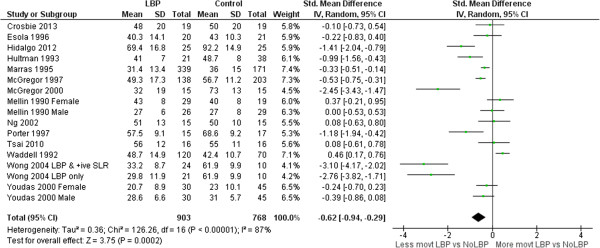
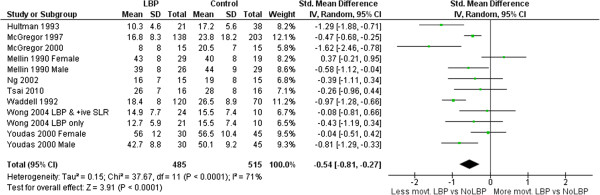
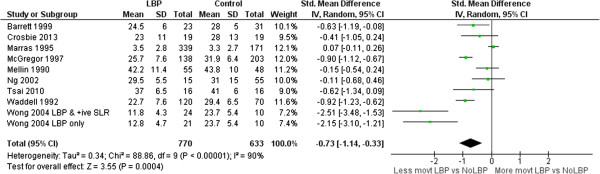
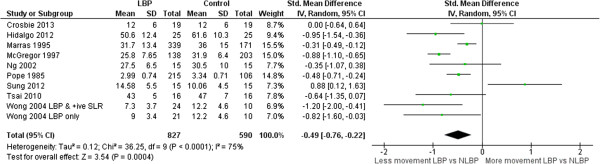
- Pooled analyses showed reduced lumbar ROM in people with LBP versus NoLBP: flexion SMD −0.62 (95% CI −0.94 to −0.29, p < 0.01), extension SMD −0.54 (−0.81 to −0.27, p < 0.01), lateral flexion SMD −0.73 (−1.14 to −0.33, p < 0.01), and rotation SMD −0.49 (−0.76 to −0.22, p = 0.04).
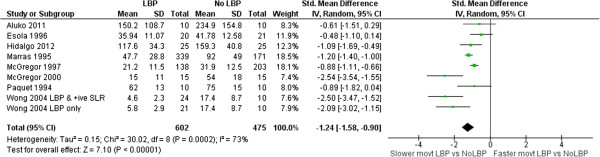
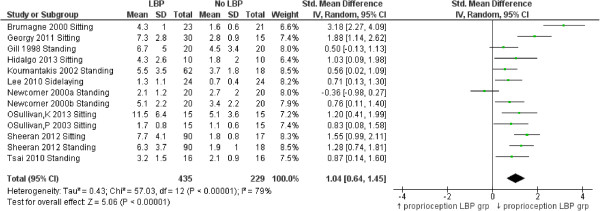
- People with LBP moved more slowly (SMD −1.24, 95% CI −1.58 to −0.90, p < 0.0001) and had poorer proprioception on repositioning accuracy (SMD 1.04, 95% CI 0.64 to 1.45, p < 0.0001).
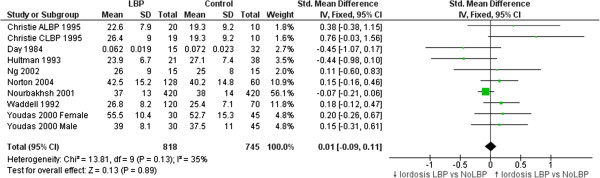
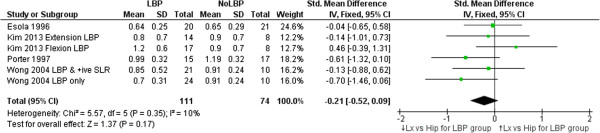
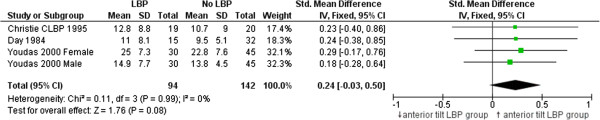
- No significant pooled differences were found for lordosis angle (SMD 0.01, 95% CI −0.09 to 0.11, p = 0.89), lumbar versus hip end-range flexion ROM (SMD −0.21, 95% CI −0.52 to 0.09, p = 0.17), or standing pelvic tilt angle (SMD 0.24, 95% CI −0.03 to 0.50, p = 0.08).
- Within-group variability was significantly greater in the LBP group for flexion, lateral flexion, rotation, and speed/acceleration, with coefficient-of-variation ratios of 1.31 (1.13–1.51), 1.31 (1.17–1.48), 1.20 (1.02–1.40), and 1.28 (1.13–1.46), respectively.
Methods
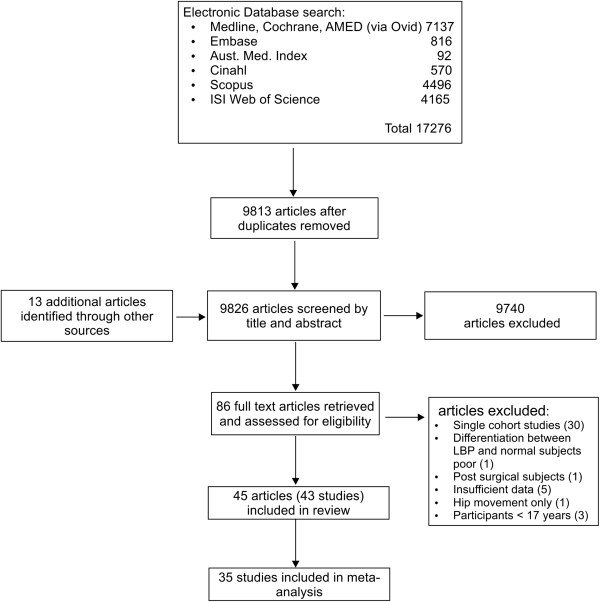
- Systematic review and meta-analysis; eight databases (MEDLINE, Cochrane Central, EMBASE, AMI, CINAHL, Scopus, AMED, ISI Web of Science) were searched from inception until January 2014, yielding 43 eligible studies (45 articles).
- Inclusion required adults >17 years, non-invasive skin-surface measurement, same procedures for LBP and NoLBP groups, and at least one lumbo-pelvic kinematic measure; no specific LBP or control definitions were required.
- Standardised mean differences and 95% confidence intervals were pooled using RevMan, with random-effects models where heterogeneity was indicated; within-group variability was compared using sample-size-weighted coefficients of variation, and Pearson’s r examined effect size versus study quality.
Limitations
- The authors state that they treated people with LBP as a homogeneous group, that findings do not show whether movement changes cause or result from LBP or improve outcomes, that only English-language articles were included, and that broad inclusion criteria likely weakened between-group differences.
- The authors also note considerable heterogeneity across studies, including variable definitions of LBP and NoLBP, and no studies blinded assessors to group status.
- Evident from the text: quality assessment showed only 37% of studies reported standardised movement instructions, 2% reported trained assessors, 17% used the same assessors for both groups, and 0% blinded assessors, which the authors identify as exposing studies to random or systematic error.
Model-written summary. Check it against the paper before relying on it.
Integrity signals
Registry
Cites
Statistics
Figures
Verification
Claims the paper makes
2 Valid · 1 Not valid · 15 Not checked · 61 Own results and interpretations
The cited sources support only part of this claim — read each source’s verdict below.
In the paper
“Astfalk et al. [85] found no differences in average lumbar flexion angle in sitting (reflecting pelvic tilt position) when comparing adolescents with and without LBP (125.3 ± 19.8° vs 130.6° ± 15.7 respectively).”
§ Comparing lumbo-pelvic kinematics in people with and without back pain: a systematic review and meta-analysis > Discussion > Pelvic tilt angle, position and range
What the sources say
- Partly supportedcites [85] Astfalck RG O'Sullivan PB Straker LM Smith AJ Burnett A Caneiro JP Dankaerts W Sitting postures and trunk muscle activity in adolescents with and without nonspecific chronic low back pain: an analysis based on subclassification Spine 2010 35 14 1387 1395 20195206 sourceExperimental — accuracy not yet measured
The Spinal Kinematics section (p. 4) reports no significant difference in sitting spinal posture between adolescents with and without chronic low back pain before the pain group was subdivided. It does not report the cited values of 125.3 ± 19.8° and 130.6 ± 15.7°; it also reports lumbar-angle differences after subgrouping, so the no-difference finding applies to the overall group comparison. (LLM, conf=0.88)
plain- Asserted: passes — The authors put it forward as true.
- Checkable: passes — It can be checked against evidence.
- Load-bearing: passes — The paper’s conclusions depend on it.
- Based: passes — The paper gives a reason why it holds.
- Partly supported
A result the paper reports from its own data — it cites no other source for it, so there is none to check. The quote shows it is in the paper.
In the paper
“A post-hoc meta-analysis of three studies that compared genders indicated that women had greater lordosis angles than men (SMD = 0.92, 95% CI 0.8 to 1.05, p < 0.01).”
§ Comparing lumbo-pelvic kinematics in people with and without back pain: a systematic review and meta-analysis > Results > Movement characteristics
hedgedstates an association- Asserted: passes — The authors put it forward as true.
- Checkable: passes — It can be checked against evidence.
- Load-bearing: unclear — It is unclear whether the paper’s conclusions depend on it.
- Based: passes — The paper gives a reason why it holds.
A result the paper reports from its own data — it cites no other source for it, so there is none to check. The quote shows it is in the paper.
In the paper
“(i) no difference in lordosis angle (8 studies)”
- Also stated in: § Movement characteristics · plain
“The pooled difference (SMD = 0.01, 95% CI -0.09 to 0.11, p = 0.89) was not significant.”
- Also stated in: § Proprioception · plain
“Lordosis*, n = 8 | 0.01 (-0.09 to 0.11), p = 0.89”
§ Comparing lumbo-pelvic kinematics in people with and without back pain: a systematic review and meta-analysis > Abstract > Results
plainn = 8- Asserted: passes — The authors put it forward as true.
- Checkable: passes — It can be checked against evidence.
- Load-bearing: passes — The paper’s conclusions depend on it.
- Based: passes — The paper gives a reason why it holds.
- Also stated in: § Movement characteristics · plain
A result the paper reports from its own data — it cites no other source for it, so there is none to check. The quote shows it is in the paper.
In the paper
“(vi) reduced proprioception (17 studies)”
- Also stated in: § Proprioception · boosted
“A consistent, large and significant reduction in ability to accurately re-position the spine at pre-specified angles for people with LBP compared to those without LBP is shown in Figure 10 (SMD = 1.04, 95% CI 0.64 to 1.45, p < 0.01).”
- Also stated in: § Proprioception · plain
“Proprioception (re-position accuracy)§, n = 12 | 1.04 (0.64 to 1.45), p < 0.0001”
§ Comparing lumbo-pelvic kinematics in people with and without back pain: a systematic review and meta-analysis > Abstract > Results
boostedstates an associationn = 12 ·- Asserted: passes — The authors put it forward as true.
- Checkable: passes — It can be checked against evidence.
- Load-bearing: passes — The paper’s conclusions depend on it.
- Based: passes — The paper gives a reason why it holds.
- Also stated in: § Proprioception · boosted
A result the paper reports from its own data — it cites no other source for it, so there is none to check. The quote shows it is in the paper.
In the paper
“(v) slower movement (8 studies)”
- Also stated in: § Speed/Acceleration · boosted
“A large, significant effect of slower movement in the LBP group was evident (SMD -1.46 95% CI -1.96 to -1.02, p < .01).”
- Also stated in: § Proprioception · plain
“Speed/Acceleration‡, n = 8 | -1.24 (-1.58 to -0.90), p < 0.0001”
§ Comparing lumbo-pelvic kinematics in people with and without back pain: a systematic review and meta-analysis > Abstract > Results
boostedstates an associationn = 8 ·- Asserted: passes — The authors put it forward as true.
- Checkable: passes — It can be checked against evidence.
- Load-bearing: passes — The paper’s conclusions depend on it.
- Based: passes — The paper gives a reason why it holds.
- Also stated in: § Speed/Acceleration · boosted
34 more claims
Create a free account to see all 79 claims and to verify the 2 references still open.
- It may state two separate claims as one. 32
- Probably not a substantial claim. 14
Self-check
Percentages, sums and reported differences re-computed from the paper’s own numbers.
Each contradiction between two passages listed here was confirmed by an independent check.
Rated major: it would touch a result — a value a result rests on, reported and recomputed p-values on opposite sides of the significance level, two passages that conflict with no sign which is right, or a cited work retracted before this paper was published.
In the paper
§ Comparing lumbo-pelvic kinematics in people with and without back pain: a systematic review and meta-analysis > Results > Speed/Acceleration
“A large, significant effect of slower movement in the LBP group was evident (SMD -1.46 95% CI -1.96 to -1.02, p < .01).”
§ Comparing lumbo-pelvic kinematics in people with and without back pain: a systematic review and meta-analysis > Results > Proprioception
“| Speed/Acceleration‡, n = 8 | -1.24 (-1.58 to -0.90), p < 0.0001 |”
Rated major: it would touch a result — a value a result rests on, reported and recomputed p-values on opposite sides of the significance level, two passages that conflict with no sign which is right, or a cited work retracted before this paper was published.
In the paper
§ Comparing lumbo-pelvic kinematics in people with and without back pain: a systematic review and meta-analysis > Results > Lumbar spine versus hip contribution to flexion/extension
“Esola et al. [34] (SMD = -0.86, 95% CI -1.51 to -0.22) and Porter et al. [52] (SMD = -0.71 95% CI -1.43 to 0.00) both found significant reductions of lumbar contribution to mid-range flexion but not at end range.”
§ Comparing lumbo-pelvic kinematics in people with and without back pain: a systematic review and meta-analysis > Discussion > Lumbar versus hip contribution to movement
“This finding is supported by McClure et al. [40], Esola et al. [34] and Porter et al. [52] who all reported relatively greater lumbar through-range contribution in people with LBP on flexion movement.”
Rated minor: it would not touch a result — a value no result rests on, a p-value that stays on the same side of the significance level, or a conflict that is clerical, resolved elsewhere in the paper, or outside its own findings.
In the paper
§ Comparing lumbo-pelvic kinematics in people with and without back pain: a systematic review and meta-analysis > Discussion > Differences in variability between people with and without LBP
“Our assessment of differences in variability between people with and without LBP for nine movement characteristics demonstrated significantly greater variability for four movement characteristics”
§ Comparing lumbo-pelvic kinematics in people with and without back pain: a systematic review and meta-analysis > Results > Differences in variability between groups
“Table 3 presents a summary of the within group variability in movements pooled across studies. Significantly greater variability for people with LBP compared to people without LBP was observed on four of the eight measures: flexion, lateral flexion, rotation and speed/acceleration.”
Rated minor: it would not touch a result — a value no result rests on, a p-value that stays on the same side of the significance level, or a conflict that is clerical, resolved elsewhere in the paper, or outside its own findings.
In the paper
§ Comparing lumbo-pelvic kinematics in people with and without back pain: a systematic review and meta-analysis > Results > Search yield
“No studies attempted blinding of assessors to group status, and only one study reported standardizing instructions to participants.”
§ Comparing lumbo-pelvic kinematics in people with and without back pain: a systematic review and meta-analysis > Results > Search yield
“| 8. | Was a system for standardising movement instructions reported? | 37% |”
Citations
Cites
Preferred Reporting Items for Systematic Reviews and Meta-Analyses: the PRISMA statement
Moher, D., Liberati, A., Tetzlaff, J., Altman, D. G., & for the PRISMA Group (2009) · BMJ · doi:10.1136/bmj.b2535 · Cited by 83,823
Measuring inconsistency in meta-analyses
Higgins, J. P. T., Thompson, S. G., Deeks, J. J., & Altman, D. G. (2003) · BMJ · doi:10.1136/bmj.327.7414.557 · Cited by 63,139 · cited 1×
“A random effects model was used for pooling where fixed effects modeling indicated statistical heterogeneity of the data (Mantel-Haenszel method), as determined by chi-squared and I(2) statistics; otherwise the results of fixed effects modeling was reported [25,26].”
MethodPreferred reporting items for systematic reviews and meta-analyses: The PRISMA statement
Moher, D., Liberati, A., Tetzlaff, J., Altman, D. G., & the PRISMA Group* (2009) · Annals of Internal Medicine · doi:10.7326/0003-4819-151-4-200908180-00135 · Cited by 37,554
Towards complete and accurate reporting of studies of diagnostic accuracy: The STARD Initiative.
Bossuyt, P. M., Reitsma, J. B., Bruns, D. E., Gatsonis, C. A., Glasziou, P. P., Irwig, L. M., Lijmer, J. G., Moher, D., Rennie, D., de Vet, H. C. W., et al. (2003) · Annals of Internal Medicine · doi:10.7326/0003-4819-138-1-200301070-00010 · Cited by 3,219
Towards Complete and Accurate Reporting of Studies of Diagnostic Accuracy: The STARD Initiative
Bossuyt, P. M., Reitsma, J. B., Bruns, D. E., Gatsonis, C. A., Glasziou, P. P., Irwig, L. M., Lijmer, J. G., Moher, D., Rennie, D., & de Vet, H. C. W. (2003) · Radiology · doi:10.1148/radiol.2261021292 · Cited by 3,215
Towards complete and accurate reporting of studies of diagnostic accuracy: the STARD initiative
Bossuyt, P. M., Reitsma, J. B., Bruns, D. E., Gatsonis, C. A., Glasziou, P. P., Irwig, L. M., Lijmer, J. G., Moher, D., Rennie, D., & de Vet, H. C. W. (2003) · BMJ · doi:10.1136/bmj.326.7379.41 · Cited by 3,215
Davis, H. S. (1966) · JAMA: The Journal of the American Medical Association · doi:10.1001/jama.1966.03100200106038 · Cited by 1,719
Diagnosis and Treatment of Movement Impairment Syndromes
Sahrmann, S. A. (2001) · Cited by 1,257
O’Sullivan, P. (2005) · Manual Therapy · doi:10.1016/j.math.2005.07.001 · Cited by 985
Evaluation of QUADAS, a tool for the quality assessment of diagnostic accuracy studies
Whiting, P. F., Weswood, M. E., Rutjes, A. W., Reitsma, J. B., Bossuyt, P. N., & Kleijnen, J. (2006) · BMC Medical Research Methodology · doi:10.1186/1471-2288-6-9 · Cited by 769 · cited 1×
“assessment tools [20-22].”
Research works printed but not linked: 4
- McKenzie R May S Lumbar Spine, Mechanical Diagnosis and Therapy 2003 2 Waikanae, New Zealand: Spinal Publications Ltd
- Schober P The lumbar vertebral column and back ache Munch Med Wochenschr 1937 84 336
- The NCBI Handbook (internet) 2013 2 Betheseda (MD): National Centre for Biotechnology Information (US) http://www.ncbi.nlm.nih.gov/mesh
- The Cochrane Collaboration Review Manager (RevMan) (computer program). Version 5.2 2012 Copenhagen: The Nordic Cochrane Centre, The Cochrane Collaboration
Cited by
Items 301–400 of 407
Holzgreve, F., Nazzal, C., Nazzal, R., et al. (2024) · Journal of Occupational Medicine and Toxicology · doi:10.1186/s12995-024-00405-w · Cited by 2
“Laird et al. [14] compared the biomechanical aspects of lumbo-pelvic movement using skin surface measurement techniques to measure the lumbo-pelvic posture or movement in people with lumbar spine complaints compared to those without.”
BackgroundMartin, S. (2017) · Topics in Geriatric Rehabilitation · doi:10.1097/tgr.0000000000000130 · Cited by 3
Creencias y actitudes de los atletas sobre el dolor lumbar
Pierobon, A., Policastro, P. O., Soliño, S., Andreu, M. F., Novoa, G. A., Raguzzi, I. A., & Villalba, F. J. (2022) · Argentinian Journal of Respiratory & Physical Therapy · doi:10.58172/ajrpt.v4i1.191 · Cited by 2
Rampersaud, Y. R., Nakamura, A., & Lewis, S. J. (2015) · Springer eBooks · doi:10.1007/978-3-319-19560-5_4 · Cited by 1
“Clinically, the range of motion for the lumbar spine varies signifi cantly and depends on age (reduces with increasing age), sex (greater in women than men), the presence or absence of LBP (reduced with LBP), and most signifi cantly the method of measurement [ 19 ].”
MethodThe correlation between low back pain and disability index with lumbar lordosis among dentists
Fasih-Ramandi, F., Nadri, A., Teimori-Boghsani, G., & Nadri, H. (2019) · Russian Open Medical Journal · doi:10.15275/rusomj.2019.0207 · Cited by 1
“[17] showed no significant difference of lumbar lordotic curvature between subjects with and those without LBP.”
An Exploration of the Influence of Non-Biomechanical Factors on Lifting-Related LBP
Saraceni, N., Campbell, A., Kent, P. M., Ng, L., Straker, L. M., & O’Sullivan, P. (2023) · International Journal of Environmental Research and Public Health · doi:10.3390/ijerph20031903 · Cited by 1
“Explicitly, this meant that the workers had not missed a day of work or altered activity levels due to LBP, and also had no LBP which exceeded 24 h in duration that was greater than 3/10 intensity on a numerical pain rating scale (NPRS) and had never visited a healthcare professional for LBP [27].”
BackgroundSelf-citationDattatray, K. A., & Sreeraj, S. R. (2024) · International Journal of Physiotherapy · doi:10.15621/ijphy/2024/v11i1/1421 · Cited by 1
Validation of proprioception measures of the lumbar spine
Larivière, C., Eskandari, A. H., Mecheri, H., & Duclos, C. (2024) · Journal of Electromyography and Kinesiology · doi:10.1016/j.jelekin.2024.102924 · Cited by 1
Wang, H., Wang, K., Zheng, Y., Deng, Z., Yu, Z., Zhan, H., & Zhao, Y. (2024) · Clinical Biomechanics · doi:10.1016/j.clinbiomech.2024.106344 · Cited by 1
Wongwitwichote, K., Yu, C. W. G., Mansfield, M., Deane, J. A., & Falla, D. (2025) · BMJ Open · doi:10.1136/bmjopen-2024-096594 · Cited by 2
Klerx, S. P., Bruijn, S. M., Coppieters, M. W., Kiers, H., Twisk, J. W. R., & Pool‐Goudzwaard, A. (2025) · European Journal of Neuroscience · doi:10.1111/ejn.70051 · Cited by 1
Chronic low back pain is associated with a reduction in lumbar movement – a prospective cohort study
Schömig, F., Pumberger, M., Becker, L. A., Reitmaier, S., Bashkuev, M., Duda, G. N., & Schmidt, H. (2025) · Scientific Reports · doi:10.1038/s41598-025-04851-2 · Cited by 1
“While previous studies have found an increased spinal range of motion and velocity to be associated with improved pain, this has not been shown for the amount of spinal movement 5 .”
Trunk Postural Variability and its Association with Perceived Back Load and Pain in Surgical Staff
Brouwer, N. P., Kingma, I., & van Dieën, J. H. (2025) · IISE Transactions on Occupational Ergonomics and Human Factors · doi:10.1080/24725838.2025.2540964 · Cited by 1
“Conversely, patients with LBP typically show reduced lumbar range of motion (Laird et al., 2014).”
The Postural-Structural-Biomechanical (PSB) Model
Bassimtabar, A. (2025) · Springer eBooks · doi:10.1007/978-3-662-71562-8_4 · Cited by 1
The puzzle of RehbeCa: an exergame for assessing cervicalgia
Roig-Maimó, M. F., Varona, J., Salinas‐Bueno, I., MacKenzie, I. S., & Mas-Sansó, R. (2025) · Universal Access in the Information Society · doi:10.1007/s10209-025-01258-8 · Cited by 1
“This aligns with clinical obser - vations where slower movement is reported in people with low back pain (LBP) compared to people without LBP [15].”
Vredeveld, T., Ramaekers, S. P. J., Coppieters, M. W., & Pool‐Goudzwaard, A. (2025) · Physiotherapy Theory and Practice · doi:10.1080/09593985.2025.2549140 · Cited by 1
“…that LBP may cause altered movement patterns through greater coactivation, more activity of superficial muscles, and lower variability of muscle recruitment, compared to individuals without pain (Laird, Gilbert, Kent, and Keating, 2014; Van Dieën, Flor, and Hodges, 2017; van Dieën et al, 2019).”
Fanuscu, A., & Ülger, Ö. (2025) · Irish Journal of Medical Science (1971 -) · doi:10.1007/s11845-025-04187-w · Cited by 1
Kongoun, S., Klahan, K., Rujirek, N., Vachalathiti, R., Richards, J., & Wattananon, P. (2026) · BMC Musculoskeletal Disorders · doi:10.1186/s12891-026-09488-4 · Cited by 2
“Spinal dysfunction, specifically impaired lumbopelvic control, is considered a major contributor to chronic and recurrent LBP [2–4].”
Savaş, T., Savaş, N. Y., Albayrak, F., Kurtgil, M. E., Barut, A. B., & Kısacık, B. (2026) · Journal of Back and Musculoskeletal Rehabilitation · doi:10.1177/10538127261430796 · Cited by 1
“20 Our study supports the literature discussions on this subject and highlights the need for additional prospective studies.”
Ducas, J., Véret, C., Gauthier‐Wong, É., Descarreaux, M., & Abboud, J. (2026) · European Journal of Pain · doi:10.1002/ejp.70264 · Cited by 1
Haddas, R., Romiyo, P., Shu, Y., et al. (2026) · European Spine Journal · doi:10.1007/s00586-026-10006-2 · Cited by 1
Courbalay, A., Deroche, T., & Descarreaux, M. (2017) · Journal of Nonverbal Behavior · doi:10.1007/s10919-017-0254-3 · Cited by 1
Online Monitoring of Posture for Preventive Medicine Using Low-Cost Inertial Sensors
Kellner, K., Le, H. M., Blatnik, J., Rosegger, V., Pilacek, R., & Treytl, A. (2018) · Lecture notes of the Institute for Computer Sciences, Social Informatics and Telecommunications Engineering · doi:10.1007/978-3-319-98551-0_8 · Cited by 2
Lumbar Spine Kinematics in Asymptomatic People When Changing Body Position From Sitting to Standing
Berger-Pasternak, B., Brylka, D., & Sipko, T. (2021) · Journal of Manipulative and Physiological Therapeutics · doi:10.1016/j.jmpt.2020.07.014 · Cited by 1
Lumbale Rückenschmerzen und Wirbelsäulenverletzungen bei Sportlern – Ursachen und Risikomanagement
Sheeran, L. (2021) · Sportphysio · doi:10.1055/a-1256-2158 · Cited by 1
“Wirbelsäule Verminderte Lateralflexion und Lendenlordose sowie eine reduzierte Dehnfähigkeit der Hamstrings wurden als Prädiktoren für lumbale Rückenschmerzen in der Allgemeinbevölkerung identifiziert [25].”
BackgroundInfluentialTHE EFFICIENCY OF KINESIOTHERAPY IN THE REHABILITATION OF PATIENTS WITH LOW BACK PAIN
Breha, R. M., & Breha, A. M. (2020) · Știința și arta mișcării · doi:10.4316/sam.2020.0122 · Cited by 1
Vatovec, R., Kozinc, Ž., & Šarabon, N. (2022) · German Journal of Exercise and Sport Research · doi:10.1007/s12662-022-00857-4 · Cited by 2
Estimating range of pelvic motion during gait by using in-shoe motion sensors
Wang, Z., Huang, C., Ihara, K., Nihey, F., Fukushi, K., Kajitani, H., Nozaki, Y., & Nakahara, K. (2023) · IEEE International Instrumentation and Measurement Technology Conference · doi:10.1109/i2mtc53148.2023.10176100 · Cited by 1
“According to many meta-analyses, range of movement of the lumbar spine reducing were suggested the main characteristics of people with lower back pain [28].”
BackgroundComparison of saddles in hippotherapy for patients with chronic low back pain
Ruamsilp, W., Thawinchai, N., Sitilertpisan, P., et al. (2023) · Veterinary Integrative Sciences · doi:10.12982/vis.2023.058 · Cited by 1
Impact of Sacroiliac Belt Utilization on Balance in Patients with Low Back Pain
Daniels, A. H., Park, A. M., Lee, D. J., et al. (2024) · Orthopedic Reviews · doi:10.52965/001c.116960 · Cited by 1
Hooker, Q. L., Lanier, V. M., & Dillen, L. R. V. (2024) · Journal of Electromyography and Kinesiology · doi:10.1016/j.jelekin.2024.102960 · Cited by 1
Colonna, S., D'Alessandro, A., Tarozzi, R., & Casacci, F. (2025) · Cureus · doi:10.7759/cureus.83785 · Cited by 2
Assessing lumbar posture variability in individuals with chronic low back pain in daily life
Schömig, F., Bashkuev, M., Reitmaier, S., Fleig, L., Pumberger, M., & Schmidt, H. (2025) · Frontiers in Bioengineering and Biotechnology · doi:10.3389/fbioe.2025.1509634 · Cited by 1
Aure, O. F., & Kvåle, A. (2020) · European Journal of Physiotherapy · doi:10.1080/21679169.2020.1801834 · Cited by 1
“Studies have shown that LBP can reduce mobility, especially in ventral flexion [16,17].”
BackgroundKnox, P. J., Pohlig, R. T., Pugliese, J. M., Coyle, P. C., Sions, J. M., & Hicks, G. E. (2021) · Archives of Physical Medicine and Rehabilitation · doi:10.1016/j.apmr.2021.08.014 · Cited by 2
Grande‐Alonso, M., Pérez-Muñoz, R., Aceña-García, J. M., Recio-Mateo, F. F., Pro-Marín, D., & Touche, R. L. (2021) · Journal of MOVE and Therapeutic Science · doi:10.37382/jomts.v3i1.471 · Cited by 2
“…physical disability might correlate with a decrease in functional performance in terms of static and dynamic posture, in addition to producing alterations in the proprioceptive mechanism (Brech et al., 2012; Laird et al., 2014; Tsigkanos et al., 2016; Sadler et al., 2017; Tong et al., 2017).”
BackgroundComment se réalise une séance kinésithérapique de reconstruction posturale ?
Ehret, J., & Triby, E. (2021) · Kinésithérapie la Revue · doi:10.1016/j.kine.2021.11.007 · Cited by 1
Putra, Y. P., Widnyana, M., & Saraswati, N. L. P. G. K. (2022) · Sport and Fitness Journal · doi:10.24843/spj.2022.v10.i01.p07 · Cited by 1
Bakar, F. A., Staal, J. B., van Cingel, R. E. H., Saito, H., Ostelo, R., & van Dieën, J. H. (2023) · medRxiv · doi:10.1101/2023.06.06.23290554 · Cited by 1
La Técnica de Pinza rodada en el tratamiento de la lumbalgia inespecífica crónica
Esteban, S. D. (2016) · UVaDOC UVaDOC University of Valladolid Documentary Repository (University of Valladolid) · doi:10.35376/10324/16739
Monie, A. P. (2016) · manuelletherapie · doi:10.1055/s-0042-117990
Biomechanical analysis of INFINITY rehabilitation method for treatment of low back pain
Daniel, M., Tomanová, M., Hornová, J., Novotná, I., & Lhotská, L. (2017) · Journal of Physical Therapy Science · doi:10.1589/jpts.29.832
An Integrated Approach to Treatment of Chronic Low Back Pain: Based on Neuroscience of Pain
Wang, S. (2017) · Journal of Complementary Medicine & Alternative Healthcare · doi:10.19080/jcmah.2017.02.555581
“Changes in proprioception and motor control have also been thought as a possible reason behind low back pain [22].”
BackgroundGiesche, F., Krause, F., Niederer, D., Wilke, J., Engeroff, T., Vogt, L., & Banzer, W. B. (2018) · Journal of Back and Musculoskeletal Rehabilitation · doi:10.3233/bmr-181203
“In detail, meta-analyses describe reduced lumbar range of motion (ROM) and slower movement velocity (V) compared to healthy controls [8].”
Low back pain and motor control
Grosdent, S., Demoulin, C., & Vanderthommen, M. (2018) · ORBi (University of Liège)
Kim, W.-D., Seo, M., Park, D.-C., & Shin, D. (2021) · Physical therapy rehabilitation science · doi:10.14474/ptrs.2021.10.2.156
“Robert A 등[19]이 수행한 체계적 고찰에서 허리통증 이 있는 대상자 들은 허리뼈 가동범위 감소, 움직임 속도 감소, 고유감각의 감소는 있었지만 허리뼈와 골반의 기울 기 각도는 차이가 없는 것으로 나타났다.”
Chronic low back pain changes in trunk controls of gaitPreprint
Nishi, Y., Shigetoh, H., Fujii, R., Osumi, M., & Morioka, S. (2021) · Research Square · doi:10.21203/rs.3.rs-127066/v2
Goncharow, P. N. (2021) · Brock University Digital Repository (Brock University)
Huang, T.-Z., & Kim, S.-Y. (2021) · Research Square · doi:10.21203/rs.3.rs-1179826/v1
Dehcheshmeh, F. G., Arab, A. M., & Nourbakhsh, M. R. (2021) · Research Square · doi:10.21203/rs.3.rs-1164346/v1
Hooker, Q. L., & Dillen, L. R. V. (2022) · medRxiv · doi:10.1101/2022.02.28.22271619
Barot, A. M., & Patel, R. A. (2022) · INTERNATIONAL JOURNAL OF SCIENTIFIC RESEARCH · doi:10.36106/ijsr/9300186
Janssen, E. (2022) · Research Publications (Maastricht University) · doi:10.26481/dis.20220121ej · Cited by 1
Nishi, Y., Shigetoh, H., Fujii, R., et al. (2020) · Research Square · doi:10.21203/rs.3.rs-127066/v1
Huang, T.-Z., & Kim, S.-Y. (2022) · Research Square · doi:10.21203/rs.3.rs-1179826/v2
Tarnanen, S. P. (2023) · Elsevier eBooks · doi:10.1016/b978-3-437-45252-9.00017-1 · Cited by 1
(2023) · Elsevier eBooks · doi:10.1016/b978-3-437-45252-9.09976-4
Samani, M. Y. M., & Zuriaga, D. S. (2023) · Fisioterapia · doi:10.1016/j.ft.2022.11.009
Mingels, S., Dankaerts, W., van Etten, L. M. L. A., Bruckers, L. M., & Granitzer, M. (2023) · Physiotherapy Theory and Practice · doi:10.1080/09593985.2023.2232858 · Cited by 1
“Yet, scientific evidence does not support any posture causing spinal pain (Laird, Gilbert, Kent, and Keating, 2014), and no consensus is reached on what constitutes the best sitting posture (Slater et al., 2019).”
Machine Learning Derived Lifting Technique in People without Low Back Pain
Phan, T. C., Pranata, A., Farragher, J. B., et al. (2023) · Proceedings of the Annual International Conference of the IEEE Engineering in Medicine and Biology Society · doi:10.1109/embc40787.2023.10340260
“However, the literature suggests that there is no single 'best' lifting technique as a lifting technique depends on individual factors (e.g., hamstring muscle length), the environment, load lifted and other considerations [3, 4].”
BackgroundHip and Trunk Variables in University Students with and without Recurrent Low Back Pain
Lehecka, B. J., Burleson, J., Diederich, P., Salem, M., Schoonover, R., & Tejano, J. (2024) · International Journal of Sports Physical Therapy · doi:10.26603/001c.91640
Lumbopelvic ratio based screening tool for Lumbar health assessment
Renganathan, G., & Kurita, Y. (2024) · Augmented Humans International Conference (AHs) · doi:10.1145/3652920.3653046
“The trunk intervals were indicated based on a range of motion (during the start, maximum, and at the end of the trunk motion) and the L/P ratio was calculated for all the defined trunk intervals [6].”
MethodAltered trunk-pelvis kinematics during load carriage with a compliant versus a rigid system
Lundervold, A., Ellison, M., Madsen, K., Werkhausen, A., & Rice, H. M. (2024) · Ergonomics · doi:10.1080/00140139.2024.2390125
“…and without lower back pain in cross-sectional studies, it has been reported that those with pain demonstrate reduced lumbar range of motion (ROM) (laird et al. 2014), including during a step-up task (Mitchell et al. 2017). there is very limited understanding of risk factors for lower back pain,…”
InfluentialDambadarjaa, B., Khuyagbaatar, B., Boldbaatar, D., Avirmed, B., Wong, A. Y. L., Sullivan, J., Ferreira, P. H., & Bayartai, M.-E. (2024) · Research Square · doi:10.21203/rs.3.rs-5025311/v1
Çiftçi, Ş., & Genç, H. (2024) · Gümüşhane Üniversitesi Sağlık Bilimleri Dergisi · doi:10.37989/gumussagbil.1410691
Silva, D. M. C. E., Goes, A. V. A., de Castro, S. S., de Jesus‐Moraleida, F. R., & Nunes, A. C. L. (2024) · Musculoskeletal Care · doi:10.1002/msc.70035
Jacquemin, D., Demoulin, C., Dorban, G., et al. (2025) · Journal of Back and Musculoskeletal Rehabilitation · doi:10.1177/10538127241310594
Das postural-strukturell-biomechanische (PSB) Modell
Bassimtabar, A. (2025) · Springer eBooks · doi:10.1007/978-3-662-70334-2_4
Demoulin, C., Michaud, J.-C., Wuinant, N., et al. (2025) · Kinésithérapie la Revue · doi:10.1016/j.kine.2025.01.080
Kandakurti, P. K., Ferreira, A. D. S., Nogueira, L. A. C., Watson Arulsingh, D. R., & Patil, S. S. (2025) · Journal of Back and Musculoskeletal Rehabilitation · doi:10.1177/10538127251326152
“20,21 Research suggests that when movements are initiated voluntarily, centrally generated signals from motor commands and perceived effort contribute to kinaes-thetic awareness.”
Fischer, L., Schroll, A., Schmidt, H., & Arampatzis, A. (2025) · Frontiers in Sports and Active Living · doi:10.3389/fspor.2025.1524489 · Cited by 1
“Similarly, other studies (53, 55) observed no differences in lumbar lordosis and pelvic angle between participants with and without low-back pain.”
InfluentialWattananon, P., Kongoun, S., Klahan, K., et al. (2025) · PLoS ONE · doi:10.1371/journal.pone.0321084
Evaluation of Lifting Techniques Using Optoelectronic Systems with Knee Range of Motion Restrictions
Storari, L., Barbari, V., Maselli, F., Nardello, F., Zamparo, P., Scafoglieri, A., & Cattrysse, E. (2025) · International Journal of Sports Medicine · doi:10.1055/a-2610-3370
Chakraborty, J., & Ghosh, S. (2025) · Journal of Bodywork and Movement Therapies · doi:10.1016/j.jbmt.2025.05.061
Cope, S., Willasey, E., Dadnam, D., & Gartshore, L. (2025) · European Journal Of Dental Education · doi:10.1111/eje.70035
Edgar, M., Jiang, H., Johnson, R., et al. (2025) · Cureus · doi:10.7759/cureus.91840
Maruoka, H., Takata, Y., Matamura, T., et al. (2025) · Cureus · doi:10.7759/cureus.93366
“One method of assessing flexion-type lower back pain is the lumbar pelvic rhythm (LPR) [7].”
Beckenschiefstand erkennen und behandeln – eine randomisierte kontrollierte Pilotstudie
von Wrede, U., Loudovici-Krug, D., & Best, N. (2025) · Zeitschrift für Komplementärmedizin · doi:10.1055/a-2679-0334
The Impact of Participant Instructions on Lumbopelvic Rhythm During Forward Spine Flexion and Return
Sany, S. A., Wilkie, A. J., Frey, M., Yi, Y., & Carvalho, D. E. D. (2025) · Journal of Applied Biomechanics · doi:10.1123/jab.2024-0245
Targeting coordination: How focus of attention influences spinal movement control in low back pain
Feier, C. H., & Brown, S. H. M. (2025) · Clinical Biomechanics · doi:10.1016/j.clinbiomech.2025.106679
Relationships and Influencing Factors for Each Item of the Lumbar Motor Control Test
Miyachi, R., Nishimura, T., Noguchi, M., Goda, A., Takeda, H., Takeshima, E., Kanazawa, Y., Imai, T., & Tanaka, W. (2025) · Perceptual and Motor Skills · doi:10.1177/00315125251394961
“…mobility is reduced in persons with low back pain, while others indicate that it is expanded depending on the timing of low back pain, psychological background, and other factors (Cholewicki et al., 2019; Laird et al., 2014; O ’ Sullivan, 2005; Scholtes et al., 2009; van Die¨en et al., 2019).”
McManus, F. J., Pranata, A., Simpson, J. A., Farragher, J. B., Crofts, S., Wu, W. H., & Bryant, A. L. (2025) · International Journal of Sports Physical Therapy · doi:10.26603/001c.146051 · Cited by 1
Diagnosing the body in physiotherapy: the passage from discipline to control
Breedt, E., Tichenor, E., & Barlott, T. (2025) · Physiotherapy Theory and Practice · doi:10.1080/09593985.2025.2585138 · Cited by 7
“…to entrenched understandings, scholars showed that there is no ideal or healthy alignment, posture, or movement (Brox, 2018; Korakakis et al, 2019; Laird, Gilbert, Kent, and Keating, 2014; Nolan et al, 2018; Okada et al, 2009; Preece et al, 2008); that tissues do not “wear and tear” with use but…”
Tokuyasu, H., Takemoto, M., Vergari, C., et al. (2025) · Cureus · doi:10.7759/cureus.97778
“A recent study has suggested that while the lumbar lordosis angle may remain unchanged in individuals with LBP, their lumbar mobility tends to decrease [14].”
EBENBICHLER, G. R., Bochdansky, T., & Tilscher, H. (2026) · Manuelle Medizin · doi:10.1007/s00337-025-01223-9
Morriss, N. J., Castle, P., Greif, D. N., Pezzulo, J. D., Ambalavanar, M. T., Manning, J. H., Shu, Y., Earnhart, J., Ramirez, G., Nicandri, G. T., et al. (2026) · Journal of Shoulder and Elbow Surgery · doi:10.1016/j.jse.2026.02.019 · Cited by 1
Gilliam, J. R., Silfies, S. P., Vendemia, J. M. C., Shin, Y. S., & Coombes, S. A. (2026) · Pain · doi:10.1097/j.pain.0000000000003949 · Cited by 1
Dambadarjaa, B., Khuyagbaatar, B., Boldbaatar, D., et al. (2026) · Journal of Bodywork and Movement Therapies · doi:10.1016/j.jbmt.2026.03.014
12주간 복합트레이닝의 주기화 프로그램이 사이클 동호회 중년 남자 선수들의 신체조성과 건강관련 체력, 체간 정렬에 미치는 영향
오, 두., & 이, 장. (2026) · 한국체육학회지 · doi:10.23949/kjpe.2026.1.65.1.14
Schmid, S. (2026) · Elsevier eBooks · doi:10.1016/b978-0-443-26568-6.00017-5
Posture et locomotion dans la pathologie dégénérative du rachis lombaire
Grelat, M. (2019) · theses.fr (ABES) · doi:10.70675/3d0c51cfz134dz4d37za4e5zd0c784be8454
Non-specific Low back pain : Exploratory analysis and clustering for a new paradigm
Robinault, L. (2023) · theses.fr (ABES) · doi:10.70675/1310d83dzf76dz473ezb037z42769807e85a
Spinal Posture and Movement in Female Adolescents with Anorexia Nervosa
Bayartai, M.-E., Tringali, G., Micheli, R. D., Grimoldi, I., Abbruzzese, L., Sonza, A., & Sartório, A. (2026) · Journal of Clinical Medicine · doi:10.3390/jcm15083054
“For example, altered spinal kinematics and reduced lumbar mobility are commonly related to low back pain [12].”
Turhan, A., Özsoy, G., Özçelep, Ö. F., Kodak, S. B., & Özsoy, İ. (2026) · Karya Journal of Health Science · doi:10.52831/kjhs.1833780 · Cited by 1
Pfluegler, G., Klinger, M., Ley, C., & Luedtke, K. (2026) · JOSPT Methods · doi:10.2519/josptmethods.2026.0027
Metadata
- Authors
- Laird, R. A., Gilbert, J., Kent, P., & Keating, J. L.
- Affiliations
- Monash University (AU)
- University of Southern Denmark (DK)
- Corresponding author
- Laird, Robert A
- Venue
- BMC Musculoskeletal Disorders
- Published
- 2014-07-10
- Volume
- 15
- Issue
- 1
- Pages
- 229-229
- ISSN
- 1471-2474 (ISSN-L)
- PMC
- PMC4096432
- OpenAlex
- W2010688137
- Cited by
- 443
- References
- 96
- Citations by year
- 2026: 30 · 2025: 49 · 2024: 52 · 2023: 50 · 2022: 58 · 2021: 48 · 2020: 36 · 2019: 37 · 2018: 26 · 2017: 28 · 2016: 20 · 2015: 9
- FWCI
- 2.54
- Type
- journal article
- Language
- en
- Open access
- gold
- doi.org
- Licence
- Locations
- BMC Musculoskeletal Disorders (publishedVersion, cc-by)
- PubMed Central (publishedVersion, cc-by)
- PubMed (publishedVersion)
- University of Southern Denmark Research Portal (University of Southern Denmark) (publishedVersion)
- eSpace (Curtin University) (submittedVersion, cc-by)
- Topics
- Health Sciences › Health Professions › Physical Therapy, Sports Therapy and Rehabilitation › Musculoskeletal pain and rehabilitation
- Health Sciences › Medicine › Orthopedics and Sports Medicine › Spine and Intervertebral Disc Pathology
- Health Sciences › Medicine › Obstetrics and Gynecology › Pregnancy-related medical research
- Keywords
- low back pain, lumbar range of motion, lumbar lordosis, pelvic tilt, lumbar proprioception, movement speed, movement variability
- MeSH terms
- Biomechanical Phenomena, Humans, Lordosis, Lumbar Vertebrae, Pelvis, Posture, Proprioception, Chi-Square Distribution, Range of Motion, Articular, Low Back Pain
About these checks
Registry, retraction, Cites and statistics results are computed, not judged, with one exception: a printed reference that no index lists is read once by a model before it counts as a citation error. Claims are extracted by a model and kept only when their quote appears verbatim in the text; each cited source is then checked, with a model’s help, for whether it says what the claim relies on. Those verdicts can be wrong — read the claim’s quote and the cited source before relying on one.
The claim verdicts this report counts are experimental: their accuracy is not yet measured.
A language model drew the claims from the paper on 2026-10-04, under version 3 of the claim definition (model deepseek-v4.1-flash, prompt extract-v3).
A second model labelled each claim on 2026-10-04 (model jev-1.13-20260917, definition revision gold-guideline-v0.2).
Cited sources are checked with a language model’s help (gpt-6-sol).
Statistics and arithmetic are recomputed, not judged.
Confidence bands are shown only for fields calibrated on our annotated test set. None is calibrated yet, so no band is shown.
What counts as a claim ›How we measure confidence ›How we check this ›
Are you an author, or do you see a problem with this page? Request a review
Data sources
Bibliographic data: Semantic Scholar, OpenAlex, Crossref.
Contains information from the Semantic Scholar Academic Graph Datasets, made available under the ODC Attribution License (ODC-BY 1.0).
Semantic Scholar’s data is described in: Kinney, R., et al. (2023). The Semantic Scholar Open Data Platform. arXiv:2301.10140.
