

The DOI matches its Crossref record; 111 of the 112 references it cites were found in a registry or an index.
An update of stabilisation exercises for low back pain: a systematic review with meta-analysis
Open accessAbstract
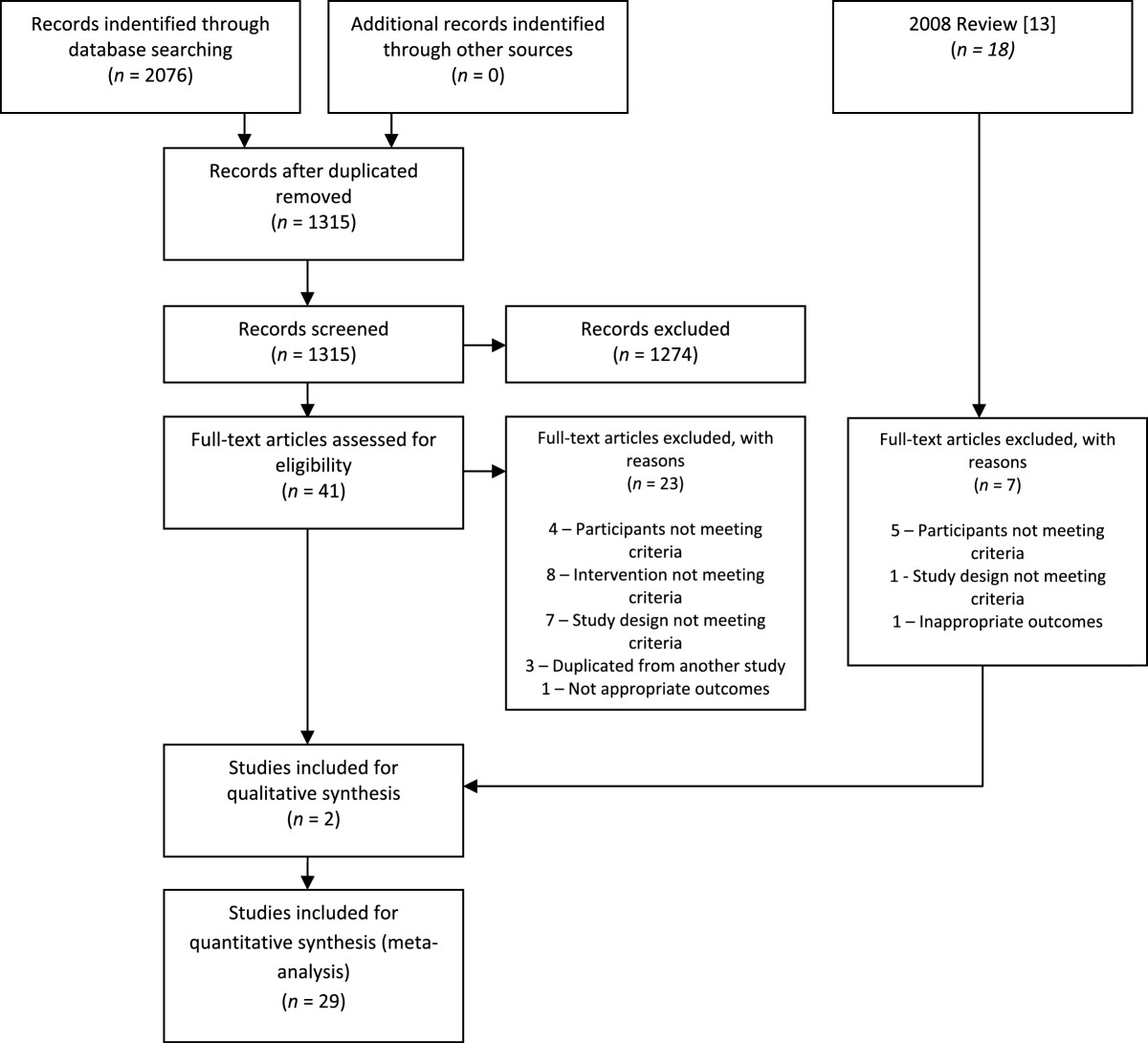
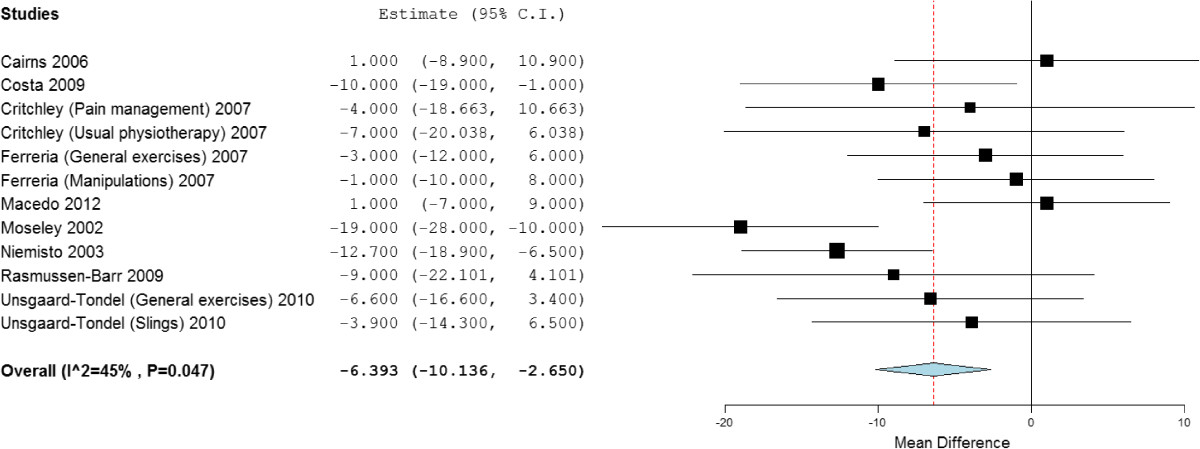
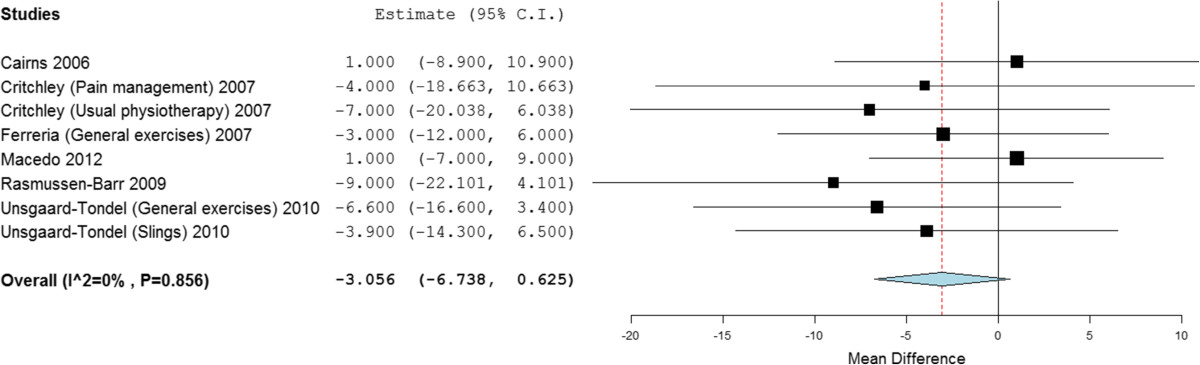
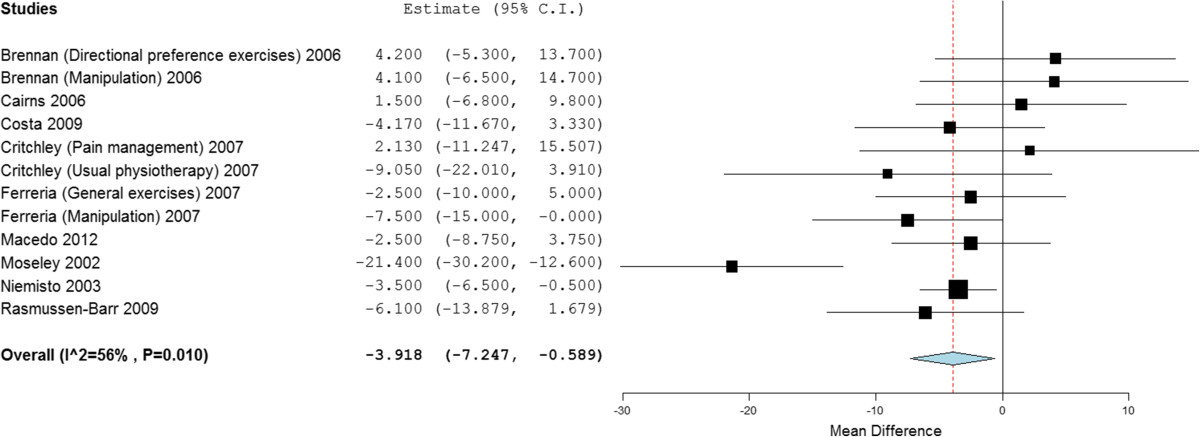
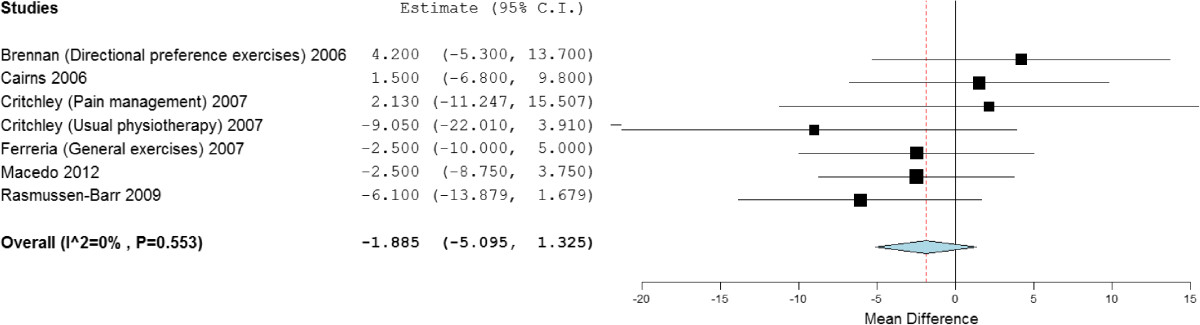
BACKGROUND: Non-specific low back pain (NSLBP) is a large and costly problem. It has a lifetime prevalence of 80% and results in high levels of healthcare cost. It is a major cause for long term sickness amongst the workforce and is associated with high levels of fear avoidance and kinesiophobia. Stabilisation (or 'core stability') exercises have been suggested to reduce symptoms of pain and disability and form an effective treatment. Despite it being the most commonly used form of physiotherapy treatment within the UK there is a lack of positive evidence to support its use. The aims of this systematic review update is to investigate the effectiveness of stabilisation exercises for the treatment of NSLBP, and compare any effectiveness to other forms of exercise. METHODS: A systematic review published in 2008 was updated with a search of PubMed, CINAHL, AMED, Pedro and The Cochrane Library, October 2006 to October 2013. Two authors independently selected studies, and two authors independently extracted the data. Methodological quality was evaluated using the PEDro scale. Meta-analysis was carried out when appropriate. RESULTS: 29 studies were included: 22 studies (n = 2,258) provided post treatment effect on pain and 24 studies (n = 2,359) provided post treatment effect on disability. Pain and disability scores were transformed to a 0 to 100 scale. Meta-analysis showed significant benefit for stabilisation exercises versus any alternative treatment or control for long term pain and disability with mean difference of -6.39 (95% CI -10.14 to -2.65) and -3.92 (95% CI -7.25 to -0.59) respectively. The difference between groups was clinically insignificant. When compared with alternative forms of exercise, there was no statistical or clinically significant difference. Mean difference for pain was -3.06 (95% CI -6.74 to 0.63) and disability -1.89 (95% CI -5.10 to 1.33). CONCLUSION: There is strong evidence stabilisation exercises are not more effective than any other form of active exercise in the long term. The low levels of heterogeneity and large number of high methodological quality of available studies, at long term follow-up, strengthen our current findings, and further research is unlikely to considerably alter this conclusion.
Overview
The claims and statistics of this paper haven’t been checked yet.
Run the check — free, no account needed. It reads the open-access text and checks the sources it cites.
Integrity signals
Registry
Cites
Statistics
Figures
Verification
Claims the paper makes
The claims and statistics of this paper haven’t been checked yet.
Run the check — free, no account needed. It reads the open-access text and checks the sources it cites.
Claims other papers make about this one
Each is checked against this paper’s own text: does it say what the citing paper says it does?
The source backs part of the claim, not all of it — or backs it for a different population, condition or comparison.
In the citing paper
“No particular type of exercise has been shown to be superior to another [5, 18]”
From Exercise combined with Acceptance and Commitment Therapy (ExACT) compared to a supervised exercise programme for adults with chronic pain: study protocol for a randomised controlled trial. (2018) · cites this paper as [18]
Experimental — accuracy not yet measuredIn the citing paper
“Compared to other forms of active exercise, stabilisation and core stability exercise was found to be no more effective than in the long term [7,10].”
Self-check
Percentages, sums and reported differences re-computed from the paper’s own numbers.
The self-check needs the paper’s full text.
Citations
Cites
Preferred Reporting Items for Systematic Reviews and Meta-Analyses: the PRISMA statement
Moher, D., Liberati, A., Tetzlaff, J., Altman, D. G., & for the PRISMA Group (2009) · BMJ · doi:10.1136/bmj.b2535 · Cited by 83,823
The Measurement of Observer Agreement for Categorical Data
Landis, J. R., & Koch, G. G. (1977) · Biometrics · doi:10.2307/2529310 · Cited by 81,148
Preferred Reporting Items for Systematic Reviews and Meta-Analyses: The PRISMA Statement
Moher, D., Liberati, A., Tetzlaff, J., Altman, D. G., & The PRISMA Group (2009) · PLoS Medicine · doi:10.1371/journal.pmed.1000097 · Cited by 64,042
Measuring inconsistency in meta-analyses
Higgins, J. P. T., Thompson, S. G., Deeks, J. J., & Altman, D. G. (2003) · BMJ · doi:10.1136/bmj.327.7414.557 · Cited by 63,139
Preferred reporting items for systematic reviews and meta-analyses: the PRISMA Statement.
(2009) · PubMed Central · Cited by 44,859
A Coefficient of Agreement for Nominal Scales
Cohen, J. (1960) · Educational and Psychological Measurement · doi:10.1177/001316446002000104 · Cited by 42,398
Meta-analysis in clinical trials
DerSimonian, R., & Laird, N. (1986) · Controlled Clinical Trials · doi:10.1016/0197-2456(86)90046-2 · Cited by 39,552
Preferred Reporting Items for Systematic Reviews and Meta-Analyses: The PRISMA Statement
Moher, D., Liberati, A., Tetzlaff, J., & Altman, D. G. (2009) · Journal of Clinical Epidemiology · doi:10.1016/j.jclinepi.2009.06.005 · Cited by 19,575
Wang, G., Ma, R., Qiao, G., Wada, K., Aizawa, Y., & Satoh, T. (2015) · Integrative Medicine International · doi:10.1159/000368408 · Cited by 18,762
Statistical Methods for Rates and Proportions
Fleiss, J. L., Levin, B., & Paik, M. C. (2003) · Wiley Series in Probability and Statistics · doi:10.1002/0471445428 · Cited by 18,646
Research works printed but not linked: 5
- National Institute for Health and Care Excellence: Low Back Pain. Early Management of Persistent Non-Specific Low Back Pain [CG88]. 2009
- Department of Health (DoH): The NHS Plan: A Plan for Investment a Plan for Reform. 2000, 82-
- Norris C: Back Stability. 2000, Leeds: Human Kinetics Europe Ltd
- Higgins J, Deeks J: Cochrane Handbook: General Methods For Cochrane Reviews: Ch 7: Selecting Studies and Collecting Data. Cochrane Handb Syst Rev Interv. Volume 6. Edited by: Higgins PTJ, Green S. 2011, Wiley-Blackwell, 151-186. [Cochrane Book Series]
- Xueqiang W, Jiejiao Z, Xia B, Jing L: Effect of core stability training on patients with chronic low back pain. HealthMED. 2012, 6: 754-759.
Cited by
Sorted by citations
Items 201–223 of 223
Grooten, W. J. A., Boström, C., Dedering, Å., Halvorsen, M., Kuster, R. P., Nilsson-Wikmar, L. B., Olsson, C. B., Rovner, G., Tseli, E., & Rasmussen-Barr, E. (2022) · Figshare · doi:10.6084/m9.figshare.20545776
Larivière, C., Preuss, R. A., Coutu, M., Sullivan, M. J. L., Roy, N., & Henry, S. M. (2024) · Figshare · doi:10.6084/m9.figshare.25751452
Grooten, W. J. A., Boström, C., Dedering, Å., Halvorsen, M., Kuster, R. P., Nilsson-Wikmar, L. B., Olsson, C. B., Rovner, G., Tseli, E., & Rasmussen-Barr, E. (2022) · Figshare · doi:10.6084/m9.figshare.20545782
Mohamed, M. A., Ali, A. S., Tawfek, M. H., Fergany, L. A., Elshebawy, H., Mohamed, R. A., Kamal, R. M., & Hafez, H. A. (2026) · Health sport rehabilitation · doi:10.58962/hsr.991
Singh, A. K., Khan, I., Pal, R., Sharma, K., & Saxena, A. (2026) · Medical Journal of Dr D Y Patil Vidyapeeth · doi:10.4103/mjdrdypu.mjdrdypu_315_25
Biomechanics of physical therapy and rehabilitation
Luomajoki, H., & Frangi, J. (2026) · Elsevier eBooks · doi:10.1016/b978-0-443-26568-6.00035-7
Larivière, C., Coutu, M., Henry, S. M., Preuss, R. A., Roy, N., & Rabhi, K. (2022) · doi:10.70010/ibqu2376
Tailored Rehabilitation Strategies for ACL-Reconstructed Basketball Athletes: A Systematic Review
Tomar, A., Saraf, A., & Kalra, S. (2026) · International Journal of Drug Delivery Technology · doi:10.25258/ijddt.16.15s.40
Umar, S. A., Ganiyu, O. G. S., Kaka, B., & Bello, B. (2026) · Nigerian Journal of Medical Rehabilitation · doi:10.34058/vv8z5w52
Online-supervised Corrective and Core Stability Exercises in Taekwondo Athletes With Low Back Pain
karimi, S., & Sahebozamani, M. (2026) · Physical Treatments - Specific Physical Therapy · doi:10.32598/ptj.2026.686.1
Raut, R. R., & Shinde, S. (2026) · International Journal of Drug Delivery Technology · doi:10.25258/ijddt.16.49s.21
Role of Physiotherapy in Improving Functional Outcome in Patients with Chronic Low Back Pain
Sabur, M. A., Ali, M. T., Uddin, M. M., & Jerin, J. (2026) · Islami Bank Medical College Journal · doi:10.70945/ibmcj.v021i01.029
Tani, K., Shpata, V., Oseku, A., Metolli, S., Matei, D., & Koperaj, O. (2026) · Balneo and PRM Research Journal · doi:10.12680/balneo.2026.1032
Effect of Foam Roller Exercises on People with Chronic Non-Specific Low Back Pain
Alpay, E. (2025) · Journal of Management and Educational Sciences · doi:10.68234/jmedusci.159
Chauhan, P., Yaduvanshi, P. K., & Tekwani, R. (2026) · Asian Journal of Advanced Research and Reports · doi:10.9734/ajarr/2026/v20i91467
Tariq, M., Sharif, F., Ahmad, A., Waqas, S., Hussain, S. I., & Mehboob, A. (2026) · Journal of Pain Research · doi:10.2147/jpr.s628766
Shim, J., & Jung, S. (2026) · International Journal of Contents · doi:10.5392/ijoc.2026.22.3.058
Reyalch, N., Anand, D. P., & Pawaria, S. (2026) · Adolescencia e Saude · doi:10.67440/ahj.vi.2704
Alecu, Ş., & Onea, G. A. (2026) · Balneo and PRM Research Journal · doi:10.12680/balneo.2026.1077
Sinkemani, A., & Zhang, S. (2026) · International Journal of Clinical Medicine · doi:10.4236/ijcm.2026.1710021
Mañalac, E. R. (2026) · Sportis Scientific Journal of School Sport Physical Education and Psychomotricity · doi:10.55040/m5hx8c06
Metadata
- Authors
- Smith, B. E., Littlewood, C., & May, S.
- Affiliations
- London Road Community Hospital (GB)
- University of Sheffield (GB)
- Sheffield Hallam University (GB)
- Corresponding author
- Smith, Benjamin E
- Venue
- BMC Musculoskeletal Disorders
- Published
- 2014-12
- Volume
- 15
- Issue
- 1
- Pages
- 416-416
- ISSN
- 1471-2474 (ISSN-L)
- PMC
- PMC4295260
- OpenAlex
- W2069264694
- Cited by
- 207
- References
- 112
- Citations by year
- 2026: 9 · 2025: 17 · 2024: 10 · 2023: 19 · 2022: 24 · 2021: 26 · 2020: 26 · 2019: 21 · 2018: 11 · 2017: 21 · 2016: 19 · 2015: 4
- FWCI
- 1.88
- Type
- journal article
- Language
- en
- Open access
- gold
- doi.org
- Licence
- Locations
- BMC Musculoskeletal Disorders (publishedVersion, cc-by)
- PubMed Central (publishedVersion, cc-by)
- PubMed (publishedVersion)
- White Rose Research Online (University of Leeds, The University of Sheffield, University of York) (acceptedVersion)
- SHURA (Sheffield Hallam University Research Archive) (Sheffield Hallam University) (acceptedVersion)
- Edge Hill University Research Information Repository (Edge Hill University) (submittedVersion, other-oa)
- Topics
- Health Sciences › Health Professions › Physical Therapy, Sports Therapy and Rehabilitation › Musculoskeletal pain and rehabilitation
- Health Sciences › Medicine › Orthopedics and Sports Medicine › Spine and Intervertebral Disc Pathology
- Health Sciences › Medicine › Obstetrics and Gynecology › Pregnancy-related medical research
- Keywords
- non-specific low back pain, core stability, physiotherapy, exercise therapy, pain, disability, long-term outcomes, treatment effectiveness
- MeSH terms
- Exercise Therapy, Humans, Randomized Controlled Trials as Topic, Treatment Outcome, Low Back Pain
About these checks
Registry, retraction, Cites and statistics results are computed, not judged, with one exception: a printed reference that no index lists is read once by a model before it counts as a citation error. Claims are extracted by a model and kept only when their quote appears verbatim in the text; each cited source is then checked, with a model’s help, for whether it says what the claim relies on. Those verdicts can be wrong — read the claim’s quote and the cited source before relying on one.
Statistics and arithmetic are recomputed, not judged.
Confidence bands are shown only for fields calibrated on our annotated test set. None is calibrated yet, so no band is shown.
What counts as a claim ›How we measure confidence ›How we check this ›
Are you an author, or do you see a problem with this page? Request a review
