

An observational cohort study of the effects of septoplasty with or without inferior turbinate reduction in patients with obstructive sleep apnea
Open accessThe DOI matches its Crossref record; 16 of the 17 references it cites were found in a registry or an index; none of the 5 sources its claims cite is checked for support yet.
Abstract
BACKGROUND: The objective of this observational study was to evaluate the outcomes of intranasal surgery in patients with obstructive sleep apnea (OSA) in a single institution in Norway. METHODS: Fifty-nine patients with OSA and clinically significant nasal obstruction underwent either septoplasty alone or septoplasty with concomitant volume reduction of the turbinates from August 2008 until the end of December 2010. Subjects were scheduled for sleep polygraphy before and 3 months after treatment. In this observational single-centre cohort study we evaluated and compared the effect of these two specific surgical procedures on sleep related parameters. RESULTS: There was a significant reduction in the apnea-hypopnea index (AHI) only in the group that had septoplasty with turbinate reduction (17.4, (SD 14.4) - 11.7, (SD 8.2), p <0.01), and this effect was significantly better than in the group treated with septoplasty alone. Other objective parameters remained unchanged. Subjective assessments obtained with a postoperative questionnaire showed an equally positive effect on diurnal sleepiness and nasal obstruction in both groups, and a better effect on sleep quality in the combined treatment group. CONCLUSION: The effect of nasal surgery on obstructive sleep apnea seemed to be greater when there were indications for combined surgery of the inferior turbinates and the nasal septum, compared to when there were indications for septoplasty alone.
Overview
CoChat Summary
TL;DR
In this single-centre observational cohort of 59 OSA patients with clinically significant nasal obstruction, septoplasty plus inferior turbinate volume reduction was associated with a significant reduction in AHI, whereas septoplasty alone was not. Both groups improved subjectively, with significant reductions in ESS overall and better self-reported sleep-quality improvement in the combined-surgery group.
Key findings
- AHI fell significantly only in the combined septoplasty plus turbinate-reduction group: 17.4 (SD 14.4) to 11.7 (SD 8.2), p = 0.007; the between-group difference in AHI change was also significant (p = 0.029).
- Pooled across both groups, AHI, ODI, and BMI did not change significantly, but ESS improved significantly: 10.7 (SD 3.7) to 8.9 (SD 3.8), p < 0.001.
- Surgical success criteria (postoperative AHI <20 and/or 50% AHI reduction) were met by 15.2% (5/33) in the septoplasty-alone group and 27% (7/26) in the combined group, but this difference was not statistically significant.
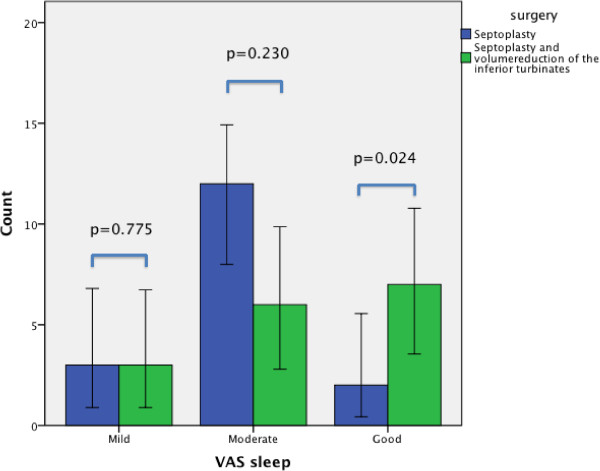
- Questionnaire responders reported improvement in nasal obstruction in 96% of group 1 and 85% of group 2, and improved sleep quality in 68% and 80%, respectively; a significantly larger proportion of group 2 reported “good” improvement in sleep quality (p = 0.024).
Methods
- Observational single-centre cohort study at Aleris Hospital in Trondheim, Norway, August 2008–December 2010; 59 OSA patients with clinically significant nasal obstruction were analyzed.
- Group 1 (n = 33) underwent septoplasty alone; group 2 (n = 26) underwent septoplasty plus volume-reductive turbinate surgery (radiofrequency tissue ablation, lateral fracture of the lower turbinate, or surgical reduction of concha bullosa).
- Patients had sleep polygraphy before and 3 months after surgery, plus ESS and a postoperative questionnaire with VAS; analyses used Wilcoxon matched-pairs, paired t-tests, independent t-tests, and natural-log transformation of AHI, with p < 0.05 considered significant.
Limitations
- The paper states that group 2 was small and could represent statistical uncertainty; night-to-night polygraph variation may affect individual AHI results; objective outpatient measurement of nasal obstruction was lacking; and because the study was observational and non-randomized, it cannot conclude that combined surgery is better than septoplasty alone in all patients with clinical indications for septal surgery.
- The paper also notes possible side effects of supplementing volume-reductive surgery in all OSA patients with septal deformities and advises avoiding that approach.
- Evident from the text: single-centre design, no randomized or sham control group, short 3-month follow-up, and surgical group assignment based on clinical evaluation rather than objective measurements.
Model-written summary. Check it against the paper before relying on it.
Integrity signals
Registry
Cites
Statistics
Figures
Verification
Claims the paper makes
0 Valid · 0 Not valid · 5 Not checked · 27 Own results and interpretations
A result the paper reports from its own data — it cites no other source for it, so there is none to check. The quote shows it is in the paper.
In the paper
“but there was a significant reduction in the mean ESS score: 11.5 (±3.7) – 10.0 (±4.5), (95% CI 0.53, 2.54), p = 0.004.”
§ An observational cohort study of the effects of septoplasty with or without inferior turbinate reduction in patients with obstructive sleep apnea > Results
plainstates a cause- Asserted: passes — The authors put it forward as true.
- Checkable: passes — It can be checked against evidence.
- Load-bearing: unclear — It is unclear whether the paper’s conclusions depend on it.
- Based: passes — The paper gives a reason why it holds.
A result the paper reports from its own data — it cites no other source for it, so there is none to check. The quote shows it is in the paper.
In the paper
“mean ODI: 14.2 (±12.3) – 12.4 (±10.7), (95% CI -1.16, 4.75), p = 0.229”
§ An observational cohort study of the effects of septoplasty with or without inferior turbinate reduction in patients with obstructive sleep apnea > Results
plain- Asserted: passes — The authors put it forward as true.
- Checkable: passes — It can be checked against evidence.
- Load-bearing: passes — The paper’s conclusions depend on it.
- Based: passes — The paper gives a reason why it holds.
A result the paper reports from its own data — it cites no other source for it, so there is none to check. The quote shows it is in the paper.
In the paper
“In group 1 there was no significant reduction in mean AHI, ODI or BMI after surgery”
§ An observational cohort study of the effects of septoplasty with or without inferior turbinate reduction in patients with obstructive sleep apnea > Results
plain- Asserted: passes — The authors put it forward as true.
- Checkable: passes — It can be checked against evidence.
- Load-bearing: passes — The paper’s conclusions depend on it.
- Based: passes — The paper gives a reason why it holds.
A result the paper reports from its own data — it cites no other source for it, so there is none to check. The quote shows it is in the paper.
In the paper
“The reduction in the difference of mean AHI after surgery was significant between the groups: 1,7 (±8,8) – 5,7 (±16,1), (95% CI 0.8, 14.0), p = 0.029”
- Also stated in: § Results · plain
“and this effect was significantly better than in the group treated with septoplasty alone.”
§ An observational cohort study of the effects of septoplasty with or without inferior turbinate reduction in patients with obstructive sleep apnea > Results
plainstates a cause- Asserted: passes — The authors put it forward as true.
- Checkable: passes — It can be checked against evidence.
- Load-bearing: passes — The paper’s conclusions depend on it.
- Based: passes — The paper gives a reason why it holds.
- Also stated in: § Results · plain
A result the paper reports from its own data — it cites no other source for it, so there is none to check. The quote shows it is in the paper.
In the paper
“The reduction in mean ESS, however, was highly statistically significant: 10.7 (±3.7) – 8.9 (±3.8), (CI 1.00, 2.61), p <0.001.”
§ An observational cohort study of the effects of septoplasty with or without inferior turbinate reduction in patients with obstructive sleep apnea > Results
plainstates a cause- Asserted: passes — The authors put it forward as true.
- Checkable: passes — It can be checked against evidence.
- Load-bearing: passes — The paper’s conclusions depend on it.
- Based: passes — The paper gives a reason why it holds.
13 more claims
Create a free account to see all 32 claims and every source verdict.
- It may state two separate claims as one. 9
- The quote only partly states this claim. 2
- Probably not a substantial claim. 7
Citations
Cites
Fokkens, W. J., Lund, V. J., Mullol, J., Bachert, C., Alobid, I., Baroody, F., Cohen, N., Cervin, A., Douglas, R., Gevaert, P., et al. (2012) · Rhinology journal · doi:10.4193/rhino12.000 · Cited by 2,387
Sher, A. E., Schechtman, K. B., & Piccirillo, J. F. (1996) · Sleep · doi:10.1093/sleep/19.2.156 · Cited by 1,335 · cited 2×
“Success criteria defined as a postoperative drop in AHI <20 and/or 50% reduction in AHI [8] were met by 15.”
MethodCardiovascular, inflammatory, and metabolic consequences of sleep deprivation
Mullington, J. M., Haack, M., Toth, M., Serrador, J. M., & Meier-Ewert, H. K. (2009) · Progress in Cardiovascular Diseases · doi:10.1016/j.pcad.2008.10.003 · Cited by 783
Effect of improved nasal breathing on obstructive sleep apnea
Friedman, M., Tanyeri, H., Lim, J. W., Landsberg, R., Vaidyanathan, K., & Caldarelli, D. (2000) · Otolaryngology–Head and Neck Surgery · doi:10.1016/s0194-5998(00)70147-1 · Cited by 267 · cited 1×
“studies represent no exception [9,10,12,14,15].”
The role of the nose in snoring and obstructive sleep apnoea: an update
Georgalas, C. (2011) · European Archives of Oto-Rhino-Laryngology · doi:10.1007/s00405-010-1469-7 · Cited by 239 · cited 1×
“Nasal surgery has been performed extensively in these patients, often with good effect on quality of life (QOL) measures [5,6].”
BackgroundEffect of Nasal Surgery on Sleep‐Related Breathing Disorders
Verse, T., Maurer, J. T., & Pirsig, W. (2002) · The Laryngoscope · doi:10.1097/00005537-200201000-00012 · Cited by 173 · cited 5×
“The impact of intranasal surgery on objective measurements in OSA patients is unclear, but is regarded as limited, as shown by Verse et al in 2002 [9].”
MethodInfluentialCritical Appraisal and Meta-Analysis of Nasal Surgery for Obstructive Sleep Apnea
Li, H.-Y., Wang, P.-C., Chen, Y.-P., Lee, L.-A., Fang, T.-J., & Lin, H.-C. (2011) · American Journal of Rhinology & Allergy · doi:10.2500/ajra.2011.25.3558 · Cited by 134 · cited 1×
“In a meta-analysis of 13 studies that dealt with nasal surgery alone in OSA patients [11], the reviewers concluded that nasal surgery for obstruction alone does not reduce AHI significantly but ameliorates daytime sleepiness and clinical symptoms of snoring.”
BackgroundRandomised trial of nasal surgery for fixed nasal obstruction in obstructive sleep apnoea
Koutsourelakis, I., Georgoulopoulos, G., Perraki, E., Vagiakis, E., Roussos, C., & Zakynthinos, S. G. (2008) · European Respiratory Journal · doi:10.1183/09031936.00087607 · Cited by 131
Li, H.-Y., Lin, Y., Chen, N.-H., Lee, L.-A., Fang, T.-J., & Wang, P.-C. (2008) · Archives of Otolaryngology–Head & Neck Surgery · doi:10.1001/archotol.134.4.429 · Cited by 127 · cited 1×
“Nasal surgery has been performed extensively in these patients, often with good effect on quality of life (QOL) measures [5,6].”
BackgroundPolysomnographic effects of nasal surgery for snoring and obstructive sleep apnea
Kim, S. T., Choi, J. H., Jeon, H. G., Cha, H. E., Kim, D. Y., & Chung, Y.-S. (2004) · Acta Oto-Laryngologica · doi:10.1080/00016480410016252 · Cited by 94 · cited 1×
“Only one of these studies described a statistically significant reduction in AHI [12].”
Background
Cited by
International Consensus Statement on Obstructive Sleep Apnea
Chang, J. L., Goldberg, A. N., Alt, J. A., Mohammed, A., Ashbrook, L., Auckley, D., Ayappa, I., Bakhtiar, H., Barrera, J. E., Bartley, B. L., et al. (2023) · International Forum of Allergy & Rhinology · doi:10.1002/alr.23079 · Cited by 350
Wu, J., Zhao, G., Li, Y., Zang, H., Wang, T., Wang, D., & Han, D. (2017) · Medicine · doi:10.1097/md.0000000000006008 · Cited by 61
Alt, J. A., DeConde, A. S., Mace, J. C., Steele, T. O., Orlandi, R. R., & Smith, T. L. (2015) · JAMA Otolaryngology–Head & Neck Surgery · doi:10.1001/jamaoto.2015.1673 · Cited by 53
The Nose and Nasal Breathing in Sleep Apnea
Cai, Y., Goldberg, A. N., & Chang, J. L. (2020) · Otolaryngologic Clinics of North America · doi:10.1016/j.otc.2020.02.002 · Cited by 61
Kent, D. T., Stanley, J. J., Aurora, R. N., Levine, C. G., Gottlieb, D. J., Spann, M. D., Torre, C. A., Green, K., & Harrod, C. G. (2021) · Journal of Clinical Sleep Medicine · doi:10.5664/jcsm.9594 · Cited by 54
Nasal Surgery for Obstructive Sleep Apnea Syndrome
Mickelson, S. A. (2016) · Otolaryngologic Clinics of North America · doi:10.1016/j.otc.2016.07.002 · Cited by 33
Rodrigues, M. M., Gabrielli, M. A. C., Garcia, O. A., Filho, V. A. P., & Pásseri, L. A. (2017) · International Journal of Oral and Maxillofacial Surgery · doi:10.1016/j.ijom.2017.05.009 · Cited by 26
Khalili, M., Larsson, M., & Müller, B. (2018) · International Journal for Numerical Methods in Fluids · doi:10.1002/fld.4696 · Cited by 24
Bosco, G., Pérez-Martín, N., Morato, M., Racionero, M. A., & Plaza, G. (2020) · Journal of Craniofacial Surgery · doi:10.1097/scs.0000000000005865 · Cited by 22
“and daytime hypersomnolence.(6,8,9,17) Consistent with these findings, the present study showed improvement in ESS.”
ResultEffect of nasal and sinus surgery in patients with and without obstructive sleep apnea
Wang, M., Liu, S. Y.-C., Zhou, B., Li, Y., Cui, S., & Huang, Q. (2019) · Acta Oto-Laryngologica · doi:10.1080/00016489.2019.1575523 · Cited by 20
“Two studies included radiofrequency tissue ablation of bilateral inferior turbinates [6,12].”
BackgroundJohnsen, S. G. (2024) · Bioengineering · doi:10.3390/bioengineering11030239 · Cited by 27
Sinonasal outcomes in obstructive sleep apnea syndrome
Kuan, E. C., Tajudeen, B. A., Peng, K. A., & Wang, M. B. (2015) · The Laryngoscope · doi:10.1002/lary.25411 · Cited by 18
“Such interventions have been shown to improve quality of life postoperatively.(16,17) Correlation of improvement or change in polysomnographic variables with SNOT-22 scores in those patients who undergo septal and/or turbinate surgery would thus be interesting.”
BackgroundPark, D., Cho, J. H., Jung, Y. G., Choi, J. H., Kim, D., Kim, S., Kim, H. J., Kim, H. Y., Park, S. K., Park, C. S., et al. (2023) · Clinical and Experimental Otorhinolaryngology · doi:10.21053/ceo.2022.01361 · Cited by 23
Role of the Allergist-Immunologist and Upper Airway Allergy in Sleep-Disordered Breathing
Shusterman, D. J., Baroody, F. M., Craig, T., Friedlander, S. L., Nsouli, T. M., & Silverman, B. A. (2016) · The Journal of Allergy and Clinical Immunology In Practice · doi:10.1016/j.jaip.2016.10.007 · Cited by 16
Brodie, K. D., & Goldberg, A. N. (2021) · Medical Clinics of North America · doi:10.1016/j.mcna.2021.05.010 · Cited by 19
Evaluation of the clinical efficacy of nasal surgery in the treatment of obstructive sleep apnoea
Wu, J., He, S., Li, Y., Wang, T., Zhao, G., Pan, Y., Zang, H., & Han, D. (2022) · American Journal of Otolaryngology · doi:10.1016/j.amjoto.2021.103158 · Cited by 12
Park, S. K., & Choi, J. H. (2025) · Journal of Clinical Medicine · doi:10.3390/jcm14217586 · Cited by 13
“By decreasing upper airway resistance and reducing the need for mouth breathing, these procedures can lessen the risk of airway collapse during sleep [71–74].”
The Efficacy of Coblator in Turbinoplasty
Lee, K.-C., Cho, J.-M., Kim, S.-K., et al. (2017) · Archives of Craniofacial Surgery · doi:10.7181/acfs.2017.18.2.82 · Cited by 12
“Moxness and Nordgard [22] conducted a comparative cohort study of the degree of improvement of the symptoms in patients with sleep apnea between the patients treated with both septoplasty and turbinoplasty and the 87www.e-acfs.org patients treated only with septoplasty.”
BackgroundCFD simulations of turbulent flow in the human upper airwaysPreprint
Aasgrav, E., Johnsen, S. G., Simonsen, A. J., et al. (2017) · arXiv (Cornell University) · doi:10.48550/arxiv.1706.02565 · Cited by 11
Moxness, M. H. S., Bugten, V., Thorstensen, W. M., Nordgård, S., & Bruskeland, G. (2016) · Rhinology Journal · doi:10.4193/rhin16.085 · Cited by 19
“This explanation can be supported of an earlier trial where we demonstrated that OSA patients improved after septoplasty when inferior turbinate reduction was incorporated in the procedure (23).”
ResultSelf-citationKarodpati, N., Ingale, M. H., Rawat, S., & Kuradagi, V. (2019) · International Journal of Otorhinolaryngology and Head and Neck Surgery · doi:10.18203/issn.2454-5929.ijohns20193616 · Cited by 10
Abd El_Wahab, S., Abd El-Aziz, A., Abd El-Fattah, A., El-Habashy, M., & Omar, H. (2018) · The Egyptian Journal of Chest Diseases and Tuberculosis · doi:10.4103/ejcdt.ejcdt_5_18 · Cited by 3
Evidence-Based Medicine: The role of nasal surgery in treatment of obstructive sleep apnea
Newsome, H. (2023) · Facial Plastic Surgery · doi:10.1055/a-2031-3289 · Cited by 3
Chen, H., Chung, C., & Chien, W. (2020) · American Journal of Rhinology and Allergy · doi:10.1177/1945892420932485 · Cited by 4
Jordal, M. R., Johnsen, S. G., Dahl, S. K., et al. (2017) · arXiv (Cornell University) · doi:10.48550/arxiv.1706.02575 · Cited by 3
“It is not known why there is such a low success rate after surgery, and why some patients improve and others do not (Moxness and Nordgård, 2014).”
BackgroundReddy, P. D., Ung, S., Qian, J., Ocasio-Nieves, B. D., Shaffer, A. D., Rushchak, M. V., & Stapleton, A. L. (2025) · International Journal of Pediatric Otorhinolaryngology · doi:10.1016/j.ijporl.2025.112578 · Cited by 3
Aliyeva, A., Huseynzada, S., Hashimli, R., & Yılmaz, B. (2025) · European Archives of Oto-Rhino-Laryngology · doi:10.1007/s00405-025-09870-3 · Cited by 2
Alcas, O., Fernández, P. R. A., Universidad de San Martín de Porres, F. D. M. H. L., Gutarra-Vilchez, R. B., & Universidad de San Martín de Porres, F. D. M. H. L. (2019) · Horizonte Médico (Lima) · doi:10.24265/horizmed.2019.v19n4.02 · Cited by 1
Sleep Disorders and the Nose: What Is the Evidence Base?
Verse, T., & Müller, S. (2023) · Springer eBooks · doi:10.1007/978-3-031-28690-2_10 · Cited by 1
A Young Man Running Out of Treatment Options
Girdhar, A., Berry, R. B., Ryals, S. M., Beck, E. M., & Wagner, M. (2015) · Journal of Clinical Sleep Medicine · doi:10.5664/jcsm.5104 · Cited by 1
“4 However, only 27% of patients undergoing both septoplasty and turbinate reduction had a postop - erative drop in AHI to less than 20/h and/or a 50% reduction in AHI.”
Chowdhury, S., Debnath, T., & Verma, S. (2021) · INTERNATIONAL JOURNAL OF SCIENTIFIC RESEARCH · doi:10.36106/ujsr/5425585 · Cited by 2
Impact of Nasal Surgery on Sleep Apnea Severity and Quality of Life: A Systematic Review
Sheikah, M. A. A., Bafaraj, A. G., Alsadah, O. A., Alhamrani, M. S., Alghamdi, A. S., Yamani, M. B., Alamri, H. M., & Taher, A. A. (2025) · Saudi Journal of Otorhinolaryngology Head and Neck Surgery · doi:10.4103/sjoh.sjoh_43_25
The Effect of Nasal Findings on Obstructive Sleep Apnea
Derin, S., Köseoğlu, S., Şahan, M., & Yılmaz, M. (2016) · The Anatolian Journal of General Medical Research · doi:10.5222/terh.2016.233
Surgical Management of the Turbinates
Kaya, E., Özüdoğru, E., & Nogueira, J. F. (2019) · Springer eBooks · doi:10.1007/978-3-030-21217-9_53
Berg, L. M. (2020) · Journal of Dental Sleep Medicine · doi:10.15331/jdsm.7118
Effect of Septoplasty on Objective and Subjective Parameters of Osas Treatment
Server, E. A., Acıoğlu, E., Yiğit, Ö., Akı, E. S., Seden, N., & Yasak, A. G. (2021) · The Turkish Journal of Ear Nose and Throat · doi:10.26650/tr-ent.2021.41275
“comparing septoplasty and turbinoplasty , 33 of 59 patients underwent septoplasty only, whereas 26 underwent septoplasty and inferior concha volumereducing surgeries (14).”
ResultNasal Obstruction and Sleep-Disordered Breathing
Scott, W. C., & Kent, D. T. (2021) · Springer eBooks · doi:10.1007/978-3-030-54146-0_16 · Cited by 1
de Luccas, G. R. (2022) · Digital Library of Theses and Dissertations (Universidade de São Paulo) · doi:10.11606/t.25.2022.tde-25012023-183421
Henríquez, J. M. B., Penagos, J. X. V., & Ortíz, K. A. G. (2023) · ACTA DE OTORRINOLARINGOLOGÍA & CIRUGÍA DE CABEZA Y CUELLO · doi:10.37076/acorl.v51i2.710
The Role of the Nose in Pharyngeal Obstructions
Verse, T. (2023) · Springer eBooks · doi:10.1007/978-3-031-34992-8_13
Maxillomandibular Advancement in the Treatment of Obstructive Sleep Apnea
Zhu, K. J., & Yang, R. (2025) · Current Otorhinolaryngology Reports · doi:10.1007/s40136-025-00523-x
Ang, L. F., Chua, N. Y. M., Loh, B. J. S., Pierro, F. D., & Ng, C. L. (2026) · Facial Plastic Surgery · doi:10.1055/a-2891-4516
Metadata
- Authors
- Moxness, M. H. S., & Nordgård, S.
- Affiliations
- Aleris Rosenborgklinikken (NO)
- Norwegian University of Science and Technology (NO)
- Corresponding author
- Nordgård, Ståle
- Venue
- BMC Ear, Nose and Throat Disorders
- Published
- 2014-10-21
- Volume
- 14
- Issue
- 1
- Pages
- 11-11
- ISSN
- 1472-6815 (ISSN-L)
- PMC
- PMC4211927
- OpenAlex
- W1983610170
- Semantic Scholar
- c992836c39ecf8bcb94ab7c5e66217633748cf20
- Cited by
- 44
- References
- 17
- Citations by year
- 2026: 2 · 2025: 5 · 2024: 1 · 2023: 5 · 2022: 2 · 2021: 6 · 2020: 3 · 2019: 5 · 2018: 2 · 2017: 5 · 2016: 5 · 2015: 3
- FWCI
- 2.88
- Type
- journal article
- Language
- en
- Open access
- hybrid
- doi.org
- Licence
- Locations
- BMC Ear Nose and Throat Disorders (publishedVersion, cc-by)
- Europe PMC (PubMed Central) (publishedVersion, cc-by)
- PubMed Central (publishedVersion, cc-by)
- PubMed (publishedVersion)
- BIBSYS Brage (BIBSYS (Norway)) (acceptedVersion, cc-by)
- NORA - Norwegian Open Research Archives (submittedVersion, cc-by)
- Topics
- Health Sciences › Medicine › Physiology (medical) › Obstructive Sleep Apnea Research
- Health Sciences › Medicine › Surgery › Nasal Surgery and Airway Studies
- Health Sciences › Medicine › Otorhinolaryngology › Sinusitis and nasal conditions
- Keywords
- obstructive sleep apnea, septoplasty, inferior turbinate reduction, nasal obstruction, intranasal surgery, apnea-hypopnea index, sleep quality, daytime sleepiness
About these checks
Registry, retraction, Cites and statistics results are computed, not judged, with one exception: a printed reference that no index lists is read once by a model before it counts as a citation error. Claims are extracted by a model and kept only when their quote appears verbatim in the text; each cited source is then checked, with a model’s help, for whether it says what the claim relies on. Those verdicts can be wrong — read the claim’s quote and the cited source before relying on one.
A language model drew the claims from the paper on 2026-10-10, under version 3 of the claim definition (model deepseek-v4.1-flash, prompt extract-v3).
A second model labelled each claim on 2026-10-10 (model jev-1.13-20260917, definition revision gold-guideline-v0.2).
Statistics and arithmetic are recomputed, not judged.
Confidence bands are shown only for fields calibrated on our annotated test set. None is calibrated yet, so no band is shown.
What counts as a claim ›How we measure confidence ›How we check this ›
Are you an author, or do you see a problem with this page? Request a review
Data sources
Bibliographic data: Semantic Scholar, OpenAlex, Crossref.
Contains information from the Semantic Scholar Academic Graph Datasets, made available under the ODC Attribution License (ODC-BY 1.0).
Semantic Scholar’s data is described in: Kinney, R., et al. (2023). The Semantic Scholar Open Data Platform. arXiv:2301.10140.
