

Physical activity and mental health in women with Polycystic Ovary Syndrome
Open accessThe DOI matches its Crossref record; 55 of the 56 references it cites were found in a registry or an index.
Abstract
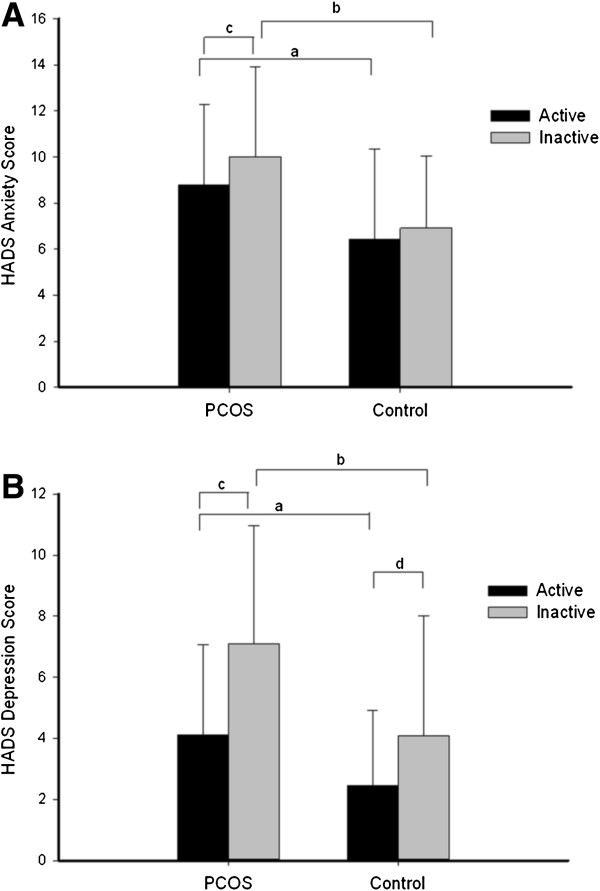
BACKGROUND: Physical activity is prescribed as a component of primary management for Polycystic Ovary Syndrome (PCOS). This study investigates the association between physical activity and mental health as well as the exercise barriers, motivators and support providers for younger women with and without PCOS to assist in physical activity uptake and prescription for these women. METHODS: Women aged 18-50 years with (n = 153) and without PCOS (n = 64) completed a questionnaire at one time point. The questionnaire included the Hospital Anxiety and Depression Scale and a survey regarding levels of physical activity, physical activity barriers, motivators and supports. A MANCOVA assessed associations between physical activity, PCOS and mental health (specifically depression and anxiety). Descriptive and Chi square goodness of fit statistics assessed the differences in perceived barriers, motivators and support providers amongst women with and without PCOS. RESULTS: Women with PCOS displayed higher severity of depression (F(1,210) = 8.32, p = 0.004) and anxiety (F(1,210) = 17.37, p < 0.001) symptoms compared to controls. Overall, for physically active women, depression was significantly less severe than in their inactive counterparts (F(2,210) = 13.62, p < 0.001). There were no differences in anxiety by physical activity status and no interaction effects between PCOS and activity status for depression or anxiety. Women with PCOS were more likely to report a lack of confidence about maintaining physical activity (Χ2 = 3.65; p = 0.046), fear of injury (Χ2 = 4.08; p = 0.043) and physical limitations (Χ2 = 11.92; p = 0.001) as barriers to physical activity and were more likely to be motivated to be active to control a medical condition (Χ2 = 7.48; p = 0.006). Women with PCOS identified more sources of support compared to women without PCOS. CONCLUSIONS: Physical activity is associated with lower depression in women with PCOS and differences exist in the self-reported physical activity barriers, motivators and support providers, compared to controls. Being more active may offer mental health benefits in managing PCOS. Prescribing physical activity to women with PCOS should be individualized and consider both common and PCOS-specific barriers and motivators for successful engagement.
Overview
The claims and statistics of this paper haven’t been checked yet.
Free: it reads the open-access text and checks the first 5 claims that cite a source we can check. Create a free account to check every claim.
Integrity signals
Registry
Cites
Statistics
Figures
Verification
Claims the paper makes
The claims and statistics of this paper haven’t been checked yet.
Free: it reads the open-access text and checks the first 5 claims that cite a source we can check. Create a free account to check every claim.
Claims other papers make about this one
Each is checked against this paper’s own text: does it say what the citing paper says it does?
The cited source says what the claim attributes to it.
In the citing paper
“This is evidenced by previous research reporting that a major barrier to physical activity adoption among women with PCOS is the perceived barrier that exercise is tiring and hard work [121], and fear of injury [72].”
From Providing lifestyle advice to women with PCOS: an overview of practical issues affecting success (2021) · cites this paper as [72]
In the citing paper
“Women with PCOS are more likely to report a lack of confidence about maintaining physical activity [72] which may be related to negative body image, and feelings of shame and worthlessness [73].”
From Providing lifestyle advice to women with PCOS: an overview of practical issues affecting success (2021) · cites this paper as [72]
Self-check
Percentages, sums and reported differences re-computed from the paper’s own numbers.
The self-check needs the paper’s full text.
Citations
Cites
1 retracted
Shaw, L. J., Bairey Merz, C. N., Azziz, R., Stanczyk, F. Z., Sopko, G., Braunstein, G. D., Kelsey, S. F., Kip, K. E., Cooper-DeHoff, R. M., Johnson, B. D., et al. (2008) · The Journal of Clinical Endocrinology & Metabolism · doi:10.1210/jc.2007-0425 · Cited by 427 · cited 1×
“PCOS has reproductive, psychological and cardio-metabolic features [3-7] and is associated with many long term adverse health problems including increased risk of obesity [4,8,9], type 2 diabetes and metabolic impairments [10-13], and cardiovascular risk factors [14,15].”
BackgroundRetractedThe Hospital Anxiety and Depression Scale
Zigmond, A. S., & Snaith, R. P. (1983) · Acta Psychiatrica Scandinavica · doi:10.1111/j.1600-0447.1983.tb09716.x · Cited by 47,139
Stages and processes of self-change of smoking: Toward an integrative model of change.
Prochaska, J. O., & DiClemente, C. C. (1983) · Journal of Consulting and Clinical Psychology · doi:10.1037/0022-006x.51.3.390 · Cited by 9,098 · cited 2×
“A simple, devised measure based on the trans-theoretical model TTM; [40] was used to assess participants’ physical activity levels.”
Method(2004) · Fertility and Sterility · doi:10.1016/j.fertnstert.2003.10.004 · Cited by 9,050
Depression, chronic diseases, and decrements in health: results from the World Health Surveys
Moussavi, S., Chatterji, S., Verdes, E., Tandon, A., Patel, V., & Ustun, B. (2007) · The Lancet · doi:10.1016/s0140-6736(07)61415-9 · Cited by 4,070 · cited 1×
“Many chronic illnesses have mental health impacts and are associated with reduction in quality of life and increases in depressive symptoms [21-24].”
BackgroundFranks, S. (1995) · New England Journal of Medicine · doi:10.1056/nejm199509283331307 · Cited by 2,463
Men at risk: occupation and male infertility
Claman, P. (2004) · Fertility and Sterility · doi:10.1016/s0015-0282(03)01188-9 · Cited by 2,387
March, W. A., Moore, V. M., Willson, K. J., Phillips, D. I. W., Norman, R. J., & Davies, M. J. (2010) · Human Reproduction · doi:10.1093/humrep/dep399 · Cited by 1,799
Global strategy on diet, physical activity and health
Samuelson, G. (2004) · Scandinavian Journal of Nutrition · doi:10.1080/11026480410034349 · Cited by 1,720
Teede, H., Deeks, A., & Moran, L. (2010) · BMC Medicine · doi:10.1186/1741-7015-8-41 · Cited by 1,565 · cited 2×
“PCOS has reproductive, psychological and cardio-metabolic features [3-7] and is associated with many long term adverse health problems including increased risk of obesity [4,8,9], type 2 diabetes and metabolic impairments [10-13], and cardiovascular risk factors [14,15].”
Self-citation
Research works printed but not linked: 1
- Australian Bureau of Statistics Physical Activity: Main barriers and motivators report 4177.0 - Participation in Sports and Physical Recreation 2007 Australia: Australian Bureau of Statistics; Canberra
Cited by
Items 101–123 of 123
Ullah, M. (2022) · Journal of Women Medical and Dental College · doi:10.56600/jwmdc.v1i1.6 · Cited by 4
Pan, J., Xiang, S., Dong, S., Qin, X., & Zhang, J. (2021) · Research Square · doi:10.21203/rs.3.rs-231675/v1 · Cited by 1
Khan, F. (2021) · DUT Open Scholar (Durban University of Technology) · doi:10.51415/10321/4031 · Cited by 4
Experiencias de mujeres jóvenes diagnosticadas con síndrome de ovario poliquístico
Ratto, D., & Inés, C. (2016) · renati
Tópicos em Ciências da Saúde Volume 3
Bezerra, E. N. R., Pichelli, A. A. W. S., Gama, J. F. D. A., Fernandes, M. C. M. D. O., de Oliveira, I. B., de Melo, M. P., Ferreira, J. F., Freires, L. D. S., Catão, R. M. R., Nunes, L. E., et al. (2019) · doi:10.5935/978-85-7042-105-0
The Relationship between Polycystic Ovary Syndrome and Psychological Symptoms
Pınar, G. (2021) · Journal of Clinical Research and Reports · doi:10.31579/2642-9756/040
“Although the genetic etiology of PCOS remains unknown, it can be associated with psychiatric disorders [3-14].”
BackgroundPatten, R. K. (2021) · Victoria University Research Repository (Victoria University) · Cited by 5
Physical activity and cardiovascular disease risk in women with polycystic ovary syndrome
Woodward, A. (2021) · Sheffield Hallam University · doi:10.7190/shu-thesis-00398 · Cited by 2
Kazemi, A., Farajzadegan, Z., Salehi, M., & ZareMobini, F. (2022) · Research Square · doi:10.21203/rs.3.rs-1912266/v1
Prabha, S. L., Theras, S. M. L., & Suresh, A. (2021) · doi:10.56984/8zg20accc
Quality of Life in Females with PCOS
-, G. G., & Shende, M. (2024) · International Journal For Multidisciplinary Research · doi:10.36948/ijfmr.2024.v06i02.17839
CONSUMO ALIMENTAR E A PRÁTICA DE ATIVIDADE FÍSICA DE MULHERES COM SÍNDROME DO OVÁRIO POLICÍSTICO
Silva, T. M., Rocha, T. B., Jota, M. G. B., & Falco, M. D. O. (2024) · Revista Estudos - Revista de Ciências Ambientais e Saúde (EVS) · doi:10.18224/evs.v51i1.14118
Murugesan, M. N., Ramasamy, A., & Venkat, A. (2024) · IP Journal of Paediatrics and Nursing Science · doi:10.18231/j.ijpns.2024.020
Bazarganipour, F., Taghavi, S. A., Montazeri, A., Ahmadi, F., Derakhshideh, Z., & Asadikalameh, Z. (2024) · BMC Psychology · doi:10.1186/s40359-024-02158-x
“Physical and psychological effects associated with PCOS, along with coping with them, lead to poor mental health and a diminished quality of life (QOL) [21, 22].”
POLİKİSTİK OVER, DİSMENORE VE PREMENSTRUAL SENDROMDA EGZERSİZ YAKLAŞIMLARI VE ÖNERİLERİ
ÜNAL, B., Demir, C., & Özden, A. V. (2025) · Atlas Universitesi Tip ve Saglik Bilimleri Dergisi · doi:10.54270/atljm.2025.80
Effect of Yoga (Malasana) on Anxiety and Depression Among Women with Polycystic Ovarian Disease
Warghane, R. S., Mahakarkar, M. G., Taksande, V. D., Teltumbde, A., Warghane, S. S., Ghugare, S. B., Dhengare, A. N., & Gulghane, A. (2025) · Journal of South Asian Federation of Obstetrics and Gynaecology · doi:10.5005/jp-journals-10006-2746
PCOS/PCOD as result of lifestyle and stress among college-going female students
Nema, P., Joseph, J., Mal, P., & Shukla, A. (2024) · Indian Journal of Health, Sexuality and Culture · doi:10.5281/zenodo.13309344
Lin, A. W., Siscovick, D. S., Sternfeld, B., Schreiner, P., Lewis, C. E., Wang, E. T., Merkin, S. S., Wellons, M., Steffen, L. M., Calderon‐Margalit, R., et al. (2021) · Figshare · doi:10.6084/m9.figshare.13534529
Mankar, S., Salekar, B. C., Sardeshmukh, S., & Sonawane, S. (2026) · International Journal of Health Sciences and Research · doi:10.52403/ijhsr.20260216
Kanamanapalli, P. V., Kuppusamy, S., Thyagaraju, C., & Subramanian, S. K. (2026) · Annals of Neurosciences · doi:10.1177/09727531261440667
“38 Conte et al. 39 and Banting et al. 40 similarly reported lower depression severity among physically active women with PCOS.”
Huang, X., Chen, Z., Zhang, L., & Li, J. (2026) · Frontiers in Endocrinology · doi:10.3389/fendo.2026.1797826
“Only a subset of women with PMOS meet recommended physical activity levels, and prolonged sedentary behavior is common (77, 133).”
Liang, H., & Wang, Z. (2026) · Research Square · doi:10.21203/rs.3.rs-10568975/v1
Plichtowicz-Kordowska, W., Stępka, A., Jaworowicz, L., Jóźwicka, A., Janikowski, W., Lewandowska, K., & Bąkowska, E. (2026) · International Journal of Innovative Technologies in Social Science · doi:10.31435/ijitss.3(51).2026.6207
Metadata
- Authors
- Banting, L. K., Gibson-Helm, M., Polman, R., Teede, H. J., & Stepto, N. K.
- Affiliations
- Victoria University (AU)
- Monash Health (AU)
- Monash University (AU)
- Corresponding author
- Stepto, Nigel K
- Venue
- BMC Women's Health
- Published
- 2014-03-27
- Volume
- 14
- Issue
- 1
- Pages
- 51-51
- ISSN
- 1472-6874 (ISSN-L)
- PMC
- PMC3986680
- OpenAlex
- W1982091562
- Cited by
- 121
- References
- 56
- Citations by year
- 2026: 7 · 2025: 2 · 2024: 15 · 2023: 13 · 2022: 13 · 2021: 22 · 2020: 9 · 2019: 14 · 2018: 6 · 2017: 2 · 2016: 10 · 2015: 6 · 2014: 2
- FWCI
- 8.08
- Type
- journal article
- Language
- en
- Open access
- gold
- doi.org
- Licence
- Locations
- BMC Women s Health (publishedVersion, cc-by)
- Europe PMC (PubMed Central) (publishedVersion, cc-by)
- PubMed Central (publishedVersion, cc-by)
- PubMed (publishedVersion)
- Bournemouth University Research Online (Bournemouth University) (acceptedVersion)
- QUT ePrints (Queensland University of Technology) (submittedVersion, cc-by)
- Minerva Access (University of Melbourne) (submittedVersion, cc-by)
- Victoria University Research Repository (Victoria University) (submittedVersion, cc-by)
- Adelaide Research & Scholarship (AR&S) (University of Adelaide) (submittedVersion, cc-by)
- Funders
- Australian Government
- National Health and Medical Research Council
- Topics
- Health Sciences › Medicine › Reproductive Medicine › Ovarian function and disorders
- Health Sciences › Medicine › Public Health, Environmental and Occupational Health › Physical Activity and Health
- Social Sciences › Life-span and Life-course Studies › Recreational Sport and Physical Activity
- Keywords
- polycystic ovary syndrome, physical activity, mental health, depression, anxiety, barriers to exercise, social support, young women, physical activity prescription, fear of injury, physical limitations, self-efficacy, individualized exercise prescription, exercise adherence
- MeSH terms
- Adolescent, Adult, Anxiety, Cross-Sectional Studies, Depression, Female, Humans, Middle Aged, Motivation, Motor Activity, Polycystic Ovary Syndrome, Psychiatric Status Rating Scales, Surveys and Questionnaires, Social Support, Body Mass Index, Case-Control Studies, Self Efficacy, Young Adult
About these checks
Registry, retraction, Cites and statistics results are computed, not judged, with one exception: a printed reference that no index lists is read once by a model before it counts as a citation error. Claims are extracted by a model and kept only when their quote appears verbatim in the text; each cited source is then checked, with a model’s help, for whether it says what the claim relies on. Those verdicts can be wrong — read the claim’s quote and the cited source before relying on one.
Statistics and arithmetic are recomputed, not judged.
Confidence bands are shown only for fields calibrated on our annotated test set. None is calibrated yet, so no band is shown.
What counts as a claim ›How we measure confidence ›How we check this ›
Are you an author, or do you see a problem with this page? Request a review
Data sources
Bibliographic data: Semantic Scholar, OpenAlex, Crossref.
Contains information from the Semantic Scholar Academic Graph Datasets, made available under the ODC Attribution License (ODC-BY 1.0).
Semantic Scholar’s data is described in: Kinney, R., et al. (2023). The Semantic Scholar Open Data Platform. arXiv:2301.10140.
