

Mindfulness for irritable bowel syndrome: protocol development for a controlled clinical trial
Open accessThe DOI matches its Crossref record; 47 of the 48 references it cites were found in a registry or an index.
Abstract
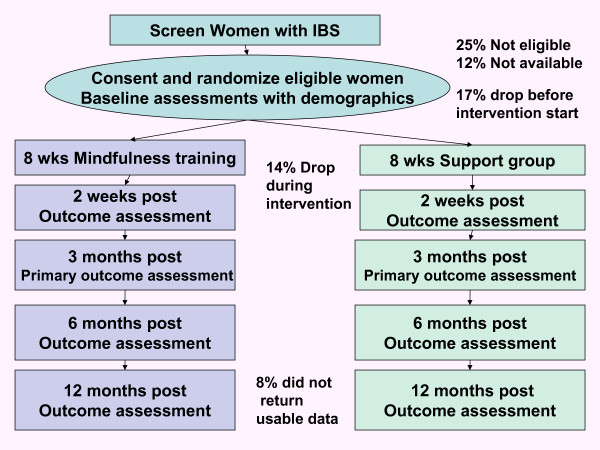
BACKGROUND: Irritable bowel syndrome (IBS), a functional bowel disorder with symptoms of abdominal pain and disturbed defecation experienced by 10% of U.S. adults, results in significant disability, impaired quality of life, and health-care burden. Conventional medical care focusing on pharmacological approaches, diet, and lifestyle management has been partially effective in controlling symptoms. Behavioral treatments, such as cognitive-behavioral therapy and hypnosis, are promising. This paper describes an on-going feasibility study to assess the efficacy of mindfulness training, a behavioral treatment involving directing and sustaining attention to present-moment experience, for the treatment of IBS. METHODS/DESIGN: The study design involves randomization of adult women with IBS according to Rome II criteria, to either an eight-week mindfulness training group (based on a Mindfulness-based Stress Reduction [MBSR] format) or a previously validated IBS social-support group as an attention-control condition. The primary hypothesis is that, compared to Support Group participants, those in the Mindfulness Program will demonstrate significant improvement in IBS symptoms as measured by the IBS Symptom Severity Scale [1]. DISCUSSION: 214 individuals have been screened for eligibility, of whom 148 were eligible for the study. Of those, 87 were enrolled, with 21 withdrawing after having given consent. 66 have completed or are in the process of completing the interventions. It is feasible to undertake a rigorous randomized clinical trial of mindfulness training for people with IBS, using a standardized MBSR protocol adapted for those experiencing IBS, compared to a control social-support group previously utilized in IBS studies. TRIAL REGISTRATION: Clinical Trials.gov Identifier: NCT00680693.
Overview
The claims and statistics of this paper haven’t been checked yet.
Free: it reads the open-access text and checks the first 5 claims that cite a source we can check. Create a free account to check every claim.
Integrity signals
Registry
Cites
Statistics
Figures
Verification
Claims the paper makes
The claims and statistics of this paper haven’t been checked yet.
Free: it reads the open-access text and checks the first 5 claims that cite a source we can check. Create a free account to check every claim.
Claims other papers make about this one
Each is checked against this paper’s own text: does it say what the citing paper says it does?
The cited source doesn’t support the claim as written.
In the citing paper
“Two RCTs of mindfulness-based treatment for IBS35,36 were also identified and reported significant treatment effects for several outcomes including GI symptoms,35,36 quality of life,35 and anxiety.35”
From Preliminary investigation of the associations between psychological flexibility, symptoms and daily functioning in people with chronic abdominal pain (2021) · cites this paper as [35]
Checked by a reasoning model — may be wrong.
Experimental — accuracy not yet measuredThe source backs part of the claim, not all of it — or backs it for a different population, condition or comparison.
In the citing paper
“psychological treatments such as hypnotherapy and mindfulness(19-22), patient focused cognitive behavior therapy (CBT)(23), behavior therapy (BT)(24, 25), patient education(26), and internet based CBT(27) have all shown effectiveness in alleviating IBS related symptoms.”
From Randomised clinical trial: Symptoms of the irritable bowel syndrome are improved by a psycho-education group intervention (2013) · cites this paper as [21]
Experimental — accuracy not yet measured
Self-check
Percentages, sums and reported differences re-computed from the paper’s own numbers.
The self-check needs the paper’s full text.
Citations
Cites
Using Self-Report Assessment Methods to Explore Facets of Mindfulness
Baer, R. A., Smith, G. T., Hopkins, J., Krietemeyer, J., & Toney, L. (2006) · Assessment · doi:10.1177/1073191105283504 · Cited by 7,511
The brief symptom inventory: an introductory report.
Derogatis, L. R., & Melisaratos, N. (1983) · Psychological Medicine · doi:10.1017/s0033291700048017 · Cited by 6,650
Kabat-Zinn, J. (1982) · General Hospital Psychiatry · doi:10.1016/0163-8343(82)90026-3 · Cited by 4,255
Functional bowel disorders and functional abdominal pain
Thompson, W. G., Longstreth, G. F., Drossman, D. A., Heaton, K. W., Irvine, E. J., & Müller-Lissner, S. A. (1999) · Gut · doi:10.1136/gut.45.2008.ii43 · Cited by 2,440
Drossman, D. A., Li, Z., Andruzzi, E., Temple, R. D., Talley, N. J., Grant Thompson, W., Whitehead, W. E., Janssens, J., Funch-Jensen, P., Corazziari, E., et al. (1993) · Digestive Diseases and Sciences · doi:10.1007/bf01303162 · Cited by 2,198
Self-citationThe clinical use of mindfulness meditation for the self-regulation of chronic pain
Kabat-Zinn, J., Lipworth, L., & Burney, R. (1985) · Journal of Behavioral Medicine · doi:10.1007/bf00845519 · Cited by 1,745
FRANCIS, C. Y., MORRIS, J., & WHORWELL, P. J. (1997) · Alimentary Pharmacology & Therapeutics · doi:10.1046/j.1365-2036.1997.142318000.x · Cited by 1,708
Meditation experience is associated with increased cortical thickness
Lazar, S. W., Kerr, C. E., Wasserman, R. H., Gray, J. R., Greve, D. N., Treadway, M. T., McGarvey, M., Quinn, B. T., Dusek, J. A., Benson, H., et al. (2005) · NeuroReport · doi:10.1097/01.wnr.0000186598.66243.19 · Cited by 1,698
Short-term meditation training improves attention and self-regulation
Tang, Y.-Y., Ma, Y., Wang, J., Fan, Y., Feng, S., Lu, Q., Yu, Q., Sui, D., Rothbart, M. K., Fan, M., et al. (2007) · Proceedings of the National Academy of Sciences · doi:10.1073/pnas.0707678104 · Cited by 1,597
Mindfulness training modifies subsystems of attention
JHA, A. P., KROMPINGER, J., & BAIME, M. J. (2007) · Cognitive, Affective, & Behavioral Neuroscience · doi:10.3758/cabn.7.2.109 · Cited by 1,580
Research works printed but not linked: 3
- 29. Dean C, Wheeler LC: IBS for dummies. Hoboken, N.J.: Wiley; 2005.
- 33. Derogatis LR: BSI-18: Administration, Scoring, and Proce- dures Manual. Minneapolis, MN: National Computer Systems; 2000.
- 36. Spielberger CD: Manual for the State-Trait Anger Expression Inventory. Odessa, FL: Psychological Assessment Resources; 1988.
Cited by
Gaylord, S. A., Palsson, O. S., Garland, E. L., Faurot, K. R., Coble, R. S., Mann, D. J., Frey, W., Leniek, K., & Whitehead, W. E. (2011) · American Journal of Gastroenterology · doi:10.1038/ajg.2011.184 · Cited by 281
Self-citationLjótsson, B., Falk, L., Vesterlund, A. W., Hedman, E., Lindfors, P., Rück, C., Hursti, T., Andréewitch, S., Jansson, L., Lindefors, N., et al. (2010) · Behaviour Research and Therapy · doi:10.1016/j.brat.2010.03.003 · Cited by 270
Lakhan, S. E., & Schofield, K. L. (2013) · PLoS ONE · doi:10.1371/journal.pone.0071834 · Cited by 233
Garland, E. L., Gaylord, S. A., Palsson, O., Faurot, K., Douglas Mann, J., & Whitehead, W. E. (2012) · Journal of Behavioral Medicine · doi:10.1007/s10865-011-9391-z · Cited by 210
Self-citationThe Application of Mindfulness to Eating Disorders Treatment: A Systematic Review
Wanden-Berghe, R. G., Sanz-Valero, J., & Wanden-Berghe, C. (2010) · Eating Disorders · doi:10.1080/10640266.2011.533604 · Cited by 184
Best practice update: Incorporating psychogastroenterology into management of digestive disorders
Keefer, L., Palsson, O. S., & Pandolfino, J. E. (2018) · Gastroenterology · doi:10.1053/j.gastro.2018.01.045 · Cited by 173
Self-citationPsychological Interventions for Irritable Bowel Syndrome and Inflammatory Bowel Diseases
Ballou, S., & Keefer, L. (2017) · Clinical and Translational Gastroenterology · doi:10.1038/ctg.2016.69 · Cited by 167
Woods-Giscombé, C. L., & Black, A. R. (2010) · Complementary health practice review · doi:10.1177/1533210110386776 · Cited by 151
Placebo effects in psychotherapy: a framework
Enck, P., & Zipfel, S. (2019) · Frontiers in Psychiatry · doi:10.3389/fpsyt.2019.00456 · Cited by 115
Naliboff, B. D., Smith, S. R., Serpa, J. G., Laird, K. T., Stains, J., Connolly, L. S., Labus, J. S., & Tillisch, K. (2020) · Neurogastroenterology & Motility · doi:10.1111/nmo.13828 · Cited by 77
Behavioural medicine and gastrointestinal disorders: the promise of positive psychology
Keefer, L. (2018) · Nature Reviews Gastroenterology & Hepatology · doi:10.1038/s41575-018-0001-1 · Cited by 71
Windgassen, S., Moss‐Morris, R., Chilcot, J., Sibelli, A., Goldsmith, K., & Chalder, T. (2017) · British Journal of Health Psychology · doi:10.1111/bjhp.12250 · Cited by 67
Labus, J., Gupta, A., Gill, H. K., Posserud, I., Mayer, M., Raeen, H., Bolus, R., Simren, M., Naliboff, B. D., & Mayer, E. A. (2013) · Alimentary Pharmacology & Therapeutics · doi:10.1111/apt.12171 · Cited by 64
Kearney, D. J., McDermott, K., Martinez, M., & Simpson, T. L. (2011) · Alimentary Pharmacology & Therapeutics · doi:10.1111/j.1365-2036.2011.04731.x · Cited by 63
Centrally Acting Therapies for Irritable Bowel Syndrome
Grover, M., & Drossman, D. A. (2011) · Gastroenterology Clinics of North America · doi:10.1016/j.gtc.2010.12.003 · Cited by 54
Sherwin, L. B., Leary, E. V., & Henderson, W. A. (2017) · Quality of Life Research · doi:10.1007/s11136-017-1554-0 · Cited by 50
Sebastián Sánchez, B., Gil Roales-Nieto, J., Ferreira, N. B., Gil Luciano, B., & Sebastián Domingo, J. J. (2017) · Revista Espanola de Enfermedades Digestivas · doi:10.17235/reed.2017.4660/2016 · Cited by 36
Pajak, R., Lackner, J. M., & Kamboj, S. K. (2013) · Journal of Psychosomatic Research · doi:10.1016/j.jpsychores.2013.05.007 · Cited by 46
Antibacterial activity of honey and medicinal plant extracts against Gram negative microorganisms
Ramalivhana, J. N., Samie, A., Iweriebor, B., Uaboi-Egbenni, P., Je, I., Momba, M. N. B., & Obi, C. (2014) · AFRICAN JOURNAL OF BIOTECHNOLOGY · doi:10.5897/ajb11.892 · Cited by 47
Implementing psychological therapies for gastrointestinal disorders in pediatrics
Reed, B., Buzenski, J., & van Tilburg, M. A. L. (2020) · Expert Review of Gastroenterology & Hepatology · doi:10.1080/17474124.2020.1806055 · Cited by 35
Person, H., & Keefer, L. (2019) · Current Gastroenterology Reports · doi:10.1007/s11894-019-0683-8 · Cited by 26
Mind Your Expectations: Exploring the Roles of Suggestion and Intention in Mindfulness Training
Farb, N. A. S. (2012) · Cited by 33
Cherpak-Castagna, C. E. (2019) · PubMed Central · Cited by 55
(2014) · Gastroenterology and hepatology from bed to bench. · Cited by 17
Long Term Effects of Mindfulness on Quality of life in Irritable Bowel Syndrome.
Zomorodi, S., Tabatabaie, S. K. R., Azadfallah, P., Ebrahimi-Daryani, N., & Arbabi, M. (2015) · Iranian Journal of Psychiatry · Cited by 19
Bitar, Z., Rogoza, R., Hallit, S., & Obeid, S. (2023) · BMC Psychology · doi:10.1186/s40359-023-01155-w · Cited by 12
Self-Management Techniques in IBD
Keefer, L., & Kane, S. V. (2015) · Springer eBooks · doi:10.1007/978-3-319-22285-1_5 · Cited by 13
Barakat, M. M., Salim, N. A., Malaeb, D. N., Dabbous, M., Sakr, F., Hallit, S. R., Fekih‐Romdhane, F., & Obeïd, S. (2024) · BMC Public Health · doi:10.1186/s12889-024-17812-7 · Cited by 16
Tayama, J., Saigo, T., Ogawa, S., Takeoka, A., Hamaguchi, T., Inoue, K., Okamura, H., Yajima, J., Matsudaira, K., Fukudo, S., et al. (2018) · Neurogastroenterology & Motility · doi:10.1111/nmo.13402 · Cited by 11
Guillén, J. M. B. (2015) · Revista de la Asociación Española de Neuropsiquiatría · doi:10.4321/s0211-57352015000200005 · Cited by 41
Felsted, K. F., & Supiano, K. P. (2019) · Research in Gerontological Nursing · doi:10.3928/19404921-20190702-02 · Cited by 10
Keefer, L., Taft, T., & Kiebles, J. L. (2012) · Wiley eBooks · doi:10.1002/9781118133880.hop209016 · Cited by 10
Yu, L., Inspector, Y., & McCracken, L. M. (2021) · British Journal of Pain · doi:10.1177/2049463720926559 · Cited by 8
The Role of Emotion in Determining Pain
Bass, C. (2009) · Digestive Diseases · doi:10.1159/000268117 · Cited by 13
Symptoms Catastrophizing Versus Social Hypervigilance in Irritable Bowel Syndrome Patients
Ng, S., & Chow, K.-W. (2012) · Social Work in Health Care · doi:10.1080/00981389.2012.701001 · Cited by 8
Solati, K., Nikfarjam, M., & Sanaei, S. (2014) · Cited by 5
Rafie, S., Akbari, R., Charati, J. Y., Elyasi, F., & Azimilolaty, H. (2020) · DOAJ (DOAJ: Directory of Open Access Journals) · Cited by 6
Abbas Haghayegh, S., Taher Neshatdoost, H., Adibi, P., & Shafii, F. (2017) · Zahedan Journal of Research in Medical Sciences · doi:10.17795/zjrms-5809 · Cited by 4
Handbook of Adolescent Medicine and Health Promotion
Paperny, D. M. N. (2011) · WORLD SCIENTIFIC eBooks · doi:10.1142/9789814317993 · Cited by 15
Mindfulness Training Has Long-Term Therapeutic Benefits in Women With Irritable Bowel Syndrome
Gaylord, S. A., Palsson, O. S., Garland, E. L., Mann, J. D., Bluth, K., Whitehead, W. E., & Faurot, K. R. (2024) · Mindfulness · doi:10.1007/s12671-024-02435-1 · Cited by 4
Self-citationKalmarzi, R. N., Moradi, G., Majd, S. A., & Khanpuor, F. (2018) · Shenakht Journal of Psychology and Psychiatry · doi:10.29252/shenakht.5.5.1 · Cited by 7
Shakernejad, S., & Alilou, M. M. (2016) · Caspian Journal of Neurological Sciences · doi:10.18869/acadpub.cjns.2.7.32 · Cited by 3
Dast, S. P. N., Maghsoud, F., Assareh, M., Khorramdel, K., & Rajabi, S. (2014) · Cited by 3
Scientometric analysis of psychological interventions based upon the use of Hypnosis
Muñoz, M. A. (2017) · Revista Iberoamericana de Psicología · doi:10.33881/2027-1786.rip.9108 · Cited by 2
Mohammadi, J., & Azizi, A. (2017) · journal of ilam university of medical sciences · doi:10.29252/sjimu.25.2.18 · Cited by 4
Lifestyle-Related Aspects of Gastrointestinal Health
Hansen, R. (2017) · Elsevier eBooks · doi:10.1016/b978-0-12-810401-9.00029-2 · Cited by 1
ezzati, Z., Shahabizadeh, F., Soleimannejad, K., & Nasri, M. (2021) · The Journal Of Psychological Science · doi:10.52547/jps.20.104.1403 · Cited by 1
Verma, N., Arora, A., Wal, A., Singh, C., Shankara, R. K., Singh, B., & Sharma, M. C. (2025) · Current Psychiatry Research and Reviews · doi:10.2174/0126660822325668241118073750 · Cited by 2
Mazaheri, M., & Manshaee, G. (2016) · KAUMS Journal · Cited by 3
Efficacy of Mindfulness Based on Stress Reduction on Rat Disorders in Patients with Irritable Bowel
Anvari, S. (2017) · Jimbun gakuhō · doi:10.24200/jsshr.vol5iss03pp56-60 · Cited by 3
Lebensstilbedingte Aspekte der gastrointestinalen Gesundheit
Hansen, R. (2017) · Elsevier eBooks · doi:10.1016/b978-3-437-23274-9.00029-0
Tecniche psicologiche basate sulle evidenze per il trattamento delle patologie legate allo stress
Compare, A., Forno, D. D., Zara, V., Cristiano, D., Beatrice, S., & Grossi, E. (2012) · Springer eBooks · doi:10.1007/978-88-470-2080-1_17
Metadata
- Authors
- Gaylord, S. A., Whitehead, W. E., Coble, R. S., Faurot, K. R., Palsson, O. S., Garland, E. L., Frey, W., & Mann, J. D.
- Affiliations
- University of North Carolina at Chapel Hill (US)
- Corresponding author
- Gaylord, Susan A
- Venue
- BMC Complementary and Alternative Medicine
- Published
- 2009-07-28
- Volume
- 9
- Issue
- 1
- Pages
- 24-24
- ISSN
- 1472-6882 (ISSN-L)
- PMC
- PMC2729728
- OpenAlex
- W1964666468
- Cited by
- 53
- References
- 48
- Citations by year
- 2025: 1 · 2024: 2 · 2023: 1 · 2021: 1 · 2020: 4 · 2019: 4 · 2018: 4 · 2017: 10 · 2016: 2 · 2015: 3 · 2014: 4 · 2013: 2 · 2012: 6
- FWCI
- 5.32
- Type
- journal article
- Language
- en
- Open access
- gold
- doi.org
- Licence
- cc-by
- creativecommons.org/licenses/by/2.0 (tdm)
- Locations
- BMC Complementary and Alternative Medicine (publishedVersion, cc-by)
- PubMed Central (publishedVersion, cc-by)
- PubMed (publishedVersion)
- Carolina Digital Repository (University of North Carolina at Chapel Hill) (submittedVersion, cc-by)
- Carolina Digital Repository (University of North Carolina at Chapel Hill) (submittedVersion)
- DOAJ (DOAJ: Directory of Open Access Journals) (submittedVersion, cc-by-sa)
- UNC Libraries
- Funders
- National Institutes of Health
- National Center for Complementary and Integrative Health (R21AT003619, T32AT003378)
- Topics
- Health Sciences › Medicine › Gastroenterology › Gastrointestinal motility and disorders
- Social Sciences › Psychology › Clinical Psychology › Mindfulness and Compassion Interventions
- Health Sciences › Medicine › Psychiatry and Mental health › Psychosomatic Disorders and Their Treatments
- Keywords
- irritable bowel syndrome, mindfulness training, mindfulness-based stress reduction, behavior therapy, feasibility study, IBS symptom severity, women, Rome II criteria, attentional control
- MeSH terms
- Adaptation, Psychological, Adult, Behavior Therapy, Feasibility Studies, Female, Humans, Research Design, Stress, Psychological, Mind-Body Therapies, Irritable Bowel Syndrome, Pain Management
About these checks
Registry, retraction, Cites and statistics results are computed, not judged, with one exception: a printed reference that no index lists is read once by a model before it counts as a citation error. Claims are extracted by a model and kept only when their quote appears verbatim in the text; each cited source is then checked, with a model’s help, for whether it says what the claim relies on. Those verdicts can be wrong — read the claim’s quote and the cited source before relying on one.
Statistics and arithmetic are recomputed, not judged.
Confidence bands are shown only for fields calibrated on our annotated test set. None is calibrated yet, so no band is shown.
What counts as a claim ›How we measure confidence ›How we check this ›
Are you an author, or do you see a problem with this page? Request a review
Data sources
Bibliographic data: Semantic Scholar, OpenAlex, Crossref.
Contains information from the Semantic Scholar Academic Graph Datasets, made available under the ODC Attribution License (ODC-BY 1.0).
Semantic Scholar’s data is described in: Kinney, R., et al. (2023). The Semantic Scholar Open Data Platform. arXiv:2301.10140.
