

Nursing churn and turnover in Australian hospitals: nurses perceptions and suggestions for supportive strategies
Open accessThe DOI matches its Crossref record; 58 of the 59 references it cites were found in a registry or an index.
Abstract
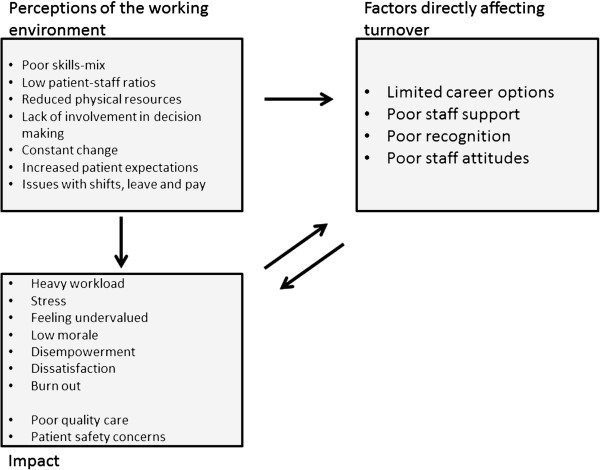
BACKGROUND: This study aimed to reveal nurses' experiences and perceptions of turnover in Australian hospitals and identify strategies to improve retention, performance and job satisfaction. Nursing turnover is a serious issue that can compromise patient safety, increase health care costs and impact on staff morale. A qualitative design was used to analyze responses from 362 nurses collected from a national survey of nurses from medical and surgical nursing units across 3 Australian States/Territories. METHOD: A qualitative design was used to analyze responses from 362 nurses collected from a national survey of nurses from medical and surgical nursing units across 3 Australian States/Territories. RESULTS: Key factors affecting nursing turnover were limited career opportunities; poor support; a lack of recognition; and negative staff attitudes. The nursing working environment is characterised by inappropriate skill-mix and inadequate patient-staff ratios; a lack of overseas qualified nurses with appropriate skills; low involvement in decision-making processes; and increased patient demands. These issues impacted upon heavy workloads and stress levels with nurses feeling undervalued and disempowered. Nurses described supportive strategies: improving performance appraisals, responsive preceptorship and flexible employment options. CONCLUSION: Nursing turnover is influenced by the experiences of nurses. Positive steps can be made towards improving workplace conditions and ensuring nurse retention. Improving performance management and work design are strategies that nurse managers could harness to reduce turnover.
Overview
The claims and statistics of this paper haven’t been checked yet.
Free: it reads the open-access text and checks the first 5 claims that cite a source we can check. Create a free account to check every claim.
Integrity signals
Registry
Cites
Statistics
Figures
Verification
Claims the paper makes
The claims and statistics of this paper haven’t been checked yet.
Free: it reads the open-access text and checks the first 5 claims that cite a source we can check. Create a free account to check every claim.
Claims other papers make about this one
Each is checked against this paper’s own text: does it say what the citing paper says it does?
The source backs part of the claim, not all of it — or backs it for a different population, condition or comparison.
In the citing paper
“A major contributing factor to the shortages seen in the health workforce is employee turnover [3].”
From A global overview of healthcare workers’ turnover intention amid COVID-19 pandemic: a systematic review with future directions (2022) · cites this paper as [3]
Experimental — accuracy not yet measured
Self-check
Percentages, sums and reported differences re-computed from the paper’s own numbers.
The self-check needs the paper’s full text.
Citations
Cites
Hospital Nurse Staffing and Patient Mortality, Nurse Burnout, and Job Dissatisfaction
Aiken, L. H. (2002) · JAMA · doi:10.1001/jama.288.16.1987 · Cited by 5,226
Qualitative data analysis for applied policy research
(2002) · Analyzing Qualitative Data · doi:10.4324/9780203413081-14 · Cited by 4,964 · cited 1×
“These were analyzed thematically [34] using an inductive process to categorise, tabulate and recombine the evidence, in line with the aim of the study reported in this paper.”
MethodGibbs, G. (2007) · doi:10.4135/9781849208574 · Cited by 4,299
The analytic challenge in interpretive description
Thorne, S., Kirkham, S. R., & O'Flynn-Magee, K. (2004) · International Journal of Qualitative Methods · doi:10.1177/160940690400300101 · Cited by 1,793 · cited 1×
“Methods A descriptive qualitative study was undertaken to explore the perceptions and views of Australian nurses of the factors that affect turnover and the working environment [33].”
BackgroundNurse turnover: A literature review – An update
Hayes, L. J., O’Brien-Pallas, L., Duffield, C., Shamian, J., Buchan, J., Hughes, F., Laschinger, H. K. S., & North, N. (2012) · International Journal of Nursing Studies · doi:10.1016/j.ijnurstu.2011.10.001 · Cited by 888 · cited 1×
“Additionally, of the research which has been done, most of it has been in the form of survey data, or quantitative analysis, rather than qualitative studies [30].”
BackgroundSelf-citationNurse turnover: A literature review
Hayes, L. J., O’Brien-Pallas, L., Duffield, C., Shamian, J., Buchan, J., Hughes, F., Spence Laschinger, H. K., North, N., & Stone, P. W. (2006) · International Journal of Nursing Studies · doi:10.1016/j.ijnurstu.2005.02.007 · Cited by 873 · cited 4×
“Finally, turnover impacts on patient safety and outcomes with registered nurse (RN) turnover found to be related to both increased infection and subsequent hospitalization [13]; an increased likelihood of medical error [1,14]; and reduced patient satisfaction [15].”
BackgroundInfluentialSelf-citationNurse turnover: the mediating role of burnout
LEITER, M. P., & MASLACH, C. (2009) · Journal of Nursing Management · doi:10.1111/j.1365-2834.2009.01004.x · Cited by 838 · cited 2×
“Leiter MP, Maslach C: Nurse turnover: the mediating role of burnout.”
BackgroundDoes Pay-for-Performance Improve the Quality of Health Care?
Petersen, L. A., Woodard, L. D., Urech, T., Daw, C., & Sookanan, S. (2006) · Annals of Internal Medicine · doi:10.7326/0003-4819-145-4-200608150-00006 · Cited by 699
Heinen, M. M., van Achterberg, T., Schwendimann, R., Zander, B., Matthews, A., Kózka, M., Ensio, A., Sjetne, I. S., Casbas, T. M., Ball, J., et al. (2013) · International Journal of Nursing Studies · doi:10.1016/j.ijnurstu.2012.09.019 · Cited by 530 · cited 1×
“A number of descriptive studies from different countries have used surveys to examine some of the reasons for nurse turnover [6,14,16].”
BackgroundStaff Turnover and Quality of Care in Nursing Homes
Castle, N. G., & Engberg, J. (2005) · Medical Care · doi:10.1097/01.mlr.0000163661.67170.b9 · Cited by 424 · cited 1×
“High rates of nursing turnover where staff voluntarily leave or transfer from their primary employment position to another position in nursing, or to another profession [1] (described as between 12% [2] to greater than 50% turnover [3]) are a problem currently affecting many countries [1,4,5].”
BackgroundImpact and determinants of nurse turnover: a pan-Canadian study
O'BRIEN-PALLAS, L., MURPHY, G. T., SHAMIAN, J., LI, X., & HAYES, L. J. (2010) · Journal of Nursing Management · doi:10.1111/j.1365-2834.2010.01167.x · Cited by 335
Revisiting Nurse Turnover Costs: Adjusting for Inflation
Jones, C. B. (2008) · JONA: The Journal of Nursing Administration · doi:10.1097/01.nna.0000295636.03216.6f · Cited by 289 · cited 1×
“Secondly, turnover affects the roles [11], morale and stress levels of remaining staff, impacting upon nurse productivity [1,12].”
BackgroundZimmerman, S., Gruber‐Baldini, A. L., Hebel, J. R., Sloane, P. D., & Magaziner, J. (2002) · Journal of the American Geriatrics Society · doi:10.1046/j.1532-5415.2002.50610.x · Cited by 260 · cited 1×
“Finally, turnover impacts on patient safety and outcomes with registered nurse (RN) turnover found to be related to both increased infection and subsequent hospitalization [13]; an increased likelihood of medical error [1,14]; and reduced patient satisfaction [15].”
BackgroundNursing unit managers, staff retention and the work environment
Duffield, C. M., Roche, M. A., Blay, N., & Stasa, H. (2011) · Journal of Clinical Nursing · doi:10.1111/j.1365-2702.2010.03478.x · Cited by 256 · cited 3×
“The effective leadership of the nursing unit managers (NUMs) is critical to improving staff retention and reducing turnover, as well as improving nurse satisfaction and the provision of a positive a working environment [7].”
BackgroundSelf-citationWorkplace Bullying: Concerns for Nurse Leaders
Johnson, S. L., & Rea, R. E. (2009) · JONA: The Journal of Nursing Administration · doi:10.1097/nna.0b013e318195a5fc · Cited by 248 · cited 3×
“Eley D, Eley R, Rogers-Clark C: Reasons for entering and leaving nursing: an Australian regional study.”
BackgroundInfluentialHospital nurse staffing models and patient and staff-related outcomes
Butler, M., Collins, R., Drennan, J., Halligan, P., O'Mathúna, D. P., Schultz, T. J., Sheridan, A., & Vilis, E. (2011) · Cochrane Database of Systematic Reviews · doi:10.1002/14651858.cd007019.pub2 · Cited by 238
De Gieter, S., Hofmans, J., & Pepermans, R. (2011) · International Journal of Nursing Studies · doi:10.1016/j.ijnurstu.2011.06.007 · Cited by 210
ABUALRUB, R. F., & AL-ZARU, I. M. (2008) · Journal of Nursing Management · doi:10.1111/j.1365-2834.2007.00810.x · Cited by 198 · cited 1×
“The importance of recognizing staff achievement is identified in studies in several countries where offering praise for a job well done was found to contribute to staff satisfaction [7,35,36].”
BackgroundTurnover factors revisited: A longitudinal study of Taiwan-based staff nurses
Chen, H.-C., Chu, C., Wang, Y.-H., & Lin, L.-C. (2006) · International Journal of Nursing Studies · doi:10.1016/j.ijnurstu.2006.08.010 · Cited by 180
Harris, I. (2006) · MedEdPORTAL · doi:10.15766/mep_2374-8265.227 · Cited by 172
Staff satisfaction and retention and the role of the Nursing Unit Manager
Duffield, C. M., Roche, M. A., O’Brien‐Pallas, L., Catling, C., & King, M. T. (2009) · Collegian Journal of the Royal College of Nursing Australia · doi:10.1016/j.colegn.2008.12.004 · Cited by 171 · cited 1×
“However, building the leadership capacity of NUMs in order to strengthen performance management and introduce flexible work design tailored to address the different context of hospital wards [57] requires organisational support from nursing executives.”
BackgroundSelf-citationIntention to leave the profession: antecedents and role in nurse turnover
Parry, J. (2008) · Journal of Advanced Nursing · doi:10.1111/j.1365-2648.2008.04771.x · Cited by 144 · cited 1×
“For instance, one Australian study found that for some nurses individual affective professional commitment was significantly related to intention to change professions [25].”
BackgroundThe Relationship Between Effective Nurse Managers and Nursing Retention
Force, M. V. (2005) · JONA: The Journal of Nursing Administration · doi:10.1097/00005110-200507000-00005 · Cited by 130
A systematic review of what factors attract and retain nurses in aged and dementia care
Chenoweth, L., Jeon, Y., Merlyn, T., & Brodaty, H. (2010) · Journal of Clinical Nursing · doi:10.1111/j.1365-2702.2009.02955.x · Cited by 120 · cited 2×
“In terms of the flexible working options requested by nurses in our study, other research has found that options such as self-scheduling system, flexibility in schedules, family-friendly policies and social hours improve health care provider retention [37-39].”
BackgroundRhéaume, A., Clément, L., & LeBel, N. (2010) · International Journal of Nursing Studies · doi:10.1016/j.ijnurstu.2010.08.005 · Cited by 120 · cited 2×
“Another study by Rhéaume and colleagues [20] found that a key component of the work environment, foundations for quality nursing care, was the top predictor of the variance in turnover.”
Backgroundvan Dam, K., Meewis, M., & HEIJDEN, B. I. J. M. V. D. (2012) · Journal of Advanced Nursing · doi:10.1111/j.1365-2648.2012.05981.x · Cited by 109
Systematic review of the links between human resource management practices and performance
Patterson, M. G., Rick, J., Wood, S., Carroll, C., Balain, S., & Booth, A. (2010) · Health Technology Assessment · doi:10.3310/hta14510 · Cited by 106 · cited 1×
“[40] also reported a positive influence between nurse staffing models and turnover although others have not found any evidence to suggest that having the right staff skill mix is effective in retaining health care providers.”
BackgroundOrganizational Effects on Patient Satisfaction in Hospital Medical-Surgical Units
Bacon, C. T., & Mark, B. A. (2009) · JONA The Journal of Nursing Administration · doi:10.1097/nna.0b013e3181a23d3f · Cited by 101
Postbaccalaureate Nurse Residency 1-Year Outcomes
Williams, C. A., Goode, C. J., Krsek, C., Bednash, G. D., & Lynn, M. R. (2007) · JONA: The Journal of Nursing Administration · doi:10.1097/01.nna.0000285112.14948.0f · Cited by 100 · cited 1×
“Nurses in our study also identified a need for clinical preceptorship for overseas qualified nurses and new graduates, the latter group being of particular concern in relation to turnover in Australia [47] and overseas [20,48].”
BackgroundChoi, S. P.-P., Pang, S. M., Cheung, K., & Wong, T. K.-S. (2011) · International Journal of Nursing Studies · doi:10.1016/j.ijnurstu.2011.03.005 · Cited by 96
Interventions aimed at improving the nursing work environment: a systematic review
Schalk, D. M., Bijl, M. L., Halfens, R. J. G., Hollands, L., & Cummings, G. G. (2010) · Implementation Science · doi:10.1186/1748-5908-5-34 · Cited by 90 · cited 1×
“Flexible scheduling has been found to be an important part of a quality work environment because nurse satisfaction is connected with having a certain level of influence on decisions pertaining to the hours they work [55].”
BackgroundThirty Years of Nursing Turnover Research: Looking Back to Move Forward
Gilmartin, M. J. (2013) · Medical Care Research and Review · doi:10.1177/1077558712449056 · Cited by 85 · cited 1×
“However the mechanisms that underpin nurses’ decisions to leave are not well understood [17].”
BackgroundTakase, M., Oba, K., & Yamashita, N. (2008) · International Journal of Nursing Studies · doi:10.1016/j.ijnurstu.2007.10.013 · Cited by 83 · cited 1×
“Other individual factors which may play a role in turnover are generational membership and age [26,27] or years of experience [4].”
BackgroundTurnover Intention Among New Nurses: A Generational Perspective
Lavoie‐Tremblay, M., Paquet, M., Marchionni, C., & Drevniok, U. (2011) · Journal for Nurses in Staff Development · doi:10.1097/nnd.0b013e31819945c1 · Cited by 79 · cited 2×
“Other individual factors which may play a role in turnover are generational membership and age [26,27] or years of experience [4].”
BackgroundImplications of staff 'churn' for nurse managers, staff, and patients.
Duffield, C. M., Roche, M. A., O’Brien‐Pallas, L., & Catling, C. (2009) · PubMed · Cited by 78
Self-citationKonno, R. (2006) · International Journal of Evidence-Based Healthcare · doi:10.1111/j.1479-6988.2006.00037.x · Cited by 62 · cited 1×
“The difficulties of overseas qualified nurses in Australia noted in our study have been found in other research [49,50].”
ResultReasons for entering and leaving nursing: an Australian regional study
Eley, R. M., Eley, D. S., & Rogers‐Clark, C. (2010) · Australian journal of advanced nursing · doi:10.37464/2010.281.1688 · Cited by 62
The consequences of executive turnover
Duffield, C. M., Roche, M. A., Blay, N., Thoms, D., & Stasa, H. (2011) · Journal of research in nursing · doi:10.1177/1744987111422419 · Cited by 53 · cited 1×
“This nursing executive must itself be stable and have opportunities for growth within its mandate [58].”
BackgroundSelf-citationGenerational Differences in Registered Nurse Turnover
LeVasseur, S. A., Wang, C., Mathews, B., & Boland, M. G. (2009) · Policy Politics & Nursing Practice · doi:10.1177/1527154409356477 · Cited by 53 · cited 1×
“Other individual factors which may play a role in turnover are generational membership and age [26,27] or years of experience [4].”
BackgroundGrote, D. (2000) · Public Personnel Management · doi:10.1177/009102600002900101 · Cited by 51
Assessing Quality Outcome and Performance Management
Martinez, J. (2003) · Cited by 44
A Competency‐Based Approach to Public Health Nursing Performance Appraisal
Bracy, K., Cherry, N. M., Kauzloric, J., Brender, A., Green, K., Miyagawa, L. A., & Shinoda‐Mettler, A. (2006) · Public Health Nursing · doi:10.1111/j.1525-1446.2006.230204.x · Cited by 42
An Evidence-Based Protocol for Nurse Retention
Gess, E., Manojlovich, M., & Warner, S. (2008) · JONA The Journal of Nursing Administration · doi:10.1097/01.nna.0000338152.17977.ca · Cited by 38
Rediscovering nursing: A study of overseas nurses working in Western Australia
Smith, C. D. A., Fisher, C. M., & Mercer, A. (2011) · Nursing and Health Sciences · doi:10.1111/j.1442-2018.2011.00613.x · Cited by 36 · cited 1×
“The difficulties of overseas qualified nurses in Australia noted in our study have been found in other research [49,50].”
ResultTurnover and vacancy rates for registered nurses
Rondeau, K. V., Williams, E. S., & Wagar, T. H. (2008) · Health Care Management Review · doi:10.1097/01.hmr.0000304494.87898.bc · Cited by 35
Hunter, E. P., & Nicol, M. (2002) · British Journal of Occupational Therapy · doi:10.1177/030802260206500504 · Cited by 33 · cited 4×
“Hunter E, Nicol M: Systematic review: evidence of the value of continuing professional development to enhance recruitment and retention of occupational therapists in mental health.”
BackgroundInfluentialThe Effect of a Nursing Labor Management Partnership on Nurse Turnover and Satisfaction
Porter, C. A., Kolcaba, K. Y., McNulty, S. R., & Fitzpatrick, J. J. (2010) · JONA The Journal of Nursing Administration · doi:10.1097/nna.0b013e3181da40a5 · Cited by 33 · cited 1×
“In another study, Porter and co-workers instituted a nursing labour management partnership (NLMP) program, which encouraged a collaborative approach between management and the nursing union [29].”
BackgroundPay for Performance in Hospitals
Bodrock, J., & Mion, L. C. (2008) · Quality Management in Health Care · doi:10.1097/01.qmh.0000316988.71544.ec · Cited by 25
Experienced Nurse Retention Strategies
Hirschkorn, C., West, T. B., Hill, K. S., Cleary, B. L., & Hewlett, P. O. (2010) · JONA The Journal of Nursing Administration · doi:10.1097/nna.0b013e3181f88fd3 · Cited by 22 · cited 1×
“Nonetheless, Hirschkorn and others [56] have identified lessons which could potentially be applied to the nursing context such as flexible work environments and phased retirement options, which may benefit working parents and carers as well as an aging workforce.”
BackgroundTurnover rate in nursing and midwifery: The Irish experience
McCarthy, G., Tyrrell, M., & Lehane, E. A. (2003) · Journal of research in nursing · doi:10.1177/136140960300800403 · Cited by 16 · cited 1×
“High rates of nursing turnover where staff voluntarily leave or transfer from their primary employment position to another position in nursing, or to another profession [1] (described as between 12% [2] to greater than 50% turnover [3]) are a problem currently affecting many countries [1,4,5].”
BackgroundNurse Education and the Retention of Registered Nurses in New South Wales*
Cunich, M. M., & Whelan, S. (2010) · Economic Record · doi:10.1111/j.1475-4932.2010.00632.x · Cited by 15 · cited 1×
“4 per cent per month [8,9].”
Diversity Within Nursing: Effects on Nurse-Nurse Interaction, Job Satisfaction, and Turnover
Beheri, W. (2009) · Nursing Administration Quarterly · doi:10.1097/naq.0b013e3181accacc · Cited by 15
What do new graduate registered nurses say they want from jobs in remote communities?
Bennett, P. W., Brown, J. A., Barlow, V., & Jones, D. (2010) · Australian Journal of Rural Health · doi:10.1111/j.1440-1584.2010.01157.x · Cited by 10 · cited 1×
“Nurses in our study also identified a need for clinical preceptorship for overseas qualified nurses and new graduates, the latter group being of particular concern in relation to turnover in Australia [47] and overseas [20,48].”
BackgroundA Survey on employee performance management and its implication to their retention in OCL India Ltd
Pradhan, S. K., & Chaudhury, S. K. (2012) · Asian Journal of Research in Social Sciences and Humanities · Cited by 7
Stevenson, A. E. (2003) · Nurse Leader · doi:10.1016/j.mnl.2003.10.001 · Cited by 6
Eley, R. M., Eley, D. S., & Rogers‐Clark, C. (2010) · The Lamp · Cited by 2
Carter, G. W., Cook, K. W., & Dorsey, D. W. (2009) · Wiley eBooks · doi:10.1002/9781444315905.ch4 · Cited by 1 · cited 2×
“Performance management (PM) for nursing staff may deserve focus as it provides processes for joint review that enable nurse and supervisor to plan for professional development and career advancement, recognise and reward staff achievements [41,42] and improve morale [43].”
BackgroundExploration of payment based on performance management in clinical practice in nursing unit
Li, H., An, L., & Yin, X. (2013) · Cited by 1
Research works printed but not linked: 4
- Dunleavy S How long can we nurse along this cruel system? The Daily Telegraph 2010 Sydney: News LTD
- O’Brien-Pallas L Murphy GT Shamian J Final report understanding the costs and outcomes of nurses’ turnover in Canadian Hospitals (Nursing Turnover Study) FRN# 66350 Nursing Health Services Research Unit 2008 http://nhsru.com/publications/understanding-the-costs-and-outcomes-of-nurses-turnover-in-canadian-hospitals
- Montague N Performance appraisal, a powerful management tool Manag Q 2007 48 2 40 53
- Francis R Report of the Mid Staffordshire NHS Foundation Trust Public Inquiry: Executive Summary, Vol. 947 2013 The Stationery Office http://www.midstaffspublicinquiry.com/report
Cited by
A comparative review of nurse turnover rates and costs across countries
Duffield, C. M., Roche, M. A., Homer, C., Buchan, J., & Dimitrelis, S. (2014) · Journal of Advanced Nursing · doi:10.1111/jan.12483 · Cited by 384
Self-citationPoon, Y.-S. R., Lin, Y. P., Griffiths, P., Yong, K. K., Seah, B., & Liaw, S. Y. (2022) · Human Resources for Health · doi:10.1186/s12960-022-00764-7 · Cited by 394
“A major contributing factor to the shortages seen in the health workforce is employee turnover [3].”
BackgroundHalter, M., Boiko, O., Pelone, F., Beighton, C., Harris, R., Gale, J., Gourlay, S., & Drennan, V. (2017) · BMC Health Services Research · doi:10.1186/s12913-017-2707-0 · Cited by 366
de Vries, N., Boone, A., Godderis, L., Bouman, J., Szemik, S., Matranga, D., & de Winter, P. (2023) · INQUIRY: The Journal of Health Care Organization, Provision, and Financing · doi:10.1177/00469580231159318 · Cited by 285
De Vries, N., Lavreysen, O., Boone, A., Bouman, J., Szemik, S., Baranski, K., Godderis, L., & De Winter, P. (2023) · Healthcare · doi:10.3390/healthcare11131887 · Cited by 168
“Three included studies discussed certain interventions [46,47,69].”
BackgroundInfluential
Metadata
- Authors
- Dawson, A. J., Stasa, H., Roche, M. A., Homer, C. S. E., & Duffield, C.
- Affiliations
- University of Technology Sydney (AU)
- Corresponding author
- Dawson, Angela J
- Venue
- BMC Nursing
- Published
- 2014-04-08
- Volume
- 13
- Issue
- 1
- Pages
- 11-11
- ISSN
- 1472-6955 (ISSN-L)
- PMC
- PMC3985533
- OpenAlex
- W2090096862
- Cited by
- 145
- References
- 59
- Citations by year
- 2026: 6 · 2025: 6 · 2024: 19 · 2023: 13 · 2022: 11 · 2021: 10 · 2020: 8 · 2019: 24 · 2018: 14 · 2017: 15 · 2016: 9 · 2015: 5 · 2014: 5
- FWCI
- 31.75
- Type
- journal article
- Language
- en
- Open access
- gold
- doi.org
- Licence
- Locations
- BMC Nursing (publishedVersion, cc-by)
- Europe PMC (PubMed Central) (publishedVersion, cc-by)
- PubMed Central (publishedVersion, cc-by)
- PubMed (publishedVersion)
- Research Bank (Australian Catholic University) (submittedVersion)
- Minerva Access (University of Melbourne) (submittedVersion, cc-by)
- UTS ePRESS (University of Technology Sydney) (submittedVersion)
- Funders
- Queen Margaret University
- ACT Government
- University of Technology Sydney
- University of Toronto
- Health Canada
- Topics
- Health Sciences › Nursing › Research and Theory › Nursing education and management
- Health Sciences › Nursing › Leadership and Management › Healthcare Education and Workforce Issues
- Health Sciences › Medicine › Public Health, Environmental and Occupational Health › Global Health Workforce Issues
- Keywords
- nurse turnover, nurse retention, nurses' perceptions, skill mix, performance evaluation (human resources), preceptorship, flexible employment, job design, job satisfaction, career opportunities, recognition, stress, Australian hospitals
About these checks
Registry, retraction, Cites and statistics results are computed, not judged, with one exception: a printed reference that no index lists is read once by a model before it counts as a citation error. Claims are extracted by a model and kept only when their quote appears verbatim in the text; each cited source is then checked, with a model’s help, for whether it says what the claim relies on. Those verdicts can be wrong — read the claim’s quote and the cited source before relying on one.
Statistics and arithmetic are recomputed, not judged.
Confidence bands are shown only for fields calibrated on our annotated test set. None is calibrated yet, so no band is shown.
What counts as a claim ›How we measure confidence ›How we check this ›
Are you an author, or do you see a problem with this page? Request a review
Data sources
Bibliographic data: Semantic Scholar, OpenAlex, Crossref.
Contains information from the Semantic Scholar Academic Graph Datasets, made available under the ODC Attribution License (ODC-BY 1.0).
Semantic Scholar’s data is described in: Kinney, R., et al. (2023). The Semantic Scholar Open Data Platform. arXiv:2301.10140.
