

Nursing churn and turnover in Australian hospitals: nurses perceptions and suggestions for supportive strategies
Open accessThe DOI matches its Crossref record; 58 of the 59 references it cites were found in a registry or an index.
Abstract
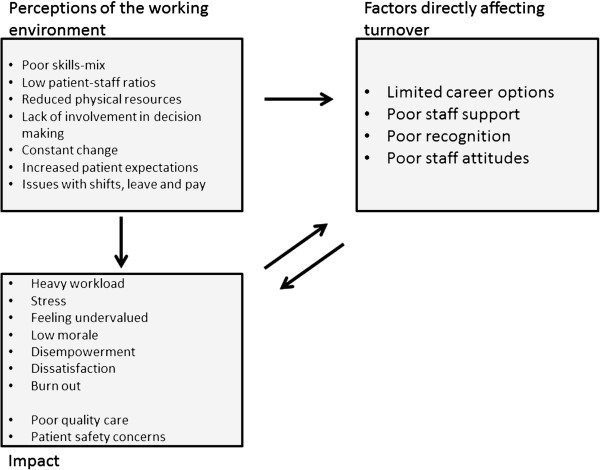
BACKGROUND: This study aimed to reveal nurses' experiences and perceptions of turnover in Australian hospitals and identify strategies to improve retention, performance and job satisfaction. Nursing turnover is a serious issue that can compromise patient safety, increase health care costs and impact on staff morale. A qualitative design was used to analyze responses from 362 nurses collected from a national survey of nurses from medical and surgical nursing units across 3 Australian States/Territories. METHOD: A qualitative design was used to analyze responses from 362 nurses collected from a national survey of nurses from medical and surgical nursing units across 3 Australian States/Territories. RESULTS: Key factors affecting nursing turnover were limited career opportunities; poor support; a lack of recognition; and negative staff attitudes. The nursing working environment is characterised by inappropriate skill-mix and inadequate patient-staff ratios; a lack of overseas qualified nurses with appropriate skills; low involvement in decision-making processes; and increased patient demands. These issues impacted upon heavy workloads and stress levels with nurses feeling undervalued and disempowered. Nurses described supportive strategies: improving performance appraisals, responsive preceptorship and flexible employment options. CONCLUSION: Nursing turnover is influenced by the experiences of nurses. Positive steps can be made towards improving workplace conditions and ensuring nurse retention. Improving performance management and work design are strategies that nurse managers could harness to reduce turnover.
Overview
The claims and statistics of this paper haven’t been checked yet.
Free: it reads the open-access text and checks the first 5 claims that cite a source we can check. Create a free account to check every claim.
Integrity signals
Registry
Cites
Statistics
Figures
Verification
Claims the paper makes
The claims and statistics of this paper haven’t been checked yet.
Free: it reads the open-access text and checks the first 5 claims that cite a source we can check. Create a free account to check every claim.
Claims other papers make about this one
Each is checked against this paper’s own text: does it say what the citing paper says it does?
The source backs part of the claim, not all of it — or backs it for a different population, condition or comparison.
In the citing paper
“A major contributing factor to the shortages seen in the health workforce is employee turnover [3].”
From A global overview of healthcare workers’ turnover intention amid COVID-19 pandemic: a systematic review with future directions (2022) · cites this paper as [3]
Experimental — accuracy not yet measured
Self-check
Percentages, sums and reported differences re-computed from the paper’s own numbers.
The self-check needs the paper’s full text.
Citations
Cites
Hospital Nurse Staffing and Patient Mortality, Nurse Burnout, and Job Dissatisfaction
Aiken, L. H. (2002) · JAMA · doi:10.1001/jama.288.16.1987 · Cited by 5,226
Qualitative data analysis for applied policy research
(2002) · Analyzing Qualitative Data · doi:10.4324/9780203413081-14 · Cited by 4,964 · cited 1×
“These were analyzed thematically [34] using an inductive process to categorise, tabulate and recombine the evidence, in line with the aim of the study reported in this paper.”
MethodGibbs, G. (2007) · doi:10.4135/9781849208574 · Cited by 4,299
The analytic challenge in interpretive description
Thorne, S., Kirkham, S. R., & O'Flynn-Magee, K. (2004) · International Journal of Qualitative Methods · doi:10.1177/160940690400300101 · Cited by 1,793 · cited 1×
“Methods A descriptive qualitative study was undertaken to explore the perceptions and views of Australian nurses of the factors that affect turnover and the working environment [33].”
BackgroundNurse turnover: A literature review – An update
Hayes, L. J., O’Brien-Pallas, L., Duffield, C., Shamian, J., Buchan, J., Hughes, F., Laschinger, H. K. S., & North, N. (2012) · International Journal of Nursing Studies · doi:10.1016/j.ijnurstu.2011.10.001 · Cited by 888 · cited 1×
“Additionally, of the research which has been done, most of it has been in the form of survey data, or quantitative analysis, rather than qualitative studies [30].”
BackgroundSelf-citationNurse turnover: A literature review
Hayes, L. J., O’Brien-Pallas, L., Duffield, C., Shamian, J., Buchan, J., Hughes, F., Spence Laschinger, H. K., North, N., & Stone, P. W. (2006) · International Journal of Nursing Studies · doi:10.1016/j.ijnurstu.2005.02.007 · Cited by 873 · cited 4×
“Finally, turnover impacts on patient safety and outcomes with registered nurse (RN) turnover found to be related to both increased infection and subsequent hospitalization [13]; an increased likelihood of medical error [1,14]; and reduced patient satisfaction [15].”
BackgroundInfluentialSelf-citationNurse turnover: the mediating role of burnout
LEITER, M. P., & MASLACH, C. (2009) · Journal of Nursing Management · doi:10.1111/j.1365-2834.2009.01004.x · Cited by 838 · cited 2×
“Leiter MP, Maslach C: Nurse turnover: the mediating role of burnout.”
BackgroundDoes Pay-for-Performance Improve the Quality of Health Care?
Petersen, L. A., Woodard, L. D., Urech, T., Daw, C., & Sookanan, S. (2006) · Annals of Internal Medicine · doi:10.7326/0003-4819-145-4-200608150-00006 · Cited by 699
Heinen, M. M., van Achterberg, T., Schwendimann, R., Zander, B., Matthews, A., Kózka, M., Ensio, A., Sjetne, I. S., Casbas, T. M., Ball, J., et al. (2013) · International Journal of Nursing Studies · doi:10.1016/j.ijnurstu.2012.09.019 · Cited by 530 · cited 1×
“A number of descriptive studies from different countries have used surveys to examine some of the reasons for nurse turnover [6,14,16].”
BackgroundStaff Turnover and Quality of Care in Nursing Homes
Castle, N. G., & Engberg, J. (2005) · Medical Care · doi:10.1097/01.mlr.0000163661.67170.b9 · Cited by 424 · cited 1×
“High rates of nursing turnover where staff voluntarily leave or transfer from their primary employment position to another position in nursing, or to another profession [1] (described as between 12% [2] to greater than 50% turnover [3]) are a problem currently affecting many countries [1,4,5].”
Background
Research works printed but not linked: 4
- Dunleavy S How long can we nurse along this cruel system? The Daily Telegraph 2010 Sydney: News LTD
- O’Brien-Pallas L Murphy GT Shamian J Final report understanding the costs and outcomes of nurses’ turnover in Canadian Hospitals (Nursing Turnover Study) FRN# 66350 Nursing Health Services Research Unit 2008 http://nhsru.com/publications/understanding-the-costs-and-outcomes-of-nurses-turnover-in-canadian-hospitals
- Montague N Performance appraisal, a powerful management tool Manag Q 2007 48 2 40 53
- Francis R Report of the Mid Staffordshire NHS Foundation Trust Public Inquiry: Executive Summary, Vol. 947 2013 The Stationery Office http://www.midstaffspublicinquiry.com/report
Cited by
A comparative review of nurse turnover rates and costs across countries
Duffield, C. M., Roche, M. A., Homer, C., Buchan, J., & Dimitrelis, S. (2014) · Journal of Advanced Nursing · doi:10.1111/jan.12483 · Cited by 384
Self-citationPoon, Y.-S. R., Lin, Y. P., Griffiths, P., Yong, K. K., Seah, B., & Liaw, S. Y. (2022) · Human Resources for Health · doi:10.1186/s12960-022-00764-7 · Cited by 394
“A major contributing factor to the shortages seen in the health workforce is employee turnover [3].”
BackgroundHalter, M., Boiko, O., Pelone, F., Beighton, C., Harris, R., Gale, J., Gourlay, S., & Drennan, V. (2017) · BMC Health Services Research · doi:10.1186/s12913-017-2707-0 · Cited by 366
de Vries, N., Boone, A., Godderis, L., Bouman, J., Szemik, S., Matranga, D., & de Winter, P. (2023) · INQUIRY: The Journal of Health Care Organization, Provision, and Financing · doi:10.1177/00469580231159318 · Cited by 285
De Vries, N., Lavreysen, O., Boone, A., Bouman, J., Szemik, S., Baranski, K., Godderis, L., & De Winter, P. (2023) · Healthcare · doi:10.3390/healthcare11131887 · Cited by 168
“Three included studies discussed certain interventions [46,47,69].”
BackgroundInfluentialAustralian midwives’ intentions to leave the profession and the reasons why
Harvie, K., Sidebotham, M., & Fenwick, J. (2019) · Women and Birth · doi:10.1016/j.wombi.2019.01.001 · Cited by 181
Roney, L. N., & Acri, M. C. (2018) · Journal of Pediatric Nursing · doi:10.1016/j.pedn.2018.01.016 · Cited by 125
Time to solve persistent, pernicious and widespread nursing workforce shortages
Peters, M. D. J. (2023) · International Nursing Review · doi:10.1111/inr.12837 · Cited by 144
Interventions to Reduce Adult Nursing Turnover: A Systematic Review of Systematic Reviews
Halter, M., Pelone, F., Boiko, O., Beighton, C., Harris, R., Gale, J., Gourlay, S., & Drennan, V. (2017) · The Open Nursing Journal · doi:10.2174/1874434601711010108 · Cited by 82
“INTRODUCTION Turnover amongst nurses, that is, nurses leaving their jobs or leaving the profession, has received international attention due to the size of the issue [1] and the consequences of high rates of turnover [2].”
BackgroundMills, J. E., Woods, C., Harrison, H., Chamberlain‐Salaun, J., & Spencer, B. (2017) · Journal of research in nursing · doi:10.1177/1744987117709515 · Cited by 102
“Findings in this study support existing literature that identifies self-concept, practice environment and resilience as factors influencing nurse retention (Arthur and Randle, 2006; Cowin et al., 2008; Dawson et al., 2014; Hart et al., 2014; Hayes et al., 2012; Jackson et al., 2007; Kramer et al., 2012; Laschinger et…”
BackgroundResultInfluentialAlves, D. F. D. S., da Silva, D., & Guirardello, E. D. B. (2016) · Journal of Nursing Management · doi:10.1111/jonm.12427 · Cited by 99
Kowalski, M. O., Basile, C., Bersick, E., Cole, D. A., McClure, D. E., & Weaver, S. H. (2019) · Worldviews on Evidence-Based Nursing · doi:10.1111/wvn.12401 · Cited by 90
Ashley, C., Peters, K., Brown, A. E., & Halcomb, E. (2018) · Journal of Nursing Management · doi:10.1111/jonm.12597 · Cited by 71
“Similarly, the relationship between manageable workloads and satisfaction found in our study resonates with previous work in acute care (Dawson et al., 2014, Halcomb and Ashley, 2017).”
ResultIs COVID‐19 the straw that broke the back of the emergency nursing workforce?
Cornish, S., Klim, S., & Kelly, A. (2021) · Emergency Medicine Australasia · doi:10.1111/1742-6723.13843 · Cited by 68
“7%.(2,3) Reasons for leaving ED nursing have previously been found to include issues with the working environment (increasing presentations, more complex patients, occupational violence and aggression, over-crowding), leadership (management style, performance target focus) and lack of appropriate support systems.”
BackgroundStressors and coping strategies of emergency department nurses and doctors: A cross-sectional study
Xu, H. G., Johnston, A. N. B., Greenslade, J. H., Wallis, M. C., Elder, E. G., Abraham, L., Thom, O., Carlström, E., & Crilly, J. L. (2019) · Australasian Emergency Care · doi:10.1016/j.auec.2018.10.005 · Cited by 65
Fostering graduate nurse practice readiness in context
Harrison, H., Birks, M., Franklin, R. C., & Mills, J. E. (2019) · Collegian Journal of the Royal College of Nursing Australia · doi:10.1016/j.colegn.2019.07.006 · Cited by 76
Alves, D. F. S., & Guirardello, E. B. (2016) · International Nursing Review · doi:10.1111/inr.12276 · Cited by 55
Evidence-Based Practice Guideline: Nurse Retention for Nurse Managers
Tang, J. H.-C., & Hudson, P. (2019) · Journal of Gerontological Nursing · doi:10.3928/00989134-20191011-03 · Cited by 77
Measuring Transformational Leadership in Establishing Nursing Care Excellence
Moon, S., van Dam, P., & Kitsos, A. (2019) · Healthcare · doi:10.3390/healthcare7040132 · Cited by 79
Leadership skills for nursing unit managers to decrease intention to leave
Duffield, C. M., Roche, M. A., Dimitrelis, S., & Frew, B. (2015) · Nursing Research and Reviews · doi:10.2147/nrr.s46155 · Cited by 91
“This paper reports a secondary analysis of data collected for a larger study that has investigated nurses’ views of turnover, 43 and explored the rates and costs of nursing turn-over in Australia.”
Self-citationOsch, M. V., Scarborough, K., Crowe, S., Wolff, A. C., & Kirkham, S. R. (2018) · Journal of Clinical Nursing · doi:10.1111/jocn.14167 · Cited by 76
Support workers’ experiences of work stress in long-term care settings: a qualitative study
Czuba, K., Kayes, N. M., & McPherson, K. M. (2019) · International Journal of Qualitative Studies on Health and Well-Being · doi:10.1080/17482631.2019.1622356 · Cited by 58
Gifkins, J., Loudoun, R. J., & Johnston, A. N. B. (2017) · Journal of Advanced Nursing · doi:10.1111/jan.13374 · Cited by 61
“The working environment is a key component contributing to attrition rates (Dawson et al., 2014) with the retention of nurses an integral part of the sustainability of the healthcare sector (Eley, Francis, & Hegney, 2014) in western societies.”
BackgroundInfluentialNurses’ organizational trust and intention to continue working at hospitals in Turkey
Basit, G., & Duygulu, S. (2017) · Collegian Journal of the Royal College of Nursing Australia · doi:10.1016/j.colegn.2017.05.003 · Cited by 49
Retaining early career registered nurses: a case study
Mills, J. E., Chamberlain‐Salaun, J., Harrison, H., Yates, K., & O’Shea, A. (2016) · BMC Nursing · doi:10.1186/s12912-016-0177-z · Cited by 55
“These factors impact on the efficiency and quality of care and patient safety [8, 16, 17, 20].”
BackgroundPhilip, S., Woodward‐Kron, R. E., Manias, E., & Noronha, M. (2018) · Collegian Journal of the Royal College of Nursing Australia · doi:10.1016/j.colegn.2018.04.002 · Cited by 46
Interventions that support novice nurses' transition into practice: A realist review
Melissant, H. C., Hendriks, R. R. A., Bakker, E. J. M., Kox, J. H. A. M., Rietveld, N., Miedema, H. S., Roelofs, P. D. D. M., & Verhaegh, K. J. (2024) · International Journal of Nursing Studies · doi:10.1016/j.ijnurstu.2024.104785 · Cited by 48
Zurynski, Y. A., Fisher, G., Wijekulasuriya, S., Leask, E., Dharmayani, P. N. A., Ellis, L. A., Smith, C. L., & Braithwaite, J. (2024) · The International Journal of Health Planning and Management · doi:10.1002/hpm.3769 · Cited by 43
Instability in patient and nurse characteristics, unit complexity and patient and system outcomes
Duffield, C. M., Roche, M. A., Dimitrelis, S., Homer, C., & Buchan, J. (2014) · Journal of Advanced Nursing · doi:10.1111/jan.12597 · Cited by 41
“2014) and explored nurses’ views of turnover (Dawson et al. 2014).”
BackgroundSelf-citationHolland, P. J., Tham, T. L., & Gill, F. J. (2018) · International Journal of Nursing Practice · doi:10.1111/ijn.12630 · Cited by 42
“As cautioned by Hegney et al. (2003), reliance on common short‐term measures such as deployment of nurses from one speciality area to another, regardless of the nurse's lack of expertise in another speciality, reliance on reentry programmes to grow nursing numbers, and raising the numbers of newly graduating nurses is…”
BackgroundNurse career mapping: a qualitative case study of a new hospital
Sandehang, P. M., Hariyati, R. T. S., & Rachmawati, I. N. (2019) · BMC Nursing · doi:10.1186/s12912-019-0353-z · Cited by 39
“Therefore, it takes travail to retain and develop nursing skills and careers, one of them with the career stages programme [2].”
BackgroundKang, C.-M., Chiu, H.-T., Lin, Y., & Chang, W. (2015) · Nurse Education Today · doi:10.1016/j.nedt.2015.11.022 · Cited by 32
“NGNs have experienced tremendous stress during one-on-one preceptorship (Dawson et al., 2014; Tsai et al., 2014; Chang et al., 2015).”
BackgroundMcIntyre, N., Crilly, J., & Elder, E. (2024) · International Emergency Nursing · doi:10.1016/j.ienj.2024.101437 · Cited by 31
Towards better healthcare: What could and should be automated?
Fruehwirt, W., & Duckworth, P. (2021) · Technological Forecasting and Social Change · doi:10.1016/j.techfore.2021.120967 · Cited by 46
Análise de indicadores gerenciais e assistenciais após adequação de pessoal de enfermagem
de Quadros, D. V., de Magalhães, A. M. M., Mantovani, V. M., da Rosa, D. S., & Echer, I. C. (2016) · Revista Brasileira de Enfermagem · doi:10.1590/0034-7167.2016690410i · Cited by 46
“In addition, the management should provide changes aiming to improve the performance of nurses(18).”
BackgroundHussein, R., Salamonson, Y., Everett, B., Hu, W. C. Y., & Ramjan, L. M. (2019) · Journal of Nursing Management · doi:10.1111/jonm.12880 · Cited by 45
Bowen, L., Kable, A. K., & Keatinge, D. (2018) · Contemporary Nurse · doi:10.1080/10376178.2018.1513808 · Cited by 26
Burston, A., Eley, R. M., Parker, D., & Tuckett, A. G. (2016) · International Journal of Older People Nursing · doi:10.1111/opn.12144 · Cited by 22
Changes to nurses’ practice environment over time
Roche, M. A., Duffield, C. M., Friedman, S., Twigg, D., Dimitrelis, S., & Rowbotham, S. J. (2016) · Journal of Nursing Management · doi:10.1111/jonm.12371 · Cited by 30
Self-citationEducational Needs of Health Professionals Caring for Adolescents and Young Adults with Cancer
Bradford, N., Greenslade, R., Edwards, R., Orford, R., Roach, J., & Henney, R. (2018) · Journal of Adolescent and Young Adult Oncology · doi:10.1089/jayao.2017.0082 · Cited by 22
Pierce, H., Perry, L., Gallagher, R. D., & Chiarelli, P. (2019) · Journal of Advanced Nursing · doi:10.1111/jan.13951 · Cited by 23
Kim, M. J., McKenna, H., Park, C. G., Ketefian, S., Park, S. H., Galvin, K., & Burke, L. (2020) · Nurse Education Today · doi:10.1016/j.nedt.2020.104475 · Cited by 25
Movement of Genetic Counselors from Clinical to Non‐clinical Positions: Identifying Driving Forces
Cohen, S. A., & Tucker, M. (2018) · Journal of Genetic Counseling · doi:10.1007/s10897-018-0242-8 · Cited by 25
Using Training Needs Assessment to Develop a Nurse Preceptor–Centered Training Program
Lee, Y.-W., Lin, H., Tseng, H.-L., Tsai, Y.-M., & Lee‐Hsieh, J. (2017) · The Journal of Continuing Education in Nursing · doi:10.3928/00220124-20170418-07 · Cited by 19
The economic case for meeting employees' needs
Henderson, M. W. (2019) · Journal of Nursing Management · doi:10.1111/jonm.12897 · Cited by 19
Churning the tides of care: when nurse turnover makes waves in patient access to primary care
Arredondo, K., Hughes, A. M., Lester, H. F., Pham, T. N. D., Petersen, L. A., Woodard, L., SoRelle, R., Jiang, C. R., Oswald, F. L., Murphy, D. R., et al. (2024) · BMC Nursing · doi:10.1186/s12912-024-02389-8 · Cited by 21
Rajkonwar, B., & Rastogi, M. (2018) · Journal of Health Management · doi:10.1177/0972063418763652 · Cited by 21
“Many researchers have attempted to examine the potential causes of nursing turnover in past which led to inception of divergent findings (Cai & Zhou, 2009; Dawson et al., 2014; Fang, 2001).”
BackgroundResultRoekel, J. V. S., Weggelaar‐Jansen, A. M., Hilders, C. G. J. M., de Bont, A., & Wallenburg, I. (2021) · BMC Nursing · doi:10.1186/s12912-021-00613-3 · Cited by 23
“crease the workload which, in turn, boosts resignation numbers of nurses [5, 6].”
BackgroundFeo, R., Urry, K., Conroy, T., & Kitson, A. A. (2022) · Journal of Advanced Nursing · doi:10.1111/jan.15220 · Cited by 21
Factors Influencing Hospital Nurses' Turnover Intention: A Cross-sectional Survey
Yeun, E. J., Kwon, Y.-M., Je, M.-S., & An, J. H. (2016) · The Journal of the Korea Contents Association · doi:10.5392/jkca.2016.16.01.094 · Cited by 18
Norm-Critical Potential in Undergraduate Nursing Education Curricula: A Document Analysis
Tengelin, E., Bülow, P. H., Berndtsson, I., & Lyckhage, E. D. (2018) · Advances in Nursing Science · doi:10.1097/ans.0000000000000228 · Cited by 19
How Nurses’ Person-Organization Fit Influences Organizational Loyalty
Sun, M., Alam, F., & Ma, C. (2023) · Risk Management and Healthcare Policy · doi:10.2147/rmhp.s425025 · Cited by 18
“53 Nurses who face ambiguity in their role show a lack of service quality and organizational loyalty.”
Brook, J., Aitken, L. M., & Salmon, D. (2023) · Nurse Education in Practice · doi:10.1016/j.nepr.2023.103851 · Cited by 21
Emotional Exhaustion and Emotional Contagion: Navigating Turnover Intention of Healthcare Personnel
Feng, Y., & Cui, J. (2024) · Journal of Multidisciplinary Healthcare · doi:10.2147/jmdh.s460088 · Cited by 19
Lovell, T., Mitchell, M. L., Powell, M., Cummins, B., Tonge, A., Metcalf, E., Ownsworth, T., O'Neill, K., Morris, L., & Ranse, K. (2022) · Australian Critical Care · doi:10.1016/j.aucc.2022.08.001 · Cited by 14
A New Smart-Fabric based Body Area Sensor Network for Work Risk Assessment
Lanatà, A., Greco, A., Modica, S. D., Niccolini, F., Vivaldi, F. M., Francesco, F. D., Tamantini, C., Cordella, F., Zollo, L., Rienzo, M. D., et al. (2020) · IEEE International Workshop on Metrology for Industry 4.0 & IoT (MetroInd4.0&IoT) · doi:10.1109/metroind4.0iot48571.2020.9138273 · Cited by 15
“as smart fabric capability has enabled system integration in many different types of clothes [1], [2].”
BackgroundRony, M. K. K., Bala, S. D., Rahman, M. M., Dola, A. J., Kayesh, I., Islam, M. T., Tama, I. J., Shafi, E. H., & Rahman, S. (2021) · Belitung Nursing Journal · doi:10.33546/bnj.1680 · Cited by 12
“The quality of service depends on the healthcare facilities and the opportunities available to nurses (Dawson et al., 2014).”
BackgroundSalehi, A. M., Khazaei, S., Masumi, M., Shavandi, F., Kavand, M., Jenabi, E., & Khatiban, M. (2021) · Emergency Medicine International · doi:10.1155/2021/9613443 · Cited by 14
“According to the critical role of motivation-hygiene measures in establishing trust, they are of great importance in promoting job satisfaction and willingness to work, and precise economic planning should be proposed to provide their financial resources [36,37].”
Moss, S., Mitchell, M. L., & Casey, V. (2017) · JONA The Journal of Nursing Administration · doi:10.1097/nna.0000000000000450 · Cited by 21
“[ In healthcare settings, workplace culture profoundly affects employee empowerment,(2-4) interdisciplinary relationships, innovation, use of evidence-based practices, and alignment to the organization_s strategic direction.(5) Authors have recognized that the consequences of poor workforce culture can result in lower…”
BackgroundNurse Turnover in India: Factors Impacting Nurses’ Decisions to Leave Employment
Lakshman, S. (2016) · South Asian Journal of Human Resources Management · doi:10.1177/2322093716657470 · Cited by 11
Strengthening nursing and midwifery capacity in rural New South Wales, Australia
Francis, K. L., Badger, A., McLeod, M., FitzGerald, M., Brown, A., & Staines, C. (2016) · Collegian Journal of the Royal College of Nursing Australia · doi:10.1016/j.colegn.2016.08.006 · Cited by 10
Yu, H., Peng, Y., Hung, Y. Y., & Zhou, L. (2017) · Journal of Clinical Nursing · doi:10.1111/jocn.14217 · Cited by 11
Australian Hospital-Based Nurse Educators' Perceptions of Their Role
Thornton, K. (2018) · The Journal of Continuing Education in Nursing · doi:10.3928/00220124-20180517-08 · Cited by 14
Early career registered nurses: How they stay
Douglas, J. A., Bourgeois, S., & Moxham, L. J. (2020) · Collegian Journal of the Royal College of Nursing Australia · doi:10.1016/j.colegn.2020.01.004 · Cited by 13
Description of an effective manager in nursing: A systematic review
Zendrato, M. V., Hariyati, R. T. S., & Afriani, T. (2019) · Enfermería Clínica · doi:10.1016/j.enfcli.2019.04.065 · Cited by 10
“Leaders will influence a group of people to reach the same goal in organizations.(9)”
BackgroundA Review of Factors Affecting Nursing Turnover in Japan
Nagaya, Y. (2018) · Biomedical Journal of Scientific & Technical Research · doi:10.26717/bjstr.2018.12.002258 · Cited by 10
“Closely related to nursing shortages is nursing turnover, which can negatively impact the health sector’s capacity to satisfy patient needs and provide quality care [2].”
BackgroundFactors related to voluntary external turnover of nursing professionals
Balabanian, Y. C. C., & Monteiro, M. I. (2019) · Revista da Escola de Enfermagem da USP · doi:10.1590/s1980-220x2017033403427 · Cited by 12
Ghandour, S., Elzohairy, M. H. S., & El-sayed, N. M. (2019) · Port Said Scientific Journal of Nursing · doi:10.21608/pssjn.2019.67994 · Cited by 8
McAllister, M., Ryan, C. L., Simes, T., Bond, S., Ford, A. J., & Brien, D. L. (2020) · Nursing Inquiry · doi:10.1111/nin.12372 · Cited by 8
Younis, J. A., Hejase, H., Dalal, H. R., Ibrahim, N. A., & Hejase, A. J. (2021) · Journal of Business Theory and Practice · doi:10.22158/jbtp.v9n4p8 · Cited by 8
“Sources: Meler & Toygar, 2020, pp. 491-493; O‘Brien-Pallas, Griffin, Shamian et al., 2006; Heinen et al., 2013; Dawson et al., 2014; Garnett et al., 2008; Shaffer & Curtin, 2020.”
Kraft, S., & Drossel, M. (2019) · HeilberufeScience · doi:10.1007/s16024-019-0327-9 · Cited by 8
“…durch eine entsprechende Vergütung und Zeichen von Wertschätzung seitens des Arbeitsgebers zu steigern und Bewältigungsmaßnahmen anzubieten, um Fachkräfte in der Pflege vor den Folgen des Fachkräftemangels zu schützen und Anreize zu schaffen, im Beruf bleiben zu wollen (Dawson et al. 2014).”
BackgroundLeadership styles and their outcomes: a study of a Nigerian hospital middle management nurses
Adunola, T. (2022) · Leadership in health services · doi:10.1108/lhs-05-2022-0058 · Cited by 8
Krishnamoorthy, L., Muthuveloo, R., & Ping, T. A. (2020) · The Malaysian Journal of Nursing · doi:10.31674/mjn.2020.v12i01.015 · Cited by 10
“Non-financial incentives are referred to provision of work autonomy, recognition of work and flexibility in working time (Dawson et al., 2014; Caldwell & Kingma, 2007; Zurn, Dolea & Stilwell, 2005; Kingma, 2003).”
BackgroundInfluentialAwosoga, O., Odole, A. C., Onyeso, O. K., Ojo, J. O., Ekediegwu, E. C., Nwosu, I. B., Nord, C., Steinke, C., Varsanyi, S., & Doan, J. B. (2023) · Home Health Care Services Quarterly · doi:10.1080/01621424.2023.2166889 · Cited by 10
“Moreover, an increase in work-related stress was associated with short- and long-term absenteeism due to sick leave (Dawson et al., 2014).”
BackgroundCan personal psychological resources reduce burnout and turnover in Australian hospital nurses?
Eley, S., & Hassmén, P. (2023) · Australian journal of advanced nursing · doi:10.37464/2023.403.1129 · Cited by 11
Parker, S. M., Tran, A., Saito, S., McNamara, C., Denney‐Wilson, E., Nutbeam, D., Harris, M., & on behalf of the Health e-Literacy for Prevention in General Practice (HeLP-GP) Trial Group (2024) · Australian Journal of Primary Health · doi:10.1071/py23085 · Cited by 6
Hutagaol, R. (2019) · International Journal of Nursing and Health Services (IJNHS) · doi:10.35654/ijnhs.v2i1.73 · Cited by 6
“(18) And (19) study showed that nurse leadership behavioral characteristics and interpersonal work relationships had a relationship with patient safety, increased health costs, and nurse morale.”
BackgroundMtega, B., Kibona, L., Dhamani, K. A., & Petrucka, P. M. (2017) · Open Journal of Nursing · doi:10.4236/ojn.2017.79076 · Cited by 6
“These findings are similar to the other studies suggesting the low nurse: patient ratios impact on nursing activities that are considered as significant to patient safety and effective nursing care [7] [24].”
BackgroundResultImplementation Study of Retention Programs and It’s Impact on Turnover Intention Nurses in Hospital
Yuniarti, L. N. L., & Tutiany, T. (2019) · Indonesian Journal of Health Research · doi:10.32805/ijhr.2019.2.2.49 · Cited by 6
YAPAY ZEKÂ KAYGISI, İŞ STRESİ VE İŞTEN AYRILMA NİYETİ: SAĞLIK ÇALIŞANLARI ÜZERİNDE BİR ANALİZ
Biçer, İ. (2025) · Çukurova Üniversitesi Sosyal Bilimler Enstitüsü Dergisi · doi:10.35379/cusosbil.1667342 · Cited by 10
Jiang, L. H., Sun, F., Bonifas, R. P., & Hodge, D. R. (2022) · Journal of Nursing Management · doi:10.1111/jonm.13564 · Cited by 5
Mambrey, V., Dreher, A., & Loerbroks, A. (2024) · BMC Health Services Research · doi:10.1186/s12913-024-11607-7 · Cited by 6
“Only one study reported increased expectations of patients and their relatives as a factor perceived to affect turnover [37].”
BackgroundOthman, M. I., Nashwan, A. J., & Abujaber, A. A. (2025) · Nursing Open · doi:10.1002/nop2.70195 · Cited by 6
“By prioritising the integration of staff expertise and workload management processes, healthcare organisations may enhance staffing efficiency and the quality of patient care (Dawson et al. 2014).”
Practice priorities for acute care nursing: A Delphi study
Connell, C. J., Plummer, V., Crawford, K., Endacott, R., Foley, P., Griffiths, D., Innes, K., Schwerdtle, P. N., Walker, L. E., & Morphet, J. (2020) · Journal of Clinical Nursing · doi:10.1111/jocn.15284 · Cited by 7
Unbundling the complexity of performance management of healthcare providers in the Middle East
Vaz, D., Qureshi, W., Temouri, Y., & Pereira, V. E. (2023) · IIM Ranchi Journal of Management Studies · doi:10.1108/irjms-03-2023-0026 · Cited by 5
Czuba, K., Vandal, A. C., Czuba, F. M., & Kayes, N. M. (2023) · International Journal of Nursing Studies Advances · doi:10.1016/j.ijnsa.2023.100158 · Cited by 8
“…aged care already exceeds the supply of available workers (Ravenswood et al., 2014; Royal Commission into Aged Care Quality and Safety, 2020; Huang et al., 2023) contributing to increased workload for this group, as well as heightened occupational stress (Dawson et al., 2014; Halpin et al., 2017).”
BackgroundRiches, C., Pitt, R., Tyler, S., Wise, M., Watman, P., & Henderson, A. J. (2024) · BMC Nursing · doi:10.1186/s12912-024-02460-4 · Cited by 4
“A pilot study in Australia estimated staff turnover costs to be $A16,634 per nurse [34].”
BackgroundYeh, S.-H., & Huang, K.-C. (2025) · Healthcare · doi:10.3390/healthcare13192396 · Cited by 6
“Studies have shown that extrinsic conditions such as pay, job security, leadership support, and career development have an impact on employee retention tendencies [50,51].”
Yeun, E. J., & Jeon, M. (2015) · Indian Journal of Science and Technology · doi:10.17485/ijst/2015/v8i25/80417 · Cited by 4
Management impact of staff turnover in the view of nurses: an exploratory study
Tironi, N. M., Silva, L. G. D. C., Dellaroza, M. S. G., Haddad, M. D. C. F. L., & Vannuchi, M. T. O. (2014) · Online Brazilian Journal of Nursing · doi:10.5935/1676-4285.20144394 · Cited by 6
Leadership Strategies to Improve Nurse Retention
Colwell, F. J. (2019) · International Journal of Nursing · doi:10.15640/ijn.v6n1a18 · Cited by 4
“In Australia, a 2014 report indicated turnover rates of 1% compared to 1.4% per month (Dawson et al., 2014).”
BackgroundInfluentialJohnson, W., Searby, A., & Alexander, L. (2024) · International Journal of Mental Health Nursing · doi:10.1111/inm.13487 · Cited by 6
Choi, H., & Song, R. (2022) · Journal of Korean Critical Care Nursing · doi:10.34250/jkccn.2022.15.3.12 · Cited by 4
“또한, 소진 은 직무만족도를 낮추는 것으로도 알려져 있는데[12], 직무만족도가 감소하면서 간호사의 사기 저하로 이어져 이직률이 높아지는 것으로 보고되고 있다[13,14].”
Abdulmohdi, N., & Huang, Y. (2025) · Nursing in Critical Care · doi:10.1111/nicc.13267 · Cited by 4
“37 Concurrent with our study, major stressors among redeployed critical care nurses were identified, including concerns about their safety, patient safety and satisfaction and the professional accountability of unsafe practices.”
Factors contributing to work motivation of nurses: Synthesis of qualitative studies
Kurucová, R., Čáp, J., Bóriková, I., Tomagová, M., & Kohanová, D. (2025) · Contemporary Nurse · doi:10.1080/10376178.2025.2523308 · Cited by 3
“Essential factors include managers’ commitment, their presence in the workplace, consistency in their actions, fairness, regular feedback, and clear communication skills (Dawson et al., 2014).”
Sağlık Çalışanlarında İşten Ayrılma Niyeti: Bibliyometrik Bir Analiz
Buse, M. E. T. E. (2023) · MEYAD Akademi · doi:10.59007/meyadakademi.1272021 · Cited by 3
Casual for a cause: Exploring the employment status of nursing in Australia and China
Wang, C. C., & Geraghty, S. (2017) · International Journal of Nursing Sciences · doi:10.1016/j.ijnss.2017.09.005 · Cited by 3
“Many agency nurses are female who have chosen family commitments over commitments to a career [23].”
BackgroundInfluentialMapping a Career Ladder as an Initial Step in the Retention of Nurses
Sandehang, P. M., & HARIYATI, R. T. S. (2017) · International Journal of Health and Medical Sciences · doi:10.20469/ijhms.3.30003-2 · Cited by 5
“A retention strategy is a program and benefit that is designed to improve the recruiting and retention of employees [3].”
BackgroundKung, S., Ibrahimi, A., & Biru, A. G. (2024) · Management · doi:10.30924/mjcmi.29.1.10 · Cited by 5
Workforce research priorities for emergency nurses in Australia
McIntyre, N., Crilly, J. L., Xu, H. G., Morphet, J., Griffin, B. R., Greenslade, J. H., & Elder, E. G. (2024) · International Emergency Nursing · doi:10.1016/j.ienj.2024.101539 · Cited by 2
Metadata
- Authors
- Dawson, A. J., Stasa, H., Roche, M. A., Homer, C. S. E., & Duffield, C.
- Affiliations
- University of Technology Sydney (AU)
- Corresponding author
- Dawson, Angela J
- Venue
- BMC Nursing
- Published
- 2014-04-08
- Volume
- 13
- Issue
- 1
- Pages
- 11-11
- ISSN
- 1472-6955 (ISSN-L)
- PMC
- PMC3985533
- OpenAlex
- W2090096862
- Cited by
- 145
- References
- 59
- Citations by year
- 2026: 6 · 2025: 6 · 2024: 19 · 2023: 13 · 2022: 11 · 2021: 10 · 2020: 8 · 2019: 24 · 2018: 14 · 2017: 15 · 2016: 9 · 2015: 5 · 2014: 5
- FWCI
- 31.75
- Type
- journal article
- Language
- en
- Open access
- gold
- doi.org
- Licence
- Locations
- BMC Nursing (publishedVersion, cc-by)
- Europe PMC (PubMed Central) (publishedVersion, cc-by)
- PubMed Central (publishedVersion, cc-by)
- PubMed (publishedVersion)
- Research Bank (Australian Catholic University) (submittedVersion)
- Minerva Access (University of Melbourne) (submittedVersion, cc-by)
- UTS ePRESS (University of Technology Sydney) (submittedVersion)
- Funders
- Queen Margaret University
- ACT Government
- University of Technology Sydney
- University of Toronto
- Health Canada
- Topics
- Health Sciences › Nursing › Research and Theory › Nursing education and management
- Health Sciences › Nursing › Leadership and Management › Healthcare Education and Workforce Issues
- Health Sciences › Medicine › Public Health, Environmental and Occupational Health › Global Health Workforce Issues
- Keywords
- nurse turnover, nurse retention, nurses' perceptions, skill mix, performance evaluation (human resources), preceptorship, flexible employment, job design, job satisfaction, career opportunities, recognition, stress, Australian hospitals
About these checks
Registry, retraction, Cites and statistics results are computed, not judged, with one exception: a printed reference that no index lists is read once by a model before it counts as a citation error. Claims are extracted by a model and kept only when their quote appears verbatim in the text; each cited source is then checked, with a model’s help, for whether it says what the claim relies on. Those verdicts can be wrong — read the claim’s quote and the cited source before relying on one.
Statistics and arithmetic are recomputed, not judged.
Confidence bands are shown only for fields calibrated on our annotated test set. None is calibrated yet, so no band is shown.
What counts as a claim ›How we measure confidence ›How we check this ›
Are you an author, or do you see a problem with this page? Request a review
Data sources
Bibliographic data: Semantic Scholar, OpenAlex, Crossref.
Contains information from the Semantic Scholar Academic Graph Datasets, made available under the ODC Attribution License (ODC-BY 1.0).
Semantic Scholar’s data is described in: Kinney, R., et al. (2023). The Semantic Scholar Open Data Platform. arXiv:2301.10140.
