

The DOI matches its Crossref record; 66 of the 68 references it cites were found in a registry or an index.
Sustainability of healthcare improvement: what can we learn from learning theory?
Open accessAbstract
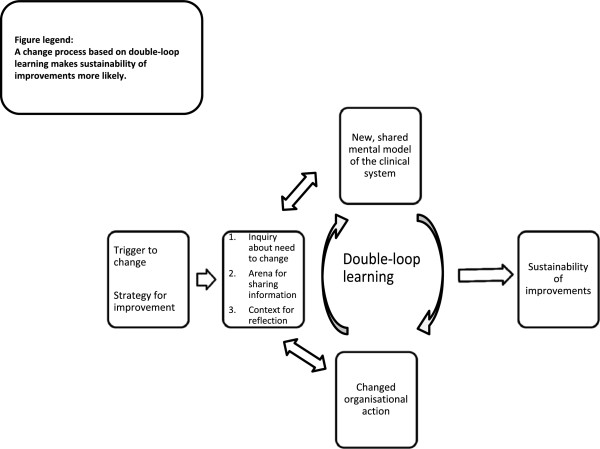
BACKGROUND: Changes that improve the quality of health care should be sustained. Falling back to old, unsatisfactory ways of working is a waste of resources and can in the worst case increase resistance to later initiatives to improve care. Quality improvement relies on changing the clinical system yet factors that influence the sustainability of quality improvements are poorly understood. Theoretical frameworks can guide further research on the sustainability of quality improvements. Theories of organizational learning have contributed to a better understanding of organizational change in other contexts. To identify factors contributing to sustainability of improvements, we use learning theory to explore a case that had displayed sustained improvement. METHODS: Førde Hospital redesigned the pathway for elective surgery and achieved sustained reduction of cancellation rates. We used a qualitative case study design informed by theory to explore factors that contributed to sustain the improvements at Førde Hospital. The model Evidence in the Learning Organization describes how organizational learning contributes to change in healthcare institutions. This model constituted the framework for data collection and analysis. We interviewed a strategic sample of 20 employees. The in-depth interviews covered themes identified through our theoretical framework. Through a process of coding and condensing, we identified common themes that were interpreted in relation to our theoretical framework. RESULTS: Clinicians and leaders shared information about their everyday work and related this knowledge to how the entire clinical pathway could be improved. In this way they developed a revised and deeper understanding of their clinical system and its interdependencies. They became increasingly aware of how different elements needed to interact to enhance the performance and how their own efforts could contribute. CONCLUSIONS: The improved understanding of the clinical system represented a change in mental models of employees that influenced how the organization changed its performance. By applying the framework of organizational learning, we learned that changes originating from a new mental model represent double-loop learning. In double-loop learning, deeper system properties are changed, and consequently changes are more likely to be sustained.
Overview
The claims and statistics of this paper haven’t been checked yet.
Run the check — free, no account needed. It reads the open-access text and checks the sources it cites.
Integrity signals
Registry
Cites
Statistics
Figures
Verification
Claims the paper makes
The claims and statistics of this paper haven’t been checked yet.
Run the check — free, no account needed. It reads the open-access text and checks the sources it cites.
Claims other papers make about this one
Each is checked against this paper’s own text: does it say what the citing paper says it does?
In the citing paper
“This has also been shown to be detrimental to improvement efforts in general as staff, patient and public opinion of improvement initiatives declines and enthusiasm for engaging in future programmes is lost [9, 10].”
From Navigating the sustainability landscape: a systematic review of sustainability approaches in healthcare (2018) · cites this paper as [9]
Self-check
Percentages, sums and reported differences re-computed from the paper’s own numbers.
The self-check needs the paper’s full text.
Citations
Cites
(1984) · Cited by 81,983
Case Study Research: Design and Methods
Chaiklin, H. (1991) · The Journal of Nervous and Mental Disease · doi:10.1097/00005053-199102000-00025 · Cited by 39,639
The fifth discipline, the art and practice of the learning organization
Senge, P. M. (1991) · Performance + Instruction · doi:10.1002/pfi.4170300510 · Cited by 20,060
A Dynamic Theory of Organizational Knowledge Creation
Nonaka, I. (1994) · Organization Science · doi:10.1287/orsc.5.1.14 · Cited by 17,809
Qualitative research & evaluation methods
Patton, M. Q. (2002) · Sage eBooks · Cited by 15,530
(2013) · Cited by 12,072
Organizational Learning: A Theory of Action Perspective
Argyris, C., & Schön, D. A. (1997) · Reis · doi:10.2307/40183951 · Cited by 11,113 · cited 5×
“Argyris C, Schön DA: Organizational learning II: theory, method, and practice.”
BackgroundInfluentialCrossing the Quality Chasm: A New Health System for the 21st Century
Baker, A. (2001) · BMJ · doi:10.1136/bmj.323.7322.1192 · Cited by 10,779
Crossing the Quality Chasm: A New Health System for the 21st Century
Committee on Quality of Health Care in America (2002) · Journal for Healthcare Quality · doi:10.1111/j.1945-1474.2002.tb00463.x · Cited by 8,508
(2008) · Cited by 6,727
Research works printed but not linked: 5
- Plsek PE, Asq ASQ: Complexity and quality: New models for the new century. 2000
- Lincoln YS, Guba EG: Naturalistic inquiry. 1985, Sage, Beverly Hills
- Cilliers P: Complexity and postmodernism: understanding complex systems. 1998, Routledge, London
- Øvretveit J: The leaders role in Quality and safety improvement. 2005, http://194.103.189.144/upload/Webbplatser/Utvecklingscentrum/dokument/ledarens_roll_engelsk.pdf%20(Accessed February 16th 2012):%20Sveriges%20Kommuner%20och%20Landsting .
- Ovretveit J: Integrated quality development in public healthcare. Continuing Education and Quality Improvement. 1999, Norwegian Medical Association, Oslo, 128.
Cited by
Sorted by citations
Lennox, L., Maher, L., & Reed, J. (2018) · Implementation Science · doi:10.1186/s13012-017-0707-4 · Cited by 421
Cowie, J., Nicoll, A., Dimova, E. D., Campbell, P., & Duncan, E. (2020) · BMC Health Services Research · doi:10.1186/s12913-020-05434-9 · Cited by 276
Braithwaite, J., Ludlow, K., Testa, L., Herkes, J., Augustsson, H., Lamprell, G., McPherson, E., & Zurynski, Y. (2020) · BMJ Open · doi:10.1136/bmjopen-2019-036453 · Cited by 147
Shrestha, R., Flacke, J., Martínez, J. A., & Maarseveen, M. V. (2018) · International Journal of Environmental Research and Public Health · doi:10.3390/ijerph15020260 · Cited by 118
Measures of Sustainability in Healthcare
Mehra, R., & Sharma, M. K. (2021) · Sustainability Analytics and Modeling · doi:10.1016/j.samod.2021.100001 · Cited by 96
Metadata
- Authors
- Hovlid, E., Bukve, O., Haug, K., Aslaksen, A. B., & von Plessen, C.
- Affiliations
- Høgskulen i Sogn og Fjordane (NO)
- University of Bergen (NO)
- Haukeland University Hospital (NO)
- Corresponding author
- Hovlid, Einar
- Venue
- BMC Health Services Research
- Published
- 2012-08-03
- Volume
- 12
- Issue
- 1
- Pages
- 235-235
- ISSN
- 1472-6963 (ISSN-L)
- PMC
- PMC3532388
- OpenAlex
- W2101420408
- Cited by
- 101
- References
- 68
- Citations by year
- 2026: 3 · 2025: 4 · 2024: 5 · 2023: 10 · 2022: 11 · 2021: 11 · 2020: 11 · 2019: 5 · 2018: 7 · 2017: 6 · 2016: 11 · 2015: 6 · 2014: 8 · 2013: 3
- FWCI
- 8.84
- Type
- journal article
- Language
- en
- Open access
- gold
- doi.org
- Licence
- Locations
- BMC Health Services Research (publishedVersion, cc-by)
- Europe PMC (PubMed Central) (publishedVersion, cc-by)
- PubMed Central (publishedVersion, cc-by)
- PubMed (publishedVersion)
- NORA - Norwegian Open Research Archives (submittedVersion, cc-by)
- DOAJ (DOAJ: Directory of Open Access Journals) (submittedVersion)
- Research at the University of Copenhagen (University of Copenhagen) (submittedVersion)
- Funders
- Norges Forskningsråd
- Topics
- Health Sciences › Medicine › Public Health, Environmental and Occupational Health › Healthcare Quality and Management
- Health Sciences › Health Professions › General Health Professions › Health Policy Implementation Science
- Social Sciences › Business, Management and Accounting › Organizational Behavior and Human Resource Management › Organizational Learning and Leadership
- Keywords
- sustainability of quality improvement, organizational learning, learning organization, double-loop learning, mental models, elective surgery, healthcare quality improvement, organizational change
- MeSH terms
- Hospitals, General, Humans, Learning, Models, Theoretical, Norway, Organizational Innovation, Quality Assurance, Health Care, Program Evaluation, Critical Pathways, Quality Improvement
About these checks
Registry, retraction, Cites and statistics results are computed, not judged, with one exception: a printed reference that no index lists is read once by a model before it counts as a citation error. Claims are extracted by a model and kept only when their quote appears verbatim in the text; each cited source is then checked, with a model’s help, for whether it says what the claim relies on. Those verdicts can be wrong — read the claim’s quote and the cited source before relying on one.
Statistics and arithmetic are recomputed, not judged.
Confidence bands are shown only for fields calibrated on our annotated test set. None is calibrated yet, so no band is shown.
What counts as a claim ›How we measure confidence ›How we check this ›
Are you an author, or do you see a problem with this page? Request a review
