

The DOI matches its Crossref record; 66 of the 68 references it cites were found in a registry or an index.
Sustainability of healthcare improvement: what can we learn from learning theory?
Open accessAbstract
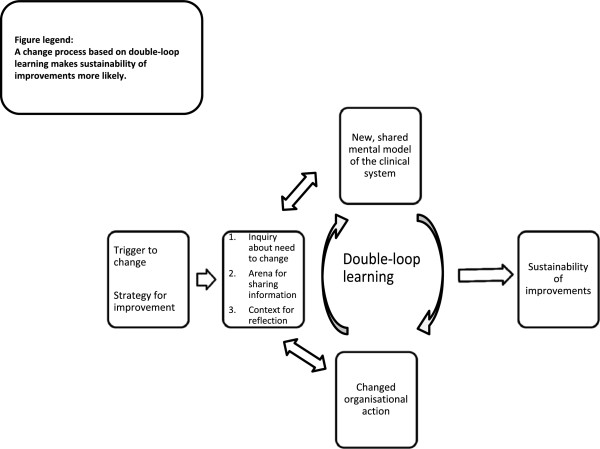
BACKGROUND: Changes that improve the quality of health care should be sustained. Falling back to old, unsatisfactory ways of working is a waste of resources and can in the worst case increase resistance to later initiatives to improve care. Quality improvement relies on changing the clinical system yet factors that influence the sustainability of quality improvements are poorly understood. Theoretical frameworks can guide further research on the sustainability of quality improvements. Theories of organizational learning have contributed to a better understanding of organizational change in other contexts. To identify factors contributing to sustainability of improvements, we use learning theory to explore a case that had displayed sustained improvement. METHODS: Førde Hospital redesigned the pathway for elective surgery and achieved sustained reduction of cancellation rates. We used a qualitative case study design informed by theory to explore factors that contributed to sustain the improvements at Førde Hospital. The model Evidence in the Learning Organization describes how organizational learning contributes to change in healthcare institutions. This model constituted the framework for data collection and analysis. We interviewed a strategic sample of 20 employees. The in-depth interviews covered themes identified through our theoretical framework. Through a process of coding and condensing, we identified common themes that were interpreted in relation to our theoretical framework. RESULTS: Clinicians and leaders shared information about their everyday work and related this knowledge to how the entire clinical pathway could be improved. In this way they developed a revised and deeper understanding of their clinical system and its interdependencies. They became increasingly aware of how different elements needed to interact to enhance the performance and how their own efforts could contribute. CONCLUSIONS: The improved understanding of the clinical system represented a change in mental models of employees that influenced how the organization changed its performance. By applying the framework of organizational learning, we learned that changes originating from a new mental model represent double-loop learning. In double-loop learning, deeper system properties are changed, and consequently changes are more likely to be sustained.
Overview
The claims and statistics of this paper haven’t been checked yet.
Run the check — free, no account needed. It reads the open-access text and checks the sources it cites.
Integrity signals
Registry
Cites
Statistics
Figures
Verification
Claims the paper makes
The claims and statistics of this paper haven’t been checked yet.
Run the check — free, no account needed. It reads the open-access text and checks the sources it cites.
Claims other papers make about this one
Each is checked against this paper’s own text: does it say what the citing paper says it does?
In the citing paper
“This has also been shown to be detrimental to improvement efforts in general as staff, patient and public opinion of improvement initiatives declines and enthusiasm for engaging in future programmes is lost [9, 10].”
From Navigating the sustainability landscape: a systematic review of sustainability approaches in healthcare (2018) · cites this paper as [9]
Self-check
Percentages, sums and reported differences re-computed from the paper’s own numbers.
The self-check needs the paper’s full text.
Citations
Cites
(1984) · Cited by 81,983
Case Study Research: Design and Methods
Chaiklin, H. (1991) · The Journal of Nervous and Mental Disease · doi:10.1097/00005053-199102000-00025 · Cited by 39,639
The fifth discipline, the art and practice of the learning organization
Senge, P. M. (1991) · Performance + Instruction · doi:10.1002/pfi.4170300510 · Cited by 20,060
A Dynamic Theory of Organizational Knowledge Creation
Nonaka, I. (1994) · Organization Science · doi:10.1287/orsc.5.1.14 · Cited by 17,809
Qualitative research & evaluation methods
Patton, M. Q. (2002) · Sage eBooks · Cited by 15,530
(2013) · Cited by 12,072
Organizational Learning: A Theory of Action Perspective
Argyris, C., & Schön, D. A. (1997) · Reis · doi:10.2307/40183951 · Cited by 11,113 · cited 5×
“Argyris C, Schön DA: Organizational learning II: theory, method, and practice.”
BackgroundInfluentialCrossing the Quality Chasm: A New Health System for the 21st Century
Baker, A. (2001) · BMJ · doi:10.1136/bmj.323.7322.1192 · Cited by 10,779
Crossing the Quality Chasm: A New Health System for the 21st Century
Committee on Quality of Health Care in America (2002) · Journal for Healthcare Quality · doi:10.1111/j.1945-1474.2002.tb00463.x · Cited by 8,508
(2008) · Cited by 6,727
Levitt, B., & March, J. G. (1988) · Annual Review of Sociology · doi:10.1146/annurev.so.14.080188.001535 · Cited by 6,669
Interviews – Learning the Craft of Qualitative Research Interviewing
Vaivio, J. (2012) · European Accounting Review · doi:10.1080/09638180.2012.675165 · Cited by 4,558
SECI, Ba and leadership: A unified model of dynamic knowledge creation
Nonaka, I., Toyama, R., & Konno, N. (2000) · Long Range Planning · doi:10.1016/s0024-6301(99)00115-6 · Cited by 4,135
Enhancing the quality and credibility of qualitative analysis.
(1999) · PubMed Central · Cited by 4,133
(2005) · Cited by 3,748
Qualitative research in health care: Assessing quality in qualitative research
Mays, N. (2000) · BMJ · doi:10.1136/bmj.320.7226.50 · Cited by 3,742
Organizational Learning II: Theory, Method, and Practice.
Greenwood, D. J., Argyris, C., & Schön, D. A. (1997) · Industrial and Labor Relations Review · doi:10.2307/2525281 · Cited by 3,455
Qualitative Research: Rigour and qualitative research
Mays, N., & Pope, C. (1995) · BMJ · doi:10.1136/bmj.311.6997.109 · Cited by 2,715
Checklists for improving rigour in qualitative research: a case of the tail wagging the dog?
Barbour, R. S. (2001) · BMJ · doi:10.1136/bmj.322.7294.1115 · Cited by 2,613
The challenge of complexity in health care
Plsek, P. E., & Greenhalgh, T. (2001) · BMJ · doi:10.1136/bmj.323.7313.625 · Cited by 2,578
Organizational learning II: Theory, method and practice
Marraffa, M. (1998) · Iris (Roma Tre University) · Cited by 2,309
The Link between Individual and Organizational Learning
Kim, D. (1998) · Elsevier eBooks · doi:10.1016/b978-0-7506-9850-4.50006-3 · Cited by 1,967
Complexity and post-modernism: understanding complex systems
Cilliers, P., & Spurrett, D. (1999) · South African Journal of Philosophy · doi:10.1080/02580136.1999.10878187 · Cited by 1,888
Complex Adaptive Systems: An Introduction to Computational Models of Social Life
Miller, J. H., & Page, S. E. (2009) · Princeton University Press eBooks · doi:10.1515/9781400835522 · Cited by 1,502
What is "quality improvement" and how can it transform healthcare?
Batalden, P. B., & Davidoff, F. (2007) · BMJ Quality & Safety · doi:10.1136/qshc.2006.022046 · Cited by 1,104
Tucker, A. L., & Edmondson, A. C. (2003) · California Management Review · doi:10.2307/41166165 · Cited by 949
Planning and Studying Improvement in Patient Care: The Use of Theoretical Perspectives
GROL, R. P. T. M., BOSCH, M. C., HULSCHER, M. E. J. L., ECCLES, M. P., & WENSING, M. (2007) · The Milbank Quarterly · doi:10.1111/j.1468-0009.2007.00478.x · Cited by 943
Complexity, leadership, and management in healthcare organisations
Plsek, P. E., & Wilson, T. (2001) · BMJ · doi:10.1136/bmj.323.7315.746 · Cited by 755
Evidence-Based Quality Improvement: The State Of The Science
Shojania, K. G., & Grimshaw, J. (2005) · Health Affairs · doi:10.1377/hlthaff.24.1.138 · Cited by 684
Complex Adaptive Systems: An Introduction to Computational Models of Social Life
Shlesinger, M. F. (2007) · Journal of Statistical Physics · doi:10.1007/s10955-007-9384-z · Cited by 633
Explaining Michigan: Developing an Ex Post Theory of a Quality Improvement Program
DIXON-WOODS, M., BOSK, C. L., AVELING, E. L., GOESCHEL, C. A., & PRONOVOST, P. J. (2011) · Milbank Quarterly · doi:10.1111/j.1468-0009.2011.00625.x · Cited by 603
Learning from failure in health care: frequent opportunities, pervasive barriers
Edmondson, A. C. (2004) · Quality and Safety in Health Care · doi:10.1136/qshc.2003.009597 · Cited by 452
Sustainability science: an integrated approach for health-programme planning
Gruen, R. L., Elliott, J. H., Nolan, M. L., Lawton, P. D., Parkhill, A., McLaren, C. J., & Lavis, J. N. (2008) · The Lancet · doi:10.1016/s0140-6736(08)61659-1 · Cited by 395
Preoperative Clinic Visits Reduce Operating Room Cancellations and Delays
Ferschl, M. B., Tung, A., Sweitzer, B., Huo, D., & Glick, D. B. (2005) · Anesthesiology · doi:10.1097/00000542-200510000-00025 · Cited by 352
Quality by design : a clinical microsystems approach
Nelson, E. C., Batalden, P. B., & Godfrey, M. M. (2007) · Jossey-Bass eBooks · Cited by 328
Batalden, P. B., & Stoltz, P. K. (1993) · The Joint Commission Journal on Quality Improvement · doi:10.1016/s1070-3241(16)30025-6 · Cited by 307
Complexity science and health care management
McDaniel, R. R., & Driebe, D. J. (2004) · Advances in health care management · doi:10.1016/s1474-8231(01)02021-3 · Cited by 277
Leading organisational learning in health care
Carroll, J. S. (2002) · BMJ Quality & Safety · doi:10.1136/qhc.11.1.51 · Cited by 240
Understanding what works—and why—in quality improvement: the need for theory-driven evaluation
Walshe, K. (2007) · International Journal for Quality in Health Care · doi:10.1093/intqhc/mzm004 · Cited by 237
van Klei, W. A., Moons, K. G. M., Rutten, C. L. G., Schuurhuis, A., Knape, J. T. A., Kalkman, C. J., & Grobbee, D. E. (2002) · Anesthesia & Analgesia · doi:10.1097/00000539-200203000-00030 · Cited by 235
Argo, J. L., Vick, C. C., Graham, L. A., Itani, K. M. F., Bishop, M. J., & Hawn, M. T. (2009) · The American Journal of Surgery · doi:10.1016/j.amjsurg.2009.07.005 · Cited by 186
Improvement, trust, and the healthcare workforce
Berwick, D. M. (2003) · BMJ Quality & Safety · doi:10.1136/qhc.12.6.448 · Cited by 179
On the trail of quality and safety in health care
Grol, R. P. T. M., Berwick, D. M., & Wensing, M. (2008) · BMJ · doi:10.1136/bmj.39413.486944.ad · Cited by 134
Estimating the duration of common elective operations: implications for operating list management
Pandit, J. J., & Carey, A. (2006) · Anaesthesia · doi:10.1111/j.1365-2044.2006.04719.x · Cited by 133
R., M., & Pandit, J. J. (2003) · Anaesthesia · doi:10.1046/j.1365-2044.2003.03189_3.x · Cited by 132
Problems in causal loop diagrams revisited
Richardson, G. P. (1997) · System Dynamics Review · doi:10.1002/(sici)1099-1727(199723)13:3 · Cited by 128
Brandrud, A. S., Schreiner, A., Hjortdahl, P., Haldorsen, G. S. H., Nyen, B., & Nelson, E. C. (2011) · BMJ Quality & Safety · doi:10.1136/bmjqs.2009.038604 · Cited by 105
Open disclosure: the only approach to medical error
Lamb, R. M. (2004) · BMJ Quality & Safety · doi:10.1136/qshc.2003.008631 · Cited by 102
The concept of surgical operating list ‘efficiency’: a formula to describe the term
Pandit, J. J., Westbury, S. K., & Pandit, M. (2007) · Anaesthesia · doi:10.1111/j.1365-2044.2007.05174.x · Cited by 101
Measuring persistence of implementation: QUERI Series
Initiative, T. H. Q. E. R., Bowman, C. C., Sobo, E. J., Asch, S. M., & Gifford, A. L. (2008) · Implementation Science · doi:10.1186/1748-5908-3-21 · Cited by 100
Review: What Can We Learn From Quality Improvement Research?
Alexander, J. A., & Hearld, L. R. (2009) · Medical Care Research and Review · doi:10.1177/1077558708330424 · Cited by 91
A new pathway for elective surgery to reduce cancellation rates
Hovlid, E., Bukve, O., Haug, K., Aslaksen, A. B., & von Plessen, C. (2012) · BMC Health Services Research · doi:10.1186/1472-6963-12-154 · Cited by 80
Self-citationMicrosystems in Health Care: Part 5. How Leaders Are Leading
Batalden, P. B., Nelson, E. C., Mohr, J. J., Godfrey, M. M., Huber, T. P., Kosnik, L. K., & Ashling, K. (2003) · The Joint Commission Journal on Quality and Safety · doi:10.1016/s1549-3741(03)29034-1 · Cited by 71
The meaning of integrated care: a systems approach
Edgren, L. (2008) · International Journal of Integrated Care · doi:10.5334/ijic.256 · Cited by 70
Dückers, M., Spreeuwenberg, P. M. M., Wagner, C., & Groenewegen, P. (2009) · Implementation Science · doi:10.1186/1748-5908-4-74 · Cited by 67
Matlow, A. (2006) · BMJ Quality & Safety · doi:10.1136/qshc.2005.014605 · Cited by 67
Rivard, P. E., Rosen, A. K., & Carroll, J. S. (2006) · Health Services Research · doi:10.1111/j.1475-6773.2006.00569.x · Cited by 62
Crossing the boundary: changing mental models in the service of improvement
Berwick, D. M. (1998) · International Journal for Quality in Health Care · doi:10.1093/intqhc/10.5.435 · Cited by 61
Advances in Health Care Management
(2012) · Advances in health care management · doi:10.1108/s1474-8231(2012)0000012016 · Cited by 56
The meaning of integrated care: a systems approach
Edgren, L. (2008) · International Journal of Integrated Care · doi:10.5334/ijic.293 · Cited by 39
Evidence in the learning organization
Crites, G. E., McNamara, M., Akl, E. A., Richardson, W. S., Umscheid, C. A., & Nishikawa, J. (2009) · Health Research Policy and Systems · doi:10.1186/1478-4505-7-4 · Cited by 36
Community Health Center Quality Improvement: A Systematic Review and Future Directions for Research
Chien, A. T., Walters, A. E., & Chin, M. H. (2007) · Progress in community health partnerships · doi:10.1353/cpr.0.0002 · Cited by 21
Gillen, S. M. I., Catchings, K., Edney, L. A., Prescott, R., & Andrews, S. M. (2009) · Journal of PeriAnesthesia Nursing · doi:10.1016/j.jopan.2009.10.008 · Cited by 21
Wensing, M., Bosch, M. B., Foy, R., van, D. W. T., Eccles, M., & Grol, R. (2005) · Newcastle University ePrints (Newcastle Univesity) · doi:10.25405/ncl.34585623.v1 · Cited by 20
O'Regan, D. J., Shah, S., Mirsadraee, S., Al‐Ruzzeh, S., Karthik, S., & Jarvis, M. (2008) · BMJ Quality & Safety · doi:10.1136/qshc.2006.021279 · Cited by 14
Advances in Health Care Management
Blair, J. D. 1., Fottler, M. D., & Savage, G. T. 1. (2000) · Advances in health care management · doi:10.1016/s1474-8231(2000)1 · Cited by 7
Research works printed but not linked: 5
- Plsek PE, Asq ASQ: Complexity and quality: New models for the new century. 2000
- Lincoln YS, Guba EG: Naturalistic inquiry. 1985, Sage, Beverly Hills
- Cilliers P: Complexity and postmodernism: understanding complex systems. 1998, Routledge, London
- Øvretveit J: The leaders role in Quality and safety improvement. 2005, http://194.103.189.144/upload/Webbplatser/Utvecklingscentrum/dokument/ledarens_roll_engelsk.pdf%20(Accessed February 16th 2012):%20Sveriges%20Kommuner%20och%20Landsting .
- Ovretveit J: Integrated quality development in public healthcare. Continuing Education and Quality Improvement. 1999, Norwegian Medical Association, Oslo, 128.
Cited by
Sorted by citations
Lennox, L., Maher, L., & Reed, J. (2018) · Implementation Science · doi:10.1186/s13012-017-0707-4 · Cited by 421
Cowie, J., Nicoll, A., Dimova, E. D., Campbell, P., & Duncan, E. (2020) · BMC Health Services Research · doi:10.1186/s12913-020-05434-9 · Cited by 276
Braithwaite, J., Ludlow, K., Testa, L., Herkes, J., Augustsson, H., Lamprell, G., McPherson, E., & Zurynski, Y. (2020) · BMJ Open · doi:10.1136/bmjopen-2019-036453 · Cited by 147
Shrestha, R., Flacke, J., Martínez, J. A., & Maarseveen, M. V. (2018) · International Journal of Environmental Research and Public Health · doi:10.3390/ijerph15020260 · Cited by 118
Measures of Sustainability in Healthcare
Mehra, R., & Sharma, M. K. (2021) · Sustainability Analytics and Modeling · doi:10.1016/j.samod.2021.100001 · Cited by 96
Metadata
- Authors
- Hovlid, E., Bukve, O., Haug, K., Aslaksen, A. B., & von Plessen, C.
- Affiliations
- Høgskulen i Sogn og Fjordane (NO)
- University of Bergen (NO)
- Haukeland University Hospital (NO)
- Corresponding author
- Hovlid, Einar
- Venue
- BMC Health Services Research
- Published
- 2012-08-03
- Volume
- 12
- Issue
- 1
- Pages
- 235-235
- ISSN
- 1472-6963 (ISSN-L)
- PMC
- PMC3532388
- OpenAlex
- W2101420408
- Cited by
- 101
- References
- 68
- Citations by year
- 2026: 3 · 2025: 4 · 2024: 5 · 2023: 10 · 2022: 11 · 2021: 11 · 2020: 11 · 2019: 5 · 2018: 7 · 2017: 6 · 2016: 11 · 2015: 6 · 2014: 8 · 2013: 3
- FWCI
- 8.84
- Type
- journal article
- Language
- en
- Open access
- gold
- doi.org
- Licence
- Locations
- BMC Health Services Research (publishedVersion, cc-by)
- Europe PMC (PubMed Central) (publishedVersion, cc-by)
- PubMed Central (publishedVersion, cc-by)
- PubMed (publishedVersion)
- NORA - Norwegian Open Research Archives (submittedVersion, cc-by)
- DOAJ (DOAJ: Directory of Open Access Journals) (submittedVersion)
- Research at the University of Copenhagen (University of Copenhagen) (submittedVersion)
- Funders
- Norges Forskningsråd
- Topics
- Health Sciences › Medicine › Public Health, Environmental and Occupational Health › Healthcare Quality and Management
- Health Sciences › Health Professions › General Health Professions › Health Policy Implementation Science
- Social Sciences › Business, Management and Accounting › Organizational Behavior and Human Resource Management › Organizational Learning and Leadership
- Keywords
- sustainability of quality improvement, organizational learning, learning organization, double-loop learning, mental models, elective surgery, healthcare quality improvement, organizational change
- MeSH terms
- Hospitals, General, Humans, Learning, Models, Theoretical, Norway, Organizational Innovation, Quality Assurance, Health Care, Program Evaluation, Critical Pathways, Quality Improvement
About these checks
Registry, retraction, Cites and statistics results are computed, not judged, with one exception: a printed reference that no index lists is read once by a model before it counts as a citation error. Claims are extracted by a model and kept only when their quote appears verbatim in the text; each cited source is then checked, with a model’s help, for whether it says what the claim relies on. Those verdicts can be wrong — read the claim’s quote and the cited source before relying on one.
Statistics and arithmetic are recomputed, not judged.
Confidence bands are shown only for fields calibrated on our annotated test set. None is calibrated yet, so no band is shown.
What counts as a claim ›How we measure confidence ›How we check this ›
Are you an author, or do you see a problem with this page? Request a review
