

The effect of empagliflozin on arterial stiffness and heart rate variability in subjects with uncomplicated type 1 diabetes mellitus
Open accessThe DOI matches its Crossref record; 63 of the 63 references it cites were found in a registry or an index.
Abstract
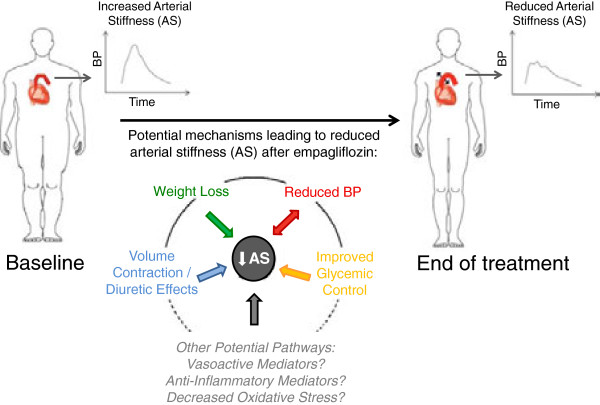
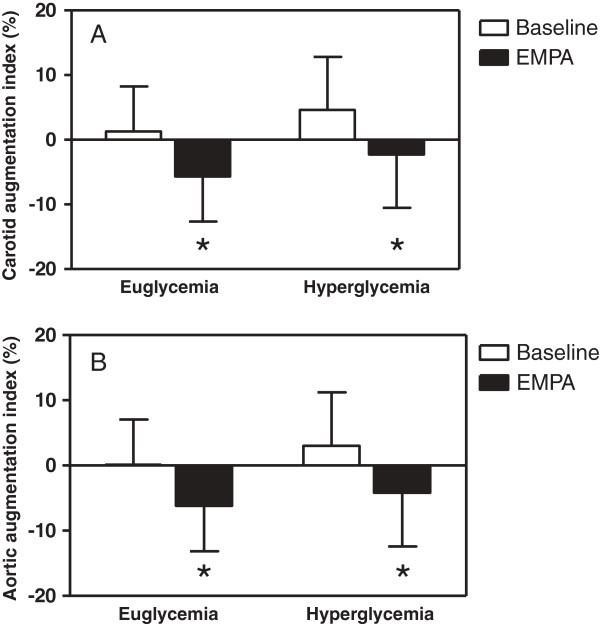
BACKGROUND: Individuals with type 1 diabetes mellitus are at high risk for the development of hypertension, contributing to cardiovascular complications. Hyperglycaemia-mediated neurohormonal activation increases arterial stiffness, and is an important contributing factor for hypertension. Since the sodium glucose cotransport-2 (SGLT2) inhibitor empagliflozin lowers blood pressure and HbA1c in type 1 diabetes mellitus, we hypothesized that this agent would also reduce arterial stiffness and markers of sympathetic nervous system activity. METHODS: Blood pressure, arterial stiffness, heart rate variability (HRV) and circulating adrenergic mediators were measured during clamped euglycaemia (blood glucose 4-6 mmol/L) and hyperglycaemia (blood glucose 9-11 mmol/L) in 40 normotensive type 1 diabetes mellitus patients. Studies were repeated after 8 weeks of empagliflozin (25 mg once daily). RESULTS: In response to empagliflozin during clamped euglycaemia, systolic blood pressure (111 ± 9 to 109 ± 9 mmHg, p = 0.02) and augmentation indices at the radial (-52% ± 16 to -57% ± 17, p = 0.0001), carotid (+1.3 ± 1 7.0 to -5.7 ± 17.0%, p < 0.0001) and aortic positions (+0.1 ± 13.4 to -6.2 ± 14.3%, p < 0.0001) declined. Similar effects on arterial stiffness were observed during clamped hyperglycaemia without changing blood pressure under this condition. Carotid-radial pulse wave velocity decreased significantly under both glycemic conditions (p ≤ 0.0001), while declines in carotid-femoral pulse wave velocity were only significant during clamped hyperglycaemia (5.7 ± 1.1 to 5.2 ± 0.9 m/s, p = 0.0017). HRV, plasma noradrenalin and adrenaline remained unchanged under both clamped euglycemic and hyperglycemic conditions. CONCLUSIONS: Empagliflozin is associated with a decline in arterial stiffness in young type 1 diabetes mellitus subjects. The underlying mechanisms may relate to pleiotropic actions of SGLT2 inhibition, including glucose lowering, antihypertensive and weight reduction effects. CLINICAL TRIAL REGISTRATION: NCT01392560.
Overview
The claims and statistics of this paper haven’t been checked yet.
Free: it reads the open-access text and checks the first 5 claims that cite a source we can check. Create a free account to check every claim.
Integrity signals
Registry
Cites
Statistics
Figures
Verification
Claims the paper makes
The claims and statistics of this paper haven’t been checked yet.
Free: it reads the open-access text and checks the first 5 claims that cite a source we can check. Create a free account to check every claim.
Claims other papers make about this one
Each is checked against this paper’s own text: does it say what the citing paper says it does?
The source backs part of the claim, not all of it — or backs it for a different population, condition or comparison.
In the citing paper
“Regardless of the underlying mechanisms, relatively modest reductions in BP with SGLT2 inhibition are unlikely to fully explain the substantial risk reductions in kidney failure and cardiovascular outcomes with these agents, 9,[35][36][37] a conclusion supported by the finding that less than 10% of treatment effects on kidney and cardiovascular outcomes were explained by change in systolic BP.”
From Blood Pressure Effects of Canagliflozin and Clinical Outcomes in Type 2 Diabetes and Chronic Kidney Disease: Insights From the CREDENCE Trial (2021) · cites this paper as [36]
Experimental — accuracy not yet measured
Self-check
Percentages, sums and reported differences re-computed from the paper’s own numbers.
The self-check needs the paper’s full text.
Citations
Cites
(1993) · New England Journal of Medicine · doi:10.1056/nejm199309303291401 · Cited by 24,667
Adler, A. I. (2000) · BMJ · doi:10.1136/bmj.321.7258.412 · Cited by 2,133 · cited 1×
“Figure 1 Physiological mechanisms implicated in arterial stiffness low lowering strategies also increase the risk of severe hypoglycemic events [15-17] and promote weight gain and sodium retention resulting in higher blood pressure [16-18], thereby mitigating the benefit that can be achieved through tight glycemic con…”
Mann, J. F., Schmieder, R. E., McQueen, M., Dyal, L., Schumacher, H., Pogue, J., Wang, X., Maggioni, A., Budaj, A., Chaithiraphan, S., et al. (2008) · The Lancet · doi:10.1016/s0140-6736(08)61236-2 · Cited by 1,589 · cited 1×
“Unfortunately, blockade of RAAS pathways provides incomplete protection against the development of diabetic complications [6] and dual RAAS blockade strategies may increase the risk of serious adverse effects such as acute kidney injury and hyperkalemia [7,8].”
Severe hypoglycemia and risks of vascular events and death
Zoungas, S., Patel, A., Chalmers, J., de Galan, B. E., Li, Q., Billot, L., Woodward, M., Ninomiya, T., Neal, B., MacMahon, S., et al. (2010) · New England Journal of Medicine · doi:10.1056/nejmoa1003795 · Cited by 1,471 · cited 1×
“Figure 1 Physiological mechanisms implicated in arterial stiffness low lowering strategies also increase the risk of severe hypoglycemic events [15-17] and promote weight gain and sodium retention resulting in higher blood pressure [16-18], thereby mitigating the benefit that can be achieved through tight glycemic con…”
Cherney, D. Z. I., Perkins, B. A., Soleymanlou, N., Maione, M., Lai, V., Lee, A., Fagan, N. M., Woerle, H. J., Johansen, O. E., Broedl, U. C., et al. (2014) · Circulation · doi:10.1161/circulationaha.113.005081 · Cited by 1,329
Self-citationSkyler, J. S., Bergenstal, R., Bonow, R. O., Buse, J., Deedwania, P., Gale, E. A. M., Howard, B. V., Kirkman, M. S., Kosiborod, M., Reaven, P., et al. (2009) · Diabetes Care · doi:10.2337/dc08-9026 · Cited by 881
Renal and retinal effects of enalapril and losartan in type 1 diabetes
Mauer, M., Zinman, B., Gardiner, R., Suissa, S., Sinaiko, A., Strand, T., Drummond, K., Donnelly, S., Goodyer, P., Gubler, M. C., et al. (2009) · New England Journal of Medicine · doi:10.1056/nejmoa0808400 · Cited by 791 · cited 2×
“Unfortunately, blockade of RAAS pathways provides incomplete protection against the development of diabetic complications [6] and dual RAAS blockade strategies may increase the risk of serious adverse effects such as acute kidney injury and hyperkalemia [7,8].”
Sodium-Glucose Cotransport Inhibition With Dapagliflozin in Type 2 Diabetes
List, J. F., Woo, V., Morales, E., Tang, W., & Fiedorek, F. T. (2009) · Diabetes Care · doi:10.2337/dc08-1863 · Cited by 698
The Diabetes Control and Complications (DCCT) Research Group (1995) · Kidney International · doi:10.1038/ki.1995.236 · Cited by 694
Barnett, A. H., Mithal, A., Manassie, J., Jones, R., Rattunde, H., Woerle, H. J., & Broedl, U. C. (2014) · The Lancet Diabetes & Endocrinology · doi:10.1016/s2213-8587(13)70208-0 · Cited by 574
Self-citation
Research works printed but not linked: 1
- Perkins BA Cherney DZI Partridge H Soleymanlou N Tschirhart H Zinman B Fagan N Kaspers S Woerle HJ Broedl UC The sodium glucose co-transporter-2 (SGLT2) inhibitor empagliflozin improves glycemic control in patients with type 1 diabetes: a single-arm clinical trial Diabetes Care 2013 in press
Cited by
Items 401–468 of 468
Lunder, M., Janić, M., Šabović, M., & Janež, A. (2018) · Slovenian Medical Journal · doi:10.6016/zdravvestn.2705 · Cited by 3
Saha, S. (2020) · Journal of Ideas in Health · doi:10.47108/jidhealth.vol3.iss2.56 · Cited by 2
Posch, M. G., Walther, N., Ferrannini, E., Powell, D. R., Banks, P. L., Wason, S., & Dahmen, R. (2022) · doi:10.2337/figshare.20069063 · Cited by 2
SGLT-2 inhibitors in chronic kidney disease: state of the art
Sabirov, I. S., Murkamilov, I. T., Fomin, V., Абдилалимовна, М. Ж., & Ибрагимовна, С. А. (2022) · Clinical pharmacology and therapy · doi:10.32756/0869-5490-2022-3-53-58 · Cited by 2
Golubovskaia, D. P., Каретникова, В. Н., Олейник, И. Р., & Барбараш, О. Л. (2022) · Rational Pharmacotherapy in Cardiology · doi:10.20996/1819-6446-2022-10-08 · Cited by 3
The role of amino acid signaling in pathogenesis of chronic kidney disease
Yan, S., Zhang, X., Bu, R., Li, G., Wang, Y., Cheng, M., Chen, Q., Wu, Y. C., Zhang, Y., Wang, D., et al. (2025) · Molecular and Cellular Biochemistry · doi:10.1007/s11010-025-05447-0 · Cited by 1
The Conventional and Alternative Therapeutic Approaches in Arterial Stiffness Management
Randriamboavonjy, J. I., Conti, V., Mazza, I., Ragot, T., Andrianjara, C., Rafatro, H., & Tesse, A. (2026) · Pharmaceutics · doi:10.3390/pharmaceutics18020166 · Cited by 2
“As shown in clinical trials by Bosch et al. [73] in 58 type 2 diabetic patients and by Cherney et al. [74] in 42 type 1 diabetic patients, empagliflozin reduced SBP and pulse pressure-associated AS related to high-sensitive inflammatory marker C-reactive protein (hsCRP) reduction.”
Natural History of Chronic Kidney Disease in Sickle Cell Disease
Ataga, K. I. (2026) · American Journal of Hematology · doi:10.1002/ajh.70300 · Cited by 1
To overcome two diseases with one pill
Mogi, M., & Horiuchi, M. (2016) · Hypertension Research · doi:10.1038/hr.2016.3 · Cited by 1
Role of Sodium Glucose Co-Transporter-2 Inhibitors in Pre-diabetes and Their Extra-glycemic Effects
Ahmadieh, H., Ghazal, N., & Azar, S. T. (2016) · International Archives of Medicine · doi:10.3823/2129 · Cited by 1
“Also, in an investigation that studied patients with T1D treated with empagliflozin 25 mg daily for a period of 8 weeks, significant blood pressure reductions were noted in addition to a significant decrease in radial augmentation index, carotid augmentation index, and aortic augmentation index, with no significant ch…”
Kardiovaskuläre Risikoreduktion durch Antidiabetika über Glukosesenkung hinaus
Siegmund, T. (2017) · Info Diabetologie · doi:10.1007/s15034-017-1222-z · Cited by 1
“Weitere diskutierte Faktoren sind günstige Eekte auf Gefäßsteifheit und -widerstand [13,14], die Hyperurikämie oder das renale neurohormonelle System [15, 16].”
Arioglu‐Inan, E., & Kayki‐Mutlu, G. (2021) · Elsevier eBooks · doi:10.1016/b978-0-12-820472-6.00162-6 · Cited by 1
Głuszek, J., & Kosicka, T. M. (2022) · Arterial Hypertension · doi:10.5603/ah.a2022.0010 · Cited by 3
“A similar effect was observed by the next authors in patients with type 1 diabetes [46].”
Nouel, A., Winter, J. L., & Sepúlveda, L. (2022) · Revista chilena de cardiología · doi:10.4067/s0718-85602022000300198 · Cited by 5
Advances in pharmacotherapy for heart failure and reduced ejection fraction: what’s new in 2024?
Ismail, Z., Aboughdir, M., Duric, B., Kaka, S., Chan, J. S. K., Bayatpoor, Y., & Harky, A. (2024) · Expert Opinion on Pharmacotherapy · doi:10.1080/14656566.2024.2408376 · Cited by 3
Sorola, S., Hyrylä, V. V., Eronen, T., Kupari, S., Venojärvi, M., Tikkanen, H. O., Tarvainen, M. P., & Lindholm, H. J. (2024) · Clinical Autonomic Research · doi:10.1007/s10286-024-01094-5 · Cited by 2
“The consistently higher SBP in the T1DM group may be related to sympathetic overactivity [28].”
Reprint of: Blood Sugar Regulation for Cardiovascular Health Promotion and Disease Prevention
Schwarz, P. E. H., Timpel, P., Harst, L., Greaves, C. J., Ali, M. K., Lambert, J. D., Weber, M. B., Almedawar, M. M., & Morawietz, H. (2018) · Journal of the American College of Cardiology · doi:10.1016/j.jacc.2018.10.026 · Cited by 2
Sander, G. E., Fernandez, C., Kadowitz, P. J., & Giles, T. D. (2016) · Hypertension Journal · doi:10.5005/jp-journals-10043-0046 · Cited by 1
A translational viewpoint explaining its potential salutary effects
de Leeuw, A. E., & de Boer, R. A. (2016) · European Heart Journal - Cardiovascular Pharmacotherapy · doi:10.1093/ehjcvp/pvw015 · Cited by 1
Duan, Y., Wang, H., Li, G., Jing, H., & Li, W. (2024) · Research Square · doi:10.21203/rs.3.rs-4695907/v1 · Cited by 1
Vardarli, I., & Özcelik, C. (2016) · Der Kardiologe · doi:10.1007/s12181-016-0047-7
Empagliflozin und kardiovaskuläre Endpunkte bei Patienten mit Diabetes mellitus Typ 2
Guthoff, M. (2016) · Der Nephrologe · doi:10.1007/s11560-016-0049-2
Empaglifozin and the reduction of risk of death in a high cardiovascular risk population
Moreira, Í. C., Bernardo, G. P., de Lima, D. S. B., Carneiro, C. B. R., Ribeiro, D. L. S., de Sá, M. C. F., de Macedo, M. J., Moreira, P. P. C., Araújo, V. L., de Alencar, J. N., et al. (2016) · International Archives of Medicine · doi:10.3823/2000
“The mechanisms behind the cardiovascular benefits of empagliflozin are multidimensional [29] and possibly involve changes in arterial stiffness [30, 31], cardiac function, and cardiac oxygen demand (in the absence of sympathetic-nerve activation) [30], as well as cardiorenal effects [30, 32-34], reduction in albuminur…”
Empagliflozin: a wonder drug in preventing diabetic nephropathy and cardiovascular effects
Thotakura, N. (2016) · International Journal of Basic & Clinical Pharmacology · doi:10.18203/2319-2003.ijbcp20163202
Gefäßprotektion durch Antidiabetika über die Glukosesenkung hinaus
Siegmund, T. (2017) · CardioVasc · doi:10.1007/s15027-017-1144-7
Siegmund, T. (2017) · MMW - Fortschritte der Medizin · doi:10.1007/s15006-017-9902-0
Saad, M., Gomceli, U., Ravi, P., Lacoste, A. G., Shah, N., & Vittorio, T. J. (2018) · Drugs in Context · doi:10.7573/dic.212549
Sodium Glucose Cotransporter-2 Inhibition and Renal Function
Rajasekeran, H. (2018) · TSpace (University of Toronto)
Sodium-glucose cotransporter 2 inhibition as a potential treatment for idiopathic oedema
Rambaran, K., Pereira, L. M. P., & Teelucksingh, S. (2019) · Medical Hypotheses · doi:10.1016/j.mehy.2019.109270
“SGLT2 inhibition reduces arterial stiffness (an indicator of arterial noncompliance and thereby hypertension), improves blood pressure control and decreases risk of cardiovascular complications [20].”
Baker, H. E. (2020) · Purdue University Indianapolis (Indiana University) · doi:10.7912/c2/2031
Extending the use of SGLT2 inhibitors from diabetic to non-diabetic kidney disease
Dekkers, C. C. J. (2020) · University of Groningen research database (University of Groningen / Centre for Information Technology) · doi:10.33612/diss.136049658
New glucose-lowering drugs in patients with heart failure
Gatzov, P. M. (2021) · Bulgarian Cardiology · doi:10.3897/bgcardio.27.e70144
Veneti, S., & Τζιόμαλος, Κ. (2021) · Expert Opinion on Pharmacotherapy · doi:10.1080/14656566.2021.1967931
Sewage sludge treatment by membrane anaerobic system (MAS)
Musliha, M. (2010) · UMP Institutional Repository (Universiti Malaysia Pahang)
Lipids in CKD: What do we actually know?
Gordin, D., Bjornstad, P., & van Raalte, D. H. (2022) · Atherosclerosis · doi:10.1016/j.atherosclerosis.2022.04.012 · Cited by 1
AÇÃO DOS ISGLT2 NO HIPERTENSO DIABÉTICO, QUANDO INDICAR?
Bianco, H. T. (2021) · Revista Brasileira de Hipertensão · doi:10.47870/1519-7522/20212804283-7
Konishi, H., Shirakawa, J., Tajima, K., Okuyama, T., Togashi, Y., Takamine, H., Kondo, Y., Kunishita, R., & Terauchi, Y. (2018) · Journal of Endocrinology and Metabolism · doi:10.14740/jem531w
Aschner, P. J. (2017) · Faculty Opinions – Post-Publication Peer Review of the Biomedical Literature · doi:10.3410/f.727299606.793538292
Posch, M. G., Walther, N., Ferrannini, E., Powell, D. R., Banks, P. L., Wason, S., & Dahmen, R. (2022) · doi:10.2337/figshare.20069063.v1
Mechanisms of SGLT2 inhibition in the kidney: from mechanism towards biomarker guided therapy
Sen, T. (2023) · University of Groningen research database (University of Groningen / Centre for Information Technology) · doi:10.33612/diss.659987622
Fusco, S. A. D., Spinelli, A., Aquilani, S., Borrelli, N., Iannopollo, G., Gulizia, M. M., Gabrielli, D., Oliva, F. G., & Colivicchi, F. (2023) · European Heart Journal Supplements · doi:10.1093/eurheartjsupp/suad107
Chou, O. H. I., Luo, Z., Chung, C. T., Chan, J. S. K., Li, H., Lakhani, I., Lee, S., Zhang, Q., Liu, T., Wong, W. T., et al. (2023) · medRxiv · doi:10.1101/2023.08.21.23294389
MESA 1: NUEVOS MEDICAMENTOS EN DIABETES MELLITUS TIPO 1
Litwak, L., Martín, C. G., Garrido, N., Koleff, C. K., Canda, M. E., Burgos, M. A., Bertollo, N., Scaliti, M. G., Blanco, M. A., Calvo, M. L., et al. (2015) · Revista de la Sociedad Argentina de Diabetes · doi:10.47196/diab.v49i3.633
Meybodi, S. M., Karimi, M. A., Mousazadeh, K., Pakmehr, S., Anar, M. A., Alizadeh, A., Poudineh, M., Zerangian, N., Rahmanian, M., Fathi, M., et al. (2024) · Research Square · doi:10.21203/rs.3.rs-3820980/v1
SGLT2 Inhibitors and Mechanisms of Arterial Hypertension
Raimzhanov, A. A., & Mangasaryan, A. A. (2023) · Texas Journal of Medical Science · doi:10.62480/tjms.2023.vol18.pp13-16
Sodium-Glucose Cotransporter 2 Inhibitors for Chronic Kidney Disease: A Comprehensive Review
Song, S. H., & Bae, E. H. (2024) · Korean Journal of Medicine · doi:10.3904/kjm.2024.99.2.61
FATORES DE RISCO COMUNS E TRATAMENTOS EMERGENTES PARA CASOS DE DOENÇAS CARDIOVASCULARES E CÂNCER
Bernardes, A. G. D. C., Wollmann, C. A. R., Horevicht, C. M., Ferreira, I. A. B. D. S., Figueredo, J. C., Ferreira, M. D., Sá, M. C., Senra, P. D. M., & Crepaldi, P. I. S. (2024) · EPITAYA eBooks · doi:10.47879/ed.ep.2024479p521
Randriamboavonjy, J. I., Rafatro, H., & Andrianjara, C. (2024) · SSRN Electronic Journal · doi:10.2139/ssrn.4865304
Nandave, M. (2024) · Springer eBooks · doi:10.1007/978-981-97-7568-2_8
Vasoactive Substances as Mediators of Renal Injury
Caceres, P. S., & Rossi, N. F. (2025) · Elsevier eBooks · doi:10.1016/b978-0-323-95488-4.00105-4
CKD as a Cardiovascular Risk Factor
García, F. M., & Quesada, V. E. (2025) · Updates in hypertension and cardiovascular protection · doi:10.1007/978-3-031-81292-7_11 · Cited by 2
Kugathasan, L., Ragi, N., Debnath, S., Sridhar, V. S., Maity, S., Feng, T., Treviño, E., Perkins, B. A., Cherney, D. Z. I., & Sharma, K. (2025) · Physiological Reports · doi:10.14814/phy2.70465 · Cited by 3
Self-citationÖzyılmaz, İ., Genç, H. Z., Çoban, Ş., Oğuz, A. S., Yılmaz, N., Tanıdır, İ. C., Öztürk, E., & Hatemi, A. C. (2025) · Cardiology in the Young · doi:10.1017/s1047951125109335
Katakami, N., Mita, T., Yoshii, H., Shiraiwa, T., Yasuda, T., Okada, Y., Torimoto, K., Umayahara, Y., Kaneto, H., Osonoi, T., et al. (2021) · Figshare · doi:10.6084/m9.figshare.13521225
Katakami, N., Mita, T., Yoshii, H., Shiraiwa, T., Yasuda, T., Okada, Y., Torimoto, K., Umayahara, Y., Kaneto, H., Osonoi, T., et al. (2021) · Figshare · doi:10.6084/m9.figshare.13521222
Katakami, N., Mita, T., Yoshii, H., Shiraiwa, T., Yasuda, T., Okada, Y., Torimoto, K., Umayahara, Y., Kaneto, H., Osonoi, T., et al. (2021) · Figshare · doi:10.6084/m9.figshare.13521210
Katakami, N., Mita, T., Yoshii, H., Shiraiwa, T., Yasuda, T., Okada, Y., Torimoto, K., Umayahara, Y., Kaneto, H., Osonoi, T., et al. (2021) · Figshare · doi:10.6084/m9.figshare.13521207
Katakami, N., Mita, T., Yoshii, H., Shiraiwa, T., Yasuda, T., Okada, Y., Torimoto, K., Umayahara, Y., Kaneto, H., Osonoi, T., et al. (2021) · Figshare · doi:10.6084/m9.figshare.13521219
Katakami, N., Mita, T., Yoshii, H., Shiraiwa, T., Yasuda, T., Okada, Y., Torimoto, K., Umayahara, Y., Kaneto, H., Osonoi, T., et al. (2021) · Figshare · doi:10.6084/m9.figshare.13521213
Katakami, N., Mita, T., Yoshii, H., Shiraiwa, T., Yasuda, T., Okada, Y., Torimoto, K., Umayahara, Y., Kaneto, H., Osonoi, T., et al. (2021) · Figshare · doi:10.6084/m9.figshare.13521216
Chen, C., Shi, J., Xie, Y., Zhang, L., Li, S., Huang, Y., & Chen, M. (2026) · BMC Cardiovascular Disorders · doi:10.1186/s12872-026-05547-9
Fardin, A., Gholami, E., Maleki, M., Parsaei, H., & Yaribeygi, H. (2026) · International Urology and Nephrology · doi:10.1007/s11255-026-05147-8
“A study by Cherney et al. (2014) indicated that SGLT2 inhibitors, including empagli-flozin, reduce triglyceride levels in diabetic patients while preserving HDL levels, which may contribute to improved cardiovascular and renal health [25].”
Fernandes, S., Hettinger, B., Ang, L. P., & Pop‐Busui, R. (2026) · Endocrinology and Metabolism Clinics of North America · doi:10.1016/j.ecl.2026.04.007
Heart Rate Variability in Heart Failure: Mechanisms, Prognostic Value and Modulation Strategies
Cersosimo, A., Teresi, L., Rovelli, R., Brangi, E., Pierucci, N., Cerani, E., Metra, M., & Vizzardi, E. (2026) · Cardiovascular Medicine · doi:10.3390/cardiovascmed29030030
“…were reported in patients with type 1 diabetes mellitus treated with empagliflozin [60], as well as in the EMPYREAN study [62], which compared empagliflozin with sitagliptin in individuals with type 2 diabetes mellitus and found no differences between treatments in terms of HRV modulation [60].”
Lee, S. Y., Kim, S. M., & Song, Y. B. (2026) · Journal of Cardiovascular Intervention · doi:10.54912/jci.2026.0011
SGLT2 Inhibitors as Endothelial Protectors: Mechanisms of Vascular Restoration in Type 2 Diabetes
Okojie, O., Checa-Ros, A., & D’Marco, L. (2026) · Metabolites · doi:10.3390/metabo16110824
Metadata
- Authors
- Cherney, D. Z., Perkins, B. A., Soleymanlou, N., Har, R., Fagan, N., Johansen, O., Woerle, H.-J., von Eynatten, M., & Broedl, U. C.
- Affiliations
- University Health Network (CA)
- Boehringer Ingelheim (Canada) (CA)
- Boehringer Ingelheim (United States) (US)
- Boehringer Ingelheim (Germany) (DE)
- Corresponding author
- Cherney, David ZI
- Venue
- Cardiovascular Diabetology
- Published
- 2014
- Volume
- 13
- Issue
- 1
- Pages
- 28
- ISSN
- 1475-2840 (ISSN-L)
- PMC
- PMC3915232
- OpenAlex
- W2148513135
- Cited by
- 470
- References
- 63
- Citations by year
- 2026: 11 · 2025: 19 · 2024: 27 · 2023: 30 · 2022: 40 · 2021: 52 · 2020: 55 · 2019: 46 · 2018: 49 · 2017: 46 · 2016: 49 · 2015: 33 · 2014: 12
- FWCI
- 32.07
- Type
- journal article
- Language
- en
- Open access
- gold
- doi.org
- Locations
- Cardiovascular Diabetology (publishedVersion)
- Europe PMC (PubMed Central) (publishedVersion, cc-by)
- PubMed Central (publishedVersion, cc-by)
- PubMed (publishedVersion)
- TSpace (University of Toronto) (submittedVersion)
- Funders
- American Society of Nephrology
- Heart and Stroke Foundation of Canada
- Canadian Diabetes Association
- Kidney Foundation of Canada
- Topics
- Health Sciences › Medicine › Cardiology and Cardiovascular Medicine › Cardiovascular Health and Disease Prevention
- Health Sciences › Medicine › Endocrinology, Diabetes and Metabolism › Diabetes Treatment and Management
- Health Sciences › Medicine › Cardiology and Cardiovascular Medicine › Blood Pressure and Hypertension Studies
- Keywords
- empagliflozin, type 1 diabetes, arterial stiffness, heart rate variability, SGLT2 inhibitors, hyperglycemia, pulse wave velocity, blood pressure, sympathetic activity, norepinephrine, epinephrine, hypertension, cardiovascular complications, neurohormonal activation, augmentation index
- MeSH terms
- Adult, Benzhydryl Compounds, Blood Pressure, Diabetes Mellitus, Type 1, Female, Glucosides, Heart Rate, Humans, Male, Prospective Studies, Cohort Studies, Treatment Outcome, Young Adult, Vascular Stiffness
About these checks
Registry, retraction, Cites and statistics results are computed, not judged, with one exception: a printed reference that no index lists is read once by a model before it counts as a citation error. Claims are extracted by a model and kept only when their quote appears verbatim in the text; each cited source is then checked, with a model’s help, for whether it says what the claim relies on. Those verdicts can be wrong — read the claim’s quote and the cited source before relying on one.
Statistics and arithmetic are recomputed, not judged.
Confidence bands are shown only for fields calibrated on our annotated test set. None is calibrated yet, so no band is shown.
What counts as a claim ›How we measure confidence ›How we check this ›
Are you an author, or do you see a problem with this page? Request a review
Data sources
Bibliographic data: Semantic Scholar, OpenAlex, Crossref.
Contains information from the Semantic Scholar Academic Graph Datasets, made available under the ODC Attribution License (ODC-BY 1.0).
Semantic Scholar’s data is described in: Kinney, R., et al. (2023). The Semantic Scholar Open Data Platform. arXiv:2301.10140.
