

The DOI matches its Crossref record; 52 of the 52 references it cites were found in a registry or an index.
Characterizing acetogenic metabolism using a genome-scale metabolic reconstruction of Clostridium ljungdahlii
Open accessAbstract
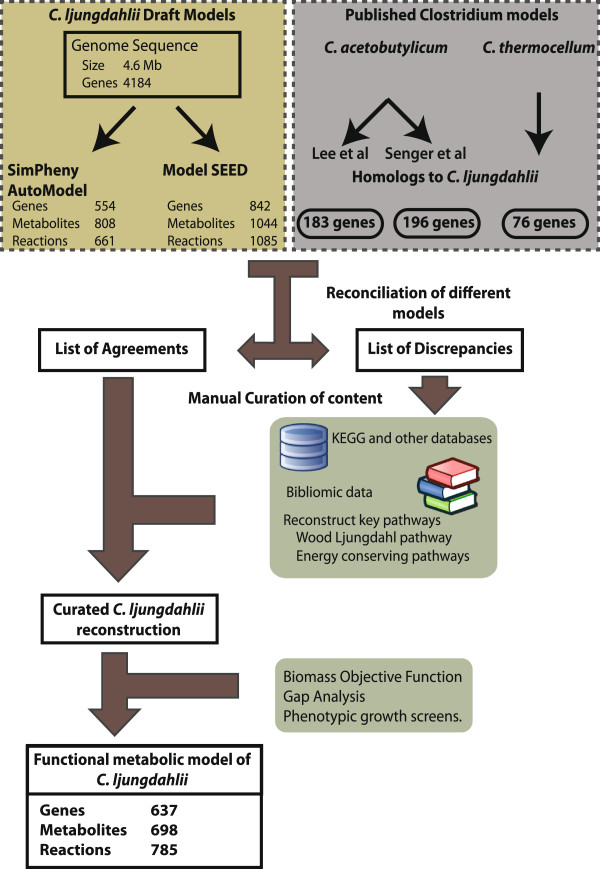
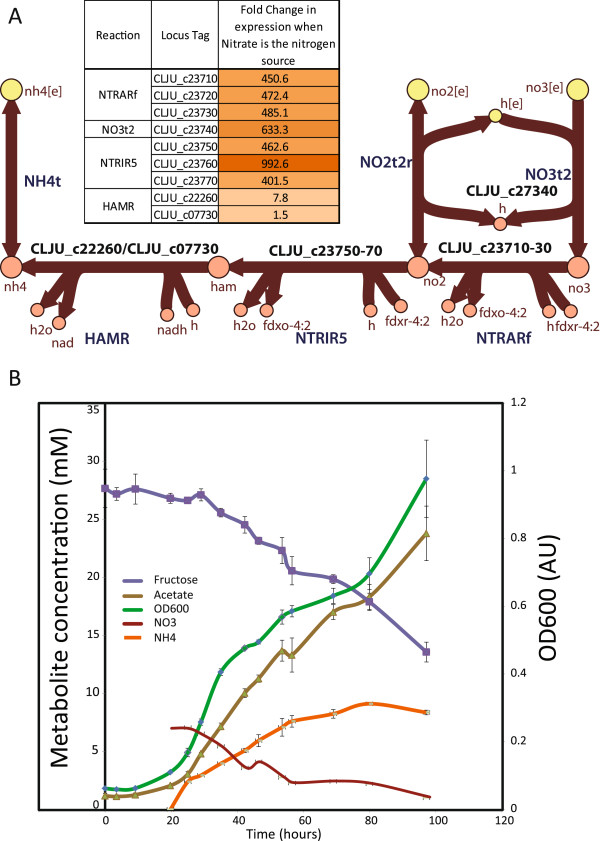
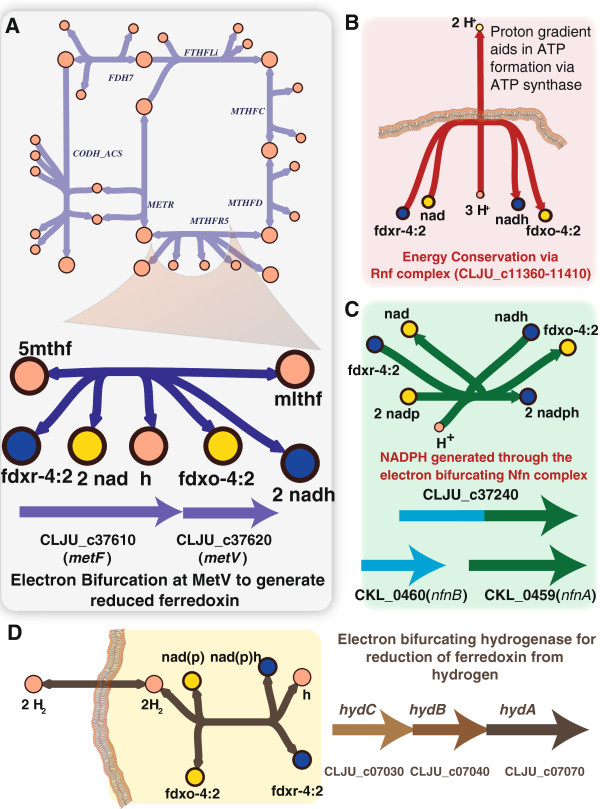
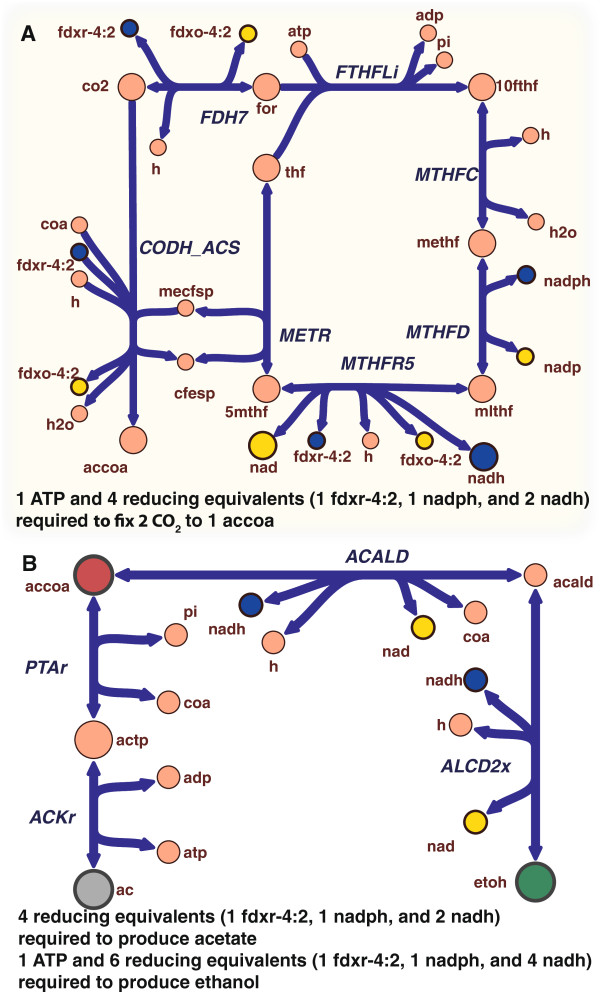
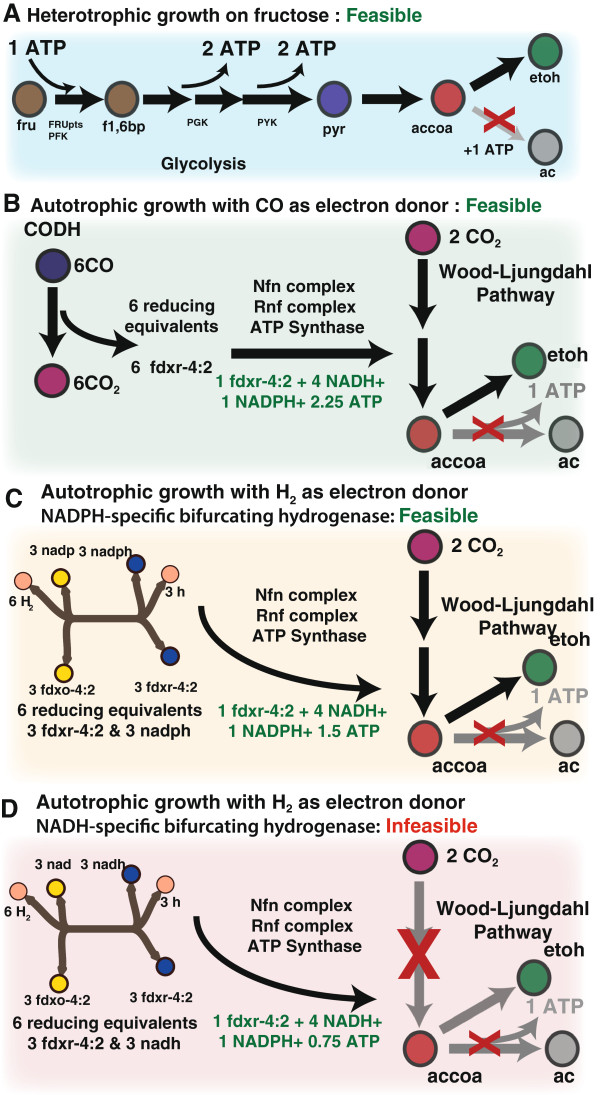
BACKGROUND: The metabolic capabilities of acetogens to ferment a wide range of sugars, to grow autotrophically on H2/CO2, and more importantly on synthesis gas (H2/CO/CO2) make them very attractive candidates as production hosts for biofuels and biocommodities. Acetogenic metabolism is considered one of the earliest modes of bacterial metabolism. A thorough understanding of various factors governing the metabolism, in particular energy conservation mechanisms, is critical for metabolic engineering of acetogens for targeted production of desired chemicals. RESULTS: Here, we present the genome-scale metabolic network of Clostridium ljungdahlii, the first such model for an acetogen. This genome-scale model (iHN637) consisting of 637 genes, 785 reactions, and 698 metabolites captures all the major central metabolic and biosynthetic pathways, in particular pathways involved in carbon fixation and energy conservation. A combination of metabolic modeling, with physiological and transcriptomic data provided insights into autotrophic metabolism as well as aided the characterization of a nitrate reduction pathway in C. ljungdahlii. Analysis of the iHN637 metabolic model revealed that flavin based electron bifurcation played a key role in energy conservation during autotrophic growth and helped identify genes for some of the critical steps in this mechanism. CONCLUSIONS: iHN637 represents a predictive model that recapitulates experimental data, and provides valuable insights into the metabolic response of C. ljungdahlii to genetic perturbations under various growth conditions. Thus, the model will be instrumental in guiding metabolic engineering of C. ljungdahlii for the industrial production of biocommodities and biofuels.
Overview
The claims and statistics of this paper haven’t been checked yet.
Run the check — free, no account needed. It reads the open-access text and checks the sources it cites.
Integrity signals
Registry
Cites
Statistics
Figures
Verification
Claims the paper makes
The claims and statistics of this paper haven’t been checked yet.
Run the check — free, no account needed. It reads the open-access text and checks the sources it cites.
Claims other papers make about this one
Each is checked against this paper’s own text: does it say what the citing paper says it does?
The cited source says what the claim attributes to it.
In the citing paper
“and transcriptomics analyses of C. autoethanogenum (Mock et al., 2015; Marcellin et al., 2016) and C. ljungdahlii (Nagarajan et al., 2013; Tan et al., 2013; Whitham et al., 2015).”
From Gas Fermentation—A Flexible Platform for Commercial Scale Production of Low-Carbon-Fuels and Chemicals from Waste and Renewable Feedstocks (2016) · cites this paper as Nagarajan et al., 2013
In the citing paper
“Similar models also exist for C. ljungdahlii (Nagarajan et al., 2013) and M. thermoacetica (Islam et al., 2015).”
From Gas Fermentation—A Flexible Platform for Commercial Scale Production of Low-Carbon-Fuels and Chemicals from Waste and Renewable Feedstocks (2016) · cites this paper as Nagarajan et al., 2013
Self-check
Percentages, sums and reported differences re-computed from the paper’s own numbers.
The self-check needs the paper’s full text.
Citations
Cites
KEGG: Kyoto Encyclopedia of Genes and Genomes
Kanehisa, M. (2000) · Nucleic Acids Research · doi:10.1093/nar/28.1.27 · Cited by 37,077
KEGG: Kyoto Encyclopedia of Genes and Genomes
Ogata, H., Goto, S., Sato, K., Fujibuchi, W., Bono, H., & Kanehisa, M. (1999) · Nucleic Acids Research · doi:10.1093/nar/27.1.29 · Cited by 31,232
Ultrafast and memory-efficient alignment of short DNA sequences to the human genome.
Langmead, B., Trapnell, C., Pop, M., & Salzberg, S. L. (2009) · Genome Biology · doi:10.1186/gb-2009-10-3-r25 · Cited by 21,849
Trapnell, C., Williams, B. A., Pertea, G., Mortazavi, A., Kwan, G., van Baren, M. J., Salzberg, S. L., Wold, B. J., & Pachter, L. (2010) · Nature Biotechnology · doi:10.1038/nbt.1621 · Cited by 15,556
What is flux balance analysis?
Orth, J. D., Thiele, I., & Palsson, B. Ø. (2010) · Nature Biotechnology · doi:10.1038/nbt.1614 · Cited by 3,903
Quantitative prediction of cellular metabolism with constraint-based models: the COBRA Toolbox v2.0
Schellenberger, J., Que, R., Fleming, R. M. T., Thiele, I., Orth, J. D., Feist, A. M., Zielinski, D. C., Bordbar, A., Lewis, N. E., Rahmanian, S., et al. (2011) · Nature Protocols · doi:10.1038/nprot.2011.308 · Cited by 1,835
Acetogenesis and the Wood–Ljungdahl pathway of CO2 fixation
Ragsdale, S. W., & Pierce, E. (2008) · Biochimica et Biophysica Acta (BBA) - Proteins and Proteomics · doi:10.1016/j.bbapap.2008.08.012 · Cited by 1,409
Feist, A. M., Henry, C. S., Reed, J. L., Krummenacker, M., Joyce, A. R., Karp, P. D., Broadbelt, L. J., Vassily Hatzimanikatis, A., & Palsson, B. Ø. (2007) · Molecular Systems Biology · doi:10.1038/msb4100155 · Cited by 1,408
Metabolic engineering of Escherichia coli for direct production of 1,4-butanediol
Yim, H. H., Haselbeck, R. J., Niu, W., Pujol-Baxley, C., Burgard, A. P., Boldt, J., Khandurina, J., Trawick, J. D., Osterhout, R. E., Stephen, R., et al. (2011) · Nature Chemical Biology · doi:10.1038/nchembio.580 · Cited by 1,114
High-throughput generation, optimization and analysis of genome-scale metabolic models
Henry, C. S., DeJongh, M., Best, A. A., Frybarger, P. M., Linsay, B., & Stevens, R. L. (2010) · Nature Biotechnology · doi:10.1038/nbt.1672 · Cited by 1,090
Cited by
Sorted by citations
Schuchmann, K., & Müller, V. (2014) · Nature Reviews Microbiology · doi:10.1038/nrmicro3365 · Cited by 845
Liew, F., Martin, M. E., Tappel, R. C., Heijstra, B. D., Mihalcea, C., & Köpke, M. (2016) · Frontiers in Microbiology · doi:10.3389/fmicb.2016.00694 · Cited by 485
Chen, P., Torralba, M., Tan, J., Embree, M., Zengler, K., Stärkel, P., van Pijkeren, J.-P., DePew, J., Loomba, R., Ho, S. B., et al. (2015) · Gastroenterology · doi:10.1053/j.gastro.2014.09.014 · Cited by 322
Self-citationC1-carbon sources for chemical and fuel production by microbial gas fermentation
Dürre, P., & Eikmanns, B. J. (2015) · Current Opinion in Biotechnology · doi:10.1016/j.copbio.2015.03.008 · Cited by 250
Metabolic engineering of Clostridium autoethanogenum for selective alcohol production
Liew, F. E., Henstra, A. M., Köpke, M., Winzer, K., Simpson, S. D., & Minton, N. P. (2017) · Metabolic Engineering · doi:10.1016/j.ymben.2017.01.007 · Cited by 254
Metadata
- Authors
- Nagarajan, H., Sahin, M., Nogales, J., Latif, H., Lovley, D. R., Ebrahim, A., & Zengler, K.
- Affiliations
- University of California San Diego (US)
- University of Massachusetts Amherst (US)
- Corresponding author
- Zengler, Karsten
- Venue
- Microbial Cell Factories
- Published
- 2013-11-25
- Volume
- 12
- Issue
- 1
- Pages
- 118-118
- ISSN
- 1475-2859 (ISSN-L)
- PMC
- PMC4222884
- OpenAlex
- W2038304602
- Cited by
- 170
- References
- 52
- Citations by year
- 2026: 8 · 2025: 8 · 2024: 10 · 2023: 9 · 2022: 23 · 2021: 11 · 2020: 13 · 2019: 13 · 2018: 19 · 2017: 19 · 2016: 11 · 2015: 13 · 2014: 13
- FWCI
- 5.52
- Type
- journal article
- Language
- en
- Open access
- gold
- doi.org
- Licence
- cc-by
- Locations
- Microbial Cell Factories (publishedVersion, cc-by)
- PubMed Central (publishedVersion, cc-by)
- PubMed (publishedVersion)
- eScholarship (California Digital Library) (submittedVersion)
- Funders
- National Science Foundation (1144086)
- U.S. Department of Energy (DEAR0000159, DEAR0000087, DESC0004917)
- Advanced Research Projects Agency - Energy (DE-AR0000159)
- Office of Science
- University of California, San Diego
- Advanced Research Projects Agency
- National Institute of General Medical Sciences (U01GM102098)
- Topics
- Life Sciences › Biochemistry, Genetics and Molecular Biology › Molecular Biology › Microbial Metabolic Engineering and Bioproduction
- Physical Sciences › Engineering › Biomedical Engineering › Biofuel production and bioconversion
- Life Sciences › Biochemistry, Genetics and Molecular Biology › Molecular Biology › Gene Regulatory Network Analysis
- Keywords
- Clostridium ljungdahlii, genome-scale metabolic models, autotrophic growth, energy conservation, CO2 fixation, metabolic engineering, biofuels
- MeSH terms
- Acetates, Clostridium, Genome, Metabolic Networks and Pathways, Biofuels, Metabolic Engineering
About these checks
Registry, retraction, Cites and statistics results are computed, not judged, with one exception: a printed reference that no index lists is read once by a model before it counts as a citation error. Claims are extracted by a model and kept only when their quote appears verbatim in the text; each cited source is then checked, with a model’s help, for whether it says what the claim relies on. Those verdicts can be wrong — read the claim’s quote and the cited source before relying on one.
Statistics and arithmetic are recomputed, not judged.
Confidence bands are shown only for fields calibrated on our annotated test set. None is calibrated yet, so no band is shown.
What counts as a claim ›How we measure confidence ›How we check this ›
Are you an author, or do you see a problem with this page? Request a review
