

The DOI matches its Crossref record; 81 of the 83 references it cites were found in a registry or an index.
Soluble expression of recombinant proteins in the cytoplasm of Escherichia coli
Open accessAbstract
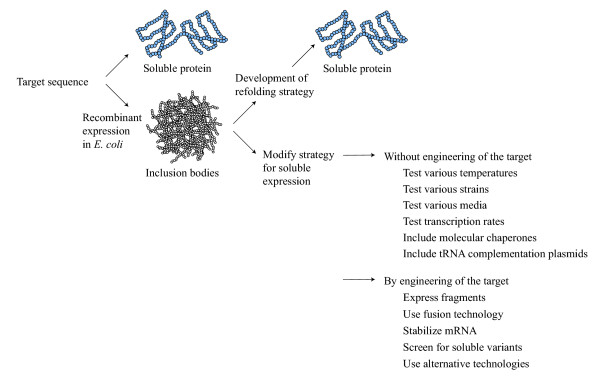
Pure, soluble and functional proteins are of high demand in modern biotechnology. Natural protein sources rarely meet the requirements for quantity, ease of isolation or price and hence recombinant technology is often the method of choice. Recombinant cell factories are constantly employed for the production of protein preparations bound for downstream purification and processing. Eschericia coli is a frequently used host, since it facilitates protein expression by its relative simplicity, its inexpensive and fast high density cultivation, the well known genetics and the large number of compatible molecular tools available. In spite of all these qualities, expression of recombinant proteins with E. coli as the host often results in insoluble and/or nonfunctional proteins. Here we review new approaches to overcome these obstacles by strategies that focus on either controlled expression of target protein in an unmodified form or by applying modifications using expressivity and solubility tags.
Overview
The claims and statistics of this paper haven’t been checked yet.
Run the check — free, no account needed. It reads the open-access text and checks the sources it cites.
Integrity signals
Registry
Cites
Statistics
Figures
Verification
Claims the paper makes
The claims and statistics of this paper haven’t been checked yet.
Run the check — free, no account needed. It reads the open-access text and checks the sources it cites.
Claims other papers make about this one
Each is checked against this paper’s own text: does it say what the citing paper says it does?
In the citing paper
“Several reports have reviewed cyanobacterial species capable of producing H2 (Abed et al. 2009; Das and Veziroglu 2001; Dutta et al. 2005) including at least 14 genera cultivated under different growth conditions.”
From Renewable energy from Cyanobacteria: energy production optimization by metabolic pathway engineering (2011) · cites this paper as Dutta et al. 2005
In the citing paper
“Among these genera it was shown that Anabaena spp. were able to produce the highest amount of H2 (68 μmol mg−1 chl a h−1).”
From Renewable energy from Cyanobacteria: energy production optimization by metabolic pathway engineering (2011) · cites this paper as Dutta et al. 2005
Self-check
Percentages, sums and reported differences re-computed from the paper’s own numbers.
The self-check needs the paper’s full text.
Citations
Cites
Principles that Govern the Folding of Protein Chains
Anfinsen, C. B. (1973) · Science · doi:10.1126/science.181.4096.223 · Cited by 7,096
Molecular Chaperones in the Cytosol: from Nascent Chain to Folded Protein
Hartl, F. U., & Hayer-Hartl, M. K. (2002) · Science · doi:10.1126/science.1068408 · Cited by 3,335
Miroux, B., & Walker, J. E. (1996) · Journal of Molecular Biology · doi:10.1006/jmbi.1996.0399 · Cited by 1,964
Strategies for achieving high-level expression of genes in Escherichia coli
Makrides, S. C. (1996) · Microbiological Reviews · doi:10.1128/mr.60.3.512-538.1996 · Cited by 1,287
Advanced genetic strategies for recombinant protein expression in Escherichia coli
Sørensen, H. P., & Mortensen, K. K. (2004) · Journal of Biotechnology · doi:10.1016/j.jbiotec.2004.08.004 · Cited by 994
Self-citationKapust, R. B., & Waugh, D. S. (1999) · Protein Science · doi:10.1110/ps.8.8.1668 · Cited by 960
Rapid protein-folding assay using green fluorescent protein
Waldo, G. S., Standish, B. M., Berendzen, J., & Terwilliger, T. C. (1999) · Nature Biotechnology · doi:10.1038/10904 · Cited by 906
Efficient folding of proteins with multiple disulfide bonds in the Escherichia coli cytoplasm
Bessette, P. H., Åslund, F., Beckwith, J., & Georgiou, G. (1999) · Proceedings of the National Academy of Sciences · doi:10.1073/pnas.96.24.13703 · Cited by 636
Stewart, E. J., Åslund, F., & Beckwith, J. (1998) · The EMBO Journal · doi:10.1093/emboj/17.19.5543 · Cited by 445
Kiefhaber, T., Rudolph, R., Kohler, H., & Büchner, J. (1991) · Nature Biotechnology · doi:10.1038/nbt0991-825 · Cited by 442
Research works printed but not linked: 1
- Held D, Yaeger K, Novy R: New coexpression vectors for expanded compatibilities in E. coli. InNovations. 2003, 18: 4-6.
Cited by
Sorted by citations
Items 201–300 of 841
Cho, S. Y., Kwean, O. S., Yang, J. W., Cho, W., Kwak, S.-Y., Park, S., Lim, Y., & Kim, H. S. (2017) · Bioresource Technology · doi:10.1016/j.biortech.2017.05.006 · Cited by 32
Fazaeli, A., Golestani, A., Lakzaei, M., Varaei, S. S. R., & Aminian, M. (2019) · PLoS ONE · doi:10.1371/journal.pone.0212217 · Cited by 32
Engineering a novel subunit vaccine against SARS-CoV-2 by exploring immunoinformatics approach
Sarkar, B., Ullah, M. A., Araf, Y., & Rahman, M. S. (2020) · Informatics in Medicine Unlocked · doi:10.1016/j.imu.2020.100478 · Cited by 34
“coli culture system is one of the most widely used and recommended systems for mass production of recombinant proteins [106].”
Singh, A., & Kumar, V. (2021) · Bioresource Technology · doi:10.1016/j.biortech.2021.124937 · Cited by 32
García-Fraga, B., da Silva, A. F., López-Seijas, J., & Sieiro, C. (2015) · Bioprocess and Biosystems Engineering · doi:10.1007/s00449-015-1485-5 · Cited by 32
“Several methods have been described for the redirection of proteins from inclusion bodies into the soluble cytoplasmic fraction, but these strategies mainly relate to protein refolding or modifications of the expression conditions [10, 12].”
InfluentialJin, H., Cantin, G. T., Maki, S. L., Chew, L., Resnick, S. M., Ngai, J., & Retallack, D. M. (2011) · Protein Expression and Purification · doi:10.1016/j.pep.2011.03.002 · Cited by 32
Wang, Q., Xin, Y., Zhang, F., Feng, Z., Fu, J., Luo, L., & Yin, Z. (2010) · World Journal of Microbiology and Biotechnology · doi:10.1007/s11274-010-0508-2 · Cited by 32
Douette, P., Navet, R., Gerkens, P., Galleni, M., Lévy, D., & Sluse, F. E. (2005) · Biochemical and Biophysical Research Communications · doi:10.1016/j.bbrc.2005.05.164 · Cited by 32
The transcriptional response of Escherichia coli to recombinant protein insolubility
Smith, H. E. (2007) · Journal of Structural and Functional Genomics · doi:10.1007/s10969-007-9030-7 · Cited by 32
Aleinein, R. A., Hamoud, R., Schäfer, H., & Wink, M. (2012) · Applied Microbiology and Biotechnology · doi:10.1007/s00253-012-4441-1 · Cited by 31
Olivieri, G., Russo, M. E., Marzocchella, A., & Salatino, P. (2011) · Biotechnology Progress · doi:10.1002/btpr.690 · Cited by 31
BioRock: new experiments and hardware to investigate microbe–mineral interactions in space
Loudon, C.-M., Nicholson, N., Finster, K. W., Leys, N., Byloos, B., Houdt, R. V., Rettberg, P., Moeller, R., Fuchs, F. M., Demets, R., et al. (2017) · International Journal of Astrobiology · doi:10.1017/s1473550417000234 · Cited by 31
High-density Cultivation in the Production of Microbial Products
Subramaniam, R. (2019) · Chemical and Biochemical Engineering Quarterly · doi:10.15255/cabeq.2018.1394 · Cited by 31
The cell-free system: A new apparatus for affordable, sensitive, and portable healthcare
Copeland, C. E., Langlois, A., Kim, J., & Kwon, Y. (2021) · Biochemical Engineering Journal · doi:10.1016/j.bej.2021.108124 · Cited by 31
Chee, W. K. D., Yeoh, J. W., Dao, V. L., & Poh, C. L. (2022) · ACS Synthetic Biology · doi:10.1021/acssynbio.1c00545 · Cited by 31
Ma, J., Gou, D., Liang, L., Liu, R., Chen, X., Zhang, C., Zhang, J., Chen, K., & Jiang, M. (2013) · Applied Microbiology and Biotechnology · doi:10.1007/s00253-013-4910-1 · Cited by 31
Overview on the Expression of Toxic Gene Products in Escherichia coli
Saida, F. B. (2007) · Current Protocols in Protein Science · doi:10.1002/0471140864.ps0519s50 · Cited by 31
Han, G.-S., Shin, S. G., Lee, J., Lee, C., Jo, M.-H., & Hwang, S. (2016) · Applied Biochemistry and Biotechnology · doi:10.1007/s12010-016-2147-z · Cited by 30
Basheer, S., Rashid, N., Ashraf, R., Akram, M. S., Siddiqui, M. A., Imanaka, T., & Akhtar, M. (2017) · Extremophiles · doi:10.1007/s00792-017-0925-3 · Cited by 30
Prakash, O., Green, S. J., Singh, P., Jasrotia, P., & Kostka, J. E. (2020) · Frontiers of Environmental Science & Engineering · doi:10.1007/s11783-020-1315-0 · Cited by 30
A rapid protein folding assay for the bacterial periplasm
Mansell, T. J., Linderman, S. W., Fisher, A. C., & DeLisa, M. P. (2010) · Protein Science · doi:10.1002/pro.388 · Cited by 31
Thomson, N. M., Saika, A., Ushimaru, K., Sangiambut, S., Tsuge, T., Summers, D., & Sivaniah, E. (2013) · Applied and Environmental Microbiology · doi:10.1128/aem.02881-12 · Cited by 30
Park, J. H., Dias, C. A. O., Lee, S. B., Valentini, S. R., Sokabe, M., Fraser, C. S., & Park, M. H. (2010) · Protein Engineering Design and Selection · doi:10.1093/protein/gzq110 · Cited by 30
Matsui, D., Nakano, S., Dadashipour, M., & Asano, Y. (2017) · Scientific Reports · doi:10.1038/s41598-017-09749-2 · Cited by 30
Srivastava, V., Mishra, S., & Chaudhuri, T. K. (2019) · Microbial Cell Factories · doi:10.1186/s12934-019-1267-x · Cited by 29
Tuyishime, P., & Sinumvayo, J. P. (2020) · World Journal of Microbiology and Biotechnology · doi:10.1007/s11274-020-02899-y · Cited by 30
Haridhasapavalan, K. K., Sundaravadivelu, P. K., & Thummer, R. P. (2020) · Molecular Biotechnology · doi:10.1007/s12033-020-00266-8 · Cited by 29
Chen, A., Li, Y., Liu, X., Long, Q., Yang, Y., & Bai, Z. (2014) · Journal of Industrial Microbiology & Biotechnology · doi:10.1007/s10295-014-1523-3 · Cited by 29
Lund, D., Coertze, R. D., Parras-Moltó, M., Berglund, F., Flach, C., Johnning, A., Larsson, D. G. J., & Kristiansson, E. (2023) · Communications Biology · doi:10.1038/s42003-023-05174-6 · Cited by 28
Structural basis of antimicrobial membrane coat assembly by human GBP1
Kuhm, T., Taisne, C., Pinto, C. D. A., Gross, L., Giannopoulou, E., Huber, S. T., Pardon, E., Steyaert, J., Tans, S. J., & Jakobi, A. J. (2024) · Nature Structural & Molecular Biology · doi:10.1038/s41594-024-01400-9 · Cited by 27
Bo-liang, G., Mao, R., Xiao, Y., Jia, M.-L., Zhong, X., Liu, Y., Xu, P., & Li, G. (2017) · Enzyme and Microbial Technology · doi:10.1016/j.enzmictec.2017.06.015 · Cited by 28
Computational re-design of protein structures to improve solubility
Navarro, S., & Ventura, S. (2019) · Expert Opinion on Drug Discovery · doi:10.1080/17460441.2019.1637413 · Cited by 29
Separation of lactobacilli bacteriocins from fermented broths using membranes
Zacharof, M., Coss, G. M., Mandale, S. J., & Lovitt, R. W. (2013) · Process Biochemistry · doi:10.1016/j.procbio.2013.05.017 · Cited by 28
Allergic Aspergillosis and the Antigens of Aspergillus fumigatus
Singh, B., Singh, S., Asif, A. R., Oellerich, M., & Sharma, G. L. (2014) · Current Protein and Peptide Science · doi:10.2174/1389203715666140512120605 · Cited by 27
“On the other hand less solubility of the recombinant proteins due to their interaction with inclusion bodies and associated toxicity also remained as major problem which is usually encountered many a times [135].”
High-throughput strategies for penicillin G acylase production in rE. colifed-batch cultivations
Velez, A., da Silva, A. J., Horta, A. C. L., Sargo, C. R., Campani, G., Silva, G. G., Giordano, R. D. L. C., & Zangirolami, T. C. (2014) · BMC Biotechnology · doi:10.1186/1472-6750-14-6 · Cited by 28
“Otherwise, the formation of insoluble protein aggregates (inclusion bodies) can occur [19].”
Shahkouhi, A. M., & Motamedian, E. (2020) · PLoS ONE · doi:10.1371/journal.pone.0227977 · Cited by 28
Liu, Z., Bartlow, P., Dilmore, R. M., Soong, Y., Pan, Z., Koepsel, R. R., & Ataai, M. M. (2008) · Biotechnology Progress · doi:10.1002/btpr.80 · Cited by 28
Mechanisms of opening and closing of the bacterial replicative helicase
Chase, J., Catalano, A., Noble, A. J., Eng, E. T., Olinares, P. D. B., Molloy, K. R., Pakotiprapha, D., Samuels, M. A., Chait, B. T., Georges, A. D., et al. (2018) · eLife · doi:10.7554/elife.41140 · Cited by 30
Aguilar, F., Ekramzadeh, K., Scheper, T. H., & Beutel, S. (2020) · ACS Omega · doi:10.1021/acsomega.0c04590 · Cited by 27
Soleimani, M., & Tabil, L. G. (2013) · Biochemical Engineering Journal · doi:10.1016/j.bej.2013.11.011 · Cited by 27
FTIR spectroscopic characterization of differently cultivated food related yeasts
Shapaval, V., Walczak, B., Gognies, S., Møretrø, T., Suso, H., Åsli, A. W., Belarbi, A., & Köhler, A. (2013) · The Analyst · doi:10.1039/c3an00304c · Cited by 27
Genome-scale genetic manipulation methods for exploring bacterial molecular biology
Gagarinova, A. G., & Emili, A. (2012) · Molecular BioSystems · doi:10.1039/c2mb25040c · Cited by 27
Zune, Q., Delepierre, A., Gofflot, S., Bauwens, J., Twizere, J., Punt, P. J., Francis, F., Toye, D., Bawin, T. G. A., & Delvigne, F. (2015) · Applied Microbiology and Biotechnology · doi:10.1007/s00253-015-6608-z · Cited by 27
Recovery of recombinant bromelain from Escherichia coli BL21-AI
Bala, M. (2011) · AFRICAN JOURNAL OF BIOTECHNOLOGY · doi:10.5897/ajb11.2761 · Cited by 27
Samoylova, Y. V., Sorokina, K. N., Piligaev, A., & Parmon, V. N. (2018) · Catalysts · doi:10.3390/catal8040154 · Cited by 27
Auto-induction for high level production of biologically active reteplase in Escherichia coli
Fathi‐Roudsari, M., Maghsoudi, N., Maghsoudi, A., Niazi, S., & Soleiman, M. (2018) · Protein Expression and Purification · doi:10.1016/j.pep.2018.05.008 · Cited by 27
Sui, D., Xu, X., Ye, X., Liu, M., Mianecki, M., Rattanasinchai, C., Buehl, C. J., Deng, X., & Kuo, M. (2014) · Molecular & Cellular Proteomics · doi:10.1074/mcp.o114.044412 · Cited by 26
Yeast prions form infectious amyloid inclusion bodies in bacteria
Espargaró, A., Villar‐Piqué, A., Sabaté, R., & Ventura, S. (2012) · Microbial Cell Factories · doi:10.1186/1475-2859-11-89 · Cited by 26
“This solubilizing effect of reduced temperature is well-documented for the expression of different model proteins [48].”
Orlova, N., Gerding, M. A., Ivashkiv, O., Olinares, P. D. B., Chait, B. T., Waldor, M. K., & Jeruzalmi, D. (2016) · Nucleic Acids Research · doi:10.1093/nar/gkw1288 · Cited by 28
Phulara, S. C., Chaurasia, D., Diwan, B., Chaturvedi, P., & Gupta, P. (2018) · Process Biochemistry · doi:10.1016/j.procbio.2018.06.019 · Cited by 26
Horvat, M., Fritsche, S., Kourist, R., & Winkler, M. (2019) · ChemCatChem · doi:10.1002/cctc.201900333 · Cited by 26
Rizzo, C., Zammuto, V., Giudice, A. L., Rizzo, M. G., Spanò, A., Laganà, P., Martínez, M., Guglielmino, S. P. P., & Gugliandolo, C. (2021) · Journal of Marine Science and Engineering · doi:10.3390/jmse9030243 · Cited by 26
Thermogenetics: Applications come of age
Chee, W. K. D., Yeoh, J. W., Dao, V. L., & Poh, C. L. (2022) · Biotechnology Advances · doi:10.1016/j.biotechadv.2022.107907 · Cited by 26
Alfasi, S., Sevastsyanovich, Y. R., Zaffaroni, L., Griffiths, L., Hall, R., & Cole, J. A. (2011) · Journal of Biotechnology · doi:10.1016/j.jbiotec.2011.08.016 · Cited by 26
Villar‐Piqué, A., & Ventura, S. (2012) · Microbial Cell Factories · doi:10.1186/1475-2859-11-166 · Cited by 26
Expression and purification of the membrane enzyme selenoprotein K
Liu, J., Srinivasan, P., Pham, D., & Rozovsky, S. (2012) · Protein Expression and Purification · doi:10.1016/j.pep.2012.08.014 · Cited by 26
High-level expression of Falcipain-2 in Escherichia coli by codon optimization and auto-induction
Salas‐Sarduy, E., Cabrera-Muñoz, A., Trejo, S. A., & Planes, M. D. L. Á. C. (2012) · Protein Expression and Purification · doi:10.1016/j.pep.2012.03.008 · Cited by 27
Gnoth, S., Simutis, R., & Lübbert, A. (2010) · Applied Microbiology and Biotechnology · doi:10.1007/s00253-010-2608-1 · Cited by 26
Sina, M., Farajzadeh, D., & Dastmalchi, S. (2015) · Advanced Pharmaceutical Bulletin · doi:10.15171/apb.2015.062 · Cited by 26
Aptamers for Targeted Delivery: Current Challenges and Future Opportunities
Chandola, C., & Neerathilingam, M. (2019) · IntechOpen eBooks · doi:10.5772/intechopen.84217 · Cited by 25
Coiled-coil inspired functional inclusion bodies
Gil-García, M., Navarro, S., & Ventura, S. (2020) · Microbial Cell Factories · doi:10.1186/s12934-020-01375-4 · Cited by 27
Wen, Q., Liu, X., Wang, H., & Lin, J. (2014) · Environmental Microbiology · doi:10.1111/1462-2920.12494 · Cited by 25
Stephens, L. L., Shonhai, A., & Blatch, G. L. (2011) · Protein Expression and Purification · doi:10.1016/j.pep.2011.01.005 · Cited by 25
Doukyu, N., & Nihei, S. (2015) · Journal of Bioscience and Bioengineering · doi:10.1016/j.jbiosc.2014.12.003 · Cited by 25
Singh, V., Kaushal, D. C., Rathaur, S., Kumar, N., & Kaushal, N. A. (2012) · Protein Expression and Purification · doi:10.1016/j.pep.2012.05.008 · Cited by 25
Kang, C. S., Yang, J. W., Cho, W., Kwak, S.-Y., Park, S., Lim, Y., Choe, J. W., & Kim, H. S. (2017) · Bioresource Technology · doi:10.1016/j.biortech.2017.03.078 · Cited by 25
Nasiri, M., Babaie, J., Amiri, S., Azimi, E., Shamshiri, S., Khalaj, V., Golkar, M., & Fard‐Esfahani, P. (2017) · Journal of Biotechnology · doi:10.1016/j.jbiotec.2017.08.015 · Cited by 25
Castillo, V., Espargaró, A., Gordo, V., Vendrell, J., & Ventura, S. (2010) · PROTEOMICS · doi:10.1002/pmic.201000260 · Cited by 26
Immobilized chaperones: A productive alternative to refolding of bacterial inclusion body proteins
Jhamb, K., Jawed, A., & Sahoo, D. K. (2008) · Process Biochemistry · doi:10.1016/j.procbio.2008.02.004 · Cited by 25
Oumer, O. J., Alexandersson, E., Johansson, E., Simachew, A., & Gessesse, A. (2024) · Scientific Reports · doi:10.1038/s41598-024-60645-y · Cited by 24
Structural Modelling Pipelines in Next Generation Sequencing Projects
Mullins, J. G. L. (2012) · Advances in protein chemistry and structural biology · doi:10.1016/b978-0-12-394287-6.00005-7 · Cited by 24
Plant tissue-specific promoters can drive gene expression in Escherichia coli
Jopčík, M., Bauer, M., Moravčíková, J., Boszorádová, E., Matušíková, I., & Libantová, J. (2012) · Plant Cell Tissue and Organ Culture (PCTOC) · doi:10.1007/s11240-012-0278-7 · Cited by 24
Avdalović, J. S., Beskoski, V. P., Gojgić‐Cvijović, G., Mattinen, M., Stojanović, M. D., Zildžović, S., & Vrvić, M. M. (2015) · Minerals Engineering · doi:10.1016/j.mineng.2014.12.010 · Cited by 24
Hayakawa, T., Howlader, M. T. H., Yamagiwa, M., & Sakai, H. (2008) · Applied Microbiology and Biotechnology · doi:10.1007/s00253-008-1560-9 · Cited by 24
“However, in the most frequently used prokaryotic expression system for production of heterologous proteins (Hannig and Makrides 1998; Sorensen and Mortensen 2005), Escherichia coli, the expression level of Cry4Aa is relatively low, which is a major disadvantage in its development as a mosquitocidal insecticide.”
Berwal, R., Gopalan, N., Chandel, K., Prasad, G., & Prakash, S. (2008) · Experimental Parasitology · doi:10.1016/j.exppara.2008.06.006 · Cited by 25
Gonzalez-Fernandez, F., Baer, C. A., & Ghosh, D. (2007) · BMC Biochemistry · doi:10.1186/1471-2091-8-15 · Cited by 23
“coli [reviewed in [53]].”
Gonzalez, D., Hiblot, J., Darbinian, N., Miller, J. C., Gotthard, G., Amini, S., Chabrière, É., & Elias, M. H. (2014) · FEBS Open Bio · doi:10.1016/j.fob.2013.12.006 · Cited by 23
Connor, A. J., Wigham, C., Bai, Y., Rai, M., Nassif, S., Koffas, M. A. G., & Zha, R. H. (2023) · Metabolic Engineering Communications · doi:10.1016/j.mec.2023.e00219 · Cited by 23
Jemli, S., Messaoud, E. B., Mabrouk, S., & Béjar, S. (2008) · BioMed Research International · doi:10.1155/2008/692573 · Cited by 23
Ryu, J., Park, H. H., Park, J. H., Lee, H. J., Rhee, W. J., & Park, T. H. (2015) · Applied Microbiology and Biotechnology · doi:10.1007/s00253-015-7199-4 · Cited by 23
Piao, D.-C., Shin, D.-W., Kim, I.-S., Li, H.-S., Oh, S.-H., Singh, B., Maharjan, S., Lee, Y.-S., Bok, J.-D., Cho, C.-S., et al. (2016) · BMC Biotechnology · doi:10.1186/s12896-016-0268-7 · Cited by 23
Dagar, V. K., Adivitiya, & Khasa, Y. P. (2016) · Protein Expression and Purification · doi:10.1016/j.pep.2016.11.005 · Cited by 23
de Witt, R. N., Kroukamp, H., & Volschenk, H. (2018) · FEMS Yeast Research · doi:10.1093/femsyr/foy116 · Cited by 23
Recent advances in biomolecular process intensification
Choe, W., Nian, R., & Lai, W.-B. (2005) · Chemical Engineering Science · doi:10.1016/j.ces.2005.07.032 · Cited by 23
Wyre, C., & Overton, T. W. (2014) · Journal of Industrial Microbiology and Biotechnology · doi:10.1007/s10295-014-1489-1 · Cited by 27
“alternatively, the recombinant protein may be synthesised in a correctly folded, soluble form, and purified in this functional form [22].”
Bioprocessing of inclusion bodies from E. coli. to produce bioactive recombinant proteins
Rani, A. K., Katiyar, R., & Rathore, A. S. (2023) · Biochemical Engineering Journal · doi:10.1016/j.bej.2023.109188 · Cited by 24
Lactic acid bacteria: little helpers for many human tasks
Sauer, M., & Han, N. S. (2021) · Essays in Biochemistry · doi:10.1042/ebc20200133 · Cited by 22
Zune, Q., Soyeurt, D., Toye, D., Ongena, M., Thonart, P., & Delvigne, F. (2013) · Journal of Chemical Technology & Biotechnology · doi:10.1002/jctb.4128 · Cited by 22
Ko, J. K., Jung, M. W., Kim, K. H., & Choi, I. (2009) · New Biotechnology · doi:10.1016/j.nbt.2009.07.009 · Cited by 22
Paal, M., Heel, T., Schneider, R., & Auer, B. (2009) · Microbial Cell Factories · doi:10.1186/1475-2859-8-7 · Cited by 22
Zecchin, S., Colombo, M., & Cavalca, L. (2019) · World Journal of Microbiology and Biotechnology · doi:10.1007/s11274-019-2690-1 · Cited by 22
DNA fragmentation-based combinatorial approaches to soluble protein expression
Prodromou, C., Savva, R., & Driscoll, P. C. (2007) · Drug Discovery Today · doi:10.1016/j.drudis.2007.08.012 · Cited by 22
Yang, J., Wang, C., Guo, C., Peng, X., & Li, H. (2011) · Molecular BioSystems · doi:10.1039/c1mb05193h · Cited by 21
Saini, P., Wani, S. I., Kumar, R., Chhabra, R., Chimni, S. S., & Sareen, D. (2014) · Protein Expression and Purification · doi:10.1016/j.pep.2014.09.004 · Cited by 21
Tileva, M., Krachmarova, E., Ivanov, I., Maskos, K., & Nacheva, G. A. (2015) · Protein Expression and Purification · doi:10.1016/j.pep.2015.09.022 · Cited by 21
Schultz, T., Liu, J., Capasso, P., & de Marco, A. (2007) · Biochemical and Biophysical Research Communications · doi:10.1016/j.bbrc.2007.01.149 · Cited by 20
Lyu, Y., Zhong, L., Liu, Y., Lu, J. N., LaPointe, G., Lü, F., & Lu, Z. (2017) · Journal of Chemical Technology & Biotechnology · doi:10.1002/jctb.5521 · Cited by 20
Ciaćma, K., Wieckiewicz, J., Kędracka–Krok, S., Kurtyka, M., Stec, M., Siedlar, M., & Baran, J. (2018) · Microbial Cell Factories · doi:10.1186/s12934-018-1028-2 · Cited by 20
Wang, X., Li, M., Zhang, J., Zhang, Y., Zhang, G., & Wang, J. (2006) · Molecular Biology Reports · doi:10.1007/s11033-006-9034-6 · Cited by 20
Chen, M., Wen, K., Tao, X., Xie, J., Wang, L., Li, Y., Ding, S., & Jiang, H. (2014) · Protein Expression and Purification · doi:10.1016/j.pep.2014.04.015 · Cited by 20
Metadata
- Authors
- Sørensen, H. P., & Mortensen, K. K.
- Affiliations
- Aarhus University (DK)
- Corresponding author
- Mortensen, Kim Kusk
- Venue
- Microbial Cell Factories
- Published
- 2005-01-04
- Volume
- 4
- Issue
- 1
- Pages
- 1-1
- ISSN
- 1475-2859 (ISSN-L)
- PMC
- PMC544838
- OpenAlex
- W1931534490
- Cited by
- 841
- References
- 83
- Citations by year
- 2026: 20 · 2025: 20 · 2024: 35 · 2023: 30 · 2022: 37 · 2021: 50 · 2020: 45 · 2019: 49 · 2018: 49 · 2017: 44 · 2016: 41 · 2015: 43 · 2014: 63 · 2013: 52 · 2012: 53
- FWCI
- 11.96
- Type
- journal article
- Language
- en
- Open access
- gold
- doi.org
- Locations
- Microbial Cell Factories (publishedVersion, cc-by)
- PubMed Central (publishedVersion)
- PubMed (publishedVersion)
- DOAJ (DOAJ: Directory of Open Access Journals) (submittedVersion)
- Research at the University of Copenhagen (University of Copenhagen) (submittedVersion)
- Topics
- Life Sciences › Biochemistry, Genetics and Molecular Biology › Molecular Biology › Protein purification and stability
- Life Sciences › Biochemistry, Genetics and Molecular Biology › Genetics › Bacterial Genetics and Biotechnology
- Life Sciences › Biochemistry, Genetics and Molecular Biology › Molecular Biology › Fungal and yeast genetics research
- Keywords
- recombinant protein expression, soluble protein production, Escherichia coli, cytoplasmic expression, protein solubility, protein purification
About these checks
Registry, retraction, Cites and statistics results are computed, not judged, with one exception: a printed reference that no index lists is read once by a model before it counts as a citation error. Claims are extracted by a model and kept only when their quote appears verbatim in the text; each cited source is then checked, with a model’s help, for whether it says what the claim relies on. Those verdicts can be wrong — read the claim’s quote and the cited source before relying on one.
Statistics and arithmetic are recomputed, not judged.
Confidence bands are shown only for fields calibrated on our annotated test set. None is calibrated yet, so no band is shown.
What counts as a claim ›How we measure confidence ›How we check this ›
Are you an author, or do you see a problem with this page? Request a review
