

The DOI matches its Crossref record; 81 of the 83 references it cites were found in a registry or an index.
Soluble expression of recombinant proteins in the cytoplasm of Escherichia coli
Open accessAbstract
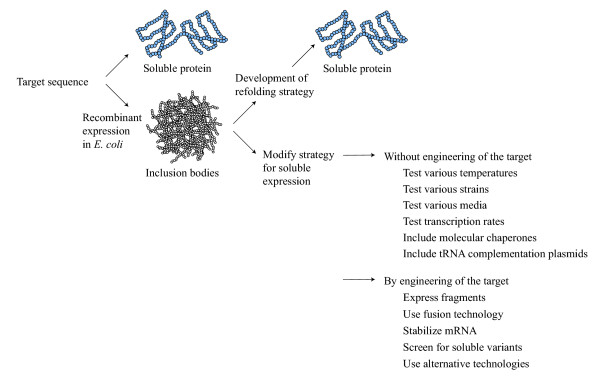
Pure, soluble and functional proteins are of high demand in modern biotechnology. Natural protein sources rarely meet the requirements for quantity, ease of isolation or price and hence recombinant technology is often the method of choice. Recombinant cell factories are constantly employed for the production of protein preparations bound for downstream purification and processing. Eschericia coli is a frequently used host, since it facilitates protein expression by its relative simplicity, its inexpensive and fast high density cultivation, the well known genetics and the large number of compatible molecular tools available. In spite of all these qualities, expression of recombinant proteins with E. coli as the host often results in insoluble and/or nonfunctional proteins. Here we review new approaches to overcome these obstacles by strategies that focus on either controlled expression of target protein in an unmodified form or by applying modifications using expressivity and solubility tags.
Overview
The claims and statistics of this paper haven’t been checked yet.
Run the check — free, no account needed. It reads the open-access text and checks the sources it cites.
Integrity signals
Registry
Cites
Statistics
Figures
Verification
Claims the paper makes
The claims and statistics of this paper haven’t been checked yet.
Run the check — free, no account needed. It reads the open-access text and checks the sources it cites.
Claims other papers make about this one
Each is checked against this paper’s own text: does it say what the citing paper says it does?
In the citing paper
“Several reports have reviewed cyanobacterial species capable of producing H2 (Abed et al. 2009; Das and Veziroglu 2001; Dutta et al. 2005) including at least 14 genera cultivated under different growth conditions.”
From Renewable energy from Cyanobacteria: energy production optimization by metabolic pathway engineering (2011) · cites this paper as Dutta et al. 2005
In the citing paper
“Among these genera it was shown that Anabaena spp. were able to produce the highest amount of H2 (68 μmol mg−1 chl a h−1).”
From Renewable energy from Cyanobacteria: energy production optimization by metabolic pathway engineering (2011) · cites this paper as Dutta et al. 2005
Self-check
Percentages, sums and reported differences re-computed from the paper’s own numbers.
The self-check needs the paper’s full text.
Citations
Cites
Principles that Govern the Folding of Protein Chains
Anfinsen, C. B. (1973) · Science · doi:10.1126/science.181.4096.223 · Cited by 7,096
Molecular Chaperones in the Cytosol: from Nascent Chain to Folded Protein
Hartl, F. U., & Hayer-Hartl, M. K. (2002) · Science · doi:10.1126/science.1068408 · Cited by 3,335
Miroux, B., & Walker, J. E. (1996) · Journal of Molecular Biology · doi:10.1006/jmbi.1996.0399 · Cited by 1,964
Strategies for achieving high-level expression of genes in Escherichia coli
Makrides, S. C. (1996) · Microbiological Reviews · doi:10.1128/mr.60.3.512-538.1996 · Cited by 1,287
Advanced genetic strategies for recombinant protein expression in Escherichia coli
Sørensen, H. P., & Mortensen, K. K. (2004) · Journal of Biotechnology · doi:10.1016/j.jbiotec.2004.08.004 · Cited by 994
Self-citationKapust, R. B., & Waugh, D. S. (1999) · Protein Science · doi:10.1110/ps.8.8.1668 · Cited by 960
Rapid protein-folding assay using green fluorescent protein
Waldo, G. S., Standish, B. M., Berendzen, J., & Terwilliger, T. C. (1999) · Nature Biotechnology · doi:10.1038/10904 · Cited by 906
Efficient folding of proteins with multiple disulfide bonds in the Escherichia coli cytoplasm
Bessette, P. H., Åslund, F., Beckwith, J., & Georgiou, G. (1999) · Proceedings of the National Academy of Sciences · doi:10.1073/pnas.96.24.13703 · Cited by 636
Stewart, E. J., Åslund, F., & Beckwith, J. (1998) · The EMBO Journal · doi:10.1093/emboj/17.19.5543 · Cited by 445
Kiefhaber, T., Rudolph, R., Kohler, H., & Büchner, J. (1991) · Nature Biotechnology · doi:10.1038/nbt0991-825 · Cited by 442
Research works printed but not linked: 1
- Held D, Yaeger K, Novy R: New coexpression vectors for expanded compatibilities in E. coli. InNovations. 2003, 18: 4-6.
Cited by
Sorted by citations
Items 801–841 of 841
Breslauer, D. N. (2025) · Elsevier eBooks · doi:10.1016/b978-0-443-24738-5.00029-x
Heterologous Expression of Recombinant L-asparaginase Genes
Pokrovskaya, M. V., Alexandrova, S. S., Pokrovsky, V. S., Dobryakova, N. V., Shishparenok, A. N., Gladilina, Y. V., & Zhdanov, D. D. (2025) · Biomedical Chemistry Research and Methods · doi:10.18097/bmcrm00265
Marques, S. E. L. (2012) · Portuguese National Funding Agency for Science, Research and Technology (RCAAP Project by FCT)
Mahlanza, M. C. (2011) · Boloka Institutional Repository (North-west University)
Kim, Y., Kim, D., Hieu, N.-M., Byun, H., & Ahn, J. H. (2024) · Figshare · doi:10.6084/m9.figshare.26709230
Yue, Y., Chen, K., Sun, C., Ahmed, S., & Ojha, S. C. (2024) · Figshare · doi:10.6084/m9.figshare.26632540
Kim, Y., Kim, D., Hieu, N.-M., Byun, H., & Ahn, J. H. (2024) · Figshare · doi:10.6084/m9.figshare.26709236
Kim, Y., Kim, D., Hieu, N.-M., Byun, H., & Ahn, J. H. (2024) · Figshare · doi:10.6084/m9.figshare.26709221
Yue, Y., Chen, K., Sun, C., Ahmed, S., & Ojha, S. C. (2024) · Figshare · doi:10.6084/m9.figshare.26632543
Kim, Y., Kim, D., Hieu, N.-M., Byun, H., & Ahn, J. H. (2024) · Figshare · doi:10.6084/m9.figshare.26709227
Yue, Y., Chen, K., Sun, C., Ahmed, S., & Ojha, S. C. (2024) · Figshare · doi:10.6084/m9.figshare.26632546
Kim, Y., Kim, D., Hieu, N.-M., Byun, H., & Ahn, J. H. (2024) · Figshare · doi:10.6084/m9.figshare.26709233
Köppl, C., Buchinger, W., Striedner, G., & Cserjan‐Puschmann, M. (2024) · Figshare · doi:10.6084/m9.figshare.25449039
Kim, Y., Kim, D., Hieu, N.-M., Byun, H., & Ahn, J. H. (2024) · Figshare · doi:10.6084/m9.figshare.26709224
Kawamura, M., Kuba, F., Sakaguchi, A., Oishi, K., Sugiyama, T., Ujiie, W., Murayama, S., Fujisawa, Y., Kikuchi, S., Tanaka, Y., et al. (2026) · Journal of Bioscience and Bioengineering · doi:10.1016/j.jbiosc.2026.01.004
Soluble Expression of Recombinant Human Mitsugumin 53 in Escherichia coli NiCo21(DE3)
Dewi, K. S., Tasia, W., Agustiyanti, D. F., Hariyatun, H., Wisnuwardhani, P. H., Rubiyana, Y., Arifa, N., Purba, H. H., Forentin, . M., Utami, R. A., et al. (2026) · The Protein Journal · doi:10.1007/s10930-026-10319-7
Biosynthesis of new alpha-bisabolol derivatives through a synthetic biology approach
Sarrade-Loucheur, A. (2020) · theses.fr (ABES) · doi:10.70675/c9915f32zcbd5z4eebz84f3zf3ff5e0ffec3
Julien, L. A. (2020) · theses.fr (ABES) · doi:10.70675/87fe6365z7ce8z43f8zbecbzf1b4ca746558
Tounkara, M. (2021) · doi:10.70675/9778ebebz92a1z4695z9601z7f7126543459
Che, Z., Wei, S., Sun, R., & Guo, C. (2026) · Protein Expression and Purification · doi:10.1016/j.pep.2026.106929
Shim, W., Cho, S., Lee, Y. S., Lee, H., Na, J., & Lee, J. (2026) · World Journal of Microbiology and Biotechnology · doi:10.1007/s11274-026-05028-3
“Molecular chaperones are well known to facilitate correct protein folding, suppress inclusion body formation, and enhance soluble expression (Sørensen and Mortensen 2005; Piao DaChuan et al. 2016; Baneyx and Mujacic 2004; Estabragh et al. 2022).”
Noori, A., Amini-Bayat, Z., Mirdamadi, S., Azizmohseni, F., Arab, S. S., & Javadi, M. M. (2025) · Iranian Biomedical Journal · doi:10.66224/ibj.5200
Sharnagat, P., & Bafana, A. (2026) · Journal of Hazardous Materials · doi:10.1016/j.jhazmat.2026.142718
Noureddine, M., Jones, B. A. I., Oliobi, O. C. M., Beckingham, R., Ehler, E., Mikolajek, H., Cowieson, N. P., Robinson, P., Redwood, C. S., Slater, A., et al. (2026) · Journal of Molecular and Cellular Cardiology · doi:10.1016/j.yjmcc.2026.06.009
“Additional biophysical analysis revealed that the mutant protein is significantly less soluble, suggesting that functional alterations likely drive its accumulation in the insoluble, inclusion body-rich fraction during E. coli expression [51].”
Siavashi, S., kojouri, P. S., Aboutalebi, F., & Dormiani, K. (2026) · World Journal of Microbiology and Biotechnology · doi:10.1007/s11274-026-05076-9
“Therefore, it is strongly recommended that the production conditions are optimized towards the high rate of protein expression in the soluble form (Baneyx and Mujacic 2004 ; Sørensen and Mortensen 2005 ).”
Andrade, J. M., Mambelli, F., Gomes, D. S., de Souza, M. F., Fahel, J. S., Sanches, R. C. O., Marinho, F. V., Salazar, N., Gomes, I. P., Martins, V. T., et al. (2026) · PLoS neglected tropical diseases · doi:10.1371/journal.pntd.0014617
Ferro-Gallego, P., & Domínguez‐Gerpe, L. (2026) · Applied Microbiology and Biotechnology · doi:10.1007/s00253-026-13968-x
“Together, these advances have facilitated the development of increasingly sophisticated expression systems that combine cloning flexibility, affinity-based purification, and controlled post-expression processing of recombinant proteins (Sørensen and Mortensen 2005; Smolke 2009).”
A biosensor toolbox for monitoring recombinant protein production in Escherichia coli
Mürköster, M., Bałka, M., Kamp, C. J., Källström, J., Karlsson, L., Aparicio, C. A. R., Tunäng, E., Ögren, H.-L., Theopold, S., Cumming, A. J., et al. (2026) · Frontiers in Bioengineering and Biotechnology · doi:10.3389/fbioe.2026.1956994
“For example, fusion proteins that increase solubility (Zutz et al., 2021; Sørensen and Mortensen, 2005) or that monitor protein folding (Waldo et al., 1999; Mansell et al., 2010), plasmids that overexpress chaperones and proteases (De Marco et al., 2007; de Marco, 2009; De Marco and De Marco, 2004;…”
Haroon, A., Rehman, H. M., Rehman, H. M., Akram, M., Arshad, L., Ahmad, S., Sheikh, M., Aslam, S., & Bashir, H. (2026) · Biotechnology Letters · doi:10.1007/s10529-026-03798-2
“Soluble protein production makes it easier to isolate recombinant proteins from the E. coli cytoplasmic fraction, resulting in higher yields while requiring only solubilization and refolding (Sørensen & Mortensen 2005).”
Urbaczek, A. C. (2012) · Americanae (AECID Library)
Expressão e purificação da proteína E3 do vírus chikungunya (CHIKV)
Pinto, T. P. C. (2013) · Portuguese National Funding Agency for Science, Research and Technology (RCAAP Project by FCT)
Biochemical Characterizations of Enzymes from Oil Reservoir Metagenomes
Hesthammer, R. K. (2014) · BIBSYS Brage (BIBSYS (Norway))
Optimizing the Production Parameters of Engineered Protein-Based MRI Contrast Agents
Auguste, R. (2022) · Digital Archive @ GSU · doi:10.57709/5555032
Biologia Estrutural: Expressão e Caracterização Estrutural da Proteína 25K do Cole latent virus
Garcia, G. E., & Luana, L. (2012) · Aleph UCLA Undergraduate Research Journal for the Humanities and Social Sciences
Expressão, purificação e caracterização estrutural de proteínas codificadas por dois fitovírus
Regatieri, L. J. (2014) · Americanae (AECID Library)
Process development for the control of solubility of Affibody® molecules
Dolfe, L. (2011) · Uppsala University Publications (Uppsala University)
(2018) · Europe PMC (PubMed Central) · Cited by 11
Metadata
- Authors
- Sørensen, H. P., & Mortensen, K. K.
- Affiliations
- Aarhus University (DK)
- Corresponding author
- Mortensen, Kim Kusk
- Venue
- Microbial Cell Factories
- Published
- 2005-01-04
- Volume
- 4
- Issue
- 1
- Pages
- 1-1
- ISSN
- 1475-2859 (ISSN-L)
- PMC
- PMC544838
- OpenAlex
- W1931534490
- Cited by
- 841
- References
- 83
- Citations by year
- 2026: 20 · 2025: 20 · 2024: 35 · 2023: 30 · 2022: 37 · 2021: 50 · 2020: 45 · 2019: 49 · 2018: 49 · 2017: 44 · 2016: 41 · 2015: 43 · 2014: 63 · 2013: 52 · 2012: 53
- FWCI
- 11.96
- Type
- journal article
- Language
- en
- Open access
- gold
- doi.org
- Locations
- Microbial Cell Factories (publishedVersion, cc-by)
- PubMed Central (publishedVersion)
- PubMed (publishedVersion)
- DOAJ (DOAJ: Directory of Open Access Journals) (submittedVersion)
- Research at the University of Copenhagen (University of Copenhagen) (submittedVersion)
- Topics
- Life Sciences › Biochemistry, Genetics and Molecular Biology › Molecular Biology › Protein purification and stability
- Life Sciences › Biochemistry, Genetics and Molecular Biology › Genetics › Bacterial Genetics and Biotechnology
- Life Sciences › Biochemistry, Genetics and Molecular Biology › Molecular Biology › Fungal and yeast genetics research
- Keywords
- recombinant protein expression, soluble protein production, Escherichia coli, cytoplasmic expression, protein solubility, protein purification
About these checks
Registry, retraction, Cites and statistics results are computed, not judged, with one exception: a printed reference that no index lists is read once by a model before it counts as a citation error. Claims are extracted by a model and kept only when their quote appears verbatim in the text; each cited source is then checked, with a model’s help, for whether it says what the claim relies on. Those verdicts can be wrong — read the claim’s quote and the cited source before relying on one.
Statistics and arithmetic are recomputed, not judged.
Confidence bands are shown only for fields calibrated on our annotated test set. None is calibrated yet, so no band is shown.
What counts as a claim ›How we measure confidence ›How we check this ›
Are you an author, or do you see a problem with this page? Request a review
