

The DOI matches its Crossref record; 81 of the 83 references it cites were found in a registry or an index.
Soluble expression of recombinant proteins in the cytoplasm of Escherichia coli
Open accessAbstract
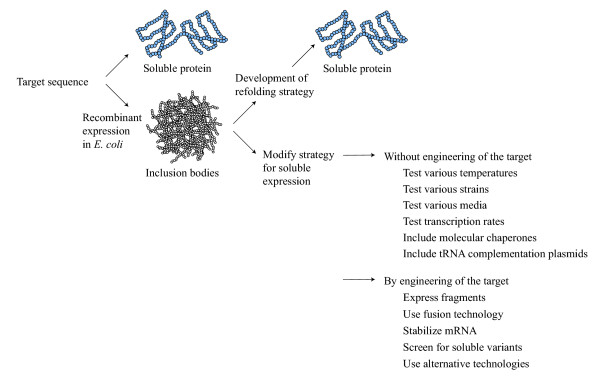
Pure, soluble and functional proteins are of high demand in modern biotechnology. Natural protein sources rarely meet the requirements for quantity, ease of isolation or price and hence recombinant technology is often the method of choice. Recombinant cell factories are constantly employed for the production of protein preparations bound for downstream purification and processing. Eschericia coli is a frequently used host, since it facilitates protein expression by its relative simplicity, its inexpensive and fast high density cultivation, the well known genetics and the large number of compatible molecular tools available. In spite of all these qualities, expression of recombinant proteins with E. coli as the host often results in insoluble and/or nonfunctional proteins. Here we review new approaches to overcome these obstacles by strategies that focus on either controlled expression of target protein in an unmodified form or by applying modifications using expressivity and solubility tags.
Overview
The claims and statistics of this paper haven’t been checked yet.
Run the check — free, no account needed. It reads the open-access text and checks the sources it cites.
Integrity signals
Registry
Cites
Statistics
Figures
Verification
Claims the paper makes
The claims and statistics of this paper haven’t been checked yet.
Run the check — free, no account needed. It reads the open-access text and checks the sources it cites.
Claims other papers make about this one
Each is checked against this paper’s own text: does it say what the citing paper says it does?
In the citing paper
“Several reports have reviewed cyanobacterial species capable of producing H2 (Abed et al. 2009; Das and Veziroglu 2001; Dutta et al. 2005) including at least 14 genera cultivated under different growth conditions.”
From Renewable energy from Cyanobacteria: energy production optimization by metabolic pathway engineering (2011) · cites this paper as Dutta et al. 2005
In the citing paper
“Among these genera it was shown that Anabaena spp. were able to produce the highest amount of H2 (68 μmol mg−1 chl a h−1).”
From Renewable energy from Cyanobacteria: energy production optimization by metabolic pathway engineering (2011) · cites this paper as Dutta et al. 2005
Self-check
Percentages, sums and reported differences re-computed from the paper’s own numbers.
The self-check needs the paper’s full text.
Citations
Cites
Principles that Govern the Folding of Protein Chains
Anfinsen, C. B. (1973) · Science · doi:10.1126/science.181.4096.223 · Cited by 7,096
Molecular Chaperones in the Cytosol: from Nascent Chain to Folded Protein
Hartl, F. U., & Hayer-Hartl, M. K. (2002) · Science · doi:10.1126/science.1068408 · Cited by 3,335
Miroux, B., & Walker, J. E. (1996) · Journal of Molecular Biology · doi:10.1006/jmbi.1996.0399 · Cited by 1,964
Strategies for achieving high-level expression of genes in Escherichia coli
Makrides, S. C. (1996) · Microbiological Reviews · doi:10.1128/mr.60.3.512-538.1996 · Cited by 1,287
Advanced genetic strategies for recombinant protein expression in Escherichia coli
Sørensen, H. P., & Mortensen, K. K. (2004) · Journal of Biotechnology · doi:10.1016/j.jbiotec.2004.08.004 · Cited by 994
Self-citationKapust, R. B., & Waugh, D. S. (1999) · Protein Science · doi:10.1110/ps.8.8.1668 · Cited by 960
Rapid protein-folding assay using green fluorescent protein
Waldo, G. S., Standish, B. M., Berendzen, J., & Terwilliger, T. C. (1999) · Nature Biotechnology · doi:10.1038/10904 · Cited by 906
Efficient folding of proteins with multiple disulfide bonds in the Escherichia coli cytoplasm
Bessette, P. H., Åslund, F., Beckwith, J., & Georgiou, G. (1999) · Proceedings of the National Academy of Sciences · doi:10.1073/pnas.96.24.13703 · Cited by 636
Stewart, E. J., Åslund, F., & Beckwith, J. (1998) · The EMBO Journal · doi:10.1093/emboj/17.19.5543 · Cited by 445
Kiefhaber, T., Rudolph, R., Kohler, H., & Büchner, J. (1991) · Nature Biotechnology · doi:10.1038/nbt0991-825 · Cited by 442
Research works printed but not linked: 1
- Held D, Yaeger K, Novy R: New coexpression vectors for expanded compatibilities in E. coli. InNovations. 2003, 18: 4-6.
Cited by
Sorted by citations
Items 501–600 of 841
Singh, R. K., Jaiswal, L. K., Nayak, T., Rawat, R. S., Kumar, S., Nand, S., & Gupta, A. (2022) · Disease Markers · doi:10.1155/2022/7475704 · Cited by 7
“The IPTG induction of recombinant proteins like human RNase L, human growth hormone (hGH), and several other proteins at lower temperatures in bacteria favors relatively higher yield of the expressed protein in the soluble fraction of the cell [41 – 47].”
Khodak, Y. A., Ryazanova, A. Y., Vorobiev, I. I., Kovalchuk, A. L., Ovechko, N. N., & Aparin, P. G. (2023) · BioTech · doi:10.3390/biotech12010009 · Cited by 7
Adeleke, R. A. (2014) · Journal of Industrial Microbiology & Biotechnology · doi:10.1007/s10295-014-1514-4 · Cited by 7
Heterologous production of l -lysine ε-oxidase by directed evolution using a fusion reporter method
Matsui, D., & Asano, Y. (2015) · Bioscience Biotechnology and Biochemistry · doi:10.1080/09168451.2015.1034654 · Cited by 7
Functional Siglec lectin domains from soluble expression in the cytoplasm of Escherichia coli
Pröpster, J. M., Yang, F., Ernst, B., Allain, F. H. ‐., & Schubert, M. (2015) · Protein Expression and Purification · doi:10.1016/j.pep.2015.01.005 · Cited by 7
Song, W. C., Sung, H.-J., Park, K. S., Choi, J., Cho, J., & Um, S. H. (2013) · Protein Expression and Purification · doi:10.1016/j.pep.2013.08.004 · Cited by 7
Jiang, L., & Sha, Y. (2014) · Chinese Journal of Oceanology and Limnology · doi:10.1007/s00343-015-4072-3 · Cited by 7
Hanif, M. U., Yaseen, A., Gul, R., Mirza, M. U., Nawaz, M. H., Ahmed, S. S., Aziz, S., Chaudhary, S., Khan, A. A., & Shoaib, M. (2018) · Applied Biochemistry and Biotechnology · doi:10.1007/s12010-018-2736-0 · Cited by 7
Babcock, T., Borden, J. H., Gries, R. M., Carroll, C. S., Moore, M. M., & Gries, G. (2018) · Environmental Entomology · doi:10.1093/ee/nvy139 · Cited by 7
Bui, L. M., Geraldi, A., Nguyen, T. T., Lee, J. H., Lee, J. Y., Cho, B., & Kim, S. C. (2019) · International Journal of Molecular Sciences · doi:10.3390/ijms20133163 · Cited by 7
Damough, S., Sabzalinezhad, M., Talebkhan, Y., Nematollahi, L., Bayat, E., Torkashvand, F., Adeli, A., Jahandar, H., Barkhordari, F., & Mahboudi, F. (2020) · Protein Expression and Purification · doi:10.1016/j.pep.2020.105805 · Cited by 7
Razali, R., Fahrudin, F. A., Subbiah, V. K., Takano, K., & Budiman, C. (2022) · Molecules · doi:10.3390/molecules27186031 · Cited by 7
Improvement of Heterologous Protein Secretion by Bacillus subtilis
Kakeshita, H., Kageyama, Y., Ozaki, K., Nakamura, K., & Ar, K. (2012) · InTech eBooks · doi:10.5772/29256 · Cited by 6
“In fact, many studies have been performed regarding methods to overcome the problem of inclusion bodies and to improve protein solubility for the expression of heterologous proteins (Kapust & Waugh, 1999; Baneyx & Mujacic, 2004; Sørensen & Mortensen, 2005; Rabhi-Essafi et al., 2007).”
Bioreactors for Azo-Dye Conversion
Olivieri, G., Donato, A. D., Marzocchella, A., & Salatino, P. (2010) · The handbook of environmental chemistry · doi:10.1007/698_2009_52 · Cited by 7
Pereira, L. M., Silva, L. R., Alves, J. F., Marín, N., Silva, F. S., Morganti, L., da Silva, I. D. C. G., & Affonso, R. (2014) · Protein Expression and Purification · doi:10.1016/j.pep.2014.06.003 · Cited by 7
Recombinant expression and refolding of the c-type lysozyme from Spodoptera litura in E. coli
Yoe, S. M., Kim, J., Yoe, J., & Lee, G. H. (2011) · Electronic Journal of Biotechnology · doi:10.2225/vol14-issue3-fulltext-6 · Cited by 7
“E. coli expression system is often more desirable than the eukaryotic expression system due to its low cost, its short generation time, the wellknown genetics, and the large number of compatible tools available for biotechnology (Sørensen and Mortensen, 2005).”
Biological Dual-Use Research and Synthetic Biology of Yeast
Cirigliano, A., Cenciarelli, O., Malizia, A., Bellecci, C., Gaudio, P. D., Lioj, M., & Rinaldi, T. (2016) · Science and Engineering Ethics · doi:10.1007/s11948-016-9774-1 · Cited by 7
Dahlroth, S., Lieu, V., Haas, J., & Nordlund, P. (2009) · Protein Expression and Purification · doi:10.1016/j.pep.2009.07.010 · Cited by 7
Combinatorial Domain Hunting: solving problems in protein expression
Littler, E. (2010) · Drug Discovery Today · doi:10.1016/j.drudis.2010.03.010 · Cited by 7
Application of Lactic Acid Bacteria for Food Biotechnology
Li, L., & Han, N. S. (2018) · doi:10.1002/9783527803293.ch22 · Cited by 7
Viana, D. A., Santos, D. L., Conceicao, M., Ferreir, L. C., Neto, B. D. B., Filho, J. L. L., Moreira, K. A., Converti, A., & Lucía, A. (2008) · Biotechnology(Faisalabad) · doi:10.3923/biotech.2009.62.69 · Cited by 6
Ebrahimi, V., & Hashemi, A. (2024) · Folia Microbiologica · doi:10.1007/s12223-024-01163-2 · Cited by 6
Muhle, M. E., Löchelt, M., & Denner, J. (2011) · Protein Expression and Purification · doi:10.1016/j.pep.2011.09.006 · Cited by 6
Immunolabeling of Nuclei/Chromosomes in Arabidopsis thaliana
Sandmann, M., Fuchs, J., & Lermontová, I. (2015) · Methods in molecular biology · doi:10.1007/978-1-4939-3142-2_10 · Cited by 6
Cytoplasmic Chaperones Enhance Soluble Expression of Anti-EGFR huscFv in Escherichia coli.
Nazari, A., Farajnia, S., Zahri, S., Bagherlou, N., Tanoumand, A., & Rahbarnia, L. (2020) · Europe PMC (PubMed Central) · doi:10.30498/ijb.2020.138200.2314 · Cited by 6
Metabolic Engineering of Lactic Acid Bacteria for Antimicrobial Peptides Production
Kumar, P., Singh, S., Sankhyan, S., & Ray, S. (2024) · Springer eBooks · doi:10.1007/978-981-97-3413-9_3 · Cited by 6
Systems biology and biological systems diversity for the engineering of microbial cell factories
Ferrer, P. (2007) · Microbial Cell Factories · doi:10.1186/1475-2859-6-35 · Cited by 6
“Microbial Cell Factories has published several review and research articles on this field over the past recent years [2-8].”
Kim, Y. S., & Chi, H. J. (2006) · Enzyme and Microbial Technology · doi:10.1016/j.enzmictec.2005.11.040 · Cited by 6
Constructing Chimeric Antigen for Precise Screening of HTLV-I Infection.
Heydari‐Zarnagh, H., Hassanpour, K., & Rasaee, M. J. (2015) · PubMed · Cited by 6
Castiñeiras, T. S., Williams, S. G., Hitchcock, A., Cole, J. A., Smith, D. C., & Overton, T. W. (2018) · Microbiology · doi:10.1099/mic.0.000622 · Cited by 6
Kawai, S., Kawamoto, J., Ogawa, T., & Kurihara, T. (2019) · Bioscience Biotechnology and Biochemistry · doi:10.1080/09168451.2019.1638754 · Cited by 6
Kaushik, V., Prasad, S., & Goel, M. (2019) · International Journal of Biological Macromolecules · doi:10.1016/j.ijbiomac.2019.07.149 · Cited by 6
Saavedra-Langer, R., Costa, T. G. F., Lima, S. A., Costal-Oliveira, F., Martins, C. A., Machado‐de‐Ávila, R. A., Minozzo, J. C., Thomaz‐Soccol, V., Guerra-Duarte, C., Kalapothakis, E., et al. (2021) · International Journal of Biological Macromolecules · doi:10.1016/j.ijbiomac.2021.07.042 · Cited by 6
Recombinant Protein Production and Purification of Insoluble Proteins
Ferrer‐Miralles, N., Saccardo, P., Corchero, J. L., & García‐Fruitós, E. (2022) · Methods in molecular biology · doi:10.1007/978-1-0716-1859-2_1 · Cited by 7
Tang, X., Yang, M., Liu, J., Zheng, L., Xu, D., Chi, C., Lv, Z., & Liu, H. (2022) · Fish & Shellfish Immunology · doi:10.1016/j.fsi.2022.04.027 · Cited by 6
Immunolabeling of Nuclei/Chromosomes in Arabidopsis thaliana
Ahmadli, U., Sandmann, M., Fuchs, J., & Lermontová, I. (2021) · Methods in molecular biology · doi:10.1007/978-1-0716-1744-1_2 · Cited by 6
Glutaryl-CoA Dehydrogenase Misfolding in Glutaric Acidemia Type 1
Barroso, M., Gertzen, M., Puchwein-Schwepcke, A., Preisler, H., Sturm, A., Reiß, D. D., Danecka, M. K., Muntau, A. C., & Gersting, S. W. (2023) · International Journal of Molecular Sciences · doi:10.3390/ijms241713158 · Cited by 6
Vinod, R., Farrukh, S. Y., Rehmat, S., Hanif, M. U., Ahmed, S. S., Musharraf, S. G., Durrani, F. G., Saleem, M., & Gul, R. (2018) · Molecular Biotechnology · doi:10.1007/s12033-018-0094-3 · Cited by 6
Expression of the functional carbohydrate-binding module (CBM) of human laforin
Moreira, S. M. G., Castanheira, P., Casal, M., Faro, C., & Gama, M. (2010) · Protein Expression and Purification · doi:10.1016/j.pep.2010.06.019 · Cited by 6
Studying the expression of a lipase from Pyrococcus furiosus using response surfaces
Moura, M. V. H., Dobler, L., Gutarra, M. L. E., & Almeida, R. V. (2012) · Protein Expression and Purification · doi:10.1016/j.pep.2012.11.008 · Cited by 6
Zeng, J., Zhang, Y., Liu, Y., Zhang, X., Xia, L., Liu, J., & Qiu, G. (2007) · Biotechnology Letters · doi:10.1007/s10529-007-9491-6 · Cited by 6
Identification of proteins involved in starch and polygalacturonic acid degradation using LC/MS
Petkauskaite, R., Lukosius, D., Dȩbski, J., Jasilionis, A., Dadlez, M., Kieraite, I., Timonina, A., & Kuisienė, N. (2014) · Open Life Sciences · doi:10.2478/s11535-014-0303-4 · Cited by 6
Fould, B., Lamamy, V., Guenin, S., Ouvry, C., Cogé, F., Boutin, J. A., & Ferry, G. (2012) · Protein Science · doi:10.1002/pro.2119 · Cited by 6
Cloning and overexpression of lysozyme fromSpodoptera liturain prokaryotic system
Kim, J., Park, S., Yoe, J., & Yoe, S. M. (2011) · Animal Cells and Systems · doi:10.1080/19768354.2011.555127 · Cited by 6
Peternel, Š., & Liović, M. (2010) · Recent Patents on Biomedical Engineering · doi:10.2174/1874764711003030153 · Cited by 6
Biomedical Applications of Bacterial Inclusion Bodies
Ratera, I., Peternel, Š., Seras‐Franzoso, J., Cano‐Garrido, O., García‐Fruitós, E., Cubarsí, R., Vázquez, E., Corchero, J. L., Rodríguez‐Carmona, E., Veciana, J., et al. (2014) · doi:10.1002/9781118845363.ch8 · Cited by 6
Wan, D., Hu, B., Zhou, J., Li, J., Chen, J., Du, G., & Zhao, X. (2026) · Food Bioscience · doi:10.1016/j.fbio.2026.108730 · Cited by 5
Perspectives for Photochemical Leaching Processes of Chalcopyrite: A Solar Radical-Leaching Process
Yepsen, O., Cornejo‐Ponce, L., & Yepsen, R. (2024) · Mining · doi:10.3390/mining4020020 · Cited by 5
Kumar, S., & Sharma, R. K. (2014) · Molecular and Cellular Biochemistry · doi:10.1007/s11010-014-2029-z · Cited by 5
Rezaei, S., Takalloo, Z., Rezaei, Z. S., Babaeipour, V., Talebi, A. F., & Sajedi, R. H. (2020) · Process Biochemistry · doi:10.1016/j.procbio.2020.06.009 · Cited by 5
Duman‐Özdamar, Z. E., Ünlü, A., Ünal, H., Woodley, J. M., & Bi̇nay, B. (2020) · Protein Expression and Purification · doi:10.1016/j.pep.2020.105753 · Cited by 5
Ezzemani, W., Ouladlahsen, A., Altawalah, H., Saı̈le, R., Sarih, M., Kettani, A., & Ezzikouri, S. (2023) · Journal of Biomolecular Structure and Dynamics · doi:10.1080/07391102.2023.2226733 · Cited by 5
“Subsequently, Escherichia coli is the most desirable for expression of our vaccine, as it facilitates protein expression due to its relative simplicity, low cost, and rapid culture at high density (Rosano & Ceccarelli, 2014; Sørensen & Mortensen, 2005).”
Mani, S., Arab, B., Akbari, V., & Chou, C.-H. P. (2024) · AMB Express · doi:10.1186/s13568-024-01765-6 · Cited by 5
Silaban, S., Maksum, I. P., GHAFFAR, S., Hasan, K., Enus, S., Subroto, T., & Soemitro, S. (2014) · Microbiology Indonesia · doi:10.5454/mi.8.4.5 · Cited by 5
“So, Thrombin can be potentially applied in replacing suture technic (Spotnitz and Prabhu 2005).”
Ashayeripanah, M., Eftekhar, F., Kazemi, B., & Joseph, J. (2017) · PubMed Central · Cited by 5
Enhancing the synthesis of latex clearing protein by different cultivation strategies
Andler, R., Heger, F., Andreeßen, C., & Steinbüchel, A. (2019) · Journal of Biotechnology · doi:10.1016/j.jbiotec.2019.03.019 · Cited by 5
Samykannu, G., Vijayababu, P., Antonyraj, C. B., & Narayanan, S. (2019) · Biochemistry and Biophysics Reports · doi:10.1016/j.bbrep.2019.100693 · Cited by 5
Enhanced Solubility and One-Step Purification of Functional Dimeric Carboxypeptidase G2
Khodakarami, A., Dabirmanesh, B., Asad, S., & Khaledi, M. (2021) · Biochemistry (Moscow) · doi:10.1134/s0006297921020073 · Cited by 5
Bockwoldt, J. A., & Ehrmann, M. A. (2022) · Antonie van Leeuwenhoek · doi:10.1007/s10482-022-01751-7 · Cited by 5
A Combinatorial Method to Enable Detailed Investigation of Protein–Protein Interactions
Maclagan, K., Tommasi, R., Laurine, E., Prodromou, C., Driscoll, P. C., Pearl, L. H., Reich, S., & Savva, R. (2011) · Future Medicinal Chemistry · doi:10.4155/fmc.10.289 · Cited by 5
Sethia, P. P., Rao, K. K., & Noronha, S. B. (2014) · Biotechnology and Bioprocess Engineering · doi:10.1007/s12257-013-0722-5 · Cited by 5
Miura, V. C., Aoki, S. M., Peitl, P., Pires, L. C., Dalmagro, P., Nakamura, A. A., & Meireles, M. V. (2017) · Revista Brasileira de Parasitologia Veterinária/Brazilian Journal of Veterinary Parasitology · doi:10.1590/s1984-29612017032 · Cited by 5
Tri-cistronic cloning, overexpression and purification of human Rad9, Rad1, Hus1 protein complex
Singh, V. K., Nurmohamed, S., Davey, S. K., & Jia, Z. (2007) · Protein Expression and Purification · doi:10.1016/j.pep.2007.03.011 · Cited by 5
Jung, K., Lee, Y.-J., Yeon, J.-H., Yoo, S. K., & Chung, B.-C. (2009) · Biotechnology and Bioprocess Engineering · doi:10.1007/s12257-008-0270-6 · Cited by 5
Hosts and Heterologous Expression Strategies of Recombinant Toxins for Therapeutic Purposes
Leandro, L. D., Colasante, M., Pitari, G., & Ippoliti, R. (2023) · Toxins · doi:10.3390/toxins15120699 · Cited by 4
Expression and functional characterization of an anti-CD22 scFv targeting B-cell malignancies
Gholizadeh, M., Abdoli, S., Mansoori, S., Arashkia, A., Riazi‐Rad, F., Hamidieh, A. A., Nouri, M., & Sharifzadeh, Z. (2025) · Research in Pharmaceutical Sciences · doi:10.4103/rps.rps_248_24 · Cited by 4
“Lowering the temperature mitigates the activation of heat shock proteases triggered by overexpression, thereby reducing the aggregation of both folded and misfolded proteins (41,53).”
Zhang, J., Lu, J., & Su, E. (2019) · Journal of Chemical Technology & Biotechnology · doi:10.1002/jctb.6075 · Cited by 4
Yamaguchi, R., Akter, S., Kanehama, A., Iwamoto, T., Hasegawa, M., Ito, A., Nishimukai, M., Yamada, M., & Kashiwagi, A. (2023) · Letters in Applied Microbiology · doi:10.1093/lambio/ovad049 · Cited by 4
Feng, Y., Shao, S., Zhou, X., Wei, W., Liu, X., Tang, Y., Hua, Y., Zheng, J., Zhang, Y., & Ying, X. (2023) · Microorganisms · doi:10.3390/microorganisms11071689 · Cited by 4
A Protocol for Phage Display and Affinity Selection Using Recombinant Protein Baits
Kushwaha, R., Schäfermeyer, K. R., & Downie, A. B. (2014) · Journal of Visualized Experiments · doi:10.3791/50685 · Cited by 4
Lee, J., Velmurugan, N., & Jeong, K. J. (2013) · Journal of Bioscience and Bioengineering · doi:10.1016/j.jbiosc.2013.04.023 · Cited by 4
Wang, K., Zhou, F., Zhu, L., Zhu, X., Zhang, K., & Zhu, L. (2014) · Protein Expression and Purification · doi:10.1016/j.pep.2014.01.008 · Cited by 4
Guo, T., Su, J., Ma, Z., Ma, J.-X., Jin, M., Li, X. O., & Lei, Z. (2015) · Gene · doi:10.1016/j.gene.2015.03.038 · Cited by 4
Expression, purification and insights into structure and folding of the ADAM22 pro domain
Sørensen, H. P., Jacobsen, J., Nielbo, S., Poulsen, F. M., & Wewer, U. M. (2008) · Protein Expression and Purification · doi:10.1016/j.pep.2008.05.020 · Cited by 4
Self-citationKim, K., Chiba, Y., Arai, H., & Ishii, M. (2015) · Bioscience Biotechnology and Biochemistry · doi:10.1080/09168451.2015.1079476 · Cited by 4
Potential of DIVA Vaccines for Fish
Monaghan, S. J., Thompson, K. D., Smith, P. D., & Adams, A. (2016) · Birkhäuser advances in infectious diseases · doi:10.1007/978-3-0348-0980-1_7 · Cited by 4
de Paula, V. S., Silva, F. H. S., Francischetti, I. M. B., Monteiro, R. Q., & Valente, A. P. (2017) · Protein Expression and Purification · doi:10.1016/j.pep.2017.07.012 · Cited by 4
Methods of adaptability and stability applied to eucalyptus breeding
dos Santos, O. P., Carvalho, I. R., Nardino, M., Olivoto, T., de Pelegrin, A. J., Szareski, V. J., Ferrari, M., Nunes, A. C. P., Demari, G. H., Lautenchleger, F., et al. (2018) · Pesquisa Agropecuária Brasileira · doi:10.1590/s0100-204x2018000100006 · Cited by 4
Oh, S.-H., Cho, Y.-S. K., Lee, H.-B., Lee, S., Kim, W.-S., Liang, H., Cho, C.-S., Choi, Y.-J., & Kang, S. (2019) · Journal of Veterinary Science · doi:10.4142/jvs.2019.20.e70 · Cited by 4
Pekarsky, A., Reininger, M., & Oliver Spadiut, A. (2021) · Bioprocess and Biosystems Engineering · doi:10.1007/s00449-021-02514-w · Cited by 4
Su, Y., Zheng, Y., Wang, S., Zhang, S., Yu, R., & Zhang, C. (2022) · Protein Expression and Purification · doi:10.1016/j.pep.2022.106107 · Cited by 4
Kudhair, B. K., & Green, J. D. (2022) · Protein Expression and Purification · doi:10.1016/j.pep.2022.106197 · Cited by 4
Sekar, A., Shin, Y., Jeong, H.-C., & Kim, K. (2018) · Biochemical and Biophysical Research Communications · doi:10.1016/j.bbrc.2018.08.133 · Cited by 4
In vitro assembly of thermostable Csm complex in CRISPR–Cas type III/A system
Park, K., An, Y., & Woo, E. (2019) · Methods in enzymology on CD-ROM/Methods in enzymology · doi:10.1016/bs.mie.2018.10.025 · Cited by 4
Intein-Mediated Fusion Soluble Expression of Recombinant Human Interferon Beta (rhIFN-β)
Seidmoradei, R., Zeinoddini, M., Saeedinia, A. R., & Xhodadadi, N. (2020) · Iranian Journal of Science and Technology Transactions A Science · doi:10.1007/s40995-020-00844-0 · Cited by 4
Xu, J. C., Nakanishi, T., Kato, T., & Park, E. Y. (2022) · Bioscience Reports · doi:10.1042/bsr20220739 · Cited by 4
Li, M., Yang, Q. K., Gao, Y., & Wu, Q. (2007) · Biochemistry (Moscow) · doi:10.1134/s0006297907030091 · Cited by 4
Pulsed Dilution Method for the Recovery of Aggregated Mouse TNF-α.
Mahmoodi, M., Ghodsi, M., Moghadam, M., & Sankian, M. (2017) · PubMed Central · Cited by 4
Ha, J.-H., Eo, Y., Ahn, H., & Ryu, K. (2017) · Acta Crystallographica Section F Structural Biology Communications · doi:10.1107/s2053230x1700468x · Cited by 4
Kristensen, J. E., Petersen, H. U., Mortensen, K. K., & Sørensen, H. P. (2005) · International Journal of Biological Macromolecules · doi:10.1016/j.ijbiomac.2005.10.011 · Cited by 4
Self-citationAggregation of Recombinant Proteins
Lotti, M., & Pollegioni, L. (2014) · Wiley eBooks · doi:10.1002/9781118845363.ch9 · Cited by 4
Methodology for high-throughput production of soluble recombinant proteins in Escherichia coli
Markland, K. (2007) · KTH Publication Database DiVA (KTH Royal Institute of Technology) · Cited by 4
Expression and Assembly of Recombinant Surface Layer Proteins in Saccharomyces cerevisiae
Korkmaz, N., Ostermann, K., & Rödel, G. (2010) · Current Microbiology · doi:10.1007/s00284-010-9715-1 · Cited by 4
The scientific impact of microbial cell factories
Felice, M. D., Mattanovich, D., Papagianni, M., Węgrzyn, G., & Villaverde, A. (2008) · Microbial Cell Factories · doi:10.1186/1475-2859-7-33 · Cited by 4
Characterisation, Manipulation and Directed Evolution of Non-Ribosomal Peptide Synthetase Enzymes
Owen, J. G. (2010) · doi:10.26686/wgtn.17009951 · Cited by 4
“Differences in osmolarity, translational machinery, pH and molecular chaperone function are all possible reasons that have been attributed for failure of a protein to fold correctly in a heterologus host [161, 163].”
InfluentialKristensen, S. S., Lukassen, M. V., Siebenhaar, S., Diep, D. B., Morth, J. P., & Mathiesen, G. (2023) · Scientific Reports · doi:10.1038/s41598-023-41559-7 · Cited by 3
Rahmatabadi, S. S., Askari, S., Khademi, F., & Soleymani, B. (2024) · Current Proteomics · doi:10.2174/0115701646305738240730113619 · Cited by 3
Aguayo, D. J. M., Poggi-Varaldo, H. M., Garcı́a-Mena, J., Ramos-Valdivia, A. C., Salgado, L. M., Martínez, M. D. L. T., & Ponce‐Noyola, T. (2013) · Archives of Microbiology · doi:10.1007/s00203-013-0935-1 · Cited by 3
The production of recombinant 15N, 13C-labelled somatostatin 14 for NMR spectroscopy
Nespovitaya, N., Barylyuk, K. V., Eichmann, C., Zenobi, R., & Riek, R. (2014) · Protein Expression and Purification · doi:10.1016/j.pep.2014.03.011 · Cited by 3
Production of a Soluble Recombinant Antibody Fragment against MMP9 Using Escherichia coli
Yeom, C.-H., & Jeong, H. (2021) · Medicina · doi:10.3390/medicina57090981 · Cited by 3
Metadata
- Authors
- Sørensen, H. P., & Mortensen, K. K.
- Affiliations
- Aarhus University (DK)
- Corresponding author
- Mortensen, Kim Kusk
- Venue
- Microbial Cell Factories
- Published
- 2005-01-04
- Volume
- 4
- Issue
- 1
- Pages
- 1-1
- ISSN
- 1475-2859 (ISSN-L)
- PMC
- PMC544838
- OpenAlex
- W1931534490
- Cited by
- 841
- References
- 83
- Citations by year
- 2026: 20 · 2025: 20 · 2024: 35 · 2023: 30 · 2022: 37 · 2021: 50 · 2020: 45 · 2019: 49 · 2018: 49 · 2017: 44 · 2016: 41 · 2015: 43 · 2014: 63 · 2013: 52 · 2012: 53
- FWCI
- 11.96
- Type
- journal article
- Language
- en
- Open access
- gold
- doi.org
- Locations
- Microbial Cell Factories (publishedVersion, cc-by)
- PubMed Central (publishedVersion)
- PubMed (publishedVersion)
- DOAJ (DOAJ: Directory of Open Access Journals) (submittedVersion)
- Research at the University of Copenhagen (University of Copenhagen) (submittedVersion)
- Topics
- Life Sciences › Biochemistry, Genetics and Molecular Biology › Molecular Biology › Protein purification and stability
- Life Sciences › Biochemistry, Genetics and Molecular Biology › Genetics › Bacterial Genetics and Biotechnology
- Life Sciences › Biochemistry, Genetics and Molecular Biology › Molecular Biology › Fungal and yeast genetics research
- Keywords
- recombinant protein expression, soluble protein production, Escherichia coli, cytoplasmic expression, protein solubility, protein purification
About these checks
Registry, retraction, Cites and statistics results are computed, not judged, with one exception: a printed reference that no index lists is read once by a model before it counts as a citation error. Claims are extracted by a model and kept only when their quote appears verbatim in the text; each cited source is then checked, with a model’s help, for whether it says what the claim relies on. Those verdicts can be wrong — read the claim’s quote and the cited source before relying on one.
Statistics and arithmetic are recomputed, not judged.
Confidence bands are shown only for fields calibrated on our annotated test set. None is calibrated yet, so no band is shown.
What counts as a claim ›How we measure confidence ›How we check this ›
Are you an author, or do you see a problem with this page? Request a review
