

The effects of 8 weeks of whey or rice protein supplementation on body composition and exercise performance
Open accessThe DOI matches its Crossref record; 29 of the 29 references it cites were found in a registry or an index.
Abstract
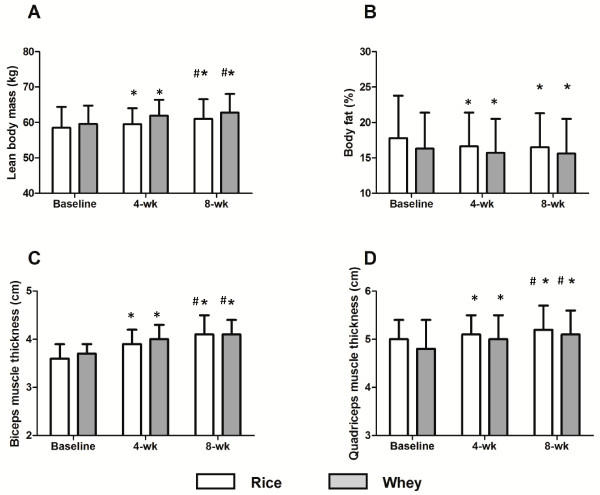
Background: Consumption of moderate amounts of animal-derived protein has been shown to differently influence skeletal muscle hypertrophy during resistance training when compared with nitrogenous and isoenergetic amounts of plant-based protein administered in small to moderate doses. Therefore, the purpose of the study was to determine if the post-exercise consumption of rice protein isolate could increase recovery and elicit adequate changes in body composition compared to equally dosed whey protein isolate if given in large, isocaloric doses. Methods 24 college-aged, resistance trained males were recruited for this study. Subjects were randomly and equally divided into two groups, either consuming 48 g of rice or whey protein isolate (isocaloric and isonitrogenous) on training days. Subjects trained 3 days per week for 8 weeks as a part of a daily undulating periodized resistance-training program. The rice and whey protein supplements were consumed immediately following exercise. Ratings of perceived recovery, soreness, and readiness to train were recorded prior to and following the first training session. Ultrasonography determined muscle thickness, dual emission x-ray absorptiometry determined body composition, and bench press and leg press for upper and lower body strength were recorded during weeks 0, 4, and 8. An ANOVA model was used to measure group, time, and group by time interactions. If any main effects were observed, a Tukey post-hoc was employed to locate where differences occurred. Results No detectable differences were present in psychometric scores of perceived recovery, soreness, or readiness to train (p > 0.05). Significant time effects were observed in which lean body mass, muscle mass, strength and power all increased and fat mass decreased; however, no condition by time interactions were observed (p > 0.05). Conclusion Both whey and rice protein isolate administration post resistance exercise improved indices of body composition and exercise performance; however, there were no differences between the two groups.
Overview
The claims and statistics of this paper haven’t been checked yet.
Free: it reads the open-access text and checks the first 5 claims that cite a source we can check. Create a free account to check every claim.
Integrity signals
Registry
Cites
Statistics
Figures
Verification
Claims the paper makes
The claims and statistics of this paper haven’t been checked yet.
Free: it reads the open-access text and checks the first 5 claims that cite a source we can check. Create a free account to check every claim.
Claims other papers make about this one
Each is checked against this paper’s own text: does it say what the citing paper says it does?
The cited source says what the claim attributes to it.
In the citing paper
“Preliminary findings suggest that rice [98] and pea protein [103] may be able to stimulate similar changes in fat-free mass and strength as whey protein, although the reader should understand that many other factors (dose provided, training status of participants, duration of training and supplementation, etc.) will ultimately impact these outcomes and consequently more research is needed.”
From ISSN exercise & sports nutrition review update: research & recommendations (2018) · cites this paper as [98]
The cited source says what the claim attributes to it.
In the citing paper
“In what is still an emerging area of research, various plant sources of protein have been examined for their ability to stimulate increases in muscle protein synthesis [77, 97] and promote exercise training adaptations [98].”
From ISSN exercise & sports nutrition review update: research & recommendations (2018) · cites this paper as [98]
The cited source says what the claim attributes to it.
In the citing paper
“rice protein may be a suitable alternative to whey protein at promoting resistance training adaptations.”
From International Society of Sports Nutrition Position Stand: protein and exercise (2017) · cites this paper as [89]
The cited source says what the claim attributes to it.
In the citing paper
“demonstrated that rice protein stimulated similar increases in body composition adaptations to whey protein.”
From International Society of Sports Nutrition Position Stand: protein and exercise (2017) · cites this paper as [89]
In the citing paper
“Joy et al. [121] reported that 48 g/day of rice or whey protein isolate on training days during an eight-week resistance training program in college-aged adults caused similar improvements in body composition and bench and leg press strength.”
From Plant Proteins: Assessing Their Nutritional Quality and Effects on Health and Physical Function (2020) · cites this paper as [121]
2 more claims about this paper
Create a free account to see every claim other papers make about this one.
Self-check
Percentages, sums and reported differences re-computed from the paper’s own numbers.
The self-check needs the paper’s full text.
Citations
Cites
Tang, J. E., Moore, D. R., Kujbida, G. W., Tarnopolsky, M. A., & Phillips, S. M. (2009) · Journal of Applied Physiology · doi:10.1152/japplphysiol.00076.2009 · Cited by 998
Moore, D. R., Robinson, M. J., Fry, J. L., Tang, J. E., Glover, E. I., Wilkinson, S. B., Prior, T., Tarnopolsky, M. A., & Phillips, S. M. (2009) · The American Journal of Clinical Nutrition · doi:10.3945/ajcn.2008.26401 · Cited by 973 · cited 2×
“Data is displayed as mean ± standard deviation, * denotes significant change from in prior research [25,26].”
MethodResultAn abundant supply of amino acids enhances the metabolic effect of exercise on muscle protein
Biolo, G., Tipton, K. D., Klein, S., & Wolfe, R. R. (1997) · American Journal of Physiology-Endocrinology and Metabolism · doi:10.1152/ajpendo.1997.273.1.e122 · Cited by 825 · cited 1×
“In support, the consumption of a protein or EAA complex that contains sufficient leucine has been shown to shift protein balance to a net positive state after intense exercise training [6,13].”
BackgroundInternational Society of Sports Nutrition position stand: protein and exercise
Campbell, B., Kreider, R. B., Ziegenfuss, T., La Bounty, P., Roberts, M., Burke, D., Landis, J., Lopez, H., & Antonio, J. (2007) · Journal of the International Society of Sports Nutrition · doi:10.1186/1550-2783-4-8 · Cited by 716
Postexercise net protein synthesis in human muscle from orally administered amino acids
Tipton, K. D., Ferrando, A. A., Phillips, S. M., Doyle, D., & Wolfe, R. R. (1999) · American Journal of Physiology-Endocrinology and Metabolism · doi:10.1152/ajpendo.1999.276.4.e628 · Cited by 616 · cited 14×
“After consumption of the supplement, MPS rates were monitored for four hours.”
Influential(2008) · Nutrition & Food Science · doi:10.1108/nfs.2008.01738aab.008 · Cited by 611
Branched-Chain Amino Acids: Enzyme and Substrate Regulation
Brosnan, J. T., & Brosnan, M. E. (2006) · The Journal of Nutrition · doi:10.1093/jn/136.1.207s · Cited by 577 · cited 1×
“The BCAAs are unique among the essential amino acids (EAAs) for their roles in protein metabolism [6], neural function [7-9], and blood glucose and insulin regulation [10].”
BackgroundWilkinson, S. B., Tarnopolsky, M. A., MacDonald, M. J., MacDonald, J. R., Armstrong, D., & Phillips, S. M. (2007) · The American Journal of Clinical Nutrition · doi:10.1093/ajcn/85.4.1031 · Cited by 530 · cited 1×
“Plant-based proteins contain approximately 6–8% leucine, and in low doses, they do not increase MPS compared to animal-based proteins, which contain approximately 8–11% leucine [18,19].”
BackgroundHartman, J. W., Tang, J. E., Wilkinson, S. B., Tarnopolsky, M. A., Lawrence, R. L., Fullerton, A. V., & Phillips, S. M. (2007) · The American Journal of Clinical Nutrition · doi:10.1093/ajcn/86.2.373 · Cited by 498
Amino acid ingestion improves muscle protein synthesis in the young and elderly
Paddon-Jones, D., Sheffield-Moore, M., Zhang, X.-J., Volpi, E., Wolf, S. E., Aarsland, A., Ferrando, A. A., & Wolfe, R. R. (2004) · American Journal of Physiology-Endocrinology and Metabolism · doi:10.1152/ajpendo.00368.2003 · Cited by 467
Research works printed but not linked: 1
- Norton L Wilson GJ Optimal protein intake to maximize muscle protein synthesis AgroFood industry hi-tech 2009 20 54 57
Cited by
Items 101–179 of 179
Nutritional Considerations for the Female Vegan Athlete
Schoenfeld, M. L. (2018) · Strength and conditioning journal · doi:10.1519/ssc.0000000000000405 · Cited by 9
“There is some emerging evidence that demonstrates that supplemental plant proteins such as rice and soy proteins may perform as well as dairy protein in training recovery, body composition, and performance (30), but there are also some data to the contrary (57).”
BackgroundDeep Processing of Rice and Comprehensive Utilization of Its By-products
Li, W., Ma, Y., Lin, Q., & Fu, D. (2019) · Journal of Food and Nutrition Research · doi:10.12691/jfnr-7-5-6 · Cited by 7
“Rice protein can be classified into four categories according to Osborne's solubility-based classification: albumin, globulin, prolamin and gluten [25].”
BackgroundAshtary‐Larky, D. (2025) · Nutrition · doi:10.1016/j.nut.2025.112742 · Cited by 7
Trending Nutrition Controversies #3: Top Controversies in 2021
Aggarwal, M., Freeman, A. M., Ros, E., Allen, K., Sikand, G., Aspry, K. E., Kris‐Etherton, P. M., Devries, S. R., Reddy, K. R., Singh, T. K., et al. (2021) · The American Journal of Medicine · doi:10.1016/j.amjmed.2021.07.046 · Cited by 6
Amatori, S., Callarelli, C., Gobbi, E., Bertuccioli, A., Zeppa, S. D., Sisti, D., Rocchi, M., & Perroni, F. (2023) · International Journal of Environmental Research and Public Health · doi:10.3390/ijerph20065187 · Cited by 8
Govindasamy, K., Parpa, K., Katanić, B., Clark, C. C. T., Elayaraja, M., Valappil, I. N. K., Dulceanu, C. R., Geantă, V. A., Tolan, G. A., & Zouhal, H. (2025) · Nutrients · doi:10.3390/nu17152571 · Cited by 8
“Similarly, Joy et al. (2013) [22] and Moon et al. (2020) [24] found no significant differences in strength, lean mass, or performance gains between rice or pea proteins and whey protein when consumed post-exercise over 8 weeks.”
InfluentialLanger, H. T., & Carlsohn, A. (2014) · Strength and conditioning journal · doi:10.1519/ssc.0000000000000057 · Cited by 8
“(32) 48 g whey or 48 g rice protein LBM 8 wk LBM[; no difference between the groups Effects of Different Dietary Proteins”
BackgroundInfluentialMametjanov, A., Musulmanova, M., Laučienė, L., Kondrotienė, K., Aleksandrovas, E., Zakarienė, G., Kiseliovienė, S., Šalaševičienė, A., Keršienė, M., Leskauskaitė, D., et al. (2025) · LWT · doi:10.1016/j.lwt.2025.117505 · Cited by 5
Faller, A. C., Shanmughanandhan, D., Ragupathy, S., Zhang, Y., Lu, Z., Chang, P., Swanson, G., & Newmaster, S. G. (2021) · Frontiers in Plant Science · doi:10.3389/fpls.2021.661770 · Cited by 4
Hagele, A. M., Krieger, J. M., Gaige, C. J., Holley, K. F., Gross, K. N., Iannotti, J. M., Allen, L. E., Sutton, P. J., Orr, L. S., Mumford, P. W., et al. (2024) · PLoS ONE · doi:10.1371/journal.pone.0312997 · Cited by 5
Self-citationSouza, R. P., Libânio, J. A., Branco, R. R. D. O. C., dos Santos, A. B., Pereira, L. C. A., Matos, R. P. D. S., Rodrigues, H. S., de Melo, D. S., & Sales, S. C. D. S. (2020) · Research Society and Development · doi:10.33448/rsd-v9i8.5398 · Cited by 3
Ahmed, A., Afzaal, M., Ali, S. W., Muzammil, H. S., Masood, A., Saleem, M. A., Saeed, F., Hussain, M., Rasheed, A., & Jbawi, E. M. A. (2022) · International Journal of Food Properties · doi:10.1080/10942912.2022.2120495 · Cited by 4
RetractedAlternative protein sources in sustainable sports nutrition
Turnagöl, H. H., Aktitiz, S., Baltürk, Ş. İ., Yakışıklı, İ., & Erbaş, Z. (2022) · Turkish Journal of Sports Medicine · doi:10.47447/tjsm.0694 · Cited by 7
Chen, W. (2025) · Journal of Health Population and Nutrition · doi:10.1186/s41043-025-01031-w · Cited by 5
“Joy et al. [52] demonstrated comparable hypertrophic effects between whey and plant-based proteins, providing empirical support for diversified protein sourcing.”
Mohammadi, S., Ashtary‐Larky, D., Alaghemand, N., Alnsour, A. F., Shokouhifar, S., Borzabadi, A., Mehrbod, M., Candow, D. G., Forbes, S. C., António, J., et al. (2025) · Nutrients · doi:10.3390/nu17243877 · Cited by 7
Casagranda, M., Zanella, P. B., Vieira, A., & Macedo, R. C. O. (2019) · Nutrition & Food Science · doi:10.1108/nfs-11-2018-0328 · Cited by 5
Shen, M., Zhang, W., Wu, G., Zhu, L., Qi, X., & Zhang, H. (2021) · Critical Reviews in Food Science and Nutrition · doi:10.1080/10408398.2021.1956877 · Cited by 3
“Current studies are now inclined toward postexercise supplementation (Naclerio et al. 2017; Oertzen-Hagemann et al. 2019; Kirmse et al. 2019; Jendricke et al. 2019) and trying to involve protein hydrolysis intake at night (Beelen et al. 2008).”
BackgroundSandoval, C., Villagrán-Silva, F., Recabarren, B., Schulz, M., & Souza‐Mello, V. (2023) · Science & Sports · doi:10.1016/j.scispo.2022.05.008 · Cited by 3
The question of ergogenic potential of the Paleolithic diet
Bujko, J., & Kowalski, L. M. (2014) · Wielkopolska Digital Library · Cited by 4
Souza, L. B. L., Palmeira, M. E., & Palmeira, E. O. (2015) · LA Referencia (Red Federada de Repositorios Institucionales de Publicaciones Científicas) · Cited by 7
Becker, L. K., Pereira, A. N., Pena, G. E., de Oliveira, E. C., & Silva, M. E. (2016) · Americanae (AECID Library) · Cited by 9
Yan-guo, S., Zhang, N., Guo, Q., Guan, H., Ikeda, S., Guo, C.-H., Piekoszewski, W., Kalenik, T. K., & Motkina, E. (2018) · Food & Function · doi:10.1039/c8fo01405a · Cited by 3
A Whey-Based Diet Can Ameliorate the Effects of LPS-Induced Growth Attenuation in Young Rats
Menahem, C., Foist, M., Mansour, Y., Shtaif, B., Bar-Maisels, M., Phillip, M., & Gat‐Yablonski, G. (2023) · Nutrients · doi:10.3390/nu15081823 · Cited by 6
“Whey is also especially rich in branched amino acids (BCAA) as well as sulfur-containing amino acids [45], including leucine, which is known to regulate protein synthesis [46], isoleucine, and valine, which all play crucial roles in metabolism, blood glucose homeostasis, neural function [47], and microbiome compositio…”
BackgroundSønksen, J. O., Hansen, E. F., Biering‐Sørensen, F., & Colstrup, H. (1990) · PubMed · Cited by 4
Ergogenic Aids and the Female Athlete
Jordan, S. L., Naclerio, F., & Morales, J. B. (2023) · Springer eBooks · doi:10.1007/978-3-031-15485-0_23 · Cited by 2
Drummond, M. D. M., da Silva, R. Â. D., Carvas, N., de Melo, M. S., & Ferreira, M. H. L. (2026) · Translational Sports Medicine · doi:10.1155/tsm2/5557511 · Cited by 4
Moon, S.-H., & Kim, C.-H. (2026) · Food Science of Animal Resources · doi:10.1007/s44463-025-00023-y · Cited by 3
“…value higher than the proteins found in eggs and soy, primarily due to its branched-chain amino acid (BCAA) content (Boirie et al., 1997 ; Joy et al., 2013; BAPs that exhibit anti-inflammatory and antioxidant properties, as evidenced by their immune-regulating and radical-scavenging…”
Carvalho, A. M. P., Tavares, P. G. D. S. Z., & Santos, A. C. D. C. P. (2024) · Research Society and Development · doi:10.33448/rsd-v13i6.46166 · Cited by 6
Boonla, O., Booranasuksakul, U., Padkao, T., Phoemsapthawee, J., Tangwattanachuleeporn, M., Koowattanatianchai, S., & Prasertsri, P. (2024) · Nutrition and Health · doi:10.1177/02601060241302387 · Cited by 3
“What ’ s more, previous studies showed that supplementation with protein at approximately 0.20 ‒ 0.32 g/kg BW/day can promote muscle protein synthesis (Joy et al., 2013).”
InfluentialCaicedo-Eraso, J. C., González-Correa, C. H., González-Correa, C.-A., & Gallagher, D. (2019) · Journal of Physics Conference Series · doi:10.1088/1742-6596/1272/1/012002 · Cited by 2
Ziegenfuss, T. N., Cesareo, K. R., Raub, B. J., Kedia, A. W., Sandrock, J. E., Kerksick, C. M., Ferrando, A. A., & Lopez, H. L. (2021) · Journal of Exercise and Nutrition · doi:10.53520/jen2021.10394 · Cited by 3
Upadhyay, R., Banjara, M., Thombare, D. T., Yankanchi, S., & Chandel, G. (2021) · ORYZA- An International Journal on Rice · doi:10.35709/ory.2021.58.4.9 · Cited by 2
Biochemical Controversies Regarding the Use of Vegetal Proteins in Performance Athletes
Bătrînu, M.-G., Tero-Vescan, A., & Miklos, A. (2020) · Acta Biologica Marisiensis · doi:10.2478/abmj-2020-0006 · Cited by 3
“It commonly accepted that essential amino acids and especially BCAAs induce an anabolic effect by stimulating protein synthesis, and their deficiency can limit the synthesis process (Wolfe, 2017; Joy et al., 2013).”
BackgroundResultInfluentialThe Influence of The Protein Source in Clinical Outcomes of Patients on Enteral Nutrition Therapy
Schieferdecker, M. E. M. (2020) · Research and Reviews on Healthcare Open Access Journal · doi:10.32474/rrhoaj.2020.05.000221 · Cited by 1
“However, these products are designed to complement the diet in terms of proteins and amino acids, not meeting the need for a complete enteral nutrition formula that is composed of all macronutrients and macronutrients in the recommended intake amounts[11,12].”
Backgroundde Stefano, M. I., Monda, A., Maio, G. D., Casillo, M., Messina, A., Monda, V., Moscatelli, F., Monda, M., Polito, R., & Messina, G. (2026) · Sport Sciences for Health · doi:10.1007/s11332-025-01600-w · Cited by 1
Beyond the Obvious: Future Innovations in Sports Nutrition
Almada, A. L. (2015) · Springer eBooks · doi:10.1007/978-3-319-18230-8_16 · Cited by 2
“Jacob Wilson’s laboratory in Florida compared supplementation with high-dose protein from rice protein concentrate (Growing Naturals Rice Protein Isolate with Oryzatein ® rice protein, Axiom Foods) versus high-dose protein from whey protein isolate (NutraBio 100 % Whey Protein Isolate, NutraBio), each consumed after a…”
MethodResultEffect of Rice Bran Supplementation on Endurance Exercise Capacity in Mice
Kim, S., Park, J., Kim, K., & Jun, W. (2019) · Journal of the Korean Society of Food Science and Nutrition · doi:10.3746/jkfn.2019.48.12.1317 · Cited by 1
Cárdenas, L. H. (2019) · Cited by 1
Lin, Y., Li, X., Zhao, H., Chen, J.-H., Li, J.-Q., & Yan, Y. (2024) · Journal of Exercise Science & Fitness · doi:10.1016/j.jesf.2024.02.006 · Cited by 1
“In the same population, Joy et al. 53 also demonstrated that consuming rice protein or whey protein during RT decreased fat mass.”
BackgroundCraddock, J. C., Wakefield, A., Peoples, G. E., Goldman, D., & Larkin, T. (2024) · Cureus · doi:10.7759/cureus.59972 · Cited by 1
Effect of protein supplements on cardiovascular health and exercise performance of young adult males
Khandelwal, E., Chawali, K. D., & Bhavya, S. (2024) · Journal of Family Medicine and Primary Care · doi:10.4103/jfmpc.jfmpc_132_24 · Cited by 1
“[9] A study by Joy JM, et al. [10] has shown that the use of whey isolates every day increases lean body mass, muscle mass, strength, and power while decreasing the fat mass.”
Nutrient intake and body composition in children with phenylketonuria
Hammons, M. M. (2015) · doi:10.6083/m4kk99j8 · Cited by 1
Proteins and Amino Acids and Physical Exercise
Patterson, S. D., Waldron, M., & Jeffries, O. (2018) · Elsevier eBooks · doi:10.1016/b978-0-12-810422-4.00013-0 · Cited by 2
Nuszbaum, C., Wollmar, M., & Sjöberg, A. (2021) · Research Square · doi:10.21203/rs.3.rs-608825/v1 · Cited by 2
Lorenzetti, R. L. (2021) · ERA: Education and Research Archive (University of Alberta) · doi:10.7939/r3-8phw-q520 · Cited by 3
Nuszbaum, C., Wollmar, M., & Sjöberg, A. (2021) · Research Square · doi:10.21203/rs.3.rs-608825/v2 · Cited by 1
Laakso, M. (2015) · Jyväskylä University Digital Archive (University of Jyväskylä) · Cited by 1
Richardson, B. (2014) · Digital Archive @ GSU · doi:10.57709/5801100
Effectiveness of Whey Protein Supplement in Resistance Trained
AlKhatib, A. H., & Jiménez, A. (2013)
15: Dietary Protein and Physical Training Effects on Body Composition and Performance
Devries, M. C., Oikawa, S. Y., & Phillips, S. M. (2017) · CRC Press eBooks · doi:10.1201/9781351260008-15
Obradović, J., Jurišić, M. V., Rakonjac, D., Aleksić‐Veljković, A., & Batez, M. (2018) · Facta Universitatis Series Physical Education and Sport · doi:10.22190/fupes180114040o
“According to Joy et al. (2013) resistance trained males increased MM by 3.2kg after 8 weeks of resistance training and whey protein consumption.”
BackgroundKalauz a fehérjetartalmú étrend-kiegészítők világában
Fritz, P., Mészáros, N., Ignits, D., & Katona, S. (2017) · Recreation · doi:10.21486/recreation.2017.7.4.1
SAFETY AND EFFICACY OF WHEY PROTEIN SUPPLEMENTATION IN TEENAGE ATHLETES
Stranieri, A. (2019) · Digital Commons - URI (University of Rhode Island) · doi:10.23860/thesis-stranieri-andrew-2019 · Cited by 1
“Joy et al. compared whey protein supplementation versus rice protein supplementation (Joy et al., 2013).”
Backgroundسلامه, خ. م. ا. (2017) · مجلة بحوث التربية الشاملة · doi:10.21608/jsei.2017.66582
Influência da fonte proteica da dieta nas adaptações crônicas ao treinamento de força
Hevia-Larraín, V. (2020) · Digital Library of Theses and Dissertations (Universidade de São Paulo) · doi:10.11606/d.39.2020.tde-15012020-110142
A comparison of in-field fat mass evaluation techniques: a practical perspective
Bertuccioli, A., Vici, G. F., Ceci, R. L., Cesanelli, L., Belli, L. V., & Polzonetti, V. (2019) · Nutrafoods
The anabolic role of plant-based proteins in response to chronic resistance exercise
SANTOS, C. D. S., Júnior, E. S. O., de Sá, M. J. L., & Esteves, E. A. (2021) · REVISTA CIÊNCIAS EM SAÚDE · doi:10.21876/rcshci.v11i3.1135
Filho, E. M. D. A., de Souza, Y. B. A., & de Carvalho, L. M. F. (2021) · Research Society and Development · doi:10.33448/rsd-v10i15.22405 · Cited by 1
Aglomeração de proteína concentrada de arroz em leito fluidizado
Andreola, K. (2017) · doi:10.47749/t/unicamp.2017.989717 · Cited by 1
A new view on plant and animal protein
Miroshnikov, A. B., Smolеnsky, A. V., Meshtel, A. V., & Rybakova, P. D. (2022) · Clinical nutrition and metabolism · doi:10.17816/clinutr105296 · Cited by 1
15: Dietary Protein and Physical Training Effects on Body Composition and Performance
Devries, M. C., Oikawa, S. Y., & Phillips, S. M. (2017) · CRC Press eBooks · doi:10.1201/9781351260008-20
Jibril, A. T., Jayedi, A., Ghorbaninejad, P., Mohammadpour, S., Djafarian, K., Clark, C. C. T., & Shab‐Bidar, S. (2022) · Nutrition Today · doi:10.1097/nt.0000000000000543
da Silva, M. N. S., Dias, T. D. S., & Castro, N. S. (2022) · Brazilian Journal of Health Review · doi:10.34119/bjhrv5n4-054 · Cited by 4
Supplementation with Multi-Ingredients for Physically Active Individuals.
Naclerio, F. (2023) · Revista Iberoamericana de Ciencias de la Actividad Física y el Deporte · doi:10.24310/riccafd.12.3.2023.17761 · Cited by 2
Importância do consumo de diferentes fontes de proteína na recuperação muscular após o exercício
Nogueira, F. C., Moreira, E. V. F., Lopes, V. L. B., Cavicchioli, A. C. M., & Puiatti, M. A. (2024) · Brazilian Journal of Health Review · doi:10.34119/bjhrv7n1-546 · Cited by 2
Kravets, K. K., & Drozdovska, S. (2024) · Актуальні проблеми сучасної медицини Вісник Української медичної стоматологічної академії · doi:10.31718/2077-1096.24.3.209
More, S., & Nair, N. (2025) · Journal of Current Research in Food Science · doi:10.22271/foodsci.2025.v6.i1d.215
Bernal, A. D. J. (2024) · Revista de la Escuela de Ingenierías y Tecnologías Unimonserrate · doi:10.29151/reit.n4a3
Guney-Coskun, M., Ersoy, N., & Ersoy, G. (2025) · Research Square · doi:10.21203/rs.3.rs-7534127/v1 · Cited by 1
Liu, Q., Guo, Y., Fan, D., Peng, B., Wang, J., Chen, Z., Gu, W., Wu, J. X., Niu, Z., Wang, S., et al. (2026) · PeerJ · doi:10.7717/peerj.20778
“It remained unclear whether protein supplementation provided an additional boost in strength gains, since previous studies demonstrated conflicting results ( Coburn et al., 2006 ; Joy et al., 2013 ; Herda et al., 2013 ; Paoli et al., 2015 ; Taylor et al., 2016 ).”
InfluentialApplications, Future Perspectives, and Challenges for Modified Plant Protein-Based Food Products
Bindu, Rahman, M., & Verma, K. (2026) · Springer eBooks · doi:10.1007/978-3-032-19821-1_11
Huang, X., Zhu, J., Zang, P., Chen, J., Chen, P., Xu, N., & Liu, W. (2026) · Frontiers in Sports and Active Living · doi:10.3389/fspor.2026.1819117
“Studies found that the intake of 48 g day 1 of rice protein after resistance exercise showed similar effects to whey protein in terms of muscle growth, bench press and leg press strength, and peak power increase (42).”
Sustainable Nutrition and Health in Sports
AKKAYA, B. (2026) · SDÜ Tıp Fakültesi Dergisi · doi:10.17343/sdutfd.1767838
García-Durán, J., Sánchez-Oliver, A. J., Rodríguez-Martín, N. M., Fernández‐Pachón, M., Pedroche, J., Millán, F., & González-Jurado, J. A. (2026) · Journal of the International Society of Sports Nutrition · doi:10.1080/15502783.2026.2723237
“Moreover, structural adaptations in lean body mass variables typically require longer interventions—often 6 to 8 weeks or more—before they can be detected [25,27].”
InfluentialCorsetti, G., & Pasini, E. (2026) · Frontiers in Nutrition · doi:10.3389/fnut.2026.1970280
Callegari, I. O. M., Silva, G. M., & Oliveira, A. G. (2026) · Journal of the International Society of Sports Nutrition · doi:10.1080/15502783.2026.2752317
“Consistent findings were also reported for rice [27,28] and pea protein [29], as well as for plant-based protein blends rich in essential amino acids [30].”
Metadata
- Authors
- Joy, J. M., Lowery, R. P., Wilson, J. M., Purpura, M., De Souza, E. O., Wilson, S. M., Kalman, D. S., Dudeck, J. E., & Jäger, R.
- Affiliations
- Northeastern University (US)
- University of Tampa (US)
- Increnovo LLC (United States) (US)
- Corresponding author
- Jäger, Ralf
- Venue
- Nutrition Journal
- Published
- 2013-06-20
- Volume
- 12
- Issue
- 1
- Pages
- 86-86
- ISSN
- 1475-2891 (ISSN-L)
- PMC
- PMC3698202
- OpenAlex
- W2138747913
- Cited by
- 179
- References
- 28
- Citations by year
- 2026: 10 · 2025: 11 · 2024: 14 · 2023: 14 · 2022: 16 · 2021: 26 · 2020: 16 · 2019: 18 · 2018: 12 · 2017: 13 · 2016: 8 · 2015: 10 · 2014: 8 · 2013: 2
- FWCI
- 5.42
- Type
- journal article
- Language
- en
- Open access
- gold
- doi.org
- Licence
- Locations
- Nutrition Journal (publishedVersion, cc-by)
- Europe PMC (PubMed Central) (publishedVersion, cc-by)
- PubMed Central (publishedVersion, cc-by)
- PubMed (publishedVersion)
- Topics
- Health Sciences › Nursing › Nutrition and Dietetics › Muscle metabolism and nutrition
- Health Sciences › Medicine › Orthopedics and Sports Medicine › Sports Performance and Training
- Life Sciences › Biochemistry, Genetics and Molecular Biology › Molecular Biology › Muscle Physiology and Disorders
- Keywords
- whey protein isolate, rice protein isolate, plant proteins, animal protein, resistance training, body composition, lean body mass, fat mass, muscle strength, power, perceived recovery, muscle soreness
- MeSH terms
- Whey Proteins, Body Composition, Dietary Proteins, Double-Blind Method, Humans, Male, Milk Proteins, Plant Proteins, Oryza, Muscle, Skeletal, Dietary Supplements, Resistance Training, Young Adult
About these checks
Registry, retraction, Cites and statistics results are computed, not judged, with one exception: a printed reference that no index lists is read once by a model before it counts as a citation error. Claims are extracted by a model and kept only when their quote appears verbatim in the text; each cited source is then checked, with a model’s help, for whether it says what the claim relies on. Those verdicts can be wrong — read the claim’s quote and the cited source before relying on one.
Statistics and arithmetic are recomputed, not judged.
Confidence bands are shown only for fields calibrated on our annotated test set. None is calibrated yet, so no band is shown.
What counts as a claim ›How we measure confidence ›How we check this ›
Are you an author, or do you see a problem with this page? Request a review
Data sources
Bibliographic data: Semantic Scholar, OpenAlex, Crossref.
Contains information from the Semantic Scholar Academic Graph Datasets, made available under the ODC Attribution License (ODC-BY 1.0).
Semantic Scholar’s data is described in: Kinney, R., et al. (2023). The Semantic Scholar Open Data Platform. arXiv:2301.10140.
