

On the viability of implantable electrodes for the natural control of artificial limbs: Review and discussion
Open accessThe DOI matches its Crossref record; 115 of the 115 references it cites were found in a registry or an index.
Abstract
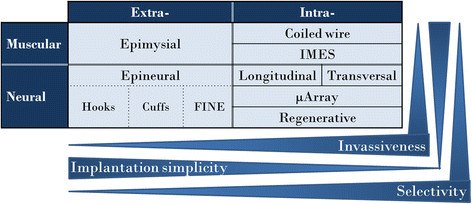
The control of robotic prostheses based on pattern recognition algorithms is a widely studied subject that has shown promising results in acute experiments. The long-term implementation of this technology, however, has not yet been achieved due to practical issues that can be mainly attributed to the use of surface electrodes and their highly environmental dependency. This paper describes several implantable electrodes and discusses them as a solution for the natural control of artificial limbs. In this context "natural" is defined as producing control over limb movement analogous to that of an intact physiological system. This includes coordinated and simultaneous movements of different degrees of freedom. It also implies that the input signals must come from nerves or muscles that were originally meant to produce the intended movement and that feedback is perceived as originating in the missing limb without requiring burdensome levels of concentration. After scrutinizing different electrode designs and their clinical implementation, we concluded that the epimysial and cuff electrodes are currently promising candidates to achieving a long-term stable and natural control of robotic prosthetics, provided that communication from the electrodes to the outside of the body is guaranteed.
Overview
The claims and statistics of this paper haven’t been checked yet.
Free: it reads the open-access text and checks the first 5 claims that cite a source we can check. Create a free account to check every claim.
Integrity signals
Registry
Cites
Statistics
Figures

Verification
Claims the paper makes
The claims and statistics of this paper haven’t been checked yet.
Free: it reads the open-access text and checks the first 5 claims that cite a source we can check. Create a free account to check every claim.
Claims other papers make about this one
Each is checked against this paper’s own text: does it say what the citing paper says it does?
The cited source says what the claim attributes to it.
In the citing paper
“Presently, with regards to long-term human implantations, extraneural electrodes still emerge as the most favorable choice for clinical applications [26, 37].”
From Safety of long-term electrical peripheral nerve stimulation: review of the state of the art (2019) · cites this paper as [37]
The cited source says what the claim attributes to it.
In the citing paper
“At present, extraneural electrodes have shown superior long-term stability in comparison to intraneural electrodes.”
From Safety of long-term electrical peripheral nerve stimulation: review of the state of the art (2019) · cites this paper as [37]
Self-check
Percentages, sums and reported differences re-computed from the paper’s own numbers.
The self-check needs the paper’s full text.
Citations
Cites
Neuronal ensemble control of prosthetic devices by a human with tetraplegia
Hochberg, L. R., Serruya, M. D., Friehs, G. M., Mukand, J. A., Saleh, M., Caplan, A. H., Branner, A., Chen, D., Penn, R. D., & Donoghue, J. P. (2006) · Nature · doi:10.1038/nature04970 · Cited by 3,295 · cited 4×
“A review of intrafascicular electrodes with focus on the central nervous system (CNS) is given by Cheung in [9].”
BackgroundMethodInfluentialNeural Stimulation and Recording Electrodes
Cogan, S. F. (2008) · Annual Review of Biomedical Engineering · doi:10.1146/annurev.bioeng.10.061807.160518 · Cited by 2,243 · cited 1×
“[7], and in 2008 by Cogan with the emphasis on microelectrodes for stimulation [8].”
BackgroundResponse of brain tissue to chronically implanted neural electrodes
Polikov, V. S., Tresco, P. A., & Reichert, W. M. (2005) · Journal of Neuroscience Methods · doi:10.1016/j.jneumeth.2005.08.015 · Cited by 1,896 · cited 1×
“An update on the biocompatibility of microelectrodes is given in [14] and a more detailed review of the brain tissue response can be found in [15].”
BackgroundMedical Instrumentation-Application and Design
Webster, J. G. (1978) · Journal of Clinical Engineering · doi:10.1097/00004669-197807000-00017 · Cited by 1,847
A robust, real-time control scheme for multifunction myoelectric control
Englehart, K., & Hudgins, B. (2003) · IEEE Transactions on Biomedical Engineering · doi:10.1109/tbme.2003.813539 · Cited by 1,743 · cited 1×
“Nowadays, several researchers have demonstrated that it is possible to identify finger and hand positioning using a variety of pattern recognition algorithms, such as artificial neural networks (ANNs), support vector machine (SVM), hidden Markov models (HMM), wavelets and so on [91-98].”
BackgroundDissolvable films of silk fibroin for ultrathin conformal bio-integrated electronics
Kim, D.-H., Viventi, J., Amsden, J. J., Xiao, J., Vigeland, L., Kim, Y.-S., Blanco, J. A., Panilaitis, B., Frechette, E. S., Contreras, D., et al. (2010) · Nature Materials · doi:10.1038/nmat2745 · Cited by 1,721 · cited 2×
“It is worth mentioning that electrode technology continues to progress and newmaterials, coatings or surface treatments such as PEDOT [88], silk fibroin [90] and ion-selective membranes [89] could eventually replace or be applied to standard epimysial and cuff electrodes.”
BackgroundElectromyography: Physiology, Engineering, and Noninvasive Applications
(2004) · Wiley eBooks · doi:10.1002/0471678384 · Cited by 1,151
Targeted Muscle Reinnervation for Real-time Myoelectric Control of Multifunction Artificial Arms
Kuiken, T. A. (2009) · JAMA · doi:10.1001/jama.2009.116 · Cited by 1,089 · cited 1×
“’s work on TMR provides another strong argument in favor of the viability of nerves after amputation [114].”
BackgroundBioelectrical Signal Processing in Cardiac and Neurological Applications
(2005) · Elsevier eBooks · doi:10.1016/b978-0-12-437552-9.x5000-4 · Cited by 993 · cited 1×
“consistent over time and less affected by surrounding noise [103].”
BackgroundScheme, E., & Englehart, K. (2011) · The Journal of Rehabilitation Research and Development · doi:10.1682/jrrd.2010.09.0177 · Cited by 969 · cited 20×
“On the other hand, the way in which the nature of SEs inherently impacts the problems mentioned above is obvious.”
BackgroundInfluential
Research works printed but not linked: 3
- Merletti R Parker P Electromyography: Physiology, Engineering, and Noninvasive Applications 2004 John Wiley & Sons, New Jersey, USA
- Hargrove L Englehart K Hudgins B A Comparison of Surface and Intramuscular Myoelectric Signal Classification IEEE Trans Biomed Eng 2007 54 5 847 853 17518281
- Almström C Herberts P Körner L Experience with Swedish Multifunctional Prosthetic Hands Controlled by Pattern Recognition of Multiple Myoelectric Signals Int Orthop 1981 5 15 21 7275404
Cited by
Items 101–142 of 142
Ultra‐Thin Soft Pneumatic Actuation for Minimally Invasive Neural Interfacing
Coles, L., Troughton, J. G., Carnicer‐Lombarte, A., Malliaras, G. G., & Proctor, C. M. (2025) · Advanced Materials Technologies · doi:10.1002/admt.202502125 · Cited by 2
“Additionally, PNIs are being adapted for use in brain-computer interfaces, providing a platform for the control of prosthetic limbs [ 7–9 ].”
A MicroChannel Neural Interface ASIC
Lancashire, H. T., Jiang, D., Demosthenous, A., & Donaldson, N. (2018) · IEEE International Symposium on Circuits and Systems proceedings · doi:10.1109/iscas.2018.8351380 · Cited by 2
“Many devices for recording from and stimulating the peripheral nervous system have been investigated [4], and one key approach to re-establishing intuitive sensory and motor function is using highly selective neural interfaces [5].”
Somatosensory Neuromodulation with a Focus Towards Clinical Systems
Graczyk, E. L., & Tyler, D. J. (2022) · Handbook of Neuroengineering · doi:10.1007/978-981-15-2848-4_92-1 · Cited by 2
Fully Implantable Multichannel EMG Measurement System: First Results
Lewis, S., Russold, M., Hahn, M., & Aszmann, O. C. (2014) · Biosystems & biorobotics · doi:10.1007/978-3-319-08072-7_12 · Cited by 2
Effect of the nerve fiber path eccentricity on the single fiber action potential
Horn, M. R., Qiao, S., & Yoshida, K. (2013) · International IEEE/EMBS Conference on Neural Engineering · doi:10.1109/ner.2013.6696139 · Cited by 2
“Microfabricated microelectrode arrays, such as the thinfilm longitudinal intrafascicular electrode (tfLIFE) and transverse intrafascicular multichannel electrode (TIME) are selective, penetrating neural interfaces that place an array of electrode contacts within the body of the peripheral nerve fascicle [1-5].”
BackgroundNeural electrodes for long-term tissue interfaces
del Valle, J., Rodríguez‐Meana, B., & Navarro, X. (2021) · Elsevier eBooks · doi:10.1016/b978-0-12-822828-9.00009-5 · Cited by 2
EMG as a control parameter in lower limb prosthetics : surface vs. implanted electrodes
Sigurðardóttir, J. S. (2015) · Cited by 3
Control interfaces to actively support the arm function of men with Duchenne Muscular Dystrophy
Lobo-Prat, J. (2016) · doi:10.3990/1.9789036541701 · Cited by 7
Robust Electromyography Based Control of Multifunctional Prostheses of The Upper Extremity
Amsuess, S. (2015) · eDiss (Georg-August-Universität Göttingen) · doi:10.53846/goediss-4989 · Cited by 2
Avances en prótesis: una mirada al presente y al futuro
García, S. D., & Espinoza, V. M. J. (2014) · Revista Médica Clínica Las Condes · doi:10.1016/s0716-8640(14)70039-2 · Cited by 7
Tashiro, H., Popović, M. B., Iramina, K., Terasawa, Y., & Ohta, J. (2019) · Elsevier eBooks · doi:10.1016/b978-0-12-812939-5.00006-9 · Cited by 2
Biomedical Devices: Materials, Fabrication and Control
Lascano, S. K., & Estay, D. (2022) · International series on intelligent systems, control and automation: science and engineering · doi:10.1007/978-3-319-40003-7_9 · Cited by 3
Implementing a Bluetooth EMG System Comprising a Subcutaneous Sensor and the Associated Transceiver
Calado, A., Errico, V., Boccardo, N., Canepa, M., Gruppioni, E., & Saggio, G. (2022) · Lecture notes in electrical engineering · doi:10.1007/978-3-031-08136-1_35 · Cited by 1
Somatosensory Neuromodulation with a Focus Towards Clinical Systems
Graczyk, E. L., & Tyler, D. J. (2023) · Handbook of Neuroengineering · doi:10.1007/978-981-16-5540-1_92 · Cited by 1
Kundu, A., Patrick, E. E., Currlin, S., Madler, R., Delgado, F., Fahmy, A., Verplancke, R., Ballini, M., Braeken, D., de Beeck, M. O., et al. (2024) · Micromachines · doi:10.3390/mi15020280 · Cited by 1
““Non-remote” integrated electronics [46] help to reduce the wiring and signal loss of transmission.”
BackgroundChannel selection and wavelet transformation-based data compression preserve motor unit information
Wang, S., Quinn, K. N., Slepyan, A., Qin, L., & Thakor, N. V. (2024) · Annual International Conference of the IEEE Engineering in Medicine and Biology Society (EMBC) · doi:10.1109/embc53108.2024.10782539 · Cited by 1
“One major limitation of most current neuroprosthetic solutions is they lack a control method that replicates the smooth, natural movement possible in an intact limb [1].”
Antonello, M., Collu, R., Roberto, P., Andrea, D., Cordella, F., Zollo, L., Massimo, B., & Cosseddu, P. (2025) · Scientific Reports · doi:10.1038/s41598-025-21599-x · Cited by 2
Upper and Lower Limb Robotic Prostheses
Pilarski, P. M., & Hebert, J. S. (2017) · CRC Press eBooks · doi:10.4324/9781315368788-4 · Cited by 2
Electrodes for Nerve Recording and Stimulation
Liu, J., Tian, H., Kang, X., & Wang, M. (2017) · Toxinology · doi:10.1007/978-981-10-2798-7_43-1 · Cited by 1
A Novel Water Proof Prosthetic Hand Based on Conductive Silicon sEMG Sensors
Xue, J., Kang, F., Yokoi, H., Zhu, C., & Duan, F. (2020) · IEEE International Conference on Real-time Computing and Robotics (RCAR) · doi:10.1109/rcar49640.2020.9303310 · Cited by 1
Sudden Deaths: A Failure of Feedback Control
Budde, R. B., Biggs, E. N., & Irazoqui, P. P. (2023) · Handbook of Neuroengineering · doi:10.1007/978-981-16-5540-1_9 · Cited by 1
Peripheral Nerve Interface, Intraneural Electrode
Frankel, M. (2014) · Encyclopedia of Computational Neuroscience · doi:10.1007/978-1-4614-7320-6_211-1 · Cited by 1
Peripheral Nerve Interface, Intraneural Electrode
Frankel, M. (2015) · Encyclopedia of Computational Neuroscience · doi:10.1007/978-1-4614-6675-8_211 · Cited by 1
Tchimino, J. (2023) · VBN Forskningsportal (Aalborg Universitet) · doi:10.54337/aau539427829 · Cited by 1
CIR-Myo News: Abstracts of the 2015 Spring Padua Muscle Days
Editors, T. L. O. (2015) · European Journal of Translational Myology · doi:10.4081/bam.2015.3.145
Yarygin, A. A., Aytbaev, B. H., Kanyshev, A. Y., & Alekseeva, E. A. (2019) · Issues of radio electronics · doi:10.21778/2218-5453-2019-5-64-75 · Cited by 1
Osseointegrated Amputation Prostheses and Implanted Electrodes
Li, Y., Ortiz-Catalan, M., & Brånemark, R. (2021) · Springer eBooks · doi:10.1007/978-3-030-60746-3_6 · Cited by 1
Self-citationIntegration of autonomous and pattern recognition controls in hand prostheses
Mouchoux, J. (2022) · eDiss (Georg-August-Universität Göttingen) · doi:10.53846/goediss-33
Sudden Deaths: A Failure of Feedback Control
Budde, R. B., Biggs, E. N., & Irazoqui, P. P. (2022) · Handbook of Neuroengineering · doi:10.1007/978-981-15-2848-4_9-1 · Cited by 1
Electrodes for Nerve Recording and Stimulation
Liu, J., Tian, H., Kang, X., & Wang, M. (2018) · Micro/Nano technologies · doi:10.1007/978-981-10-5945-2_43
Ferrigno, G., Pedrocchi, A., Momi, E. D., Ambrosini, E., & Beretta, E. (2015) · CRC Press eBooks · doi:10.1201/b19147-3
Turushev, N. V., Аvdeeva, D. K., & Grigoriev, M. G. (2015) · MATEC Web of Conferences · doi:10.1051/matecconf/20152806005
Development of an Affordable Myoelectric Hand for Transradial Amputees
Prakash, A., & Sharma, S. (2021) · IGI Global eBooks · doi:10.4018/978-1-7998-8050-9.ch017
Peripheral Nerve Interface, Intraneural Electrode
Frankel, M. A. (2022) · Encyclopedia of Computational Neuroscience · doi:10.1007/978-1-0716-1006-0_211
Mneimneh, M., Quadir, N. A., & Albasha, L. (2024) · IEEE Access · doi:10.1109/access.2024.3441840 · Cited by 1
Tashiro, H., Herr, H., Popović, M. B., Iramina, K., Terasawa, Y., & Ohta, J. (2024) · Elsevier eBooks · doi:10.1016/b978-0-443-13862-1.00017-5
Functionalized Material–Based Flexible Biomedical Devices
Shet, S. M., Mondal, D., & Nataraj, S. K. (2025) · Wiley eBooks · doi:10.1002/9781394214105.ch15
A wireless magnetic implant system for continuous neuromuscular sensing
Shallal, C., Taylor, C. R., Yeon, S. H., Casler, R. J., Oseyemi, D., Herrera-Arcos, G., Qiao, J., Shu, T., Xu, J., Levine, D., et al. (2026) · Nature Sensors · doi:10.1101/2025.11.17.25340274 · Cited by 3
Self-citationBrånemark, R. (2014) · Biosystems & biorobotics · doi:10.1007/978-3-319-08072-7_6
Self-citation
Metadata
- Authors
- Ortiz-Catalan, M., Brånemark, R., Håkansson, B., & Delbeke, J.
- Affiliations
- Sahlgrenska University Hospital (SE)
- Chalmers University of Technology (SE)
- UCLouvain (BE)
- Corresponding author
- Ortiz-Catalan, Max
- Venue
- BioMedical Engineering OnLine
- Published
- 2012
- Volume
- 11
- Issue
- 1
- Pages
- 33
- ISSN
- 1475-925X (ISSN-L)
- PMC
- PMC3438028
- OpenAlex
- W2108693629
- Cited by
- 144
- References
- 115
- Citations by year
- 2026: 1 · 2025: 6 · 2024: 9 · 2023: 12 · 2022: 11 · 2021: 10 · 2020: 8 · 2019: 19 · 2018: 11 · 2017: 18 · 2016: 8 · 2015: 14 · 2014: 13 · 2013: 4
- FWCI
- 1.05
- Type
- journal article
- Language
- en
- Open access
- gold
- doi.org
- Licence
- cc-by
- Locations
- BioMedical Engineering OnLine (publishedVersion, cc-by)
- Europe PMC (PubMed Central) (publishedVersion, cc-by)
- PubMed Central (publishedVersion, cc-by)
- PubMed (publishedVersion)
- DOAJ (DOAJ: Directory of Open Access Journals) (submittedVersion)
- eScholarship (California Digital Library) (submittedVersion)
- eScholarship (California Digital Library) (submittedVersion, cc-by)
- Chalmers Research (Chalmers University of Technology) (submittedVersion)
- Funders
- Waalse Gewest
- VINNOVA (2010-00482)
- Chalmers Tekniska Högskola
- Topics
- Life Sciences › Neuroscience › Cellular and Molecular Neuroscience › Neuroscience and Neural Engineering
- Physical Sciences › Engineering › Biomedical Engineering › Muscle activation and electromyography studies
- Physical Sciences › Engineering › Biomedical Engineering › Prosthetics and Rehabilitation Robotics
- Keywords
- implanted electrodes, robotic prostheses, cuff electrodes, neural interfaces, surface electrodes, pattern recognition, long-term stability, feedback perception
- MeSH terms
- Animals, Artificial Limbs, Electrodes, Implanted, Humans, Muscles, Nervous System Physiological Phenomena
About these checks
Registry, retraction, Cites and statistics results are computed, not judged, with one exception: a printed reference that no index lists is read once by a model before it counts as a citation error. Claims are extracted by a model and kept only when their quote appears verbatim in the text; each cited source is then checked, with a model’s help, for whether it says what the claim relies on. Those verdicts can be wrong — read the claim’s quote and the cited source before relying on one.
Statistics and arithmetic are recomputed, not judged.
Confidence bands are shown only for fields calibrated on our annotated test set. None is calibrated yet, so no band is shown.
What counts as a claim ›How we measure confidence ›How we check this ›
Are you an author, or do you see a problem with this page? Request a review
Data sources
Bibliographic data: Semantic Scholar, OpenAlex, Crossref.
Contains information from the Semantic Scholar Academic Graph Datasets, made available under the ODC Attribution License (ODC-BY 1.0).
Semantic Scholar’s data is described in: Kinney, R., et al. (2023). The Semantic Scholar Open Data Platform. arXiv:2301.10140.
