

Quantification of short and long asbestos fibers to assess asbestos exposure: a review of fiber size toxicity
Open accessThe DOI matches its Crossref record; 122 of the 122 references it cites were found in a registry or an index; 5 of the 290 sources its claims cite were checked for support.
Abstract
The fibrogenicity and carcinogenicity of asbestos fibers are dependent on several fiber parameters including fiber dimensions. Based on the WHO (World Health Organization) definition, the current regulations focalise on long asbestos fibers (LAF) (Length: L ≥ 5 μm, Diameter: D < 3 μm and L/D ratio > 3). However air samples contain short asbestos fibers (SAF) (L < 5 μm). In a recent study we found that several air samples collected in buildings with asbestos containing materials (ACM) were composed only of SAF, sometimes in a concentration of ≥10 fibers.L-1. This exhaustive review focuses on available information from peer-review publications on the size-dependent pathogenetic effects of asbestos fibers reported in experimental in vivo and in vitro studies. In the literature, the findings that SAF are less pathogenic than LAF are based on experiments where a cut-off of 5 μm was generally made to differentiate short from long asbestos fibers. Nevertheless, the value of 5 μm as the limit for length is not based on scientific evidence, but is a limit for comparative analyses. From this review, it is clear that the pathogenicity of SAF cannot be completely ruled out, especially in high exposure situations. Therefore, the presence of SAF in air samples appears as an indicator of the degradation of ACM and inclusion of their systematic search should be considered in the regulation. Measurement of these fibers in air samples will then make it possible to identify pollution and anticipate health risk.
Overview
CoChat Summary
TL;DR
This review argues that short asbestos fibers (SAF, L < 5 μm) are systematically present in air samples and cannot be dismissed as non-toxic, although long asbestos fibers (LAF) are generally more pathogenic. It recommends measuring both SAF and LAF to detect asbestos-containing material (ACM) degradation and anticipate health risk.
Key findings
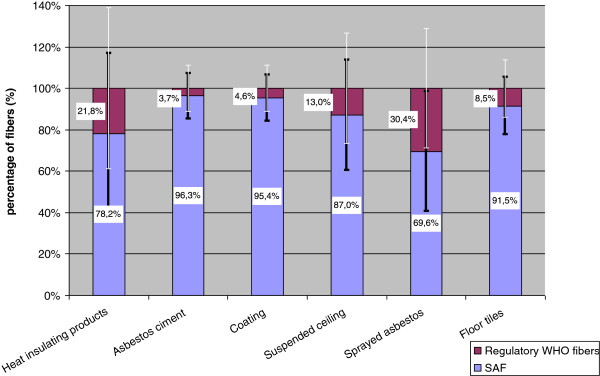
- In 105 positive indoor air samples from 64 French public buildings (1997–2004), 40 contained only SAF, sometimes at >10 f.L−1; SAF mean concentrations varied by ACM type: heat insulation 91 f.L−1, floor tiles 36.2 f.L−1, sprayed asbestos 20.4 f.L−1, suspended ceiling 5.1 f.L−1, coating 2.4 f.L−1, asbestos cement 0.9 f.L−1. Regulatory WHO fibers represented less than 20% of the size distribution.
- In 192 occupational samples re-analyzed by TEM, >45,000 fibers were counted, 98% chrysotile; average/maximum concentrations were 16.3/505.2 f.mL−1 for SAF, 0.4/18.4 f.mL−1 for LAF with diameter <0.2 μm, and 0.5/9.3 f.mL−1 for PCM-measured fibers. SAF made up 87–96% and LAF <0.2 μm made up 2.1–5.6%.
- Experimental data show SAF are less active than LAF but not harmless: in rats, amosite inhalation produced 0% lung tumors and 2.4% mesotheliomas with SAF versus 27.5% lung tumors and 7.5% mesotheliomas with LAF; chrysotile inhalation produced 17.5% lung tumors with SAF versus 50% with LAF. After intraperitoneal injection of 25 mg amosite, mesothelioma incidence was 4% for SAF versus 90% for LAF.
- Recent epidemiological studies found cumulative exposures to all fiber size classes, including fibers ≤5 μm, were statistically significant predictors of lung cancer mortality, but high correlations across size categories complicate distinguishing a specific biological role for short fibers.
Methods
- Narrative review of peer-reviewed and grey literature; PubMed searches used keyword groups including “asbestos toxicity”, “epidemiology OR animal OR in vitro”, and “short OR long”; papers on fiber-dimension effects and size distributions were selected, plus public reports from ATSDR, NIOSH, US-EPA, HSL-UK, and FIOH.
- Original re-analysis of air samples by transmission electron microscopy (TEM): 105 indoor samples from 64 public buildings in the Paris area (1997–2004), 115 outdoor samples from Ile de France (1993–1995), and 192 occupational samples from IRSST Québec (1990–2006) re-analyzed by LEPI.
- Synthesis of experimental in vivo and in vitro studies, including animal inhalation, intratracheal instillation, intracavitary injection, cell culture cytotoxicity/genotoxicity assays, and biopersistence studies.
Limitations
- Stated in the paper: the 64 indoor buildings were not representative of all French buildings; the epidemiological review remains fragmented; uncertainties in exposure estimates, non-representative measurement data, and the presence of fibers ≥5 μm in lower-risk sectors prevent a formal conclusion on SAF carcinogenicity; ATSDR found no validated epidemiological morbidity or mortality data associated with SAF.
- Stated in the paper: generating samples containing only SAF is difficult and usually leaves a small percentage of LAF; sample preparation can alter fiber properties; biopersistence results are conflicting; and the 5 μm length limit is not based on scientific evidence but was chosen for practical analytical reasons.
- Evident from the text: the review is not a systematic review or meta-analysis, relies on heterogeneous older studies with different methods and exposure metrics, and includes no new primary epidemiological data.
Model-written summary. Check it against the paper before relying on it.
Integrity signals
Registry
Cites
Statistics
Figures
Verification
Claims the paper makes
5 Valid · 11 Not valid · 175 Not checked · 70 Own results and interpretations
Every source the paper cites for this claim was checked and supports it.
In the paper
“The model for TEM fibers > 5 μm of length fits the data better than models for other TEM exposure indicators of size classes.”
§ Quantification of short and long asbestos fibers to assess asbestos exposure: a review of fiber size toxicity > Background > Human exposure to asbestos fibers
What the sources say
- Supportedcites [34] Loomis D Dement J Richardson D Wolf S Asbestos fibre dimensions and lung cancer mortality among workers exposed to chrysotile Occup Environ Med 2010 67 580 584 19897464 PMC2975987 source
The Results section 'Lung cancer risk and TEM fibres' states verbatim in substance that 'The model for TEM fibres >5 μm long... fit the data better than models for other TEM exposure indicators and the exposure term was more highly significant (p=0.004)', with Table 1 showing the lowest AIC among TEM indicators (2344.2 vs 2345.1 total TEM and 2345.3 for <5 μm). The claim's narrower framing ('other TEM exposure indicators of size classes') is a subset of the source's broader statement, so nothing attributed is unsupported. Consistent with the Abstract Results and the fibre-size-category results, where longer/thinner fibre models fit best. (LLM, conf=0.90)
plainstates an association- Asserted: passes — The authors put it forward as true.
- Checkable: passes — It can be checked against evidence.
- Load-bearing: unclear — It is unclear whether the paper’s conclusions depend on it.
- Based: passes — The paper gives a reason why it holds.
- Supported
Every source the paper cites for this claim was checked and supports it.
In the paper
“Moreover, biopersistence is dependent on the chemical stability of the fibers.”
§ Quantification of short and long asbestos fibers to assess asbestos exposure: a review of fiber size toxicity > Background > Hypotheses on the mechanism of action of asbestos fibers
What the sources say
- Supportedcites [38] Mossman BT Lippmann M Hesterberg TW Kelsey KT Barchowsky A Bonner JC Pulmonary endpoints (lung carcinomas and asbestosis) following inhalation exposure to asbestos J Toxicol Environ Health Part B Critical Rev 2011 14 76 121 PMC3118517 21534086 source
In 'FACTORS THAT INDUCE FIBER TOXICITY' our copy states that persistence is 'a function of fiber durability' and that fibers 'whose chemical composition renders them wholly or partially soluble once deposited in the lung' either dissolve completely or weaken and break into shorter, clearable fibers — i.e. biopersistence tracks the fibers' chemical stability/durability. The 'Disadvantages of In Vitro Assays' subsection lists among the determinants of biopersistence 'their lack of solubility in lung fluids (durability)', alongside clearance, breakage and membrane transport, so chemical durability is presented as a (not the sole) dependency, which the claim's wording does not exclude. (LLM, conf=0.85)
plainstates a cause- Asserted: passes — The authors put it forward as true.
- Checkable: passes — It can be checked against evidence.
- Load-bearing: unclear — It is unclear whether the paper’s conclusions depend on it.
- Based: passes — The paper gives a reason why it holds.
- Supported
The cited sources support only part of this claim — read each source’s verdict below.
In the paper
“Studies conducted with crocidolite fibers showed a lower retention of fibers < 5 μm compared to fibers > 5 μm or > 20 μm [112,113] or to WHO fibers [114].”
§ Quantification of short and long asbestos fibers to assess asbestos exposure: a review of fiber size toxicity > Background > Hypotheses on the mechanism of action of asbestos fibers
What the sources say
- Not checked — no full text of the sourcecites [112] Eastes W Hadley JG Dissolution of fibers inhaled by rats Inhal Toxicol 1995 7 179 196 source
- Partly supportedcites [113] Musselman RP Miiller WC Eastes W Hadley JG Kamstrup O Thevenaz P Hesterberg TW Biopersistences of man-made vitreous fibers and crocidolite fibers in rat lungs following short-term exposures Environ Health Perspect 1994 102 139 143 7882918 PMC1567257 sourceExperimental — accuracy not yet measured
Our copy supports the length comparison: the Results state that 'Long crocidolite fiber retention tended to be prolonged compared to retention of crocidolite particles (i.e., <5 [mu]m long)... beginning after 31 days,' and Table 2 gives 545-day percent retention of 17% for <5 [mu]m versus 33% for >5 [mu]m and 38% for >20 [mu]m crocidolite. However, the paper hedges this as a tendency ('tended to be higher'; PRs of >10 [mu]m 'did not differ significantly' from those of <=5 [mu]m), whereas the citing sentence states it flatly. Nothing in our copy reports retention of crocidolite expressed against WHO-definition fibers — WHO fibers appear only in the Methods as the counting convention (phase contrast microscopy for total and WHO fiber numbers, ref. 8) — so that part of the sentence is not supported by this source. (LLM, conf=0.78)
- Not checked — no full text of the sourcecites [114] Hesterberg TW Miiller WC Musselman RP Kamstrup O Hamilton RD Thevenaz P Biopersistence of man-made vitreous fibers and crocidolite asbestos in the rat lung following inhalation Fundam Appl Toxicol 1996 29 267 279 8742325 source
plainstates an association- Asserted: passes — The authors put it forward as true.
- Checkable: passes — It can be checked against evidence.
- Load-bearing: unclear — It is unclear whether the paper’s conclusions depend on it.
- Based: passes — The paper gives a reason why it holds.
In the paper
“Samples only contained chrysotile.”
§ Quantification of short and long asbestos fibers to assess asbestos exposure: a review of fiber size toxicity > Background > Human exposure to asbestos fibers
What the sources say
- Not checked yetcites [1] AFSSET Influence of Asbestos Fibers Dimensions to the Health Risk Characterization: Toxicological, Metrological and Epidemiological Data Review in Order to Carry out an Health Risk Assessment for the General Population and the Workers (in French) 2009 Maisons-Alfort: AFSSET 394
plainn = 115- Asserted: passes — The authors put it forward as true.
- Checkable: passes — It can be checked against evidence.
- Load-bearing: unclear — It is unclear whether the paper’s conclusions depend on it.
- Based: passes — The paper gives a reason why it holds.
In the paper
“Concentrations and percentages of SAF apparently varied according to the type of ACM.”
§ Quantification of short and long asbestos fibers to assess asbestos exposure: a review of fiber size toxicity > Background > Human exposure to asbestos fibers
What the sources say
- Not checked yetcites [1] AFSSET Influence of Asbestos Fibers Dimensions to the Health Risk Characterization: Toxicological, Metrological and Epidemiological Data Review in Order to Carry out an Health Risk Assessment for the General Population and the Workers (in French) 2009 Maisons-Alfort: AFSSET 394
hedgedstates an associationn = 105- Asserted: passes — The authors put it forward as true.
- Checkable: passes — It can be checked against evidence.
- Load-bearing: unclear — It is unclear whether the paper’s conclusions depend on it.
- Based: passes — The paper gives a reason why it holds.
105 more claims
Create a free account to see all 261 claims and to verify the 84 references still open.
- It may state two separate claims as one. 109
- Probably not a substantial claim. 64
- The quote only partly states this claim. 1
Claims other papers make about this one
Each is checked against this paper’s own text: does it say what the citing paper says it does?
The source backs part of the claim, not all of it — or backs it for a different population, condition or comparison.
In the citing paper
“This is efficient when the mean diameter of the particles/fibers is smaller than the mean diameter of the macrophage (10 microns) but, when the size exceeds this, there can be incomplete phagocytosis and clearance [93].”
From Asbestos and Iron (2023) · cites this paper as [93]
Experimental — accuracy not yet measuredIn the citing paper
“When inhaled chrysotile fibers are present in the lung and pleura, the lung clearance of the fibers is more rapid than amphibole due to longitudinal cleavage into fibrils, which can break and be phagocytized easier by the macrophages [30].”
From A Review of Asbestos Bioweathering by Siderophore-Producing Pseudomonas: A Potential Strategy of Bioremediation (2020) · cites this paper as [30]
Self-check
Percentages, sums and reported differences re-computed from the paper’s own numbers.
Each contradiction between two passages listed here was confirmed by an independent check.
Rated minor: it would not touch a result — a value no result rests on, a p-value that stays on the same side of the significance level, or a conflict that is clerical, resolved elsewhere in the paper, or outside its own findings.
In the paper
§ Quantification of short and long asbestos fibers to assess asbestos exposure: a review of fiber size toxicity > Background > Synthesis of experimental studies of cancer
“A publication by Stettler et al. [72] complemented that of Platek et al. [71] by extending the post-exposure period to 15.5 years in monkeys.”
§ Quantification of short and long asbestos fibers to assess asbestos exposure: a review of fiber size toxicity > References
“72. Stettler LE Sharpnack DD Krieg EF Chronic inhalation of short asbestos: Lung fiber burdens and histopathology for monkeys maintained for 11.5 years after exposure”
Rated minor: it would not touch a result — a value no result rests on, a p-value that stays on the same side of the significance level, or a conflict that is clerical, resolved elsewhere in the paper, or outside its own findings.
In the paper
§ Quantification of short and long asbestos fibers to assess asbestos exposure: a review of fiber size toxicity > Background > Studies carried out with cell systems in culture
“Among the 10 samples of chrysotile fibers tested, 5 induced a significant increase in the number of cells with mitotic abnormalities and 5 remained without significant effect.”
§ Quantification of short and long asbestos fibers to assess asbestos exposure: a review of fiber size toxicity > Background > Studies carried out with cell systems in culture
“| Calidria | 0.5 | 4.8 | 19.6 | 1.5 | | NIEHS | 0.5 | 1.2 | 3.1 | 0.4 | | UICCA | 0.5 | 0.8 | 10.2 | 0.3 | | 4.4.3 | 1.0 | 1.1 | 15.9 | 0.3 | | 4.4.5 | 1.0 | 1.8 | 14.2 | 1.0 | | SF | 1.0 | 0.4 | 3.9 | 0.2 | | P3 | 1.0 | 1.3 | 3.7 | 0.66 | | Pmilled | 2.0 | 3.7 | 9.3 | 2.1 |”
Citations
Cites
The quantitative risks of mesothelioma and lung cancer in relation to asbestos exposure
Hodgson, J. (2000) · The Annals of Occupational Hygiene · doi:10.1016/s0003-4878(00)00045-4 · Cited by 661
Carcinogenicity of Fibrous Glass: Pleural Response in the Rat in Relation to Fiber Dimension
Stanton, M. F., Layard, M., Tegeris, A., Miller, E., May, M., & Kent, E. (1977) · JNCI: Journal of the National Cancer Institute · doi:10.1093/jnci/58.3.587 · Cited by 467 · cited 2×
“In a first study, the authors implanted 70 fiber samples of various size distributions in the pleura of rats [57,58].”
BackgroundA Meta-Analysis of Asbestos-Related Cancer Risk That Addresses Fiber Size and Mineral Type
Berman, D. W., & Crump, K. S. (2008) · Critical Reviews in Toxicology · doi:10.1080/10408440802273156 · Cited by 246 · cited 1×
“Others publications found that the risk of asbestosrelated cancer mortality increases with exposure to longer and thinner fibers, particularly for lung cancer [28,29].”
BackgroundEffects of fiber characteristics on lung deposition, retention, and disease.
Lippmann, M. (1990) · Environmental Health Perspectives · doi:10.1289/ehp.9088311 · Cited by 203
Pulmonary Endpoints (Lung Carcinomas and Asbestosis) Following Inhalation Exposure to Asbestos
Mossman, B. T., Lippmann, M., Hesterberg, T. W., Kelsey, K. T., Barchowsky, A., & Bonner, J. C. (2011) · Journal of Toxicology and Environmental Health, Part B · doi:10.1080/10937404.2011.556047 · Cited by 192 · cited 4×
“Due to the airway anatomy and the mechanisms of particle deposition, large particles are eliminated in the upper airways [38].”
BackgroundInfluentialUpdate of potency factors for asbestos-related lung cancer and mesothelioma
Berman, D. W., & Crump, K. S. (2008) · Critical Reviews in Toxicology · doi:10.1080/10408440802276167 · Cited by 188 · cited 1×
“Others publications found that the risk of asbestosrelated cancer mortality increases with exposure to longer and thinner fibers, particularly for lung cancer [28,29].”
BackgroundSchinwald, A., Murphy, F. A., Prina-Mello, A., Poland, C. A., Byrne, F., Movia, D., Glass, J. R., Dickerson, J. C., Schultz, D. A., Jeffree, C. E., et al. (2012) · Toxicological Sciences · doi:10.1093/toxsci/kfs171 · Cited by 181 · cited 1×
“[81] injected several types of fibers with different lengths (metallic nanofibers and amosite) in the pleural cavity of mice.”
BackgroundRole of Mutagenicity in Asbestos Fiber-Induced Carcinogenicity and Other Diseases
Huang, S. X. L., Jaurand, M.-C., Kamp, D. W., Whysner, J., & Hei, T. K. (2011) · Journal of Toxicology and Environmental Health, Part B · doi:10.1080/10937404.2011.556051 · Cited by 163 · cited 1×
“As far as carcinogenesis is concerned, asbestos fibers were found to be mutagenic, an important effect in carcinogenesis [94].”
BackgroundSelf-citationHesterberg, T. W., Chase, G., Axten, C., Miller, W. C., Musselman, R. P., Kamstrup, O., Hadley, J., Morscheidt, C., Bernstein, D. M., & Thevenaz, P. (1998) · Toxicology and Applied Pharmacology · doi:10.1006/taap.1998.8472 · Cited by 149
Asbestos fiber length as related to potential pathogenicity: A critical review
Dodson, R. F., Atkinson, M. A. L., & Levin, J. L. (2003) · American Journal of Industrial Medicine · doi:10.1002/ajim.10263 · Cited by 141 · cited 1×
“Several investigators have suggested that SAF may play a role in the induction of pathologies, particularly cancer, and do not recommend immediately ruling out this particle size class [19-22].”
Background
Research works printed but not linked: 11
- AFSSET Influence of Asbestos Fibers Dimensions to the Health Risk Characterization: Toxicological, Metrological and Epidemiological Data Review in Order to Carry out an Health Risk Assessment for the General Population and the Workers (in French) 2009 Maisons-Alfort: AFSSET 394
- AFNOR X43-050. Qualité de l’air - Détermination de la Concentration en Fibres d’amiante par Microscopie Électronique à Transmission - Méthode Indirecte. Association Française de Normalisation 1996 La Plaine Saint-Denis: AFNOR 42
- AFNOR XP X 43–269. Qualité de l’air - Air des Lieux de Travail - Détermination de la Concentration en Nombre de Fibres par Microscopie Optique en Contraste de Phase - Méthode du Filtre à Membrane 2002 La Plaine Saint-Denis: AFNOR 40
- ATSDR Eastern Research Group,Inc Report on the Expert Panel on Health Effects of Asbestos and Synthetic Vitreous Fibers: The Influence of Fiber Length 2003 Altanta: US Department of Health and Human Services
- Gilbert S Stayner L Kuempel E Dement J Determining an Optimal Exposure Metric from a Bivariate Distribution of Asbestos Exposures (Length, Diameter) in a Cohort of South Carolina Textile Workers Joint Statistical Meetings 2006 2006 Seattle, Washington (DC) (Poster). http://www.amstat.org/meetings/jsm/2006/onlineprogram/index.cfm?fuseaction=abstract_details&abstractid=307203
- Campbell WJ Huggins CW Wylie AG Chemical and physical characterization of amosite, chrysotile, crocidolite, and nonfibrous tremolite for oral ingestion studies by the National Institute of Environmental Health Sciences 1980 Washington, D.C.: U.S. Dept. of the Interior, U.S. Bureau of Mines 63
- Wagner JC Biological Effects of Short Fibers Proceedings of the VIIth International Pneumoconioses Conference. VIIth International Pneumoconioses Conference, August 23-26 1988 Pittsburgh, (PA) 835 840 http://www.cdc.gov/niosh/docs/90-108/pdfs/90-108-1.pdf
- National Toxicological Program (NTP) 12th Report on Carcinogens (RoC) 2011
- Berman DW Crump KS Chatfield EJ Davis JMG Jones AD The sizes, shapes, and mineralogy of asbestos structures that induce lung tumors or mesothelioma in AF/HAN rats following inhalation Risk Anal 1995 15 181 195 7597255 · DOI · Paper page
- Wagner JC Significance of the fibre size of erionite Proceedings of the VIIth International Pneumoconioses Conference. VIIth International Pneumoconioses Conference, August 23-26 1988 Pittsburgh, (PA) 158 159 http://www.cdc.gov/niosh/docs/90-108/pdfs/90-108-1.pdf
- Egilman DS Continued controversy on chrysotile biopersistence Int J Occup Environ Health 2011 17 99 102 21344825
Cited by
Items 101–184 of 184
Misleading “New Insights into the Chrysotile Debate”
Woitowitz, H. ‐., & Baur, X. (2018) · Pneumologie · doi:10.1055/s-0044-102169 · Cited by 9
“Uniformly, experienced research groups described a half-life of amphiboles of a few years with an extreme of 20 years [11 – 15] whereas half-life of chrysotile was found to be in the range of several months [15 – 17] (see also below).”
BackgroundA postmortem case control study of asbestos burden in lungs of malignant mesothelioma cases
Visoná, S. D., Bertoglio, B., Favaron, C., Capella, S., Belluso, E., Colosio, C., Villani, S., Ivic‐Pavlicic, T., & Taioli, E. (2023) · Journal of Translational Medicine · doi:10.1186/s12967-023-04761-9 · Cited by 10
“However, the widely shared opinion is that fibers longer than 10 μm play the most important role in MM and lung cancer causation [1, 28, 29].”
BackgroundAsbestos in Talc and Mesothelioma: Review of the Causality Using Epidemiology
Kanarek, M. S., & Liegel, J. (2020) · Medical Research Archives · doi:10.18103/mra.v8i5.2097 · Cited by 8
A multidisciplinary review of several aspects of Asbestos-Related Lung Cancer (ARLC)
van Zandwijk, N., & Frank, A. L. (2024) · Lung Cancer · doi:10.1016/j.lungcan.2024.107474 · Cited by 8
Cigarette filters as a major source of microfibers in aquatic environments
Mohammadi, A., Bahrani, F., De-la-Torre, G. E., Saeedi, R., Renner, G., Schmidt, T. C., & Dobaradaran, S. (2025) · Scientific Reports · doi:10.1038/s41598-025-20771-7 · Cited by 7
“The aspect ratio and length of MFs is an important factor affecting their toxicity 69,70 .”
Bertolotti, M., Tamburro, M., Salzo, A., Cassinari, A., Crivellari, S., Bertolina, C., Farotto, M., Adesso, C., Palma, M. A. D., Natale, A., et al. (2024) · Preventive Medicine Reports · doi:10.1016/j.pmedr.2024.102940 · Cited by 8
“The health risks associated with asbestos exposure depend on several factors, including the concentration of fibres in the air, the length of exposure, the type and size of the fibres (Pawe ł czyk and Bo ˇ zek, 2015; Boulanger et al., 2014; Ramada Rodilla et al., 2022).”
Huo, T., Dong, F., Jianjun, D., Zhang, Q., Ye, W., Zhang, W., Wang, P., & Sun, D. (2017) · Environmental Science and Pollution Research · doi:10.1007/s11356-017-9796-5 · Cited by 7
“…including mineral identity and chemical composition (Rapisarda et al. 2015), morphological aspect ratio of the asbestos fibers (Aust et al. 2011; Boulanger et al. 2014; Donaldson et al. 2011; Schinwald et al. 2012), surface activity (Yu et al. 2016), biopersistence (Bernstein et al. 2001), and…”
BackgroundLaser vs. thermal treatments of green pigment PG36: coincidence and toxicity of processes
Bauer, E., Cecchetti, D., Guerriero, E., Nisticò, S. P., Germinario, G., Sennato, S., Gontrani, L., Tagliatesta, P., & Carbone, M. (2021) · Archives of Toxicology · doi:10.1007/s00204-021-03052-w · Cited by 7
“2012), whereas the toxicity of SiO2 fibers is known, especially with an aspect ratio L/D > 3 (L = length, D = diameter) (Boulanger et al. 2014).”
BackgroundMalignant Mesothelioma: Mechanism of Carcinogenesis
Kane, A. B., Jean, D., Knuutila, S., & Jaurand, M. (2020) · Springer eBooks · doi:10.1007/978-3-030-30766-0_19 · Cited by 7
Self-citationLescano, L., Locati, F., Sfragulla, J. A., Marfil, S. A., Bonalumi, A., & Maiza, P. (2017) · Environmental Earth Sciences · doi:10.1007/s12665-017-6969-y · Cited by 7
“Regarding the effect of short fibres (\5 lm), there are studies that recommend taking them into account because they may play a role in the induction of pathologies such as cancer (Dodson et al. 2003; Boulanger et al. 2014; Markowitz 2015), although their bioreactivity and toxicity would be substantially lower compare…”
BackgroundMcDonald, S. A., Fan, Y., Rogers, R. A., & Godleski, J. J. (2019) · Ultrastructural Pathology · doi:10.1080/01913123.2019.1692119 · Cited by 7
Bardelli, F., Brun, F., De Panfilis, S., Cloetens, P., Capella, S., Belluso, E., Bellis, D., Di Napoli, A., & Cedola, A. (2021) · Toxicology Letters · doi:10.1016/j.toxlet.2021.05.002 · Cited by 6
Detection of fine asbestos fibers using fluorescently labeled asbestos-binding proteins in talc
Nishimura, T., Ishida, T., Funabashi, H., Hirota, R., Ikeda, T., & Kuroda, A. (2023) · Journal of Hazardous Materials Advances · doi:10.1016/j.hazadv.2023.100332 · Cited by 6
An Overview on the Safety of Tubular Clay Minerals
Jaurand, M. (2016) · Developments in clay science · doi:10.1016/b978-0-08-100293-3.00020-0 · Cited by 6
Self-citationFerruginous bodies resolved by synchrotron XRF in a dog with peritoneal malignant mesothelioma
Pascotto, E., Gianoncelli, A., Calligaro, C., Marcuzzo, T., Melato, M., Rizzardi, C., & Pascolo, L. (2018) · Environmental Science and Pollution Research · doi:10.1007/s11356-018-3521-x · Cited by 6
Fibrogenic effects of crocidolite, amosite, and chrysotile asbestos fibers on lung fibroblasts
Yu, S., Choi, H.-H., Park, G., Kim, I. W., & Kim, T. J. (2019) · Toxicological & Environmental Chemistry Reviews · doi:10.1080/02772248.2019.1625358 · Cited by 6
“It was shown that asbestos cytotoxicity is correlated with fiber length (Boulanger et al. 2014) and adverse effects of asbestos minerals, including carcinogenicity, depend on the type of fiber (Brunner et al. 2006) and cumulative exposure (Scimeca et al. 2016).”
BackgroundMalignant Pleural Mesothelioma: History, Controversy, and Future of a Man-Made Epidemic
Røe, O. D., & Stella, G. M. (2017) · Current cancer research · doi:10.1007/978-3-319-53560-9_4 · Cited by 7
Białas, N., Rosenkranz, N., Weber, D. G., Kostka, K., Johnen, G., Winter, A., Brik, A., Loza, K., Szafranski, K., Brüning, T., et al. (2024) · Particle and Fibre Toxicology · doi:10.1186/s12989-024-00586-6 · Cited by 6
“This reflects the strong toxicity of asbestos and MWCNT in vivo [3, 11].”
BackgroundInfluentialFeldman, D. S. (2021) · Materials · doi:10.3390/ma14164572 · Cited by 6
The effect of short silica fibers (0.3 μm 3.2 μm) on macrophages
Olejnik, M., Breisch, M., Sokolova, V., Loza, K., Prymak, O., Rosenkranz, N., Westphal, G., Bünger, J., Köller, M., Sengstock, C., et al. (2021) · The Science of The Total Environment · doi:10.1016/j.scitotenv.2020.144575 · Cited by 7
Franken, R., Tromp, P., Ervik, T. K., Staff, J. F., Jensen, K. A., Eypert-Blaison, C., Brostrøm, A., Cannizzaro, A., Cabo, M. T. S., Bruno, M. R., et al. (2025) · Annals of Work Exposures and Health · doi:10.1093/annweh/wxaf023 · Cited by 4
Banning asbestos in talcum powder: Time for action in India
Singh, S., Pradhan, S. R., Yadav, A., & Singh, P. K. (2023) · Dialogues in Health · doi:10.1016/j.dialog.2023.100158 · Cited by 4
“The length of the fibers is closely linked to the associated health risks [63].”
Zahiu, T., Mihu, C. M., Boşca, A. B., Mărginean, M. V., Mocan, L. P., Lupean, R.-A., Suflețel, R. T., Mihu, C., & Melincovici, C. S. (2025) · Diagnostics · doi:10.3390/diagnostics15111323 · Cited by 6
“The WHO indicates that fibres under 3 µ m in diameter and over 5 µ m in length, with a length-to-diameter ratio greater than 3, pose the highest mesothelioma risk due to their ability to penetrate the lung and pleura, evading removal [17–19].”
First Identification of Pulmonary Asbestos Fibres in a Spanish Population
Velasco‐García, M., Cruz, M. J., Diego, C., Montero, M., Álvarez-Simón, D., & Ferrer, J. (2017) · Lung · doi:10.1007/s00408-017-0042-1 · Cited by 4
Barium sulphate microparticles are taken up by three different cell types: HeLa, THP-1, and hMSC
Sokolova, V., Loza, K., Ebel, J., Buer, J., Westendorf, A. M., & Epple, M. (2023) · Acta Biomaterialia · doi:10.1016/j.actbio.2023.03.043 · Cited by 4
Quantitative Assessment of Asbestos Fibers in Abdominal Organs: A Scoping Review
Caraballo-Arias, Y., Roccuzzo, F., Graziosi, F., Danilevskaia, N., Rota, S., Zunarelli, C., Caffaro, P., Boffetta, P., Bonetti, M., & Violante, F. S. (2023) · La Medicina del Lavoro · doi:10.23749/mdl.v114i6.14946 · Cited by 4
“It is known that the fibrogenicity and carcinogenicity of asbestos fibers depend on several fiber parameters including fiber dimensions [24].”
BackgroundUnderstanding exposure risk using soil testing and GIS around an abandoned asbestos mine
Jadhav, A., Gawde, N. C., Veerappan, R., Choi, Y., & Frank, A. L. (2025) · Annals of Global Health · doi:10.5334/aogh.4624 · Cited by 4
Coupled SEM-EDS-RAMAN: A complimentary approach for characterisation – Application to geomaterials
Wille, G., Lahondère, D., & Kloppmann, W. (2025) · IOP Conference Series Materials Science and Engineering · doi:10.1088/1757-899x/1324/1/012012 · Cited by 4
Gualtieri, A. F., Glossop, L., Malferrari, D., Castellini, E., Gualtieri, M. L., Hanuskovà, M., Nodari, L., Ogor, J., & Fantini, R. (2025) · Applied Clay Science · doi:10.1016/j.clay.2025.107917 · Cited by 4
Malignant mesothelioma as a difficult interdisciplinary problem
Rokicki, W., Rokicki, M., Wojtacha, J., & Rydel, M. (2017) · Polish Journal of Cardio-Thoracic Surgery · doi:10.5114/kitp.2017.72232 · Cited by 4
“01 μm or less in diameter) pose the greatest danger as they permeate into the lower respiratory tract, digging into the tissue of the parietal pleura and the lungs; by chronically irritating the surrounding cells, they may cause the development of lung cancer or malignant pleural mesothelioma (MPM) [2].”
BackgroundShao, Y., MacLehose, R. F., Lin, L., Hwang, J., Alexander, B. H., Mandel, J. H., & Ramachandran, G. (2020) · Annals of Work Exposures and Health · doi:10.1093/annweh/wxaa074 · Cited by 4
Wang, A., Gupta, A. B., Grimm, M. D., Pressburger, D. T., Sparrow, B., Richey, J. S., Shaw, J. R., Elsass, K. E., Roberts, G., Yao, P., et al. (2023) · Inhalation Toxicology · doi:10.1080/08958378.2023.2220737 · Cited by 4
“Due to apparent visual similarities, particularly among the amphiboles, characterization by morphology alone is not considered a reliable methodology to identify asbestos fibers, thus microscopy is typically combined with other analytical approaches (Boulanger et al. 2014).”
BackgroundGwenzi, W. (2021) · Wiley eBooks · doi:10.1002/9781119710134.ch1 · Cited by 4
Wang, A., Gupta, A. B., Grimm, M. D., Pressburger, D. T., Sparrow, B., Richey, J. S., Shaw, J. R., Elsass, K. E., Roberts, G., Yao, P., et al. (2023) · Inhalation Toxicology · doi:10.1080/08958378.2023.2220735 · Cited by 3
“With respect to biopersistence, previous studies reported fiber dimension was one of the most important determinants of pathogenicity and cancer development (Davis et al. 1986; McConnell et al. 1999; Oberdorster 2000; Boulanger et al. 2014).”
Mesothelioma from Asbestos Exposure in Brake Mechanics: Epidemiology in Context
Kanarek, M. S. (2018) · Epidemiology Open Access · doi:10.4172/2161-1165.1000340 · Cited by 3
Janik, H., & Wrona, M. (2017) · Elsevier eBooks · doi:10.1016/b978-0-12-409547-2.14311-2 · Cited by 3
Podlipec, R., Sebastijanović, A., Cassidy, H., Han, L., Danielsen, P., Čotar, P., Kokot, H., Koser, B. K., Vencelj, A., Pirker, L., et al. (2024) · bioRxiv (Cold Spring Harbor Laboratory) · doi:10.1101/2024.01.07.574515 · Cited by 4
“Longer fibers generally pose greater toxicity 11 , but even shorter fibers (less than 5 μm) are not harmless 12 .”
BackgroundLiu, F., Ren, Y., Yu, S., Wang, Y., Zhang, C., Dong, Q., Sun, C., & Qian, H. (2026) · Building and Environment · doi:10.1016/j.buildenv.2026.114620 · Cited by 2
Effects of different amosite preparations on macrophages, lung damages, and autoimmunity
Lescoat, A., Leinardi, R., Pouxvielh, K., Yakoub, Y., Lelong, M., Pochet, A., Dumontet, E., Bellamri, N., Tallec, E. L., Pavan, C., et al. (2023) · Journal of Molecular Medicine · doi:10.1007/s00109-023-02401-9 · Cited by 2
“However, indoor air samples usually contain more than 70% of short respirable asbestos fibers [15], i.e., the fibers characterized by L < 5 µm, D < 3 µm, and L/D > 3.”
Self-citationMirata, S., Almonti, V., Passalacqua, M., Vernazza, S., Bassi, A. M., Giuseppe, D. D., Gualtieri, A. F., & Scarfì, S. (2024) · Toxicology · doi:10.1016/j.tox.2024.154032 · Cited by 2
Asbestos and the Pathophysiology of Mesothelioma
van Zandwijk, N., & Reid, G. (2019) · Springer eBooks · doi:10.1007/978-3-030-16884-1_2 · Cited by 3
Inobeme, A., Adekoya, M. A., Mathew, J. T., Inobeme, J., Omali, P., & Awuzie, S. (2024) · Elsevier eBooks · doi:10.1016/b978-0-443-15459-1.00008-5 · Cited by 1
Leinardi, R., Petriglieri, J. R., Uwambayinema, F., Pochet, A., Yakoub, Y., Ibouraadaten, S., Tomatis, M., Lescoat, A., Turci, F., Lecureur, V., et al. (2025) · Journal of Hazardous Materials · doi:10.1016/j.jhazmat.2025.139648 · Cited by 2
“To date, in contrast, there is no study specifically dedicated to address the biopersistence of short amphibole fibers (L 5 µ m), whose pulmonary toxicity is still debated [10,12,21,26 – 29].”
Nanowaste management in laboratory practice – a technical guideline
Schwab, F., Rothen‐Rutishauser, B., Scherz, A., Meyer, T., Karakoçak, B. B., & Petri‐Fink, A. (2026) · Environmental Science Nano · doi:10.1039/d6en00013d · Cited by 1
Giordani, M., Nasoni, M. G., Bargagni, E., Cangiotti, M., Luchetti, F., & Mattioli, M. (2026) · Environmental Pollution · doi:10.1016/j.envpol.2026.128030 · Cited by 2
Timalsina, B., Ghimire, N. P., & Uprety, Y. (2026) · Journal of Ecology and Environment · doi:10.5141/jee.26.001 · Cited by 1
Mesothelioma Heterogeneity: Potential Mechanisms
Felley-Bosco, E. (2019) · MDPI eBooks · doi:10.3390/books978-3-03897-474-1 · Cited by 1
Nkechi, A. C., Okorie, E. A., Ilo, C. I., Okeke, M. U., Nwankwo, C. J., EChukwudebelu, A., Okwudili, M. N., Nwazunku, A. A., Odupute Colman, N., & Ojo, O. K. (2021) · Magna Scientia Advanced Research and Reviews · doi:10.30574/msarr.2021.3.1.0066 · Cited by 1
Maghin, F., Antonietti, A., Cerri, N., Lancini, L. M., Maccarinelli, A., Manzoni, S., Restori, M., Rota, M., Ruffini, D., Verzeletti, A., et al. (2022) · Legal Medicine · doi:10.1016/j.legalmed.2022.102076 · Cited by 1
Gardner, M., Cross, M., Reed, S., Davidson, M., Hughes, R., & Oosthuizen, J. (2022) · International Journal of Environmental Research and Public Health · doi:10.3390/ijerph192416649 · Cited by 1
“Indeed, the concentration of fibres that fulfil specific dimensional metrics is used as the basis for regulatory threshold levels for asbestiform fibre exposure [32].”
BackgroundMathematical Modeling of Cancer Potency for Various Fibrous Minerals
Korchevskiy, A. A., Rasmuson, J., & Rasmuson, E. J. (2024) · Wiley eBooks · doi:10.1002/9781119438397.ch11 · Cited by 1
Fraser, K. (2021) · The Research Repository @ WVU (West Virginia University) · doi:10.33915/etd.8085 · Cited by 1
Study of lung asbestos content in a Spanish population
García, V., & Isabel, M. (2014) · TDX (Tesis Doctorals en Xarxa)
Biomarkers of Response to Asbestos Exposure
Mesaros, C., Weng, L., & Blair, I. A. (2017) · Current cancer research · doi:10.1007/978-3-319-53560-9_12
Etude des facteurs associés au mésothéliome chez la femme
Stang, N. L. (2018) · theses.fr (ABES) · doi:10.70675/fda162b6zf768z46cdz9813zb0e66272e526
Nowak, A. K., Edwards, J. G., & Creaney, J. (2017) · Wiley eBooks · doi:10.1002/9781119196235.ch16
Bruno, M. R., Cannizzaro, A., Olori, A., Tombolini, F., Angelosanto, F., Sinopoli, F., Bruni, B. M., Casalinuovo, F., & Campopiano, A. (2022) · The Science of The Total Environment · doi:10.1016/j.scitotenv.2022.159061
Voloaca, O. M. (2022) · Sheffield Hallam University · doi:10.7190/shu-thesis-00479
Lescoat, A., Leinardi, R., Pouxvielh, K., Yacoub, Y., Lelong, M., Pochet, A., Dumontet, E., Bellamri, N., Tallec, E. L., Pavan, C., et al. (2023) · Research Square · doi:10.21203/rs.3.rs-2504079/v1
Self-citationSarin, H. (2023) · IntechOpen eBooks · doi:10.5772/intechopen.112595
Toxicity of nanomaterials used in oil–water separation
Latif, S., Imran, M., Siddique, H., & Hussain, N. (2024) · Elsevier eBooks · doi:10.1016/b978-0-323-95517-1.00014-7
ANALYSIS OF ASBESTOS IN BUILDING MATERIALS – CASE IN TOWN SKOPJE
Stefov, V., & Boev, B. (2024) · Contributions Section of Natural Mathematical and Biotechnical Sciences · doi:10.20903/masa/nmbsci.2022.43.11
Methods for treatment of asbestos-containing wastes for their safe disposal and gainful utilization
Singh, R., & Budarayavalasa, S. (2024) · Elsevier eBooks · doi:10.1016/b978-0-443-23775-1.00018-7 · Cited by 1
Asbest i byggeindustrien:Rapport til Arbejdsmiljøforskningsfonden
Bønløkke, J. H., Brostrøm, A., Harboe, H., Kines, P., Fonseca, A. S., Frederiksen, M., Iversen, I. B., Jensen, K. A., Omland, Ø., Schlünssen, V., et al. (2024) · VBN Forskningsportal (Aalborg Universitet)
Visonà, S. D., Bertoglio, B., Favaron, C., Capella, S., Belluso, E., Colosio, C., Villani, S., Ivic‐Pavlicic, T., & Taioli, E. (2024) · Figshare · doi:10.6084/m9.figshare.26648565
Mirata, S. (2023) · CINECA IRIS Institutial Research Information System (University of Genoa) · doi:10.15167/mirata-serena_phd2023-05-29
Fraser, K., Kodali, V., Yanamala, N. V. K., Birch, M. E., Cena, L. G., Casuccio, G. S., Bunker, K. L., Lersch, T. L., Evans, D. E., Stefaniak, A., et al. (2020) · Figshare · doi:10.6084/m9.figshare.13346932
Białas, N., Rosenkranz, N., Weber, D. G., Kostka, K., Johnen, G., Winter, A., Brik, A., Loza, K., Szafranski, K., Brüning, T., et al. (2024) · Figshare · doi:10.6084/m9.figshare.25802849
Preliminary evaluation on interaction between Galdieria sulphuraria and chrysotile
Zanetti, G., Alpe, D., Marini, P., Zanetti, M., & Riggio, V. A. (2025) · Bioresource Technology Reports · doi:10.1016/j.biteb.2025.102388
Asbestos burden in lung tissue from the general population: a systematic review
Visoná, S. D., Cecchetto, G., & Taioli, E. (2025) · Environmental Sciences Europe · doi:10.1186/s12302-025-01319-y
“The currently widely shared opinion is that the most carcinogenic fibres for lung and pleura are those exceeding 10 µm in length [54, 55].”
DeStefano, A., Martin, C. F., & Wallace, D. I. (2026) · Bulletin of Mathematical Biology · doi:10.1007/s11538-026-01605-7
Luminescent proximity assay to rapidly screen materials for asbestos contamination
Ichikawa, K., Ishida, T., Kuwano, S., Funabashi, H., HIROTA, R., Ikeda, T., & Kuroda, A. (2026) · Journal of Hazardous Materials Letters · doi:10.1016/j.hazl.2026.100177
Grouping of engineered nanomaterials using Adverse Outcome Pathways
Partanen, M. (2024) · Tampere University Institutional Repository (Tampere University)
Altérations génétiques et hétérogénéité tumorale du mésothéliome pleural malin
Quetel, L. (2018) · theses.fr (ABES) · doi:10.70675/799e029dz38c5z4b0cza50az2633e9e2d276
Application of squalenoylation in chronic pain alleviation
Silva, A. D. (2023) · theses.fr (ABES) · doi:10.70675/83a7bd41z85b4z4dcazaa47z92efc29ff8da
Marzini, L., Ciofini, D., Agresti, J., Mencaglia, A. A., Disperati, L., Marian, N. M., Valletti, N., Viti, C., Bellagamba, S., Malinconico, S., et al. (2026) · Journal of Hazardous Materials Advances · doi:10.1016/j.hazadv.2026.101168
Mhlongo, L. N., Ngcobo, Z., Mashele, T., Mizan, G., Gumbo, N., Sebola, L., & Lakhoo, D. G. (2026) · Discover Public Health · doi:10.1186/s12982-026-01675-x
Pfau, J. C., & Keil, D. E. (2026) · Journal of Toxicology and Environmental Health Part B · doi:10.1080/10937404.2026.2671074
Breaking the vicious cycle: asbestos-cement waste management in post-conflict Kosovo
Ahmeti, M., & Sylejmani, M. (2026) · Proceedings of the Institution of Civil Engineers - Waste and Resource Management · doi:10.1680/jwarm.25.00039
Asbestos in New Zealand's Urban Water Mains: The Impacts of Aging Infrastructure
Knopick, M. (2023) · Otago University Research Archive (University of Otago)
Winter, A., Rosenkranz, N., Kostka, K., Białas, N., Brik, A., Johnen, G., Loza, K., Brüning, T., Krabbe, J., Westphal, G., et al. (2026) · Materials Advances · doi:10.1039/d6ma00195e
Bachratá, Š., Jansa, Z., & Minář, J. (2026) · SSRN Electronic Journal · doi:10.2139/ssrn.7478042
Thelan, V., & Liebenberg, A. (2026) · Journal of Occupational and Environmental Hygiene · doi:10.1080/15459624.2026.2737093
Metadata
- Authors
- Boulanger, G., Andujar, P., Pairon, J.-C., Billon-Galland, M.-A., Dion, C., Dumortier, P., Brochard, P., Sobaszek, A., Bartsch, P., Paris, C., & Jaurand, M.-C.
- Affiliations
- Agence Nationale de Sécurité Sanitaire de l’Alimentation, de l’Environnement et du Travail (FR)
- Inserm (FR)
- Institut de recherche Robert-Sauvé en santé et en sécurité du travail (CA)
- Université Libre de Bruxelles (BE)
- Université de Bordeaux (FR)
- Université de Lille (FR)
- University of Liège (BE)
- Corresponding author
- Jaurand, Marie-Claude
- ORCID
- Venue
- Environmental Health
- Published
- 2014-07-21
- Volume
- 13
- Issue
- 1
- Pages
- 59-59
- ISSN
- 1476-069X (ISSN-L)
- PMC
- PMC4112850
- OpenAlex
- W2030813809
- Cited by
- 176
- References
- 122
- Citations by year
- 2026: 9 · 2025: 13 · 2024: 17 · 2023: 23 · 2022: 13 · 2021: 16 · 2020: 17 · 2019: 13 · 2018: 17 · 2017: 19 · 2016: 11 · 2015: 5 · 2014: 2
- FWCI
- 2.11
- Type
- journal article
- Language
- en
- Open access
- gold
- doi.org
- Licence
- Locations
- Environmental Health (publishedVersion, cc-by)
- Europe PMC (PubMed Central) (publishedVersion, cc-by)
- PubMed Central (publishedVersion, cc-by)
- PubMed (publishedVersion)
- HAL (submittedVersion, other-oa)
- Dépôt institutionnel de l'Université libre de Bruxelles (Université Libre de Bruxelles) (submittedVersion, other-oa)
- PhareSST (submittedVersion)
- Topics
- Health Sciences › Medicine › Pulmonary and Respiratory Medicine › Occupational and environmental lung diseases
- Social Sciences › Health › Occupational Health and Global Justice
- Health Sciences › Medicine › Public Health, Environmental and Occupational Health › Occupational Health and Safety in Workplaces
- Keywords
- asbestos fibers, fiber diameter, asbestos exposure assessment, asbestos-containing materials, fiber degradation, fibrogenicity, carcinogenicity, air sampling, health risks
- MeSH terms
- Air Pollutants, Animals, Asbestos, Environmental Exposure, Humans, Particle Size, Occupational Exposure, Inhalation Exposure
About these checks
Registry, retraction, Cites and statistics results are computed, not judged, with one exception: a printed reference that no index lists is read once by a model before it counts as a citation error. Claims are extracted by a model and kept only when their quote appears verbatim in the text; each cited source is then checked, with a model’s help, for whether it says what the claim relies on. Those verdicts can be wrong — read the claim’s quote and the cited source before relying on one.
The claim verdicts this report counts are experimental: their accuracy is not yet measured.
A language model drew the claims from the paper on 2026-11-11, under version 3 of the claim definition (model deepseek-v4.1-flash, prompt extract-v3).
A second model labelled each claim on 2026-11-11 (model jev-1.13-20260917, definition revision gold-guideline-v0.2).
Cited sources are checked with a language model’s help (qwen3.8-omni-flash).
Statistics and arithmetic are recomputed, not judged.
Confidence bands are shown only for fields calibrated on our annotated test set. None is calibrated yet, so no band is shown.
What counts as a claim ›How we measure confidence ›How we check this ›
Are you an author, or do you see a problem with this page? Request a review
Data sources
Bibliographic data: Semantic Scholar, OpenAlex, Crossref.
Contains information from the Semantic Scholar Academic Graph Datasets, made available under the ODC Attribution License (ODC-BY 1.0).
Semantic Scholar’s data is described in: Kinney, R., et al. (2023). The Semantic Scholar Open Data Platform. arXiv:2301.10140.
