

Quantification of short and long asbestos fibers to assess asbestos exposure: a review of fiber size toxicity
Open accessThe DOI matches its Crossref record; 122 of the 122 references it cites were found in a registry or an index; 5 of the 290 sources its claims cite were checked for support.
Abstract
The fibrogenicity and carcinogenicity of asbestos fibers are dependent on several fiber parameters including fiber dimensions. Based on the WHO (World Health Organization) definition, the current regulations focalise on long asbestos fibers (LAF) (Length: L ≥ 5 μm, Diameter: D < 3 μm and L/D ratio > 3). However air samples contain short asbestos fibers (SAF) (L < 5 μm). In a recent study we found that several air samples collected in buildings with asbestos containing materials (ACM) were composed only of SAF, sometimes in a concentration of ≥10 fibers.L-1. This exhaustive review focuses on available information from peer-review publications on the size-dependent pathogenetic effects of asbestos fibers reported in experimental in vivo and in vitro studies. In the literature, the findings that SAF are less pathogenic than LAF are based on experiments where a cut-off of 5 μm was generally made to differentiate short from long asbestos fibers. Nevertheless, the value of 5 μm as the limit for length is not based on scientific evidence, but is a limit for comparative analyses. From this review, it is clear that the pathogenicity of SAF cannot be completely ruled out, especially in high exposure situations. Therefore, the presence of SAF in air samples appears as an indicator of the degradation of ACM and inclusion of their systematic search should be considered in the regulation. Measurement of these fibers in air samples will then make it possible to identify pollution and anticipate health risk.
Overview
CoChat Summary
TL;DR
This review argues that short asbestos fibers (SAF, L < 5 μm) are systematically present in air samples and cannot be dismissed as non-toxic, although long asbestos fibers (LAF) are generally more pathogenic. It recommends measuring both SAF and LAF to detect asbestos-containing material (ACM) degradation and anticipate health risk.
Key findings
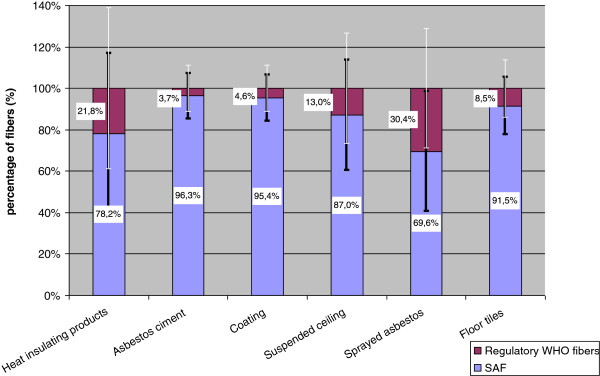
- In 105 positive indoor air samples from 64 French public buildings (1997–2004), 40 contained only SAF, sometimes at >10 f.L−1; SAF mean concentrations varied by ACM type: heat insulation 91 f.L−1, floor tiles 36.2 f.L−1, sprayed asbestos 20.4 f.L−1, suspended ceiling 5.1 f.L−1, coating 2.4 f.L−1, asbestos cement 0.9 f.L−1. Regulatory WHO fibers represented less than 20% of the size distribution.
- In 192 occupational samples re-analyzed by TEM, >45,000 fibers were counted, 98% chrysotile; average/maximum concentrations were 16.3/505.2 f.mL−1 for SAF, 0.4/18.4 f.mL−1 for LAF with diameter <0.2 μm, and 0.5/9.3 f.mL−1 for PCM-measured fibers. SAF made up 87–96% and LAF <0.2 μm made up 2.1–5.6%.
- Experimental data show SAF are less active than LAF but not harmless: in rats, amosite inhalation produced 0% lung tumors and 2.4% mesotheliomas with SAF versus 27.5% lung tumors and 7.5% mesotheliomas with LAF; chrysotile inhalation produced 17.5% lung tumors with SAF versus 50% with LAF. After intraperitoneal injection of 25 mg amosite, mesothelioma incidence was 4% for SAF versus 90% for LAF.
- Recent epidemiological studies found cumulative exposures to all fiber size classes, including fibers ≤5 μm, were statistically significant predictors of lung cancer mortality, but high correlations across size categories complicate distinguishing a specific biological role for short fibers.
Methods
- Narrative review of peer-reviewed and grey literature; PubMed searches used keyword groups including “asbestos toxicity”, “epidemiology OR animal OR in vitro”, and “short OR long”; papers on fiber-dimension effects and size distributions were selected, plus public reports from ATSDR, NIOSH, US-EPA, HSL-UK, and FIOH.
- Original re-analysis of air samples by transmission electron microscopy (TEM): 105 indoor samples from 64 public buildings in the Paris area (1997–2004), 115 outdoor samples from Ile de France (1993–1995), and 192 occupational samples from IRSST Québec (1990–2006) re-analyzed by LEPI.
- Synthesis of experimental in vivo and in vitro studies, including animal inhalation, intratracheal instillation, intracavitary injection, cell culture cytotoxicity/genotoxicity assays, and biopersistence studies.
Limitations
- Stated in the paper: the 64 indoor buildings were not representative of all French buildings; the epidemiological review remains fragmented; uncertainties in exposure estimates, non-representative measurement data, and the presence of fibers ≥5 μm in lower-risk sectors prevent a formal conclusion on SAF carcinogenicity; ATSDR found no validated epidemiological morbidity or mortality data associated with SAF.
- Stated in the paper: generating samples containing only SAF is difficult and usually leaves a small percentage of LAF; sample preparation can alter fiber properties; biopersistence results are conflicting; and the 5 μm length limit is not based on scientific evidence but was chosen for practical analytical reasons.
- Evident from the text: the review is not a systematic review or meta-analysis, relies on heterogeneous older studies with different methods and exposure metrics, and includes no new primary epidemiological data.
Model-written summary. Check it against the paper before relying on it.
Integrity signals
Registry
Cites
Statistics
Figures
Verification
Claims the paper makes
5 Valid · 11 Not valid · 175 Not checked · 70 Own results and interpretations
Every source the paper cites for this claim was checked and supports it.
In the paper
“The model for TEM fibers > 5 μm of length fits the data better than models for other TEM exposure indicators of size classes.”
§ Quantification of short and long asbestos fibers to assess asbestos exposure: a review of fiber size toxicity > Background > Human exposure to asbestos fibers
What the sources say
- Supportedcites [34] Loomis D Dement J Richardson D Wolf S Asbestos fibre dimensions and lung cancer mortality among workers exposed to chrysotile Occup Environ Med 2010 67 580 584 19897464 PMC2975987 source
The Results section 'Lung cancer risk and TEM fibres' states verbatim in substance that 'The model for TEM fibres >5 μm long... fit the data better than models for other TEM exposure indicators and the exposure term was more highly significant (p=0.004)', with Table 1 showing the lowest AIC among TEM indicators (2344.2 vs 2345.1 total TEM and 2345.3 for <5 μm). The claim's narrower framing ('other TEM exposure indicators of size classes') is a subset of the source's broader statement, so nothing attributed is unsupported. Consistent with the Abstract Results and the fibre-size-category results, where longer/thinner fibre models fit best. (LLM, conf=0.90)
plainstates an association- Asserted: passes — The authors put it forward as true.
- Checkable: passes — It can be checked against evidence.
- Load-bearing: unclear — It is unclear whether the paper’s conclusions depend on it.
- Based: passes — The paper gives a reason why it holds.
- Supported
Every source the paper cites for this claim was checked and supports it.
In the paper
“Moreover, biopersistence is dependent on the chemical stability of the fibers.”
§ Quantification of short and long asbestos fibers to assess asbestos exposure: a review of fiber size toxicity > Background > Hypotheses on the mechanism of action of asbestos fibers
What the sources say
- Supportedcites [38] Mossman BT Lippmann M Hesterberg TW Kelsey KT Barchowsky A Bonner JC Pulmonary endpoints (lung carcinomas and asbestosis) following inhalation exposure to asbestos J Toxicol Environ Health Part B Critical Rev 2011 14 76 121 PMC3118517 21534086 source
In 'FACTORS THAT INDUCE FIBER TOXICITY' our copy states that persistence is 'a function of fiber durability' and that fibers 'whose chemical composition renders them wholly or partially soluble once deposited in the lung' either dissolve completely or weaken and break into shorter, clearable fibers — i.e. biopersistence tracks the fibers' chemical stability/durability. The 'Disadvantages of In Vitro Assays' subsection lists among the determinants of biopersistence 'their lack of solubility in lung fluids (durability)', alongside clearance, breakage and membrane transport, so chemical durability is presented as a (not the sole) dependency, which the claim's wording does not exclude. (LLM, conf=0.85)
plainstates a cause- Asserted: passes — The authors put it forward as true.
- Checkable: passes — It can be checked against evidence.
- Load-bearing: unclear — It is unclear whether the paper’s conclusions depend on it.
- Based: passes — The paper gives a reason why it holds.
- Supported
The cited sources support only part of this claim — read each source’s verdict below.
In the paper
“Studies conducted with crocidolite fibers showed a lower retention of fibers < 5 μm compared to fibers > 5 μm or > 20 μm [112,113] or to WHO fibers [114].”
§ Quantification of short and long asbestos fibers to assess asbestos exposure: a review of fiber size toxicity > Background > Hypotheses on the mechanism of action of asbestos fibers
What the sources say
- Not checked — no full text of the sourcecites [112] Eastes W Hadley JG Dissolution of fibers inhaled by rats Inhal Toxicol 1995 7 179 196 source
- Partly supportedcites [113] Musselman RP Miiller WC Eastes W Hadley JG Kamstrup O Thevenaz P Hesterberg TW Biopersistences of man-made vitreous fibers and crocidolite fibers in rat lungs following short-term exposures Environ Health Perspect 1994 102 139 143 7882918 PMC1567257 sourceExperimental — accuracy not yet measured
Our copy supports the length comparison: the Results state that 'Long crocidolite fiber retention tended to be prolonged compared to retention of crocidolite particles (i.e., <5 [mu]m long)... beginning after 31 days,' and Table 2 gives 545-day percent retention of 17% for <5 [mu]m versus 33% for >5 [mu]m and 38% for >20 [mu]m crocidolite. However, the paper hedges this as a tendency ('tended to be higher'; PRs of >10 [mu]m 'did not differ significantly' from those of <=5 [mu]m), whereas the citing sentence states it flatly. Nothing in our copy reports retention of crocidolite expressed against WHO-definition fibers — WHO fibers appear only in the Methods as the counting convention (phase contrast microscopy for total and WHO fiber numbers, ref. 8) — so that part of the sentence is not supported by this source. (LLM, conf=0.78)
- Not checked — no full text of the sourcecites [114] Hesterberg TW Miiller WC Musselman RP Kamstrup O Hamilton RD Thevenaz P Biopersistence of man-made vitreous fibers and crocidolite asbestos in the rat lung following inhalation Fundam Appl Toxicol 1996 29 267 279 8742325 source
plainstates an association- Asserted: passes — The authors put it forward as true.
- Checkable: passes — It can be checked against evidence.
- Load-bearing: unclear — It is unclear whether the paper’s conclusions depend on it.
- Based: passes — The paper gives a reason why it holds.
In the paper
“Samples only contained chrysotile.”
§ Quantification of short and long asbestos fibers to assess asbestos exposure: a review of fiber size toxicity > Background > Human exposure to asbestos fibers
What the sources say
- Not checked yetcites [1] AFSSET Influence of Asbestos Fibers Dimensions to the Health Risk Characterization: Toxicological, Metrological and Epidemiological Data Review in Order to Carry out an Health Risk Assessment for the General Population and the Workers (in French) 2009 Maisons-Alfort: AFSSET 394
plainn = 115- Asserted: passes — The authors put it forward as true.
- Checkable: passes — It can be checked against evidence.
- Load-bearing: unclear — It is unclear whether the paper’s conclusions depend on it.
- Based: passes — The paper gives a reason why it holds.
In the paper
“Concentrations and percentages of SAF apparently varied according to the type of ACM.”
§ Quantification of short and long asbestos fibers to assess asbestos exposure: a review of fiber size toxicity > Background > Human exposure to asbestos fibers
What the sources say
- Not checked yetcites [1] AFSSET Influence of Asbestos Fibers Dimensions to the Health Risk Characterization: Toxicological, Metrological and Epidemiological Data Review in Order to Carry out an Health Risk Assessment for the General Population and the Workers (in French) 2009 Maisons-Alfort: AFSSET 394
hedgedstates an associationn = 105- Asserted: passes — The authors put it forward as true.
- Checkable: passes — It can be checked against evidence.
- Load-bearing: unclear — It is unclear whether the paper’s conclusions depend on it.
- Based: passes — The paper gives a reason why it holds.
105 more claims
Create a free account to see all 261 claims and to verify the 84 references still open.
- It may state two separate claims as one. 109
- Probably not a substantial claim. 64
- The quote only partly states this claim. 1
Claims other papers make about this one
Each is checked against this paper’s own text: does it say what the citing paper says it does?
The source backs part of the claim, not all of it — or backs it for a different population, condition or comparison.
In the citing paper
“This is efficient when the mean diameter of the particles/fibers is smaller than the mean diameter of the macrophage (10 microns) but, when the size exceeds this, there can be incomplete phagocytosis and clearance [93].”
From Asbestos and Iron (2023) · cites this paper as [93]
Experimental — accuracy not yet measuredIn the citing paper
“When inhaled chrysotile fibers are present in the lung and pleura, the lung clearance of the fibers is more rapid than amphibole due to longitudinal cleavage into fibrils, which can break and be phagocytized easier by the macrophages [30].”
From A Review of Asbestos Bioweathering by Siderophore-Producing Pseudomonas: A Potential Strategy of Bioremediation (2020) · cites this paper as [30]
Self-check
Percentages, sums and reported differences re-computed from the paper’s own numbers.
Each contradiction between two passages listed here was confirmed by an independent check.
Rated minor: it would not touch a result — a value no result rests on, a p-value that stays on the same side of the significance level, or a conflict that is clerical, resolved elsewhere in the paper, or outside its own findings.
In the paper
§ Quantification of short and long asbestos fibers to assess asbestos exposure: a review of fiber size toxicity > Background > Synthesis of experimental studies of cancer
“A publication by Stettler et al. [72] complemented that of Platek et al. [71] by extending the post-exposure period to 15.5 years in monkeys.”
§ Quantification of short and long asbestos fibers to assess asbestos exposure: a review of fiber size toxicity > References
“72. Stettler LE Sharpnack DD Krieg EF Chronic inhalation of short asbestos: Lung fiber burdens and histopathology for monkeys maintained for 11.5 years after exposure”
Rated minor: it would not touch a result — a value no result rests on, a p-value that stays on the same side of the significance level, or a conflict that is clerical, resolved elsewhere in the paper, or outside its own findings.
In the paper
§ Quantification of short and long asbestos fibers to assess asbestos exposure: a review of fiber size toxicity > Background > Studies carried out with cell systems in culture
“Among the 10 samples of chrysotile fibers tested, 5 induced a significant increase in the number of cells with mitotic abnormalities and 5 remained without significant effect.”
§ Quantification of short and long asbestos fibers to assess asbestos exposure: a review of fiber size toxicity > Background > Studies carried out with cell systems in culture
“| Calidria | 0.5 | 4.8 | 19.6 | 1.5 | | NIEHS | 0.5 | 1.2 | 3.1 | 0.4 | | UICCA | 0.5 | 0.8 | 10.2 | 0.3 | | 4.4.3 | 1.0 | 1.1 | 15.9 | 0.3 | | 4.4.5 | 1.0 | 1.8 | 14.2 | 1.0 | | SF | 1.0 | 0.4 | 3.9 | 0.2 | | P3 | 1.0 | 1.3 | 3.7 | 0.66 | | Pmilled | 2.0 | 3.7 | 9.3 | 2.1 |”
Citations
Cites
The quantitative risks of mesothelioma and lung cancer in relation to asbestos exposure
Hodgson, J. (2000) · The Annals of Occupational Hygiene · doi:10.1016/s0003-4878(00)00045-4 · Cited by 661
Carcinogenicity of Fibrous Glass: Pleural Response in the Rat in Relation to Fiber Dimension
Stanton, M. F., Layard, M., Tegeris, A., Miller, E., May, M., & Kent, E. (1977) · JNCI: Journal of the National Cancer Institute · doi:10.1093/jnci/58.3.587 · Cited by 467 · cited 2×
“In a first study, the authors implanted 70 fiber samples of various size distributions in the pleura of rats [57,58].”
BackgroundA Meta-Analysis of Asbestos-Related Cancer Risk That Addresses Fiber Size and Mineral Type
Berman, D. W., & Crump, K. S. (2008) · Critical Reviews in Toxicology · doi:10.1080/10408440802273156 · Cited by 246 · cited 1×
“Others publications found that the risk of asbestosrelated cancer mortality increases with exposure to longer and thinner fibers, particularly for lung cancer [28,29].”
BackgroundEffects of fiber characteristics on lung deposition, retention, and disease.
Lippmann, M. (1990) · Environmental Health Perspectives · doi:10.1289/ehp.9088311 · Cited by 203
Pulmonary Endpoints (Lung Carcinomas and Asbestosis) Following Inhalation Exposure to Asbestos
Mossman, B. T., Lippmann, M., Hesterberg, T. W., Kelsey, K. T., Barchowsky, A., & Bonner, J. C. (2011) · Journal of Toxicology and Environmental Health, Part B · doi:10.1080/10937404.2011.556047 · Cited by 192 · cited 4×
“Due to the airway anatomy and the mechanisms of particle deposition, large particles are eliminated in the upper airways [38].”
BackgroundInfluentialUpdate of potency factors for asbestos-related lung cancer and mesothelioma
Berman, D. W., & Crump, K. S. (2008) · Critical Reviews in Toxicology · doi:10.1080/10408440802276167 · Cited by 188 · cited 1×
“Others publications found that the risk of asbestosrelated cancer mortality increases with exposure to longer and thinner fibers, particularly for lung cancer [28,29].”
BackgroundSchinwald, A., Murphy, F. A., Prina-Mello, A., Poland, C. A., Byrne, F., Movia, D., Glass, J. R., Dickerson, J. C., Schultz, D. A., Jeffree, C. E., et al. (2012) · Toxicological Sciences · doi:10.1093/toxsci/kfs171 · Cited by 181 · cited 1×
“[81] injected several types of fibers with different lengths (metallic nanofibers and amosite) in the pleural cavity of mice.”
BackgroundRole of Mutagenicity in Asbestos Fiber-Induced Carcinogenicity and Other Diseases
Huang, S. X. L., Jaurand, M.-C., Kamp, D. W., Whysner, J., & Hei, T. K. (2011) · Journal of Toxicology and Environmental Health, Part B · doi:10.1080/10937404.2011.556051 · Cited by 163 · cited 1×
“As far as carcinogenesis is concerned, asbestos fibers were found to be mutagenic, an important effect in carcinogenesis [94].”
BackgroundSelf-citationHesterberg, T. W., Chase, G., Axten, C., Miller, W. C., Musselman, R. P., Kamstrup, O., Hadley, J., Morscheidt, C., Bernstein, D. M., & Thevenaz, P. (1998) · Toxicology and Applied Pharmacology · doi:10.1006/taap.1998.8472 · Cited by 149
Asbestos fiber length as related to potential pathogenicity: A critical review
Dodson, R. F., Atkinson, M. A. L., & Levin, J. L. (2003) · American Journal of Industrial Medicine · doi:10.1002/ajim.10263 · Cited by 141 · cited 1×
“Several investigators have suggested that SAF may play a role in the induction of pathologies, particularly cancer, and do not recommend immediately ruling out this particle size class [19-22].”
Background
Research works printed but not linked: 11
- AFSSET Influence of Asbestos Fibers Dimensions to the Health Risk Characterization: Toxicological, Metrological and Epidemiological Data Review in Order to Carry out an Health Risk Assessment for the General Population and the Workers (in French) 2009 Maisons-Alfort: AFSSET 394
- AFNOR X43-050. Qualité de l’air - Détermination de la Concentration en Fibres d’amiante par Microscopie Électronique à Transmission - Méthode Indirecte. Association Française de Normalisation 1996 La Plaine Saint-Denis: AFNOR 42
- AFNOR XP X 43–269. Qualité de l’air - Air des Lieux de Travail - Détermination de la Concentration en Nombre de Fibres par Microscopie Optique en Contraste de Phase - Méthode du Filtre à Membrane 2002 La Plaine Saint-Denis: AFNOR 40
- ATSDR Eastern Research Group,Inc Report on the Expert Panel on Health Effects of Asbestos and Synthetic Vitreous Fibers: The Influence of Fiber Length 2003 Altanta: US Department of Health and Human Services
- Gilbert S Stayner L Kuempel E Dement J Determining an Optimal Exposure Metric from a Bivariate Distribution of Asbestos Exposures (Length, Diameter) in a Cohort of South Carolina Textile Workers Joint Statistical Meetings 2006 2006 Seattle, Washington (DC) (Poster). http://www.amstat.org/meetings/jsm/2006/onlineprogram/index.cfm?fuseaction=abstract_details&abstractid=307203
- Campbell WJ Huggins CW Wylie AG Chemical and physical characterization of amosite, chrysotile, crocidolite, and nonfibrous tremolite for oral ingestion studies by the National Institute of Environmental Health Sciences 1980 Washington, D.C.: U.S. Dept. of the Interior, U.S. Bureau of Mines 63
- Wagner JC Biological Effects of Short Fibers Proceedings of the VIIth International Pneumoconioses Conference. VIIth International Pneumoconioses Conference, August 23-26 1988 Pittsburgh, (PA) 835 840 http://www.cdc.gov/niosh/docs/90-108/pdfs/90-108-1.pdf
- National Toxicological Program (NTP) 12th Report on Carcinogens (RoC) 2011
- Berman DW Crump KS Chatfield EJ Davis JMG Jones AD The sizes, shapes, and mineralogy of asbestos structures that induce lung tumors or mesothelioma in AF/HAN rats following inhalation Risk Anal 1995 15 181 195 7597255 · DOI · Paper page
- Wagner JC Significance of the fibre size of erionite Proceedings of the VIIth International Pneumoconioses Conference. VIIth International Pneumoconioses Conference, August 23-26 1988 Pittsburgh, (PA) 158 159 http://www.cdc.gov/niosh/docs/90-108/pdfs/90-108-1.pdf
- Egilman DS Continued controversy on chrysotile biopersistence Int J Occup Environ Health 2011 17 99 102 21344825
Cited by
A novel method for preparing microplastic fibers
Cole, M. (2016) · Scientific Reports · doi:10.1038/srep34519 · Cited by 332
Review of toxicity studies of carbon nanotubes
Kobayashi, N., Izumi, H., & Morimoto, Y. (2017) · Journal of Occupational Health · doi:10.1539/joh.17-0089-ra · Cited by 339
Lung carcinogenicity of inhaled multi-walled carbon nanotube in rats
Kasai, T., Umeda, Y., Ohnishi, M., Mine, T., Kondo, H., Takeuchi, T., Matsumoto, M., & Fukushima, S. (2015) · Particle and Fibre Toxicology · doi:10.1186/s12989-016-0164-2 · Cited by 262
Malignant pleural mesothelioma: history, controversy and future of a manmade epidemic
Røe, O. D., & Stella, G. M. (2015) · European Respiratory Review · doi:10.1183/09059180.00007014 · Cited by 185
From properties to toxicity: Comparing microplastics to other airborne microparticles
Wieland, S., Balmes, A., Bender, J., Kitzinger, J., Meyer, F., Ramsperger, A. F., Roeder, F., Tengelmann, C., Wimmer, B. H., Laforsch, C., et al. (2022) · Journal of Hazardous Materials · doi:10.1016/j.jhazmat.2021.128151 · Cited by 166
Re, V. (2019) · Hydrogeology Journal · doi:10.1007/s10040-019-01998-x · Cited by 149
Highly Flexible Superhydrophobic and Fire-Resistant Layered Inorganic Paper
Chen, F., Zhu, Y.-J., Xiong, Z., Sun, T., & Shen, Y. (2016) · ACS Applied Materials & Interfaces · doi:10.1021/acsami.6b12838 · Cited by 144
Is asbestos still a problem in the world? A current review
Thives, L. P., Ghisi, E., Thives Júnior, J. J., & Vieira, A. S. (2022) · Journal of Environmental Management · doi:10.1016/j.jenvman.2022.115716 · Cited by 118
How Asbestos and Other Fibers Cause Mesothelioma
Gaudino, G., Xue, J., & Yang, H. (2020) · Translational Lung Cancer Research · doi:10.21037/tlcr.2020.02.01 · Cited by 102
“According to the WHO (World Health Organization) asbestos fibers can be operationally distinguished in short asbestos fibers (SAF) with length <5 μm and long asbestos fibers (LAF), having length >5 μm, diameter <3 μm and length/diameter ratio >3, which are targeted by the current regulatory rules (11).”
BackgroundKuempel, E. D., Jaurand, M.-C., Møller, P., Morimoto, Y., Kobayashi, N., Pinkerton, K. E., Sargent, L. M., Vermeulen, R. C. H., Fubini, B., & Kane, A. B. (2017) · Critical Reviews in Toxicology · doi:10.1080/10408444.2016.1206061 · Cited by 89
“It should be noted that definitive sizes of asbestos and other fibers that are carcinogenic has also not been determined, although long fibers are more carcinogenic that short fibers, when using a cutoff at 5 lm (Boulanger et al 2014).”
Self-citationMurphy, F. A., Dekkers, S., Braakhuis, H., Ma‐Hock, L., Johnston, H. J., Janer, G., Cristo, L. D., Sabella, S., Jacobsen, N. R., Oomen, A. G., et al. (2021) · NanoImpact · doi:10.1016/j.impact.2021.100314 · Cited by 70
Fraser, K., Kodali, V., Yanamala, N. V. K., Birch, M. E., Cena, L. G., Casuccio, G. S., Bunker, K. L., Lersch, T. L., Evans, D. E., Stefaniak, A. B., et al. (2020) · Particle and Fibre Toxicology · doi:10.1186/s12989-020-00392-w · Cited by 71
Mesothelium and Malignant Mesothelioma
Hiriart, E., Deepe, R., & Wessels, A. (2019) · Journal of Developmental Biology · doi:10.3390/jdb7020007 · Cited by 66
Wang, X., Gong, J., Rong, R., Gui, Z., Hu, T., & Xu, X. (2018) · Journal of Agricultural and Food Chemistry · doi:10.1021/acs.jafc.7b04615 · Cited by 62
The health effects of short fiber chrysotile and amphibole asbestos
Bernstein, D. M. (2022) · Critical Reviews in Toxicology · doi:10.1080/10408444.2022.2056430 · Cited by 60
“Boulanger et al. (2014) also reviewed fiber size toxicity through the quantification of short and long asbestos fibers to assess asbestos exposure.”
BackgroundBrostrøm, A., Kling, K. I., Hougaard, K. S., & Mølhave, K. S. (2020) · Scientific Reports · doi:10.1038/s41598-020-65383-5 · Cited by 59
Do Carbon Nanotubes and Asbestos Fibers Exhibit Common Toxicity Mechanisms?
Gupta, S. S., Singh, K. P., Gupta, S. K., Dušinská, M., & Rahman, Q. (2022) · Nanomaterials · doi:10.3390/nano12101708 · Cited by 55
“Various types of chromosomal damage may be observed in cells presented with asbestos fibers, including chromosomal breaks and fragments (micronuclei), exchange of chromosomal, lagging chromosomes, segments between two chromosomes and chromosomal mis-segregation [103].”
BackgroundAndujar, P., Lacourt, A., Brochard, P., Pairon, J. ‐., Jaurand, M., & Jean, D. (2016) · Journal of Toxicology and Environmental Health Part B · doi:10.1080/10937404.2016.1193361 · Cited by 60
“Nevertheless, in an exhaustive review focusing on available information from peerreviewed publications on the size-dependent pathogenic effects of asbestos fibers reported in experimental in vivo and in vitro studies, fibers shorter than 5 μm were less pathogenic than fibers longer than 5 μm, but the cutoff of 5 μm as…”
MethodSelf-citationKorchevskiy, A., Rasmuson, J. O., & Rasmuson, E. J. (2019) · Inhalation Toxicology · doi:10.1080/08958378.2019.1640320 · Cited by 50
“Aspect ratio can be viewed as one of the possible characteristics, useful, even if not universal, to generalize the dimensional characteristics of fibers (Boulanger et al. 2014).”
BackgroundGwenzi, W. (2019) · The Science of The Total Environment · doi:10.1016/j.scitotenv.2019.134622 · Cited by 49
Reifenrath, J., Wellmann, M., Kempfert, M., Angrisani, N., Welke, B., Gniesmer, S., Kampmann, A., Menzel, H., & Willbold, E. (2020) · International Journal of Molecular Sciences · doi:10.3390/ijms21031046 · Cited by 50
“With respect to asbestos fibres it is known that longer fibres (> 5 μm) have a much higher fibrogenicity and carcinogenicity than shorter fibres [57].”
BackgroundCurado, A., Nunes, L. J. R., Carvalho, A., Abrantes, J. C. C., Lima, E., & Tomé, M. (2024) · Fibers · doi:10.3390/fib12120102 · Cited by 44
“While these conditions are generally less severe, they still necessitate medical attention due to the potential risks they pose over time [44].”
Bhattacharjee, P., Paul, S., & Bhattacharjee, P. (2016) · Environmental Research · doi:10.1016/j.envres.2016.02.038 · Cited by 46
“It was reported earlier, that localized concentration of several airborne matter like asbestos, silicon and arsenic leads to development of pulmonary disorders like asbestosis, silicosis and arsenicosis (Bang et al., 2015; Boulanger et al., 2014; d'Errico et al., 2009; Finkelstein, 2013; Halatek et al., 2009; Radnoff…”
BackgroundGiordani, M., Mattioli, M., Ballirano, P., Pacella, A., Cenni, M., Boscardin, M., & Valentini, L. (2017) · Journal of Toxicology and Environmental Health Part B · doi:10.1080/10937404.2016.1263586 · Cited by 48
“…which depends on the size including length, diameter, and relative ratio and the aerodynamic equivalent diameter (Aust, Cook, and Dodson 2011; Boulanger et al. 2014; Dodson, Atkinson, and Levin 2003; Lee 1985; Millette 2006, 2015; Oberdörster, Oberdörster, and Oberdörster 2005; Pott et al.…”
BackgroundQuantitative structure-activity relationships for green algae growth inhibition by polymer particles
Nolte, T. M., Peijnenburg, W. J. G. M., Hendriks, A. J., & van de Meent, D. (2017) · Chemosphere · doi:10.1016/j.chemosphere.2017.03.067 · Cited by 45
“However, this assumption was found incorrect for certain chemical species which exert higher toxicity than their individual constituents, like in the case of asbestos and cationic antimicrobial polymers (Boulanger et al., 2014; Uppu et al., 2016; Tsuji et al., 2006).”
BackgroundChitosan-Based Particulate Carriers: Structure, Production and Corresponding Controlled Release
Weng, J., Durand, A., & Desobry, S. (2023) · Pharmaceutics · doi:10.3390/pharmaceutics15051455 · Cited by 41
Palomäki, J., Sund, J., Vippola, M., Kinaret, P., Greco, D., Savolainen, K., Puustinen, A., & Alenius, H. T. (2014) · Nanotoxicology · doi:10.3109/17435390.2014.969346 · Cited by 38
“One reason that no apoptosis was not detected in asbestos-treated cells might be because asbestos fibers of different sizes elicit pathogenic effects through different routes (Boulanger et al., 2014).”
BackgroundNel, A. E. (2023) · Environmental Research · doi:10.1016/j.envres.2022.114580 · Cited by 43
Koivisto, A. J., Brostrøm, A., Kling, K. I., Fonseca, A. S., Redant, E., Andrade, F. T. S. A., Hougaard, K. S., Krepker, M. A., Setter, O. P., Segal, E., et al. (2018) · NanoImpact · doi:10.1016/j.impact.2018.04.003 · Cited by 36
“Gebel et al. (2014) proposed that biodurable HARN that do not meet the fi ber paradigm may be classi fi ed as granular biodurable particles (GBPs).”
BackgroundMethodInfluentialBuilding and indoor environmental quality assessment of Nigerian primary schools: A pilot study
Toyinbo, O., Phipatanakul, W., Shaughnessy, R. J., & Haverinen‐Shaughnessy, U. (2019) · Indoor Air · doi:10.1111/ina.12547 · Cited by 37
Public health risks from asbestos cement roofing
Kottek, M., & Yuen, M. L. (2021) · American Journal of Industrial Medicine · doi:10.1002/ajim.23321 · Cited by 36
Current Research and Opportunities to Address Environmental Asbestos Exposures
Carlin, D. J., Larson, T. C., Pfau, J. C., Gavett, S. H., Shukla, A., Miller, A., & Hines, R. (2015) · Environmental Health Perspectives · doi:10.1289/ehp.1409662 · Cited by 31
“The importance of environmental exposure to asbestos and EMPs is demonstrated in more than 600 reviews (e.g., Norbet et al. 2015; Boulanger et al. 2014), recent commentaries (e.g., Haynes 2010; LaDou et al. 2010), and meetings (e.g., Gwinn et al. 2011).”
Li, X., Ding, D., Xie, W., Zhang, Y., Kong, L., Li, M., Li, M., & Deng, S. (2024) · Scientific Reports · doi:10.1038/s41598-024-58117-4 · Cited by 32
Militello, G. M., Gaggero, L., & La Maestra, S. (2021) · Minerals · doi:10.3390/min11050525 · Cited by 29
Carbon nanotubes stimulate synovial inflammation by inducing systemic pro-inflammatory cytokines
Ma, J., Li, R., Qu, G., Liu, H., Yan, B., Xia, T., Liu, Y., & Liu, S. (2016) · Nanoscale · doi:10.1039/c6nr06041b · Cited by 29
The role of sex in particle‐induced inflammation and injury
Ray, J. L., Fletcher, P., Burmeister, R., & Holian, A. (2019) · Wiley Interdisciplinary Reviews Nanomedicine and Nanobiotechnology · doi:10.1002/wnan.1589 · Cited by 31
The need for awareness and action in managing nanowaste
Schwab, F., Rothen‐Rutishauser, B., Scherz, A., Meyer, T., Karakoçak, B. B., & Petri‐Fink, A. (2023) · Nature Nanotechnology · doi:10.1038/s41565-023-01331-4 · Cited by 28
Lessons from the history of inorganic nanoparticles for inhalable diagnostics and therapeutics
Uskoković, V. (2023) · Advances in Colloid and Interface Science · doi:10.1016/j.cis.2023.102903 · Cited by 27
Dimensional determinants for the carcinogenic potency of elongate amphibole particles
Korchevskiy, A. A., & Wylie, A. G. (2021) · Inhalation Toxicology · doi:10.1080/08958378.2021.1971340 · Cited by 26
“In particular, Boulanger et al. (2014) suggested that the value of 5 mm as a regulatory limit for length is not based on scientific evidence and argued for the inclusion of short asbestos fibers into the process of measurements of asbestos fibers during inspection of building with…”
BackgroundInfluentialGiordani, M., Mattioli, M., Dogan, M., & Doğan, A. U. (2016) · Journal of Toxicology and Environmental Health · doi:10.1080/15287394.2016.1182453 · Cited by 26
“…that defines the hazardousness of fibrous minerals is the size of the fibers and fibrils that may originate from the source crystals (Stanton et al., 1981; Lee, 1985; Oberdörster, 2005; Millette, 2006; Aust et al., 2011; Mossman et al., 2011; Boulanger et al., 2014; Oberdorster et al., 2015).”
BackgroundMesotheliomas in Genetically Engineered Mice Unravel Mechanism of Mesothelial Carcinogenesis
Jean, D., & Jaurand, M. (2018) · International Journal of Molecular Sciences · doi:10.3390/ijms19082191 · Cited by 24
“Lung tumours and mesotheliomas were observed at different rates, depending on the route of exposure and fibre type [54].”
BackgroundSelf-citationEPR, TEM and cell viability study of asbestiform zeolite fibers in cell media
Cangiotti, M., Salucci, S., Battistelli, M., Falcieri, E., Mattioli, M., Giordani, M., & Ottaviani, M. F. (2017) · Colloids and Surfaces B Biointerfaces · doi:10.1016/j.colsurfb.2017.10.045 · Cited by 26
Asbestos: Modern Insights for Toxicology in the Era of Engineered Nanomaterials
Felley-Bosco, E., & MacFarlane, M. (2018) · Chemical Research in Toxicology · doi:10.1021/acs.chemrestox.8b00146 · Cited by 23
Nielsen, G. D., & Koponen, I. K. (2018) · Regulatory Toxicology and Pharmacology · doi:10.1016/j.yrtph.2018.01.021 · Cited by 26
David, S. R., & Geoffroy, V. A. (2020) · Microorganisms · doi:10.3390/microorganisms8121870 · Cited by 23
“When inhaled chrysotile fibers are present in the lung and pleura, the lung clearance of the fibers is more rapid than amphibole due to longitudinal cleavage into fibrils, which can break and be phagocytized easier by the macrophages [30].”
BackgroundCould soluble minerals be hazardous to human health? Evidence from fibrous epsomite
Giordani, M., Meli, M. A., Roselli, C., Betti, M., Peruzzi, F., Taussi, M., Valentini, L., Fagiolino, I., & Mattioli, M. (2021) · Environmental Research · doi:10.1016/j.envres.2021.112579 · Cited by 24
(2012) · Wiley eBooks · doi:10.1002/9781118464557 · Cited by 24
Mattioli, M., Giordani, M., Arcangeli, P., Valentini, L., Boscardin, M., Pacella, A., & Ballirano, P. (2018) · Minerals · doi:10.3390/min8020069 · Cited by 24
“This is further supported by the fact that ultrafine fibers are particularly suitable for penetration from the proximal area to the peripheral part of the lung and migration from the lung to the pleura and the other sites within the human [6,77,78].”
BackgroundStevulova, N., Estokova, A., Holub, M., Singovszka, E., & Csach, K. (2020) · Applied Sciences · doi:10.3390/app10114048 · Cited by 22
Bauer, E., Scibetta, E. V., Cecchetti, D., Piccirillo, S., Antonaroli, S., Sennato, S., Cerasa, M., Tagliatesta, P., & Carbone, M. (2020) · Archives of Toxicology · doi:10.1007/s00204-020-02790-7 · Cited by 22
“1 3 fibers are considered most toxic when their aspect ratio is > 5 (Boulanger et al. 2014).”
BackgroundCharacterization and assessment of the potential toxicity/pathogenicity of fibrous glaucophane
Giuseppe, D. D., Harper, M., Bailey, M., Erskine, B. G., Ventura, G. D., Ardit, M., Pasquali, L., Tomaino, G., Ray, R., Mason, H. E., et al. (2019) · Environmental Research · doi:10.1016/j.envres.2019.108723 · Cited by 21
Visoná, S. D., Capella, S., Bodini, S., Borrelli, P., Villani, S., Crespi, E., Colosio, C., Previderè, C., & Belluso, E. (2021) · Frontiers in Public Health · doi:10.3389/fpubh.2021.678040 · Cited by 22
Cangiotti, M., Battistelli, M., Salucci, S., Falcieri, E., Mattioli, M., Giordani, M., & Ottaviani, M. F. (2017) · Journal of Toxicology and Environmental Health · doi:10.1080/15287394.2016.1275901 · Cited by 21
“, lengths, diameters, and relative ratio) and aerodynamic equivalent diameter (Stanton et al., 1981; Dodson et al., 2003; Oberdörster et al., 2005, 2015; Aust et al., 2011; Boulanger et al., 2014; Wylie & Candela, 2015).”
BackgroundCasalone, E., Allione, A., Viberti, C., Pardini, B., Guarrera, S., Betti, M., Dianzani, I., Aldieri, E., & Matullo, G. (2018) · Archives of Toxicology · doi:10.1007/s00204-018-2179-y · Cited by 20
Asbestos-Related lung Cancer: An underappreciated oncological issue
van Zandwijk, N., Frank, A. L., Reid, G., Røe, O. D., & Amos, C. I. (2024) · Lung Cancer · doi:10.1016/j.lungcan.2024.107861 · Cited by 20
Shachar-Berman, L., Ostrovski, Y., Rosis, A. D., Kassinos, S. C., & Sznitman, J. (2017) · European Journal of Pharmaceutical Sciences · doi:10.1016/j.ejps.2017.09.023 · Cited by 21
“While our understanding of the health outcomes resulting from fiber deposition on airway tissues has tremendously improved (Boulanger et al., 2014; Donaldson et al., 1989), there remains a gap in our prediction of their transport dynamics leading to deposition in the distal pulmonary regions in the…”
Yanamala, N. V. K., Kisin, E. R., Gutkin, D. W., Shurin, M. R., Harper, M., & Shvedova, A. A. (2017) · Journal of Toxicology and Environmental Health · doi:10.1080/15287394.2017.1408201 · Cited by 19
“These studies indicate that morphology, fiber type/size/number and biopersistence are not the only critical factors/indicators that determine fiber-induced carcinogenesis (Boulanger et al. 2014).”
BackgroundInfluentialBrostrøm, A., Kling, K. I., Koponen, I. K., Hougaard, K. S., Kandler, K., & Mølhave, K. S. (2019) · Scientific Reports · doi:10.1038/s41598-019-44495-7 · Cited by 20
Giordani, M., Mattioli, M., Cangiotti, M., Fattori, A., Ottaviani, M. F., Betti, M., Ballirano, P., Pacella, A., Giuseppe, D. D., Scognamiglio, V., et al. (2021) · Chemosphere · doi:10.1016/j.chemosphere.2021.133067 · Cited by 21
Indoor release of asbestiform fibers from naturally contaminated water and related health risk
Roccaro, P., & Vagliasindi, F. G. A. (2018) · Chemosphere · doi:10.1016/j.chemosphere.2018.03.040 · Cited by 18
Availability and Risk Assessment of Nanoparticles in Living Systems
Shweta, Tripathi, D. K., Chauhan, D. K., & Peralta-Videa, J. R. (2018) · Elsevier eBooks · doi:10.1016/b978-0-12-811487-2.00001-3 · Cited by 17
Cao, Y., Shao, L., Jones, T. P., Deng, W., Santosh, M., Liu, P., Yang, C., Li, Y., Zhang, D., & BéruBé, K. (2023) · TrAC Trends in Analytical Chemistry · doi:10.1016/j.trac.2023.117442 · Cited by 18
The silent malignant mesothelioma epidemic: a call to action
van Zandwijk, N., Rasko, J. E. J., George, A. M., Frank, A. L., & Reid, G. (2022) · The Lancet Oncology · doi:10.1016/s1470-2045(22)00269-8 · Cited by 19
Occupational exposure in the removal and disposal of asbestos-containing materials in Italy
Scarselli, A., Corfiati, M., & Di Marzio, D. (2016) · International Archives of Occupational and Environmental Health · doi:10.1007/s00420-016-1126-6 · Cited by 16
“The biological effects of asbestos fibers depend on their chemico-physical characteristics, such as size, solubility and biopersistence (Boulanger et al. 2014; Berman and Crump 2008).”
BackgroundVoloaca, O. M., Clench, M. R., Koellensperger, G., Cole, L. M., Haywood‐Small, S., & Theiner, S. (2022) · Analytical Chemistry · doi:10.1021/acs.analchem.1c04857 · Cited by 16
Ghio, A. J., Stewart, M., Sangani, R. G., Pavlisko, E. N., & Roggli, V. L. (2023) · International Journal of Molecular Sciences · doi:10.3390/ijms241512390 · Cited by 15
“This is efficient when the mean diameter of the particles/fibers is smaller than the mean diameter of the macrophage (10 microns) but, when the size exceeds this, there can be incomplete phagocytosis and clearance [93].”
BackgroundSingh, R., Rao, B., & Asolekar, S. R. (2024) · Journal of Material Cycles and Waste Management · doi:10.1007/s10163-024-02076-5 · Cited by 15
Feder, I. S., Theile, A., & Tannapfel, A. (2017) · International Journal of Occupational Medicine and Environmental Health · doi:10.13075/ijomeh.1896.01148 · Cited by 16
Abdelgied, M., El‐Gazzar, A. M., Alexander, D. B., Alexander, W. T., Numano, T., Iigou, M., Naiki‐Ito, A., Takase, H., Abdou, K. A. H., Hirose, A., et al. (2018) · Cancer Science · doi:10.1111/cas.13643 · Cited by 16
“Long fibers that are not stable can be fragmented into shorter fibers and, consequently, unstable fibers will be cleared from the lung.(24,25) POT fibers are biologically stable and have been recovered from rat lung 12 months after short-term inhalation exposure with no change in their surface or diameter.”
Kasai, T., & Fukushima, S. (2023) · Nanomaterials · doi:10.3390/nano13182598 · Cited by 14
“Our proposal that fiber retention and fiber induced lung carcinogenesis can occur in the absence of frustrated phagocytosis agrees with a review of asbestos fibers and lung cancer that concluded that in humans, exposure to fibers longer than 5 μm, a length insufficient to result in frustrated phagocytosis, was associa…”
BackgroundTetik, Y. O., Zümrüt, İ. B., Çamurcu, A. G., Kale, Ö. A., & Baradan, S. (2024) · Environmental Science and Pollution Research · doi:10.1007/s11356-023-31819-4 · Cited by 15
Johnson, N. F. (2021) · Journal of Aerosol Medicine and Pulmonary Drug Delivery · doi:10.1089/jamp.2020.1609 · Cited by 14
Lam, R., Haider, S. H., Crowley, G., Caraher, E. J., Ostrofsky, D. F., Talusan, A., Kwon, S., Prezant, D. J., Wang, Y., Liu, M., et al. (2020) · International Journal of Environmental Research and Public Health · doi:10.3390/ijerph17124318 · Cited by 14
Resse, M., Paolillo, R., Minucci, B. P., Costa, D., Fiorito, C., Santangelo, M. L., Rosa, P. D., & Claudio Napoli, A. (2017) · Experimental and Clinical Transplantation · doi:10.6002/ect.2016.0292 · Cited by 14
Singh, R., & Frank, A. L. (2023) · Cureus · doi:10.7759/cureus.37305 · Cited by 13
Voloaca, O. M., Greenhalgh, C. J., Cole, L. M., Clench, M. R., Managh, A. J., & Haywood‐Small, S. (2020) · Rapid Communications in Mass Spectrometry · doi:10.1002/rcm.8906 · Cited by 14
Cytotoxicity of fibrous antigorite from New Caledonia
Gazzano, E., Petriglieri, J. R., Aldieri, E., Fubini, B., Laporte‐Magoni, C., Pavan, C., Tomatis, M., & Turci, F. (2022) · Environmental Research · doi:10.1016/j.envres.2022.115046 · Cited by 16
Cook, P. M., Swintek, J., Dawson, T. D., Chapman, D., Etterson, M. A., & Hoff, D. J. (2016) · Journal of Toxicology and Environmental Health Part B · doi:10.1080/10937404.2016.1195326 · Cited by 13
“(3) We provide evidence that (as precedented in Davis et al. 1991; Macdonald and Kane 1997; Dodson et al. 2001; Suzuki and Yuen 2002; Dodson et al. 2003; Miserocchi et al. 2008; Mercer et al. 2010; Boulanger et al. 2014) the potency of short EPs should not be ignored.”
BackgroundAsbestos Exposure and Malignant Pleural Mesothelioma: A Systematic Review of Literature
Santos, C., Dixe, M. D. A., Sacadura‐Leite, E., Astoul, P. J., & Uva, A. D. S. (2022) · Portuguese Journal of Public Health · doi:10.1159/000527971 · Cited by 16
“All asbestos fibres are carcinogenic and genotoxic [4] and are not possible to define a threshold dose for exposure below which it cannot be stated with certainty that carcinogenic effects are not observed (“threshold”) [63, 64].”
Leinardi, R., Petriglieri, J. R., Pochet, A., Yakoub, Y., Lelong, M., Lescoat, A., Turci, F., Lecureur, V., & Huaux, F. (2023) · International Journal of Molecular Sciences · doi:10.3390/ijms242015145 · Cited by 12
The respiratory health effects of geogenic (earth derived) PM 10
Williams, L., Chen, L., & Zosky, G. R. (2017) · Inhalation Toxicology · doi:10.1080/08958378.2017.1367054 · Cited by 15
“Thus, they have the potential to cause diseases associated with asbestos inhalation (Boulanger et al., 2014; Lippmann, 2014; Roggli, 2015).”
BackgroundOkazaki, Y. (2021) · Pathology International · doi:10.1111/pin.13196 · Cited by 12
“The definition of asbestos length was determined by the scientific community and administrators in the 1960s due to its convenience and reproducibility using light microscopy and consistency with scientific evidence.(10) While asbestos fibers are fragmentated to small fibrils, which become less than 5 μm length and 3…”
BackgroundBernareggi, A., Ren, E., Borelli, V., Vita, F., Constanti, A., & Zabucchi, G. (2015) · Toxicological Sciences · doi:10.1093/toxsci/kfv050 · Cited by 13
“The mechanisms underlying its repertoire of biological cellular effects are still not completely understood, although fibre morphology and chemical composition are recognized to be important factors (Boulanger et al., 2014).”
BackgroundGhio, A. J., Stewart, M., Sangani, R. G., Pavlisko, E. N., & Roggli, V. L. (2025) · Frontiers in Public Health · doi:10.3389/fpubh.2025.1558723 · Cited by 11
Toxicological impacts of microplastic fibers: A review assessing risk to human and aquatic health
O’Connor, A., Irhin, K., Sabo‐Attwood, T., & Gray, A. (2025) · Environmental Research · doi:10.1016/j.envres.2025.123272 · Cited by 18
“Over the years, different morphological criteria have been used to determine a fiber, such as a length-to-diameter ratio of >3 (Boulanger et al., 2014), or “a length substantially longer than its width” (Kershaw, 2019).”
Framework for assessment and phytoremediation of asbestos-contaminated sites
Gonneau, C., Miller, K., Mohanty, S. K., Xu, R., Hwang, W., Willenbring, J. K., & Casper, B. B. (2017) · Environmental Science and Pollution Research · doi:10.1007/s11356-017-0177-x · Cited by 11
“Because the size of asbestos fibers controls their exposure pathways (Boulanger et al. 2014), it is critical to develop a screening method that accounts for the fractionation of asbestos based on the particle size of contaminated soil or waste materials.”
Meyer‐Plath, A., Bäger, D., Dziurowitz, N., Perseke, D., Simonow, B. K., Thim, C., Wenzlaff, D., & Plitzko, S. (2020) · Atmosphere · doi:10.3390/atmos11111254 · Cited by 11
“, had already reported pathogenic effects of thin fibers, now sometimes called Stanton fibers, that were longer than 8 μm and thinner than 250 nm and found a strong correlation between tumor incidence and fiber number dose [14,15].”
BackgroundA commentary on Roggli’s “The So-Called Short-Fiber Controversy”
Egilman, D. S., & Tran, T. (2016) · International Journal of Occupational and Environmental Health · doi:10.1080/10773525.2016.1153866 · Cited by 12
Airborne Asbestos Exposures from Warm Air Heating Systems in Schools
Burdett, G. J., Dewberry, K., & Staff, J. (2015) · Annals of Occupational Hygiene · doi:10.1093/annhyg/mev062 · Cited by 10
“Even though their health effects are uncertain, short asbestos fibres are considered helpful in detecting if very low emissions are present (AFSSET, 2009; Boulanger et al., 2014).”
BackgroundSignificance of the Presence of Asbestos in Construction and Demolition Wastes in India
Singh, R., Vivek, J. M., Rao, B., & Asolekar, S. R. (2018) · Springer eBooks · doi:10.1007/978-981-13-0215-2_21 · Cited by 10
Schapira, J. S., Bolhar, R., Master, S., & Wilson, A. H. (2023) · Minerals · doi:10.3390/min13101352 · Cited by 10
Sato, E., McDonald, S. A., Fan, Y., Peterson, S., Brain, J. D., & Godleski, J. J. (2020) · Particle and Fibre Toxicology · doi:10.1186/s12989-020-00356-0 · Cited by 10
“The Stanton hypothesis states that for the same mass, longer fibers have a higher pathogenic potential than shorter ones [10].”
BackgroundFrequent homozygous deletion of Cdkn2a/2b in tremolite‐induced malignant mesothelioma in rats
Okazaki, Y., Misawa, N., Akatsuka, S., Kohyama, N., Sekido, Y., Takahashi, T., & Toyokuni, S. (2020) · Cancer Science · doi:10.1111/cas.14358 · Cited by 12
Vinyl-asbestos floor risk exposure in three different simulations
Zichella, L., Baudana, F., Zanetti, G., & Marini, P. (2021) · International Journal of Environmental Research and Public Health · doi:10.3390/ijerph18042073 · Cited by 9
“[14] studied the presence of SAF (short asbestos fibers L < 5 micron) in air samples as an indicator of the degradation of ACM to identify pollution and anticipate health risk.”
BackgroundImpacts of non-petroleum and petroleum-based microfibers on aquatic organisms: a meta-analysis
Parker, B., Lewis, C. N., & Galloway, T. S. (2025) · Environmental Toxicology and Chemistry · doi:10.1093/etojnl/vgaf113 · Cited by 10
Microfibres and health: State of the evidence and research gaps
Taptiklis, P., Boulic, M., Phipps, R., Heerden, V., & Shaw, C. (2025) · Journal of Hazardous Materials Advances · doi:10.1016/j.hazadv.2025.100766 · Cited by 12
An Ill Wind? Growing Recognition of Airborne Nano- and Microplastic Exposures
Nicole, W. (2023) · Environmental Health Perspectives · doi:10.1289/ehp12662 · Cited by 9
Asbestos: Mineralogical features and fiber analysis in biological materials
Şahin, E. R., & Köksal, D. (2023) · Archives of Environmental & Occupational Health · doi:10.1080/19338244.2023.2264764 · Cited by 9
Richardson, D. B., Keil, A. P., Cole, S. R., & Dement, J. M. (2018) · American Journal of Industrial Medicine · doi:10.1002/ajim.22836 · Cited by 9
“proportion of samples, no fibers were counted when using a light microscope but substantial numbers of asbestos fibers were counted when using electron microscopy.(5,6) Themissed fibers are not necessarily innocuous(7); rather theywere”
Demolition waste contaminated with asbestos
Števulová, N., Eštoková, A., Holub, M., & Singovszká, E. (2022) · Elsevier eBooks · doi:10.1016/b978-0-12-824533-0.00002-5 · Cited by 10
Metadata
- Authors
- Boulanger, G., Andujar, P., Pairon, J.-C., Billon-Galland, M.-A., Dion, C., Dumortier, P., Brochard, P., Sobaszek, A., Bartsch, P., Paris, C., & Jaurand, M.-C.
- Affiliations
- Agence Nationale de Sécurité Sanitaire de l’Alimentation, de l’Environnement et du Travail (FR)
- Inserm (FR)
- Institut de recherche Robert-Sauvé en santé et en sécurité du travail (CA)
- Université Libre de Bruxelles (BE)
- Université de Bordeaux (FR)
- Université de Lille (FR)
- University of Liège (BE)
- Corresponding author
- Jaurand, Marie-Claude
- ORCID
- Venue
- Environmental Health
- Published
- 2014-07-21
- Volume
- 13
- Issue
- 1
- Pages
- 59-59
- ISSN
- 1476-069X (ISSN-L)
- PMC
- PMC4112850
- OpenAlex
- W2030813809
- Cited by
- 176
- References
- 122
- Citations by year
- 2026: 9 · 2025: 13 · 2024: 17 · 2023: 23 · 2022: 13 · 2021: 16 · 2020: 17 · 2019: 13 · 2018: 17 · 2017: 19 · 2016: 11 · 2015: 5 · 2014: 2
- FWCI
- 2.11
- Type
- journal article
- Language
- en
- Open access
- gold
- doi.org
- Licence
- Locations
- Environmental Health (publishedVersion, cc-by)
- Europe PMC (PubMed Central) (publishedVersion, cc-by)
- PubMed Central (publishedVersion, cc-by)
- PubMed (publishedVersion)
- HAL (submittedVersion, other-oa)
- Dépôt institutionnel de l'Université libre de Bruxelles (Université Libre de Bruxelles) (submittedVersion, other-oa)
- PhareSST (submittedVersion)
- Topics
- Health Sciences › Medicine › Pulmonary and Respiratory Medicine › Occupational and environmental lung diseases
- Social Sciences › Health › Occupational Health and Global Justice
- Health Sciences › Medicine › Public Health, Environmental and Occupational Health › Occupational Health and Safety in Workplaces
- Keywords
- asbestos fibers, fiber diameter, asbestos exposure assessment, asbestos-containing materials, fiber degradation, fibrogenicity, carcinogenicity, air sampling, health risks
- MeSH terms
- Air Pollutants, Animals, Asbestos, Environmental Exposure, Humans, Particle Size, Occupational Exposure, Inhalation Exposure
About these checks
Registry, retraction, Cites and statistics results are computed, not judged, with one exception: a printed reference that no index lists is read once by a model before it counts as a citation error. Claims are extracted by a model and kept only when their quote appears verbatim in the text; each cited source is then checked, with a model’s help, for whether it says what the claim relies on. Those verdicts can be wrong — read the claim’s quote and the cited source before relying on one.
The claim verdicts this report counts are experimental: their accuracy is not yet measured.
A language model drew the claims from the paper on 2026-11-11, under version 3 of the claim definition (model deepseek-v4.1-flash, prompt extract-v3).
A second model labelled each claim on 2026-11-11 (model jev-1.13-20260917, definition revision gold-guideline-v0.2).
Cited sources are checked with a language model’s help (qwen3.8-omni-flash).
Statistics and arithmetic are recomputed, not judged.
Confidence bands are shown only for fields calibrated on our annotated test set. None is calibrated yet, so no band is shown.
What counts as a claim ›How we measure confidence ›How we check this ›
Are you an author, or do you see a problem with this page? Request a review
Data sources
Bibliographic data: Semantic Scholar, OpenAlex, Crossref.
Contains information from the Semantic Scholar Academic Graph Datasets, made available under the ODC Attribution License (ODC-BY 1.0).
Semantic Scholar’s data is described in: Kinney, R., et al. (2023). The Semantic Scholar Open Data Platform. arXiv:2301.10140.
