

The DOI matches its Crossref record; 104 of the 104 references it cites were found in a registry or an index.
A comparison of temporal trends in United States autism prevalence to trends in suspected environmental factors
Open accessAbstract
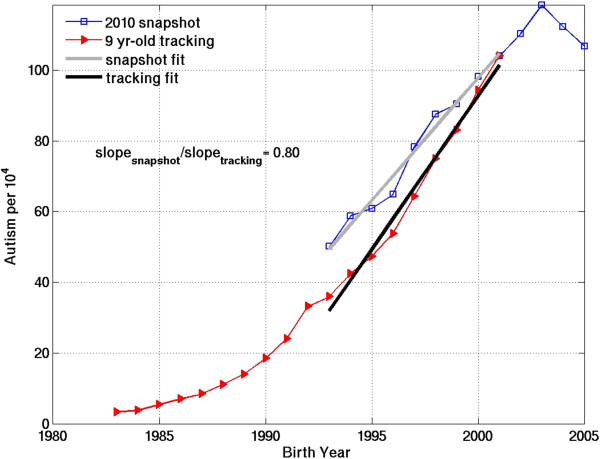
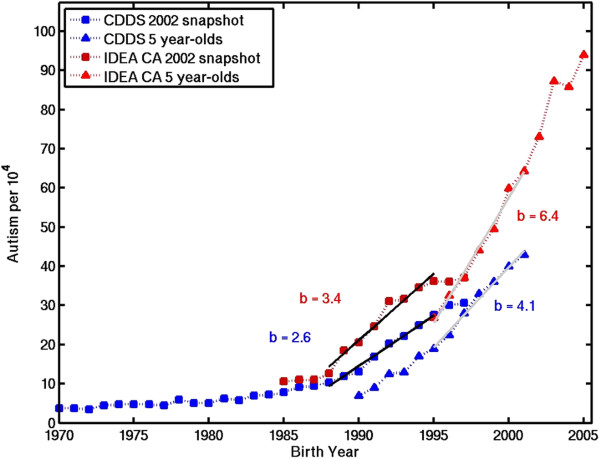
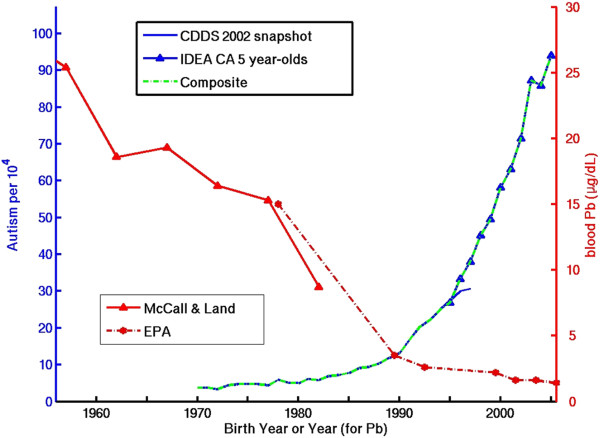
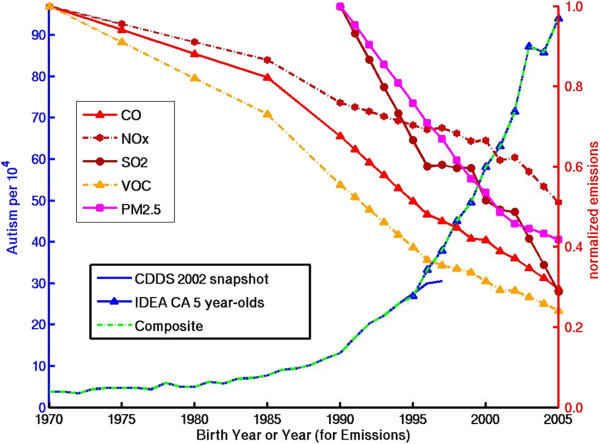
BACKGROUND: The prevalence of diagnosed autism has increased rapidly over the last several decades among U.S. children. Environmental factors are thought to be driving this increase and a list of the top ten suspected environmental toxins was published recently. METHODS: Temporal trends in autism for birth years 1970-2005 were derived from a combination of data from the California Department of Developmental Services (CDDS) and the United States Individuals with Disabilities Education Act (IDEA). Temporal trends in suspected toxins were derived from data compiled during an extensive literature survey. Toxin and autism trends were compared by visual inspection and computed correlation coefficients. Using IDEA data, autism prevalence vs. birth year trends were calculated independently from snapshots of data from the most recent annual report, and by tracking prevalence at a constant age over many years of reports. The ratio of the snapshot:tracking trend slopes was used to estimate the "real" fraction of the increase in autism. RESULTS: The CDDS and IDEA data sets are qualitatively consistent in suggesting a strong increase in autism prevalence over recent decades. The quantitative comparison of IDEA snapshot and constant-age tracking trend slopes suggests that ~75-80% of the tracked increase in autism since 1988 is due to an actual increase in the disorder rather than to changing diagnostic criteria. Most of the suspected environmental toxins examined have flat or decreasing temporal trends that correlate poorly to the rise in autism. Some, including lead, organochlorine pesticides and vehicular emissions, have strongly decreasing trends. Among the suspected toxins surveyed, polybrominated diphenyl ethers, aluminum adjuvants, and the herbicide glyphosate have increasing trends that correlate positively to the rise in autism. CONCLUSIONS: Diagnosed autism prevalence has risen dramatically in the U.S over the last several decades and continued to trend upward as of birth year 2005. The increase is mainly real and has occurred mostly since the late 1980s. In contrast, children's exposure to most of the top ten toxic compounds has remained flat or decreased over this same time frame. Environmental factors with increasing temporal trends can help suggest hypotheses for drivers of autism that merit further investigation.
Overview
The claims and statistics of this paper haven’t been checked yet.
Run the check — free, no account needed. It reads the open-access text and checks the sources it cites.
Integrity signals
Registry
Cites
Statistics
Figures
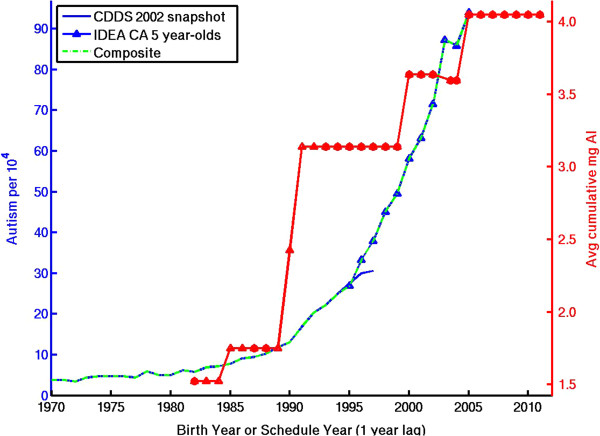
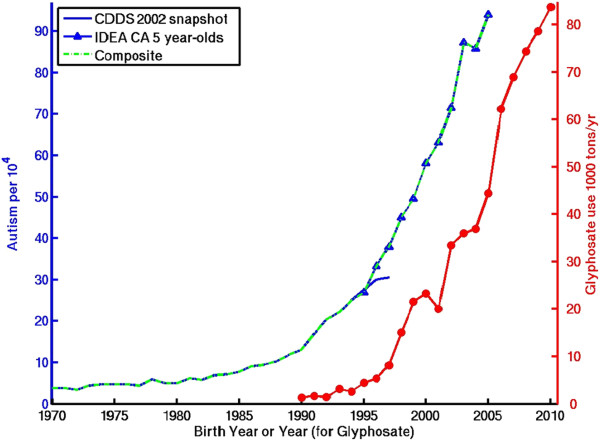
Verification
Claims the paper makes
The claims and statistics of this paper haven’t been checked yet.
Run the check — free, no account needed. It reads the open-access text and checks the sources it cites.
Claims other papers make about this one
Each is checked against this paper’s own text: does it say what the citing paper says it does?
The source backs part of the claim, not all of it — or backs it for a different population, condition or comparison.
In the citing paper
“To date, there is weak or conflicting evidence for the hypothesis that geographic variation or time trends in prevalence may reflect differences in exposure to environmental risk factors (Nevison, 2014) or increased patterns of migration (Keen et al., 2010).”
From Global prevalence of autism: A systematic review update (2022) · cites this paper as Nevison, 2014
Experimental — accuracy not yet measuredIn the citing paper
“Further, ASD risk associated with environmental exposures has been stable for air pollutants and pesticides, with lifestyle risk factors such as smoking and alcohol consumption and other potential hazards related to nutrition and medication in decline [264].”
From The contribution of environmental exposure to the etiology of autism spectrum disorder (2019) · cites this paper as [264]
In the citing paper
“Further, ASD risk associated with environmental exposures has been stable for air pollutants and pesticides, with lifestyle risk factors such as smoking and alcohol consumption and other potential hazards related to nutrition and medication in decline [264].”
From The contribution of environmental exposure to the etiology of autism spectrum disorder (2019) · cites this paper as [264]
Self-check
Percentages, sums and reported differences re-computed from the paper’s own numbers.
The self-check needs the paper’s full text.
Citations
Cites
1 retracted
Hepatitis B vaccination of male neonates and autism diagnosis, NHIS 1997–2002.
Gallagher, C. M., & Goodman, M. S. (2010) · Journal of Toxicology and Environmental Health, Part A · doi:10.1080/15287394.2010.519317 · Cited by 72
Retracted(1943) · The Nervous child · Cited by 8,870
Bulletin of the World Health Organization
van der Sande, M. A. B., Walraven, G. E. L., Milligan, P. J., BANYA, W. A. S., CEESAY, S. M., Nyan, O. A., & McAdam, K. P. W. J. (2001) · Bulletin of the World Health Organization · Cited by 7,097
Metabolic Endotoxemia Initiates Obesity and Insulin Resistance
Cani, P. D., Amar, J., Iglesias, M. A., Poggi, M., Knauf, C., Bastelica, D., Neyrinck, A. M., Fava, F., Tuohy, K. M., Chabo, C., et al. (2007) · Diabetes · doi:10.2337/db06-1491 · Cited by 6,638
Baio, J., Wiggins, L., Christensen, D. L., Maenner, M. J., Daniels, J., Warren, Z., Kurzius-Spencer, M., Zahorodny, W., Robinson, C., Rosenberg, et al. (2018) · MMWR. Surveillance Summaries · doi:10.15585/mmwr.ss6706a1 · Cited by 6,078
Autistic disturbances of affective contact.
Kanner, L. (1968) · PubMed · Cited by 2,282
Genetic Heritability and Shared Environmental Factors Among Twin Pairs With Autism
Hallmayer, J. (2011) · Archives of General Psychiatry · doi:10.1001/archgenpsychiatry.2011.76 · Cited by 1,970
Environmental Health Perspectives
Goehl, T. (2002) · Environmental Health Perspectives · doi:10.1289/ehp.110-1240809 · Cited by 1,944
Bulletin of the World Health Organization
Rennie, S., & Behets, F. (2006) · Bulletin of the World Health Organization · doi:10.2471/blt.00.00000 · Cited by 1,602
Naarden Braun, K. V., Lopez, M., White, T., et al. (2023) · Carolina Digital Repository (University of North Carolina at Chapel Hill) · doi:10.17615/y3kk-5x30 · Cited by 1,381
Research works printed but not linked: 7
- California Health and Human Services Agency, Dept. of Developmental Services: Autistic Spectrum Disorders. Changes in California Caseload. An Update: 1999 Through 2002. 2003, Sacramento, CA: California Health and Human Services Agency, Dept. of Developmental Services
- USEPA (United States Environmental Protection Agency): America’s Children and the Environment, Volume 13. 2013, 504-3
- Davis SC, Diegel SW, Boundy RG: Transportation Energy Data Book. 2010, Oak Ridge, TN: Center for Transportation Analysis, Oak Ridge National Laboratory, 29
- USEPA (United States Environmental Protection Agency): National Emissions Inventory (NEI) Air Pollutant Emissions Trends Data. 2012
- Institute of Medicine (IOM): Immunization Safety Review: Vaccines and Autism. 2004, Washington, D.C, 214-
- Osteen C, Livingston M: Pest Management Practices. In: Agricultural Resources and Environmental Indicators 2006 Edition, Chapter 4.3: In (Wiebe K, Gollehon N, Eds) EIB-16. 2006, Washington, DC: USDA
- Grube Donaldson D, Kiely T, Wu LA: Pesticides Industry Sales and Usage, 2006 and 2007 Market Estimates, US EPA. 2011
Cited by
Sorted by citations
Global prevalence of autism: A systematic review update
Zeidan, J., Fombonne, E., Scorah, J., Ibrahim, A., Durkin, M. S., Saxena, S., Yusuf, A., Shih, A., & Elsabbagh, M. (2022) · Autism Research · doi:10.1002/aur.2696 · Cited by 3,117
Lactoferrin: Structure, function, denaturation and digestion
Wang, B., Timilsena, Y. P., Blanch, E. W., & Adhikari, B. (2017) · Critical Reviews in Food Science and Nutrition · doi:10.1080/10408398.2017.1381583 · Cited by 525
The contribution of environmental exposure to the etiology of autism spectrum disorder
Bölte, S., Girdler, S., & Marschik, P. B. (2019) · Cellular and Molecular Life Sciences · doi:10.1007/s00018-018-2988-4 · Cited by 509
Autism spectrum disorders and neuropathology of the cerebellum
Hampson, D. R., & Blatt, G. J. (2015) · Frontiers in Neuroscience · doi:10.3389/fnins.2015.00420 · Cited by 263
Kubsad, D., Nilsson, E. E., King, S. E., Sadler‐Riggleman, I., Beck, D., & Skinner, M. K. (2019) · Scientific Reports · doi:10.1038/s41598-019-42860-0 · Cited by 234
High intelligence: A risk factor for psychological and physiological overexcitabilities
Karpinski, R. I., Kinase Kolb, A. M., Tetreault, N. A., & Borowski, T. B. (2018) · Intelligence · doi:10.1016/j.intell.2017.09.001 · Cited by 217
Seneff, S., & Samsel, A. (2015) · Surgical Neurology International · doi:10.4103/2152-7806.153876 · Cited by 170
Liew, Z., Ritz, B. R., Virk, J., & Olsen, J. (2015) · Autism Research · doi:10.1002/aur.1591 · Cited by 165
The relationship between mercury and autism: A comprehensive review and discussion
Kern, J. K., Geier, D. A., Sykes, L. K., Haley, B. E., & Geier, M. R. (2016) · Journal of Trace Elements in Medicine and Biology · doi:10.1016/j.jtemb.2016.06.002 · Cited by 136
Re-registration Challenges of Glyphosate in the European Union
Székács, A., & Darvas, B. (2018) · Frontiers in Environmental Science · doi:10.3389/fenvs.2018.00078 · Cited by 138
The association of environmental toxicants and autism spectrum disorders in children
Ye, B. S., Leung, A. O. W., & Wong, M. H. (2017) · Environmental Pollution · doi:10.1016/j.envpol.2017.04.039 · Cited by 133
Aluminium in the Human Brain: Routes of Penetration, Toxicity, and Resulting Complications
Bryliński, Ł., Kostelecka, K., Woliński, F., Duda, P., Góra, J., Granat, M., Flieger, J., Teresiński, G., Buszewicz, G., Sitarz, R., et al. (2023) · International Journal of Molecular Sciences · doi:10.3390/ijms24087228 · Cited by 139
Risk factors in autism: Thinking outside the brain
Matelski, L., & de Water, J. V. (2015) · Journal of Autoimmunity · doi:10.1016/j.jaut.2015.11.003 · Cited by 126
Carter, C., & Blizard, R. (2016) · Neurochemistry International · doi:10.1016/j.neuint.2016.10.011 · Cited by 116
Kern, J. K., Geier, D. A., Homme, K. G., King, P. G., Bjørklund, G., Chirumbolo, S., & Geier, M. R. (2017) · Acta Neurobiologiae Experimentalis · doi:10.21307/ane-2017-061 · Cited by 112
Pugsley, K., Scherer, S. W., Bellgrove, M. A., & Hawi, Z. (2021) · Molecular Psychiatry · doi:10.1038/s41380-021-01142-w · Cited by 114
Glyphosate and adverse pregnancy outcomes, a systematic review of observational studies
Araújo, J. N. D. M., Delgado, I. F., & Paumgartten, F. J. R. (2016) · BMC Public Health · doi:10.1186/s12889-016-3153-3 · Cited by 105
Autism Spectrum Disorder Studies Using fMRI Data and Machine Learning: A Review
Liu, M., Baojuan Li, A., & Hu, D. (2021) · Frontiers in Neuroscience · doi:10.3389/fnins.2021.697870 · Cited by 97
Grau, D., Grau, N., Gascuel, Q., Paroissin, C., Stratonovitch, C., Lairon, D., Devault, D. A., & Cristofaro, J. D. (2022) · Environmental Science and Pollution Research · doi:10.1007/s11356-021-18110-0 · Cited by 91
The Experiences of Fathers Who Have Offspring with Autism Spectrum Disorder
Burrell, A., Ives, J., & Unwin, G. (2017) · Journal of Autism and Developmental Disorders · doi:10.1007/s10803-017-3035-2 · Cited by 107
Wang, J., Ma, B., Wang, J., Zhang, Z., & Chen, O. (2022) · Frontiers in Psychiatry · doi:10.3389/fpsyt.2022.963102 · Cited by 90
Parker, W., Hornik, C. D., Bilbo, S. D., Holzknecht, Z. E., Gentry, L., Rao, R., Lin, S. S., Herbert, M. R., & Nevison, C. D. (2017) · Journal of International Medical Research · doi:10.1177/0300060517693423 · Cited by 87
Self-citationEffects of Roundup and its main component, glyphosate, upon mammalian sperm function and survival
Nerozzi, C., Recuero, S., Galeati, G., Bucci, D., Spinaci, M., & Yeste, M. (2020) · Scientific Reports · doi:10.1038/s41598-020-67538-w · Cited by 81
Monogenic mouse models of autism spectrum disorders: Common mechanisms and missing links
Hulbert, S. W., & Jiang, Y. (2015) · Neuroscience · doi:10.1016/j.neuroscience.2015.12.040 · Cited by 76
Nevison, C., Blaxill, M., & Zahorodny, W. (2018) · Journal of Autism and Developmental Disorders · doi:10.1007/s10803-018-3670-2 · Cited by 71
“%) of the increase in ASD prevalence, over the period from 1988 to 2002, was due to a true increase in the condition rather than to better and expanded diagnosis (Nevison 2014).”
BackgroundMethodInfluentialSelf-citationAkhter, S., Hussain, A. E., Shefa, J., Kundu, G. K., Rahman, F., & Biswas, A. (2018) · F1000Research · doi:10.12688/f1000research.13563.1 · Cited by 73
Wu, J., & Jackson, L. E. (2017) · Environment International · doi:10.1016/j.envint.2017.07.010 · Cited by 76
Nadeem, A., Ahmad, S. F., Al-Harbi, N. O., Attia, S. M., Alshammari, M. A., Alzahrani, K. S., & Bakheet, S. A. (2018) · Progress in Neuro-Psychopharmacology and Biological Psychiatry · doi:10.1016/j.pnpbp.2018.09.012 · Cited by 65
Autism in 2016: the need for answers
Posar, A., & Visconti, P. (2016) · Jornal de Pediatria · doi:10.1016/j.jped.2016.09.002 · Cited by 63
Race/Ethnicity-Resolved Time Trends in United States ASD Prevalence Estimates from IDEA and ADDM
Nevison, C. D., & Zahorodny, W. M. (2019) · Journal of Autism and Developmental Disorders · doi:10.1007/s10803-019-04188-6 · Cited by 62
Self-citationBi, X.-A., Zhao, J., Xu, Q., Sun, Q., & Wang, Z. (2018) · Frontiers in Physiology · doi:10.3389/fphys.2018.00475 · Cited by 54
Prenatal chemical exposures and child language development
Dzwilewski, K. L. C., & Schantz, S. L. (2015) · Journal of Communication Disorders · doi:10.1016/j.jcomdis.2015.07.002 · Cited by 53
Polychlorinated biphenyls influence on autism spectrum disorder risk in the MARBLES cohort
Granillo, L., Sethi, S., Keil, K. P., Lin, Y., Ozonoff, S. J., Iosif, A., Puschner, B., & Schmidt, R. J. (2018) · Environmental Research · doi:10.1016/j.envres.2018.12.061 · Cited by 53
Update of the risk assessment of polybrominated diphenyl ethers (PBDEs) in food
(CONTAM), E. P. O. C. I. T. F. C., Schrenk, D., Bignami, M., Bodin, L., Chipman, J. K., del Mazo, J., Grasl‐Kraupp, B., Högstrand, C., Hoogenboom, L. A. P., Leblanc, J., et al. (2024) · EFSA Journal · doi:10.2903/j.efsa.2024.8497 · Cited by 52
Hill, C. E., Sapouckey, S. A., Suvorov, A., & Vandenberg, L. N. (2017) · Cogent Medicine · doi:10.1080/2331205x.2017.1317690 · Cited by 46
Heffler, K. F., & Oestreicher, L. M. (2016) · Medical Hypotheses · doi:10.1016/j.mehy.2015.06.019 · Cited by 59
Global Data on Autism Spectrum Disorders Prevalence: A Review of Facts, Fallacies and Limitations
Onaolapo, A. Y., & Onaolapo, O. J. (2017) · Universal Journal of Clinical Medicine · doi:10.13189/ujcm.2017.050202 · Cited by 53
Bahado-Singh, R. O., Vishweswaraiah, S., Aydas, B., Mishra, N. K., Yılmaz, A., Guda, C., & Radhakrishna, U. (2019) · Brain Research · doi:10.1016/j.brainres.2019.146457 · Cited by 45
Vitamin D Deficiency During Pregnancy and Autism Spectrum Disorders Development
Principi, N., & Esposito, S. (2020) · Frontiers in Psychiatry · doi:10.3389/fpsyt.2019.00987 · Cited by 46
Seneff, S., Swanson, N., & Li, C. (2015) · Agricultural Sciences · doi:10.4236/as.2015.61005 · Cited by 43
Shaw, W. (2017) · Europe PMC (PubMed Central) · Cited by 41
The effects of the exposure to neurotoxic elements on Italian schoolchildren behavior
Renzetti, S., Cagna, G., Calza, S., Conversano, M., Fedrighi, C., Forte, G., Giorgino, A., Guazzetti, S., Majorani, C., Oppini, M., et al. (2021) · Scientific Reports · doi:10.1038/s41598-021-88969-z · Cited by 39
Fordyce, T. A., Leonhard, M. J., & Chang, E. T. (2017) · Journal of Environmental Science and Health Part A · doi:10.1080/10934529.2017.1383121 · Cited by 39
Epigenetic Treatment of Neuropsychiatric Disorders: Autism and Schizophrenia
Moos, W. H., Maneta, E., Pinkert, C. A., Irwin, M. H., Hoffman, M. E., Faller, D. V., & Steliou, K. (2016) · Drug Development Research · doi:10.1002/ddr.21295 · Cited by 41
Environmental risk factors for autism spectrum disorders
Liu, L., Zhang, D. X., Rodzinka-pasko, J. K., & Li, Y. (2016) · Der Nervenarzt · doi:10.1007/s00115-016-0172-3 · Cited by 39
Human Inducible Pluripotent Stem Cells and Autism Spectrum Disorder: Emerging Technologies
Nestor, M. W., Phillips, A. W., Artimovich, E., Nestor, J. E., Hussman, J. P., & Blatt, G. J. (2015) · Autism Research · doi:10.1002/aur.1570 · Cited by 36
Blaylock, R. L., Strunecká, A., Patočka, J., & Strunecký, O. (2018) · Surgical Neurology International · doi:10.4103/sni.sni_407_17 · Cited by 36
The association between air pollutants and autism spectrum disorders
Yang, C., Zhao, W., Deng, K., Zhou, V., Zhou, X., & Hou, Y. (2017) · Environmental Science and Pollution Research · doi:10.1007/s11356-017-8928-2 · Cited by 32
Setting safer exposure limits for toxic substance combinations
Kostoff, R. N., Aschner, M., Γούμενου, Μ., & Tsatsakis, A. M. (2020) · Food and Chemical Toxicology · doi:10.1016/j.fct.2020.111346 · Cited by 31
Nutritional and Metabolic Biomarkers in Autism Spectrum Disorders: An Exploratory Study.
Esparham, A. E., Smith, T., Belmont, J. M., Haden, M., Wagner, L., Evans, R. G., & Drisko, J. (2015) · PubMed Central · Cited by 30
Dong, H.-Y., Feng, J., Li, H., Yue, X.-J., & Jia, F. (2022) · BMC Pediatrics · doi:10.1186/s12887-021-03086-0 · Cited by 27
Bilbo, S. D., Nevison, C. D., & Parker, W. (2015) · Microbial Ecology in Health and Disease · doi:10.3402/mehd.v26.26253 · Cited by 28
Self-citationThe strengths and difficulties questionnaire (SDQ) in autism spectrum disorders
Salayev, K., & Sanne, B. (2016) · International Journal on Disability and Human Development · doi:10.1515/ijdhd-2016-0025 · Cited by 25
Rezaei, M., Rezaei, A., Esmaeili, A., Nakhaee, S., Azadi, N. A., & Mansouri, B. (2022) · Environmental Science and Pollution Research · doi:10.1007/s11356-022-19933-1 · Cited by 24
Systematic literature review of the epidemiology of glyphosate and neurological outcomes
Chang, E. T., Odo, N. U., & Acquavella, J. (2022) · International Archives of Occupational and Environmental Health · doi:10.1007/s00420-022-01878-0 · Cited by 21
Mawson, A. R., Ray, B. D., Bhuiyan, A. R., & Jacob, B. (2017) · Journal of Translational Science · doi:10.15761/jts.1000186 · Cited by 19
Lactoferrin acts as an adjuvant during influenza vaccination of neonatal mice
Sherman, M. P., Pritzl, C. J., Xia, C., Miller, M. M., Zaghouani, H., & Hahm, B. (2015) · Biochemical and Biophysical Research Communications · doi:10.1016/j.bbrc.2015.10.067 · Cited by 18
Diagnostic Substitution for Intellectual Disability: A Flawed Explanation for the Rise in Autism
Nevison, C. D., & Blaxill, M. F. (2017) · Journal of Autism and Developmental Disorders · doi:10.1007/s10803-017-3187-0 · Cited by 18
Self-citationAutism Spectrum Disorder in 2023: A Challenge Still Open
Posar, A., & Visconti, P. (2023) · Turkish Archives of Pediatrics · doi:10.5152/turkarchpediatr.2023.23194 · Cited by 24
Beyond Genes: Germline Disruption in the Etiology of Autism Spectrum Disorders
Escher, J., Yan, W., Rissman, E. F., Wang, H. V., Hernández, A., & Corces, V. G. (2021) · Journal of Autism and Developmental Disorders · doi:10.1007/s10803-021-05304-1 · Cited by 15
Walton, R. G., & Monte, W. C. (2015) · Medical Hypotheses · doi:10.1016/j.mehy.2015.06.025 · Cited by 13
Estimating the prevalence of autism spectrum disorder in Lebanon
Richa, S., Khoury, R. E., JRouhayem, J., Chammay, R. E., Kazour, F., Khalil, R. B., Kheir, W., Choueifaty, D. E., Hreich, E. K., Gerbaka, B., et al. (2020) · L Encéphale · doi:10.1016/j.encep.2020.05.015 · Cited by 13
Yan, X., Li, Y., Li, Q., Li, Q., Xu, G., Lu, J., & Yang, W. (2026) · Journal of Autism and Developmental Disorders · doi:10.1007/s10803-024-06390-7 · Cited by 11
GapMap: Enabling Comprehensive Autism Resource Epidemiology
Albert, N., Daniels, J., Schwartz, J. N., Du, M., & Wall, D. P. (2017) · JMIR Public Health and Surveillance · doi:10.2196/publichealth.7150 · Cited by 10
Cristofaro, C. D. S., Branco, C. W. C., Rocha, M. I. D. A., & Portugal, S. D. G. M. (2021) · Ambiente e Agua - An Interdisciplinary Journal of Applied Science · doi:10.4136/ambi-agua.2615 · Cited by 10
Identifying Windows of Susceptibility by Temporal Gene Analysis
Bennett, K. P., Brown, E. M., Santos, H. D. L., Poegel, M., Kiehl, T. R., Patton, E. W., Norris, S., Temple, S., Erickson, J., McGuinness, D. L., et al. (2019) · Scientific Reports · doi:10.1038/s41598-019-39318-8 · Cited by 11
Environmental Toxicants and Infant Mortality in the USA
Davidson Robert, M. (2016) · Open Journal of Biological Sciences · doi:10.17352/ojbs.000005 · Cited by 9
Chung, M. K., Smith, M. R., Lin, Y., Walker, D. I., Jones, D. P., Patel, C. J., & Kong, S. W. (2021) · Exposome · doi:10.1093/exposome/osab004 · Cited by 9
Gray, W. A., & Billock, V. A. (2017) · International Journal of Developmental Neuroscience · doi:10.1016/j.ijdevneu.2017.07.004 · Cited by 10
DISINFECTION PROTOCOL AND IN VITRO GERMINATION OF SEEDS OF Dalbergia nigra
dos Santos, M. M., Cezario, L. F. C., Simões, I. M., Baptista, J. O., de Araújo, C. P., de Mello, T., Mayard, H., Gonçalves, E. D. O., Fontes, M. M. P., Schmildt, E. R., et al. (2020) · CERNE · doi:10.1590/01047760202026022714 · Cited by 7
Untangling the most probable role for vitamin D 3 in autism
Godar, D. E., & Merrill, S. J. (2017) · Dermato-Endocrinology · doi:10.1080/19381980.2017.1387702 · Cited by 7
Autism in 2016: the need for answers
Posar, A., & Visconti, P. (2017) · Jornal de Pediatria (Versão em Português) · doi:10.1016/j.jpedp.2016.11.004 · Cited by 7
Gonzalez, B., Bartels, K., & Talyn, B. (2025) · Food and Chemical Toxicology · doi:10.1016/j.fct.2025.115621 · Cited by 6
Sterol pathway disruption in pregnancy: a link to autism
Peeples, E. S., Anzalone, A. J., Dai, R., Reisher, E., Korade, Ž., & Mirnics, K. (2026) · Molecular Psychiatry · doi:10.1038/s41380-026-03610-7 · Cited by 5
Torre, E. H. G., & Amarante, P. (2022) · Saúde em Debate · doi:10.1590/0103-11042022e222 · Cited by 6
The Benefit Assessment of the Physiotherapy Sessions for Children with Autism Spectrum Disorder
Draudvilienė, L., Sosunkevič, S., Daniusevičiūtė-Brazaitė, L., Burkauskienė, A., & Draudvila, J. (2020) · Baltic Journal of Sport and Health Sciences · doi:10.33607/bjshs.v3i118.971 · Cited by 6
Shaw, C. A. (2017) · Wiley eBooks · doi:10.1002/9781118634523.refs · Cited by 9
Peyre, H., Rios, P., Botton, J., Herlemont, P., Olié, V., Miranda, S., Zureik, M., Weill, A., & Dray‐Spira, R. (2026) · Molecular Psychiatry · doi:10.1038/s41380-026-03607-2 · Cited by 4
The Route to Autism Spectrum Diagnosis in Pediatric Practice in Bulgaria
Ivanov, I. S., Pacheva, I. H., Timova, E., Yordanova, R. V., Galabova, F. K., Gaberova, K., Petkova, A., Kotetarov, V., Panova, M. V., Tonchev, N., et al. (2021) · Diagnostics · doi:10.3390/diagnostics11010106 · Cited by 4
Aluminium adjuvants in vaccines and potential health effects: systematic review
Doyon-Plourde, P., Chong, J., Abrams, E. M., Pless, R., Young, K., Tunis, M. C., & Zafack, J. G. (2026) · BMJ · doi:10.1136/bmj-2025-088921 · Cited by 3
THE EXPANSION OF AGRIBUSINESS AND THE AGRARIAN RESTRUCTURING
Fogel, R. B. (2022) · Estudios Rurales · doi:10.48160/22504001er18.25 · Cited by 4
Haque, M., Bhagat, V., Simbak, N., & Jaalam, K. (2017) · Advances in Human Biology · doi:10.4103/aihb.aihb_17_17 · Cited by 2
Ambienti sensoriali “terapeutici” che rendano Abili
Bellini, E. (2020) · Premio Tesi dottorato/Premio Tesi di dottorato · doi:10.36253/978-88-6453-987-4 · Cited by 2
Carneiro, C. L. D. C. V., de Oliveira, N. A. C., Bachur, T. P. R., de Moraes, M. E. A., & Aragão, G. F. (2020) · Archives of Neurology and Neuro Disorders · doi:10.22259/2638-504x.0301002 · Cited by 1
Maggio, A. G., Shu, H. T., Laufer, B. I., Hwang, H., Bi, C., Lai, Y., LaSalle, J. M., & Hu, V. W. (2021) · Research Square · doi:10.21203/rs.3.rs-297668/v1 · Cited by 2
Parental locus of control and the failure to obtain a child diagnosis: a longitudinal cohort study
Nowicki, S., Rai, D., Gregory, S., Iles‐Caven, Y., Ellis, G. L., & Golding, J. (2020) · Wellcome Open Research · doi:10.12688/wellcomeopenres.15923.1 · Cited by 1
A Systematic Survey of Technology Driven Diagnosis for Autism Spectrum Disorder
Singh, U., Shukla, S., & Gore, M. M. (2025) · SN Computer Science · doi:10.1007/s42979-025-04393-4 · Cited by 1
A Review of Potential Metal Toxicity and Mineral Deficiency in Autism
Sikarwar, A., Balakrishnan, H., Tong, S., Vien, K., Yoong, J., Hao, K., Chin, N., Xuan, K., Jiayi, L., & Yee, T. (2015) · International Journal of Biochemistry Research & Review · doi:10.9734/ijbcrr/2015/13913 · Cited by 1
Elsabbagh, M. (2023) · Springer eBooks · doi:10.1007/978-3-031-20792-1_13 · Cited by 1
The thousand faces of autism spectrum disorder
Posar, A., Visconti, P., & Cocuk Noroloji ve Psikiyatri Birimi, B. N. B. I. E. (2019) · Türk Pediatri Arşivi · doi:10.5152/turkpediatriars.2018.18066 · Cited by 1
The association between sleeping position and symptom severity of Autism Spectrum Disorder
Bisson, J. B., Keramati, C., Colwell, C., Bott, E., Shealy, K., & Shiffer, M. (2022) · Medical Hypotheses · doi:10.1016/j.mehy.2022.110773 · Cited by 1
Dong, H., Feng, J., Li, H., Yue, X., & Jia, F. (2020) · doi:10.21203/rs.3.rs-106964/v1 · Cited by 1
Autyzm – środowiskowe czynniki ryzyka
Langauer-Lewowicka, H., Rudkowski, Z., & Pawlas, K. (2016) · Medycyna Środowiskowa - Environmental Medicine
Epigenetic Understanding of Gene-Environment Interaction in Autism Spectrum Disorder
Kubota, T. (2017) · Journal of Pediatric Neurology · doi:10.1055/s-0037-1602815
Ellis, M. (2018) · doi:10.1093/oso/9780190259358.003.0008
Autism Spectrum Disorder: Is it really on the rise?
Manzoor, F. (2021) · The Meducator · doi:10.15173/m.v1i28.2614
EXTRACTIVISMO, FUERZAS PRODUCTIVAS Y REESTRUCTURACIÓN AGRARIA EN PARAGUAY
Fogel, R. B. (2021) · Editora Artemis eBooks · doi:10.37572/edart_2906213922
Humanização em terapia intensiva - Aspectos iniciais
Ferreira, F. H. (2021) · Editora Conhecimento Livre eBooks · doi:10.37423/210403979
Baker, S. M. (2020) · Elsevier eBooks · doi:10.1016/b978-0-323-43044-9.00152-7
Daños colaterales del régimen agroalimentario neoliberal
Fogel, R. B. (2023) · Brazilian Journal of Development · doi:10.34117/bjdv9n1-078
Metadata
- Authors
- Nevison, C. D.
- Affiliations
- Institute of Arctic and Alpine Research (US)
- Corresponding author
- Nevison, Cynthia D
- ORCID
- Nevison, Cynthia D
- Venue
- Environmental Health
- Published
- 2014-09-05
- Volume
- 13
- Issue
- 1
- Pages
- 73-73
- ISSN
- 1476-069X (ISSN-L)
- PMC
- PMC4177682
- OpenAlex
- W2105742120
- Cited by
- 111
- References
- 103
- Citations by year
- 2026: 7 · 2025: 3 · 2024: 5 · 2023: 5 · 2022: 10 · 2021: 12 · 2020: 11 · 2019: 5 · 2018: 9 · 2017: 21 · 2016: 9 · 2015: 14
- FWCI
- 8.11
- Type
- journal article
- Language
- en
- Open access
- gold
- doi.org
- Licence
- Locations
- Environmental Health (publishedVersion, cc-by)
- Europe PMC (PubMed Central) (publishedVersion, cc-by)
- PubMed Central (publishedVersion, cc-by)
- PubMed (publishedVersion)
- Topics
- Life Sciences › Neuroscience › Cognitive Neuroscience › Autism Spectrum Disorder Research
- Health Sciences › Medicine › Psychiatry and Mental health › Child Nutrition and Feeding Issues
- Life Sciences › Biochemistry, Genetics and Molecular Biology › Genetics › Genetics and Neurodevelopmental Disorders
- Keywords
- autism prevalence, temporal trends, environmental toxins, autism risk factors, lead exposure, organochlorine pesticides, vehicle emissions, polybrominated diphenyl ethers, alum adjuvant, glyphosate, diagnostic criteria revision, Individuals with Disabilities Education Act, children's environmental exposure
- MeSH terms
- Adolescent, Autistic Disorder, Child, Child, Preschool, Environmental Pollutants, Female, Humans, Male, United States, Prevalence
About these checks
Registry, retraction, Cites and statistics results are computed, not judged, with one exception: a printed reference that no index lists is read once by a model before it counts as a citation error. Claims are extracted by a model and kept only when their quote appears verbatim in the text; each cited source is then checked, with a model’s help, for whether it says what the claim relies on. Those verdicts can be wrong — read the claim’s quote and the cited source before relying on one.
Statistics and arithmetic are recomputed, not judged.
Confidence bands are shown only for fields calibrated on our annotated test set. None is calibrated yet, so no band is shown.
What counts as a claim ›How we measure confidence ›How we check this ›
Are you an author, or do you see a problem with this page? Request a review
