

Incorporation of EPA and DHA into plasma phospholipids in response to different omega-3 fatty acid formulations--a comparative bioavailability study of fish oil vs. krill oil
Open accessThe DOI matches its Crossref record; 27 of the 28 references it cites were found in a registry or an index.
Abstract
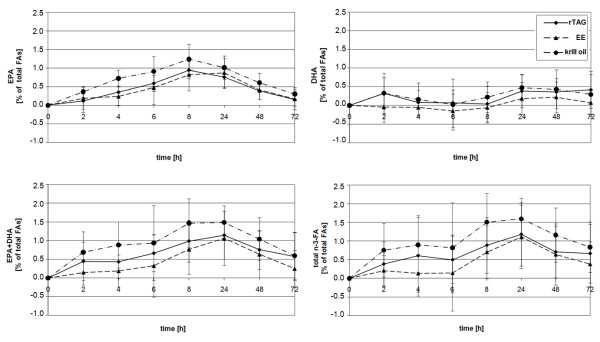
BACKGROUND: Bioavailability of omega-3 fatty acids (FA) depends on their chemical form. Superior bioavailability has been suggested for phospholipid (PL) bound omega-3 FA in krill oil, but identical doses of different chemical forms have not been compared. METHODS: In a double-blinded crossover trial, we compared the uptake of three EPA+DHA formulations derived from fish oil (re-esterified triacylglycerides [rTAG], ethyl-esters [EE]) and krill oil (mainly PL). Changes of the FA compositions in plasma PL were used as a proxy for bioavailability. Twelve healthy young men (mean age 31 y) were randomized to 1680 mg EPA+DHA given either as rTAG, EE or krill oil. FA levels in plasma PL were analyzed pre-dose and 2, 4, 6, 8, 24, 48, and 72 h after capsule ingestion. Additionally, the proportion of free EPA and DHA in the applied supplements was analyzed. RESULTS: The highest incorporation of EPA+DHA into plasma PL was provoked by krill oil (mean AUC0-72 h: 80.03 ± 34.71%*h), followed by fish oil rTAG (mean AUC0-72 h: 59.78 ± 36.75%*h) and EE (mean AUC0-72 h: 47.53 ± 38.42%*h). Due to high standard deviation values, there were no significant differences for DHA and the sum of EPA+DHA levels between the three treatments. However, a trend (p = 0.057) was observed for the differences in EPA bioavailability. Statistical pair-wise group comparison's revealed a trend (p = 0.086) between rTAG and krill oil. FA analysis of the supplements showed that the krill oil sample contained 22% of the total EPA amount as free EPA and 21% of the total DHA amount as free DHA, while the two fish oil samples did not contain any free FA. CONCLUSION: Further studies with a larger sample size carried out over a longer period are needed to substantiate our findings and to determine differences in EPA+DHA bioavailability between three common chemical forms of LC n-3 FA (rTAG, EE and krill oil). The unexpected high content of free EPA and DHA in krill oil, which might have a significant influence on the availability of EPA+DHA from krill oil, should be investigated in more depth and taken into consideration in future trials.
Overview
The claims and statistics of this paper haven’t been checked yet.
Free: it reads the open-access text and checks the first 5 claims that cite a source we can check. Create a free account to check every claim.
Integrity signals
Registry
Cites
Statistics
Figures
Verification
Claims the paper makes
The claims and statistics of this paper haven’t been checked yet.
Free: it reads the open-access text and checks the first 5 claims that cite a source we can check. Create a free account to check every claim.
Claims other papers make about this one
Each is checked against this paper’s own text: does it say what the citing paper says it does?
The source backs part of the claim, not all of it — or backs it for a different population, condition or comparison.
In the citing paper
“The amount and ratio of EPA and DHA differ in various supplements, resulting in different bioavailability and absorption rates. 142 , 143 , 144”
From Association Between Omega-3 Fatty Acid Intake and Dyslipidemia: A Continuous Dose-Response Meta-Analysis of Randomized Controlled Trials (2023) · cites this paper as [142]
Experimental — accuracy not yet measuredThe cited source says what the claim attributes to it.
In the citing paper
“The FFA formulation has greater bioavailability compared with the ethyl esters”
From The Forgotten Lipids: Triglycerides, Remnant Cholesterol, and Atherosclerotic Cardiovascular Disease Risk (2019) · cites this paper as [151]
In the citing paper
“In contrast to most other algal food constituents, the bioaccessibility of DHA and EPA in algal-derived oils and extracts is well quantified for humans, ranging from ∼50 to 100 % depending on the matrix (Haug et al. 2011; Schuchardt et al. 2011).”
From Algae as nutritional and functional food sources: revisiting our understanding. (2017) · cites this paper as Schuchardt et al. 2011
Self-check
Percentages, sums and reported differences re-computed from the paper’s own numbers.
The self-check needs the paper’s full text.
Citations
Cites
Koletzko, B., Lien, E., Agostoni, C., Böhles, H., Campoy, C., Cetin, I., Decsi, T., Dudenhausen, J. W., Dupont, C., Forsyth, S., et al. (2008) · Journal of Perinatal Medicine · doi:10.1515/jpm.2008.001 · Cited by 707
Omega-3 polyunsaturated fatty acids and cardiovascular diseases.
Lavie, C. J., Milani, R. V., Mehra, M. R., & Ventura, H. O. (2009) · Journal of the American College of Cardiology · doi:10.1016/j.jacc.2009.02.084 · Cited by 644 · cited 1×
“Scientific and regulatory bodies recommend an increased intake of EPA+DHA for cardiovascular prevention or during pregnancy [1-3].”
BackgroundKris-Etherton, P. M., Harris, W. S., & Appel, L. J. (2003) · Arteriosclerosis, Thrombosis, and Vascular Biology · doi:10.1161/01.atv.0000057393.97337.ae · Cited by 596
Influence of emulsifier type on in vitro digestibility of lipid droplets by pancreatic lipase
Mun, S., Decker, E. A., & McClements, D. J. (2007) · Food Research International · doi:10.1016/j.foodres.2007.01.007 · Cited by 454 · cited 1×
“As a result, PL influence the surface composition of fat droplets, which possibly facilitates the binding of hydrolyzing enzymes and hence the digestion [22].”
BackgroundMori, T. A., Bao, D. Q., Burke, V., Puddey, I. B., & Beilin, L. J. (1999) · Hypertension · doi:10.1161/01.hyp.34.2.253 · Cited by 407 · cited 1×
“Of note, systolic blood pressure declined only in the menhaden oil group, possibly reflecting the fact that DHA, but not EPA, lowers blood pressure [17].”
BackgroundDietary reference intakes for DHA and EPA
Kris-Etherton, P. M., Grieger, J. A., & Etherton, T. D. (2009) · Prostaglandins, Leukotrienes and Essential Fatty Acids · doi:10.1016/j.plefa.2009.05.011 · Cited by 404 · cited 1×
“Scientific and regulatory bodies recommend an increased intake of EPA+DHA for cardiovascular prevention or during pregnancy [1-3].”
BackgroundHuman absorption of fish oil fatty acids as triacylglycerols, free acids, or ethyl esters
Lawson, L. D., & Hughes, B. G. (1988) · Biochemical and Biophysical Research Communications · doi:10.1016/s0006-291x(88)80718-6 · Cited by 359 · cited 2×
“Smaller trials carried out earlier had inconsistent results [8-13].”
ResultUlven, S. M., Kirkhus, B., Lamglait, A., Basu, S., Elind, E., Haider, T., Berge, K., Vik, H., & Pedersen, J. I. (2011) · Lipids · doi:10.1007/s11745-010-3490-4 · Cited by 303 · cited 3×
“[15] analyzed total plasma FA composition, we used changes in plasma PL FA composition after a single dose treatment as a proxy for bioavailability.”
BackgroundMethodInfluentialThe omega-3 index as a risk factor for coronary heart disease
Harris, W. S. (2008) · The American Journal of Clinical Nutrition · doi:10.1093/ajcn/87.6.1997s · Cited by 297 · cited 1×
“67 g/d) leads to a faster and higher increase of the omega-3 index - the percentage of EPA and DHA in red cell membranes reflecting the long-term intake and n-3 FA status of an individual [5] - when consumed as rTAG than when consumed as EE [6].”
BackgroundBioavailability of marine n-3 fatty acid formulations
Dyerberg, J., Madsen, P., Møller, J. M., Aardestrup, I., & Schmidt, E. B. (2010) · Prostaglandins, Leukotrienes and Essential Fatty Acids · doi:10.1016/j.plefa.2010.06.007 · Cited by 256 · cited 3×
“Our results were in line with data from a short-term study of two weeks duration measuring the FA compositions of serum cholesterol-esters, TAG and phospholipids (PL): relative bioavailability of EPA+DHA from rTAG was superior (124%) compared with cod liver oil (100%), whereas the bioavailability from EE was inferior…”
BackgroundResultInfluential
Cited by
Items 201–300 of 323
Lipidome reveals the alleviation of acrylamide-induced impairment by krill oil
Shi, J., Wang, Y., Lei, Y., Chen, X., Liu, Y., & Xu, Y. (2022) · Food & Function · doi:10.1039/d2fo00781a · Cited by 10
Alfonso Valenzuela, B., Rodrigo Valenzuela, B., Julio Sanhueza, C., Fernando de la Barra, D., & Morales, G. I. (2014) · Revista chilena de nutrición · doi:10.4067/s0717-75182014000400013 · Cited by 10
“La biodisponibilidad a nivel intestinal de los ácidos grasos, cuando son aportados en la forma de fosfolípidos, es sustancialmente mayor que cuando son aportados como triglicéridos (21), aspecto que es muy importante cuando se trata de suplementación con un tipo específico de ácidos grasos, por ejemplo EPA y/o DHA (26…”
BackgroundPharmacokinetics and Safety Profile of Omega-3 Polyunsaturated Fatty Acids
Tamargo, J. L., & Tamargo, M. (2016) · Springer eBooks · doi:10.1007/978-3-319-40458-5_39 · Cited by 10
Promising Functional Lipids for Therapeutic Applications
Paul, D., Dey, T. K., Chakraborty, A., & Dhar, P. (2018) · Elsevier eBooks · doi:10.1016/b978-0-12-811448-3.00013-9 · Cited by 10
Li, Y.-C., Wu, S.-X., Zou, Q.-Y., Zheng, Y., Wu, Z., Zhao, X., Gao, X., Yang, Y., & Du, L. (2025) · Food Research International · doi:10.1016/j.foodres.2025.117086 · Cited by 9
Lee, H. J., Seo, J. W., Chun, Y. S., Kim, J., Lim, T., & Shim, S. (2023) · Food Science & Nutrition · doi:10.1002/fsn3.3576 · Cited by 9
Hosomi, R. (2024) · Journal of Oleo Science · doi:10.5650/jos.ess24253 · Cited by 9
Martín-Olmedo, J. J., & Jurado‐Fasoli, L. (2025) · Critical Reviews in Food Science and Nutrition · doi:10.1080/10408398.2025.2472858 · Cited by 9
“…are typically found in fish oil are FFA, EE-FA, TG, or PL [the latter notably present in krill oil (K. C. Maki et al. 2009; Ramprasath et al. 2013; J. Schuchardt et al. 2011; Ulven et al. 2011)], resulting from the technological processing of raw materials from fish, as previously described.”
Tabernero, M., Bermejo, L. M., Elvira, M., Caz, V., Baeza, F., Señoráns, F. J., de Miguel, E., & Largó, C. (2013) · Journal of Functional Foods · doi:10.1016/j.jff.2013.01.021 · Cited by 9
Wu, J., Wang, D.-L., Xu, X., Long, N., & Zhang, R. (2020) · Molecular Catalysis · doi:10.1016/j.mcat.2020.111278 · Cited by 9
Antioxidant supplements in age-related macular degeneration: are they actually beneficial?
Banerjee, M., Chawla, R., & Kumar, A. (2021) · Therapeutic Advances in Ophthalmology · doi:10.1177/25158414211030418 · Cited by 9
Kim, Y., Jang, G.-H., Seok, C.-H., Kim, B., Bae, J., Kim, B.-H., & Yoon, M. S. (2022) · Food Science and Biotechnology · doi:10.1007/s10068-022-01151-7 · Cited by 9
Verde, A. R., Sierra, M. B., Alarcón, L. M., Pedroni, V. I., Appignanesi, G. A., & Morini, M. A. (2018) · Chemistry and Physics of Lipids · doi:10.1016/j.chemphyslip.2018.10.003 · Cited by 9
Zhang, K. (2015) · Elsevier eBooks · doi:10.1016/b978-1-63067-044-3.50018-2 · Cited by 9
Ali, D. M., Hogeveen, K. N., Orhant, R.-M., de Kerangal, T. L. G., Ergan, F., Ulmann, L., & Pencreach, G. (2023) · Nutrients · doi:10.3390/nu15092137 · Cited by 8
“It is now recognized that the bioavailability of DHA in EE form is significantly lower than in TAG form [23].”
BackgroundRosmalina, R. T., Kosasih, W., & Priatni, S. (2021) · Jurnal Teknologi dan Industri Pangan · doi:10.6066/jtip.2021.32.1.16 · Cited by 8
Pan, J., Wang, H., Li, Y., & Lu, C. (2021) · Food Science and Human Wellness · doi:10.1016/j.fshw.2021.11.005 · Cited by 8
Effective Antarctic krill oil extraction using switchable hydrophilicity solvents
Sun, W., Huang, W.-C., Shi, B., Xue, C., & Jiang, X. (2020) · Marine Life Science & Technology · doi:10.1007/s42995-019-00019-w · Cited by 8
Liu, M., Liu, Y. M., & Wang, X. (2024) · Foods · doi:10.3390/foods13071128 · Cited by 7
“Meanwhile, the fatty acid ethyl ester, due to its decomposition into ethanol in the gastrointestinal tract, will lead to undesirable consequences, especially in older adults and children [19,20].”
BackgroundSabinari, I. W., Horakova, O., Čajka, T., Kleinova, V., Wieckowski, M. R., & Rossmeisl, M. (2024) · Physiological Research · doi:10.33549/physiolres.935396 · Cited by 7
Sung, H., Sinclair, A. J., & Su, X. Q. (2022) · Lipids · doi:10.1002/lipd.12335 · Cited by 7
Chuang, J. C., Briskey, D. R., Dang, J., Rajgopal, A., & Rao, A. (2023) · Food Science and Biotechnology · doi:10.1007/s10068-023-01466-z · Cited by 7
Non-polar lipid from greenshell mussel (Perna canaliculus) inhibits osteoclast differentiation
Siriarchavatana, P., Kruger, M. C., Miller, M. R., Tian, H. S., & Wolber, F. M. (2021) · Bone Reports · doi:10.1016/j.bonr.2021.101132 · Cited by 7
Phospholipids in Marine Larval Rearing
Li, K., Olsen, R. E., Jin, Y. O., & Ôlsen, Y. (2018) · Springer eBooks · doi:10.1007/978-3-319-73244-2_5 · Cited by 7
McMullin, R. M. (2020) · Otago University Research Archive (University of Otago) · Cited by 7
Äikäs, L., Kovanen, P. T., Lorey, M. B., Laaksonen, R., Holopainen, M., Ruhanen, H., Käkelä, R., Jauhiainen, M., Hermansson, M., & Öörni, K. (2025) · JCI Insight · doi:10.1172/jci.insight.193637 · Cited by 6
“Sustained high EPA levels throughout the 28-day supplementation and their decrease after a 7-day washout indicate a strong but reversible effect of IPE. Consistently, kinetic studies indicate rapid EPA clearance from circulation (35, 36).”
Tia, A., Konan, A. G., Hauser, J., Ndri, K. Y., Ciclet, O., Esso, L. J. C. E., & Nindjin, C. (2025) · Nutrients · doi:10.3390/nu17223602 · Cited by 6
Nutritional strategies for enhancing the quality of animal-derived food products
Kazemi, M., & Valizadeh, Ř. (2025) · Discover Food · doi:10.1007/s44187-025-00759-y · Cited by 7
Nutraceuticals for Healthy Sporting
Mudila, H., Prasher, P., Khati, B., Kumar, S., & Punetha, H. (2017) · Advances in human services and public health (AHSPH) book series · doi:10.4018/978-1-5225-2970-5.ch004 · Cited by 6
Effects of microencapsulation on bioavailability of fish oil omega‐3 fatty acids
Christophersen, P. C., Yang, M., & Mu, H. (2016) · Wiley eBooks · doi:10.1002/9781118946893.ch11 · Cited by 6
Guo, W., Fu, S.-S., Li, X., Wang, C., Xue, C., Wang, Y., & Zhang, T. (2025) · Food Chemistry · doi:10.1016/j.foodchem.2025.142915 · Cited by 5
Applications of (Nano)encapsulated Natural Products by Physical and Chemical Methods
Assis, M., Gonçalves, M. O., de Foggi, C. C., Bürck, M., Ramos, S. D. P., Líbero, L. O., Braga, A. R. C., Longo, E., & de Sousa, C. P. (2023) · Springer eBooks · doi:10.1007/978-3-031-35205-8_11 · Cited by 5
Kuksis, A., & Pruzanski, W. (2021) · Lipids · doi:10.1002/lipd.12320 · Cited by 5
Sin, G. H., Hong, S. H., Goo, Y. T., Jung, H. M., Lee, S. K., & Choi, Y. W. (2023) · Heliyon · doi:10.1016/j.heliyon.2023.e20376 · Cited by 5
Sakai, Y., Hashimoto, M., Enkhjargal, B., Mitsuishi, H., Nobe, H., Horie, I., Iwamoto, T., & Yanagimoto, K. (2014) · Life Sciences · doi:10.1016/j.lfs.2014.01.070 · Cited by 5
Vahedi, L., Ostadrahimi, A., Edalati-Fard, F., Aslani, H., & Farshbaf‐Khalili, A. (2018) · Journal of Complementary and Integrative Medicine · doi:10.1515/jcim-2018-0010 · Cited by 5
Sharman, A., Zhou, R., Pugh, J. N., Close, G. L., Fisk, H. L., Calder, P. C., & Yaqoob, P. (2025) · British Journal Of Nutrition · doi:10.1017/s0007114525000625 · Cited by 4
Urina-Triana, M. A., David-Pardo, D. G., Urina-Triana, M., Valencia, J., Bernal-Martínez, A., Urina‐Jassir, D., Orozco-Acosta, E., & Elajami, T. K. (2026) · BMC Complementary Medicine and Therapies · doi:10.1186/s12906-026-05245-1 · Cited by 4
“Notably, Schuchardt et al. demonstrated in a randomized crossover trial that krill oil—rich in phospholipid-bound EPA and DHA—achieves superior incorporation into plasma phospholipids compared to triglyceride or ethyl ester formulations [14].”
Health Beneficial Food Emulsifier Produced from Fishery Byproducts
Nagao, T., Takahashi, S., Kurihara, H., & Takahashi, K. (2020) · Journal of Oleo Science · doi:10.5650/jos.ess20145 · Cited by 4
Heyen, S., Schneider, V., Hüppe, L., Meyer, B., & Wilkes, H. (2023) · PLoS ONE · doi:10.1371/journal.pone.0295677 · Cited by 4
“…fraction from krill oil is administered as a dietary supplement due to an enhanced bioavailability compared to triacylglycerols in fish oil, even though other factors like the food matrix or the amount of free fatty acids in the krill oil may also be responsible for a better absorption [20–22].”
Luo, J., Tu, S., Li, K., Yang, R., Lin, Y., Deng, J., Chen, X., & Ge, J. (2025) · International Ophthalmology · doi:10.1007/s10792-025-03693-1 · Cited by 5
“Omega-3 fatty acids in phospholipid form is suggested to be more bioavailable than other forms [17].”
Assessment of nutritional and macro-mineral profiles in selected underutilized deep-sea fishes
Amal, T. R., & Rajasree, S. R. R. (2025) · Regional Studies in Marine Science · doi:10.1016/j.rsma.2025.104375 · Cited by 4
Purely Domestic Giant Scallop Oil as a more Health Beneficial Oil than Fish Oil
Takahashi, K., Fukunaga, K., & Yoshioka, T. (2018) · Oleoscience · doi:10.5650/oleoscience.18.341 · Cited by 4
Wang, J., Xu, S., Chen, L., Zheng, P., Song, R., Song, Y., Sun, J., & Zhang, B. (2025) · Foods · doi:10.3390/foods14203482 · Cited by 3
“However, EPA’s high degree of unsaturation renders it prone to oxidation when exposed to light, heat or air, and its lipophilicity limits bioavailability [10].”
Piccionello, A. P., Riccio, V., Sassaroli, S., Tredanari, A., Ciabocco, F., Galosi, M., Fordellone, M., Rossi, G., Pilati, N., & Dini, F. (2026) · Frontiers in Veterinary Science · doi:10.3389/fvets.2025.1693838 · Cited by 3
Effects of Antarctic krill oil on lipid profiles and SPM levels in rats over time
Lu, W., Huangfu, N., Ge, L., Wu, H., Wang, S., Wu, J., Xue, J., Zeng, C., Xuan, T., Cui, L., et al. (2026) · npj Science of Food · doi:10.1038/s41538-026-00727-5 · Cited by 3
Kim, H., Kim, J., Hwang, B., Park, S. Y., Shin, J.-Y., Go, E. B., Kim, J. S., Roh, Y., Myung, S. C., Yun, S. J., et al. (2024) · Food Science and Human Wellness · doi:10.26599/fshw.2023.9250017 · Cited by 3
FLAX SEED LECITHIN – CHEMICAL COMPOSITION AND PROSPECTS FOR USE
Lyutikov, A. A., Маркина, В. Ю., & Konoplenko, E. S. (2025) · chemistry of plant raw material · doi:10.14258/jcprm.20250215685 · Cited by 3
Omega 3 fatty acids in psychiatry
Pavlovic, D. M., Pavlovic, A. M., & Lačković, M. (2013) · Archives of Biological Sciences · doi:10.2298/abs1301043p · Cited by 3
Novel Marine Sources of Nutraceuticals and Functional Foods
Tou, J. C. L., Oldaker, C., & Yuan, Y. (2020) · Wiley eBooks · doi:10.1002/9781119143802.ch119 · Cited by 3
Loukil, I., Vachon, A., Çaku, A., & Plourde, M. (2026) · American Journal of Clinical Nutrition · doi:10.1016/j.ajcnut.2026.101346 · Cited by 2
“The chemical form of ω -3 FAs can also modulate the response to supplementation in plasma [15 – 18] and tissues [19,20].”
Protective effects of krill oil on ischemic reperfusion injury in experimental model of priapism
Kölükçü, E., Uluocak, N., & Ünsal, V. (2019) · Journal of Surgery and Medicine · doi:10.28982/josam.560609 · Cited by 2
Risk of Heavy Metal Contamination in Krill Oils
KIZILIRMAK, F. E., Aslan, R., Çetingül, İ. S., GÜLAY, Ö. Y., & Gülay, M. Ş. (2021) · Kocatepe Veterinary Journal · doi:10.30607/kvj.960071 · Cited by 2
(2014) · CRC Press eBooks · doi:10.1201/b17656-4 · Cited by 2
Coplanar PCB-induced inflammation and dietary interventions
Eske, K. (2013) · UKnowledge (University of Kentucky) · Cited by 2
A Study of Salmon Oil Type Analysis by FT-IR and Carbon Isotopes Ratio
Cho, E.-A., Cha, Y.-H., & Lee, Y.-S. (2012) · The Korean Journal of Food And Nutrition · doi:10.9799/ksfan.2012.25.4.968 · Cited by 2
Impact of Long-Chain Polyunsaturated Fatty Acids on Cognitive and Mental Development
Schuchardt, J. P., & Hahn, A. (2012) · Humana Press eBooks · doi:10.1007/978-1-62703-215-5_8 · Cited by 2
Self-citationPatten, G. S., Sanguansri, L., Augustin, M. A., Abeywardena, M. Y., Bird, A. R., Patch, C. S., & Belobrajdic, D. P. (2016) · International Journal of Food Sciences and Nutrition · doi:10.1080/09637486.2016.1224229 · Cited by 2
“This proposed improved bioavailability for krill oil could be due to the phospholipid form of LC n-3 PUFA rather than the ethyl ester or triglyceride forms that are predominately found in fish oils (Maki et al. 2009; Schuchardt et al. 2011; Ulven et al. 2011; Ramprasath et al. 2013).”
BackgroundMaternal fatty acid profiles in term and preterm pregnancies
Sassine, A. B. (2019) · Spiral (Imperial College London) · doi:10.25560/80206 · Cited by 2
Cannabinoid-Based Medicine: Pharmacology and Drug Interactions
Davis, M. P. (2022) · Springer eBooks · doi:10.1007/978-3-030-89918-9_2 · Cited by 2
Heyen, S., Töpker, V., Kopke, B., Cakić, N., Hüppe, L., Meyer, B., & Wilkes, H. (2025) · PLoS ONE · doi:10.1371/journal.pone.0327747 · Cited by 1
Fatty acids and bioactive lipids
Petrović, J. D., Stojković, D. S., & Djordjevic, A. D. (2025) · Elsevier eBooks · doi:10.1016/b978-0-443-29983-4.00001-6 · Cited by 1
Okagu, I. U., Aguchem, R. N., Ogbu, C. P., & Omeje, A. (2026) · Pharmacological Research - Natural Products · doi:10.1016/j.prenap.2026.100510 · Cited by 1
Gomes‐Bispo, A., Cardoso, C. L., Afonso, C., Lourenço, H. M., Pedro, S., Moniz, P., & Bandarra, N. M. (2026) · Marine Drugs · doi:10.3390/md24060197 · Cited by 1
BackesJM Ruisinger, J. F. (2014) · Journal of Glycomics & Lipidomics · doi:10.4172/2153-0637.1000121 · Cited by 1
“This difference in chemical for may therefore impact the absorption and bioavailability of the EPA+DHA, and potentially the subsequent cardioprotective effects of these products.”
BackgroundConvenience Drinks Fortified with n-3 Fatty Acids: A Systematic Review
von Schacky, C. (2013) · Springer eBooks · doi:10.1007/978-1-4614-7110-3_8 · Cited by 1
Omega 3 fatty acids in psychiatry: Myth and reality
Pavlović, D. M., Pavlovic, A. M., & Đordević, J. (2020) · Engrami · doi:10.5937/engrami2001044p · Cited by 1
Barbeau-Grégoire, M. (2022) · Papyrus : Institutional Repository (Université de Montréal) · doi:10.71781/3692 · Cited by 1
Yang, S. (2017) · Mspace (University of Manitoba) · Cited by 1
Encapsulation of DHA oil as Pickering emulsion : effect on DHA bioaccessibility and metabolism
Wang, J. (2022) · theses.fr (ABES) · doi:10.70675/8bd2ed1az4d01z4bb6za7a2zc9317ad41d3e · Cited by 1
大学生の心理的ストレスへの応答における食事によるn-6/n-3系多価不飽和脂肪酸の摂取比率の影響
池谷昌枝, 凉子, 島., & 庄子, 和. (2014) · doi:10.11427/jhas.10.75
García, J. T. (2013) · Universidad de Chile · Cited by 1
Tillander, V. (2013) · Figshare
Pena, P., & Pineda‐Peña, E. A. (2013) · REMERI - Red Mexicana de Repositorios Institucionales
Guo, H.-L. W. M.-W., & Wang, Q. L. H. (2015) · Biochemistry & Pharmacology Open Access · doi:10.4172/2167-0501.1000189
“Unlike fish oil, which is based on ω-3 fatty acids bound to triglycerides, Krill Oil’s ω-3 fatty acids are bound to phospholipids [16,17].”
BackgroundThe Role of n-3 Fatty Acids in Cardiometabolic Risk
Jones, W. S. (2016) · Liverpool John Moores University · doi:10.24377/ljmu.t.00004360
Immune Mediators of Murine Lyme Arthritis
Cunningham, A. M. (2014) · MOspace Institutional Repository (University of Missouri) · doi:10.32469/10355/45872
Nutrition and Rheumatic Diseases
Stamp, L. K., & Cleland, L. G. (2016) · Elsevier eBooks · doi:10.1016/b978-0-323-31696-5.00068-1
Sung, H. (2017) · Victoria University Research Repository (Victoria University)
Effects of Antarctic Ocean Krill Meal with NaF Oral Administration on Serum and Tissues in Rats
Kang, D., Jin, D.-H., Oh, D.-Y., Lee, Y., & Kim, H. (2018) · Journal of Environmental Science International · doi:10.5322/jesi.2018.27.11.999
Qureshi, A. W. (2019) · theses.fr (ABES) · doi:10.70675/d797a456z9080z4550z83f5zc87650e521d4
Sampalis, T., Pesant, Y., Pouliot, J., Elliott, T. G., Tsoukas, G. M., Gonzalez, Y., Dufour, R., Sampalis, J. S., Lemieux, P., Amiri, F., et al. (2014) · Journal of clinical lipidology · doi:10.1016/j.jacl.2014.02.040
ペルオキシソームにおける脂肪酸酸化の役割 (特集 ここまでわかった脂質の機能)
森戸, 克., & 田中, 保. (2020) · Institutional Repositories DataBase (IRDB)
Maternal DHA Impact on Child Neurodevelopment
Duttaroy, A. K. (2021) · MDPI eBooks · doi:10.3390/books978-3-0365-1615-8
Nutraceuticals for Healthy Sporting
Mudila, H., Prasher, P., Khati, B., Kumar, S., & Punetha, H. (2021) · IGI Global eBooks · doi:10.4018/978-1-7998-7707-3.ch047
Estimation of serum electrolytes in type-II diabetic patients in Durg District Chhattisgarh, India
Kumar, J., Roy, V., Mishra, M. C., & Saraf, A. (2022) · International Journal of Health Sciences · doi:10.53730/ijhs.v6ns3.8507
Environment Impact on Algal Food Quality
Vasumathi, K., Sundar, K., & Premalatha, M. (2022) · BENTHAM SCIENCE PUBLISHERS eBooks · doi:10.2174/9789815051872122010007
Xiong, Y., & Zhou, L. (2024) · Pharmacological Research · doi:10.1016/j.phrs.2024.107479
Functional foods for ocular health and vision
Göz, B., Ersoy, B., & Gulsunoglu‐Konuskan, Z. (2025) · Elsevier eBooks · doi:10.1016/b978-0-443-28862-3.00018-2
Effect of krill oil on development of zebrafish embryos
Akshay Durga Prasad, M., Jaikanth, C. M., Srinivasan, R., Govindaraj, E., Harsitha, V. M., & Thangamalai, R. (2025) · International Journal of Advanced Biochemistry Research · doi:10.33545/26174693.2025.v9.i11f.6315
Postprandial Variability in Plasma Long-Chain Omega-3 is Independent of Supplement Lipid StructurePreprint
Sinclair, A. J., & Li, D. (2025) · Preprints.org · doi:10.20944/preprints202509.2392.v1
Neubronner, J. (2012) · Institutional Repository of Leibniz Universität Hannover (Leibniz Universität Hannover) · doi:10.15488/7922
Self-citationWerner, K. (2014) · FreiDok plus (Universitätsbibliothek Freiburg)
Lipider i silderogn: Ekstraksjon med "grønn teknologi"
Stabell, R. (2021) · NORA - Norwegian Open Research Archives
DeBalsi, K. L., Goodman, K. D., Sommerville, L. J., Mitchell, M. W., Lane, B. A., Evans, A. M., & Kennedy, A. D. (2025) · Metabolites · doi:10.3390/metabo16010028
Colin, J. (2015) · theses.fr (ABES) · doi:10.70675/88b68e25z2b2dz4567z8cb6z69e663514db0
“D’aut es données montrent une biodisponibilité plus élevée de l'EPA et du DHA à partir des PL, avec une incorporation a i ale esu e da s les e a es th o tai es de % suite à l’a so ptio d’AGPI-PL, de 60% de rTG et de 58% d’EE (Schuchardt et al., 2011 ; Ulven et al., 2011).”
Background
Metadata
- Authors
- Schuchardt, J., Schneider, I., Meyer, H., Neubronner, J., von Schacky, C., & Hahn, A.
- Affiliations
- Leibniz University Hannover (DE)
- Corresponding author
- Schuchardt, Jan
- Venue
- Lipids in Health and Disease
- Published
- 2011
- Volume
- 10
- Issue
- 1
- Pages
- 145
- ISSN
- 1476-511X (ISSN-L)
- PMC
- PMC3168413
- OpenAlex
- W2142533350
- Cited by
- 291
- References
- 28
- Citations by year
- 2026: 13 · 2025: 16 · 2024: 16 · 2023: 12 · 2022: 15 · 2021: 22 · 2020: 21 · 2019: 26 · 2018: 22 · 2017: 11 · 2016: 21 · 2015: 30 · 2014: 26 · 2013: 27 · 2012: 13
- FWCI
- 19.48
- Type
- journal article
- Language
- en
- Open access
- gold
- doi.org
- Licence
- cc-by
- Locations
- Lipids in Health and Disease (publishedVersion, cc-by)
- Europe PMC (PubMed Central) (publishedVersion, cc-by)
- PubMed Central (publishedVersion, cc-by)
- PubMed (publishedVersion)
- Institutional Repository of Leibniz Universität Hannover (Leibniz Universität Hannover) (submittedVersion, cc-by-nc-nd)
- DOAJ (DOAJ: Directory of Open Access Journals) (submittedVersion, cc-by-sa)
- Open access LMU (Ludwid Maxmilian's Universitat Munchen) (submittedVersion)
- Leibniz Universität Hannover (cc-by)
- Funders
- Gottfried Wilhelm Leibniz Universität Hannover
- Ludwig-Maximilians-Universität München
- Leibniz-Gemeinschaft
- Topics
- Health Sciences › Nursing › Nutrition and Dietetics › Fatty Acid Research and Health
- Physical Sciences › Chemistry › Organic Chemistry › Edible Oils Quality and Analysis
- Life Sciences › Agricultural and Biological Sciences › Aquatic Science › Aquaculture Nutrition and Growth
- Keywords
- omega-3 fatty acids, EPA, docosahexaenoic acid, bioavailability, krill oil, fish oil, ethyl esters, free fatty acids, plasma phospholipids, n-3 long-chain polyunsaturated fatty acids, dietary supplement formulation, healthy young men, crossover trial
- MeSH terms
- Adult, Animals, Chemistry, Pharmaceutical, Docosahexaenoic Acids, Double-Blind Method, Fish Oils, Humans, Male, Phospholipids, Eicosapentaenoic Acid, Area Under Curve, Euphausiacea
About these checks
Registry, retraction, Cites and statistics results are computed, not judged, with one exception: a printed reference that no index lists is read once by a model before it counts as a citation error. Claims are extracted by a model and kept only when their quote appears verbatim in the text; each cited source is then checked, with a model’s help, for whether it says what the claim relies on. Those verdicts can be wrong — read the claim’s quote and the cited source before relying on one.
Statistics and arithmetic are recomputed, not judged.
Confidence bands are shown only for fields calibrated on our annotated test set. None is calibrated yet, so no band is shown.
What counts as a claim ›How we measure confidence ›How we check this ›
Are you an author, or do you see a problem with this page? Request a review
Data sources
Bibliographic data: Semantic Scholar, OpenAlex, Crossref.
Contains information from the Semantic Scholar Academic Graph Datasets, made available under the ODC Attribution License (ODC-BY 1.0).
Semantic Scholar’s data is described in: Kinney, R., et al. (2023). The Semantic Scholar Open Data Platform. arXiv:2301.10140.
