

Incorporation of EPA and DHA into plasma phospholipids in response to different omega-3 fatty acid formulations--a comparative bioavailability study of fish oil vs. krill oil
Open accessThe DOI matches its Crossref record; 27 of the 28 references it cites were found in a registry or an index.
Abstract
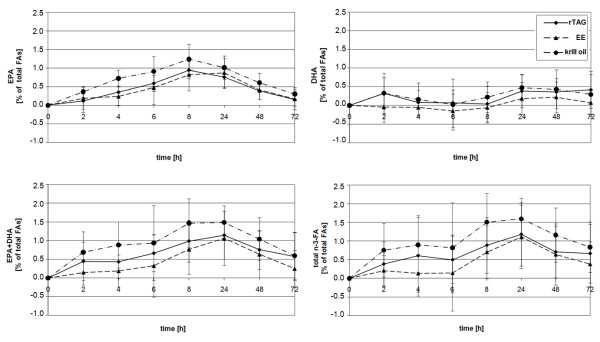
BACKGROUND: Bioavailability of omega-3 fatty acids (FA) depends on their chemical form. Superior bioavailability has been suggested for phospholipid (PL) bound omega-3 FA in krill oil, but identical doses of different chemical forms have not been compared. METHODS: In a double-blinded crossover trial, we compared the uptake of three EPA+DHA formulations derived from fish oil (re-esterified triacylglycerides [rTAG], ethyl-esters [EE]) and krill oil (mainly PL). Changes of the FA compositions in plasma PL were used as a proxy for bioavailability. Twelve healthy young men (mean age 31 y) were randomized to 1680 mg EPA+DHA given either as rTAG, EE or krill oil. FA levels in plasma PL were analyzed pre-dose and 2, 4, 6, 8, 24, 48, and 72 h after capsule ingestion. Additionally, the proportion of free EPA and DHA in the applied supplements was analyzed. RESULTS: The highest incorporation of EPA+DHA into plasma PL was provoked by krill oil (mean AUC0-72 h: 80.03 ± 34.71%*h), followed by fish oil rTAG (mean AUC0-72 h: 59.78 ± 36.75%*h) and EE (mean AUC0-72 h: 47.53 ± 38.42%*h). Due to high standard deviation values, there were no significant differences for DHA and the sum of EPA+DHA levels between the three treatments. However, a trend (p = 0.057) was observed for the differences in EPA bioavailability. Statistical pair-wise group comparison's revealed a trend (p = 0.086) between rTAG and krill oil. FA analysis of the supplements showed that the krill oil sample contained 22% of the total EPA amount as free EPA and 21% of the total DHA amount as free DHA, while the two fish oil samples did not contain any free FA. CONCLUSION: Further studies with a larger sample size carried out over a longer period are needed to substantiate our findings and to determine differences in EPA+DHA bioavailability between three common chemical forms of LC n-3 FA (rTAG, EE and krill oil). The unexpected high content of free EPA and DHA in krill oil, which might have a significant influence on the availability of EPA+DHA from krill oil, should be investigated in more depth and taken into consideration in future trials.
Overview
The claims and statistics of this paper haven’t been checked yet.
Free: it reads the open-access text and checks the first 5 claims that cite a source we can check. Create a free account to check every claim.
Integrity signals
Registry
Cites
Statistics
Figures
Verification
Claims the paper makes
The claims and statistics of this paper haven’t been checked yet.
Free: it reads the open-access text and checks the first 5 claims that cite a source we can check. Create a free account to check every claim.
Claims other papers make about this one
Each is checked against this paper’s own text: does it say what the citing paper says it does?
The source backs part of the claim, not all of it — or backs it for a different population, condition or comparison.
In the citing paper
“The amount and ratio of EPA and DHA differ in various supplements, resulting in different bioavailability and absorption rates. 142 , 143 , 144”
From Association Between Omega-3 Fatty Acid Intake and Dyslipidemia: A Continuous Dose-Response Meta-Analysis of Randomized Controlled Trials (2023) · cites this paper as [142]
Experimental — accuracy not yet measuredThe cited source says what the claim attributes to it.
In the citing paper
“The FFA formulation has greater bioavailability compared with the ethyl esters”
From The Forgotten Lipids: Triglycerides, Remnant Cholesterol, and Atherosclerotic Cardiovascular Disease Risk (2019) · cites this paper as [151]
In the citing paper
“In contrast to most other algal food constituents, the bioaccessibility of DHA and EPA in algal-derived oils and extracts is well quantified for humans, ranging from ∼50 to 100 % depending on the matrix (Haug et al. 2011; Schuchardt et al. 2011).”
From Algae as nutritional and functional food sources: revisiting our understanding. (2017) · cites this paper as Schuchardt et al. 2011
Self-check
Percentages, sums and reported differences re-computed from the paper’s own numbers.
The self-check needs the paper’s full text.
Citations
Cites
Koletzko, B., Lien, E., Agostoni, C., Böhles, H., Campoy, C., Cetin, I., Decsi, T., Dudenhausen, J. W., Dupont, C., Forsyth, S., et al. (2008) · Journal of Perinatal Medicine · doi:10.1515/jpm.2008.001 · Cited by 707
Omega-3 polyunsaturated fatty acids and cardiovascular diseases.
Lavie, C. J., Milani, R. V., Mehra, M. R., & Ventura, H. O. (2009) · Journal of the American College of Cardiology · doi:10.1016/j.jacc.2009.02.084 · Cited by 644 · cited 1×
“Scientific and regulatory bodies recommend an increased intake of EPA+DHA for cardiovascular prevention or during pregnancy [1-3].”
BackgroundKris-Etherton, P. M., Harris, W. S., & Appel, L. J. (2003) · Arteriosclerosis, Thrombosis, and Vascular Biology · doi:10.1161/01.atv.0000057393.97337.ae · Cited by 596
Influence of emulsifier type on in vitro digestibility of lipid droplets by pancreatic lipase
Mun, S., Decker, E. A., & McClements, D. J. (2007) · Food Research International · doi:10.1016/j.foodres.2007.01.007 · Cited by 454 · cited 1×
“As a result, PL influence the surface composition of fat droplets, which possibly facilitates the binding of hydrolyzing enzymes and hence the digestion [22].”
BackgroundMori, T. A., Bao, D. Q., Burke, V., Puddey, I. B., & Beilin, L. J. (1999) · Hypertension · doi:10.1161/01.hyp.34.2.253 · Cited by 407 · cited 1×
“Of note, systolic blood pressure declined only in the menhaden oil group, possibly reflecting the fact that DHA, but not EPA, lowers blood pressure [17].”
BackgroundDietary reference intakes for DHA and EPA
Kris-Etherton, P. M., Grieger, J. A., & Etherton, T. D. (2009) · Prostaglandins, Leukotrienes and Essential Fatty Acids · doi:10.1016/j.plefa.2009.05.011 · Cited by 404 · cited 1×
“Scientific and regulatory bodies recommend an increased intake of EPA+DHA for cardiovascular prevention or during pregnancy [1-3].”
BackgroundHuman absorption of fish oil fatty acids as triacylglycerols, free acids, or ethyl esters
Lawson, L. D., & Hughes, B. G. (1988) · Biochemical and Biophysical Research Communications · doi:10.1016/s0006-291x(88)80718-6 · Cited by 359 · cited 2×
“Smaller trials carried out earlier had inconsistent results [8-13].”
ResultUlven, S. M., Kirkhus, B., Lamglait, A., Basu, S., Elind, E., Haider, T., Berge, K., Vik, H., & Pedersen, J. I. (2011) · Lipids · doi:10.1007/s11745-010-3490-4 · Cited by 303 · cited 3×
“[15] analyzed total plasma FA composition, we used changes in plasma PL FA composition after a single dose treatment as a proxy for bioavailability.”
BackgroundMethodInfluentialThe omega-3 index as a risk factor for coronary heart disease
Harris, W. S. (2008) · The American Journal of Clinical Nutrition · doi:10.1093/ajcn/87.6.1997s · Cited by 297 · cited 1×
“67 g/d) leads to a faster and higher increase of the omega-3 index - the percentage of EPA and DHA in red cell membranes reflecting the long-term intake and n-3 FA status of an individual [5] - when consumed as rTAG than when consumed as EE [6].”
BackgroundBioavailability of marine n-3 fatty acid formulations
Dyerberg, J., Madsen, P., Møller, J. M., Aardestrup, I., & Schmidt, E. B. (2010) · Prostaglandins, Leukotrienes and Essential Fatty Acids · doi:10.1016/j.plefa.2010.06.007 · Cited by 256 · cited 3×
“Our results were in line with data from a short-term study of two weeks duration measuring the FA compositions of serum cholesterol-esters, TAG and phospholipids (PL): relative bioavailability of EPA+DHA from rTAG was superior (124%) compared with cod liver oil (100%), whereas the bioavailability from EE was inferior…”
BackgroundResultInfluential
Cited by
Algae as nutritional and functional food sources: revisiting our understanding.
Wells, M. L., Potin, P., Craigie, J. S., Raven, J. A., Merchant, S. S., Helliwell, K. E., Smith, A. G., Camire, M. E., & Brawley, S. H. (2017) · Journal of Applied Phycology · doi:10.1007/s10811-016-0974-5 · Cited by 1,562
“In contrast to most other algal food constituents, the bioaccessibility of DHA and EPA in algal-derived oils and extracts is well quantified for humans, ranging from ∼ 50 to 100 % depending on the matrix (Haug et al. 2011; Schuchardt et al. 2011).”
Omega-3 polyunsaturated fatty acids and their health benefits
Shahidi, F., & Ambigaipalan, P. (2018) · Annual Review of Food Science and Technology · doi:10.1146/annurev-food-111317-095850 · Cited by 1,390
Siscovick, D. S., Barringer, T. A., Fretts, A. M., Wu, J. H. Y., Lichtenstein, A. H., Costello, R. B., Kris-Etherton, P. M., Jacobson, T. A., Engler, M. B., Alger, H. M., et al. (2017) · Circulation · doi:10.1161/cir.0000000000000482 · Cited by 629
Sandesara, P. B., Virani, S. S., Fazio, S., & Shapiro, M. D. (2019) · Endocrine Reviews · doi:10.1210/er.2018-00184 · Cited by 608
A Comprehensive Review of Chemistry, Sources and Bioavailability of Omega-3 Fatty Acids
Cholewski, M., Tomczykowa, M., & Tomczyk, M. (2018) · Nutrients · doi:10.3390/nu10111662 · Cited by 372
Comprehensive Profiling of Plasma Fatty Acid Concentrations in Young Healthy Canadian Adults
Abdelmagid, S. A., Clarke, S. E., Nielsen, D. E., Badawi, A., El-Sohemy, A., Mutch, D. M., & Ma, D. W. L. (2015) · PLOS ONE · doi:10.1371/journal.pone.0116195 · Cited by 360
Omega-3 fatty acids in obesity and metabolic syndrome: A mechanistic update
Albracht-Schulte, K., Kalupahana, N. S., Ramalingam, L., Wang, S., Rahman, S. M., Robert-McComb, J., & Moustaid-Moussa, N. (2018) · The Journal of Nutritional Biochemistry · doi:10.1016/j.jnutbio.2018.02.012 · Cited by 355
“Future perspectives Both animal and human studies have examined the beneficial effects of combining n-3 PUFA with other dietary supplements and pharmaceuticals including antidiabetic drugs, Lalanyl-L-glutamine [205], as well as α-lipoic acid [118] and krill oil [206].”
BackgroundBioavailability of long-chain omega-3 fatty acids
Schuchardt, J. P., & Hahn, A. (2013) · Prostaglandins, Leukotrienes and Essential Fatty Acids · doi:10.1016/j.plefa.2013.03.010 · Cited by 344
Self-citationHealth benefits of dietary marine DHA/EPA-enriched glycerophospholipids
Zhang, T.-T., Xu, J., Wang, Y.-M., & Xue, C.-H. (2019) · Progress in Lipid Research · doi:10.1016/j.plipres.2019.100997 · Cited by 339
Ryckebosch, E., Bruneel, C., Termote-Verhalle, R., Goiris, K., Muylaert, K., & Foubert, I. (2014) · Food Chemistry · doi:10.1016/j.foodchem.2014.03.087 · Cited by 318
Fatty acids in cardiovascular health and disease: A comprehensive update
Baum, S. J., Kris-Etherton, P. M., Willett, W. C., Lichtenstein, A. H., Rudel, L. L., Maki, K. C., Whelan, J., Ramsden, C. E., & Block, R. C. (2012) · Journal of Clinical Lipidology · doi:10.1016/j.jacl.2012.04.077 · Cited by 277
Marine Omega-3 Phospholipids: Metabolism and Biological Activities
Burri, L., Hoem, N., Banni, S., & Berge, K. (2012) · International Journal of Molecular Sciences · doi:10.3390/ijms131115401 · Cited by 257
Ahmmed, M. K., Ahmmed, F., Tian, H. (., Carne, A., & Bekhit, A. E. (2020) · Comprehensive Reviews in Food Science and Food Safety · doi:10.1111/1541-4337.12510 · Cited by 241
Rossmeisl, M., Macek Jilkova, Z., Kuda, O., Jelenik, T., Medrikova, D., Stankova, B., Kristinsson, B., Haraldsson, G. G., Svensen, H., Stoknes, I., et al. (2012) · PLoS ONE · doi:10.1371/journal.pone.0038834 · Cited by 230
“In line with previous data on krill oil [11,25,26,35], our results support the notion that the endocannabinoid system is involved in the mechanism of action of LC n-3 PUFA.”
ResultLipid signaling in adipose tissue: Connecting inflammation & metabolism
Masoodi, M., Kuda, O., Rossmeisl, M., Flachs, P., & Kopecky, J. (2015) · Biochimica et Biophysica Acta (BBA) - Molecular and Cell Biology of Lipids · doi:10.1016/j.bbalip.2014.09.023 · Cited by 221
Xie, D., Gong, M., Wei, W., Jin, J., Wang, X., Wang, X., & Jin, Q. (2019) · Comprehensive Reviews in Food Science and Food Safety · doi:10.1111/1541-4337.12427 · Cited by 214
Docosahexaenoic acid (DHA), a fundamental fatty acid for the brain: New dietary sources
Echeverría, F., Valenzuela, R., Catalina Hernandez-Rodas, M., & Valenzuela, A. (2017) · Prostaglandins, Leukotrienes and Essential Fatty Acids · doi:10.1016/j.plefa.2017.08.001 · Cited by 202
Influence of lipid type on gastrointestinal fate of oil-in-water emulsions: In vitro digestion study
Zhang, R., Zhang, Z., Zhang, H., Decker, E. A., & McClements, D. J. (2015) · Food Research International · doi:10.1016/j.foodres.2015.05.014 · Cited by 202
“Indeed, in vivo studies have reported higher bioavailability of omega-3 fatty acids when delivered as krill oil rather than as fish oil, which was partly attributed to the fact that the polyunsaturated fatty acids were part of phospholipids in krill oil (Kohler, Sarkkinen, Tapola, Niskanen, & Bruheim, 2015; Schuchardt…”
BackgroundUnsaturated Fatty Acids and Their Immunomodulatory Properties
Coniglio, S. J., Shumskaya, M. A., & Vassiliou, E. K. (2023) · Biology · doi:10.3390/biology12020279 · Cited by 200
“Krill oil consumption leads to the highest incorporation of DHA and EPA into plasma phospholipids [38].”
BackgroundDavidson, M. H., Johnson, J., Rooney, M. W., Kyle, M. L., & Kling, D. F. (2012) · Journal of Clinical Lipidology · doi:10.1016/j.jacl.2012.01.002 · Cited by 191
The Effect of n-3 Fatty Acids on Glucose Homeostasis and Insulin Sensitivity
FLACHS, P., ROSSMEISL, M., & KOPECKY, J. (2014) · Physiological Research · doi:10.33549/physiolres.932715 · Cited by 183
“…when compared with fish oils, the bioavailability of dietary DHA and especially of EPA was even better when omega-3 were supplemented as marine phospholipids, as demonstrated both in mice (Rossmeisl et al. 2012) and in humans (Maki et al. 2009, Schuchardt et al. 2011, Ulven et al. 2011).”
BackgroundOmega 3-metabolism, absorption, bioavailability and health benefits–A review
Punia, S., Sandhu, K. S., Siroha, A. K., & Dhull, S. B. (2019) · PharmaNutrition · doi:10.1016/j.phanu.2019.100162 · Cited by 148
Ramprasath, V. R., Eyal, I., Zchut, S., & Jones, P. J. (2013) · Lipids in Health and Disease · doi:10.1186/1476-511x-12-178 · Cited by 175
“At the most, data from a bioavailability study in humans showed a tendency for higher bioavailability for EPA after krill oil consumption compared with fish oil [18], however, this study tested an acute single dose of n-3 PUFA over 48 h.”
BackgroundResultOmega-3 polyunsaturated fatty acids and cancer: lessons learned from clinical trials
Nabavi, S. F., Bilotto, S., Russo, G. L., Orhan, I. E., Habtemariam, S., Daglia, M., Devi, K. P., Loizzo, M. R., Tundis, R., & Nabavi, S. M. (2015) · Cancer and Metastasis Reviews · doi:10.1007/s10555-015-9572-2 · Cited by 171
Ghasemifard, S., Turchini, G. M., & Sinclair, A. J. (2014) · Progress in Lipid Research · doi:10.1016/j.plipres.2014.09.001 · Cited by 167
“[14], Case Study 7; study length 72 h; Davidson et al.”
BackgroundResultInfluentialMcPartland, J. M., Guy, G. W., & Di Marzo, V. (2014) · PLoS ONE · doi:10.1371/journal.pone.0089566 · Cited by 161
“Krill oil contains DHA and EPA esterified in phospholipids, primarily phosphatidylcholines, which may improve their bioavailability; furthermore krill oil contains less AA than fish oil [141].”
BackgroundComparison of bioavailability of krill oil versus fish oil and health effect
Ulven, S. M., & Holven, K. B. (2015) · Vascular Health and Risk Management · doi:10.2147/vhrm.s85165 · Cited by 150
Köhler, A., Sarkkinen, E. S., Tapola, N. S., Niskanen, T. H., & Bruheim, I. A. (2015) · Lipids in Health and Disease · doi:10.1186/s12944-015-0015-4 · Cited by 125
“A strength of our study is that the omega-3 preparations studied not only contained comparable doses of EPA and DHA in total but also of each fatty acid individually, which has not been done in all bioavailability studies of krill oil [4,5,7,8,13-15] Moreover, we used a cross-over design in order to limit the effects…”
Distinguishing Health Benefits of Eicosapentaenoic and Docosahexaenoic Acids
Russell, F. D., & Bürgin-Maunder, C. (2012) · Marine Drugs · doi:10.3390/md10112535 · Cited by 124
Kitson, A. P., Metherel, A. H., Chen, C. T., Domenichiello, A. F., Trépanier, M.-O., Berger, A., & Bazinet, R. P. (2016) · The Journal of Nutritional Biochemistry · doi:10.1016/j.jnutbio.2016.02.009 · Cited by 106
“Several studies have attempted to compare the bioavailability of TAG- or PLenriched sources of DHA based on responses of blood biomarkers and have concluded either higher bioavailability of PL-DHA [31-33] or equal efficacy [34-37], although this area is controversial [38-41].”
BackgroundLane, K. E., Li, W., Smith, C., & Derbyshire, E. (2014) · International Journal of Food Science & Technology · doi:10.1111/ijfs.12455 · Cited by 106
“168 169 The minimum washout period of 21 days between treatments was based on previously published 170 LC3PUFA crossover studies and it was anticipated that this would be sufficient to allow baseline 171 values to return to normal levels (Garaiova et al. 2007, Schuchardt et al. 2011).”
MethodLiu, L., Bartke, N., Van Daele, H., Lawrence, P., Qin, X., Park, H. G., Kothapalli, K., Windust, A., Bindels, J., Wang, Z., et al. (2014) · Journal of Lipid Research · doi:10.1194/jlr.m045930 · Cited by 117
Haider, J., Majeed, H., Williams, P. A., Safdar, W., & Zhong, F. (2016) · Food Hydrocolloids · doi:10.1016/j.foodhyd.2016.08.020 · Cited by 115
“The particular and unique amphiphilic structural arrangement of 61 phospholipids provides KO with a much better bioavailability (Schuchardt et al., 2011).”
BackgroundRyckebosch, E., Cuéllar‐Bermúdez, S. P., Termote‐Verhalle, R., Bruneel, C., Muylaert, K., Parra‐Saldívar, R., & Foubert, I. (2013) · Journal of Applied Phycology · doi:10.1007/s10811-013-0189-y · Cited by 111
Yurko‐Mauro, K., Kralovec, J. A., Bailey‐Hall, E., Smeberg, V., Stark, J. G., & Salem, N. (2015) · Lipids in Health and Disease · doi:10.1186/s12944-015-0109-z · Cited by 104
“Other studies have indicated lower plasma levels of DHA and/or EPA with fish oil-EE administration versus re-esterified TG [9, 21, 22], suggesting lower bioavailability and reduced functional outcomes, e.”
BackgroundRyckebosch, E., Bruneel, C., Termote-Verhalle, R., Muylaert, K., & Foubert, I. (2014) · Algal Research · doi:10.1016/j.algal.2013.11.001 · Cited by 102
Stotts, C., Corrales‐Medina, V., & Rayner, K. J. (2023) · Circulation Research · doi:10.1161/circresaha.122.321636 · Cited by 100
Berge, K., Musa-Veloso, K., Harwood, M., Hoem, N., & Burri, L. (2014) · Nutrition Research · doi:10.1016/j.nutres.2013.12.003 · Cited by 95
“[11] Schuchardt JP, Schneider I, Meyer H, Neubronner J, von Schacky C, Hahn A.”
BackgroundLu, F., Bruheim, I. A., Haugsgjerd, B. O., & Jacobsen, C. (2014) · Food Chemistry · doi:10.1016/j.foodchem.2014.02.059 · Cited by 97
“This structural difference provides krill oil with a better bioavailability and oxidative stability (Burri, 2011; Schuchardt et al., 2011; Thomsen et al., 2013).”
BackgroundBioavailability of EPA and DHA in humans – A comprehensive review
Alijani, S., Hahn, A., Harris, W. S., & Schuchardt, J. P. (2024) · Progress in Lipid Research · doi:10.1016/j.plipres.2024.101318 · Cited by 96
Self-citationWerner, K., de Gaudry, D. K., Taylor, L. A., Keck, T., Unger, C., Hopt, U. T., & Massing, U. (2017) · Lipids in Health and Disease · doi:10.1186/s12944-017-0495-5 · Cited by 94
Silvestri, C., & Marzo, V. D. (2012) · Expert Opinion on Investigational Drugs · doi:10.1517/13543784.2012.704019 · Cited by 91
Preparation and characterization of novel nanocarriers containing krill oil for food application
Zhu, J., Zhuang, P., Luan, L., Sun, Q., & Cao, F. (2015) · Journal of Functional Foods · doi:10.1016/j.jff.2015.06.017 · Cited by 89
A Comprehensive Overview on Microalgal-Fortified/Based Food and Beverages
Sidari, R., & Tofalo, R. (2019) · Food Reviews International · doi:10.1080/87559129.2019.1608557 · Cited by 87
A Brief Review of Krill Oil History, Research, and the Commercial Market
Kwantes, J. M., & Grundmann, O. (2014) · Journal of Dietary Supplements · doi:10.3109/19390211.2014.902000 · Cited by 88
Park, Y., Lee, A. L., Shim, S. C., Lee, J. H., Choe, J., Ahn, H. Y., Choi, C. B., Sung, Y., & Bae, S. (2013) · The Journal of Nutritional Biochemistry · doi:10.1016/j.jnutbio.2012.11.004 · Cited by 85
“Recent studies [28,29] reported that the triglyceride form of n-3 PUFA was more effective in reducing plasma triglyceride concentration and incorporation into plasma phospholipid as compared with ethyl ester form, suggesting that the bioavailability of n-3 PUFA was important.”
Essential Fatty Acids as Biomedicines in Cardiac Health
Balta, I., Ştef, L., Peț, I., Iancu, T., Stef, D. S., & Corcionivoschi, N. (2021) · Biomedicines · doi:10.3390/biomedicines9101466 · Cited by 81
“In contrast, the best bioavailability was indicated in the case of phospholipid-bound omega-3 fatty acids from krill oil formulations, characterized by incorporation of DHA and EPA into the plasma, with re-esterified triacylglyceride fish oils and followed by ethyl esters [129].”
BackgroundCastejón, N., & Señoráns, F. J. (2020) · New Biotechnology · doi:10.1016/j.nbt.2020.02.006 · Cited by 81
Dacks, P. A., Shineman, D. W., & Fillit, H. M. (2013) · The journal of nutrition health & aging · doi:10.1007/s12603-012-0431-3 · Cited by 79
“…are well absorbed from the intestine. slightly lower bioavailability is reported for the ethyl ester forms commonly found in concentrated fish oil, lovaza, and Vascepa compared to triglyceride and free fatty acid forms (22, 33, 112, 113) (but the clinical importance of this difference is uncertain.”
Laidlaw, M., Cockerline, C. A., & Rowe, W. J. (2014) · Lipids in Health and Disease · doi:10.1186/1476-511x-13-99 · Cited by 78
“In the most recent publication on this issue, krill oil, the most common phospholipid supplement, was not significantly different than re-esterified TG or EE in bioavailability of DHA or EPA +DHA, although there was a trend towards an increased bioavailability of EPA with krill oil [30].”
BackgroundThe effects of omega-3 polyunsaturated fatty acids on cardiac rhythm: A critical reassessment
Billman, G. E. (2013) · Pharmacology & Therapeutics · doi:10.1016/j.pharmthera.2013.05.011 · Cited by 77
“…occurring n−3 PUFAs have a superior bioavailability as compared to pharmaceutical preparations of n−3 PUFA ethyl esters (Neubronner et al., 2011; Schuchardt et al., 2011) and DHA ethyl esters antagonize the stimulatory effect of DHA on vascular smooth muscle large-conductance Ca2+ and…”
BackgroundKrill Products: An Overview of Animal Studies
Burri, L., & Johnsen, L. (2015) · Nutrients · doi:10.3390/nu7053300 · Cited by 71
“In some studies, the effects of n-3 PUFAs from KO were more pronounced than the ones observed with FO [44–46].”
ResultWang, T., Zhang, X., Zhou, N., Shen, Y., Li, B., Chen, B. E., & Li, X. (2023) · Journal of the American Heart Association · doi:10.1161/jaha.123.029512 · Cited by 73
Castro-Gómez, M. P., Holgado, F., Rodríguez-Alcalá, L. M., Montero, O., & Fontecha, J. (2015) · Food Analytical Methods · doi:10.1007/s12161-015-0150-6 · Cited by 73
“Moreover, the KO seems to be more effective in increasing plasma levels of eicosapentaenoic acid (EPA) and docosahexaenoic acid (DHA), when compared to fish oil (Maki et al. 2009; Schuchardt et al. 2011; Ulven et al. 2011).”
BackgroundTillander, V., Bjørndal, B., Burri, L., Bohov, P., Skorve, J., Berge, R. K., & Alexson, S. E. H. (2014) · Nutrition & Metabolism · doi:10.1186/1743-7075-11-20 · Cited by 73
“Incorporation of omega3 PUFAs in PLs has been suggested to give these lipids a higher bioavailability [14,42,43], in fact, PLs enriched from KO was shown to be even more efficient in lowering plasma cholesterol than KO itself when given to rats fed a high cholesterol diet [44].”
BackgroundInfluentialNutritional Properties of Dietary Omega-3-Enriched Phospholipids
Murru, E., Banni, S., & Carta, G. (2013) · BioMed Research International · doi:10.1155/2013/965417 · Cited by 67
“It is likely that supplementation of n-3 HPUFA as PLs exerts stronger biological effects compared with the TAG form because (i) various PL species can also act as ligands for nuclear receptors involved in the transcriptional regulation of steroidogenesis and cholesterol metabolism [99, 100] and (ii) the PLs form has b…”
Xie, H., Zhou, D., Liu, Z., Li, D., Tan, Z., Dong, X., Liu, X., Shahidi, F., & Zhu, B. (2019) · Food Chemistry · doi:10.1016/j.foodchem.2019.05.133 · Cited by 70
Advances in Technologies for Highly Active Omega-3 Fatty Acids from Krill Oil: Clinical Applications
Colletti, A., Cravotto, G., Citi, V., Martelli, A., Testai, L., & Cicero, A. F. G. (2021) · Marine Drugs · doi:10.3390/md19060306 · Cited by 68
Araujo, P. W., Zhu, H., Breivik, J. F., Hjelle, J. I., & Zeng, Y. (2013) · Lipids · doi:10.1007/s11745-013-3855-6 · Cited by 68
“It has been reported that krill oil, due exclusively to its high content of PL, offers greater potential than other marine oils (rich in TAG) to promote lipid metabolism [6], control hyperlipidemia [7], incorporate 20:5n-3 and 22:6n3 as PL into plasma [8], reduce chronic inflammation, arthritic symptoms and blood gluc…”
BackgroundProfile and distribution of fatty acids in edible parts of commonly consumed marine fishes in Chile
Rincón‐Cervera, M. Á., González‐Barriga, V., Valenzuela, R., López‐Arana, S., Romero, J., & Valenzuela, A. (2018) · Food Chemistry · doi:10.1016/j.foodchem.2018.08.113 · Cited by 67
Cook, C. M., Hallaråker, H., Sæbø, P. C., Innis, S. M., Kelley, K., Sanoshy, K. D., Berger, A., & Maki, K. C. (2016) · Prostaglandins Leukotrienes and Essential Fatty Acids · doi:10.1016/j.plefa.2016.01.007 · Cited by 66
Omega-3 polyunsaturated fatty acids and mitochondria, back to the future
de Oliveira, M. R., Nabavi, S. F., Nabavi, S. M., & Jardim, F. R. (2017) · Trends in Food Science & Technology · doi:10.1016/j.tifs.2017.06.019 · Cited by 65
Yum, H.-W., Na, H., & Surh, Y. (2016) · Seminars in Cancer Biology · doi:10.1016/j.semcancer.2016.08.004 · Cited by 64
Ramprasath, V. R., Eyal, I., Zchut, S., Shafat, I., & Jones, P. J. H. (2015) · Lipids in Health and Disease · doi:10.1186/s12944-015-0142-y · Cited by 63
“Similarly, others [6, 7, 11] have also reported similar findings of higher efficiency with krill oil compared to fish oil in raising circulating n-3 PUFA levels.”
ResultKagan, M. L., West, A. L., Zante, C., & Calder, P. C. (2013) · Lipids in Health and Disease · doi:10.1186/1476-511x-12-102 · Cited by 55
“The apparently higher incorporation of EPA with algal compared with krill oil is particularly interesting because a recent study reported better incorporation of EPA into plasma over 72 hours if participants consumed krill oil compared with if they consumed TAGs, both providing the same amounts of EPA and DHA [27].”
BackgroundYuan, Y., Wang, X., Jin, M., Sun, P., & Zhou, Q. (2019) · Aquaculture · doi:10.1016/j.aquaculture.2019.04.068 · Cited by 62
Ghasemifard, S., Hermon, K. M., Turchini, G. M., & Sinclair, A. J. (2015) · British Journal Of Nutrition · doi:10.1017/s0007114515002457 · Cited by 61
Tullberg, C., Vegarud, G. E., & Undeland, I. (2018) · Food Chemistry · doi:10.1016/j.foodchem.2018.07.049 · Cited by 62
“Also, 22 and 21% of eicosapentaenoic acid (EPA) and docosahexaenoic acid (DHA) have been found to be present in free form in krill oil (Schuchardt et al., 2011).”
BackgroundManipulation of Omega‐3 PUFAs in Lamb: Phenotypic and Genotypic Views
Alvarenga, T. I. R. C., Chen, Y., Garcia, I. F. F., Pérez, J. R. O., & Hopkins, D. L. (2015) · Comprehensive Reviews in Food Science and Food Safety · doi:10.1111/1541-4337.12131 · Cited by 60
Kagan, M. L., Levy, A., & Leikin-Frenkel, A. (2015) · Food & Function · doi:10.1039/c4fo00591k · Cited by 54
Moran, C. A., Morlacchini, M., Keegan, J. D., & Fusconi, G. (2018) · The Journal of Applied Poultry Research · doi:10.3382/japr/pfy075 · Cited by 58
Investigation of oxidative degradation and non‐enzymatic browning reactions in krill and fish oils
Thomsen, B. R., Haugsgjerd, B. O., Griinari, M., Lu, H. F. S., Bruheim, I. A., Vogt, G., Oterhals, Å., & Jacobsen, C. (2013) · European Journal of Lipid Science and Technology · doi:10.1002/ejlt.201300141 · Cited by 57
Fasano, E., Serini, S., Mondella, N., Trombino, S., Celleno, L., Lanza, P., Cittadini, A. R. M., & Calviello, G. (2014) · BioMed Research International · doi:10.1155/2014/327452 · Cited by 57
Absorption rate of krill oil and fish oil in blood and brain of rats
Ahn, S. H., Lim, S. J., Ryu, Y. M., Park, H.-R., Suh, H. J., & Han, S. (2018) · Lipids in Health and Disease · doi:10.1186/s12944-018-0812-7 · Cited by 57
Peritore, A. F., Siracusa, R., Crupi, R., & Cuzzocrea, S. (2019) · Nutrients · doi:10.3390/nu11092175 · Cited by 56
“Krill oil contains both DHA and EPA, which are esterified in phospholipids, mainly phosphatidylcholine, which can improve their bioavailability; in addition, krill oil contains less AA than fish oil [20].”
BackgroundNavalho, S., Ferrer-Ledo, N., Barbosa, M. J., & Varela, J. C. S. (2025) · Marine Drugs · doi:10.3390/md23030128 · Cited by 55
“For instance, a higher digestibility of PUFAs esterified to polar lipids was reported by in vitro studies using models mimicking the intestinal tract [78,79].”
Qin, Y., Nyheim, H., Haram, E. M., Moritz, J. M., & Hustvedt, S. O. (2017) · Lipids in Health and Disease · doi:10.1186/s12944-017-0589-0 · Cited by 54
“5X of standard fish oil [19, 20], but still require hydrolyzation by gut enzymes, in addition, the cost to gain clinically relevant EPA + DHA doses is significantly higher than fish oil-derived ethyl esters.”
BackgroundPreparation and functionality of lipase-catalysed structured phospholipid – A review
Ang, X., Chen, H., Xiang, J., Wei, F., & Quek, S. Y. (2019) · Trends in Food Science & Technology · doi:10.1016/j.tifs.2019.04.005 · Cited by 53
Murota, K. (2020) · Biocatalysis and Agricultural Biotechnology · doi:10.1016/j.bcab.2020.101633 · Cited by 52
A reexamination of krill oil bioavailability studies
Salem, N., & Kuratko, C. N. (2014) · Lipids in Health and Disease · doi:10.1186/1476-511x-13-137 · Cited by 51
“In an acute study where KO was compared to a FO over 72 h in a cross-over trial in 12 healthy, young men, no statistically significant differences were observed in EPA, DHA or the sum of EPA +DHA in plasma phospholipids after giving a closely matched amount (1680 mg) of EPA/ DHA [8].”
MethodWu, B., Xie, Y., Xu, S., Lv, X., Yin, H., Xiang, J., Chen, H., & Wei, F. (2020) · Journal of Agricultural and Food Chemistry · doi:10.1021/acs.jafc.0c05215 · Cited by 51
Bonafini, S., Antoniazzi, F., Maffeis, C., Minuz, P., & Fava, C. (2015) · Prostaglandins & Other Lipid Mediators · doi:10.1016/j.prostaglandins.2015.03.006 · Cited by 50
Lipid Class Specific Quantitative Analysis of n-3 Polyunsaturated Fatty Acids in Food Supplements
Kutzner, L., Ostermann, A. I., Konrad, T., Riegel, D., Hellhake, S., Schuchardt, J. P., & Schebb, N. H. (2016) · Journal of Agricultural and Food Chemistry · doi:10.1021/acs.jafc.6b03745 · Cited by 49
Self-citationZhang, Y., Wu, G., Zhang, Y., Wang, X., Jin, Q., & Zhang, H. (2020) · Comprehensive Reviews in Food Science and Food Safety · doi:10.1111/1541-4337.12543 · Cited by 47
Dietary DHA, bioaccessibility, and neurobehavioral development in children
Cardoso, C. L., Afonso, C. M., & Bandarra, N. M. (2017) · Critical Reviews in Food Science and Nutrition · doi:10.1080/10408398.2017.1338245 · Cited by 47
“In krill oil, which is rich in PL, it has been claimed that its DHA bioavailability is higher on the basis of in vivo studies (Maki et al., 2009; Schuchardt et al., 2011).”
BackgroundMitra, M., & Mishra, S. (2019) · Algal Research · doi:10.1016/j.algal.2018.101387 · Cited by 46
Zhang, L., Ding, L., Shi, H.-H., Xu, J., Xue, C., Zhang, T., & Wang, Y. (2019) · Food & Function · doi:10.1039/c9fo00868c · Cited by 47
Santos, L. R. B., & Fleming, I. (2019) · Prostaglandins & Other Lipid Mediators · doi:10.1016/j.prostaglandins.2019.106407 · Cited by 47
Chevalier, L., & Plourde, M. (2020) · European Journal of Clinical Nutrition · doi:10.1038/s41430-020-00767-4 · Cited by 46
Krill Oil for Knee Osteoarthritis: A Randomized Clinical Trial
Laslett, L. L., Scheepers, L. E. J. M., Antony, B., Wluka, A. E., Cai, G., Hill, C. L., MARCH, L. M., Keen, H. I., Otáhal, P., Cicuttini, F., et al. (2024) · JAMA · doi:10.1001/jama.2024.6063 · Cited by 44
Fish oil and krill oil differentially modify the liver and brain lipidome when fed to mice
Skorve, J., Hilvo, M., Vihervaara, T., Burri, L., Bohov, P., Tillander, V., Bjørndal, B., Suoniemi, M., Laaksonen, R., Ekroos, K., et al. (2015) · Lipids in Health and Disease · doi:10.1186/s12944-015-0086-2 · Cited by 44
“readily incorporated into cell membranes [4–7].”
Encapsulation of food ingredients by nanostructured lipid carriers (NLCs)
Mohammadi, M., Assadpour, E., & Jafari, S. M. (2019) · Elsevier eBooks · doi:10.1016/b978-0-12-815673-5.00007-6 · Cited by 45
McCauley, J. I., Winberg, P. C., Meyer, B. J., & Skropeta, D. (2018) · Algal Research · doi:10.1016/j.algal.2018.09.016 · Cited by 42
West, A. L., Miles, E. A., Lillycrop, K. A., Han, L., Sayanova, O. V., Napier, J. A., Calder, P. C., & Burdge, G. C. (2019) · British Journal Of Nutrition · doi:10.1017/s0007114519000825 · Cited by 43
“plasma PC was greater than TAG after fasting and during the postprandial period(28,30,31) and suggests that EPA and DHA”
Nutrigenomics of Dietary Lipids
Bordoni, L., Petracci, I., Zhao, F., Min, W., Pierella, E., Assmann, T. S., Martínez, J. A., & Gabbianelli, R. (2021) · Antioxidants · doi:10.3390/antiox10070994 · Cited by 43
Lobraico, J. M., DiLello, L. C., Butler, A. D., Cordisco, M. E., Petrini, J. R., & Ahmadi, R. (2015) · BMJ Open Diabetes Research & Care · doi:10.1136/bmjdrc-2015-000107 · Cited by 38
“While both krill and fish oils possess ω-3 fatty acids, the fatty acids in fish oil are attached to either triglycerides or ethyl esters which reportedly produce a high abundance of ω-3 fatty acids in whole blood.(4) However, it has been suggested that krill oil has better bioavailability because the ω-3 fatty acids,…”
Cook, C. M., Larsen, T. S., Derrig, L. D., Kelly, K. M., & Tande, K. S. (2016) · Lipids · doi:10.1007/s11745-016-4189-y · Cited by 43
Dysregulation of cellular membrane homeostasis as a crucial modulator of cancer risk
Erazo‐Oliveras, A., Muñoz‐Vega, M., Salinas, M. L., Wang, X., & Chapkin, R. S. (2022) · FEBS Journal · doi:10.1111/febs.16665 · Cited by 42
Yalagala, P. C. R., Dhavamani, S., Zaldua, S., Tai, L. M., & Subbaiah, P. V. (2020) · Molecular Nutrition & Food Research · doi:10.1002/mnfr.202000059 · Cited by 40
Albert, B. B., Derraik, J. G. B., Brennan, C. M., Biggs, J. B., Garg, M. L., Cameron‐Smith, D., Hofman, P. L., & Cutfield, W. S. (2015) · American Journal of Clinical Nutrition · doi:10.3945/ajcn.114.103028 · Cited by 39
“Unlike fish oil that contains triglycerides, n–3 PUFAs in krill oil are predominantly in phospholipid form (20, 21).”
Background
Metadata
- Authors
- Schuchardt, J., Schneider, I., Meyer, H., Neubronner, J., von Schacky, C., & Hahn, A.
- Affiliations
- Leibniz University Hannover (DE)
- Corresponding author
- Schuchardt, Jan
- Venue
- Lipids in Health and Disease
- Published
- 2011
- Volume
- 10
- Issue
- 1
- Pages
- 145
- ISSN
- 1476-511X (ISSN-L)
- PMC
- PMC3168413
- OpenAlex
- W2142533350
- Cited by
- 291
- References
- 28
- Citations by year
- 2026: 13 · 2025: 16 · 2024: 16 · 2023: 12 · 2022: 15 · 2021: 22 · 2020: 21 · 2019: 26 · 2018: 22 · 2017: 11 · 2016: 21 · 2015: 30 · 2014: 26 · 2013: 27 · 2012: 13
- FWCI
- 19.48
- Type
- journal article
- Language
- en
- Open access
- gold
- doi.org
- Licence
- cc-by
- Locations
- Lipids in Health and Disease (publishedVersion, cc-by)
- Europe PMC (PubMed Central) (publishedVersion, cc-by)
- PubMed Central (publishedVersion, cc-by)
- PubMed (publishedVersion)
- Institutional Repository of Leibniz Universität Hannover (Leibniz Universität Hannover) (submittedVersion, cc-by-nc-nd)
- DOAJ (DOAJ: Directory of Open Access Journals) (submittedVersion, cc-by-sa)
- Open access LMU (Ludwid Maxmilian's Universitat Munchen) (submittedVersion)
- Leibniz Universität Hannover (cc-by)
- Funders
- Gottfried Wilhelm Leibniz Universität Hannover
- Ludwig-Maximilians-Universität München
- Leibniz-Gemeinschaft
- Topics
- Health Sciences › Nursing › Nutrition and Dietetics › Fatty Acid Research and Health
- Physical Sciences › Chemistry › Organic Chemistry › Edible Oils Quality and Analysis
- Life Sciences › Agricultural and Biological Sciences › Aquatic Science › Aquaculture Nutrition and Growth
- Keywords
- omega-3 fatty acids, EPA, docosahexaenoic acid, bioavailability, krill oil, fish oil, ethyl esters, free fatty acids, plasma phospholipids, n-3 long-chain polyunsaturated fatty acids, dietary supplement formulation, healthy young men, crossover trial
- MeSH terms
- Adult, Animals, Chemistry, Pharmaceutical, Docosahexaenoic Acids, Double-Blind Method, Fish Oils, Humans, Male, Phospholipids, Eicosapentaenoic Acid, Area Under Curve, Euphausiacea
About these checks
Registry, retraction, Cites and statistics results are computed, not judged, with one exception: a printed reference that no index lists is read once by a model before it counts as a citation error. Claims are extracted by a model and kept only when their quote appears verbatim in the text; each cited source is then checked, with a model’s help, for whether it says what the claim relies on. Those verdicts can be wrong — read the claim’s quote and the cited source before relying on one.
Statistics and arithmetic are recomputed, not judged.
Confidence bands are shown only for fields calibrated on our annotated test set. None is calibrated yet, so no band is shown.
What counts as a claim ›How we measure confidence ›How we check this ›
Are you an author, or do you see a problem with this page? Request a review
Data sources
Bibliographic data: Semantic Scholar, OpenAlex, Crossref.
Contains information from the Semantic Scholar Academic Graph Datasets, made available under the ODC Attribution License (ODC-BY 1.0).
Semantic Scholar’s data is described in: Kinney, R., et al. (2023). The Semantic Scholar Open Data Platform. arXiv:2301.10140.
