

The DOI matches its Crossref record; 44 of the 44 references it cites were found in a registry or an index.
Evaluating the responsiveness of the Warwick Edinburgh Mental Well-Being Scale (WEMWBS): Group and individual level analysis
Open accessAbstract
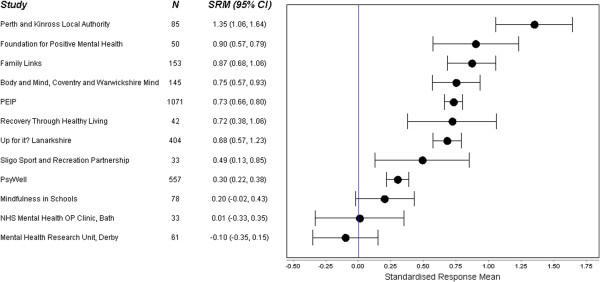
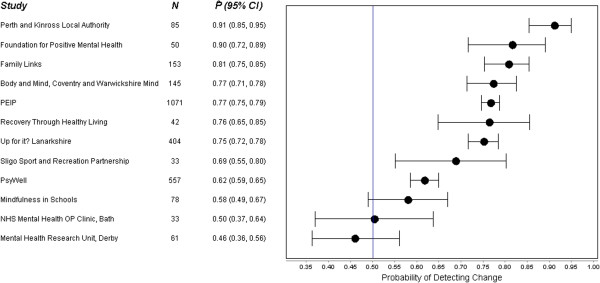
BACKGROUND: Mental well-being now features prominently in UK and international health policy. However, progress has been hampered by lack of valid measures that are responsive to change. The objective of this study was to evaluate the responsiveness of the Warwick Edinburgh Mental Well-being Scale (WEMWBS) at both the individual and group level. METHODS: Secondary analysis of twelve different interventional studies undertaken in different populations using WEMWBS as an outcome measure. Standardised response mean (SRM), probability of change statistic (P(^)) and standard error of measurement (SEM) were used to evaluate whether WEMWBS detected statistically important changes at the group and individual level, respectively. RESULTS: Mean change in WEMWBS score ranged from -0.6 to 10.6. SRM ranged from -0.10 (95% CI: -0.35, 0.15) to 1.35 (95% CI: 1.06, 1.64). In 9/12 studies the lower limit of the 95% CI for P(^) was greater than 0.5, denoting responsiveness. SEM ranged from 2.4 to 3.1 units, and at the threshold 2.77 SEM, WEMWBS detected important improvement in at least 12.8% to 45.7% of participants (lower limit of 95% CI>5.0%). CONCLUSIONS: WEMWBS is responsive to changes occurring in a wide range of mental health interventions undertaken in different populations. It offers a secure base for research and development in this rapidly evolving field. Further research using external criteria of change is warranted.
Overview
The claims and statistics of this paper haven’t been checked yet.
Run the check — free, no account needed. It reads the open-access text and checks the sources it cites.
Integrity signals
Registry
Cites
Statistics
Figures
Verification
Claims the paper makes
The claims and statistics of this paper haven’t been checked yet.
Run the check — free, no account needed. It reads the open-access text and checks the sources it cites.
Claims other papers make about this one
Each is checked against this paper’s own text: does it say what the citing paper says it does?
The cited source says what the claim attributes to it.
In the citing paper
“At an individual level, a change of three or more units is interpreted as representing ‘meaningful change’. 45”
From Feasibility of RESTORE: An online Acceptance and Commitment Therapy intervention to improve palliative care staff wellbeing. (2023) · cites this paper as [45]
Self-check
Percentages, sums and reported differences re-computed from the paper’s own numbers.
The self-check needs the paper’s full text.
Citations
Cites
Coefficient Alpha and the Internal Structure of Tests
Cronbach, L. J. (1951) · Psychometrika · doi:10.1007/bf02310555 · Cited by 43,931 · cited 1×
“In the one study undertaken in the adolescent population, WEMWBS demonstrated satisfactory internal consistency [44], however, the Cronbach’s alpha score was lower than that found in the validation study undertaken in an adolescent population [17].”
ResultOn Happiness and Human Potentials: A Review of Research on Hedonic and Eudaimonic Well-Being
Ryan, R. M., & Deci, E. L. (2001) · Annual Review of Psychology · doi:10.1146/annurev.psych.52.1.141 · Cited by 11,567 · cited 1×
“; licensee BioMed Ce Creative Commons Attribution License (http:/ distribution, and reproduction in any medium and that it covers both eudaimonic (psychological functioning) and hedonic (affective) dimensions [12].”
BackgroundJacobson, N. S., & Truax, P. (1991) · Journal of Consulting and Clinical Psychology · doi:10.1037/0022-006x.59.1.12 · Cited by 7,770 · cited 1×
“96√2 × SEM) takes into account measurement error, the combined variability across the baseline and post intervention samples, and chance at the 95% confidence interval [32,33].”
BackgroundThe Warwick-Edinburgh Mental Well-being Scale (WEMWBS): development and UK validation
Tennant, R., Hiller, L., Fishwick, R., Platt, S., Joseph, S., Weich, S., Parkinson, J., Secker, J., & Stewart-Brown, S. (2007) · Health and Quality of Life Outcomes · doi:10.1186/1477-7525-5-63 · Cited by 5,031 · cited 5×
“WEMWBS is a valid, reliable and acceptable measure [13], which we have demonstrated, is responsive to change in a wide variety of settings from the community settings, to schools, and psychiatric hospitals, making it suitable for use in evaluation of interventions at group and individual level.”
BackgroundMethodResultInfluentialSelf-citationJaeschke, R., Singer, J., & Guyatt, G. H. (1989) · Controlled Clinical Trials · doi:10.1016/0197-2456(89)90005-6 · Cited by 4,982 · cited 1×
“5 units on each item on a Likert scale would equate to an improvement deemed important by individuals [45].”
BackgroundMental illness and/or mental health? Investigating axioms of the complete state model of health
Keyes, C. L. M. (2005) · Journal of Consulting and Clinical Psychology · doi:10.1037/0022-006x.73.3.539 · Cited by 3,357 · cited 1×
“While debate surrounds the precise definitions of both well-being and mental well-being [10,11], there is broad consensus that the latter is more than the absence of mental illness”
BackgroundReport by the commission on the measurement of economic performance and social progress
Fitoussi, J., Sen, A. K., & Stiglitz, J. E. (2011) · Cited by 2,887
Effect Sizes for Interpreting Changes in Health Status
Kazis, L. E., Anderson, J. J., & Meenan, R. F. (1989) · Medical Care · doi:10.1097/00005650-198903001-00015 · Cited by 2,401 · cited 1×
“However, in the literature a variety of statistics have been used to evaluate responsiveness at the group-level, including the paired t-test [35] and Cohen’s effect size (mean change in score by the standard deviation of the baseline score) [36].”
MethodIndividual-patient monitoring in clinical practice: are available health status surveys adequate?
McHorney, C. A., & Tarlov, A. R. (1995) · Quality of Life Research · doi:10.1007/bf01593882 · Cited by 2,206
Measuring change over time: assessing the usefulness of evaluative instruments.
Guyatt, G., Walter, S. D., & Norman, G. (1987) · Journal of Chronic Diseases · doi:10.1016/0021-9681(87)90069-5 · Cited by 1,997 · cited 2×
“Responsive instruments should have the ability to detect changes in health status where these occur [19].”
Background
Cited by
Sorted by citations
Items 101–200 of 265
Allard, J., Pollard, A. S., Laugharne, R. A., Coates, J., Wildfire-Roberts, J., Millward, M., & Shankar, R. (2024) · BJPsych Open · doi:10.1192/bjo.2023.646 · Cited by 16
The health and well-being impacts of a work integration social enterprise from a systems perspective
Joyce, A., Elmes, A., Campbell, P., Moussa, B., Suchowerska, R., Barraket, J., & Carey, G. E. (2021) · Health Promotion International · doi:10.1093/heapro/daab052 · Cited by 13
Promoting mental wellbeing: developing a theoretically and empirically sound complex intervention
Millar, S., & Donnelly, M. (2013) · Journal of Public Health · doi:10.1093/pubmed/fdt075 · Cited by 14
Mack, D. E., Vo, K. T., & Wilson, P. M. (2024) · Journal of Happiness Studies · doi:10.1007/s10902-024-00715-0 · Cited by 12
“Finally, WEMWBS scores have demonstrated sensitivity to change when adopted as the outcome of interventions (Maheswaran et al., 2012).”
Brown, M., Hooper, N., James, P., Scott, D., Bodger, O. G., & John, A. M. (2020) · JMIR Formative Research · doi:10.2196/18586 · Cited by 12
Bourne, J., Harrison, T. L., Wigham, S., Morison, C.-J., & Hackett, S. (2021) · Journal of Applied Research in Intellectual Disabilities · doi:10.1111/jar.12919 · Cited by 15
Eggleton, K. S., Stewart, L., & Kask, A. (2018) · Journal of Primary Health Care · doi:10.1071/hc17068 · Cited by 16
Gandhi, S., Palled, V. K., Sahu, M., Jagannathan, A., Khanna, M., & Jose, A. (2019) · Journal of Neurosciences in Rural Practice · doi:10.1055/s-0039-3399613 · Cited by 12
Luttenberger, K., Baggenstos, B., Najem, C., Sifri, C., Lewczuk, P., Radegast, A., & Rosenbaum, S. (2024) · Conflict and Health · doi:10.1186/s13031-024-00615-3 · Cited by 17
Watkins, E. R., Warren, F. C., Newbold, A., Hulme, C., Cranston, T., Aas, B., Bear, H., Botella, C., Burkhardt, F., Ehring, T., et al. (2024) · The Lancet Digital Health · doi:10.1016/s2589-7500(24)00149-3 · Cited by 12
Stansfeld, S. A., Berney, L., Bhui, K. S., Chandola, T., Costelloe, C., Hounsome, N., Kerry, S., Lanz, D., & Russell, J. (2015) · Public Health Research · doi:10.3310/phr03090 · Cited by 11
“Ineligible 0 1 5 6 1 7 Refused 2 7 1 10 1 11 Consented (% of those approached) 100 (70) 126 (72) 115 (56) 341 (66) 83 (64) 424 (65)”
Skinner, T. L., Peeters, G. M. E. E., Croci, I., Bell, K. R., Burton, N. W., Chambers, S. K., & Bolam, K. A. (2016) · Asia-Pacific Journal of Clinical Oncology · doi:10.1111/ajco.12474 · Cited by 11
Brown, M., Lord, E., & John, A. M. (2023) · JMIR Formative Research · doi:10.2196/39913 · Cited by 13
“The validated measure enables researchers to establish where a specific population falls in relation to published national population averages following the use of interventions of 2-week (or longer) duration [52-55].”
BackgroundGriffiths, C., da Silva, K. M., Hina, F., Jugon, S., Willis, G., Yardley, S., Walker, J., & Kelbrick, M. (2022) · Open Journal of Psychiatry · doi:10.4236/ojpsych.2022.122015 · Cited by 11
“WEMWBS has a minimal clinically important difference (MCID) of 3 [47].”
BackgroundFranklin, M. K., Mukuria, C., Mulhern, B. J., Tran, I., Brazier, J. E., & Watson, S. (2019) · Patient · doi:10.1007/s40271-019-00358-x · Cited by 11
Mental wellbeing in bereaved carers: A Health Survey for England population study
Hodiamont, F., Allgar, V. L., Currow, D. C., & Johnson, M. J. (2019) · BMJ Supportive & Palliative Care · doi:10.1136/bmjspcare-2019-001957 · Cited by 10
Zubala, A., Kennell, N., MacInnes, C., MacInnes, M., & Malcolm, M. (2023) · Frontiers in Psychiatry · doi:10.3389/fpsyt.2023.1193445 · Cited by 10
“However, both scales have shown to be responsive to change at an individual level: for WEMWBS, a minimally important level of change in wellbeing was detected at 3 points difference (44) and for WHO-5 a 10% difference indicates a significant change (45).”
BackgroundStancombe, J., Williams, R., Drury, J., Hussey, L. J., Gittins, M., Barrett, A., French, P., & Chitsabesan, P. (2023) · BJPsych Open · doi:10.1192/bjo.2023.527 · Cited by 10
Ballou, N., Sewall, C. J. R., Ratcliffe, J., Zendle, D. I., Tokarchuk, L. N., & Deterding, S. (2024) · Technology Mind and Behavior · doi:10.1037/tmb0000124 · Cited by 18
“This aligned with estimates for the Warwick-Edinburgh Mental Wellbeing Scale (WEMWBS; Maheswaran et al., 2012) and Positive and Negative Affect Schedule (PANAS) positive affect subscale (Anvari & Lakens, 2021), both approximately .3 scale points.”
Kaylor‐Hughes, C., Rawsthorne, M., Coulson, N., Simpson, S., Simons, L., Guo, B., James, M., Moran, P., Simpson, J., Hollis, C. P., et al. (2017) · JMIR Research Protocols · doi:10.2196/resprot.8061 · Cited by 10
“The primary outcome will be clinical effectiveness (mental well-being) of BWW versus Moodzone as measured by the 14-item Warwick-Edinburgh Well-being Scale [23,24] from baseline, 3 to 6 weeks.”
BackgroundMethodJohnson, L., Cronin, L., Huntley, E., & Marchant, D. (2020) · International Journal of Sport and Exercise Psychology · doi:10.1080/1612197x.2020.1819368 · Cited by 14
“This is important as it has been suggested that an increase of three of more on the WEMWBS scale demonstrates that mental well-being has meaningfully improved (Maheswaran et al., 2012).”
BackgroundRavalier, J. M. (2022) · International Journal of Environmental Research and Public Health · doi:10.3390/ijerph19084646 · Cited by 10
“Lastly, the WEMWBS is sensitive to change at both group and individual levels [36].”
BackgroundHolt, N. J. (2023) · Nordic Journal of Arts Culture and Health · doi:10.18261/njach.5.1.1 · Cited by 10
Huang, Y., Lin, G., Lee, S., Chen, Y., Huang, S., & Hsieh, C. (2017) · Archives of Physical Medicine and Rehabilitation · doi:10.1016/j.apmr.2017.08.472 · Cited by 10
Davies, C., Budgeon, C. A., Murray, K., Hunter, M. L., & Knuiman, M. W. (2023) · Frontiers in Public Health · doi:10.3389/fpubh.2023.1288760 · Cited by 9
Sumich, A. L., Heym, N., Sarkar, M., Burgess, T., French, J., Hatch, L. M., & Hunter, K. A. (2022) · Psychology & Neuroscience · doi:10.1037/pne0000288 · Cited by 11
Experiences with a universal mindfulness and well-being programme at a UK medical school
Stewart-Brown, S. L., Cader, M., Walker, T., Janjua, S., Hanson, E., & Chilton, A.-M. (2018) · Health Education · doi:10.1108/he-10-2017-0053 · Cited by 9
“Change scores are correlated with clinical observation in counselling populations [Ragonesi, 2013], and clinically important change has been estimated using different methods as 3 and 8 points [Maheswaran et al., 2012].”
MethodSelf-citationQuek, G. S. M., Kwan, Y. H., Chan, C. Q. H., Phang, J. K., & Low, L. L. (2022) · Journal of Interprofessional Education & Practice · doi:10.1016/j.xjep.2022.100504 · Cited by 9
Walker, L., Smith, N., & Delon, C. (2021) · BMJ Nutrition Prevention & Health · doi:10.1136/bmjnph-2020-000219 · Cited by 9
The impact of diet and lifestyle on wellbeing in adults during COVID-19 lockdown
Muth, A.-K., Vermeer, A. B. L., Terenzi, D., & Park, S. Q. (2022) · Frontiers in Nutrition · doi:10.3389/fnut.2022.993180 · Cited by 15
An EEG-Based Positive Feedback Mechanism for VR Mindfulness Meditation to Improve Emotion Regulation
Wang, Q., Liu, F., Yang, B., Yang, Z., Huang, J., Xu, Y., Zheng, C., She, Y., Cai, H., & Tian, F. (2025) · IEEE Transactions on Computational Social Systems · doi:10.1109/tcss.2025.3557711 · Cited by 10
“The visual analog scale (VAS) of “anxious,” “nervous,” and “worried” were scored on a likert scale from 0 (not at all) to 100 (extremely) [66], [67], in addition to the 6-item state-trait anxiety inventory (STAI) [68] and the short Warwick Edinburgh mental well-being scale (SWEMWBS) [69].”
Petrogiannis, K., Sangeorzan, I., & Andriopoulou, P. (2024) · Adversity and Resilience Science · doi:10.1007/s42844-024-00134-3 · Cited by 8
“Research confirms its ease of administration, user-friendliness, robust psychometric validity (Clarke et al., 2011; Lloyd & Devine, 2012; Maheswaran et al., 2012; Taggart et al., 2013; Tennant et al., 2007), and sensitivity to change in different well-being promotion initiatives (Stewart-Brown,…”
Foster, J., Martin, C. R., & Davis, J. P. (2021) · International Journal of Environmental Research and Public Health · doi:10.3390/ijerph182413042 · Cited by 8
Moore, J., Flynn, M., & Morgan, M. (2019) · Child Abuse Review · doi:10.1002/car.2548 · Cited by 8
Psychometric properties of the Warwick Edinburgh Mental Well-being Scale: a systematic review
Perera, R., Wickremasinghe, R., & Za, T. A. P. D. (2025) · Systematic Reviews · doi:10.1186/s13643-025-02897-x · Cited by 8
“Only one study evaluated the responsiveness of the scale [55].”
InfluentialKoh, Z. H., Serbetci, D., Skues, J., & Murray, G. (2025) · JMIR Mental Health · doi:10.2196/59351 · Cited by 6
Al‐Wattary, N., Mollazehi, M., Al-Jubouri, A. M., Al-Qahtani, N., Jolo, L., Badr, A. A., Arif, M., ElTantawi, N., & Al-Kuwari, M. S. (2023) · Mental Health Science · doi:10.1002/mhs2.18 · Cited by 7
Nguyen, T., & O’Neill, C. (2025) · Journal of Affective Disorders · doi:10.1016/j.jad.2025.02.049 · Cited by 11
Heller, S., Rebolledo, C. M., Rodríguez‐Blázquez, C., Chillón, L. C., Muñoz, A. P., Pérez, I. R., & Martínez‐Martín, P. (2015) · Journal of Neurology · doi:10.1007/s00415-015-7692-9 · Cited by 7
“Precision as measured by SEM was satisfactory, indicating a potential high sensitivity to change [31, 32].”
MethodThompson, T., Callaghan, L., Hazeldine, E., Quinn, C., Walker, S., Byng, R., Wallace, G., Creanor, S., Green, C., Hawton, A., et al. (2018) · BMJ Open · doi:10.1136/bmjopen-2018-023123 · Cited by 7
Sierra‐Siegert, M., Jay, E.-L., Florez, C., & Garcia, A. E. (2016) · The Journal of Creative Behavior · doi:10.1002/jocb.168 · Cited by 8
Clark, C., Smuk, M., Cummins, S., Eldridge, S. M., Fahy, A., Lewis, D. J., Moore, D. G., Smith, N., Taylor, S. J., & Stansfeld, S. A. (2017) · American Journal of Epidemiology · doi:10.1093/aje/kwx205 · Cited by 7
“Authors of a recent systematic review of interventions using the WEMWBS found large variability in change scores for different interventions (30), but there were few studies in which associations with neighborhood interventions had been examined.”
BackgroundFoster, J., & Patel, S. P. (2019) · BMJ Open · doi:10.1136/bmjopen-2018-023730 · Cited by 7
Tribe, R. H., Alcock, K., Scior, K., & Huddy, V. C. (2021) · Journal of Mental Health · doi:10.1080/09638237.2021.1922641 · Cited by 7
“The presence of clinically significant change was determined for participants WEMWBS scores using the Jacobson and Truax (1991) criterion B (comparison samples were taken from Maheswaran et al., 2012).”
MethodLuttenberger, K., Najem, C., Rosenbaum, S., Sifri, C., Kind, L., & Baggenstos, B. (2023) · International Journal of Environmental Research and Public Health · doi:10.3390/ijerph20054289 · Cited by 8
“Primary Outcome Psychological well-being is being measured with the WEMWBS [44].”
BackgroundMethodInfluentialCastelino, A., Dawson, S., Li, P., Thompson, Z., Tamplin, J., Watt, B., Archbold, J., Lamb, K. E., Braat, S., Sousa, T. V., et al. (2025) · Alzheimer s & Dementia · doi:10.1002/alz.70124 · Cited by 6
“39 It has a high test–retest reliability co-efficient ( r = 0.83), internal consistency ( α = 0.91).”
InfluentialKwan, Y. H., Aw, F. F., Fong, W. W. S., Phang, J. K., Kiltz, U., Lim, K. K., Chew, E., Lui, N. L., Tan, C. S., Thumboo, J., et al. (2019) · International Journal of Rheumatic Diseases · doi:10.1111/1756-185x.13640 · Cited by 6
“Among 108 patients (median age: 37 [21-77], 80.”
Hatcher, S., Werier, J. A., Edgar, N. E., Booth, J., Cameron, D. W., Corrales‐Medina, V., Corsi, D. J., Cowan, J., Giguère, P., Kaluzienski, M., et al. (2022) · Trials · doi:10.1186/s13063-022-06578-1 · Cited by 8
“It has been validated in general population samples and in English and French [57], and is sensitive to change [58].”
BackgroundAldubaybi, A. A., Coneyworth, L. J., & Jethwa, P. H. (2024) · Nutrition Bulletin · doi:10.1111/nbu.12662 · Cited by 9
Self-Reported Sleep during the COVID Lockdown in a Sample of UK University Students and Staff
Foster, J., & Rankin, S. (2022) · Healthcare · doi:10.3390/healthcare10102083 · Cited by 6
“Validity and reliability have been widely tested and this measure can be used in the general population [27].”
BackgroundThe impact of social prescribing on well-being outcomes in a nationwide analysis
Bu, F., Hayes, D., Munford, L. A., & Fancourt, D. E. (2026) · Nature Health · doi:10.1038/s44360-026-00099-w · Cited by 5
“The SWEMWBS is a widely used and validated tool for measuring mental well-being and detecting clinically meaningful changes 27,28 .”
O’Connor, C. M. C., Poulos, R. G., Heldon, M., Preti, C., Beattie, E., & Poulos, C. J. (2024) · Journal of Geriatric Psychiatry and Neurology · doi:10.1177/08919887241267335 · Cited by 5
How adolescents perceive that community-based exercise improves their well-being
Rourke, K., & Wilson, C. J. (2017) · Australasian Psychiatry · doi:10.1177/1039856217726718 · Cited by 5
Mooney, J. T., Webb, J. B., Armstrong, L. M., & Dahl, A. A. (2023) · Body Image · doi:10.1016/j.bodyim.2023.03.009 · Cited by 5
Gough, L. A., Weldon, A., Clark, C. C. T., Young, A., Roberts, C. J., Clarke, N. D., Brown, M. A., & Williams, R. (2025) · Nutrients · doi:10.3390/nu17213390 · Cited by 4
“Given that the 3-point threshold is used for determining clinical meaningful outcomes [28], this suggests that some may benefit from B-GOS supplementation.”
From theory to practice: a participatory HR-led training programme for employee wellbeing
Shekhar, A., Saurombe, M. D., & Joseph, R. M. (2025) · Frontiers in Organizational Psychology · doi:10.3389/forgp.2025.1624518 · Cited by 9
Sandra, L. (2025) · BMC Psychology · doi:10.1186/s40359-025-03727-4 · Cited by 6
“Effect sizes for the key findings were evaluated using established guidelines for SEM [253, 254].”
Turan, N., Canbulat, Ş., & Yeler, D. (2023) · Journal of Religion and Health · doi:10.1007/s10943-023-01792-w · Cited by 4
Designing and Evaluating a Psychological Intervention for Individuals with Multiple Complex Needs
Sapsford, H., Schroder, T. A., Tickle, A., & Boos, D. D. (2023) · Journal of Constructivist Psychology · doi:10.1080/10720537.2023.2294326 · Cited by 4
“…of the scale claim it to be sensitive to change in mental wellbeing at individual and group level with a probability of change greater than 0.5 (Maheswaran et al., 2012), normally distributed, have high test-retest reliability (.83) and good content validity (.91) (Stewart-Brown et al., 2011).”
InfluentialDupuy, E. G., Vincent, T. L., Lecchino, C., Boisvert, A., Trépanier, L., Nadeau, S. M., de Guise, É., & Bherer, L. (2024) · Frontiers in Psychiatry · doi:10.3389/fpsyt.2024.1263351 · Cited by 11
Bhutani, G. (2015) · Cognitive Behaviour Therapy · doi:10.1017/s1754470x15000227 · Cited by 5
“It was selected as a validated measure of well-being within a non-clinical population (Tennant et al. 2007; Stewart-Brown et al. 2009) that is also sensitive to change (Maheswaran et al. 2012).”
BackgroundMethodInfluentialEvaluation of NHS Practitioner Health: capturing mental health outcomes using five instruments
Simpson, K., Ashworth, M. J., Roberts-Lewis, S. F., & Ayis, S. A. (2021) · BJPsych Open · doi:10.1192/bjo.2021.926 · Cited by 5
Gilmore, J. N., Troutman, B., DePuy, M., Kenney, K., Engel, J., Freed, K., Campbell, S., & Garrigan, S. (2022) · Television & New Media · doi:10.1177/15274764221092159 · Cited by 5
“WEMWBS is explicitly designed for population and group modeling, not for individuals except in hospital situations (Stewart-Brown and Janmohamed 2008, pp. 15–18, see also Maheswaran et al. 2012).”
BackgroundStable or Fluid? An Investigation Into Female Student Athlete Basketball Players’ Well-Being
Columbus, A., Mack, D. E., Wilson, P. M., & Chimera, N. J. (2023) · Case Studies in Sport and Exercise Psychology · doi:10.1123/cssep.2022-0023 · Cited by 7
Morowatisharifabad, M. A., Iranpour, A., & Rajabalipour, M. (2024) · Health Scope · doi:10.5812/healthscope-145770 · Cited by 4
Ali, N. A., Hudson, J., Stratton, G., Mullins, J. M., & Sahoo, D. R. (2024) · BMJ Open · doi:10.1136/bmjopen-2024-084645 · Cited by 4
Husted, M. M., Beck, A. M., & Ulrikkeholm, L. K. (2019) · Clinical Rehabilitation · doi:10.1177/0269215519837742 · Cited by 4
Wright, H., Martin, F., Clyne, W., Clark, C. C. T., McGillion, M. H., Matouskova, G., & Turner, A. (2020) · JMIR Research Protocols · doi:10.2196/24264 · Cited by 5
“A change of ≥3 is seen as a clinically “meaningful” change [38].”
BackgroundHusted, M. M., Beck, A. M., & Ulrikkeholm, L. K. (2018) · Pilot and Feasibility Studies · doi:10.1186/s40814-018-0323-3 · Cited by 4
Trait anxiety, dispositional hope and mental well-being: examining longitudinal mediation
Akat, M. (2025) · BMC Psychology · doi:10.1186/s40359-025-02864-0 · Cited by 3
“It is stated that mental well-being is a complex concept that includes psychological and subjective well-being [5, 6].”
Woods, C. B., O’Regan, A., Doyle, C. B., Hayes, G., Clifford, A. M., Donnelly, A., Gillespie, P., Glynn, L. G., Murphy, A. W., Sheikhi, A., et al. (2024) · Frontiers in Public Health · doi:10.3389/fpubh.2024.1348110 · Cited by 3
“…well-being was assessed using the seven-item version of The Warwick-Edinburgh Mental Well-being Scale (WEMWBS) (50) which has demonstrated high correlation with other scales that measure positive mental health and well-being while it is highly sensitive to changes in mental well-being (51).”
MethodHeller, S., Steinberg, A., & Sedler, M. J. (2017) · Journal of Alzheimer s Disease Reports · doi:10.3233/adr-170038 · Cited by 3
“Precision, as measured by SEM, was satisfactory, indicating a high sensitivity to change [26, 27].”
MethodWade, M., Brown, N., Steele, J., Mann, S., Dancy, B., Winter, S., & Majumdar, A. (2021) · Journal of Public Health · doi:10.1093/pubmed/fdab198 · Cited by 3
Vanderlinden, J., Biddle, G. J. H., Boen, F., & van Uffelen, J. G. Z. (2023) · Journal of Activity Sedentary and Sleep Behaviors · doi:10.1186/s44167-023-00019-3 · Cited by 3
Barbalat, G., Melac, A. T., Zante, É., Haesebaert, F., & Franck, N. (2023) · Frontiers in Public Health · doi:10.3389/fpubh.2023.1234023 · Cited by 3
“The WEMWBS has been shown to detect subtle change in populations with both good and poor mental health (56) and has already been widely used to study the COVID-19 outbreak (57, 58).”
MethodPsychometric Evaluation of the Warwick-Edinburgh Mental Well-Being Scale on Indonesian Students
Ramadhana, M. R. (2023) · Journal An-Nafs Kajian Penelitian Psikologi · doi:10.33367/psi.v8i2.3817 · Cited by 3
“In addition, WEMWBS can be applied to non-clinical settings and includes mental health education programs such as mental health literacy, social, and emotional learning in educational settings (Taggart et al., 2013; Maheswaran et al., 2012).”
MethodKara, A., & Sarsıkoğlu, A. F. (2024) · Mehmet Akif Ersoy üniversitesi eğitim fakültesi dergisi. · doi:10.21764/maeuefd.1434076 · Cited by 3
Munir, F., Yarker, J., Duckworth, J., Chen, Y., Brinkley, A., Varela-Mato, V., Lewis, R., & Clemes, S. A. (2021) · Work · doi:10.3233/wor-205180 · Cited by 4
Kay, C., & McKenna, J. (2022) · Military Psychology · doi:10.1080/08995605.2021.2002595 · Cited by 4
“been extensively validated and widely used in well-being research (Maheswaran et al., 2012).”
BackgroundMethodHarrison, L., Herrmann, A., Quitmann, C., Stieglbauer, G., Zeitz, C., Reininghaus, U., Schick, A., & Danquah, I. (2025) · BMC Public Health · doi:10.1186/s12889-025-22533-6 · Cited by 2
“A reliability study has shown that the retest reliability within one week is high (ICC = 0.83) and that the WEMWBS is responsive for group level analysis [36].”
InfluentialGambling and wellbeing: Uneven gains and deficits across risk levels
Forrest, D., McHale, I. G., Narita, K., & Orujov, A. (2026) · Social Science & Medicine · doi:10.1016/j.socscimed.2026.119060 · Cited by 2
McGowan, B., Romero-Ortuno, R., Brennan, L. K., Murphy, E., Boyle, G., & Robinson, D. W. (2026) · Frontiers in Public Health · doi:10.3389/fpubh.2026.1762593 · Cited by 2
“However, a change of 3 or more points (1 SEM) is still meaningful, as it exceeds the measurement error in most studies (39).”
Watt, R. G., Lodder, A., Box, L., Brand, A., Butt, J., Crawford, M., Heilmann, A., Hoare, Z., Karlsen, S., Kelly, Y. J., et al. (2026) · The Lancet Public Health · doi:10.1016/s2468-2667(26)00046-0 · Cited by 2
Evaluation of Mental Effectiveness Training Pilot
Webber, M. (2015) · Cited by 2
Cochrane, A., Booth, A., Walker, I., Morgan, S. A., Mitchell, A. S., Barlow-Pay, M., Hewitt, C. E., Taylor, B., Chapman, C., Raftery, J. P., et al. (2021) · Trials · doi:10.1186/s13063-021-05905-2 · Cited by 2
Costa, A. V. G. D. S., Santos, M., de Almeida, R. S., Jorge-Monteiro, M. F., & Marques, A. J. (2022) · COVID · doi:10.3390/covid2020015 · Cited by 3
Wright, H., Walker-Clarke, A., Drummond, A. E., Kidd, L., Yeates, G., Williams, D., McWilliams, D. J., Clyne, W., Clark, C. C. T., Kimani, P., et al. (2023) · Pilot and Feasibility Studies · doi:10.1186/s40814-023-01421-z · Cited by 2
“Scores on mental wellbeing measures (see Secondary Outcomes section for full details) will be screened at T1 (8 weeks) and T2 (6 months) for any clinically meaningful decrease in scores since T0 (e.g. a reduction in Warwick Edinburgh Mental Well-being Score of 3 or more [47]).”
BackgroundMethodLinden, M., Leonard, R. A., Forbes, T. L., Brown, M. J., Marsh, L., Todd, S., Hughes, N., & Truesdale, M. (2024) · Pilot and Feasibility Studies · doi:10.1186/s40814-024-01448-w · Cited by 2
“Previous research found that a change of about 3 or more points can be considered clinically significant [26].”
BackgroundMethodHenrickson, L., Jennings, G., & Bewick, B. (2024) · Cogent Education · doi:10.1080/2331186x.2024.2373181 · Cited by 1
“WEMWBS can be used to evaluate change across time (e.g. Collins et al., 2012; Maheswaran et al., 2012).”
Griffiths, C., da Silva, K. M., Sheldon, A., & Smith, G. (2024) · Psychology · doi:10.4236/psych.2024.157071 · Cited by 2
“…Warwick-Edinburgh Mental Wellbeing Scale-14 (WEMWBS) is a 14 item self-report measure of psychological wellbeing; is valid, reliable, and acceptable (Tennant et al., 2007), responsive to change, and suitable for evaluation of interventions at the individual level (Maheswaran et al., 2012).”
Iacob, C., Tabacaru, C. D., Yildiz, M., & Folostina, R. (2025) · Current Psychology · doi:10.1007/s12144-025-07530-7 · Cited by 2
“Maheswaran et al. (2012) conducted a study to assess the responsiveness to WEMWBS at the individual and group level and confirmed its validity and relevance due to its ability to detect changes in individuals and groups with a range of mental health issues.”
Joinson, D., Haworth, C. M. A., Simpson, E., Cristianini, N., Cara, N. H. D., & Davis, O. S. P. (2025) · Scientific Reports · doi:10.1038/s41598-025-14745-y · Cited by 3
Facebook and mental wellbeing: a crossover randomised controlled study
Wolf, A. (2016) · F1000Research · doi:10.12688/f1000research.8835.1 · Cited by 2
powell, J. A., Atherton, H., Williams, V., Martin, A., Bennett, K., Bennett, A., Mollison, J., Yu, L., Yang, Y., Locock, L., et al. (2017) · Digital Health · doi:10.1177/2055207617702272 · Cited by 2
Self-citationEffects of a mindfulness-based stress reduction group programme on family carers
Appleton, P., Barrasin, E., Trotman, A., Appleton, D., Lesley, R., & Melluish, S. (2019) · Mental Health Practice · doi:10.7748/mhp.2019.e1362 · Cited by 2
Skinner, M., Mason, S., & Cockling, N. (2022) · Health and Social Care Chaplaincy · doi:10.1558/hscc.20588 · Cited by 2
Perceived Impact of Person-Centred Technology-Based AAC for Adults with ASD
Feerick, E., McDonnell, M., & Challenor, L. (2024) · Lecture notes in computer science · doi:10.1007/978-3-031-62849-8_15 · Cited by 2
The Effect of Out of School Music Education on Mental Wellness
Sarıgül, E. Ö., & Orhan, Ş. Y. (2023) · Kesit Akademi · doi:10.29228/kesit.68811 · Cited by 1
Coulton, S., Nizalova, O. Y., Pellatt‐Higgins, T., Stevens, A., Hendrie, N., Marchand, C., Vass, R., Deluca, P., Drummond, C., Ferguson, J., et al. (2023) · Public Health Research · doi:10.3310/fkpy6814 · Cited by 1
The Impact of Art Therapy on Mental Health and Well-being
JOSÉ, H. M. G. (2023) · Frontiers research topics · doi:10.3389/978-2-8325-3508-0 · Cited by 1
Metadata
- Authors
- Maheswaran, H., Weich, S., Powell, J., & Stewart-Brown, S.
- Affiliations
- University of Warwick (GB)
- University of Oxford (GB)
- Corresponding author
- Maheswaran, Hendramoorthy
- Venue
- Health and Quality of Life Outcomes
- Published
- 2012
- Volume
- 10
- Issue
- 1
- Pages
- 156
- ISSN
- 1477-7525 (ISSN-L)
- PMC
- PMC3560098
- OpenAlex
- W2139610815
- Cited by
- 265
- References
- 44
- Citations by year
- 2026: 20 · 2025: 29 · 2024: 27 · 2023: 28 · 2022: 22 · 2021: 27 · 2020: 23 · 2019: 19 · 2018: 14 · 2017: 19 · 2016: 12 · 2015: 15 · 2014: 4 · 2013: 6
- FWCI
- 10.61
- Type
- journal article
- Language
- en
- Open access
- gold
- doi.org
- Licence
- cc-by
- Locations
- Health and Quality of Life Outcomes (publishedVersion, cc-by)
- Europe PMC (PubMed Central) (publishedVersion, cc-by)
- PubMed Central (publishedVersion, cc-by)
- PubMed (publishedVersion)
- White Rose Research Online (University of Leeds, The University of Sheffield, University of York) (acceptedVersion)
- Warwick Research Archive Portal (University of Warwick) (acceptedVersion)
- DOAJ (DOAJ: Directory of Open Access Journals) (submittedVersion)
- Funders
- NHS Health Scotland
- University of Warwick
- University of Bath
- University of Edinburgh
- Topics
- Social Sciences › Decision Sciences › Management Science and Operations Research › Psychometric Methodologies and Testing
- Social Sciences › Economics, Econometrics and Finance › Economics and Econometrics › Health Systems, Economic Evaluations, Quality of Life
- Social Sciences › Psychology › Social Psychology › Psychological Well-being and Life Satisfaction
- Keywords
- Warwick-Edinburgh Mental Well-being Scale, responsiveness to change, psychological well-being, mental health interventions, standardized response mean, standard error of measurement, psychometric properties, outcome measurement
- MeSH terms
- Adolescent, Adult, Aged, Female, United Kingdom, Humans, Male, Mental Health, Middle Aged, Personal Satisfaction, Psychometrics, Surveys and Questionnaires, Reproducibility of Results, Confidence Intervals, Young Adult
About these checks
Registry, retraction, Cites and statistics results are computed, not judged, with one exception: a printed reference that no index lists is read once by a model before it counts as a citation error. Claims are extracted by a model and kept only when their quote appears verbatim in the text; each cited source is then checked, with a model’s help, for whether it says what the claim relies on. Those verdicts can be wrong — read the claim’s quote and the cited source before relying on one.
Statistics and arithmetic are recomputed, not judged.
Confidence bands are shown only for fields calibrated on our annotated test set. None is calibrated yet, so no band is shown.
What counts as a claim ›How we measure confidence ›How we check this ›
Are you an author, or do you see a problem with this page? Request a review
