

Development of a new occupational balance-questionnaire: incorporating the perspectives of patients and healthy people in the design of a self-reported occupational balance outcome instrument
Open accessThe DOI matches its Crossref record; 49 of the 51 references it cites were found in a registry or an index.
Abstract
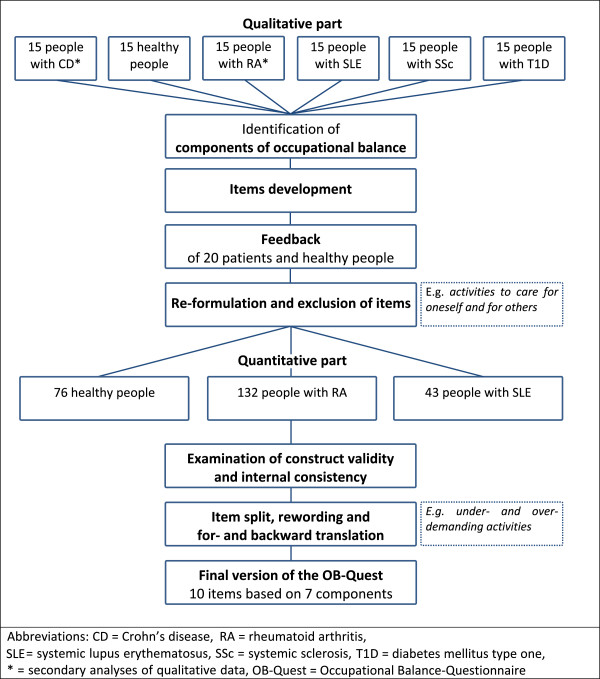
BACKGROUND: Self-reported outcome instruments in health research have become increasingly important over the last decades. Occupational therapy interventions often focus on occupational balance. However, instruments to measure occupational balance are scarce. The aim of the study was therefore to develop a generic self-reported outcome instrument to assess occupational balance based on the experiences of patients and healthy people including an examination of its psychometric properties. METHODS: We conducted a qualitative analysis of the life stories of 90 people with and without chronic autoimmune diseases to identify components of occupational balance. Based on these components, the Occupational Balance-Questionnaire (OB-Quest) was developed. Construct validity and internal consistency of the OB-Quest were examined in quantitative data. We used Rasch analyses to determine overall fit of the items to the Rasch model, person separation index and potential differential item functioning. Dimensionality testing was conducted by the use of t-tests and Cronbach's alpha. RESULTS: The following components emerged from the qualitative analyses: challenging and relaxing activities, activities with acknowledgement by the individual and by the sociocultural context, impact of health condition on activities, involvement in stressful activities and fewer stressing activities, rest and sleep, variety of activities, adaptation of activities according to changed living conditions and activities intended to care for oneself and for others. Based on these, the seven items of the questionnaire (OB-Quest) were developed. 251 people (132 with rheumatoid arthritis, 43 with systematic lupus erythematous and 76 healthy) filled in the OB-Quest. Dimensionality testing indicated multidimensionality of the questionnaire (t = 0.58, and 1.66 after item reduction, non-significant). The item on the component rest and sleep showed differential item functioning (health condition and age). Person separation index was 0.51. Cronbach's alpha changed from 0.38 to 0.57 after deleting two items. CONCLUSIONS: This questionnaire includes new items addressing components of occupational balance meaningful to patients and healthy people which have not been measured so far. The reduction of two items of the OB-Quest showed improved internal consistency. The multidimensionality of the questionnaire indicates the need for a summary of several components into subscales.
Overview
The claims and statistics of this paper haven’t been checked yet.
Free: it reads the open-access text and checks the first 5 claims that cite a source we can check. Create a free account to check every claim.
Integrity signals
Registry
Cites
Statistics
Figures
Verification
Claims the paper makes
The claims and statistics of this paper haven’t been checked yet.
Free: it reads the open-access text and checks the first 5 claims that cite a source we can check. Create a free account to check every claim.
Self-check
Percentages, sums and reported differences re-computed from the paper’s own numbers.
The self-check needs the paper’s full text.
Citations
Cites
(1992) · PubMed · Cited by 33,716
A Global Measure of Perceived Stress
Cohen, S., Kamarck, T., & Mermelstein, R. (1983) · Journal of Health and Social Behavior · doi:10.2307/2136404 · Cited by 32,807
The MOS 36-ltem Short-Form Health Survey (SF-36): I. Conceptual Framework and Item Selection
Ware, J. E., & Sherbourne, C. D. (1992) · Medical Care · doi:10.1097/00005650-199206000-00002 · Cited by 30,033 · cited 2×
“multidimensionality indicates that a total score of the instrument is not justified and thus requests the summary of several of the components into subscales, as this is the case in the SF-36 [41].”
BackgroundArnett, F. C., Edworthy, S. M., Bloch, D. A., Mcshane, D. J., Fries, J. F., Cooper, N. S., Healey, L. A., Kaplan, S. R., Liang, M. H., Luthra, H. S., et al. (1988) · Arthritis & Rheumatism · doi:10.1002/art.1780310302 · Cited by 19,752 · cited 1×
“Patients of two outpatient clinics of the Medical University of Vienna, Austria, diagnosed with Crohn’s disease (CD) [16], rheumatoid arthritis (RA) [17], systemic lupus erythematosus (SLE) [18], systemic sclerosis (SSc) [19] or diabetes mellitus type one (T1D) [20] were asked to participate.”
BackgroundGuillemin, F., Bombardier, C., & Beaton, D. (1993) · Journal of Clinical Epidemiology · doi:10.1016/0895-4356(93)90142-n · Cited by 6,060 · cited 2×
“A German version was designed first and then forward and back translated into English according to standard translation procedures [14].”
MethodDerivation of the sledai. A disease activity index for lupus patients
Bombardier, C., Gladman, D. D., Urowitz, M. B., Caron, D., Chang, C. H., Austin, A., Bell, A., Bloch, D. A., Corey, P. N., Decker, J. L., et al. (1992) · Arthritis & Rheumatism · doi:10.1002/art.1780350606 · Cited by 4,570 · cited 3×
“α: Alpha; CD: Crohn’s disease; CDAI: Clinical disease activity index; Hba1c: Glycosylated haemoglobin; HBI: Harvey Bradshaw Index; OB-Quest: Occupational balance-questionnaire; PSI: Person separation index; PCA: Principal component analysis; DIF: Differential item functioning; RA: Rheumatoid arthritis; SF-36: Short-Fo…”
BackgroundInfluentialApplying the Rasch Model: Fundamental Measurement in the Human Sciences
Bond, T. G., & Fox, C. M. (2003) · Journal of Educational Measurement · doi:10.1111/j.1745-3984.2003.tb01103.x · Cited by 4,492
Mokkink, L. B., Terwee, C. B., Patrick, D. L., Alonso, J., Stratford, P. W., Knol, D. L., Bouter, L. M., & de Vet, H. C. W. (2010) · Journal of Clinical Epidemiology · doi:10.1016/j.jclinepi.2010.02.006 · Cited by 4,465 · cited 2×
“This requires a conceptual definition of the construct to be measured and a specification of its components [13].”
BackgroundA SIMPLE INDEX OF CROHN'S-DISEASE ACTIVITY
Harvey, R. F., & Bradshaw, J. M. (1980) · The Lancet · doi:10.1016/s0140-6736(80)92767-1 · Cited by 2,959 · cited 3×
“α: Alpha; CD: Crohn’s disease; CDAI: Clinical disease activity index; Hba1c: Glycosylated haemoglobin; HBI: Harvey Bradshaw Index; OB-Quest: Occupational balance-questionnaire; PSI: Person separation index; PCA: Principal component analysis; DIF: Differential item functioning; RA: Rheumatoid arthritis; SF-36: Short-Fo…”
BackgroundInfluentialStandards of Medical Care in Diabetes—2009
American Diabetes Association (2009) · Diabetes Care · doi:10.2337/dc09-s013 · Cited by 2,167
Research works printed but not linked: 7
- WHO International Statistical Classification of Diseases and Related Health Problems 10th Revision (ICD-10) Version for 2010 2010 Geneva, Switzerland: World Health Organization
- SPSS SPSS Statistics 17.00 for Windows 2008 Chicago: SPSS Inc
- Rumm Laboratory PL RUMM2030. Released in January 2010. License Re-structure from March 2012 2012 Australia, Duncraig
- Tennant A Pallant JF Unidimensionality Matters! (A Tale of Two Smiths?) Rasch Measurement Transactions 2006 Volume 20 1048 1051 http://www.rasch.org/rmt/rmt201c.htm: Archives of the Rasch Measurement SIG, AERA
- Rumm Laboratory PL Interpreting RUMM2030. PART I Dichotomus data 2009 Australia, Duncraig
- Rumm Laboratry PL Extending the RUMM2030 Analysis. RUMM2030 Rasch Unidimensional Measurment Model 2012 8
- Jaccard J Jacoby J Theory Construction and Model-Building Skills (Methodology in the Social Sciences) 2009 London: Guilford Press
Cited by
Eklund, M., Orban, K., Argentzell, E., Bejerholm, U., Tjörnstrand, C., Erlandsson, L.-K., & Håkansson, C. (2017) · Scandinavian Journal of Occupational Therapy · doi:10.1080/11038128.2016.1224271 · Cited by 140
“It includes 10 components or items that are rated on a three-point scale [94].”
BackgroundConstruct validity of a revised version of the Occupational Balance Questionnaire
Håkansson, C., Wagman, P., & Hagell, P. (2020) · Scandinavian Journal of Occupational Therapy · doi:10.1080/11038128.2019.1660801 · Cited by 115
“and types of occupation [5], as described below.”
MethodPerception of occupational balance by people with mental illness: A new methodology
Eklund, M., & Argentzell, E. (2016) · Scandinavian Journal of Occupational Therapy · doi:10.3109/11038128.2016.1143529 · Cited by 81
“A few other questionnaires exist for estimating occupational balance,[53,54] but they were not available when this study began.”
BackgroundHo, E. C. M., & Siu, A. M. H. (2018) · Occupational Therapy International · doi:10.1155/2018/8637498 · Cited by 106
Evans, K. L., Millsteed, J., Richmond, J. E., Falkmer, M., Falkmer, T., & Girdler, S. J. (2016) · PLoS ONE · doi:10.1371/journal.pone.0157469 · Cited by 88
Measuring occupational balance and its relationship to perceived stress and health
Yu, Y., Manku, M., & Backman, C. L. (2018) · Canadian Journal of Occupational Therapy · doi:10.1177/0008417417734355 · Cited by 63
“Recently, theoretically informed instruments have been developed to measure occupational balance, such as questionnaires designed by researchers in Sweden (Wagman & Håkansson, 2014b) and Austria (Dür et al., 2014).”
BackgroundMethodDefinitions of occupational balance and their coverage by instruments
Dür, M., Unger, J., Stoffer, M. A., Dragoi, R. G., Kautzky‐Willer, A., Fialka‐Moser, V., Smolen, J. S., & Stamm, T. (2015) · British Journal of Occupational Therapy · doi:10.1177/0308022614561235 · Cited by 54
“This study was part of a larger study, namely the gender, occupational balance and immunology (GOBI) study (Dür et al., 2014a).”
MethodResultSelf-citationOccupational therapists’ perception of the concept of occupational balance
Yazdani, F., Harb, A., Rassafiani, M., Nobakht, L., & Yazdani, N. (2017) · Scandinavian Journal of Occupational Therapy · doi:10.1080/11038128.2017.1325934 · Cited by 63
Valued activities and informal caregiving in stroke: a scoping review
Jellema, S., Wijnen, M., Steultjens, E. M. J., der Sanden, M. W. G. N., & van der Sande, R. (2018) · Disability and Rehabilitation · doi:10.1080/09638288.2018.1460625 · Cited by 47
Röschel, A., Wagner, C., & Dür, M. (2022) · BMC Geriatrics · doi:10.1186/s12877-022-03124-1 · Cited by 32
“Abbreviations BSFC: Burden Scale for Family Caregivers; OBI-Care: Occupational Balance in Informal Caregivers Questionnaire; OA: Occupational areas; OC: Occupational characteristics; OR: Occupational resilience; RESTQ: Recovery-Stress Questionnaires; SCQ-D: Self-Administered Comorbidity Questionnaire – German; SF-12:…”
BackgroundInfluentialSelf-citationWagman, P., Ahlstrand, I., Björk, M., & Håkansson, C. (2020) · Musculoskeletal Care · doi:10.1002/msc.1454 · Cited by 35
Occupational balance from a clinical perspective
Dhas, B. N., & Wagman, P. (2020) · Scandinavian Journal of Occupational Therapy · doi:10.1080/11038128.2020.1865450 · Cited by 42
Dür, M., Coenen, M., Stoffer, M. A., Fialka‐Moser, V., Kautzky‐Willer, A., Kjeken, I., Dragoi, R. G., Mattsson, M., Boström, C., Smolen, J. S., et al. (2015) · Health and Quality of Life Outcomes · doi:10.1186/s12955-015-0214-8 · Cited by 28
“The current project was part of a larger study [27,28].”
BackgroundSelf-citationPeral‐Gómez, P., López-Roig, S., Pastor-Mira, M. D. L. Á., Abad, E., Valera‐Gran, D., Håkansson, C., & Wagman, P. (2021) · International Journal of Environmental Research and Public Health · doi:10.3390/ijerph18147506 · Cited by 32
Fatigue in inflammatory arthritis
Dures, E. K., Cramp, F. L., Hackett, K., & Primdahl, J. (2020) · Best Practice & Research Clinical Rheumatology · doi:10.1016/j.berh.2020.101526 · Cited by 30
Röschel, A., Wagner, C., & Dür, M. (2021) · PLoS ONE · doi:10.1371/journal.pone.0261815 · Cited by 29
Self-citationDür, M., Steiner, G. E., Stoffer, M. A., Fialka‐Moser, V., Kautzky‐Willer, A., Dejaco, C., Ekmekçioğlu, C., Prodinger, B., Binder, A., Smolen, J. S., et al. (2015) · Psychoneuroendocrinology · doi:10.1016/j.psyneuen.2015.12.015 · Cited by 27
“Since most of the components of occupational balance which were meaningful to people with and without chronic autoimmune diseases (Dür et al., 2014; Stamm et al., 2009), correlated with IL-6, IL-8, IFN or CRP, further research on these associations and their meaning in the clinical practice is…”
BackgroundSelf-citationEvans, K. L., Girdler, S. J., Falkmer, T., Richmond, J. E., Wagman, P., Millsteed, J., & Falkmer, M. (2016) · Scandinavian Journal of Occupational Therapy · doi:10.1080/11038128.2016.1250814 · Cited by 20
A new tool to measure occupational balance: Adolescent Occupational Balance Scale (A-OBS)
Yılmaz, G. G., Avcı, H., & Akı, E. (2022) · Scandinavian Journal of Occupational Therapy · doi:10.1080/11038128.2022.2154262 · Cited by 18
Wagman, P., Nordin, M., Alfredsson, L. S., Westerholm, P. J. M., & Fransson, E. I. (2016) · Scandinavian Journal of Occupational Therapy · doi:10.1080/11038128.2016.1217926 · Cited by 15
Dür, M., Brückner, V., Oberleitner-Leeb, C., Fuiko, R., Matter, B., & Berger, A. (2018) · PLoS ONE · doi:10.1371/journal.pone.0202189 · Cited by 17
Self-citationDhas, B. N., Wagman, P., Marji, F. A., Håkansson, C., & Carrasco, R. (2021) · British Journal of Occupational Therapy · doi:10.1177/03080226211039432 · Cited by 12
“…in the literature are as follows: The revised Occupational Balance Questionnaire [(OBQ11] (Håkansson et al., 2019b, 2019c), Satisfaction with Daily Occupations - Occupational Balance [SDO-OB] (Eklund and Argentzell, 2016), and the Occupational Balance Questionnaire [OB-QUEST] (Dür et al., 2014).”
BackgroundRasch model of the Child Perceptions Questionnaire for oral health–related quality of life
Omara, M., Stamm, T., Boecker, M., Ritschl, V., Mosor, E., Salzberger, T., Hirsch, C., & Bekes, K. (2019) · The Journal of the American Dental Association · doi:10.1016/j.adaj.2018.12.001 · Cited by 11
Self-citationDür, M., Röschel, A., Oberleitner-Leeb, C., Herrmanns, V., Pichler-Stachl, E., Mattner, B., Pernter, S.-D., Wald, M., Urlesberger, B., Kurz, H., et al. (2021) · PLoS ONE · doi:10.1371/journal.pone.0259648 · Cited by 13
Self-citationHo, E. C. M., Dür, M., Stamm, T., & Siu, A. M. H. (2020) · Hong Kong Journal of Occupational Therapy · doi:10.1177/1569186120944534 · Cited by 10
“The Cronbach’s a of OB-Quest is 0.57 (Dür et al., 2014).”
BackgroundMethodResultInfluentialSelf-citationVidaña-Moya, L., Eklund, M., Merchán-Baeza, J. A., Peral‐Gómez, P., Zango-Martín, I., & Hultqvist, J. (2020) · International Journal of Environmental Research and Public Health · doi:10.3390/ijerph17238906 · Cited by 13
Peral‐Gómez, P., Espinosa-Sempere, C., Navarrete‐Muñoz, E. M., Hurtado‐Pomares, M., Juárez-Leal, I., Valera‐Gran, D., & Pérez, A. S. (2022) · Annals of Medicine · doi:10.1080/07853890.2022.2145016 · Cited by 13
sadati, S. S. S., Raji, P., Ansari, N. N., Håkansson, C., & Wagman, P. (2023) · British Journal of Occupational Therapy · doi:10.1177/03080226231174103 · Cited by 10
“Email: praji@tums.ac.ir and resources and the balance between a person’s own and others’ demands (Dür et al., 2014).”
BackgroundMethodInfluentialAğce, Z. B., Yaran, M., Özkan, E., Ekici, G., Huri, M., & Akel, S. (2021) · Occupational Therapy In Health Care · doi:10.1080/07380577.2021.2010160 · Cited by 10
“In addition, participants completed the OB-Quest, the Beck Depression Inventory (BDI) and the 12-item Short Form Survey (SF-12) (Beck, 1961; Dür et al., 2014; Hagell et al., 2017).”
BackgroundMethodInfluentialInterdisciplinary Wellbeing Construct Developed Among Resettled Refugees
Martin‐Willett, R., Blevins, M. L., Bailey, L., McCormick, Z., & Aliyu, M. H. (2018) · Journal of International Migration and Integration / Revue de l integration et de la migration internationale · doi:10.1007/s12134-018-0597-6 · Cited by 9
Occupational balance in people with type-2 diabetes: A comparative cross-sectional study
Binesh, M., Aghili, R., & Mehraban, A. H. (2020) · British Journal of Occupational Therapy · doi:10.1177/0308022620963745 · Cited by 9
“There are various perspectives for the assessment of occupational balance, and a single measure cannot assess different aspects of this multi-dimensional concept (Dür et al., 2014, 2015; Eklund et al., 2017).”
BackgroundBonsaksen, T., Lindstad, M. Ø., Håkansson, C., Wagman, P., & Cordier, R. (2021) · Occupational Therapy International · doi:10.1155/2021/8863453 · Cited by 8
“Resulting from different conceptualizations, different tools for measuring occupational balance have emerged, such as the Life Balance Inventory [15] and the Occupational Balance Questionnaire (OBQuest) [16].”
MethodAyuso, D. M. R., Jara-Urzúa, A., Lapierre, M., & Triviño-Juárez, J. M. (2024) · Cadernos Brasileiros de Terapia Ocupacional · doi:10.1590/2526-8910.ctoao27983642 · Cited by 5
Doğu, S. E., Günal, A., Pekçetin, S., Örsel, S., Wagman, P., & Håkansson, C. (2023) · Scandinavian Journal of Occupational Therapy · doi:10.1080/11038128.2022.2164351 · Cited by 6
“Reliable and valid occupational balance tools are needed to assess occupational balance of individuals with different health conditions in addition to qualitative data on individuals’ perspectives and experiences [15].”
BackgroundPekçetin, S., Günal, A., & Håkansson, C. (2021) · Ergoterapi ve Rehabilitasyon Dergisi · doi:10.30720/ered.843360 · Cited by 5
Psychometric properties of the Arabic Occupational Balance Questionnaire (OBQ11-A)
Dhas, B. N., Alhadi, S. A. A. A. A., That, G. M. R. D. A., & Abdulla, S. S. H. A. (2024) · Annals of Medicine · doi:10.1080/07853890.2024.2346945 · Cited by 6
Danish translation and validation of the Occupational Balance Questionnaire
Hansen, A. Ø., Boll, M., Skaarup, L., Hansen, T., Dür, M., Stamm, T., & Kristensen, H. K. (2020) · Scandinavian Journal of Occupational Therapy · doi:10.1080/11038128.2020.1842491 · Cited by 9
“development of the original German OB-Quest [7].”
BackgroundMethodInfluentialSelf-citationEkici, G., & DEMİRBAS, M. (2020) · Ergoterapi ve Rehabilitasyon Dergisi · doi:10.30720/ered.581577 · Cited by 4
Evaluation of an occupation-based sleep programme for people with Insomnia
Ho, E. C. M., & Siu, A. M. H. (2022) · Hong Kong Journal of Occupational Therapy · doi:10.1177/15691861221136261 · Cited by 10
Park, S., & Lee, C. D. (2023) · Journal of Occupational Science · doi:10.1080/14427591.2023.2243281 · Cited by 6
“…and Needs Assessment (MAWNA; Eakman, 2015), Occupational Balance Questionnaire (OBQ; Wagman & Håkansson, 2014b), Occupational Balance-Questionnaire (OB-Quest; Dür et al., 2014), Inter-goal Relations Questionnaire (IRQ; Riediger et al., 2005), and Personal Projects Analysis (PPA; Little, 1983).”
Betätigungen individuell dosieren – Occupational Balance
Herm, R. (2023) · ergopraxis · doi:10.1055/a-2048-3168 · Cited by 2
Honoré, H., Boll, M., Hansen, A. Ø., & Kristensen, H. K. (2023) · British Journal of Occupational Therapy · doi:10.1177/03080226231207277 · Cited by 2
“One questionnaire was the 10-item Occupational Balance Questionnaire (OB-Quest) developed by Dür et al. (2014; Hansen et al., 2020).”
MethodBesonderheiten der Forschung im Gesundheitswesen
Stamm, T., Karner, G., Möseneder, J., Ritschl, V., Perkhofer, S., Tucek, G., & Weigl, R. (2016) · Studium Pflege, Therapie, Gesundheit · doi:10.1007/978-3-662-49908-5_3 · Cited by 2
Self-citationAkyürek, G., Gündoğmuş, E., & Bilgin, N. (2026) · Informatics for Health and Social Care · doi:10.1080/17538157.2025.2611126 · Cited by 2
Laosee, O. C., Rattanapan, C., Sritoomma, N., & Ounsaneha, W. (2026) · BMC Psychology · doi:10.1186/s40359-026-04412-w · Cited by 1
“Although OB has been a cornerstone of occupational therapy since its inception, it remains a complex concept measured through various lenses, such as need satisfaction [9], levels of meaningfulness [10], and types of occupation [11– 13].”
Cognitive interviews on the Swedish occupational balance questionnaire
Wagman, P., Karlsson, L., Ekblad, N., & Håkansson, C. (2024) · Scandinavian Journal of Occupational Therapy · doi:10.1080/11038128.2024.2413144 · Cited by 1
“For doing this, they need to use standardised instruments [5], and several instruments for measuring self-rated occupational balance have been developed [6–10].”
Pain and its relation to participation in valued activities in rheumatoid arthritis
Ahlstrand, I. (2015) · DiVA - Jönköping University · Cited by 2
Hackett, K. L., & Cartner, H. (2021) · Oxford University Press eBooks · doi:10.1093/med/9780198806684.003.0023
Alles im Gleichgewicht – Occupational Balance Questionnaire
Dittrich, A. (2022) · ergopraxis · doi:10.1055/a-1768-9595
Besonderheiten der Forschung im Gesundheitswesen
Stamm, T., Karner, G., Kutrovátz, J., Ritschl, V., Perkhofer, S., Tucek, G., & Weigl, R. (2023) · Studium Pflege, Therapie, Gesundheit · doi:10.1007/978-3-662-66501-5_3
Self-citationDeğerli, M. N. Ö., Bektaş, S. A., Altuntaş, O., & Bumın, G. (2023) · Work · doi:10.3233/wor-230078 · Cited by 2
Albay, S., & Ekici, G. (2024) · Ergoterapi ve Rehabilitasyon Dergisi · doi:10.30720/ered.1461487
Jang, W.-H., Seo, S.-M., & Kim, S.-H. (2025) · Occupational Therapy International · doi:10.1155/oti/3566653
“However, the fact that all other subjects showed improvements of 2 points or more on the remaining items can be considered a statistically signi fi cant change [46].”
Peral‐Gómez, P., Belda-Martí, A., Prieto-Botella, D., Navarrete‐Muñoz, E. M., & Hurtado‐Pomares, M. (2025) · Cadernos Brasileiros de Terapia Ocupacional · doi:10.1590/2526-8910.ctoao403339363
Validity and reliability of the Japanese version of the occupational balance questionnaire
Yamada, Y., Kobayashi, N., Wagman, P., & Håkansson, C. (2025) · British Journal of Occupational Therapy · doi:10.1177/03080226251329771 · Cited by 2
Albay, S., Salar, S., & Ekici, G. (2026) · American Journal of Occupational Therapy · doi:10.5014/ajot.2026.051431
“It is valid and reliable in the Turkish population (Bahad ı r et al., 2023; Dür et al., 2014).”
Development and validation of the occupational balance assessment scale for healthcare professionals
Onda, S., Teraoka, M., & Kyougoku, M. (2026) · British Journal of Occupational Therapy · doi:10.1177/03080226261454903
Lönn, M. E., Westberg, K. H., Holst, A.-C., & Erlandsson, L. (2026) · Occupational Therapy International · doi:10.1155/oti/9972405
Parental Physical Illness and College Students’ Life Satisfaction: Role of Occupational Balance
Chen, Y.-C. (2026) · OTJR Occupational Therapy Journal of Research · doi:10.1177/15394492261462117
Metadata
- Authors
- Dür, M., Steiner, G., Fialka-Moser, V., Kautzky-Willer, A., Dejaco, C., Prodinger, B., Stoffer, M. A., Binder, A., Smolen, J., & Stamm, T. A.
- Affiliations
- Medical University of Vienna (AT)
- Göttlicher Heiland Krankenhaus Wien (AT)
- Klinik Hietzing (AT)
- Hochschule Campus Wien (AT)
- Corresponding author
- Stamm, Tanja Alexandra
- ORCID
- Venue
- Health and Quality of Life Outcomes
- Published
- 2014-04-05
- Volume
- 12
- Issue
- 1
- Pages
- 45-45
- ISSN
- 1477-7525 (ISSN-L)
- PMC
- PMC4005851
- OpenAlex
- W2137084475
- Semantic Scholar
- f9e1c8b450e6c0e6f6e6b024281a870569f6dd3c
- Cited by
- 59
- References
- 51
- Citations by year
- 2026: 6 · 2025: 3 · 2024: 4 · 2023: 7 · 2022: 5 · 2021: 8 · 2020: 8 · 2019: 2 · 2018: 5 · 2017: 1 · 2016: 6 · 2015: 4
- FWCI
- 11.40
- Type
- journal article
- Language
- en
- Open access
- gold
- doi.org
- Licence
- cc-by
- Locations
- Health and Quality of Life Outcomes (publishedVersion, cc-by)
- Europe PMC (PubMed Central) (publishedVersion, cc-by)
- PubMed Central (publishedVersion, cc-by)
- PubMed (publishedVersion)
- OPUS (Augsburg University) (submittedVersion, cc-by)
- Funders
- Austrian Science Fund
- Topics
- Health Sciences › Health Professions › Occupational Therapy › Occupational Therapy Practice and Research
- Social Sciences › Decision Sciences › Management Science and Operations Research › Psychometric Methodologies and Testing
- Health Sciences › Health Professions › Physical Therapy, Sports Therapy and Rehabilitation › Medical Practices and Rehabilitation
- Keywords
- occupational balance, chronic autoimmune disease, rheumatoid arthritis, systemic lupus erythematosus, occupational therapy, questionnaire development, psychometric properties, Rasch analysis, differential item functioning, multidimensionality, sleep and rest, meaningful activities
- MeSH terms
- Adult, Arthritis, Rheumatoid, Autoimmune Diseases, Diabetes Mellitus, Type 1, Employment, Female, Humans, Lupus Erythematosus, Systemic, Male, Middle Aged, Surveys and Questionnaires, Relaxation, Scleroderma, Systemic, Reproducibility of Results, Treatment Outcome, Qualitative Research
About these checks
Registry, retraction, Cites and statistics results are computed, not judged, with one exception: a printed reference that no index lists is read once by a model before it counts as a citation error. Claims are extracted by a model and kept only when their quote appears verbatim in the text; each cited source is then checked, with a model’s help, for whether it says what the claim relies on. Those verdicts can be wrong — read the claim’s quote and the cited source before relying on one.
Statistics and arithmetic are recomputed, not judged.
Confidence bands are shown only for fields calibrated on our annotated test set. None is calibrated yet, so no band is shown.
What counts as a claim ›How we measure confidence ›How we check this ›
Are you an author, or do you see a problem with this page? Request a review
Data sources
Bibliographic data: Semantic Scholar, OpenAlex, Crossref.
Contains information from the Semantic Scholar Academic Graph Datasets, made available under the ODC Attribution License (ODC-BY 1.0).
Semantic Scholar’s data is described in: Kinney, R., et al. (2023). The Semantic Scholar Open Data Platform. arXiv:2301.10140.
