

Development of a new occupational balance-questionnaire: incorporating the perspectives of patients and healthy people in the design of a self-reported occupational balance outcome instrument
Open accessThe DOI matches its Crossref record; 49 of the 51 references it cites were found in a registry or an index.
Abstract
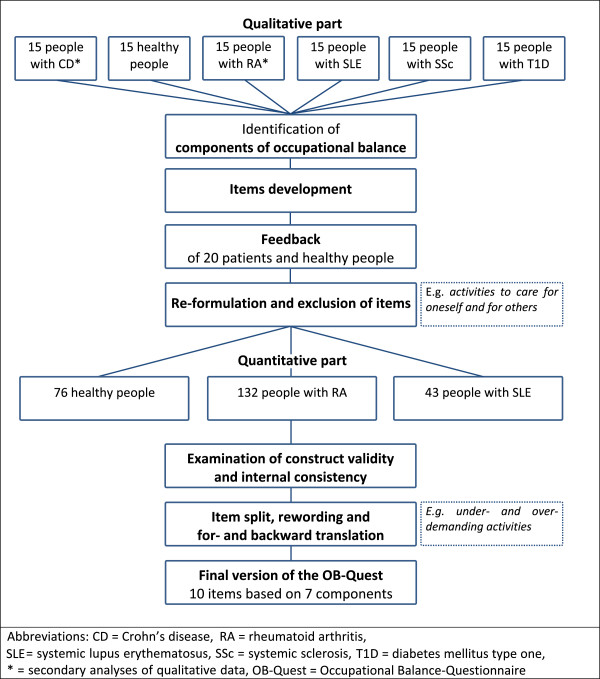
BACKGROUND: Self-reported outcome instruments in health research have become increasingly important over the last decades. Occupational therapy interventions often focus on occupational balance. However, instruments to measure occupational balance are scarce. The aim of the study was therefore to develop a generic self-reported outcome instrument to assess occupational balance based on the experiences of patients and healthy people including an examination of its psychometric properties. METHODS: We conducted a qualitative analysis of the life stories of 90 people with and without chronic autoimmune diseases to identify components of occupational balance. Based on these components, the Occupational Balance-Questionnaire (OB-Quest) was developed. Construct validity and internal consistency of the OB-Quest were examined in quantitative data. We used Rasch analyses to determine overall fit of the items to the Rasch model, person separation index and potential differential item functioning. Dimensionality testing was conducted by the use of t-tests and Cronbach's alpha. RESULTS: The following components emerged from the qualitative analyses: challenging and relaxing activities, activities with acknowledgement by the individual and by the sociocultural context, impact of health condition on activities, involvement in stressful activities and fewer stressing activities, rest and sleep, variety of activities, adaptation of activities according to changed living conditions and activities intended to care for oneself and for others. Based on these, the seven items of the questionnaire (OB-Quest) were developed. 251 people (132 with rheumatoid arthritis, 43 with systematic lupus erythematous and 76 healthy) filled in the OB-Quest. Dimensionality testing indicated multidimensionality of the questionnaire (t = 0.58, and 1.66 after item reduction, non-significant). The item on the component rest and sleep showed differential item functioning (health condition and age). Person separation index was 0.51. Cronbach's alpha changed from 0.38 to 0.57 after deleting two items. CONCLUSIONS: This questionnaire includes new items addressing components of occupational balance meaningful to patients and healthy people which have not been measured so far. The reduction of two items of the OB-Quest showed improved internal consistency. The multidimensionality of the questionnaire indicates the need for a summary of several components into subscales.
Overview
The claims and statistics of this paper haven’t been checked yet.
Free: it reads the open-access text and checks the first 5 claims that cite a source we can check. Create a free account to check every claim.
Integrity signals
Registry
Cites
Statistics
Figures
Verification
Claims the paper makes
The claims and statistics of this paper haven’t been checked yet.
Free: it reads the open-access text and checks the first 5 claims that cite a source we can check. Create a free account to check every claim.
Self-check
Percentages, sums and reported differences re-computed from the paper’s own numbers.
The self-check needs the paper’s full text.
Citations
Cites
(1992) · PubMed · Cited by 33,716
A Global Measure of Perceived Stress
Cohen, S., Kamarck, T., & Mermelstein, R. (1983) · Journal of Health and Social Behavior · doi:10.2307/2136404 · Cited by 32,807
The MOS 36-ltem Short-Form Health Survey (SF-36): I. Conceptual Framework and Item Selection
Ware, J. E., & Sherbourne, C. D. (1992) · Medical Care · doi:10.1097/00005650-199206000-00002 · Cited by 30,033 · cited 2×
“multidimensionality indicates that a total score of the instrument is not justified and thus requests the summary of several of the components into subscales, as this is the case in the SF-36 [41].”
BackgroundArnett, F. C., Edworthy, S. M., Bloch, D. A., Mcshane, D. J., Fries, J. F., Cooper, N. S., Healey, L. A., Kaplan, S. R., Liang, M. H., Luthra, H. S., et al. (1988) · Arthritis & Rheumatism · doi:10.1002/art.1780310302 · Cited by 19,752 · cited 1×
“Patients of two outpatient clinics of the Medical University of Vienna, Austria, diagnosed with Crohn’s disease (CD) [16], rheumatoid arthritis (RA) [17], systemic lupus erythematosus (SLE) [18], systemic sclerosis (SSc) [19] or diabetes mellitus type one (T1D) [20] were asked to participate.”
BackgroundGuillemin, F., Bombardier, C., & Beaton, D. (1993) · Journal of Clinical Epidemiology · doi:10.1016/0895-4356(93)90142-n · Cited by 6,060 · cited 2×
“A German version was designed first and then forward and back translated into English according to standard translation procedures [14].”
MethodDerivation of the sledai. A disease activity index for lupus patients
Bombardier, C., Gladman, D. D., Urowitz, M. B., Caron, D., Chang, C. H., Austin, A., Bell, A., Bloch, D. A., Corey, P. N., Decker, J. L., et al. (1992) · Arthritis & Rheumatism · doi:10.1002/art.1780350606 · Cited by 4,570 · cited 3×
“α: Alpha; CD: Crohn’s disease; CDAI: Clinical disease activity index; Hba1c: Glycosylated haemoglobin; HBI: Harvey Bradshaw Index; OB-Quest: Occupational balance-questionnaire; PSI: Person separation index; PCA: Principal component analysis; DIF: Differential item functioning; RA: Rheumatoid arthritis; SF-36: Short-Fo…”
BackgroundInfluentialApplying the Rasch Model: Fundamental Measurement in the Human Sciences
Bond, T. G., & Fox, C. M. (2003) · Journal of Educational Measurement · doi:10.1111/j.1745-3984.2003.tb01103.x · Cited by 4,492
Mokkink, L. B., Terwee, C. B., Patrick, D. L., Alonso, J., Stratford, P. W., Knol, D. L., Bouter, L. M., & de Vet, H. C. W. (2010) · Journal of Clinical Epidemiology · doi:10.1016/j.jclinepi.2010.02.006 · Cited by 4,465 · cited 2×
“This requires a conceptual definition of the construct to be measured and a specification of its components [13].”
BackgroundA SIMPLE INDEX OF CROHN'S-DISEASE ACTIVITY
Harvey, R. F., & Bradshaw, J. M. (1980) · The Lancet · doi:10.1016/s0140-6736(80)92767-1 · Cited by 2,959 · cited 3×
“α: Alpha; CD: Crohn’s disease; CDAI: Clinical disease activity index; Hba1c: Glycosylated haemoglobin; HBI: Harvey Bradshaw Index; OB-Quest: Occupational balance-questionnaire; PSI: Person separation index; PCA: Principal component analysis; DIF: Differential item functioning; RA: Rheumatoid arthritis; SF-36: Short-Fo…”
BackgroundInfluentialStandards of Medical Care in Diabetes—2009
American Diabetes Association (2009) · Diabetes Care · doi:10.2337/dc09-s013 · Cited by 2,167
Mokkink, L. B., Terwee, C. B., Knol, D. L., Stratford, P. W., Alonso, J., Patrick, D. L., Bouter, L. M., & de Vet, H. C. (2010) · BMC Medical Research Methodology · doi:10.1186/1471-2288-10-22 · Cited by 1,834
Unwin, N. C. (2006) · Cited by 1,661
Van Assche, G., Dignass, A., Panes, J., Beaugerie, L., Karagiannis, J., Allez, M., Ochsenkühn, T., Orchard, T., Rogler, G., Louis, E., et al. (2010) · Journal of Crohn's and Colitis · doi:10.1016/j.crohns.2009.12.003 · Cited by 1,453 · cited 1×
“Patients of two outpatient clinics of the Medical University of Vienna, Austria, diagnosed with Crohn’s disease (CD) [16], rheumatoid arthritis (RA) [17], systemic lupus erythematosus (SLE) [18], systemic sclerosis (SSc) [19] or diabetes mellitus type one (T1D) [20] were asked to participate.”
BackgroundBond, T. G., & Fox, C. M. (2001) · Psychology Press eBooks · doi:10.4324/9781410600127 · Cited by 1,346
Andrich, D. (1988) · doi:10.4135/9781412985598 · Cited by 1,345
Aletaha, D., Nell, V. P., Stamm, T., Uffmann, M., Pflugbeil, S., Machold, K., & Smolen, J. S. (2005) · Arthritis Research & Therapy · doi:10.1186/ar1740 · Cited by 1,068
Self-citationDevelopment of the perceived stress questionnaire: A new tool for psychosomatic research
Levenstein, S., Prantera, C., Varvo, V., Scribano, M. L., Berto, E., Luzi, C., & Andreoli, A. (1993) · Journal of Psychosomatic Research · doi:10.1016/0022-3999(93)90120-5 · Cited by 985 · cited 1×
“Frequently used instruments, such as the Perceived Stress Questionnaire [43] or the Perceived Stress Scale [44] do not capture potential relations between stress and activities.”
Method(2002) · PubMed · Cited by 953
Schned, E. S., Glickstein, S. L., & Anne Doyle, M. T. (1993) · Arthritis & Rheumatism · doi:10.1002/art.1780360623 · Cited by 725
Stange, E. F., Travis, S. P. L., Vermeire, S., Beglinger, C., Kupcinkas, L., Geboes, K., Barakauskiene, A., Villanacci, V, Von Herbay, A., Warren, B. F., et al. (2006) · Gut · doi:10.1136/gut.2005.081950a · Cited by 510 · cited 1×
“Patients of two outpatient clinics of the Medical University of Vienna, Austria, diagnosed with Crohn’s disease (CD) [16], rheumatoid arthritis (RA) [17], systemic lupus erythematosus (SLE) [18], systemic sclerosis (SSc) [19] or diabetes mellitus type one (T1D) [20] were asked to participate.”
BackgroundPRO development: rigorous qualitative research as the crucial foundation
Lasch, K. E., Marquis, P., Vigneux, M., Abetz, L., Arnould, B., Bayliss, M., Crawford, B., & Rosa, K. (2010) · Quality of Life Research · doi:10.1007/s11136-010-9677-6 · Cited by 461 · cited 3×
“Additionally, this process followed common recommendations for the development of self-reported outcome instruments [5,50] and resulted in the identification of new components of occupational balance.”
BackgroundMethodRosenthal, G. (1993) · Social Science Open Access Repository (GESIS – Leibniz Institute for the Social Sciences) · Cited by 440
Josselson, R., & Lieblich, A. (1993) · Sage Pub. eBooks · Cited by 436
Occupational balance as used in occupational therapy: A concept analysis
Wagman, P., Håkansson, C., & Björklund, A. (2012) · Scandinavian Journal of Occupational Therapy · doi:10.3109/11038128.2011.596219 · Cited by 334 · cited 1×
“Challenging and relaxing activities and adaptation of activities have already been identified as components of occupational balance [21,38,39].”
BackgroundRiediger, M., & Freund, A. M. (2004) · Personality and Social Psychology Bulletin · doi:10.1177/0146167204271184 · Cited by 312 · cited 1×
“For example, occupational imbalance, defined as interference among occupations, was negatively associated with subjective wellbeing [49] and life satisfaction [45].”
BackgroundAhmed, S., Berzon, R. A., Revicki, D. A., Lenderking, W. R., Moinpour, C. M., Basch, E., Reeve, B. B., & Wu, A. W. (2012) · Medical Care · doi:10.1097/mlr.0b013e318268aaff · Cited by 272
Meyer, A. (1977) · PubMed · Cited by 249
Backman, C. L. (2004) · Canadian Journal of Occupational Therapy · doi:10.1177/000841740407100404 · Cited by 181
Rasch analysis of the Hospital Anxiety and Depression Scale (HADS) for use in motor neurone disease
Gibbons, C. J., Mills, R. J., Thornton, E. W., Ealing, J., Mitchell, J. D., Shaw, P. J., Talbot, K., Tennant, A., & Young, C. A. (2011) · Health and Quality of Life Outcomes · doi:10.1186/1477-7525-9-82 · Cited by 130 · cited 1×
“7) is preferred, since this indicates a high probability that people with enhanced performance will achieve high measures (sensitivity) and vice versa [30,31].”
BackgroundThe relationship between occupational balance and health: a pilot study
Wilcock, A. A., Chelin, M., Hall, M., Hamley, N., Morrison, B., Scrivener, L., Townsend, M., & Treen, K. (1997) · Occupational Therapy International · doi:10.1002/oti.45 · Cited by 125 · cited 1×
“Up to now, only one questionnaire exists (Wilcock’s twopage “questionnaire on involvement in physical, mental, social and rest occupations”) which was developed and used to assess occupational balance [12].”
MethodA new direction in the conceptualization and categorization of occupation
Jonsson, H. (2008) · Journal of Occupational Science · doi:10.1080/14427591.2008.9686601 · Cited by 119 · cited 1×
“Moreover, the two models of occupational balance which are based on empirical quantitative and qualitative data [10,47] also challenge a unidimensional conceptualisation of occupational balance.”
BackgroundJonsson, H., & Persson, D. (2006) · Journal of Occupational Science · doi:10.1080/14427591.2006.9686571 · Cited by 95 · cited 2×
“Moreover, the two models of occupational balance which are based on empirical quantitative and qualitative data [10,47] also challenge a unidimensional conceptualisation of occupational balance.”
BackgroundPatient-reported outcomes in meta-analyses – Part 1: assessing risk of bias and combining outcomes
Johnston, B. C., Patrick, D. L., Busse, J. W., Schünemann, H. J., Agarwal, A., & Guyatt, G. H. (2013) · Health and Quality of Life Outcomes · doi:10.1186/1477-7525-11-109 · Cited by 93 · cited 1×
“Background The use of self-reported outcome instruments in health care research has become increasingly important over the last decades, because the perspective of patients is an essential part regarding the effectiveness or non-effectiveness of a treatment [1-3].”
BackgroundExecutive Summary: Standards of Medical Care in Diabetes—2009
(2008) · Diabetes Care · doi:10.2337/dc09-s006 · Cited by 93
Stamm, T., Lovelock, L., Stew, G., Nell, V., Smolen, J., MacHold, K., Jonsson, H., & Sadlo, G. (2009) · OTJR: Occupational Therapy Journal of Research · doi:10.1177/153944920902900105 · Cited by 77 · cited 2×
“Only the qualitative data from patients with CD and RA were used from previous studies which employed the same methodological approach [11,15,21].”
BackgroundMethodSelf-citationthe HELENA Study Group, Vriendt, T. D., Clays, E., Moreno, L. A., Bergman, P., Vicente‐Rodríguez, G., Nagy, E., Dietrich, S., Μanios, Y., & Henauw, S. D. (2011) · BMC Public Health · doi:10.1186/1471-2458-11-717 · Cited by 65 · cited 1×
“Another example is the Adolescent Stress Questionnaire which includes items on having enough time for activities others than school tasks [42].”
BackgroundThe Role of Occupational Characteristics and Occupational Imbalance in Explaining Well-being
Anaby, D., Jarus, T., Backman, C. L., & Zumbo, B. D. (2010) · Applied Research in Quality of Life · doi:10.1007/s11482-010-9094-6 · Cited by 64 · cited 3×
“However, this was not the case in another study on occupational imbalance [48].”
BackgroundResultMeasuring Occupational Balance: A Theoretical Exploration of Two Approaches
Anaby, D. R., Backman, C. L., & Jarus, T. (2010) · Canadian Journal of Occupational Therapy · doi:10.2182/cjot.2010.77.5.4 · Cited by 61 · cited 3×
“Furthermore, the authors of previous studies came to the conclusion that occupational balance might be a multidimensional construct [45,46].”
BackgroundExploring Occupational Balance in Adults with Rheumatoid Arthritis
Forhan, M., & Backman, C. (2010) · OTJR: Occupational Therapy Journal of Research · doi:10.3928/15394492-20090625-01 · Cited by 60 · cited 1×
“Furthermore, the authors of previous studies came to the conclusion that occupational balance might be a multidimensional construct [45,46].”
BackgroundExperiences of Women with Stress-Related Ill Health in a Therapeutic Gardening Program
Eriksson, T., Westerberg, Y., & Jonsson, H. (2011) · Canadian Journal of Occupational Therapy · doi:10.2182/cjot.2011.78.5.2 · Cited by 53 · cited 1×
“Additionally, stress has also been related to occupational balance earlier [40].”
BackgroundDür, M., Sadloňová, M., Haider, S., Binder, A., Stoffer, M., Coenen, M., Smolen, J., Dejaco, C., Kautzky-Willer, A., Fialka-Moser, V., et al. (2014) · Journal of Crohn's and Colitis · doi:10.1016/j.crohns.2012.12.014 · Cited by 49 · cited 2×
“Only the qualitative data from patients with CD and RA were used from previous studies which employed the same methodological approach [11,15,21].”
MethodSelf-citationThe Role of Occupational Therapy in Disaster Preparedness, Response, and Recovery
Scaffa, M. E., Gerardi, S. M., Herzberg, G. L., & McColl, M. A. (2006) · American Journal of Occupational Therapy · doi:10.5014/ajot.60.6.642 · Cited by 41
Occupational balance of women with rheumatoid arthritis: a qualitative study
Stamm, T., Wright, J., Machold, K., Sadlo, G., & Smolen, J. (2004) · Musculoskeletal Care · doi:10.1002/msc.62 · Cited by 38 · cited 2×
“Only the qualitative data from patients with CD and RA were used from previous studies which employed the same methodological approach [11,15,21].”
BackgroundMethodSelf-citationUse of Patient-Reported Outcomes in Randomized, Double-Blind, Placebo-Controlled Clinical Trials
Dinan, M. A., Compton, K. L., Dhillon, J. K., Hammill, B. G., DeWitt, E. M., Weinfurt, K. P., & Schulman, K. A. (2011) · Medical Care · doi:10.1097/mlr.0b013e3182064aa2 · Cited by 35 · cited 1×
“Background The use of self-reported outcome instruments in health care research has become increasingly important over the last decades, because the perspective of patients is an essential part regarding the effectiveness or non-effectiveness of a treatment [1-3].”
BackgroundPatient Perspective: Choosing or Developing Instruments
KIRWAN, J. R., FRIES, J. F., HEWLETT, S., & OSBORNE, R. H. (2011) · The Journal of Rheumatology · doi:10.3899/jrheum.110390 · Cited by 34 · cited 1×
“Additionally, this process followed common recommendations for the development of self-reported outcome instruments [5,50] and resulted in the identification of new components of occupational balance.”
Kirwan, J., Fries, J. F., HEWLETT, S. E., Osborne, R. H., Newman, S. P., Ciciriello, S., van de Laar, M. A. F. J., Dures, E. K., Minnock, P., Heiberg, T., et al. (2011) · The Journal of Rheumatology · doi:10.3899/jrheum.110391 · Cited by 30 · cited 2×
“Items were generated by the first author in collaboration with patients and healthy people [4].”
BackgroundMethodFormiga, F., Moga, I., Pac, M., Mitjavila, F., Rivera, A., & Pujol, R. (1999) · Rheumatology · doi:10.1093/rheumatology/38.8.724 · Cited by 30 · cited 3×
“α: Alpha; CD: Crohn’s disease; CDAI: Clinical disease activity index; Hba1c: Glycosylated haemoglobin; HBI: Harvey Bradshaw Index; OB-Quest: Occupational balance-questionnaire; PSI: Person separation index; PCA: Principal component analysis; DIF: Differential item functioning; RA: Rheumatoid arthritis; SF-36: Short-Fo…”
BackgroundInfluentialSkin involvement as a relevant outcome measure in clinical trials of systemic sclerosis
Seibold, J. R., & McCloskey, D. (1997) · Current Opinion in Rheumatology · doi:10.1097/00002281-199711000-00014 · Cited by 21 · cited 3×
“α: Alpha; CD: Crohn’s disease; CDAI: Clinical disease activity index; Hba1c: Glycosylated haemoglobin; HBI: Harvey Bradshaw Index; OB-Quest: Occupational balance-questionnaire; PSI: Person separation index; PCA: Principal component analysis; DIF: Differential item functioning; RA: Rheumatoid arthritis; SF-36: Short-Fo…”
BackgroundInfluentialEpidemiology and classification of systemic lupus erythematosus
Simard, J. F., & Costenbader, K. H. (2015) · Elsevier eBooks · doi:10.1016/b978-0-323-09138-1.00124-8 · Cited by 18
The Role of Occupational Therapy in Disaster Preparedness, Response, and Recovery
(2011) · American Journal of Occupational Therapy · doi:10.5014/ajot.2011.65s11 · Cited by 13
Rest is a Meaningful Occupation for Women with Hip and Knee Osteoarthritis
Gibbs, L. B., & Klinger, L. (2010) · OTJR Occupational Therapy Journal of Research · doi:10.3928/15394492-20101122-01 · Cited by 12 · cited 1×
“Challenging and relaxing activities and adaptation of activities have already been identified as components of occupational balance [21,38,39].”
Background
Research works printed but not linked: 7
- WHO International Statistical Classification of Diseases and Related Health Problems 10th Revision (ICD-10) Version for 2010 2010 Geneva, Switzerland: World Health Organization
- SPSS SPSS Statistics 17.00 for Windows 2008 Chicago: SPSS Inc
- Rumm Laboratory PL RUMM2030. Released in January 2010. License Re-structure from March 2012 2012 Australia, Duncraig
- Tennant A Pallant JF Unidimensionality Matters! (A Tale of Two Smiths?) Rasch Measurement Transactions 2006 Volume 20 1048 1051 http://www.rasch.org/rmt/rmt201c.htm: Archives of the Rasch Measurement SIG, AERA
- Rumm Laboratory PL Interpreting RUMM2030. PART I Dichotomus data 2009 Australia, Duncraig
- Rumm Laboratry PL Extending the RUMM2030 Analysis. RUMM2030 Rasch Unidimensional Measurment Model 2012 8
- Jaccard J Jacoby J Theory Construction and Model-Building Skills (Methodology in the Social Sciences) 2009 London: Guilford Press
Cited by
Eklund, M., Orban, K., Argentzell, E., Bejerholm, U., Tjörnstrand, C., Erlandsson, L.-K., & Håkansson, C. (2017) · Scandinavian Journal of Occupational Therapy · doi:10.1080/11038128.2016.1224271 · Cited by 140
“It includes 10 components or items that are rated on a three-point scale [94].”
BackgroundConstruct validity of a revised version of the Occupational Balance Questionnaire
Håkansson, C., Wagman, P., & Hagell, P. (2020) · Scandinavian Journal of Occupational Therapy · doi:10.1080/11038128.2019.1660801 · Cited by 115
“and types of occupation [5], as described below.”
MethodPerception of occupational balance by people with mental illness: A new methodology
Eklund, M., & Argentzell, E. (2016) · Scandinavian Journal of Occupational Therapy · doi:10.3109/11038128.2016.1143529 · Cited by 81
“A few other questionnaires exist for estimating occupational balance,[53,54] but they were not available when this study began.”
BackgroundHo, E. C. M., & Siu, A. M. H. (2018) · Occupational Therapy International · doi:10.1155/2018/8637498 · Cited by 106
Evans, K. L., Millsteed, J., Richmond, J. E., Falkmer, M., Falkmer, T., & Girdler, S. J. (2016) · PLoS ONE · doi:10.1371/journal.pone.0157469 · Cited by 88
Metadata
- Authors
- Dür, M., Steiner, G., Fialka-Moser, V., Kautzky-Willer, A., Dejaco, C., Prodinger, B., Stoffer, M. A., Binder, A., Smolen, J., & Stamm, T. A.
- Affiliations
- Medical University of Vienna (AT)
- Göttlicher Heiland Krankenhaus Wien (AT)
- Klinik Hietzing (AT)
- Hochschule Campus Wien (AT)
- Corresponding author
- Stamm, Tanja Alexandra
- ORCID
- Venue
- Health and Quality of Life Outcomes
- Published
- 2014-04-05
- Volume
- 12
- Issue
- 1
- Pages
- 45-45
- ISSN
- 1477-7525 (ISSN-L)
- PMC
- PMC4005851
- OpenAlex
- W2137084475
- Semantic Scholar
- f9e1c8b450e6c0e6f6e6b024281a870569f6dd3c
- Cited by
- 59
- References
- 51
- Citations by year
- 2026: 6 · 2025: 3 · 2024: 4 · 2023: 7 · 2022: 5 · 2021: 8 · 2020: 8 · 2019: 2 · 2018: 5 · 2017: 1 · 2016: 6 · 2015: 4
- FWCI
- 11.40
- Type
- journal article
- Language
- en
- Open access
- gold
- doi.org
- Licence
- cc-by
- Locations
- Health and Quality of Life Outcomes (publishedVersion, cc-by)
- Europe PMC (PubMed Central) (publishedVersion, cc-by)
- PubMed Central (publishedVersion, cc-by)
- PubMed (publishedVersion)
- OPUS (Augsburg University) (submittedVersion, cc-by)
- Funders
- Austrian Science Fund
- Topics
- Health Sciences › Health Professions › Occupational Therapy › Occupational Therapy Practice and Research
- Social Sciences › Decision Sciences › Management Science and Operations Research › Psychometric Methodologies and Testing
- Health Sciences › Health Professions › Physical Therapy, Sports Therapy and Rehabilitation › Medical Practices and Rehabilitation
- Keywords
- occupational balance, chronic autoimmune disease, rheumatoid arthritis, systemic lupus erythematosus, occupational therapy, questionnaire development, psychometric properties, Rasch analysis, differential item functioning, multidimensionality, sleep and rest, meaningful activities
- MeSH terms
- Adult, Arthritis, Rheumatoid, Autoimmune Diseases, Diabetes Mellitus, Type 1, Employment, Female, Humans, Lupus Erythematosus, Systemic, Male, Middle Aged, Surveys and Questionnaires, Relaxation, Scleroderma, Systemic, Reproducibility of Results, Treatment Outcome, Qualitative Research
About these checks
Registry, retraction, Cites and statistics results are computed, not judged, with one exception: a printed reference that no index lists is read once by a model before it counts as a citation error. Claims are extracted by a model and kept only when their quote appears verbatim in the text; each cited source is then checked, with a model’s help, for whether it says what the claim relies on. Those verdicts can be wrong — read the claim’s quote and the cited source before relying on one.
Statistics and arithmetic are recomputed, not judged.
Confidence bands are shown only for fields calibrated on our annotated test set. None is calibrated yet, so no band is shown.
What counts as a claim ›How we measure confidence ›How we check this ›
Are you an author, or do you see a problem with this page? Request a review
Data sources
Bibliographic data: Semantic Scholar, OpenAlex, Crossref.
Contains information from the Semantic Scholar Academic Graph Datasets, made available under the ODC Attribution License (ODC-BY 1.0).
Semantic Scholar’s data is described in: Kinney, R., et al. (2023). The Semantic Scholar Open Data Platform. arXiv:2301.10140.
