

The DOI matches its Crossref record; 14 of the 15 references it cites were found in a registry or an index.
Correlated physical and mental health summary scores for the SF-36 and SF-12 Health Survey, V.1
Open accessAbstract
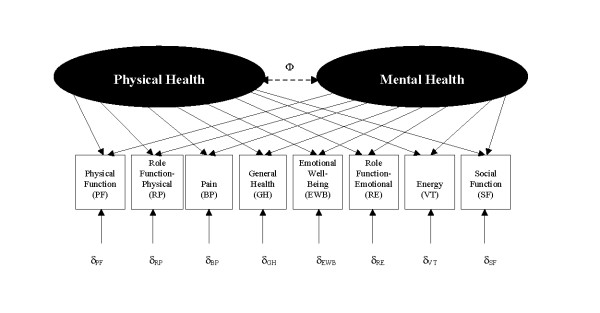
BACKGROUND: The SF-36 and SF-12 summary scores were derived using an uncorrelated (orthogonal) factor solution. We estimate SF-36 and SF-12 summary scores using a correlated (oblique) physical and mental health factor model. METHODS: We administered the SF-36 to 7,093 patients who received medical care from an independent association of 48 physician groups in the western United States. Correlated physical health (PCSc) and mental health (MCSc) scores were constructed by multiplying each SF-36 scale z-score by its respective scoring coefficient from the obliquely rotated two factor solution. PCSc-12 and MCSc-12 scores were estimated using an approach similar to the one used to derive the original SF-12 summary scores. RESULTS: The estimated correlation between SF-36 PCSc and MCSc scores was 0.62. There were far fewer negative factor scoring coefficients for the oblique factor solution compared to the factor scoring coefficients produced by the standard orthogonal factor solution. Similar results were found for PCSc-12, and MCSc-12 summary scores. CONCLUSION: Correlated physical and mental health summary scores for the SF-36 and SF-12 derived from an obliquely rotated factor solution should be used along with the uncorrelated summary scores. The new scoring algorithm can reduce inconsistent results between the SF-36 scale scores and physical and mental health summary scores reported in some prior studies.(Subscripts C = correlated and UC = uncorrelated).
Overview
The claims and statistics of this paper haven’t been checked yet.
Run the check — free, no account needed. It reads the open-access text and checks the sources it cites.
Integrity signals
Registry
Cites
Statistics
Figures
Verification
Claims the paper makes
The claims and statistics of this paper haven’t been checked yet.
Run the check — free, no account needed. It reads the open-access text and checks the sources it cites.
Claims other papers make about this one
Each is checked against this paper’s own text: does it say what the citing paper says it does?
In the citing paper
“Factor analyses of scale scores for the SF-36 health survey, provided strong support for two underlying factors with physical health defined primarily by measures of physical functioning, pain, and role limitations due to physical health problems, and by mental health reflected primarily by measures of emotional well-being and role limitations caused by emotional problems [17–18].”
From PROMIS®-29 v2.0 profile physical and mental health summary scores (2018) · cites this paper as [17]
In the citing paper
“Allowing the underlying physical and mental health summary scores to be correlated reflects the reality of health and eliminates the inconsistency between scale scores and summary measures [17].”
From PROMIS®-29 v2.0 profile physical and mental health summary scores (2018) · cites this paper as [17]
Self-check
Percentages, sums and reported differences re-computed from the paper’s own numbers.
The self-check needs the paper’s full text.
Citations
Cites
WARE, J. E., KOSINSKI, M., & KELLER, S. D. (1996) · Medical Care · doi:10.1097/00005650-199603000-00003 · Cited by 17,392
(1994) · Medical Entomology and Zoology · Cited by 4,156
The rand 36‐item health survey 1.0
Hays, R. D., Sherbourne, C. D., & Mazel, R. M. (1993) · Health Economics · doi:10.1002/hec.4730020305 · Cited by 2,971
Self-citationThe RAND-36 measure of health-related quality of life
Hays, R. D., & Morales, L. S. (2001) · Annals of Medicine · doi:10.3109/07853890109002089 · Cited by 1,460 · cited 1×
“[13] Summary scores that are forced to be uncorrelated may yield contradictory results compared to the scale scores.”
ResultSelf-citationThe Factor Structure of the SF-36 Health Survey in 10 Countries
Ware, J. E., Kosinski, M. R., Gandek, B., Aaronson, N. K., Apolone, G., Bech, P., Brazier, J. E., Bullinger, M., Kaasa, S., Leplège, A., et al. (1998) · Journal of Clinical Epidemiology · doi:10.1016/s0895-4356(98)00107-3 · Cited by 669
McHorney, C. A., Kosinski, M. R., & Ware, J. E. (1994) · Medical Care · doi:10.1097/00005650-199406000-00002 · Cited by 605
Interpreting SF&-36 summary health measures: A response
Ware, J. E., & Kosinski, M. R. (2001) · Quality of Life Research · doi:10.1023/a:1012588218728 · Cited by 569
Do SF-36 summary component scores accurately summarize subscale scores?
Taft, C., Karlsson, J., & Sullivan, M. (2001) · Quality of Life Research · doi:10.1023/a:1012552211996 · Cited by 392
SF-36 Summary Scores: Are Physical and Mental Health Truly Distinct
Simon, G. E., Revicki, D. A., Grothaus, L., & Vonkorff, M. (1998) · Medical Care · doi:10.1097/00005650-199804000-00012 · Cited by 211
Performance of the RAND-12 and SF-12 summary scores in type 2 diabetes
Johnson, J. A., & Maddigan, S. L. (2004) · Quality of Life Research · doi:10.1023/b:qure.0000018494.72748.cf · Cited by 65
Research works printed but not linked: 5
- Ware JE, Kosinski M, Gandek B: SF-36 ® Health Survey: Manual & Interpretation Guide. Lincoln, RI: QualityMetric Incorporated;1993; 2000.
- Ware JE, Kosinski M, Turner-Bowker DM, Gandek B: How to Score Version 2 of the SF-12 Health Survey (With a Supplement Documenting Version 1). Lincoln, RI: QualityMetric Incorporated; 2002.
- Taft C: Reply to Drs Ware and Kosinski. Qual Life Res 2001, 10: 415–420. 10.1023/A:1012552211996 · DOI · Paper page
- Hays RD, Morales LS: The RAND-36 measure of health-related quality of life. Ann Med 2001, 33: 350–357. · DOI · Paper page
- Hays RD, Prince-Embury S, Chen H: R-36 HIS: RAND-36 Health Status Inventory. San Antonio, TX: The Psychological Corporation; 1998.
Cited by
Sorted by citations
Items 401–412 of 412
Yoon, J.-H., Park, J.-H., Kim, D., Hwang, S., Park, J., Kim, J. H., Choi, S., Ko, E., Lee, B. J., Moon, Y., et al. (2026) · BMC Medical Genomics · doi:10.1186/s12920-026-02390-x
Yonemochi, T., Ina, K., Ina, H., Morizane, A., Kabeya, M., Nagasaka, M., Sakaguchi, A., Taniguchi, A., Nishiyama, S., & Ohta, Y. (2026) · Cureus · doi:10.7759/cureus.109144
Cruz, M. R., Naik, A. D., Burnett, J., Tsai, J., & Schick, V. (2026) · Journal of Applied Gerontology · doi:10.1177/07334648261451906
Arslan, N. (2026) · Frontiers in Nutrition · doi:10.3389/fnut.2026.1846293
Vernerová, L., Lážnovská, L., Baloun, J., Balounová, V., Vokurková, M., Klein, M., Verner, Z., Kičura, T., Mann, H., Oreská, S., et al. (2026) · Arthritis Research & Therapy · doi:10.1186/s13075-026-03847-1
Exploring education-related differential item functioning in the EQ-HWB
Zhang, G., Jong, J. E. W.-D., Busschbach, J., Mulhern, B. J., Finch, A., Luo, N., & Yang, Z. (2026) · Health and Quality of Life Outcomes · doi:10.1186/s12955-026-02593-x
Mehta, T. S., Young, H., Tracy, T., Aly, S., Baidwan, N. K., Thirumalai, M., Pekmezi, D., Riser, E., & Rimmer, J. H. (2026) · Archives of Physical Medicine and Rehabilitation · doi:10.1016/j.apmr.2026.08.007
Cementless calcar-guided short stems: 24-month clinical outcomes and migration analysis
Budde, S., Schwarze, M., Hurschler, C., Fennema, P., Windhagen, H. J., Plagge, J., Floerkemeier, T., von Lewinski, G., Noll, Y., & Derksen, A. (2026) · Scientific Reports · doi:10.1038/s41598-026-67610-x
Aly, S., Young, H., Tracy, T., Baidwan, N. K., Rimmer, J. H., Motl, R., & Mehta, T. (2026) · eNeurologicalSci · doi:10.1016/j.ensci.2026.100623
Physical activity and improvement of physiological parameters by training
Reis, R. A. D. M., Arida, R. M., da Nobrega, A. C. L., Mattos, J. D., Freitas, H. R., Ramos, M. C. S., Fortunato, R. S., Matta, L., Ferreira, G. C., & Canetti, C. D. A. (2026) · Frontiers in Sports and Active Living · doi:10.3389/fspor.2026.1944574
Olsen, B. C., Hagen, M., Opheim, R., Kristensen, V. A., Lund, C. I., Aabrekk, T. B., Johansen, I., Holten, K. I. A., Strande, V., Glad, I. F., et al. (2026) · Inflammatory Bowel Diseases · doi:10.1093/ibd/izag196
Azurdia, A. X. (2015) · uO Research (University of Ottawa) · doi:10.20381/ruor-6790
Metadata
- Authors
- Farivar, S. S., Cunningham, W. E., & Hays, R. D.
- Affiliations
- Amgen (United States) (US)
- University of California, Los Angeles (US)
- RAND Corporation (US)
- Corresponding author
- Farivar, Sepideh S
- Venue
- Health and Quality of Life Outcomes
- Published
- 2007-09-07
- Volume
- 5
- Issue
- 1
- Pages
- 54-54
- ISSN
- 1477-7525 (ISSN-L)
- PMC
- PMC2065865
- OpenAlex
- W2097456882
- Cited by
- 412
- References
- 15
- Citations by year
- 2026: 19 · 2025: 35 · 2024: 40 · 2023: 30 · 2022: 33 · 2021: 43 · 2020: 35 · 2019: 29 · 2018: 23 · 2017: 28 · 2016: 17 · 2015: 18 · 2014: 7 · 2013: 10 · 2012: 7
- FWCI
- 22.29
- Type
- journal article
- Language
- en
- Open access
- gold
- doi.org
- Licence
- Locations
- Health and Quality of Life Outcomes (publishedVersion, cc-by)
- PubMed Central (publishedVersion, cc-by)
- PubMed (publishedVersion)
- eScholarship (California Digital Library) (submittedVersion)
- DOAJ (DOAJ: Directory of Open Access Journals) (submittedVersion)
- Funders
- National Institutes of Health (5p20md000148-05)
- National Institute on Aging (AG20679-01, P01AG020679)
- National Institute on Minority Health and Health Disparities (P20-MD00148-01, P20-MD000148)
- Topics
- Social Sciences › Economics, Econometrics and Finance › Economics and Econometrics › Health Systems, Economic Evaluations, Quality of Life
- Social Sciences › Decision Sciences › Management Science and Operations Research › Psychometric Methodologies and Testing
- Health Sciences › Health Professions › Physical Therapy, Sports Therapy and Rehabilitation › Musculoskeletal pain and rehabilitation
- Keywords
- SF-36, SF-12, health-related quality of life, patient-reported outcomes
- MeSH terms
- Adolescent, Adult, Algorithms, Female, Health Services Accessibility, Health Status Indicators, Humans, Independent Practice Associations, Male, Mental Health, Middle Aged, Quality of Life, Surveys and Questionnaires, United States, Utilization Review, Sickness Impact Profile
About these checks
Registry, retraction, Cites and statistics results are computed, not judged, with one exception: a printed reference that no index lists is read once by a model before it counts as a citation error. Claims are extracted by a model and kept only when their quote appears verbatim in the text; each cited source is then checked, with a model’s help, for whether it says what the claim relies on. Those verdicts can be wrong — read the claim’s quote and the cited source before relying on one.
Statistics and arithmetic are recomputed, not judged.
Confidence bands are shown only for fields calibrated on our annotated test set. None is calibrated yet, so no band is shown.
What counts as a claim ›How we measure confidence ›How we check this ›
Are you an author, or do you see a problem with this page? Request a review
