

Systematic review of the health benefits of physical activity and fitness in school-aged children and youth
Open accessThe DOI matches its Crossref record; 114 of the 116 references it cites were found in a registry or an index; none of the 128 sources its claims cite is checked for support yet.
Abstract
BACKGROUND: The purpose was to: 1) perform a systematic review of studies examining the relation between physical activity, fitness, and health in school-aged children and youth, and 2) make recommendations based on the findings. METHODS: The systematic review was limited to 7 health indicators: high blood cholesterol, high blood pressure, the metabolic syndrome, obesity, low bone density, depression, and injuries. Literature searches were conducted using predefined keywords in 6 key databases. A total of 11,088 potential papers were identified. The abstracts and full-text articles of potentially relevant papers were screened to determine eligibility. Data was abstracted for 113 outcomes from the 86 eligible papers. The evidence was graded for each health outcome using established criteria based on the quantity and quality of studies and strength of effect. The volume, intensity, and type of physical activity were considered. RESULTS: Physical activity was associated with numerous health benefits. The dose-response relations observed in observational studies indicate that the more physical activity, the greater the health benefit. Results from experimental studies indicate that even modest amounts of physical activity can have health benefits in high-risk youngsters (e.g., obese). To achieve substantive health benefits, the physical activity should be of at least a moderate intensity. Vigorous intensity activities may provide even greater benefit. Aerobic-based activities had the greatest health benefit, other than for bone health, in which case high-impact weight bearing activities were required. CONCLUSION: The following recommendations were made: 1) Children and youth 5-17 years of age should accumulate an average of at least 60 minutes per day and up to several hours of at least moderate intensity physical activity. Some of the health benefits can be achieved through an average of 30 minutes per day. [Level 2, Grade A]. 2) More vigorous intensity activities should be incorporated or added when possible, including activities that strengthen muscle and bone [Level 3, Grade B]. 3) Aerobic activities should make up the majority of the physical activity. Muscle and bone strengthening activities should be incorporated on at least 3 days of the week [Level 2, Grade A].
Overview
CoChat Summary
TL;DR
This systematic review found physical activity is associated with numerous health benefits in school-aged children and youth, with observational dose-response evidence suggesting more activity yields greater benefit. It recommends an average of at least 60 minutes per day of at least moderate activity, with some benefits achievable at 30 minutes per day, plus added vigorous and muscle/bone-strengthening activities.
Key findings
- From 11,088 unique citations, 86 eligible papers yielded 113 outcomes across 7 health indicators. Physical activity was associated with benefits; observational studies showed dose-response relations, and experimental studies indicated even modest activity can benefit high-risk youngsters (e.g., obese).
- Metabolic syndrome: summary odds ratio for least active vs most active was 1.68 (95% CI 1.22–2.31) in 3 self-report studies; least fit vs most fit was 6.79 (95% CI 5.11–9.03) in 4 fitness studies. Obesity: median odds ratio was 1.33 for self-reported activity and 3.79 for objective measures. Cholesterol: unfit girls were 1.89 (1.12–3.17) times and unfit boys 3.68 (2.55–5.31) times more likely to have hypercholesterolemia than moderately/high fit peers.
- Recommendations: children and youth 5–17 years should accumulate an average of at least 60 minutes per day and up to several hours of at least moderate intensity activity; some health benefits can be achieved through an average of 30 minutes per day [Level 2, Grade A]. More vigorous activities should be incorporated when possible, including muscle- and bone-strengthening activities [Level 3, Grade B]; aerobic activities should make up the majority, with muscle and bone strengthening on at least 3 days per week [Level 2, Grade A].
- Bone: as little as 10 minutes of moderate-to-high impact activities on as little as 2 or 3 days per week can have a modest effect on bone mineral density when combined with general weight-bearing aerobic activities. Injuries: all 3 included studies reported higher injury rates in active children/youth and clear dose-response relations; vigorous sports risk estimates were high.
Methods
- Systematic review limited to 7 health indicators: high blood cholesterol, high blood pressure, metabolic syndrome, obesity, low bone density, depression, and injuries. Searches used predefined keywords in 6 databases (MEDLINE, EMBASE, CINAHL, PsycINFO, Evidence-Based Medicine Reviews, SPORTDiscus) to January 2008, limited to human participants, English language, and ages 5–17 years.
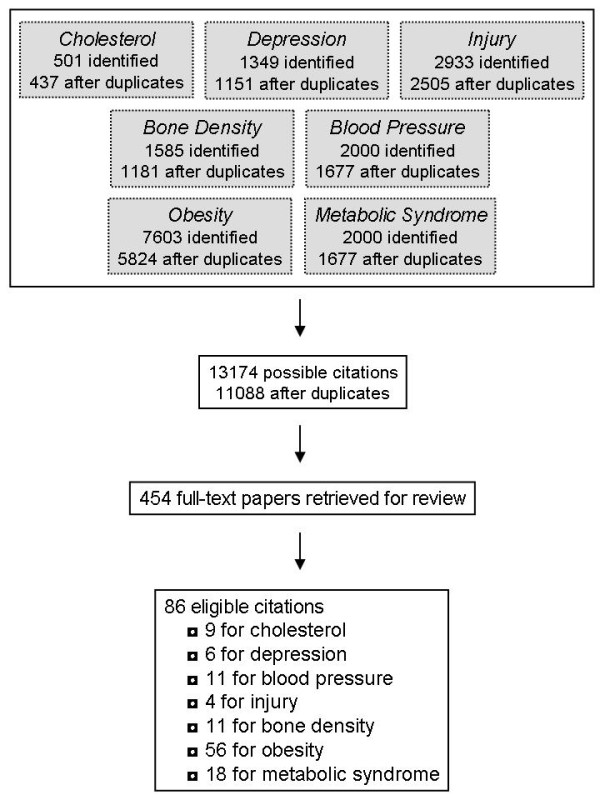
- After duplicates, 11,088 unique citations were screened; 454 full-text articles were reviewed; 86 unique citations met eligibility and 113 outcomes were abstracted. Observational studies had to report dichotomous outcomes; intervention studies were excluded if they included dietary or other behavioral components that could independently affect outcomes.
- Evidence was graded using pre-specified criteria based on quantity/quality of studies and strength of effect; meta-analyses were performed when at least 4 studies were available. RCT quality was assessed with the Downs and Black checklist, and effect sizes used Cohen’s d and ratio-score criteria.
Limitations
- Stated: unpublished and non-English studies were excluded, no extensive cross-referencing of reference lists was performed, the review was limited to 7 health outcomes, and many observational studies were excluded because they did not report dichotomous outcomes; these may have biased results and recommendations.
- Stated RCT limitations: samples were small and non-representative, statistical power was often lacking, adverse events were rarely reported, dropout details were limited, and intent-to-treat analyses were not performed; therefore Level 2 was the highest level assignable to any recommendation.
- Evident from the text: the nature of dose-response relations (linear vs curvilinear) often remained unclear, and the moderating effects of age and sex were not systematically addressed across outcomes.
Model-written summary. Check it against the paper before relying on it.
Integrity signals
Registry
Cites
Statistics
Figures
Verification
Claims the paper makes
0 Valid · 0 Not valid · 42 Not checked · 127 Own results and interpretations
A result the paper reports from its own data — it cites no other source for it, so there is none to check. The quote shows it is in the paper.
In the paper
“Results from experimental studies indicate that even modest amounts of physical activity can have health benefits in high-risk youngsters (e.g., obese).”
§ Systematic review of the health benefits of physical activity and fitness in school-aged children and youth > Abstract > Results
hedgedstates a cause- Asserted: passes — The authors put it forward as true.
- Checkable: passes — It can be checked against evidence.
- Load-bearing: passes — The paper’s conclusions depend on it.
- Based: passes — The paper gives a reason why it holds.
A result the paper reports from its own data — it cites no other source for it, so there is none to check. The quote shows it is in the paper.
In the paper
“Physical activity was associated with numerous health benefits.”
§ Systematic review of the health benefits of physical activity and fitness in school-aged children and youth > Abstract > Results
plainstates an association- Asserted: passes — The authors put it forward as true.
- Checkable: passes — It can be checked against evidence.
- Load-bearing: passes — The paper’s conclusions depend on it.
- Based: passes — The paper gives a reason why it holds.
A result the paper states — it cites no source for it, so there is none to check. The quote shows it is in the paper.
In the paper
“Aerobic-based activities had the greatest health benefit, other than for bone health, in which case high-impact weight bearing activities were required.”
§ Systematic review of the health benefits of physical activity and fitness in school-aged children and youth > Abstract > Results
plainstates an association- Asserted: passes — The authors put it forward as true.
- Checkable: passes — It can be checked against evidence.
- Load-bearing: passes — The paper’s conclusions depend on it.
- Based: passes — The paper gives a reason why it holds.
A result the paper reports from its own data — it cites no other source for it, so there is none to check. The quote shows it is in the paper.
In the paper
“The dose-response relations observed in observational studies indicate that the more physical activity, the greater the health benefit.”
§ Systematic review of the health benefits of physical activity and fitness in school-aged children and youth > Abstract > Results
hedgedstates an association- Asserted: passes — The authors put it forward as true.
- Checkable: passes — It can be checked against evidence.
- Load-bearing: passes — The paper’s conclusions depend on it.
- Based: passes — The paper gives a reason why it holds.
None of the sources cited for this claim have been checked yet.
In the paper
“The results indicated that unfit girls, defined as the lowest 20% fit, were 1.89 (95% confidence interval: 1.12-3.17) times more likely to have hypercholesterolemia and 1.03 (0.74-1.43) times more likely to have a low HDL-cholesterol by comparison to moderately and high fit girls.”
§ Systematic review of the health benefits of physical activity and fitness in school-aged children and youth > Results > Cholesterol and blood lipids
hedgedstates an associationn = 3,110- Asserted: passes — The authors put it forward as true.
- Checkable: passes — It can be checked against evidence.
- Load-bearing: passes — The paper’s conclusions depend on it.
- Based: passes — The paper gives a reason why it holds.
103 more claims
Create a free account to see all 169 claims and every source verdict.
- Probably not a substantial claim. 26
- The quote only partly states this claim. 2
- It may state two separate claims as one. 37
Claims other papers make about this one
Each is checked against this paper’s own text: does it say what the citing paper says it does?
The source backs part of the claim, not all of it — or backs it for a different population, condition or comparison.
In the citing paper
“Research indicates that those who are physically active show or report better overall physical and mental health, a higher level of fitness and a lower level of obesity than their sedentary or physically inactive counterparts1–4”
From Physical activity and health in Chinese children and adolescents: expert consensus statement (2020) (2020) · cites this paper as [2]
Experimental — accuracy not yet measuredThe cited source says what the claim attributes to it.
In the citing paper
“The association with overweight/obesity tends to be stronger when moderate to vigorous-intensity physical activities are performed.2”
From Physical activity and health in Chinese children and adolescents: expert consensus statement (2020) (2020) · cites this paper as [2]
The cited source says what the claim attributes to it.
In the citing paper
“Among physical activity interventions, the effects of physical activity independent of dietary changes on measures indicative of weight reduction (eg, BMI, total fat, abdominal fat) tend to be in the small range.2”
From Physical activity and health in Chinese children and adolescents: expert consensus statement (2020) (2020) · cites this paper as [2]
The cited source says what the claim attributes to it.
In the citing paper
“In general, as the level of physical activity increases, the likelihood of injury increases.2”
From Physical activity and health in Chinese children and adolescents: expert consensus statement (2020) (2020) · cites this paper as [2]
The cited source says what the claim attributes to it.
In the citing paper
“Systematic reviews have shown that physical activity (PA) is associated with greater mental health, 6 and a reduced risk of mental ill-health, specifically depression and anxiety.7,8”
From Domain-Specific Physical Activity and Mental Health: A Meta-analysis (2017) · cites this paper as [8]
2 more claims about this paper
Create a free account to see every claim other papers make about this one.
Self-check
Percentages, sums and reported differences re-computed from the paper’s own numbers.
Each contradiction between two passages listed here was confirmed by an independent check.
Rated major: it would touch a result — a value a result rests on, reported and recomputed p-values on opposite sides of the significance level, two passages that conflict with no sign which is right, or a cited work retracted before this paper was published.
In the paper
§ Systematic review of the health benefits of physical activity and fitness in school-aged children and youth > Discussion > Recommendations based on systematic review
“More vigorous intensity activities should be incorporated or added when possible, including activities that strengthen muscle and bone. [Level 3, Grade B].”
§ Systematic review of the health benefits of physical activity and fitness in school-aged children and youth > Discussion > Recommendations based on systematic review
“This recommendation was given a lower grade (Grade C) because of the potential increase in injury risk associated with more vigorous intensity activities and sports.”
Rated minor: it would not touch a result — a value no result rests on, a p-value that stays on the same side of the significance level, or a conflict that is clerical, resolved elsewhere in the paper, or outside its own findings.
In the paper
§ Systematic review of the health benefits of physical activity and fitness in school-aged children and youth > Results > Metabolic syndrome
“Sixteen articles examining the metabolic syndrome met the inclusion criteria.”
§ Systematic review of the health benefits of physical activity and fitness in school-aged children and youth > Results > Metabolic syndrome
“Eight of the 17 identified studies were observational in nature”
Rated minor: it would not touch a result — a value no result rests on, a p-value that stays on the same side of the significance level, or a conflict that is clerical, resolved elsewhere in the paper, or outside its own findings.
In the paper
“A total of 31 observational studies (24 cross-sectional, 3 prospective cohort, 2 case-control, 1 mixed) were retrieved”
§ Systematic review of the health benefits of physical activity and fitness in school-aged children and youth > Results > Overweight and obesity
Reported 31 · recomputed 30
Rated minor: it would not touch a result — a value no result rests on, a p-value that stays on the same side of the significance level, or a conflict that is clerical, resolved elsewhere in the paper, or outside its own findings.
In the paper
“437 citations were identified for cholesterol, 1151 for depression, 2505 for injury, 1181 for bone density, 1677 for blood pressure, 5824 for obesity, and 1677 for the metabolic syndrome. Thus, the grand total was 13174.”
§ Systematic review of the health benefits of physical activity and fitness in school-aged children and youth > Results > Literature review
Reported 13174 · recomputed 14452
Citations
Cites
Downs, S. H., & Black, N. (1998) · Journal of Epidemiology and Community Health · doi:10.1136/jech.52.6.377 · Cited by 8,252
Evidence Based Physical Activity for School-age Youth
Strong, W. B., Malina, R. M., Blimkie, C. J. R., Daniels, S. R., Dishman, R. K., Gutin, B., Hergenroeder, A. C., Must, A., Nixon, P. A., Pivarnik, J. M., et al. (2005) · The Journal of Pediatrics · doi:10.1016/j.jpeds.2005.01.055 · Cited by 4,222
Systematic Reviews: Synthesis of Best Evidence for Clinical Decisions
Cook, D. J., Mulrow, C. D., & Haynes, R. B. (1997) · Annals of Internal Medicine · doi:10.7326/0003-4819-126-5-199703010-00006 · Cited by 2,184
Andersen, L. B., Harro, M., Sardinha, L. B., Froberg, K., Ekelund, U., Brage, S., & Anderssen, S. A. (2006) · The Lancet · doi:10.1016/s0140-6736(06)69075-2 · Cited by 1,473
Lau, D. C. W., Douketis, J. D., Morrison, K. M., Hramiak, I. M., Sharma, A. M., Ur, E., & Panel, F. M. O. T. O. C. C. P. G. E. (2007) · Canadian Medical Association Journal · doi:10.1503/cmaj.061409 · Cited by 1,154
Paterson, D. H., & Warburton, D. E. (2010) · International Journal of Behavioral Nutrition and Physical Activity · doi:10.1186/1479-5868-7-38 · Cited by 953
A systematic review of the evidence for Canada's Physical Activity Guidelines for Adults
Warburton, D. E., Charlesworth, S., Ivey, A., Nettlefold, L., & Bredin, S. S. (2010) · International Journal of Behavioral Nutrition and Physical Activity · doi:10.1186/1479-5868-7-39 · Cited by 902 · cited 1×
“This report was part of a much larger project around Canada's physical activity guidelines, and comparable systematic reviews for adults [ 10 ] and older adults [11] have also been published in the journal.”
A meta-regression to examine the relationship between aerobic fitness and cognitive performance
Etnier, J. L., Nowell, P. M., Landers, D. M., & Sibley, B. A. (2006) · Brain Research Reviews · doi:10.1016/j.brainresrev.2006.01.002 · Cited by 749
Is the Canadian childhood obesity epidemic related to physical inactivity?
Tremblay, M. S., & Willms, J. D. (2003) · International Journal of Obesity · doi:10.1038/sj.ijo.0802376 · Cited by 517
Nassis, G. P., Papantakou, K., Skenderi, K., Triandafillopoulou, M., Kavouras, S. A., Yannakoulia, M., Chrousos, G. P., & Sidossis, L. S. (2005) · Metabolism · doi:10.1016/j.metabol.2005.05.013 · Cited by 469
Research works printed but not linked: 1
- Petitti DB Meta-Analysis, Decision Analysis, and Cost-Effective Analysis 1994 New York, NY: Oxford University Press
Cited by
Items 2,401–2,500 of 4,834
Time use and health and wellbeing outcomes of sport school students in Australia
Knowles, O., Gastin, P. B., & Kremer, P. J. (2017) · Sport Sciences for Health · doi:10.1007/s11332-017-0378-1 · Cited by 10
Energy expenditure associated with walking speed and angle of turn in children
Crossley, S. G. M., Mackintosh, K. A., Wilson, R. P., Lester, L., Griffiths, I. W., & McNarry, M. A. (2018) · European Journal of Applied Physiology · doi:10.1007/s00421-018-3981-1 · Cited by 10
García‐Hermoso, A., Izquierdo, M., & López‐Gil, J. F. (2023) · Scandinavian Journal of Medicine and Science in Sports · doi:10.1111/sms.14504 · Cited by 10
“7 However, most of the evidence on physical activity for maintaining a healthy weight in adolescents is based solely on aerobic physical activity alone (i.e., 60 min per day of moderate- to-vigorous physical activity [MVPA]), 8,9 with little attention given to the muscle strength component.”
BackgroundBorgundvaag, E., McIsaac, M. A., Borghese, M. M., & Janssen, I. (2017) · Journal of Physical Activity and Health · doi:10.1123/jpah.2016-0706 · Cited by 8
Self-citationResidential Environment for Outdoor Play Among Children in Latino Farmworker Families
Arcury, T. A., Suerken, C. K., Ip, E. H., Moore, J. B., & Quandt, S. A. (2016) · Journal of Immigrant and Minority Health · doi:10.1007/s10903-016-0473-4 · Cited by 8
Hernández-Rubio, J. A., Martínez, S. G., Olaya-Cuartero, J., & Férriz-Valero, A. (2023) · Journal of Sport and Health Research · doi:10.58727/jshr.88813 · Cited by 20
Brandes, B., Sell, L., Buck, C., Busse, H., Zeeb, H., & Brandes, M. (2023) · International Journal of Behavioral Nutrition and Physical Activity · doi:10.1186/s12966-023-01497-z · Cited by 11
“There is robust evidence on substantial health benefits for children who are more active and engage in higher volumes and intensities of physical activity (PA) [3].”
BackgroundMethodPredictors of Physical Activity in Positive Deviant Adolescents
Spurr, S., Bally, J. M. G., & Trinder, K. M. (2015) · Journal of Pediatric Nursing · doi:10.1016/j.pedn.2015.11.006 · Cited by 8
Buttazzoni, A. N., Pham, J., Ferguson, K. N., Fabri, E., Clark, A., Tobin, D., Frisbee, N. C., & Gilliland, J. (2024) · International Journal of Qualitative Studies on Health and Well-Being · doi:10.1080/17482631.2024.2320183 · Cited by 8
“…mental health (Biddle & Asare, 2011), physical health, and body composition and function (de Moraes Ferrari et al., 2015; Herman et al., 2015), and can mitigate the risk of chronic illnesses such as obesity, heart disease, and Type II diabetes (Figueroa-Munoz et al., 2001; Janssen & LeBlanc, 2010).”
BackgroundNyberg, G., Andermo, S., Nordenfelt, A., Lidin, M., & Hellénius, M.-L. (2020) · International Journal of Environmental Research and Public Health · doi:10.3390/ijerph17113794 · Cited by 13
An Update on Physical Activity Research among Children in Hong Kong: A Scoping Review
Zhang, C., Chung, P., Cheng, S.-S., Yeung, V. W.-C., Zhang, R., Liu, S., & Rhodes, R. E. (2020) · International Journal of Environmental Research and Public Health · doi:10.3390/ijerph17228521 · Cited by 10
Pesola, A. J., Melin, M., Vanhala, A., Gao, Y., & Finni, T. J. (2018) · International Journal of Environmental Research and Public Health · doi:10.3390/ijerph15081595 · Cited by 9
Hu, Y., Zhao, L., Sui, W., & Gao, Y. F. (2025) · Frontiers in Psychology · doi:10.3389/fpsyg.2025.1577987 · Cited by 19
Hao, Y., & Razman, R. (2023) · Frontiers in Public Health · doi:10.3389/fpubh.2023.1056191 · Cited by 12
König, T. T., Frankenbach, M.-L., Gianicolo, E., et al. (2023) · European Journal of Pediatrics · doi:10.1007/s00431-023-04923-3 · Cited by 8
Sex Differences in Birth Weight and Physical Activity in Japanese Schoolchildren
Yamakita, M., Sato, M., Suzuki, K., Ando, D., & Yamagata, Z. (2018) · Journal of Epidemiology · doi:10.2188/jea.je20170078 · Cited by 14
Gouveia, É. R., de Gouveia, B. R. F. O., Marques, A., Lopes, H., Rodrigues, A. J. A., Peralta, M., Kliegel, M., & Ihle, A. (2020) · Sustainability · doi:10.3390/su12218874 · Cited by 19
Family Dog-Assisted Adapted Physical Activity: A Case Study
Tepfer, A., Ross, S. M., MacDonald, M., Udell, M. A. R., Ruaux, C. G., & Baltzer, W. I. (2017) · Animals · doi:10.3390/ani7050035 · Cited by 14
Molner, B., Curtin, K. D., Kongats, K., Brown, J. A., Thomson, M., Atkey, K. M., & Nykiforuk, C. I. J. (2022) · Journal of Transport & Health · doi:10.1016/j.jth.2022.101537 · Cited by 9
Changes from 1986 to 2006 in reasons for liking leisure‐time physical activity among adolescents
Wold, B., Littlecott, H., Tynjälä, J., Samdal, O., Moore, L., Roberts, C., Kannas, L. K., Villberg, J. J., & Aarø, L. E. (2015) · Scandinavian Journal of Medicine and Science in Sports · doi:10.1111/sms.12528 · Cited by 13
Li, X., Xu, H. Y., Zhang, J., & Cao, X. (2025) · BMC Psychology · doi:10.1186/s40359-025-03351-2 · Cited by 22
“Recent studies have shown that PE teachers support students’ overall well-being by fostering “physical literacy” [1, 2].”
Arnaiz, P., Seelig, H., Gerber, M., Adams, L., Degen, J., Dolley, D., Joubert, N., Nienaber, M., Nqweniso, S., Steinmann, P., et al. (2023) · Frontiers in Public Health · doi:10.3389/fpubh.2023.1199381 · Cited by 13
Faulkner, G., Solomon, V., Berry, T. R., Deshpande, S., Latimer‐Cheung, A. E., Rhodes, R. E., Spence, J. C., & Tremblay, M. S. (2014) · Journal of Applied Research on Children Informing Policy for Children at Risk · doi:10.58464/2155-5834.1156 · Cited by 13
Sollerhed, A., Fransson, J., Skoog, J., & Garmy, P. (2022) · Frontiers in Sports and Active Living · doi:10.3389/fspor.2022.830913 · Cited by 14
Corella, C., Casterad, J. Z., Clemente, J. A. J., Rodríguez, V., Medrano, C., Plaza, I., & Sos, A. A. (2019) · International Journal of Environmental Research and Public Health · doi:10.3390/ijerph16224368 · Cited by 12
Bajwa, R. S. (2024) · Advances in human and social aspects of technology book series · doi:10.4018/979-8-3693-3350-1.ch006 · Cited by 9
Barriers and Determinants of Active Commuting to School in Slovenia
Jurak, G., Sorić, M., Ocvirk, T., Potočnik, Ž. L., Meh, K., Đurić, S., Sember, V., & Starc, G. (2021) · Sustainability · doi:10.3390/su132413808 · Cited by 16
Wattanathorn, J., Tong-un, T., Thukham-mee, W., & Weerapreeyakul, N. (2023) · Foods · doi:10.3390/foods12183411 · Cited by 11
Merrigan, J. J., Volgenau, K. M., McKay, A. J., Mehlenbeck, R., Jones, M. T., & Gallo, S. (2021) · Sports · doi:10.3390/sports9020026 · Cited by 8
Cereal consumption and indicators of cardiovascular risk in adolescent girls
Franko, D. L., Albertson, A. M., Thompson, D. R., & BARTON, B. A. (2010) · Public Health Nutrition · doi:10.1017/s1368980010002016 · Cited by 10
The health-related determinants of eating pattern of high school athletes in Goiás, Brazil
Noll, M. A., Rodrigues, A. P. S., & Silveira, É. A. (2020) · Archives of Public Health · doi:10.1186/s13690-020-0396-3 · Cited by 10
Hilland, T. A., Brown, T. D., & Fairclough, S. J. (2017) · Journal of Sports Sciences · doi:10.1080/02640414.2017.1308002 · Cited by 11
The effect of low-intensity exercise on emotional and cognitive engagement in the classroom
Tamura, A., Murayama, K., Ishii, R., Sakaki, M., & Tanaka, A. (2022) · npj Science of Learning · doi:10.1038/s41539-022-00125-y · Cited by 12
OECD (2017) · Health at a glance · doi:10.1787/health_glance-2017-66-en · Cited by 11
Suh, J., Choi, H. S., Kwon, A., Chae, H. W., Eom, S., & Kim, H.-S. (2019) · Journal of Pediatric Endocrinology and Metabolism · doi:10.1515/jpem-2019-0120 · Cited by 8
Sasayama, K., & Adachi, M. (2020) · BMC Research Notes · doi:10.1186/s13104-020-05231-x · Cited by 8
Weatherson, K. A., Locke, S., & Jung, M. E. (2018) · Translational Behavioral Medicine · doi:10.1093/tbm/iby053 · Cited by 13
McCreary, C., Miller‐Perrin, C., & Trammell, J. P. (2019) · Psi Chi Journal of Psychological Research · doi:10.24839/2325-7342.jn24.3.194 · Cited by 10
Device-based physical activity levels among Finnish adolescents with functional limitations
Ng, K., Rintala, P., Husu, P., Villberg, J. J., Vasankari, T. J., & Kokko, S. P. (2018) · Disability and health journal · doi:10.1016/j.dhjo.2018.08.011 · Cited by 10
Lindgren, E., Haraldsson, K., & Håman, L. (2019) · International Journal of Environmental Research and Public Health · doi:10.3390/ijerph16224543 · Cited by 13
Mixed‐Methods Evaluation of a Healthy Exercise, Eating, and Lifestyle Program for Primary Schools
Cochrane, T., & Davey, R. (2017) · Journal of School Health · doi:10.1111/josh.12555 · Cited by 8
Dauenhauer, B. D., Ha, T., Webster, C. A., Erwin, H. E., Centeio, E. E., Papa, J., & Burgeson, C. R. (2022) · Journal of Physical Activity and Health · doi:10.1123/jpah.2021-0792 · Cited by 9
Modrzejewska, M., Domaradzki, J., Jedziniak, W., Florkiewicz, B., & Zwierko, T. (2022) · Journal of Clinical Medicine · doi:10.3390/jcm11195672 · Cited by 9
Bittencourt, J. C., Scheinbein, G. H. A., de Oliveira, W. C., Bassi, R., Moura, L. B., Correa, A. L. D., Bernardes, R. G. D. L., Freitas, L. S., Lemos, J. C., Gonçalves, G. K. N., et al. (2023) · European Journal of Pediatrics · doi:10.1007/s00431-023-04807-6 · Cited by 10
Validation of the SenseWear Mini activity monitor in 5−12-year-old children
van Loo, C. M. T., Okely, A. D., Batterham, M. J., Hinkley, T., Ekelund, U., Brage, S., Reilly, J. J., Peoples, G. E., Jones, R. A., Janssen, X., et al. (2016) · Journal of science and medicine in sport · doi:10.1016/j.jsams.2016.04.010 · Cited by 10
Schlechter, C. R., Rosenkranz, R. R., Guagliano, J. M., & Dzewaltowski, D. A. (2018) · Translational Behavioral Medicine · doi:10.1093/tbm/iby091 · Cited by 9
Zitouni, D., & Guinhouya, B. C. (2011) · Journal of science and medicine in sport · doi:10.1016/j.jsams.2011.11.254 · Cited by 10
Wang, H., Zhou, Y., Blake, H., & Chattopadhyay, K. (2022) · International Journal of Environmental Research and Public Health · doi:10.3390/ijerph19021021 · Cited by 11
Zask, A., Pattinson, M., Ashton, D., Ahmadi, M. N., Trost, S. G., Irvine, S., Stafford, L., Delbaere, K., & Adams, J. (2023) · Health Promotion Journal of Australia · doi:10.1002/hpja.688 · Cited by 20
Costa-Pereira, L. V., Melo, D. D. S., SANTOS, C. D. S., Mendes, B. F., Esteves, E. A., Lacerda, A. C. R., de Miranda, J. L., Rocha‐Vieira, E., Gripp, F., Amorim, F. T., et al. (2016) · Scandinavian Journal of Medicine and Science in Sports · doi:10.1111/sms.12737 · Cited by 7
Sweeney, E. A., Little, C. C., Wilson, J. C., Potter, M. N., Seehusen, C. N., & Howell, D. R. (2022) · Journal of Athletic Training · doi:10.4085/1062-6050-0266.22 · Cited by 8
Romero-Martínez, J., Menescardi, C., Ortega-Benavent, N., Montalt-García, S., Barnett, L. M., García‐Massó, X., & Estevan, I. (2025) · Journal of science and medicine in sport · doi:10.1016/j.jsams.2025.05.006 · Cited by 14
Hutmacher, D., Eckelt, M., Bund, A., & Steffgen, G. (2021) · Journal of Psychoeducational Assessment · doi:10.1177/07342829211005571 · Cited by 10
García, J. L., Aadland, E., Berger, N., Hansen, B. H., Benadjaoud, M. A., van Hees, V. T., Danilevicz, I. M., & Sabia, S. (2025) · Scientific Reports · doi:10.1038/s41598-025-03866-z · Cited by 14
Nasruddin, N. I. N., Murphy, J., & Armstrong, M. E. G. (2023) · JMIR Pediatrics and Parenting · doi:10.2196/42461 · Cited by 8
Makai, A., Prémusz, V., Dózsa-Juhász, O., Mazzag, K., Melczer, C., & Ács, P. (2023) · Children · doi:10.3390/children10091547 · Cited by 20
“Physical activity (PA) in youth has several benefits, including cardiorespiratory fitness, normal muscle strength, and mental status, and reduces the risk of obesity and certain metabolic diseases [6].”
BackgroundLeduc, G., Gilbert, J., Ayotte, A., Moreau, N., Drapeau, V., Lemoyne, J., Monthuy‐Blanc, J., Tremblay, J., & Mathieu, M.-E. (2021) · BMC Public Health · doi:10.1186/s12889-021-10200-5 · Cited by 12
Vicente-Gabriel, S., Lugones‐Sánchez, C., Tamayo‐Morales, O., Prieto, A. V., González‐Sánchez, S., Martín, S. C., Gómez‐Sánchez, M., Rodríguez‐Sánchez, E., García‐Ortiz, L., Gómez‐Sánchez, L., et al. (2024) · Frontiers in Public Health · doi:10.3389/fpubh.2024.1322437 · Cited by 16
Denton, S. J., Trenell, M. I., Plötz, T., Savory, L. A., Bailey, D. P., & Kerr, C. J. (2013) · PLoS ONE · doi:10.1371/annotation/09abd773-39df-46a9-b28e-3031be04fcb9 · Cited by 8
Renninger, D., Bachner, J., García‐Massó, X., Molina‐García, J., Reimers, A. K., Marzi, I., Beck, F., & Demetriou, Y. (2023) · Behavioral Sciences · doi:10.3390/bs13030272 · Cited by 11
Paravidino, V. B., Mediano, M. F. F., & Sichieri, R. (2017) · Physiology & Behavior · doi:10.1016/j.physbeh.2017.02.016 · Cited by 10
Bähr, F., Wöhrl, T., Teich, P., Puta, C., & Kliegl, R. M. (2025) · Scientific Reports · doi:10.1038/s41598-025-95461-5 · Cited by 10
Killian, C. M., Kern, B. D., Wilson, W. J., & van der Mars, H. (2024) · Journal of Physical Activity and Health · doi:10.1123/jpah.2024-0340 · Cited by 12
Gallant, F., & Bélanger, M. F. (2021) · Frontiers in Sports and Active Living · doi:10.3389/fspor.2021.741495 · Cited by 14
Akter, M. M., & Hossain, M. J. (2024) · Health Science Reports · doi:10.1002/hsr2.70259 · Cited by 24
Measuring change in adolescent physical activity: Responsiveness of a single item
O’Halloran, P., Sullivan, C., Staley, K., Nicholson, M., Randle, E., Bauman, A. E., Donaldson, A., McNeil, N., Stukas, A. A., Wright, A., et al. (2022) · PLoS ONE · doi:10.1371/journal.pone.0268459 · Cited by 10
Keating, X. D., Stephenson, R., Hodges, M., et al. (2020) · Physical Education and Sport Pedagogy · doi:10.1080/17408989.2020.1806994 · Cited by 8
DeBate, R. D., & Bleck, J. R. (2016) · International Journal of Health Promotion and Education · doi:10.1080/14635240.2015.1126528 · Cited by 10
Punar, E., Şevgin, Ö., & Altunalan, T. (2024) · BMC Pediatrics · doi:10.1186/s12887-024-05309-6 · Cited by 19
A cross-sectional study of Canadian children's valuation of literacies across social contexts
Bremer, E., Jefferies, P., Cairney, J., & Kriellaars, D. J. (2023) · Frontiers in Sports and Active Living · doi:10.3389/fspor.2023.1125072 · Cited by 8
Béland-Millar, A., Takimoto, M., Hamada, T., & Messier, C. (2020) · Brain Research · doi:10.1016/j.brainres.2020.147126 · Cited by 9
Manneville, F., Legrand, K., Omorou, A. Y., Rydberg, J. A., Langlois, J., Böhme, P., Saez, L., Lecomte, E., & Briançon, S. (2024) · International Journal of Behavioral Medicine · doi:10.1007/s12529-024-10312-3 · Cited by 8
“Weight underestimation could lead to changes in lifestyle behaviors such as physical activity (PA), sedentary behavior (SB), and eating behavior (EB), which are important modifiable factors to prevent and reduce overweight and obesity in adolescents with overweight or obesity [10–13].”
Okoye, E. C., Onwuakagba, I. U., Ani, K. U., Babatunde, J. K., Akosile, C. O., Okeke, M. C., & Aronu, A. E. (2020) · Disability and Rehabilitation · doi:10.1080/09638288.2020.1817159 · Cited by 8
Malek, M. E., Norman, Å., Elinder, L. S., Patterson, E., & Nyberg, G. (2022) · Children · doi:10.3390/children9020248 · Cited by 9
Cha, J.-Y., Min, S.-K., Yoon, T.-H., & Jee, Y. (2020) · Journal of Exercise Rehabilitation · doi:10.12965/jer.2040270.135 · Cited by 10
Dereceli, Ç., DOKUZOĞLU, G., & Dereceli, E. (2023) · Research in Sport Education and Sciences · doi:10.5152/jpess.2023.23071 · Cited by 7
Tabak, I., Oblacińska, A., & Jodkowska, M. (2012) · Physical Culture and Sport Studies and Research · doi:10.2478/v10141-012-0008-1 · Cited by 7
“Currently, however, the need for daily physical activity, 7 days a week, is increasingly often discussed (Currie et al. 2008, Janssen and Leblanc 2010).”
BackgroundResultMotivational Aspects and Critical Issues of a Pedometer Intervention in Adolescents
Suchert, V., Steinvoord, K., Schwarz, J., Isensee, B., & Krieger, C. (2016) · Health Promotion Practice · doi:10.1177/1524839916667273 · Cited by 8
Effects of Isometric and Isotonic Training on Health-Related Fitness Components in Young Adults
Azeem, K., & Zemková, E. (2022) · Applied Sciences · doi:10.3390/app12178682 · Cited by 12
Wade, L., Beauchamp, M. R., Nathan, N., Smith, J. J., Leahy, A. A., Kennedy, S. G., Boyer, J., Bao, R., Diallo, T., Conti, J. V., et al. (2023) · PLoS ONE · doi:10.1371/journal.pone.0279661 · Cited by 8
Alamoudi, N. A., Algabbani, M. F., Al‐Heizan, M. O., & Alhusaini, A. A. (2024) · Frontiers in Pediatrics · doi:10.3389/fped.2024.1463288 · Cited by 10
Heo, M., & Wylie‐Rosett, J. (2020) · Journal of School Health · doi:10.1111/josh.12879 · Cited by 9
Vorlíček, M., Stewart, T. I., Dygrýn, J., Rubín, L., Mitáš, J., & Schipperijn, J. (2019) · Acta Gymnica · doi:10.5507/ag.2019.009 · Cited by 9
Physical Activity-Related Injuries and Risk Factors among Secondary School Students in Hong Kong
Cai, W., Sun, Y., Peng, K., Kwok, H. H. M., Lei, L., Wu, S., Lam, C. K., Li, L., & Gao, Y. (2020) · International Journal of Environmental Research and Public Health · doi:10.3390/ijerph17030747 · Cited by 7
Enhanced Body Composition and Physical Fitness in Prepubescent Soccer Players
Ateş, B. (2018) · Pedagogical Research · doi:10.20897/pr/3896 · Cited by 7
Husøy, A., Kolle, E., Steene‐Johannessen, J., Andersen, L. B., Anderssen, S. A., & Ekelund, U. (2024) · Medicine & Science in Sports & Exercise · doi:10.1249/mss.0000000000003595 · Cited by 10
Hilton, C. L., Ratcliff, K., & Hong, I. (2020) · Journal of Autism and Developmental Disorders · doi:10.1007/s10803-020-04591-4 · Cited by 8
“Participation in a variety of activities is essential for the growth and development of children and adolescents, and directly relates to lifetime health, well-being, and quality of life (Bohnert et al. 2019; Chang et al. 2019; Gray et al. 2014; Janssen and Leblanc 2010; Larson 2000).”
BackgroundAkkerman, M., Mouton, L. J., Disseldorp, L. M., Niemeijer, A. S., van Brussel, M., van der Woude, L. H. V., & Nieuwenhuis, M. K. (2018) · BMC Sports Science Medicine and Rehabilitation · doi:10.1186/s13102-018-0093-5 · Cited by 9
Zhong, T., Liu, H., Li, Y., & Qi, J. (2022) · International Journal of Environmental Research and Public Health · doi:10.3390/ijerph192316301 · Cited by 10
Wallace, J., Deitrick, J. M., Martin, T. G., et al. (2020) · Digital Scholarship - UNLV (University of Nevada Reno) · Cited by 7
Weir, N., Pringle, A., & Roscoe, C. M. P. (2024) · Children · doi:10.3390/children11111355 · Cited by 25
Pirnes, K. P., Kallio, J., Kankaanpää, A., HÄKKINEN, A. H., & Tammelin, T. (2020) · Scandinavian Journal of Pain · doi:10.1515/sjpain-2020-0038 · Cited by 11
da Costa, B. G. G., Bruner, B., Raymer, G. H., Benson, S. M. S., Chaput, J., McGoey, T., Rickwood, G., Robertson‐Wilson, J., Saunders, T. J., & Law, B. (2022) · Frontiers in Psychology · doi:10.3389/fpsyg.2022.1025444 · Cited by 8
Schirmer, T., Bailey, A. W., Kerr, N., Walton, A., Ferrington, L., & Cecilio, M. E. (2023) · BMC Public Health · doi:10.1186/s12889-022-14927-7 · Cited by 14
PROPIEDADES PSICOMÉTRICAS DEL AUTOINFORME DE BARRERAS PARA LA PRÁCTICA DEL EJERCICIO FÍSICO (ABPEF)
Alonso, J. D., López-Castelo, A., & Portela-Pino, I. (2018) · Revista Internacional de Medicina y Ciencias de la Actividad Física y del Deporte · doi:10.15366/rimcafd2018.72.010 · Cited by 11
Carson, V., Barnes, J. D., LeBlanc, C. M. A., Moreau, E., & Tremblay, M. S. (2017) · Paediatrics & Child Health · doi:10.1093/pch/pxx006 · Cited by 8
Andermo, S., Hellénius, M.-L., Lidin, M., Hedby, U., Nordenfelt, A., & Nyberg, G. (2020) · BMC Public Health · doi:10.1186/s12889-020-08895-z · Cited by 10
Sugimoto, D., Stracciolini, A., Berbert, L., Nohelty, E., Kobelski, G. P., Parmeter, B., Weller, E. A., Faigenbaum, A. D., & Myer, G. D. (2023) · International Journal of Environmental Research and Public Health · doi:10.3390/ijerph20032552 · Cited by 17
Xu, S. Y., Turakhia, S., Miller, M. L., Johnston, D., Maddalozzo, J. P., Thompson, D. M., Trosman, I., Grandner, M. A., Sheldon, S. H., Ahluwalia, V., et al. (2021) · Journal of Clinical Sleep Medicine · doi:10.5664/jcsm.9726 · Cited by 7
“24 Understanding the relationship between TST and physical functional mobility may be crucial to educating children about healthier relationships to sleep behaviors, such as setting appropriate bedtimes, which may lead to increased physical mobility and enhanced well-being.”
dos Santos, S. F. D. S., Bordin, D., de Souza, E. F. D., & Júnior, I. F. F. (2019) · Contemporary Clinical Trials Communications · doi:10.1016/j.conctc.2019.100505 · Cited by 12
Metadata
- Authors
- Janssen, I., & LeBlanc, A. G.
- Affiliations
- Queen's University (CA)
- Corresponding author
- Janssen, Ian
- Venue
- International Journal of Behavioral Nutrition and Physical Activity
- Published
- 2010
- Volume
- 7
- Issue
- 1
- Pages
- 40
- ISSN
- 1479-5868 (ISSN-L)
- PMC
- PMC2885312
- OpenAlex
- W2145702257
- Semantic Scholar
- ef8d55efd11b9d5e4a4814b6a38ff3d60d820d37
- Cited by
- 4,829
- References
- 116
- Citations by year
- 2026: 185 · 2025: 257 · 2024: 310 · 2023: 304 · 2022: 371 · 2021: 451 · 2020: 459 · 2019: 401 · 2018: 387 · 2017: 490 · 2016: 302 · 2015: 280 · 2014: 250 · 2013: 191 · 2012: 109
- FWCI
- 12.18
- Type
- journal article
- Language
- en
- Open access
- gold
- doi.org
- Licence
- cc-by
- Locations
- International Journal of Behavioral Nutrition and Physical Activity (publishedVersion, cc-by)
- PubMed Central (publishedVersion, cc-by)
- PubMed (publishedVersion)
- DOAJ (DOAJ: Directory of Open Access Journals) (submittedVersion, cc-by-sa)
- Funders
- Public Health Agency of Canada
- Public Health Agency
- Topics
- Health Sciences › Medicine › Public Health, Environmental and Occupational Health › Physical Activity and Health
- Health Sciences › Medicine › Public Health, Environmental and Occupational Health › Obesity, Physical Activity, Diet
- Social Sciences › Life-span and Life-course Studies › Recreational Sport and Physical Activity
- Keywords
- physical activity, physical fitness, school-aged children, youth, health benefits, serum cholesterol, blood pressure, metabolic syndrome, childhood obesity, bone mineral density, depression, injuries, dose-response relationship, aerobic exercise, physical activity guidelines
About these checks
Registry, retraction, Cites and statistics results are computed, not judged, with one exception: a printed reference that no index lists is read once by a model before it counts as a citation error. Claims are extracted by a model and kept only when their quote appears verbatim in the text; each cited source is then checked, with a model’s help, for whether it says what the claim relies on. Those verdicts can be wrong — read the claim’s quote and the cited source before relying on one.
A language model drew the claims from the paper on 2026-10-10, under version 3 of the claim definition (model deepseek-v4.1-flash, prompt extract-v3).
A second model labelled each claim on 2026-10-10 (model jev-1.13-20260917, definition revision gold-guideline-v0.2).
Statistics and arithmetic are recomputed, not judged.
Confidence bands are shown only for fields calibrated on our annotated test set. None is calibrated yet, so no band is shown.
What counts as a claim ›How we measure confidence ›How we check this ›
Are you an author, or do you see a problem with this page? Request a review
Data sources
Bibliographic data: Semantic Scholar, OpenAlex, Crossref.
Contains information from the Semantic Scholar Academic Graph Datasets, made available under the ODC Attribution License (ODC-BY 1.0).
Semantic Scholar’s data is described in: Kinney, R., et al. (2023). The Semantic Scholar Open Data Platform. arXiv:2301.10140.
