

Effect of nanoparticles on heat capacity of nanofluids based on molten salts as PCM for thermal energy storage
Open accessThe DOI matches its Crossref record; 55 of the 56 references it cites were found in a registry or an index.
Abstract
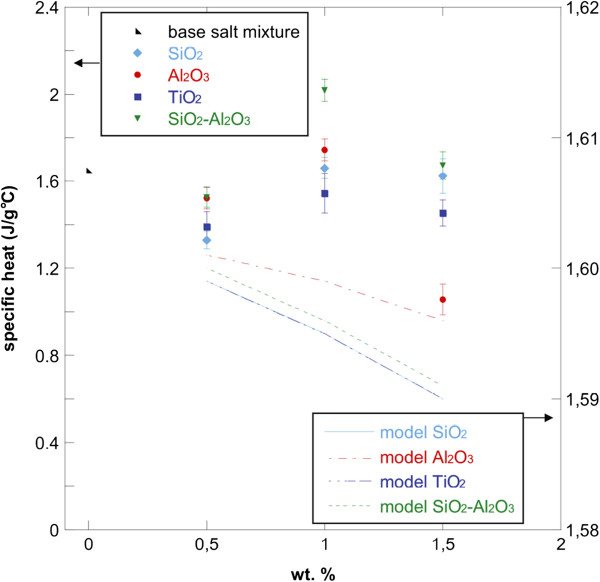
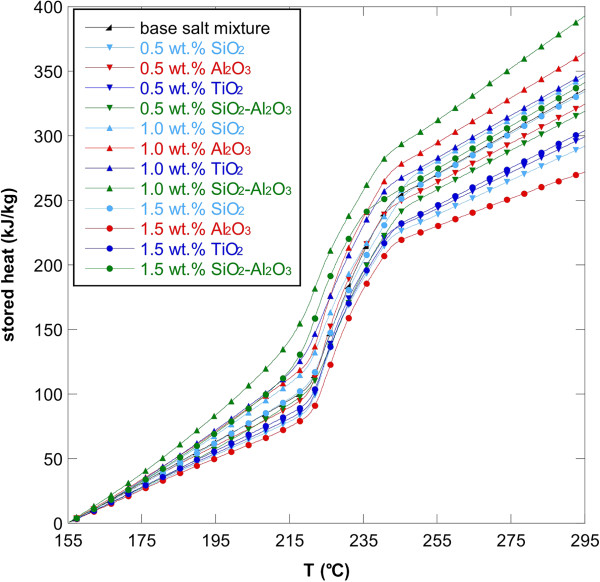
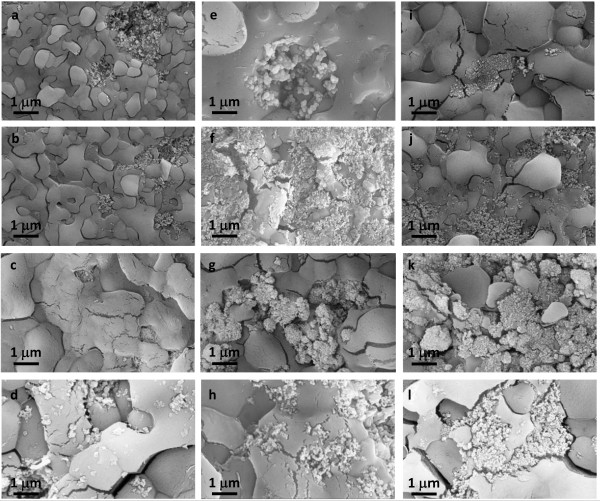
In this study, different nanofluids with phase change behavior were developed by mixing a molten salt base fluid (selected as phase change material) with nanoparticles using the direct-synthesis method. The thermal properties of the nanofluids obtained were investigated. These nanofluids can be used in concentrating solar plants with a reduction of storage material if an improvement in the specific heat is achieved. The base salt mixture was a NaNO3-KNO3 (60:40 ratio) binary salt. The nanoparticles used were silica (SiO2), alumina (Al2O3), titania (TiO2), and a mix of silica-alumina (SiO2-Al2O3). Three weight fractions were evaluated: 0.5, 1.0, and 1.5 wt.%. Each nanofluid was prepared in water solution, sonicated, and evaporated. Measurements on thermophysical properties were performed by differential scanning calorimetry analysis and the dispersion of the nanoparticles was analyzed by scanning electron microscopy (SEM). The results obtained show that the addition of 1.0 wt.% of nanoparticles to the base salt increases the specific heat of 15% to 57% in the solid phase and of 1% to 22% in the liquid phase. In particular, this research shows that the addition of silica-alumina nanoparticles has a significant potential for enhancing the thermal storage characteristics of the NaNO3-KNO3 binary salt. These results deviated from the predictions of the theoretical model used. SEM suggests a greater interaction between these nanoparticles and the salt.
Overview
The claims and statistics of this paper haven’t been checked yet.
Free: it reads the open-access text and checks the first 5 claims that cite a source we can check. Create a free account to check every claim.
Integrity signals
Registry
Cites
Statistics
Figures
Verification
Claims the paper makes
The claims and statistics of this paper haven’t been checked yet.
Free: it reads the open-access text and checks the first 5 claims that cite a source we can check. Create a free account to check every claim.
Claims other papers make about this one
Each is checked against this paper’s own text: does it say what the citing paper says it does?
The cited source says what the claim attributes to it.
In the citing paper
“All of the NPs reduced the onset and melting temperatures of the PCM.”
From Nano-Enhanced Phase Change Materials in Latent Heat Thermal Energy Storage Systems: A Review (2021) · cites this paper as [66]
The cited source says what the claim attributes to it.
In the citing paper
“The NPs also increased the specific heat and heat of fusion.”
From Nano-Enhanced Phase Change Materials in Latent Heat Thermal Energy Storage Systems: A Review (2021) · cites this paper as [66]
The cited source says what the claim attributes to it.
In the citing paper
“The 1.0 wt % concentration was the most effective by far, as were the SiO 2 -Al 2 O 3 NPs, although the other types of NPs were also effective [66].”
From Nano-Enhanced Phase Change Materials in Latent Heat Thermal Energy Storage Systems: A Review (2021) · cites this paper as [66]
The cited source says what the claim attributes to it.
In the citing paper
“1.0 wt % SiO 2 -Al 2 O 3 were the most effective”
From Nano-Enhanced Phase Change Materials in Latent Heat Thermal Energy Storage Systems: A Review (2021) · cites this paper as [66]
Self-check
Percentages, sums and reported differences re-computed from the paper’s own numbers.
The self-check needs the paper’s full text.
Citations
Cites
Convective Transport in Nanofluids
Buongiorno, J. (2006) · Journal of Heat Transfer · doi:10.1115/1.2150834 · Cited by 7,013 · cited 1×
“The measurements were also compared with a theoretical model based on the assumption of thermal equilibrium between the particles and the surrounding fluid [26,31]:”
Review on thermal energy storage with phase change materials and applications
Sharma, A., Tyagi, V. V., Chen, C. R., & Buddhi, D. (2009) · Renewable and Sustainable Energy Reviews · doi:10.1016/j.rser.2007.10.005 · Cited by 5,936 · cited 2×
“Therefore, several studies on PCM used as thermal energy storage material have been published [10-16].”
BackgroundZalba, B., Marı́n, J. M., Cabeza, L. F., & Mehling, H. (2003) · Applied Thermal Engineering · doi:10.1016/s1359-4311(02)00192-8 · Cited by 4,738 · cited 1×
“Therefore, several studies on PCM used as thermal energy storage material have been published [10-16].”
BackgroundA review on phase change energy storage: materials and applications
Farid, M. M., Khudhair, A. M., Razack, S. A. K., & Al-Hallaj, S. (2004) · Energy Conversion and Management · doi:10.1016/j.enconman.2003.09.015 · Cited by 3,097 · cited 1×
“Therefore, several studies on PCM used as thermal energy storage material have been published [10-16].”
BackgroundMaterials used as PCM in thermal energy storage in buildings: A review
Cabeza, L. F., Castell, A., Barreneche, C., de Gracia, A., & Fernández, A. I. (2011) · Renewable and Sustainable Energy Reviews · doi:10.1016/j.rser.2010.11.018 · Cited by 1,889
Gil, A., Medrano, M., Martorell, I., Lázaro, A., Dolado, P., Zalba, B., & Cabeza, L. F. (2010) · Renewable and Sustainable Energy Reviews · doi:10.1016/j.rser.2009.07.035 · Cited by 1,762
Yu, W., & Choi, S. U. S. (2003) · Journal of Nanoparticle Research · doi:10.1023/a:1024438603801 · Cited by 1,737
Role of Brownian motion in the enhanced thermal conductivity of nanofluids
Jang, S. P., & Choi, S. U. S. (2004) · Applied Physics Letters · doi:10.1063/1.1756684 · Cited by 1,596
Enhanced thermal conductivity of TiO2—water based nanofluids
Murshed, S. M. S., Leong, K. C., & Yang, C. (2005) · International Journal of Thermal Sciences · doi:10.1016/j.ijthermalsci.2004.12.005 · Cited by 1,395
Hasnain, S. M. (1998) · Energy Conversion and Management · doi:10.1016/s0196-8904(98)00025-9 · Cited by 1,267 · cited 2×
“Low-temperature storage systems are based almost entirely on sensible heat storage using liquid water [3], but for temperatures exceeding 100°C (concentrated solar power plants), non-pressurized liquid water and the use of pressure vessels make this technology unattractive.”
BackgroundHigh-temperature phase change materials for thermal energy storage
Kenisarin, M. M. (2010) · Renewable and Sustainable Energy Reviews · doi:10.1016/j.rser.2009.11.011 · Cited by 1,192 · cited 1×
“Therefore, several studies on PCM used as thermal energy storage material have been published [10-16].”
BackgroundA review on phase change materials integrated in building walls
Kuznik, F., David, D., Johannes, K., & Roux, J.-J. (2011) · Renewable and Sustainable Energy Reviews · doi:10.1016/j.rser.2010.08.019 · Cited by 1,057 · cited 1×
“Among the various methods of energy storage, latent heat thermal energy storage (LHTES) systems using phase change materials (PCMs) have been gaining importance in such fields as solar energy systems, district heating and cooling systems, energy efficiency buildings [6-9], cool storage systems for central air-conditio…”
BackgroundThermal conductivity enhancement of suspensions containing nanosized alumina particles
Xie, H., Wang, J., Xi, T., Liu, Y., Ai, F., & Wu, Q. (2002) · Journal of Applied Physics · doi:10.1063/1.1454184 · Cited by 1,004 · cited 1×
“the contribution of interfacial effects will be stronger in this kind of suspensions [55,56].”
BackgroundPhase change materials for building applications: A state-of-the-art review
Baetens, R., Jelle, B. P., & Gustavsen, A. (2010) · Energy and Buildings · doi:10.1016/j.enbuild.2010.03.026 · Cited by 997 · cited 1×
“Among the various methods of energy storage, latent heat thermal energy storage (LHTES) systems using phase change materials (PCMs) have been gaining importance in such fields as solar energy systems, district heating and cooling systems, energy efficiency buildings [6-9], cool storage systems for central air-conditio…”
BackgroundInternational Energy Agency (2011) · World Energy Outlook · doi:10.1787/weo-2011-en · Cited by 956
Particle shape effects on thermophysical properties of alumina nanofluids
Timofeeva, E. V., Routbort, J. L., & Singh, D. (2009) · Journal of Applied Physics · doi:10.1063/1.3155999 · Cited by 925 · cited 1×
“the contribution of interfacial effects will be stronger in this kind of suspensions [55,56].”
BackgroundThermal Conductivity of Nanoscale Colloidal Solutions (Nanofluids)
Prasher, R., Bhattacharya, P., & Phelan, P. E. (2005) · Physical Review Letters · doi:10.1103/physrevlett.94.025901 · Cited by 917 · cited 1×
“They are based on Brownian motion of nanoparticles [37-39],”
BackgroundHeat and cold storage with PCM: An up to date introduction into basics and applications
Mehling, H., & Cabeza, L. F. (2008) · Heat and Mass Transfer · doi:10.1007/978-3-540-68557-9 · Cited by 894
Aggregation structure and thermal conductivity of nanofluids
Xuan, Y., Li, Q., & Hu, W. (2003) · AIChE Journal · doi:10.1002/aic.690490420 · Cited by 827 · cited 1×
“aggregation of nanoparticles [40-42] and formation of a nanolayer [21,43-45].”
BackgroundLatent Heat Storage Materials and Systems: A Review
Sharma, S. D., & Sagara, K. (2005) · International Journal of Green Energy · doi:10.1081/ge-200051299 · Cited by 714 · cited 2×
“Therefore, several studies on PCM used as thermal energy storage material have been published [10-16].”
BackgroundMeasurement of the specific heat capacity of water-based Al2O3 nanofluid
Zhou, S.-Q., & Ni, R. (2008) · Applied Physics Letters · doi:10.1063/1.2890431 · Cited by 632 · cited 1×
“This behavior was also reported in previous studies [21,26,35,36].”
ResultShin, D., & Banerjee, D. (2011) · International Journal of Heat and Mass Transfer · doi:10.1016/j.ijheatmasstransfer.2010.11.017 · Cited by 534 · cited 9×
“The SEM characterization of the nanofluids developed in our study did not show the presence of a substructure at nanoparticle locations as reported in other researches [21,32] that was considered as probably responsible for heat capacity enhancement.”
BackgroundMethodResultInfluentialEvans, W., Prasher, R., Fish, J., Meakin, P., Phelan, P., & Keblinski, P. (2008) · International Journal of Heat and Mass Transfer · doi:10.1016/j.ijheatmasstransfer.2007.10.017 · Cited by 478 · cited 1×
“aggregation of nanoparticles [40-42] and formation of a nanolayer [21,43-45].”
BackgroundSarı, A., & Karaipekli, A. (2009) · Solar Energy Materials and Solar Cells · doi:10.1016/j.solmat.2008.11.057 · Cited by 469 · cited 1×
“Therefore, several studies on PCM used as thermal energy storage material have been published [10-16].”
BackgroundRole of Brownian motion hydrodynamics on nanofluid thermal conductivity
Evans, W., Fish, J., & Keblinski, P. (2006) · Applied Physics Letters · doi:10.1063/1.2179118 · Cited by 446
Survey of Thermal Energy Storage for Parabolic Trough Power Plants
Herrmann, U., & Kearney, D. W. (2002) · Journal of Solar Energy Engineering · doi:10.1115/1.1467601 · Cited by 416 · cited 1×
“Economic storage of thermal energy (thermal energy storage - TES) is a key technological issue for solar thermal power plants and industrial waste heat recovery [3-5].”
BackgroundMeasurement of Specific Heat Functions by Differential Scanning Calorimetry.
O'Neill, M. J. (1966) · Analytical Chemistry · doi:10.1021/ac60242a011 · Cited by 375
Zhu, H., Zhang, C., Liu, S., Tang, Y., & Yin, Y. (2006) · Applied Physics Letters · doi:10.1063/1.2221905 · Cited by 367 · cited 1×
“aggregation of nanoparticles [40-42] and formation of a nanolayer [21,43-45].”
BackgroundExperimental investigation of viscosity and specific heat of silicon dioxide nanofluids
Namburu, P. K., Kulkarni, D. P., Dandekar, A., & Das, D. K. (2007) · Micro & Nano Letters · doi:10.1049/mnl:20070037 · Cited by 365 · cited 1×
“This behavior was also reported in previous studies [21,26,35,36].”
ResultOrdered Liquid Aluminum at the Interface with Sapphire
Oh, S. H., Kauffmann, Y., Scheu, C., Kaplan, W. D., & Rühle, M. (2005) · Science · doi:10.1126/science.1118611 · Cited by 361 · cited 1×
“aggregation of nanoparticles [40-42] and formation of a nanolayer [21,43-45].”
BackgroundExperimental study on melting/solidification characteristics of a paraffin as PCM
Akgün, M., Aydın, O., & Kaygusuz, K. (2007) · Energy Conversion and Management · doi:10.1016/j.enconman.2006.05.014 · Cited by 305 · cited 1×
“PCMs studied during the last 40 years are mainly paraffin waxes, fatty acids, metal alloys, salts (fluorides and chlorides, hydroxides, nitrates, carbonates) [17-20].”
BackgroundSpecific Heat Measurement of Three Nanofluids and Development of New Correlations
Vajjha, R. S., & Das, D. K. (2009) · Journal of Heat Transfer · doi:10.1115/1.3090813 · Cited by 302 · cited 1×
“However, research work on the specific heat of nanofluids has been limited compared to that on thermal conductivity especially those prepared by adding nanoparticles [21,25-29].”
BackgroundEnhanced specific heat capacity of high-temperature molten salt-based nanofluids
Tiznobaik, H., & Shin, D. (2013) · International Journal of Heat and Mass Transfer · doi:10.1016/j.ijheatmasstransfer.2012.10.062 · Cited by 279 · cited 2×
“SEM analysis has been used in other works focused in the preparation and characterization of nanofluids to evaluate the dispersion/aggregation of nanoparticles [21,22,32].”
BackgroundMethodFatty Acids as Phase Change Materials (PCMs) for Thermal Energy Storage: A Review
Rozanna, D., Chuah, T. G., Salmiah, A., Choong, T. S. Y., & Sa'ari, M. (2005) · International Journal of Green Energy · doi:10.1081/ge-200038722 · Cited by 276 · cited 1×
“PCMs studied during the last 40 years are mainly paraffin waxes, fatty acids, metal alloys, salts (fluorides and chlorides, hydroxides, nitrates, carbonates) [17-20].”
BackgroundEnhanced Specific Heat of Silica Nanofluid
Shin, D., & Banerjee, D. (2011) · Journal of Heat Transfer · doi:10.1115/1.4002600 · Cited by 256 · cited 1×
“However, research work on the specific heat of nanofluids has been limited compared to that on thermal conductivity especially those prepared by adding nanoparticles [21,25-29].”
Background純FC‐84及びFC‐3284及びその二元混合物の核沸騰における高分解能測定
Enno, W., & Peter, S. (2009) · Cited by 255
Surface and Size Effects on the Specific Heat Capacity of Nanoparticles
Wang, B.-X., Zhou, L.-P., & Peng, X.-F. (2006) · International Journal of Thermophysics · doi:10.1007/s10765-006-0022-9 · Cited by 247
On the Specific Heat Capacity of CuO Nanofluid
Zhou, L.-P., Wang, B.-X., Peng, X.-F., Du, X.-Z., & Yang, Y.-P. (2010) · Advances in Mechanical Engineering · doi:10.1155/2010/172085 · Cited by 241 · cited 3×
“However, research work on the specific heat of nanofluids has been limited compared to that on thermal conductivity especially those prepared by adding nanoparticles [21,25-29].”
BackgroundResultO'Hanley, H., Buongiorno, J., McKrell, T., & Hu, L.-W. (2012) · Advances in Mechanical Engineering · doi:10.1155/2012/181079 · Cited by 201 · cited 1×
“In particular, the DSC procedure followed to estimate specific heat values was the three-step procedure [30].”
MethodTamme, R., Bauer, T., Buschle, J., Laing, D., Müller-Steinhagen, H., & Steinmann, W.-D. (2008) · International Journal of Energy Research · doi:10.1002/er.1346 · Cited by 199 · cited 1×
“Therefore, several studies on PCM used as thermal energy storage material have been published [10-16].”
BackgroundCritical Issues in Nanofluids Preparation, Characterization and Thermal Conductivity
Wu, D., Zhu, H., Wang, L., & Liu, L. (2009) · Current Nanoscience · doi:10.2174/157341309787314548 · Cited by 168 · cited 1×
“Nanoparticles with a smaller diameter could be more effectively dispersed into the salt and give better thermal characteristics [53,54].”
BackgroundCai, Y., Ke, H., Dong, J., Wei, Q., Lin, J., Zhao, Y., Song, L., Hu, Y., Huang, F., Gao, W., et al. (2011) · Applied Energy · doi:10.1016/j.apenergy.2010.12.071 · Cited by 167 · cited 1×
“Some researchers have shown that the addition of nanoparticles may allow an increase in both the thermal capacity and the thermal conductivity of the storage media [21-23].”
BackgroundLi, L., Zhang, Y., Ma, H., & Yang, M. (2010) · Journal of Nanoparticle Research · doi:10.1007/s11051-009-9728-5 · Cited by 166 · cited 1×
“aggregation of nanoparticles [40-42] and formation of a nanolayer [21,43-45].”
BackgroundFlow Loop Experiments Using Polyalphaolefin Nanofluids
Nelson, I. C., Banerjee, D., & Ponnappan, R. (2009) · Journal of Thermophysics and Heat Transfer · doi:10.2514/1.31033 · Cited by 140 · cited 1×
“However, research work on the specific heat of nanofluids has been limited compared to that on thermal conductivity especially those prepared by adding nanoparticles [21,25-29].”
BackgroundShin, D., & Banerjee, D. (2013) · Journal of Heat Transfer · doi:10.1115/1.4005163 · Cited by 139 · cited 2×
“SEM analysis has been used in other works focused in the preparation and characterization of nanofluids to evaluate the dispersion/aggregation of nanoparticles [21,22,32].”
MethodResultNew eutectic alloys and their heats of transformation
Farkas, D., & Birchenall, C. E. (1985) · Metallurgical Transactions A · doi:10.1007/bf02814330 · Cited by 135
Specific heat capacity of molten salt-based alumina nanofluid
Lu, M.-C., & Huang, C.-H. (2013) · Nanoscale Research Letters · doi:10.1186/1556-276x-8-292 · Cited by 132
Enhancement of Molar Heat Capacity of Nanostructured Al2O3
Wang, L., Tan, Z., Meng, S.-H., Liang, D., & Li, G. (2001) · Journal of Nanoparticle Research · doi:10.1023/a:1012514216429 · Cited by 129 · cited 1×
“Nevertheless, the higher specific heat recorded in our research could be associated to the high specific surface energies associated with the high surface area of the nanoparticles per unit volume [51,52].”
BackgroundExperimental study of forced convective heat transfer of nanofluids in a microchannel
Kanjirakat, A., Sadr, R., Yu, J., Kang, S., Jeon, S., & Banerjee, D. (2012) · International Communications in Heat and Mass Transfer · doi:10.1016/j.icheatmasstransfer.2012.07.023 · Cited by 98 · cited 1×
“The agglomeration observed in the nanofluids could be caused by variations in pH during the synthesis of nanofluids, variations in concentration or temperature cycling [49].”
BackgroundMeasurement of thermophysical properties of molten salts: Mixtures of alkaline carbonate salts
Araki, N., Matsuura, M., Makino, A., Hirata, T., & Katô, Y. (1988) · International Journal of Thermophysics · doi:10.1007/bf01133274 · Cited by 93 · cited 2×
“The higher increase of Cp was obtained in solid phase; in this case, there is a slight increase of Cp with temperature) with respect to the liquid phase (where the Cp is almost constant with temperature) [17,33].”
BackgroundShin, D., & Banerjee, D. (2010) · Cited by 88
Particle size effects in the thermal conductivity enhancement of copper-based nanofluids
Saterlie, M., Sahin, H., Kavlicoglu, B., Liu, Y., & Graeve, O. (2011) · Nanoscale Research Letters · doi:10.1186/1556-276x-6-217 · Cited by 87 · cited 1×
“Nanoparticles with a smaller diameter could be more effectively dispersed into the salt and give better thermal characteristics [53,54].”
BackgroundIshida, H., & Rimdusit, S. (1999) · Journal of Thermal Analysis and Calorimetry · doi:10.1023/a:1010127805836 · Cited by 48 · cited 1×
“In any case, since it was shown that the specific heat is a structure-insensitive property [46], the formation of networks in the structure of nanofluids should not affect the specific heat.”
BackgroundModulations of Current-mode Switching Power Amplifier for Active Magnetic Bearings
Zhou, D. (2010) · Journal of Mechanical Engineering · doi:10.3901/jme.2010.20.001 · Cited by 22
International Energy Agency (2012) · IEA technology roadmaps · doi:10.1787/9789264180673-en · Cited by 4
Research works printed but not linked: 3
- Laing D Solar thermal energy storage technologies Energy Forum 10000 Solar Gigawatts, 23 April 2008 2008 Hannover: Hannover Messe http://www.dlr.de/Portaldata/41/Resources/dokumente/institut/thermischept/Solar_Thermal_Energy_Storage_Technologies_Hannover2008.pdf
- Choi SUS Developments Applications of Non-Newtonian Flows 1995 New York: ASME
- Little F Molten salt carbon nanotube thermal energy storage for concentrating solar power systems DOE Peer Review 2011 Texas A&M University: Space Engineering Research Center
Cited by
Towards hybrid nanofluids: Preparation, thermophysical properties, applications, and challenges
Babar, H., & Ali, H. M. (2019) · Journal of Molecular Liquids · doi:10.1016/j.molliq.2019.02.102 · Cited by 485
Shah, T. R., & Ali, H. M. (2019) · Solar Energy · doi:10.1016/j.solener.2019.03.012 · Cited by 366
Chandel, S. S., & Agarwal, T. (2017) · Renewable and Sustainable Energy Reviews · doi:10.1016/j.rser.2016.09.070 · Cited by 359
A review on the applications of nanofluids in solar energy field
Khanafer, K., & Vafai, K. (2018) · Renewable Energy · doi:10.1016/j.renene.2018.01.097 · Cited by 350
Mainstreaming commercial CSP systems: A technology review
Fernández, A. G., Gomez-Vidal, J., Oró, E., Kruizenga, A., Solé, A., & Cabeza, L. F. (2019) · Renewable Energy · doi:10.1016/j.renene.2019.03.049 · Cited by 311
Metadata
- Authors
- Chieruzzi, M., Cerritelli, G. F., Miliozzi, A., & Kenny, J. M.
- Affiliations
- University of Perugia (IT)
- National Agency for New Technologies, Energy and Sustainable Economic Development (IT)
- Corresponding author
- Chieruzzi, Manila
- Venue
- Nanoscale Research Letters
- Published
- 2013-10-29
- Volume
- 8
- Issue
- 1
- Pages
- 448-448
- ISSN
- 1556-276X (ISSN-L)
- PMC
- PMC4231368
- OpenAlex
- W2144901898
- Cited by
- 381
- References
- 56
- Citations by year
- 2026: 18 · 2025: 28 · 2024: 23 · 2023: 29 · 2022: 41 · 2021: 44 · 2020: 52 · 2019: 42 · 2018: 28 · 2017: 28 · 2016: 25 · 2015: 19 · 2014: 4
- FWCI
- 21.23
- Type
- journal article
- Language
- en
- Open access
- gold
- doi.org
- Licence
- cc-by
- creativecommons.org/licenses/by/2.0 (tdm)
- Locations
- Nanoscale Research Letters (publishedVersion, cc-by)
- Europe PMC (PubMed Central) (publishedVersion, cc-by)
- PubMed Central (publishedVersion, cc-by)
- PubMed (publishedVersion)
- DIGITAL.CSIC (Spanish National Research Council (CSIC)) (submittedVersion, other-oa)
- ENEA Open Archive (National Agency for New Technologies, Energy and Sustainable Economic Development) (submittedVersion)
- Funders
- Agenzia Nazionale per le Nuove Tecnologie, l'Energia e lo Sviluppo Economico Sostenibile
- Topics
- Physical Sciences › Engineering › Mechanical Engineering › Phase Change Materials Research
- Physical Sciences › Chemical Engineering › Fluid Flow and Transfer Processes › Nanofluid Flow and Heat Transfer
- Physical Sciences › Engineering › Mechanical Engineering › Adsorption and Cooling Systems
- Keywords
- nanofluids, molten salts, phase change materials, thermal energy storage, specific heat enhancement, Al2O3 nanoparticles, titanium dioxide nanoparticles, silica nanoparticles, nanoparticle dispersion, concentrated solar power, direct synthesis
About these checks
Registry, retraction, Cites and statistics results are computed, not judged, with one exception: a printed reference that no index lists is read once by a model before it counts as a citation error. Claims are extracted by a model and kept only when their quote appears verbatim in the text; each cited source is then checked, with a model’s help, for whether it says what the claim relies on. Those verdicts can be wrong — read the claim’s quote and the cited source before relying on one.
Statistics and arithmetic are recomputed, not judged.
Confidence bands are shown only for fields calibrated on our annotated test set. None is calibrated yet, so no band is shown.
What counts as a claim ›How we measure confidence ›How we check this ›
Are you an author, or do you see a problem with this page? Request a review
Data sources
Bibliographic data: Semantic Scholar, OpenAlex, Crossref.
Contains information from the Semantic Scholar Academic Graph Datasets, made available under the ODC Attribution License (ODC-BY 1.0).
Semantic Scholar’s data is described in: Kinney, R., et al. (2023). The Semantic Scholar Open Data Platform. arXiv:2301.10140.
