

Effect of nanoparticles on heat capacity of nanofluids based on molten salts as PCM for thermal energy storage
Open accessThe DOI matches its Crossref record; 55 of the 56 references it cites were found in a registry or an index.
Abstract
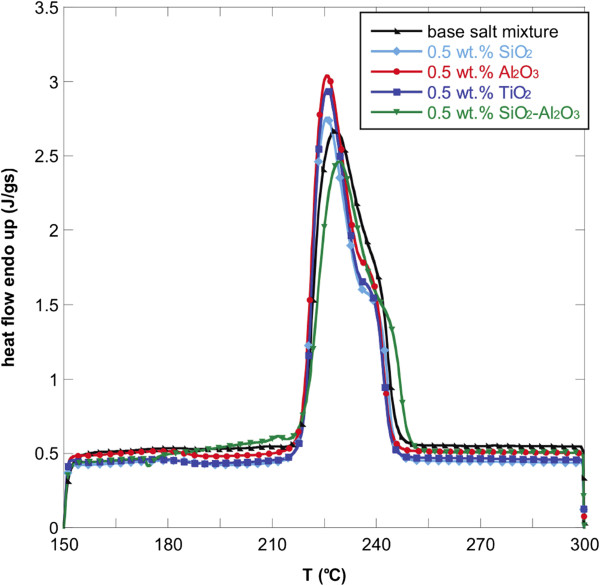
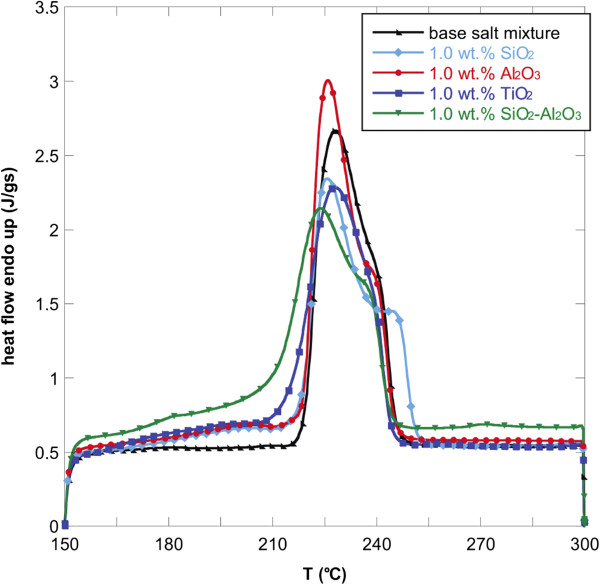
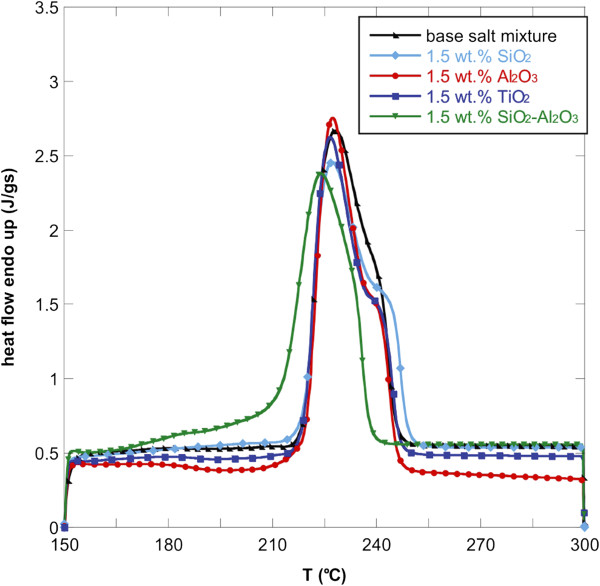
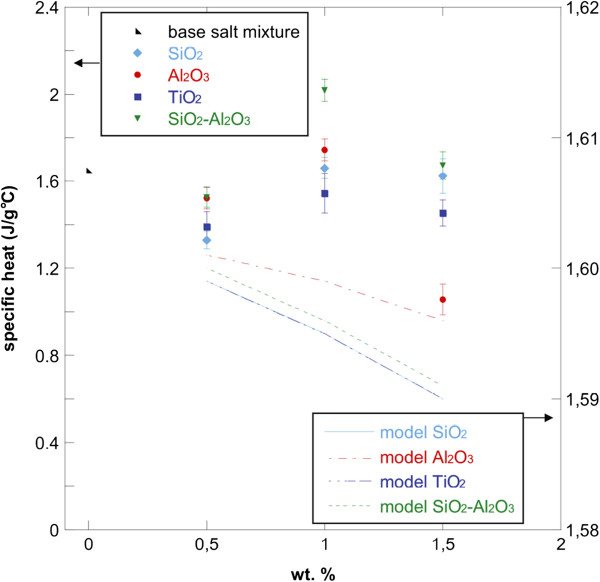
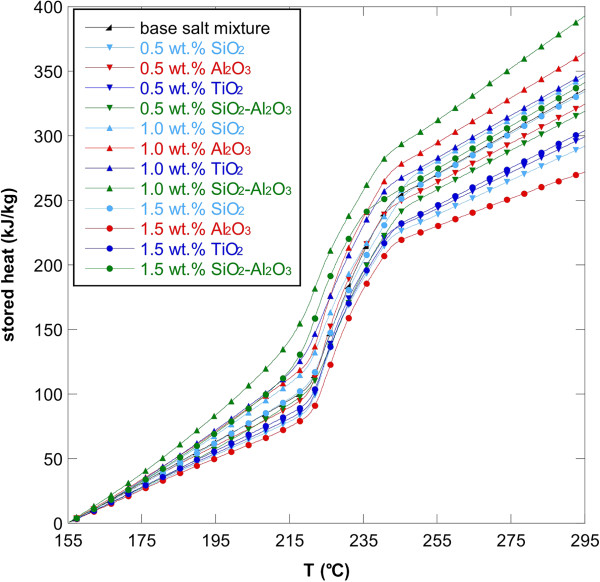
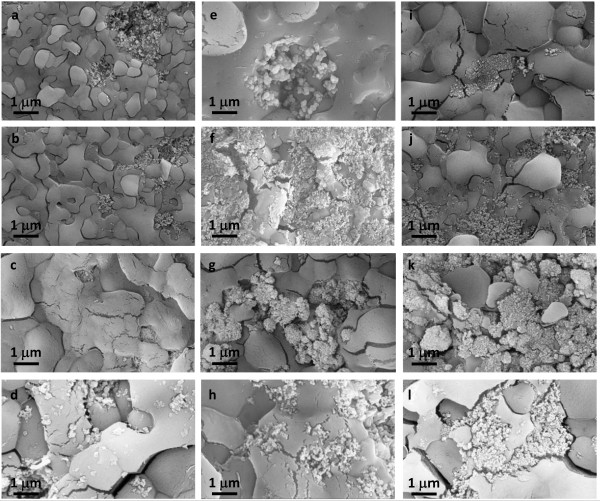
In this study, different nanofluids with phase change behavior were developed by mixing a molten salt base fluid (selected as phase change material) with nanoparticles using the direct-synthesis method. The thermal properties of the nanofluids obtained were investigated. These nanofluids can be used in concentrating solar plants with a reduction of storage material if an improvement in the specific heat is achieved. The base salt mixture was a NaNO3-KNO3 (60:40 ratio) binary salt. The nanoparticles used were silica (SiO2), alumina (Al2O3), titania (TiO2), and a mix of silica-alumina (SiO2-Al2O3). Three weight fractions were evaluated: 0.5, 1.0, and 1.5 wt.%. Each nanofluid was prepared in water solution, sonicated, and evaporated. Measurements on thermophysical properties were performed by differential scanning calorimetry analysis and the dispersion of the nanoparticles was analyzed by scanning electron microscopy (SEM). The results obtained show that the addition of 1.0 wt.% of nanoparticles to the base salt increases the specific heat of 15% to 57% in the solid phase and of 1% to 22% in the liquid phase. In particular, this research shows that the addition of silica-alumina nanoparticles has a significant potential for enhancing the thermal storage characteristics of the NaNO3-KNO3 binary salt. These results deviated from the predictions of the theoretical model used. SEM suggests a greater interaction between these nanoparticles and the salt.
Overview
The claims and statistics of this paper haven’t been checked yet.
Free: it reads the open-access text and checks the first 5 claims that cite a source we can check. Create a free account to check every claim.
Integrity signals
Registry
Cites
Statistics
Figures
Verification
Claims the paper makes
The claims and statistics of this paper haven’t been checked yet.
Free: it reads the open-access text and checks the first 5 claims that cite a source we can check. Create a free account to check every claim.
Claims other papers make about this one
Each is checked against this paper’s own text: does it say what the citing paper says it does?
The cited source says what the claim attributes to it.
In the citing paper
“All of the NPs reduced the onset and melting temperatures of the PCM.”
From Nano-Enhanced Phase Change Materials in Latent Heat Thermal Energy Storage Systems: A Review (2021) · cites this paper as [66]
The cited source says what the claim attributes to it.
In the citing paper
“The NPs also increased the specific heat and heat of fusion.”
From Nano-Enhanced Phase Change Materials in Latent Heat Thermal Energy Storage Systems: A Review (2021) · cites this paper as [66]
The cited source says what the claim attributes to it.
In the citing paper
“The 1.0 wt % concentration was the most effective by far, as were the SiO 2 -Al 2 O 3 NPs, although the other types of NPs were also effective [66].”
From Nano-Enhanced Phase Change Materials in Latent Heat Thermal Energy Storage Systems: A Review (2021) · cites this paper as [66]
The cited source says what the claim attributes to it.
In the citing paper
“1.0 wt % SiO 2 -Al 2 O 3 were the most effective”
From Nano-Enhanced Phase Change Materials in Latent Heat Thermal Energy Storage Systems: A Review (2021) · cites this paper as [66]
Self-check
Percentages, sums and reported differences re-computed from the paper’s own numbers.
The self-check needs the paper’s full text.
Citations
Cites
Convective Transport in Nanofluids
Buongiorno, J. (2006) · Journal of Heat Transfer · doi:10.1115/1.2150834 · Cited by 7,013 · cited 1×
“The measurements were also compared with a theoretical model based on the assumption of thermal equilibrium between the particles and the surrounding fluid [26,31]:”
Review on thermal energy storage with phase change materials and applications
Sharma, A., Tyagi, V. V., Chen, C. R., & Buddhi, D. (2009) · Renewable and Sustainable Energy Reviews · doi:10.1016/j.rser.2007.10.005 · Cited by 5,936 · cited 2×
“Therefore, several studies on PCM used as thermal energy storage material have been published [10-16].”
BackgroundZalba, B., Marı́n, J. M., Cabeza, L. F., & Mehling, H. (2003) · Applied Thermal Engineering · doi:10.1016/s1359-4311(02)00192-8 · Cited by 4,738 · cited 1×
“Therefore, several studies on PCM used as thermal energy storage material have been published [10-16].”
BackgroundA review on phase change energy storage: materials and applications
Farid, M. M., Khudhair, A. M., Razack, S. A. K., & Al-Hallaj, S. (2004) · Energy Conversion and Management · doi:10.1016/j.enconman.2003.09.015 · Cited by 3,097 · cited 1×
“Therefore, several studies on PCM used as thermal energy storage material have been published [10-16].”
BackgroundMaterials used as PCM in thermal energy storage in buildings: A review
Cabeza, L. F., Castell, A., Barreneche, C., de Gracia, A., & Fernández, A. I. (2011) · Renewable and Sustainable Energy Reviews · doi:10.1016/j.rser.2010.11.018 · Cited by 1,889
Gil, A., Medrano, M., Martorell, I., Lázaro, A., Dolado, P., Zalba, B., & Cabeza, L. F. (2010) · Renewable and Sustainable Energy Reviews · doi:10.1016/j.rser.2009.07.035 · Cited by 1,762
Yu, W., & Choi, S. U. S. (2003) · Journal of Nanoparticle Research · doi:10.1023/a:1024438603801 · Cited by 1,737
Role of Brownian motion in the enhanced thermal conductivity of nanofluids
Jang, S. P., & Choi, S. U. S. (2004) · Applied Physics Letters · doi:10.1063/1.1756684 · Cited by 1,596
Enhanced thermal conductivity of TiO2—water based nanofluids
Murshed, S. M. S., Leong, K. C., & Yang, C. (2005) · International Journal of Thermal Sciences · doi:10.1016/j.ijthermalsci.2004.12.005 · Cited by 1,395
Hasnain, S. M. (1998) · Energy Conversion and Management · doi:10.1016/s0196-8904(98)00025-9 · Cited by 1,267 · cited 2×
“Low-temperature storage systems are based almost entirely on sensible heat storage using liquid water [3], but for temperatures exceeding 100°C (concentrated solar power plants), non-pressurized liquid water and the use of pressure vessels make this technology unattractive.”
Background
Research works printed but not linked: 3
- Laing D Solar thermal energy storage technologies Energy Forum 10000 Solar Gigawatts, 23 April 2008 2008 Hannover: Hannover Messe http://www.dlr.de/Portaldata/41/Resources/dokumente/institut/thermischept/Solar_Thermal_Energy_Storage_Technologies_Hannover2008.pdf
- Choi SUS Developments Applications of Non-Newtonian Flows 1995 New York: ASME
- Little F Molten salt carbon nanotube thermal energy storage for concentrating solar power systems DOE Peer Review 2011 Texas A&M University: Space Engineering Research Center
Cited by
Towards hybrid nanofluids: Preparation, thermophysical properties, applications, and challenges
Babar, H., & Ali, H. M. (2019) · Journal of Molecular Liquids · doi:10.1016/j.molliq.2019.02.102 · Cited by 485
Shah, T. R., & Ali, H. M. (2019) · Solar Energy · doi:10.1016/j.solener.2019.03.012 · Cited by 366
Chandel, S. S., & Agarwal, T. (2017) · Renewable and Sustainable Energy Reviews · doi:10.1016/j.rser.2016.09.070 · Cited by 359
A review on the applications of nanofluids in solar energy field
Khanafer, K., & Vafai, K. (2018) · Renewable Energy · doi:10.1016/j.renene.2018.01.097 · Cited by 350
Mainstreaming commercial CSP systems: A technology review
Fernández, A. G., Gomez-Vidal, J., Oró, E., Kruizenga, A., Solé, A., & Cabeza, L. F. (2019) · Renewable Energy · doi:10.1016/j.renene.2019.03.049 · Cited by 311
Padmini, R., Vamsi Krishna, P., & Krishna Mohana Rao, G. (2016) · Tribology International · doi:10.1016/j.triboint.2015.10.006 · Cited by 299
Nano-PCMs for enhanced energy storage and passive cooling applications
Colla, L., Fedele, L., Mancin, S., Danza, L., & Manca, O. (2017) · Applied Thermal Engineering · doi:10.1016/j.applthermaleng.2016.03.161 · Cited by 283
Hussein, A. K. (2016) · Renewable and Sustainable Energy Reviews · doi:10.1016/j.rser.2016.04.050 · Cited by 265
Solar Still Efficiency Enhancement by Using Graphene Oxide/Paraffin Nano-PCM
Safaei, M. R., Goshayeshi, H. R., & Chaer, I. (2019) · Energies · doi:10.3390/en12102002 · Cited by 241
Nano-enhanced biolubricant in sustainable manufacturing: From processability to mechanisms
Zhang, Y., Li, H. N., Li, C., Huang, C., Ali, H. M., Xu, X., Mao, C., Ding, W., Cui, X., Yang, M., et al. (2022) · Friction · doi:10.1007/s40544-021-0536-y · Cited by 238
Sheikholeslami, M. (2022) · Journal of Energy Storage · doi:10.1016/j.est.2022.104954 · Cited by 234
Molten Salts for Sensible Thermal Energy Storage: A Review and an Energy Performance Analysis
Caraballo, A., Galán-Casado, S., Caballero, Á., & Serena, S. (2021) · Energies · doi:10.3390/en14041197 · Cited by 212
Yang, L., Villalobos, U., Akhmetov, B., Gil, A., Khor, J. O., Palacios, A., Li, Y., Ding, Y., Cabeza, L. F., Tan, W. L., et al. (2021) · Applied Energy · doi:10.1016/j.apenergy.2021.116555 · Cited by 207
“Besides the materials listed in Table 3, more have been used for above-zero PCMs, for example, copper oxide (CuO) [100], aluminum oxide (Al2O3) [101], barium carbonate (BaCO3) [102], silicon dioxide (SiO2) [103,104], graphite powder [105], nano silver-titania (Ag-TiO2) [106], magnesium sulfate (MgSO4), strontium chlor…”
MethodState-of-the-art heat transfer fluids for parabolic trough collector
Krishna, Y., Faizal, M., Saidur, R., Ng, K. C., & Aslfattahi, N. (2020) · International Journal of Heat and Mass Transfer · doi:10.1016/j.ijheatmasstransfer.2020.119541 · Cited by 205
Solar energy systems – Potential of nanofluids
Wahab, A., Hassan, A., Qasim, M. A., Ali, H. M., Babar, H., & Sajid, M. U. (2019) · Journal of Molecular Liquids · doi:10.1016/j.molliq.2019.111049 · Cited by 198
Increment of specific heat capacity of solar salt with SiO2 nanoparticles
Andreu-Cabedo, P., Mondragon, R., Hernandez, L., Martinez-Cuenca, R., Cabedo, L., & Julia, J. E. (2014) · Nanoscale Research Letters · doi:10.1186/1556-276x-9-582 · Cited by 190
“In most cases, SiO2 nanoparticles have been used [10-13,16,18,19].”
BackgroundMethodInfluentialFactors affecting the performance of hybrid nanofluids: A comprehensive review
Hamzah, M. H., Sidik, N. A. C., Ken, T. L., Mamat, R., & Najafi, G. (2017) · International Journal of Heat and Mass Transfer · doi:10.1016/j.ijheatmasstransfer.2017.07.021 · Cited by 170
Progress on use of nanoparticles in salt hydrates as phase change materials
Wong-Pinto, L.-S., Milian, Y., & Ushak, S. (2020) · Renewable and Sustainable Energy Reviews · doi:10.1016/j.rser.2020.109727 · Cited by 165
Simulation and experimental study of the specific heat capacity of molten salt based nanofluids
Qiao, G., Lasfargues, M., Alexiadis, A., & Ding, Y. (2017) · Applied Thermal Engineering · doi:10.1016/j.applthermaleng.2016.07.159 · Cited by 161
Evaluation of the nanofluid-assisted desalination through solar stills in the last decade
Iqbal, A., Mahmoud, M. S., Sayed, E. T., Elsaid, K., Abdelkareem, M. A., Alawadhi, H., & Olabi, A. G. (2020) · Journal of Environmental Management · doi:10.1016/j.jenvman.2020.111415 · Cited by 165
Ilyas, S. U., Pendyala, R., Narahari, M., & Lim, S. (2017) · Energy Conversion and Management · doi:10.1016/j.enconman.2017.01.079 · Cited by 162
Enhanced thermal properties of SiO2 nanocomposite for solar thermal energy storage applications
Shin, D., & Banerjee, D. (2015) · International Journal of Heat and Mass Transfer · doi:10.1016/j.ijheatmasstransfer.2015.01.100 · Cited by 167
Chieruzzi, M., Miliozzi, A., Crescenzi, T., Torre, L., & Kenny, J. M. (2015) · Nanoscale Research Letters · doi:10.1186/s11671-015-0984-2 · Cited by 154
“The nanoparticle weight concentration of 1 % was chosen in this study taking into account that this is the percentage which gave good results in thermal properties enhancement as reported in literature for several nanofluids [22, 23, 25, 27].”
MethodSelf-citationGasia, J., Miró, L., & Cabeza, L. F. (2017) · Renewable and Sustainable Energy Reviews · doi:10.1016/j.rser.2016.11.119 · Cited by 152
Recent progress in solar thermal energy storage using nanomaterials
Ahmed, S. F., Khalid, M., Rashmi, W., Chan, A., & Shahbaz, K. (2017) · Renewable and Sustainable Energy Reviews · doi:10.1016/j.rser.2016.09.034 · Cited by 148
Akilu, S., Baheta, A., M.Said, M. A., Minea, A., & Sharma, K. (2017) · Solar Energy Materials and Solar Cells · doi:10.1016/j.solmat.2017.10.027 · Cited by 146
Thermal-physical properties of nanoparticle-seeded nitrate molten salts
Awad, A., Navarro, H., Ding, Y., & Wen, D. (2018) · Renewable Energy · doi:10.1016/j.renene.2017.12.026 · Cited by 144
“…carbon nanotubes, hybrid silica-alumina, Mica, gold 69 and alumina nanoparticles into nitrate solar salt (Andreu-Cabedo et al., 2014, 70 Chieruzzi et al., 2013, Dudda and Shin, 2013, Jung and Banerjee, 2011, Lu and 71 Huang, 2013, Niu et al., 2014, Riazi et al., 2016, Schuller et al.,…”
BackgroundMethodInfluentialSensible energy storage options for concentrating solar power plants operating above 600 °C
Mohan, G., Venkataraman, M. B., & Coventry, J. (2019) · Renewable and Sustainable Energy Reviews · doi:10.1016/j.rser.2019.01.062 · Cited by 138
Ali, M. A., Fayaz, Viegas, R. F., Shyam Kumar, M. B., Kannapiran, R. K., & Feroskhan, M. (2019) · Journal of Energy Storage · doi:10.1016/j.est.2019.100982 · Cited by 139
Tiwari, A. K., Kumar, V., Said, Z., & Paliwal, H. K. (2021) · Journal of Cleaner Production · doi:10.1016/j.jclepro.2021.126031 · Cited by 138
Arthur, O., & Karim, A. (2015) · Renewable and Sustainable Energy Reviews · doi:10.1016/j.rser.2015.10.065 · Cited by 137
“[22] were attributed to poor dispersion and agglomeration of the particles.”
BackgroundAdvancement in phase change materials for thermal energy storage applications
Kant, K., Shukla, A., & Sharma, A. (2017) · Solar Energy Materials and Solar Cells · doi:10.1016/j.solmat.2017.07.023 · Cited by 141
Chieruzzi, M., Cerritelli, G. F., Miliozzi, A., Kenny, J. M., & Torre, L. (2017) · Solar Energy Materials and Solar Cells · doi:10.1016/j.solmat.2017.04.011 · Cited by 131
Self-citationTuning nanofluids for improved lubrication performance in turning biomedical grade titanium alloy
Rahman, S. S., Ashraf, M. Z. I., Amin, A. N., Bashar, M. S., Ashik, M. F. K., & Kamruzzaman, M. (2018) · Journal of Cleaner Production · doi:10.1016/j.jclepro.2018.09.150 · Cited by 129
A Review of Nano Fluid Role to Improve the Performance of the Heat Pipe Solar Collectors
Hussein, A. K., Li, D., Kolsi, L., Kata, S., & Sahoo, B. (2017) · Energy Procedia · doi:10.1016/j.egypro.2017.03.044 · Cited by 124
Specific heat control of nanofluids: A critical review
Riazi, H., Murphy, T., Webber, G. B., Atkin, R., Tehrani, S. S. M., & Taylor, R. A. (2016) · International Journal of Thermal Sciences · doi:10.1016/j.ijthermalsci.2016.03.024 · Cited by 131
Ojha, P. K., & Karmakar, S. (2018) · Progress in Aerospace Sciences · doi:10.1016/j.paerosci.2018.05.003 · Cited by 121
Lasfargues, M., Geng, Q., Cao, H. Q., & Ding, Y. (2015) · Nanomaterials · doi:10.3390/nano5031136 · Cited by 120
“0% increase at 440 °C (Table 1—TiO2) [32].”
BackgroundOn the specific heat capacity enhancement in nanofluids
Hentschke, R. (2016) · Nanoscale Research Letters · doi:10.1186/s11671-015-1188-5 · Cited by 120
“The two investigations by Chieruzzi [30] and Lasfargues et al. [31, 32] study the eutectic mixture of NaNO3/KNO3 doped with different nanoparticles at different concentrations.”
ResultInfluentialChen, C., Ge, Z., & Zhang, Y. (2022) · Applied Thermal Engineering · doi:10.1016/j.applthermaleng.2022.119537 · Cited by 118
Nano-Enhanced Phase Change Materials in Latent Heat Thermal Energy Storage Systems: A Review
Tofani, K., & Tiari, S. (2021) · Energies · doi:10.3390/en14133821 · Cited by 114
“…◦C) Middle COOHfunctionalized Graphene nanoplatelets (f-GNP) Melting and solidification Experimental andnumerical (2D) f-GNPs enhance PCM at 5% concentration Chieruzzi et al. (2013) [66] NaNO3-KNO3 (223–232 ◦C) Middle SiO2, Al2O3, TiO2, and SiO2-Al2O3 Melting and solidification Experimental 1.0…”
BackgroundInfluentialNithiyanantham, U., González-Fernández, L., Grosu, Y. G., Zaki, A., Igartua, J. M., & Faik, A. (2020) · Applied Thermal Engineering · doi:10.1016/j.applthermaleng.2020.114942 · Cited by 120
Thermostatic properties of nitrate molten salts and their solar and eutectic mixtures
D’Aguanno, B., Karthik, M., Grace, A. N., & Floris, A. (2018) · Scientific Reports · doi:10.1038/s41598-018-28641-1 · Cited by 119
Thermal energy storage enhancement of a binary molten salt via in-situ produced nanoparticles
Luo, Y., Du, X., Awad, A. T., & Wen, D. (2016) · International Journal of Heat and Mass Transfer · doi:10.1016/j.ijheatmasstransfer.2016.09.004 · Cited by 106
“However, Chieruzzi et al. [16] pointed out that the latent heat of 1.0 wt % SiO2+Al2O3 was 17.23 kJ/kg higher than that of the pure salt.”
BackgroundMethodInfluentialKarthik, M., Faik, A., & D’Aguanno, B. (2017) · Solar Energy Materials and Solar Cells · doi:10.1016/j.solmat.2017.08.004 · Cited by 113
Said, Z., Sohail, M. A., Pandey, A. K., Sharma, P., Waqas, A., Chen, W., Nguyen, P. Q. P., Nguyen, V. N., Pham, N. D. K., & Nguyen, X. P. (2023) · Journal of Cleaner Production · doi:10.1016/j.jclepro.2023.137736 · Cited by 121
Sidik, N. A. C., Kean, T. H., Chow, H. K., Rajaandra, A., Saidur, R., & Kaur, J. (2018) · International Communications in Heat and Mass Transfer · doi:10.1016/j.icheatmasstransfer.2018.03.024 · Cited by 111
Kant, K., Biwolé, P. H., Shamseddine, I., Tlaiji, G., Pennec, F., & Fardoun, F. (2021) · Solar Energy Materials and Solar Cells · doi:10.1016/j.solmat.2021.111309 · Cited by 110
Muñoz-Sánchez, B., Nieto-Maestre, J., Iparraguirre-Torres, I., García-Romero, A., & Sala-Lizarraga, J. M. (2017) · Renewable and Sustainable Energy Reviews · doi:10.1016/j.rser.2017.10.080 · Cited by 98
Preparation and enhanced heat capacity of nano-titania doped erythritol as phase change material
Zhichao, L., Qiang, Z., & Gaohui, W. (2014) · International Journal of Heat and Mass Transfer · doi:10.1016/j.ijheatmasstransfer.2014.09.069 · Cited by 95
Luo, Q., Liu, X., Wang, H., Xu, Q. P., Tian, Y., Liang, T., Liu, Q., Liu, Z., Yang, X., Xuan, Y., et al. (2021) · Applied Energy · doi:10.1016/j.apenergy.2021.117995 · Cited by 93
Ibrahim, A., Peng, H., Riaz, A., Basit, M. A., Rashid, U., & Basit, A. (2020) · Solar Energy Materials and Solar Cells · doi:10.1016/j.solmat.2020.110768 · Cited by 95
Saranprabhu, M. K., & Rajan, K. S. (2019) · Renewable Energy · doi:10.1016/j.renene.2019.04.027 · Cited by 89
Seo, J., & Shin, D. (2016) · Applied Thermal Engineering · doi:10.1016/j.applthermaleng.2016.03.134 · Cited by 95
A critical review of specific heat capacity of hybrid nanofluids for thermal energy applications
Adun, H. H., Wole‐Osho, I., Okonkwo, E. C., Kavaz, D., & Dagbasi, M. (2021) · Journal of Molecular Liquids · doi:10.1016/j.molliq.2021.116890 · Cited by 86
Yu, Q., Zhang, C., Lu, Y., Kong, Q., Wei, H., Yang, Y., Gao, Q., Wu, Y., & Sciacovelli, A. (2021) · Renewable Energy · doi:10.1016/j.renene.2021.03.061 · Cited by 84
Wang, W., Wu, Z., Li, B., & Sunden, B. A. (2018) · Journal of Thermal Analysis and Calorimetry · doi:10.1007/s10973-018-7765-y · Cited by 85
Song, W., Lu, Y., Wu, Y., & Ma, C. (2018) · Solar Energy Materials and Solar Cells · doi:10.1016/j.solmat.2018.01.014 · Cited by 82
Tiznobaik, H., Banerjee, D., & Shin, D. (2015) · International Journal of Heat and Mass Transfer · doi:10.1016/j.ijheatmasstransfer.2015.05.072 · Cited by 77
Zhao, C., Tao, Y. B., & Yu, Y. (2020) · International Journal of Heat and Mass Transfer · doi:10.1016/j.ijheatmasstransfer.2020.119382 · Cited by 77
Thermal Analysis of the Solar Collector Cum Storage System Using a Hybrid-Nanofluids
Dhif, K., Mebarek‐Oudina, F., Chouf, S., Vaidya, H., & Chamkha, A. J. (2021) · Journal of Nanofluids · doi:10.1166/jon.2021.1807 · Cited by 76
Liu, Y., & Yang, Y. (2017) · Applied Thermal Engineering · doi:10.1016/j.applthermaleng.2017.05.150 · Cited by 75
Grosu, Y. G., Anagnostopoulos, A. N., Balakin, B. V., Krupanek, J., Navarro, M. E., González-Fernández, L., Ding, Y., & Faik, A. (2020) · Solar Energy Materials and Solar Cells · doi:10.1016/j.solmat.2020.110838 · Cited by 82
The effect of nanoparticle morphology on the specific heat of nanosalts
Riazi, H., Mesgari, S., Ahmed, N. A., & Taylor, R. A. (2015) · International Journal of Heat and Mass Transfer · doi:10.1016/j.ijheatmasstransfer.2015.11.064 · Cited by 74
Phase change materials based thermal energy storage for solar energy systems
Ali, H. M. (2022) · Journal of Building Engineering · doi:10.1016/j.jobe.2022.104731 · Cited by 87
Recent progress on concentrating direct absorption solar collector using nanofluids
Rasih, R. A., Sidik, N. A. C., & Samion, S. (2019) · Journal of Thermal Analysis and Calorimetry · doi:10.1007/s10973-018-7964-6 · Cited by 72
Williamson, C. B., Nevers, D. R., Hanrath, T., & Robinson, R. D. (2015) · Journal of the American Chemical Society · doi:10.1021/jacs.5b10006 · Cited by 76
APPLICATIONS OF NANOTECHNOLOGY TO ENHANCE THE PERFORMANCE OF THE DIRECT ABSORPTION SOLAR COLLECTORS
Hussein, A. K. (2015) · Journal of Thermal Engineering · doi:10.18186/jte.46009 · Cited by 70
Lasfargues, M., Bell, A. J., & Ding, Y. (2016) · Journal of Nanoparticle Research · doi:10.1007/s11051-016-3460-8 · Cited by 70
Salyan, S., & Suresh, S. (2017) · Journal of Energy Storage · doi:10.1016/j.est.2017.10.013 · Cited by 69
Nano-Phase Change Materials for Electronics Cooling Applications
Colla, L., Ercole, D., Fedele, L., Mancin, S., Manca, O., & Bobbo, S. (2017) · Journal of Heat Transfer · doi:10.1115/1.4036017 · Cited by 68
Aljaerani, H. A., Samykano, M., Saidur, R., Pandey, A. K., & Kadirgama, K. (2021) · Journal of Energy Storage · doi:10.1016/j.est.2021.103280 · Cited by 76
Ong, T., Sarvghad, M., Bell, S., Will, G. D., Steinberg, T., Yin, Y., Andersson, G. G., & Lewis, D. (2023) · Applied Thermal Engineering · doi:10.1016/j.applthermaleng.2023.122034 · Cited by 84
Thermal Storage Properties of Molten Nitrate Salt-Based Nanofluids with Graphene Nanoplatelets
Xie, Q., Zhu, Q., & Li, Y. (2016) · Nanoscale Research Letters · doi:10.1186/s11671-016-1519-1 · Cited by 66
“0 wt% of SiO2–Al2O3 NPs was added to solar salt; meanwhile, the heat of fusion increased by more than 15 % [12].”
BackgroundNithiyanantham, U., Zaki, A., Grosu, Y. G., González-Fernández, L., Anagnostopoulos, A. N., Navarro, M. E., Ding, Y., Igartua, J. M., & Faik, A. (2022) · Journal of Energy Storage · doi:10.1016/j.est.2022.104276 · Cited by 72
Beyond Thermal Conductivity: A Review of Nanofluids for Enhanced Energy Storage and Heat Transfer
Mirahmad, A., Kumar, R. S., Pato‐Doldán, B., Prieto, C., & Díez-Sierra, J. (2025) · Nanomaterials · doi:10.3390/nano15040302 · Cited by 75
“This varying behavior may stem from different heat transfer mechanisms in various base fluids, as well as distinct interactions between the base fluid and NPs.”
Barthwal, M., Dhar, A., & Powar, S. (2021) · ACS Applied Energy Materials · doi:10.1021/acsaem.1c01268 · Cited by 71
Ho, M., & Pan, C. (2017) · International Journal of Heat and Mass Transfer · doi:10.1016/j.ijheatmasstransfer.2016.11.015 · Cited by 60
Ahmadlouydarab, M., Ebadolahzadeh, M., & Ali, H. M. (2019) · Physica A Statistical Mechanics and its Applications · doi:10.1016/j.physa.2019.123109 · Cited by 61
Far, B. E., Rizvi, S. M. M., Nayfeh, Y., & Shin, D. (2020) · Solar Energy Materials and Solar Cells · doi:10.1016/j.solmat.2020.110503 · Cited by 64
Yasmin, H., Giwa, S. O., Noor, S., & Sharifpur, M. (2023) · Nanomaterials · doi:10.3390/nano13020278 · Cited by 68
Effect of nanoparticles in molten salts – MD simulations and experimental study
Svobodova‐Sedlackova, A., Barreneche, C., Alonso, G., Fernández, A. I., & Gamallo, P. (2020) · Renewable Energy · doi:10.1016/j.renene.2020.01.046 · Cited by 60
A soft computing approach for estimating the specific heat capacity of molten salt-based nanofluids
Hassan, M. A., & Banerjee, D. (2019) · Journal of Molecular Liquids · doi:10.1016/j.molliq.2019.02.106 · Cited by 59
Solar salt doped by MWCNTs as a promising high thermal conductivity material for CSP
Wu, Y., Li, J., Wang, M., Wang, H., Zhong, Y., Zhao, Y., Wei, M., & Li, Y. (2018) · RSC Advances · doi:10.1039/c8ra03019g · Cited by 65
Jegadheeswaran, S., Sundaramahalingam, A., & Pohekar, S. D. (2019) · Journal of Thermal Analysis and Calorimetry · doi:10.1007/s10973-019-08297-3 · Cited by 60
Performance investigation of nanocomposite based solar water heater
Mandal, S. K., Kumar, S., Singh, P. K., Mishra, S. K., & Singh, D. K. (2020) · Energy · doi:10.1016/j.energy.2020.117295 · Cited by 57
Mechanism of heat capacity enhancement in molten salt nanofluids
Rizvi, S. M. M., & Shin, D. (2020) · International Journal of Heat and Mass Transfer · doi:10.1016/j.ijheatmasstransfer.2020.120260 · Cited by 56
Aljaerani, H. A., Samykano, M., Pandey, A. K., Kadirgama, K., & Saidur, R. (2020) · Journal of Molecular Liquids · doi:10.1016/j.molliq.2020.113807 · Cited by 59
Aslfattahi, N., Saidur, R., Sidik, N. A. C., Sabri, M. F. M., & Zahir, M. H. (2020) · Journal of Advanced Research in Fluid Mechanics and Thermal Sciences · doi:10.37934/arfmts.68.1.7385 · Cited by 56
“9 eV) and low density with promising performance for the applications in thermal interface materials (TIMs) [19, 20].”
BackgroundMa, B., Shin, D., & Banerjee, D. (2021) · Journal of Energy Storage · doi:10.1016/j.est.2021.102278 · Cited by 58
Yu, Q., Lu, Y., Zhang, X., Yang, Y., Zhang, C., & Wu, Y. (2021) · Solar Energy Materials and Solar Cells · doi:10.1016/j.solmat.2021.111215 · Cited by 62
Aljaerani, H. A., Samykano, M., Pandey, A. K., Said, Z., Sudhakar, K., & Saidur, R. (2023) · Journal of Energy Storage · doi:10.1016/j.est.2023.108449 · Cited by 55
Buonomo, B., Ercole, D., Manca, O., & Nardini, S. (2019) · Heat Transfer Engineering · doi:10.1080/01457632.2019.1600875 · Cited by 56
Maher, H., Rocky, K. A., Bassiouny, R., & Saha, B. B. (2021) · Thermal Science and Engineering Progress · doi:10.1016/j.tsep.2020.100797 · Cited by 53
Arora, S., Kapoor, A., & Shen, W. (2018) · Journal of Power Sources · doi:10.1016/j.jpowsour.2017.12.030 · Cited by 57
Liu, J., & Xiao, X. (2023) · Energy · doi:10.1016/j.energy.2023.128732 · Cited by 52
Muñoz-Sánchez, B., Nieto-Maestre, J., Veca, E., Liberatore, R., Sau, S., Navarro, M. E., Ding, Y., Navarrete, N. M., Julia, J. E., Fernández, Á. G., et al. (2017) · Solar Energy Materials and Solar Cells · doi:10.1016/j.solmat.2017.10.022 · Cited by 56
Sriharan, G., Harikrishnan, S., & Oztop, H. F. (2023) · Sustainable Energy Technologies and Assessments · doi:10.1016/j.seta.2023.103327 · Cited by 53
Lasfargues, M., Stead, G., Amjad, M., Ding, Y., & Wen, D. (2017) · Materials · doi:10.3390/ma10050537 · Cited by 51
Danish, M., Yahya, S. M., & Saha, B. B. (2019) · Journal of Thermal Analysis and Calorimetry · doi:10.1007/s10973-019-08673-z · Cited by 52
“TiO2-based nanofluids are used in many industrial applications such as for solar water heaters [11, 12], automotive cooling [13], thermal management of batteries [14], hybrid PV/Thermal systems [15] and industrial heat exchangers [10–15].”
Method
Metadata
- Authors
- Chieruzzi, M., Cerritelli, G. F., Miliozzi, A., & Kenny, J. M.
- Affiliations
- University of Perugia (IT)
- National Agency for New Technologies, Energy and Sustainable Economic Development (IT)
- Corresponding author
- Chieruzzi, Manila
- Venue
- Nanoscale Research Letters
- Published
- 2013-10-29
- Volume
- 8
- Issue
- 1
- Pages
- 448-448
- ISSN
- 1556-276X (ISSN-L)
- PMC
- PMC4231368
- OpenAlex
- W2144901898
- Cited by
- 381
- References
- 56
- Citations by year
- 2026: 18 · 2025: 28 · 2024: 23 · 2023: 29 · 2022: 41 · 2021: 44 · 2020: 52 · 2019: 42 · 2018: 28 · 2017: 28 · 2016: 25 · 2015: 19 · 2014: 4
- FWCI
- 21.23
- Type
- journal article
- Language
- en
- Open access
- gold
- doi.org
- Licence
- cc-by
- creativecommons.org/licenses/by/2.0 (tdm)
- Locations
- Nanoscale Research Letters (publishedVersion, cc-by)
- Europe PMC (PubMed Central) (publishedVersion, cc-by)
- PubMed Central (publishedVersion, cc-by)
- PubMed (publishedVersion)
- DIGITAL.CSIC (Spanish National Research Council (CSIC)) (submittedVersion, other-oa)
- ENEA Open Archive (National Agency for New Technologies, Energy and Sustainable Economic Development) (submittedVersion)
- Funders
- Agenzia Nazionale per le Nuove Tecnologie, l'Energia e lo Sviluppo Economico Sostenibile
- Topics
- Physical Sciences › Engineering › Mechanical Engineering › Phase Change Materials Research
- Physical Sciences › Chemical Engineering › Fluid Flow and Transfer Processes › Nanofluid Flow and Heat Transfer
- Physical Sciences › Engineering › Mechanical Engineering › Adsorption and Cooling Systems
- Keywords
- nanofluids, molten salts, phase change materials, thermal energy storage, specific heat enhancement, Al2O3 nanoparticles, titanium dioxide nanoparticles, silica nanoparticles, nanoparticle dispersion, concentrated solar power, direct synthesis
About these checks
Registry, retraction, Cites and statistics results are computed, not judged, with one exception: a printed reference that no index lists is read once by a model before it counts as a citation error. Claims are extracted by a model and kept only when their quote appears verbatim in the text; each cited source is then checked, with a model’s help, for whether it says what the claim relies on. Those verdicts can be wrong — read the claim’s quote and the cited source before relying on one.
Statistics and arithmetic are recomputed, not judged.
Confidence bands are shown only for fields calibrated on our annotated test set. None is calibrated yet, so no band is shown.
What counts as a claim ›How we measure confidence ›How we check this ›
Are you an author, or do you see a problem with this page? Request a review
Data sources
Bibliographic data: Semantic Scholar, OpenAlex, Crossref.
Contains information from the Semantic Scholar Academic Graph Datasets, made available under the ODC Attribution License (ODC-BY 1.0).
Semantic Scholar’s data is described in: Kinney, R., et al. (2023). The Semantic Scholar Open Data Platform. arXiv:2301.10140.
