

A universal scaling relationship between body mass and proximal limb bone dimensions in quadrupedal terrestrial tetrapods
Open accessThe DOI matches its Crossref record; 151 of the 152 references it cites were found in a registry or an index.
Abstract
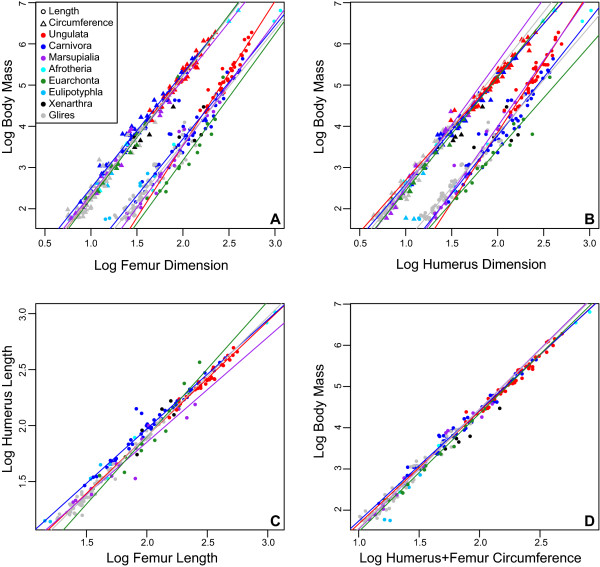
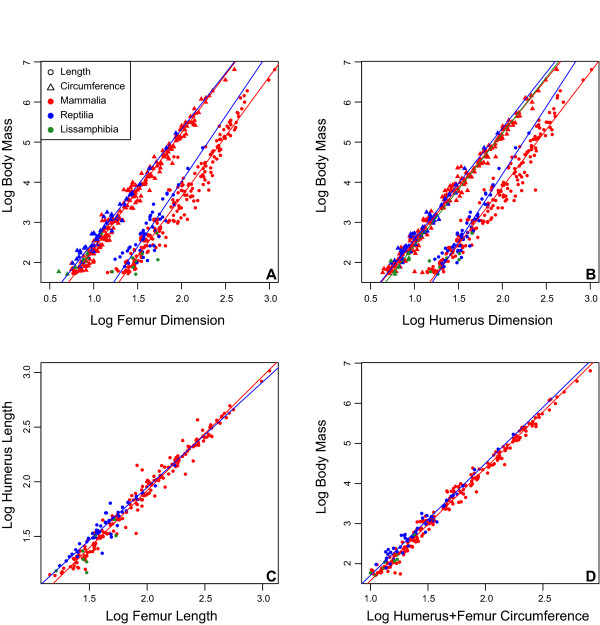
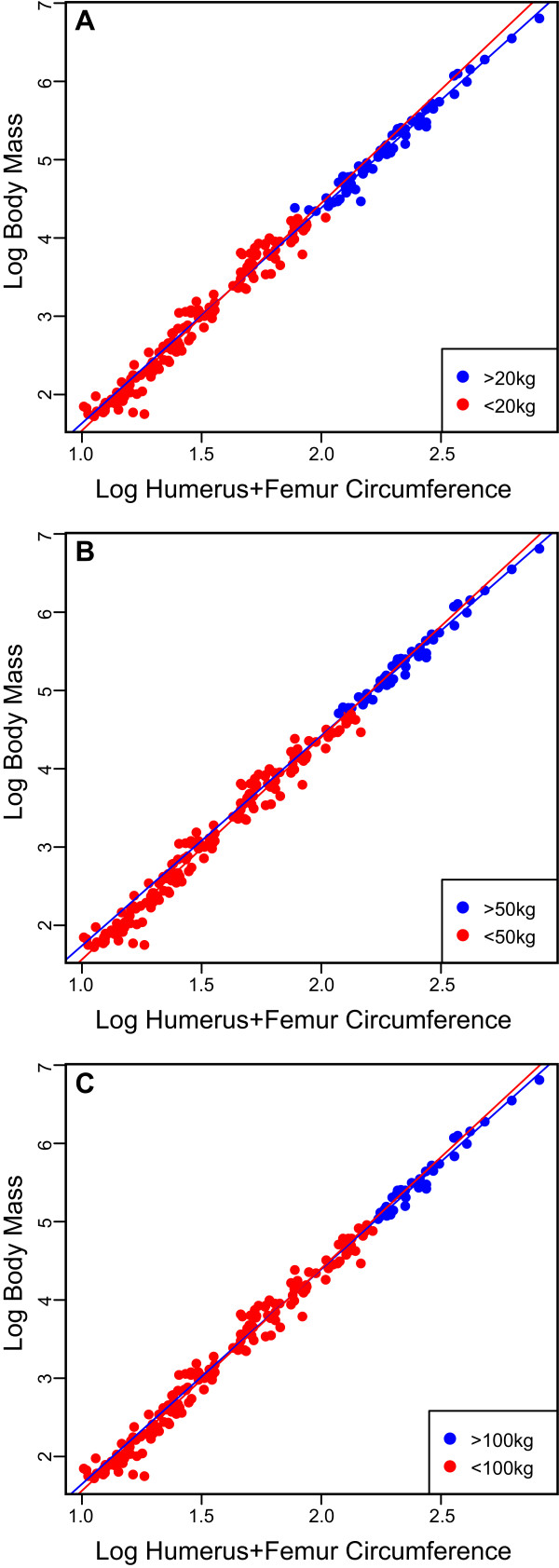
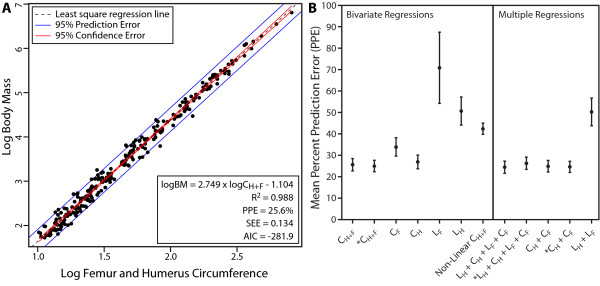
BACKGROUND: Body size is intimately related to the physiology and ecology of an organism. Therefore, accurate and consistent body mass estimates are essential for inferring numerous aspects of paleobiology in extinct taxa, and investigating large-scale evolutionary and ecological patterns in the history of life. Scaling relationships between skeletal measurements and body mass in birds and mammals are commonly used to predict body mass in extinct members of these crown clades, but the applicability of these models for predicting mass in more distantly related stem taxa, such as non-avian dinosaurs and non-mammalian synapsids, has been criticized on biomechanical grounds. Here we test the major criticisms of scaling methods for estimating body mass using an extensive dataset of mammalian and non-avian reptilian species derived from individual skeletons with live weights. RESULTS: Significant differences in the limb scaling of mammals and reptiles are noted in comparisons of limb proportions and limb length to body mass. Remarkably, however, the relationship between proximal (stylopodial) limb bone circumference and body mass is highly conserved in extant terrestrial mammals and reptiles, in spite of their disparate limb postures, gaits, and phylogenetic histories. As a result, we are able to conclusively reject the main criticisms of scaling methods that question the applicability of a universal scaling equation for estimating body mass in distantly related taxa. CONCLUSIONS: The conserved nature of the relationship between stylopodial circumference and body mass suggests that the minimum diaphyseal circumference of the major weight-bearing bones is only weakly influenced by the varied forces exerted on the limbs (that is, compression or torsion) and most strongly related to the mass of the animal. Our results, therefore, provide a much-needed, robust, phylogenetically corrected framework for accurate and consistent estimation of body mass in extinct terrestrial quadrupeds, which is important for a wide range of paleobiological studies (including growth rates, metabolism, and energetics) and meta-analyses of body size evolution.
Overview
The claims and statistics of this paper haven’t been checked yet.
Free: it reads the open-access text and checks the first 5 claims that cite a source we can check. Create a free account to check every claim.
Integrity signals
Registry
Cites
Statistics
Figures
Verification
Claims the paper makes
The claims and statistics of this paper haven’t been checked yet.
Free: it reads the open-access text and checks the first 5 claims that cite a source we can check. Create a free account to check every claim.
Claims other papers make about this one
Each is checked against this paper’s own text: does it say what the citing paper says it does?
The cited source says what the claim attributes to it.
In the citing paper
“As Microraptor is critical for our analysis we compared our mass value to one generated from an estimate of femoral circumference using the empirical equation of Campione et al. [128] as well as comparisons to mass estimates generated through 3-D computer and displacement methods [19, 22, 76]. All of these produce similar estimates to the one obtained using Christiansen & Farin ˜ a [127] (see”
From Potential for Powered Flight Neared by Most Close Avialan Relatives, but Few Crossed Its Thresholds (2020) · cites this paper as [128]
Self-check
Percentages, sums and reported differences re-computed from the paper’s own numbers.
The self-check needs the paper’s full text.
Citations
Cites
R: A Language and Environment for Statistical Computing
R Core Team (2025) · doi:10.32614/r.manuals · Cited by 352,181
Controlling the False Discovery Rate: A Practical and Powerful Approach to Multiple Testing
Benjamini, Y., & Hochberg, Y. (1995) · Journal of the Royal Statistical Society Series B: Statistical Methodology · doi:10.1111/j.2517-6161.1995.tb02031.x · Cited by 109,482 · cited 7×
“The results of the two intercept comparison methods described above are presented, and all P-values are corrected using the FDR [119,120], implemented with the ‘p.adjust’ function in R.”
BackgroundMethodInfluentialAPE: analyses of phylogenetics and evolution in R language
Paradis, E., Claude, J., & Strimmer, K. (2004) · Bioinformatics · doi:10.1093/bioinformatics/btg412 · Cited by 11,335 · cited 1×
“Branch lengths were assigned and transformed in Mesquite and the tree file was imported into R, where contrasts were calculated using the ‘APE’ package [140].”
MethodPhylogenies and the Comparative Method
Felsenstein, J. (1985) · The American Naturalist · doi:10.1086/284325 · Cited by 9,793 · cited 1×
“[73], we calculated the phylogenetic independent contrasts (PIC) for the entire dataset in order to correct for non-independence of the raw data as a result of common ancestry [121].”
Method(2009) · Cited by 6,571
The Ecological Implications of Body Size
Peters, R. H. (1983) · Cambridge University Press eBooks · doi:10.1017/cbo9780511608551 · Cited by 5,649
(2019) · American Museum Novitates · doi:10.1206/novi · Cited by 4,138
Effects of Size and Temperature on Metabolic Rate
Gillooly, J. F., Brown, J. H., West, G. B., Savage, V. M., & Charnov, E. L. (2001) · Science · doi:10.1126/science.1061967 · Cited by 3,810
Size, Function, and Life History
Calder, W. A. (1984) · Medical Entomology and Zoology · Cited by 2,864
Cellular Scaling Rules for the Brains of Marsupials: Not as “Primitive” as Expected
Dos Santos, S. E., Porfirio, J., da Cunha, F. B., Manger, P. R., Tavares, W., Pessoa, L., Raghanti, M. A., Sherwood, C. C., & Herculano-Houzel, S. (2017) · Brain, Behavior and Evolution · doi:10.1159/000452856 · Cited by 2,642
Research works printed but not linked: 12
- Hopson JA: Paleoneurology. In Biology of the Replilia, Neurology A. Volume 9. Edited by: Gans C, Northcutt RG, Ulinski P. New York: Academic Press; 1979:39-146.
- Grand TI: The functional anatomy of body mass. In Body Size in Mammalian Paleobiology: Estimation and Biological Implications. Edited by: Damuth J, MacFadden BJ. Cambridge, UK: Cambridge University Press; 1990:39-47.
- Gingerich PD: Prediction of body mass in mammalian species from long bone lengths and diameters. Contributions from the Museum of Paleontology, University of Michigan 1990, 28:79-92.
- Campbell KE, Marcus L: The relationships of hindlimb bone dimensions to body weight in birds. Natural History Museum of Los Angeles County Science Series 1992, 36:395-412.
- Gunga H-C, Kirsch K, Rittweger J, Clarke A, Albertz J, Wiedemann A, Wehr A, Heinrich W-D, Schultze H-P: Dimensions of Brachiosaurus brancai, Dicraeosaurus hansemanni and Diplodocus carnegii and their implications for gravitational physiology. Adaptation Biol Med 2002, 3:156-169.
- Wedel MJ: Vertebral pneumaticity, air sacs, and the physiology of sauropod dinosaurs. Paleobiology 2003, 29:243-255. · doi:10.1666/0094-8373(2003)029
- Mallison H: Rearing giants: kinetic-dynamic modeling of sauropod bipedal and tripodal poses. In Biology of the Sauropod Dinosaurs: Understanding the Life of Giants. Edited by: Klein N, Remes K, Gee CT, Sander PM. Bloomington, ID: Indiana University Press; 2011:237-250.
- Mallison H: Plateosaurus in 3D: how CAD models and kinetic-dynamic modeling bring an extinct animal to life. In Biology of the Sauropod Dinosaurs: Understanding the Life of Giants. Edited by: Klein N, Remes K, Gee CT, Sander PM. Bloomington, ID: Indiana University Press; 2011:219-236.
- Paul G: Dinosaur models: the good, the bad, and using them to estimate the mass of dinosaurs. In Dinofest International. Edited by: Wolberg DL, Stump E, Rosenberg GD. Arizona State University: The Academy of Natural Sciences; 1997:39-45.
- Sokal RR, Rohlf FJ: Biometry: The Principles and Practice of Statistics in Biological Science San Francisco, CA: W. H. Freeman and Company; 1969.
- Blob RW: Evolution of hindlimb posture in nonmammalian therapsids: biomechanical tests of paleontological hypotheses. Paleobiology. 2001, 27: 14-38. 10.1666/0094-8373(2001)027<0014:EOHPIN>2.0.CO;2. · doi:10.1666/0094-8373(2001)027
- Andrews RM: Patterns of growth in reptiles. Biology of the Reptilia: Physiology D. Edited by: Gans C, Pough FH. 1982, London, UK: Academic Press, 13: 273-320.
Cited by
Items 301–400 of 476
The osteohistology of Orthosuchus stormbergi using synchrotron radiation microcomputed tomography
Weiss, B. M., Dollman, K., Choiniere, J. N., Browning, C., & Botha, J. (2024) · Journal of Anatomy · doi:10.1111/joa.14166 · Cited by 4
“We also used the following regression model from Campione and Evans ( 2012 ) that used both humeral circumference ( C H ) and C F to estimate the body mass of type specimen SAMPK-K409 because of its stronger fit (R 2 0.9863): Log(BM Bone compactness parameters were calculated using Bone Profiler…”
InfluentialGoldsmith, E. R., Barta, D. E., Kligman, B. T., Nesbitt, S. J., Marsh, A. D., Parker, W. G., & Stocker, M. R. (2024) · Journal of Anatomy · doi:10.1111/joa.14185 · Cited by 4
“Lastly, we calculated the BM (g) of PEFO 45199 and PEFO 45274 from measured and estimated FL (mm), respectively, using the fol - lowing equation from Campione and Evans ( 2012 ): All calculations for specimen estimates in this study and any comparative taxa were calculated in Excel and are reported…”
InfluentialMissing data estimation in tyrannosaurid dinosaurs: Can diameter take the place of circumference?
Bradley, G., Burns, M. E., & Currie, P. J. (2015) · Cretaceous Research · doi:10.1016/j.cretres.2015.02.010 · Cited by 5
An extraordinary fossil captures the struggle for existence during the Mesozoic
Han, G., Mallon, J. C., Lussier, A. J., Wu, X., Mitchell, R., & Li, L. (2023) · Scientific Reports · doi:10.1038/s41598-023-37545-8 · Cited by 6
Estimating tusk masses in proboscideans: a comprehensive analysis and predictive model
Larramendi, A. (2023) · Historical Biology · doi:10.1080/08912963.2023.2286272 · Cited by 5
“In any case, within the methods introduced in the present paper, the predictive power is expected to be significantly higher than the regression equations employed to estimate the body mass of extinct tetrapods (Anderson et al. 1985; Campione and Evans 2012).”
Sharpe, H. S., Powers, M. J., Dyer, A. D., Rhodes, M. M., McIntosh, A. P., Garros, C. W., Currie, P. J., & Funston, G. F. (2023) · Journal of Vertebrate Paleontology · doi:10.1080/02724634.2024.2326644 · Cited by 5
“Based on the equation of Campione and Evans (2012), an adult E. regalis (CMN 2289) would have weighed 7936 kg (± 1991kg) (Cam-pione, 2015).”
MethodStuart, B. P., Huttenlocker, A. K., & Botha, J. (2024) · PeerJ · doi:10.7717/peerj.17765 · Cited by 4
Campbell, J. A., Ryan, M. J., & Anderson, J. S. (2019) · Canadian Journal of Earth Sciences · doi:10.1139/cjes-2019-0089 · Cited by 5
Integrating levels of bone growth control: From stem cells to body proportions
Kagan, B. J., & Roselló‐Díez, A. (2020) · Wiley Interdisciplinary Reviews Developmental Biology · doi:10.1002/wdev.384 · Cited by 6
“Indeed, it has been shown that overall body size/mass correlates with bone length in tetrapods (Campione & Evans, 2012; Wood, 1978), and we have discussed here evidence suggesting the long bones may control overall body size, at least in response to developmental perturbations.”
BackgroundBody size correlates with discrete-character morphological proxies
Brougham, T., & Campione, N. E. (2020) · Paleobiology · doi:10.1017/pab.2020.23 · Cited by 6
“…groups (e.g., early amniotes, synapsids, crocodylomorphs) can be constructed using the same limb-scaling relationship previously used for dinosaurs (Campione and Evans 2012; Benson et al. 2014, 2018) to determine the extent of size-dependent morphological proxies and, in turn, the ability to…”
MethodResultInfluentialSelf-citationSensory morphology, investment and plasticity in the black soldier fly (Hermetia illucens)Preprint
Birrell, N. W. (2019) · Thesis Commons (OSF Preprints) · doi:10.31237/osf.io/v8zs2 · Cited by 8
The Fossil Record of Anthropoid Brain Evolution
Kay, R. F., Kirk, E. C., Vizcaíno, S. F., Bargo, M. S., Allen, K. L., Olson, S., & Morse, P. E. (2025) · American Journal of Biological Anthropology · doi:10.1002/ajpa.70081 · Cited by 4
New perspectives on head and neck allometry and ecomorphology in tetrapods
Maher, A. E., Cox, P. G., Maddox, T. W., Gardiner, J., & Bates, K. T. (2025) · Biological reviews/Biological reviews of the Cambridge Philosophical Society · doi:10.1111/brv.70099 · Cited by 3
Raccoons Reveal Hidden Diversity in Trabecular Bone Development
Reinecke, T. E., & Angielczyk, K. D. (2024) · Integrative Organismal Biology · doi:10.1093/iob/obae038 · Cited by 3
Bishop, P. J., Tschirn, A. C., Camens, A. B., & Prideaux, G. J. (2025) · Australian Mammalogy · doi:10.1071/am24050 · Cited by 4
Bone histology of a gorgonopsian skeleton from the upper Madumabisa Mudstone Formation, Zambia
Kulik, Z. T. (2025) · Journal of Vertebrate Paleontology · doi:10.1080/02724634.2025.2490799 · Cited by 4
“Body mass estimates were generated for southern African gor-gonopsian species using the R package MASSTIMATE (Cam-pione, 2016) following Campione and Evans (2012) equations for quadrupeds.”
Dantas, M. A. T. (2022) · Journal of South American Earth Sciences · doi:10.1016/j.jsames.2022.104014 · Cited by 3
Richards, H. L., Rovinsky, D., Adams, J. W., & Evans, A. R. (2022) · Journal of Mammalian Evolution · doi:10.1007/s10914-022-09640-6 · Cited by 3
“In quadrupedal mammals, the humerus and femur are thought to covary in size and shape due to their common roles in body support during locomotion (Campione and Evans 2012; Martín‐Serra et al.”
BackgroundInfluentialPaul, G. S., & Larramendi, A. (2023) · Lethaia · doi:10.18261/let.56.2.5 · Cited by 4
Virtual skeleton and body mass for revealing the life strategies of Sinosaurus
Liang, Q., Falkingham, P. L., & Xing, L. (2024) · Historical Biology · doi:10.1080/08912963.2024.2385615 · Cited by 3
“…have a lower demand for primary fossil data, derived from standardised measurements of various body parts (Anderson et al. 1985; Alexander 1989; Campione and Evans 2012; Campione et al. 2014; Bates et al. 2015; Campione 2017), allowing it to be almost universally for estimating body mass of…”
Becerra, M. G., & Ramírez, M. A. (2018) · Ameghiniana · doi:10.5710/amgh.27.06.2018.3189 · Cited by 3
Secondary ossification center induces and protects growth plate structure
Xie, M., Herdina, A. N., Estefa, J., Medvedeva, E. V., Li, L., Newton, P. T., Kotova, S., Shavkuta, B. S., Saxena, A., Shumate, L. T., et al. (2021) · Yearbook of pediatric endocrinology · doi:10.1530/ey.18.5.16 · Cited by 3
Hubbe, A., & Machado, F. A. (2022) · Journal of South American Earth Sciences · doi:10.1016/j.jsames.2022.103994 · Cited by 3
Blázquez, A. P., Mocho, P., Escaso, F., & Ortega, F. (2025) · eLife · doi:10.7554/elife.92498 · Cited by 6
Insights into Argentavis magnificens (Aves, Teratornithidae) lifestyle based on neuroanatomy
Etchegorry, M. T., & Degrange, F. J. (2024) · Journal of Anatomy · doi:10.1111/joa.14184 · Cited by 3
Tolchard, F., Perkins, B. W., & Nesbitt, S. J. (2025) · The Anatomical Record · doi:10.1002/ar.25677 · Cited by 2
“Despite the anterior trochanter and the trochanteric shelf being scored as absent in TMM 31100-1304, it has a thicker femoral circumference (52 mm) than that of TMM 31100-1303 (43 mm), suggesting it represents a heavier individual (Campione & Evans, 2012).”
Chivatá, J. L. C., Arroyo‐Rodríguez, V., Villalobos, F., Guevara, R., Moreno, C. E., Mendoza, E., Saldívar‐Burrola, L. L., Alfaro-Díaz, N., & Escobar, F. (2025) · Biodiversity and Conservation · doi:10.1007/s10531-025-03181-z · Cited by 2
“We measured individual body mass as a proxy for body size (Campione and Evans 2012).”
Exploring functional and phylogenetic variation in limb trabecular structure across amniote taxa
Reinecke, T. E., & Angielczyk, K. D. (2025) · Biological Journal of the Linnean Society · doi:10.1093/biolinnean/blaf073 · Cited by 2
Gastroliths in hatchling Psittacosaurus show early dietary habits
Wang, L., Li, X., Wen, Q., Chen, J., & Reisz, R. R. (2025) · Science China Earth Sciences · doi:10.1007/s11430-025-1759-4 · Cited by 2
“…(Zhao et al., 2013a), and all the studied specimens died before reaching the age of 1 year (as mentioned earlier), we utilized the quadrupedal dinosaur body mass equation originally proposed by Anderson and later revised by Campione and Evans (Anderson et al., 1985; Campione and Evans, 2012).”
Athletic capability index in pterosaurs: an initial assessment
CEROULA, D. F., Pêgas, R. V., Nascimento, A. S., Nogueira, A., & Costa, F. R. (2025) · Anais da Academia Brasileira de Ciências · doi:10.1590/0001-3765202520250489 · Cited by 2
Scheidt, A., Renk, A. C. E., & Nyakatura, J. A. (2026) · Journal of Anatomy · doi:10.1111/joa.70116 · Cited by 2
“The x-axes show the log-transformed mHCs (in mm) with the corresponding estimated BMs ( Table 1 ) using the regression of mammals 20 kg BM by Campione and Evans ( 2012 ).”
InfluentialThe evolution of femoral morphology in giant non-avian theropod dinosaurs
Pintore, R., Hutchinson, J. R., Bishop, P. J., Tsai, H. P., & Houssaye, A. (2024) · Paleobiology · doi:10.1017/pab.2024.6 · Cited by 3
“Campione and Evans (2012, 2020) demonstrated that the MDC of the femur was a reliable indicator of body mass (BM) in dino-saurs.”
BackgroundPinto, J. L., Marshall, C. R., Nesbitt, S. J., & de Latorre, D. V. (2024) · PLoS ONE · doi:10.1371/journal.pone.0297894 · Cited by 2
Mallet, C., & Houssaye, A. (2024) · PeerJ · doi:10.7717/peerj.18067 · Cited by 2
“In modern rhinoceroses, our results underline a signi fi cant relation between the patellar shape and both its size and the femoral circumference, an excellent proxy of body mass in quadrupeds ( Scott, 1990 ; Campione & Evans, 2012 ; Campione, 2017 ).”
To What Extent Can Life History Strategies Inform Reptile Conservation Planning?
Stevenson, E. A., Lucas, S., McGowan, P. J. K., Smallegange, I. M., & Mair, L. (2025) · Ecology and Evolution · doi:10.1002/ece3.71488 · Cited by 2
“Body mass can be calculated using body length (e.g., Feldman et al. 2016), but this approach has its own limitations (Campione and Evans 2012).”
Riegner, M. F., & Bassar, R. D. (2023) · Integrative Organismal Biology · doi:10.1093/iob/obad010 · Cited by 3
Uma atualização na regressão para estimar a massa corporal de xenartros extintos
Dantas, M. A. T., da Costa, J. P., Soares, A. D. S., & Fraga, R. E. (2024) · Scientia Plena · doi:10.14808/sci.plena.2024.068002 · Cited by 2
“Inspired by the regressions proposed by Anderson et al. (1985) [2] and Campione and Evans (2012) [5], a novel method to estimate the body mass of extinct giant sloths and armadillos was proposed using data from extant Xenarthra [6].”
MethodGomez, K. L., Pol, D., Ezcurra, M. D., & Carballido, J. L. (2025) · Cladistics · doi:10.1111/cla.12607 · Cited by 6
“Both forelimbs and hind limbs bear the entire weight of quadrupedal animals and bones (Campione and Evans, 2012), and especially the femur has undergone changes through Sauropodomorpha that have been linked to the ability to support the animal’s body mass against gravity (Yates et al., 2010;…”
Rougier, G. W., Paez-Arango, N., Moore, J. P., & Biven-Leslie, Z. (2025) · Journal of Mammalian Evolution · doi:10.1007/s10914-025-09758-3 · Cited by 2
“…influenced by an organism’s physical demands for its dietary habits, effectively its ecological niche, than dental elements (Anderson et al. 1985; Gingerich 1990; Anyonge 1993; Mendoza et al. 2006; Campione and Evans 2012; Hopkins 2018; Richards et al. 2019; Engelman 2022; Filipippini et al. 2022).”
Filek, T., Kranner, M., Pabst, B., & Göhlich, U. B. (2025) · Royal Society Open Science · doi:10.1098/rsos.250325 · Cited by 2
“For extant reptiles, tail segment mass was approximated based on scaling relationships and allometric equations from body mass data in Campione & Evans [58].”
Locomotor shifts, stylopod proportions, and the evolution of allometry in Synapsida
Bishop, P. J., & Pierce, S. E. (2025) · The Anatomical Record · doi:10.1002/ar.70006 · Cited by 3
Limb bone robusticity is coupled with mass distribution in terrestrial tetrapods
Dempsey, M. C., Allison, K., Cross, S. R. R., Maidment, S. C. R., Campione, N. E., & Bates, K. T. (2025) · Royal Society Open Science · doi:10.1098/rsos.251103 · Cited by 2
“However, unlike relationships between total body mass and stylopodial size, which have previously been shown to be similar between different tetrapod groups [25], the relationships between stylopodial indices and relative centres of mass differ between the subsets considered here.”
InfluentialSelf-citationRelationship between masticatory rhythm, body mass and mandibular morphology in primates
Nagamine, Y., Satoh, Y., Shimizu, D., Iwasaki, S., & Terada, K. (2013) · Archives of Oral Biology · doi:10.1016/j.archoralbio.2013.02.009 · Cited by 2
Beak morphology and limb proportions as adaptations of hadrosaurid foraging ecology
Takasaki, R., & Kobayashi, Y. (2022) · Cretaceous Research · doi:10.1016/j.cretres.2022.105361 · Cited by 2
Gônet, J., Bardin, J., Girondot, M., Hutchinson, J. R., & Laurin, M. (2023) · Zoological Journal of the Linnean Society · doi:10.1093/zoolinnean/zlad006 · Cited by 2
Correction: Body Size Distribution of the Dinosaurs
O’Gorman, E. J., & Hone, D. W. E. (2013) · PLoS ONE · doi:10.1371/annotation/032ce6c0-22e3-4ae8-997a-40859bcb5609 · Cited by 2
Dantas, M. A. T. (2022) · SSRN Electronic Journal · doi:10.2139/ssrn.4103305 · Cited by 2
Osteohistology reveals the smallest adult Jurassic sauropodomorph
Chapelle, K. E. J., Botha, J., & Choiniere, J. N. (2023) · Royal Society Open Science · doi:10.1098/rsos.221565 · Cited by 2
“Body mass correlates strongly to minimum midshaft stylopod circumference [5,13,31].”
BackgroundHu, J., Xu, X., Zhao, Q., He, Y., Forster, C. A., & Han, F. (2024) · Paleobiology · doi:10.1017/pab.2024.25 · Cited by 2
“The body mass was estimated using an estimation method based on the relation between body mass and femoral circumference (Campione and Evans 2012; Campione et al. 2014).”
Bone microstructure of the basal anomodont Suminia getmanovi supports its arboreal lifestyle
Nieke, S., Fröbisch, J., & Canoville, A. (2025) · Scientific Reports · doi:10.1038/s41598-025-92727-w · Cited by 1
Pintore, R., Houssaye, A., & Hutchinson, J. R. (2025) · Palaeontology · doi:10.1111/pala.70016 · Cited by 3
“Indeed, it was not possible to estimate body mass because the current equations relying on MDC measurements differ between bipeds (i.e. only the MDC from the femur is needed) and quadrupeds (both humeral and femoral MDC are required; Campione & Evans 2012; Campione et al .”
Bueno, K. P., Santos, M. D., Rey, J. T., Tayag, P. A., Ongkiatco, C. Y., & Yaptinchay, A. A. (2025) · The Philippine Journal of Fisheries · doi:10.31398/tpjf/32.1.2025-0007 · Cited by 1
Aureliano, T., Ghilardi, A. M., Kaluza, J., & Martinelli, A. G. (2025) · The Anatomical Record · doi:10.1002/ar.70040 · Cited by 1
“…pneumatization, whereas the truly gigantic sauropods like Argentinosaurus, reaching lengths of over 30 m and masses exceeding 30 tons, likely required the extreme body density reduction provided by extensive pneumatization to achieve such unprecedented sizes (Campione & Evans, 2012; D'Emic, 2023).”
Sanchez, E., Ribeiro, M. C. S., Lazar, A., Bonvicino, C. R., & Alvarez, M. R. D. V. (2025) · Journal of Mammalian Evolution · doi:10.1007/s10914-025-09774-3 · Cited by 1
“…may be because bone size and structure are subject to factors beyond function, such as evolutionary history and developmental biology (allometry), which can explain part of the variability in bone shape (Milne et al. 2009; Campione and Evans 2012; Walmsley et al. 2012; Oliveira and Santos 2018).”
Early gigantic lamniform marks the onset of mega-body size in modern shark evolution
Bazzi, M., Siversson, M., Wintner, S. P., Newbrey, M. G., Payne, J. L., Campione, N. E., Roberts, A. J., Natanson, L. J., Hall, S. A., Blake, T., et al. (2025) · Communications Biology · doi:10.1038/s42003-025-08930-y · Cited by 1
Self-citationPersistent body size bias in the fossil record of Cenozoic North American mammals
Lindholm, A., & Close, R. A. (2025) · Proceedings of the Royal Society B Biological Sciences · doi:10.1098/rspb.2025.1780 · Cited by 2
Shan, W., Zhou, Y., Duan, M., Cui, Y., Wang, R., & Xu, M. (2025) · Molecular Ecology · doi:10.1111/mec.70177 · Cited by 3
Lecuona, A., Keeble, E., Lin, Y., & Hutchinson, J. R. (2025) · Journal of Anatomy · doi:10.1111/joa.70067 · Cited by 1
Young, J., Maho, T., & Reisz, R. R. (2026) · Scientific Reports · doi:10.1038/s41598-026-38183-6 · Cited by 1
“Following Campione and Evan’s body mass formula for quadrupedal tetrapods 34 and using the midshaft measurements of the ontogenetically intermediate humerus ( Fig.”
Dollman, K., Tolchard, F., Choiniere, J. N., Hancox, J. P., Heckert, A. B., Montgomery, C. P., Buffa, V., & Botha, J. (2026) · iScience · doi:10.1016/j.isci.2026.116162 · Cited by 1
Scaling and ecomorphology of lagomorph body shape and appendicular skeleton
Brice, N., Huizenga, C., & Law, C. J. (2026) · The Anatomical Record · doi:10.1002/ar.70278 · Cited by 1
Seymour, R. S., Miller, C. V., Hu, Q., Ezcurra, M. D., Nesbitt, S. J., Jones, M. E. H., Maidment, S. C. R., Schwarz, D., Wilberg, E. W., Campione, N. E., et al. (2026) · Paleobiology · doi:10.1017/pab.2026.10110 · Cited by 1
“Body masses (M b , kg) of the individual animals associated with the femora were calculated from equations derived from quadrupeds (Campione and Evans 2012) and bipeds (Campione et al. 2014), implemented using the R package MASSTIMATE (Campione 2020).”
Self-citationGent, C. C. V., Wible, J. R., Brusatte, S. L., Kamran, L., & Bertrand, O. (2026) · Acta Palaeontologica Polonica · doi:10.4202/app.01343.2026 · Cited by 1
Determination of a novel size proxy in comparative morphometrics
Gallagher, A. (2015) · South African Journal of Science · doi:10.17159/sajs.2015/20140221 · Cited by 1
Maciel, V., Aureliano, T., Santos, C. L. D. A., & Ghilardi, A. M. (2025) · Quaternary International · doi:10.1016/j.quaint.2025.109741 · Cited by 1
Filippini, F. S., Abdala, F., & Cassini, G. H. (2025) · Historical Biology · doi:10.1080/08912963.2025.2527804 · Cited by 1
“Some authors argue that postcranial elements (particularly stylopodial bones such as the humerus and femur) provide more accurate estimates of body mass because they support the body (Campione & Evans, 2012; Damuth & MacFadden, 1990).”
Allometry of the Thoracolumbar Region in Running Mammals
Jones, K. E. (2014) · Research Explorer (The University of Manchester) · Cited by 1
Warburton, N. M., & Yates, A. M. (2020) · Journal of Vertebrate Paleontology · doi:10.1080/02724634.2021.1878203 · Cited by 1
“Campione and Evans (2012) used a dataset of 247 modern quadrupedal amniotes to find that proximal limb bone circumference was strongly correlated with body mass and only weakly influenced by disparate limb postures and gaits and phylogenetic histories.”
MethodThe Paleoneurology of Early Reptiles
Sobral, G. (2022) · Springer eBooks · doi:10.1007/978-3-031-13983-3_2 · Cited by 1
Corona, A., Rinderknecht, A., Jones, W. W., Badín, A. C., Ubilla, M., & Perea, D. (2024) · Historical Biology · doi:10.1080/08912963.2024.2379030 · Cited by 1
“Campione and Evans (2012) performed a new analysis from 200 taxa of mammals, among them 41 were ungulates, and ratified the model by Anderson et al. (1985).”
Tanaka, K. (2016) · Libraries and Cultural Resources (University of Calgary) · doi:10.11575/prism/27073 · Cited by 2
Mendoza, R. S. D. (2018) · El Servicio de Difusión de la Creación Intelectual (National University of La Plata) · doi:10.35537/10915/67096 · Cited by 3
mass, metabolic rate and characteristic
Frasier, C. C. (2014)
Andrzejewski, K. A. (2018) · SMU Scholar (Southern Methodist University)
The Forelimb and Pectoral Girdle of Pachyrhinosaurus lakustai (Ceratopsia, Centrosaurinae)
Vice, R. M. (2020) · ERA: Education and Research Archive (University of Alberta) · doi:10.7939/r3-814a-6j34 · Cited by 1
Metadata
- Authors
- Campione, N. E., & Evans, D. C.
- Affiliations
- University of Toronto (CA)
- Royal Ontario Museum (CA)
- Corresponding author
- Campione, Nicolás E
- Venue
- BMC Biology
- Published
- 2012-07-10
- Volume
- 10
- Issue
- 1
- Pages
- 60-60
- ISSN
- 1741-7007 (ISSN-L)
- PMC
- PMC3403949
- OpenAlex
- W2053913541
- Cited by
- 475
- References
- 152
- Citations by year
- 2026: 19 · 2025: 45 · 2024: 38 · 2023: 39 · 2022: 37 · 2021: 62 · 2020: 46 · 2019: 42 · 2018: 18 · 2017: 29 · 2016: 32 · 2015: 27 · 2014: 20 · 2013: 17 · 2012: 3
- FWCI
- 15.86
- Type
- journal article
- Language
- en
- Open access
- gold
- doi.org
- Licence
- cc-by
- creativecommons.org/licenses/by/2.0 (tdm)
- Locations
- BMC Biology (publishedVersion, cc-by)
- Europe PMC (PubMed Central) (publishedVersion, cc-by)
- PubMed Central (publishedVersion, cc-by)
- PubMed (publishedVersion)
- RUNE (Research UNE) (submittedVersion, cc-by)
- TSpace (University of Toronto) (submittedVersion)
- KTH Publication Database DiVA (KTH Royal Institute of Technology) (submittedVersion, other-oa)
- DOAJ (DOAJ: Directory of Open Access Journals) (submittedVersion)
- Topics
- Physical Sciences › Earth and Planetary Sciences › Paleontology › Evolution and Paleontology Studies
- Physical Sciences › Earth and Planetary Sciences › Paleontology › Paleontology and Evolutionary Biology
- Life Sciences › Agricultural and Biological Sciences › Ecology, Evolution, Behavior and Systematics › Morphological variations and asymmetry
- Keywords
- body mass estimation, scaling laws, mammals, non-avian reptiles, non-avian dinosaurs, body size evolution, paleobiology, limb biomechanics
- MeSH terms
- Animals, Bone and Bones, Extremities, Gait, Mammals, Phylogeny, Posture, Reptiles, Least-Squares Analysis, Body Size
About these checks
Registry, retraction, Cites and statistics results are computed, not judged, with one exception: a printed reference that no index lists is read once by a model before it counts as a citation error. Claims are extracted by a model and kept only when their quote appears verbatim in the text; each cited source is then checked, with a model’s help, for whether it says what the claim relies on. Those verdicts can be wrong — read the claim’s quote and the cited source before relying on one.
Statistics and arithmetic are recomputed, not judged.
Confidence bands are shown only for fields calibrated on our annotated test set. None is calibrated yet, so no band is shown.
What counts as a claim ›How we measure confidence ›How we check this ›
Are you an author, or do you see a problem with this page? Request a review
Data sources
Bibliographic data: Semantic Scholar, OpenAlex, Crossref.
Contains information from the Semantic Scholar Academic Graph Datasets, made available under the ODC Attribution License (ODC-BY 1.0).
Semantic Scholar’s data is described in: Kinney, R., et al. (2023). The Semantic Scholar Open Data Platform. arXiv:2301.10140.
