

Predominant membrane localization is an essential feature of the bacterial signal recognition particle receptor.
Open accessThe DOI matches its Crossref record; 43 of the 43 references it cites were found in a registry or an index.
Abstract
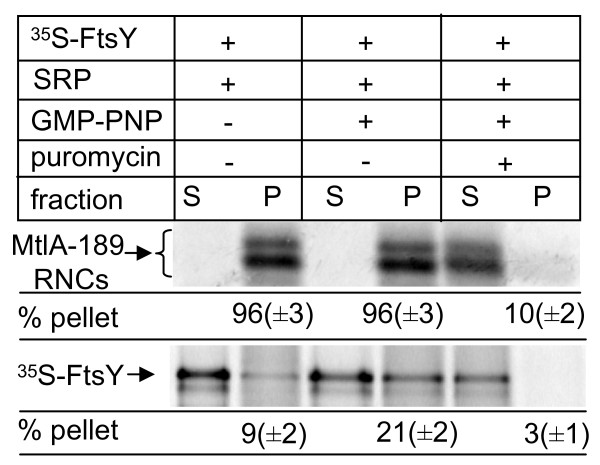
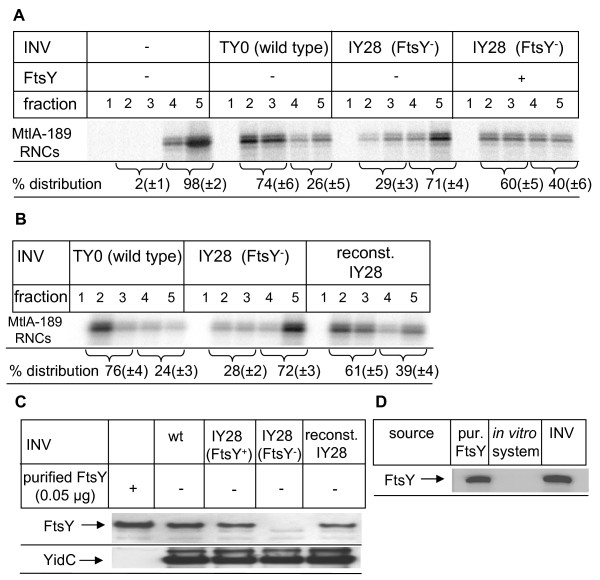
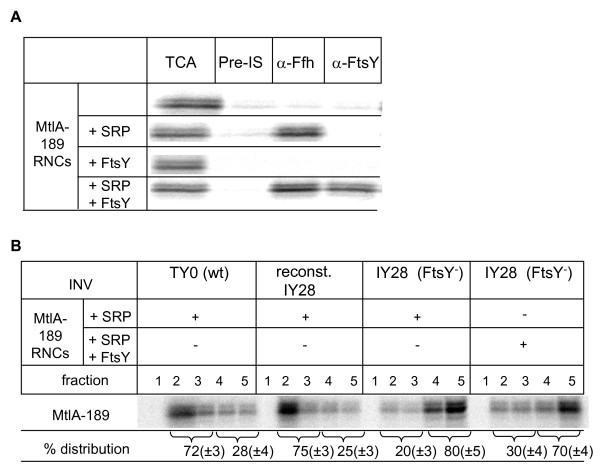
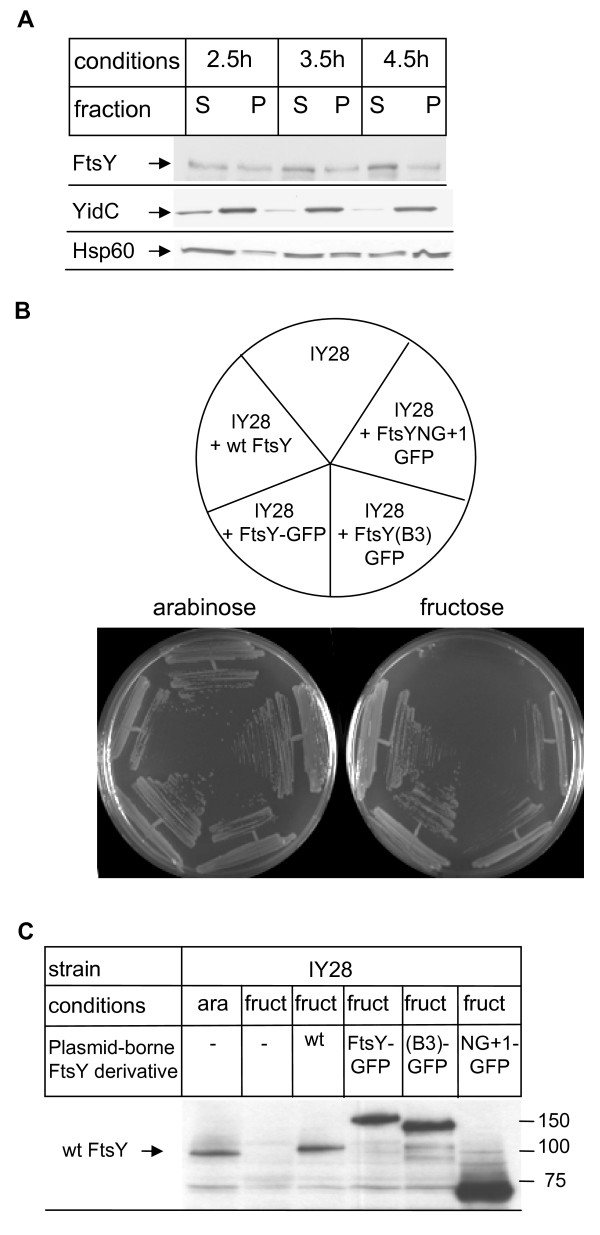
Background: The signal recognition particle (SRP) receptor plays a vital role in co-translational protein targeting, because it connects the soluble SRP-ribosome-nascent chain complex (SRP-RNCs) to the membrane bound Sec translocon. The eukaryotic SRP receptor (SR) is a heterodimeric protein complex, consisting of two unrelated GTPases. The SR β subunit is an integral membrane protein, which tethers the SRP-interacting SR α subunit permanently to the endoplasmic reticulum membrane. The prokaryotic SR lacks the SR β subunit and consists of only the SR α homologue FtsY. Strikingly, although FtsY requires membrane contact for functionality, cell fractionation studies have localized FtsY predominantly to the cytosolic fraction of Escherichia coli. So far, the exact function of the soluble SR in E. coli is unknown, but it has been suggested that, in contrast to eukaryotes, the prokaryotic SR might bind SRP-RNCs already in the cytosol and only then initiates membrane targeting. Results: In the current study we have determined the contribution of soluble FtsY to co-translational targeting in vitro and have re-analysed the localization of FtsY in vivo by fluorescence microscopy. Our data show that FtsY can bind to SRP-ribosome nascent chains (RNCs) in the absence of membranes. However, these soluble FtsY-SRP-RNC complexes are not efficiently targeted to the membrane. In contrast, we observed effective targeting of SRP-RNCs to membrane-bond FtsY. These data show that soluble FtsY does not contribute significantly to cotranslational targeting in E. coli. In agreement with this observation, our in vivo analyses of FtsY localization in bacterial cells by fluorescence microscopy revealed that the vast majority of FtsY was localized to the inner membrane and that soluble FtsY constituted only a negligible species in vivo. Conclusion: The exact function of the SRP receptor (SR) in bacteria has so far been enigmatic. Our data show that the bacterial SR is almost exclusively membrane-bound in vivo, indicating that the presence of a soluble SR is probably an artefact of cell fractionation. Thus, co-translational targeting in bacteria does not involve the formation of a soluble SR-signal recognition particle (SRP)-ribosome nascent chain (RNC) intermediate but requires membrane contact of FtsY for efficient SRP-RNC recruitment.
Overview
The claims and statistics of this paper haven’t been checked yet.
Free: it reads the open-access text and checks the first 5 claims that cite a source we can check. Create a free account to check every claim.
Integrity signals
Registry
Cites
Statistics
Figures
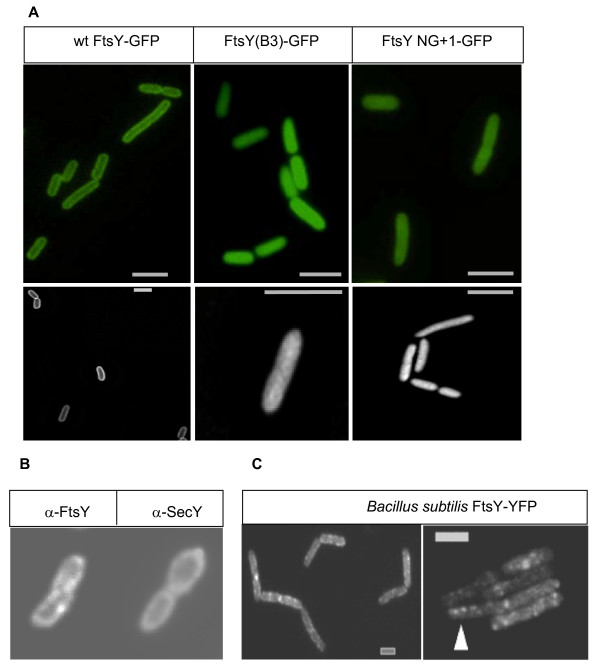
Verification
Claims the paper makes
The claims and statistics of this paper haven’t been checked yet.
Free: it reads the open-access text and checks the first 5 claims that cite a source we can check. Create a free account to check every claim.
Claims other papers make about this one
Each is checked against this paper’s own text: does it say what the citing paper says it does?
In the citing paper
“Importantly, only SecY-bound FtsY exposes the SRP binding site and is thus able to direct the SRP-RNC complex to the SecYEG translocon (Mircheva et al., 2009; Draycheva et al., 2016).”
From The Dynamic SecYEG Translocon (2021) · cites this paper as Mircheva et al., 2009
Self-check
Percentages, sums and reported differences re-computed from the paper’s own numbers.
The self-check needs the paper’s full text.
Citations
Cites
The Escherichia coli SRP and SecB targeting pathways converge at the translocon
Valent, Q. A. (1998) · The EMBO Journal · doi:10.1093/emboj/17.9.2504 · Cited by 291
Substrate twinning activates the signal recognition particle and its receptor
Egea, P. F., Shan, S.-O., Napetschnig, J., Savage, D. F., Walter, P., & Stroud, R. M. (2004) · Nature · doi:10.1038/nature02250 · Cited by 288
Heterodimeric GTPase Core of the SRP Targeting Complex
Focia, P. J., Shepotinovskaya, I. V., Seidler, J. A., & Freymann, D. M. (2004) · Science · doi:10.1126/science.1090827 · Cited by 255
An alternative protein targeting pathway in Escherichia coli: studies on the role of FtsY.
Luirink, J., ten Hagen-Jongman, C. M., van der Weijden, C. C., Oudega, B., High, S., Dobberstein, B., & Kusters, R. (1994) · The EMBO Journal · doi:10.1002/j.1460-2075.1994.tb06511.x · Cited by 249
Delivering proteins for export from the cytosol
Cross, B. C. S., Sinning, I., Luirink, J., & High, S. (2009) · Nature Reviews Molecular Cell Biology · doi:10.1038/nrm2657 · Cited by 191
Powers, T. (1997) · The EMBO Journal · doi:10.1093/emboj/16.16.4880 · Cited by 184
Bornemann, T., Jöckel, J., Rodnina, M. V., & Wintermeyer, W. (2008) · Nature Structural & Molecular Biology · doi:10.1038/nsmb.1402 · Cited by 178
In vitro translocation of bacterial proteins across the plasma membrane of Escherichia coli.
Müller, M., & Blobel, G. (1984) · Proceedings of the National Academy of Sciences · doi:10.1073/pnas.81.23.7421 · Cited by 176
Anionic phospholipids are involved in membrane association of FtsY and stimulate its GTPase activity
de Leeuw, E., Kaat, K. T., Moser, C., Menestrina, G., DEMEL, R. A., KRUIJFF, B. D., Oudega, B., Luirink, J., & Sinning, I. (2000) · The EMBO Journal · doi:10.1093/emboj/19.4.531 · Cited by 171
Koch, H.-G., Hengelage, T., Neumann-Haefelin, C., MacFarlane, J., Hoffschulte, H. K., Schimz, K.-L., Mechler, B., & Müller, M. (1999) · Molecular Biology of the Cell · doi:10.1091/mbc.10.7.2163 · Cited by 160 · cited 3×
“As the in vitro transcription/ translation system used in these experiments does not contain soluble FtsY ([ 26 ], Figure 2D), these data demonstrate that the formation of a soluble FtsY-SRP-RNC complex is obviously not essential for efficient targeting.”
MethodInfluentialSelf-citation
Cited by
Signal Recognition Particle: An Essential Protein-Targeting Machine
Akopian, D., Shen, K., Zhang, X., & Shan, S.-O. (2013) · Annual Review of Biochemistry · doi:10.1146/annurev-biochem-072711-164732 · Cited by 472
Kudva, R., Denks, K., Kuhn, P., Vogt, A., Müller, M., & Koch, H.-G. (2013) · Research in Microbiology · doi:10.1016/j.resmic.2013.03.016 · Cited by 177
Self-citationThe Sec translocon mediated protein transport in prokaryotes and eukaryotes.
Denks, K., Vogt, A., Sachelaru, I., Petriman, N.-A., Kudva, R., & Koch, H.-G. (2014) · Molecular Membrane Biology · doi:10.3109/09687688.2014.907455 · Cited by 170
“This could indicate that membrane attachment of FtsY and not its ability to bind to SecY is crucial for its function (Mircheva et al., 2009).”
Self-citationCoping with stress: How bacteria fine-tune protein synthesis and protein transport
Njenga, R. K., Boele, J., Öztürk, Y., & Koch, H. (2023) · Journal of Biological Chemistry · doi:10.1016/j.jbc.2023.105163 · Cited by 119
Self-citationTargeting and Insertion of Membrane Proteins
Kuhn, A., Koch, H.-G., & Dalbey, R. E. (2017) · EcoSal Plus · doi:10.1128/ecosalplus.esp-0012-2016 · Cited by 77
Self-citationOswald, J., Njenga, R., Natriashvili, A., Sarmah, P., & Koch, H.-G. (2021) · Frontiers in Molecular Biosciences · doi:10.3389/fmolb.2021.664241 · Cited by 88
Self-citationCo-translational protein targeting to the bacterial membrane
Saraogi, I., & Shan, S.-O. (2014) · Biochimica et Biophysica Acta (BBA) - Molecular Cell Research · doi:10.1016/j.bbamcr.2013.10.013 · Cited by 74
Dynamic switch of the signal recognition particle from scanning to targeting.
Holtkamp, W., Lee, S., Bornemann, T., Senyushkina, T., Rodnina, M. V., & Wintermeyer, W. (2012) · Nature Structural & Molecular Biology · doi:10.1038/nsmb.2421 · Cited by 81
Co-translational protein targeting in bacteria.
Steinberg, R., Knüpffer, L., Origi, A., Asti, R., & Koch, H.-G. (2018) · FEMS Microbiology Letters · doi:10.1093/femsle/fny095 · Cited by 81
Self-citationThe largely unexplored biology of small proteins in pro‐ and eukaryotes
Steinberg, R., & Koch, H. (2021) · The FEBS Journal · doi:10.1111/febs.15845 · Cited by 69
Self-citationKuhn, P., Weiche, B., Sturm, L., Sommer, E., Drepper, F., Warscheid, B., Sourjik, V., & Koch, H. (2011) · Traffic · doi:10.1111/j.1600-0854.2011.01167.x · Cited by 76
Self-citationLim, B., Miyazaki, R., Neher, S., Siegele, D. A., Ito, K., Walter, P., Akiyama, Y., Yura, T., & Gross, C. A. (2013) · PLoS Biology · doi:10.1371/journal.pbio.1001735 · Cited by 73
“Importantly, if s(32) is membrane associated via transient protein–protein and/or protein– lipid interactions, some s(32) may dissociate from the membrane during cell lysis, as was demonstrated for FtsY, another peripheral membrane protein [69,70].”
BackgroundLam, V. Q., Akopian, D., Rome, M., Henningsen, D., & Shan, S.-O. (2010) · Journal of Cell Biology · doi:10.1083/jcb.201004129 · Cited by 52
Richter, C. V., Bals, T., & Schünemann, D. (2010) · European Journal of Cell Biology · doi:10.1016/j.ejcb.2010.06.020 · Cited by 58
Ribosome binding induces repositioning of the signal recognition particle receptor on the translocon
Kuhn, P., Draycheva, A., Vogt, A., Petriman, N.-A., Sturm, L., Drepper, F., Warscheid, B., Wintermeyer, W., & Koch, H.-G. (2015) · Journal of Cell Biology · doi:10.1083/jcb.201502103 · Cited by 48
Self-citationEarly targeting events during membrane protein biogenesis in Escherichia coli
Bibi, E. (2010) · Biochimica et Biophysica Acta (BBA) - Biomembranes · doi:10.1016/j.bbamem.2010.07.025 · Cited by 52
Braig, D., Mircheva, M., Sachelaru, I., van der Sluis, E. O., Sturm, L., Beckmann, R., & Koch, H.-G. (2011) · Molecular Biology of the Cell · doi:10.1091/mbc.e11-02-0152 · Cited by 42
Self-citationStjepanovic, G., Kapp, K., Bange, G., Graf, C., Parlitz, R., Wild, K., Mayer, M. P., & Sinning, I. (2011) · Journal of Biological Chemistry · doi:10.1074/jbc.m110.212340 · Cited by 43
The bacterial SRP receptor, FtsY, is activated on binding to the translocon.
Draycheva, A., Bornemann, T., Ryazanov, S., Lakomek, N., & Wintermeyer, W. (2016) · Molecular Microbiology · doi:10.1111/mmi.13452 · Cited by 34
“FtsY is a peripheral membrane protein which interacts with membrane lipids and the translocon (Weiche et al., 2008; Braig et al., 2009; Mircheva et al., 2009; Stjepanovic et al., 2011) and has also been found in the cytoplasm (Luirink et al., 1994).”
BackgroundInfluentialErez, E., Stjepanović, G., Zelazny, A. M., Brügger, B., Sinning, I., & Bibi, E. (2010) · Journal of Biological Chemistry · doi:10.1074/jbc.m110.140921 · Cited by 29
Yin, L., Yu, L., Zhang, L., Ran, J., Li, J., Yang, C., Jiang, X., Du, H., Hu, X., & Liu, Y. (2019) · American Journal of Reproductive Immunology · doi:10.1111/aji.13159 · Cited by 23
Spatiotemporal kinetics of the SRP pathway in live E. coli cells
Volkov, I. L., Lundin, E., Kipper, K., Metelev, M., Zikrin, S., & Johansson, M. (2022) · Proceedings of the National Academy of Sciences · doi:10.1073/pnas.2204038119 · Cited by 22
Archaea Signal Recognition Particle Shows the Way
Zwieb, C. W., & Bhuiyan, S. (2010) · Archaea · doi:10.1155/2010/485051 · Cited by 24
Membrane Protein Biogenesis in Ffh- or FtsY-Depleted Escherichia coli
Yosef, I., Bochkareva, E. S., Adler, J., & Bibi, E. (2010) · PLoS ONE · doi:10.1371/journal.pone.0009130 · Cited by 20
Draycheva, A., Lee, S., & Wintermeyer, W. (2018) · Scientific Reports · doi:10.1038/s41598-018-28262-8 · Cited by 17
Dynamics of Bacterial Signal Recognition Particle at a Single Molecule Level
Mayer, B., Schwan, M., Oviedo-Bocanegra, L. M., Bange, G., Thormann, K. M., & Graumann, P. L. (2021) · Frontiers in Microbiology · doi:10.3389/fmicb.2021.663747 · Cited by 16
Self-citationFu, Y.-H. H., Huang, W. Y. C., Shen, K., Groves, J. T., Miller, T. F., & Shan, S. (2017) · eLife · doi:10.7554/elife.25885 · Cited by 15
Co-translational membrane association of the Escherichia coli SRP receptor
Bercovich-Kinori, A., & Bibi, E. (2015) · Journal of Cell Science · doi:10.1242/jcs.166116 · Cited by 13
Fiedler, S. M., & Graumann, P. L. (2024) · Cells · doi:10.3390/cells13050377 · Cited by 11
Self-citationThe contribution of mRNA targeting to spatial protein localization in bacteria
Shang, W., Lichtenberg, E., Mlesnita, A.-M., Wilde, A., & Koch, H. (2024) · FEBS Journal · doi:10.1111/febs.17054 · Cited by 11
Self-citationAboulwafa, M., & Saier, M. H. (2011) · PLoS ONE · doi:10.1371/journal.pone.0024088 · Cited by 9
The Escherichia coli SRP Receptor Forms a Homodimer at the Membrane
Kempf, G., Stjepanović, G., Sloan, J., Hendricks, A., Lapouge, K., & Sinning, I. (2018) · Structure · doi:10.1016/j.str.2018.07.008 · Cited by 5
Phospholipid dependency of membrane protein insertion by the Sec translocon
den Uijl, M. J., & Driessen, A. J. M. (2023) · Biochimica et Biophysica Acta (BBA) - Biomembranes · doi:10.1016/j.bbamem.2023.184232 · Cited by 5
Functional diversity and molecular interactions of small membrane proteins in bacteria
Yuan, J., Koch, H., & Berghoff, B. A. (2025) · microLife · doi:10.1093/femsml/uqaf035 · Cited by 4
Self-citationFunctional and structural studies of a C-terminally extended YidC
Seitl, I. (2016) · University writing server of the University of Hohenheim (Universität Hohenheim) · Cited by 2
The role of outer membrane homeostasis in the virulence of gram-negative bacteria
Morris, F. C. (2014) · University of Birmingham Institutional Research Archive (University of Birmingham) · Cited by 2
Sec and Tat Mediated Secretion Safeguards Mycobacterium tuberculosis Membrane Homeostasis
Sanyal, P., Jagadeeshwari, U., Sinha, S., Bhat, Y., Khan, S., Rajaram, S. V., Arokiyaraj, E. A., Jhingan, G. D., Agarwal, N., Samal, A., et al. (2026) · Molecular & Cellular Proteomics · doi:10.1016/j.mcpro.2026.101555 · Cited by 1
Optimizing membrane and secretory protein production in Gram-negative bacteria
Hjelm, A. (2015) · DiVA (Stockholm University) · Cited by 1
Dynamic interactions during ribosome targeting to the membrane
Lee, S. (2015) · eDiss (Georg-August-Universität Göttingen) · doi:10.53846/goediss-5053
Illuminating subcellular consequences of membrane protein production in Lactococcus lactis
van Gijtenbeek, L. A. (2017) · University of Groningen research database (University of Groningen / Centre for Information Technology)
Pross, E. K. (2020) · University writing server of the University of Hohenheim (Universität Hohenheim)
Pool, M. (2014) · Faculty Opinions – Post-Publication Peer Review of the Biomedical Literature · doi:10.3410/f.718214210.793489388
Interaction of the SecYEG translocon with the SRP receptor and the ribosome
Draycheva, A. (2015) · eDiss (Georg-August-Universität Göttingen) · doi:10.53846/goediss-5058
von Loeffelholz, O. (2013) · theses.fr (ABES) · doi:10.70675/81cb9d6fzf8afz4c19z88f1za700df516d5d
Sauerbrei, B. (2020) · Dokumentenrepositorium der RUB (Ruhr University Bochum) · doi:10.13154/294-7406
Kleinbeck, F. (2021) · University writing server of the University of Hohenheim (Universität Hohenheim)
From protein production to genome evolution in Escherichia coli
Schlegel, S. (2013) · DiVA (Digitala Vetenskapliga Arkivet)
Metadata
- Authors
- Mircheva, M., Boy, D., Weiche, B., Hucke, F., Graumann, P., & Koch, H.-G.
- Affiliations
- University of Freiburg (DE)
- Corresponding author
- Koch, Hans-Georg
- Venue
- BMC Biology
- Published
- 2009-11-13
- Volume
- 7
- Issue
- 1
- Pages
- 76-76
- ISSN
- 1741-7007 (ISSN-L)
- PMC
- PMC2780400
- OpenAlex
- W2080947490
- Cited by
- 42
- References
- 43
- Citations by year
- 2025: 1 · 2024: 2 · 2023: 2 · 2022: 1 · 2021: 3 · 2019: 1 · 2018: 3 · 2017: 3 · 2016: 1 · 2015: 5 · 2014: 4 · 2013: 5 · 2012: 1
- FWCI
- 1.47
- Type
- journal article
- Language
- en
- Open access
- gold
- doi.org
- Licence
- cc-by
- Locations
- BMC Biology (publishedVersion, cc-by)
- PubMed Central (publishedVersion, cc-by)
- PubMed (publishedVersion)
- DOAJ (DOAJ: Directory of Open Access Journals) (submittedVersion)
- eScholarship (California Digital Library) (submittedVersion)
- Funders
- Deutscher Akademischer Austauschdienst
- Deutsche Forschungsgemeinschaft
- Topics
- Life Sciences › Biochemistry, Genetics and Molecular Biology › Molecular Biology › RNA and protein synthesis mechanisms
- Life Sciences › Biochemistry, Genetics and Molecular Biology › Genetics › Bacterial Genetics and Biotechnology
- Life Sciences › Biochemistry, Genetics and Molecular Biology › Cell Biology › Cellular transport and secretion
- Keywords
- FtsY, signal recognition particle, co-translational protein targeting, membrane localization, Sec translocon, Escherichia coli, membrane contact
- MeSH terms
- SEC Translocation Channels, Bacterial Proteins, Endoplasmic Reticulum, Escherichia coli, Guanosine Triphosphate, Intracellular Membranes, Microscopy, Fluorescence, Protein Binding, Ribosomes, Receptors, Peptide, Receptors, Cytoplasmic and Nuclear, Signal Recognition Particle, Protein Transport, Protein Sorting Signals, Escherichia coli Proteins, In Vitro Techniques
About these checks
Registry, retraction, Cites and statistics results are computed, not judged, with one exception: a printed reference that no index lists is read once by a model before it counts as a citation error. Claims are extracted by a model and kept only when their quote appears verbatim in the text; each cited source is then checked, with a model’s help, for whether it says what the claim relies on. Those verdicts can be wrong — read the claim’s quote and the cited source before relying on one.
Statistics and arithmetic are recomputed, not judged.
Confidence bands are shown only for fields calibrated on our annotated test set. None is calibrated yet, so no band is shown.
What counts as a claim ›How we measure confidence ›How we check this ›
Are you an author, or do you see a problem with this page? Request a review
Data sources
Bibliographic data: Semantic Scholar, OpenAlex, Crossref.
Contains information from the Semantic Scholar Academic Graph Datasets, made available under the ODC Attribution License (ODC-BY 1.0).
Semantic Scholar’s data is described in: Kinney, R., et al. (2023). The Semantic Scholar Open Data Platform. arXiv:2301.10140.
