

There are no randomized controlled trials that support the United States Preventive Services Task Force guideline on screening for depression in primary care: a systematic review
Open accessThe DOI matches its Crossref record; 66 of the 66 references it cites were found in a registry or an index.
Abstract
BACKGROUND: The United States Preventive Services Task Force (USPSTF) recommends screening adults for depression in primary care settings when staff-assisted depression management programs are available. This recommendation, however, is based on evidence from depression management programs conducted with patients already identified as depressed, even though screening is intended to identify depressed patients not already recognized or treated. The objective of this systematic review was to evaluate whether there is evidence from randomized controlled trials (RCTs) that depression screening benefits patients in primary care, using an explicit definition of screening. METHODS: We re-evaluated RCTs included in the 2009 USPSTF evidence review on depression screening, including only trials that compared depression outcomes between screened and non-screened patients and met the following three criteria: determined patient eligibility and randomized prior to screening; excluded patients already diagnosed with a recent episode of depression or already being treated for depression; and provided the same level of depression treatment services to patients identified as depressed in the screening and non-screening trial arms. We also reviewed studies included in a recent Cochrane systematic review, but not the USPSTF review; conducted a focused search to update the USPSTF review; and reviewed trial registries. RESULTS: Of the nine RCTs included in the USPSTF review, four fulfilled none of three criteria for a test of depression screening, four fulfilled one of three criteria, and one fulfilled two of three criteria. There were two additional RCTs included only in the Cochrane review, and each fulfilled one of three criteria. No eligible RCTs were found via the updated review. CONCLUSIONS: The USPSTF recommendation to screen adults for depression in primary care settings when staff-assisted depression management programs are available is not supported by evidence from any RCTs that are directly relevant to the recommendation. The USPSTF should re-evaluate this recommendation. Please see related article: http://www.biomedcentral.com/1741-7015/12/14 REGISTRATION: PROSPERO (#CRD42013004276).
Overview
The claims and statistics of this paper haven’t been checked yet.
Free: it reads the open-access text and checks the first 5 claims that cite a source we can check. Create a free account to check every claim.
Integrity signals
Registry
Cites
Statistics
Figures
Verification
Claims the paper makes
The claims and statistics of this paper haven’t been checked yet.
Free: it reads the open-access text and checks the first 5 claims that cite a source we can check. Create a free account to check every claim.
Claims other papers make about this one
Each is checked against this paper’s own text: does it say what the citing paper says it does?
The cited source says what the claim attributes to it.
In the citing paper
“Standardised depression screening alone, however, appears to be insufficient to alter disease burden (Gilbody et al., 2008; Thombs et al., 2014).”
From The efficacy of automated feedback after internet-based depression screening: Study protocol of the German, three-armed, randomised controlled trial DISCOVER (2021) · cites this paper as Thombs et al., 2014
The check wasn’t confident either way, so it gives no verdict — never disputed.
In the citing paper
“In contrast, the dynamic coupling between frontoparietal activation (which increases with task-directed attention) and default mode deactivation is perturbed in MDD 111,117 .”
From Major depressive disorder (2016) · cites this paper as [111]
Experimental — accuracy not yet measured
Self-check
Percentages, sums and reported differences re-computed from the paper’s own numbers.
The self-check needs the paper’s full text.
Citations
Cites
Kirsch, I., Deacon, B. J., Huedo-Medina, T. B., Scoboria, A., Moore, T. J., & Johnson, B. T. (2008) · PLoS Medicine · doi:10.1371/journal.pmed.0050045 · Cited by 2,442 · cited 1×
“These factors have been discussed in detail elsewhere [3], but include the already high rate of antidepressant use in primary care settings [33,34]; the likely overestimation in the research literature of the accuracy of depression screening tools for identifying previously unrecognized cases of depression [35]; and t…”
BackgroundAntidepressant Drug Effects and Depression Severity: A Patient-Level Meta-analysis
Fournier, J. C., DeRubeis, R. J., Hollon, S. D., Dimidjian, S., Amsterdam, J. D., Shelton, R. C., & Fawcett, J. (2010) · JAMA · doi:10.1001/jama.2009.1943 · Cited by 2,009 · cited 1×
“These factors have been discussed in detail elsewhere [3], but include the already high rate of antidepressant use in primary care settings [33,34]; the likely overestimation in the research literature of the accuracy of depression screening tools for identifying previously unrecognized cases of depression [35]; and t…”
BackgroundPignone, M. P., Gaynes, B. N., Rushton, J. L., Burchell, C. M., Orleans, C. T., Mulrow, C. D., & Lohr, K. N. (2002) · Annals of Internal Medicine · doi:10.7326/0003-4819-136-10-200205210-00013 · Cited by 1,086
Wells, K. B., Sherbourne, C., Schoenbaum, M., Duan, N., Meredith, L., Unützer, J., Miranda, J., Carney, M. F., & Rubenstein, L. V. (2000) · JAMA · doi:10.1001/jama.283.2.212 · Cited by 1,021 · cited 8×
“Wells 2000, US [14,27] USPSTF 1356 Patients with probable depressive disorder eligible and randomized to enhanced depression care versus usual care.”
BackgroundMethodInfluentialNational Patterns in Antidepressant Medication Treatment
Olfson, M., & Marcus, S. C. (2009) · Archives of General Psychiatry · doi:10.1001/archgenpsychiatry.2009.81 · Cited by 730 · cited 1×
“These factors have been discussed in detail elsewhere [3], but include the already high rate of antidepressant use in primary care settings [33,34]; the likely overestimation in the research literature of the accuracy of depression screening tools for identifying previously unrecognized cases of depression [35]; and t…”
BackgroundScreening for Depression in Adults: U.S. Preventive Services Task Force Recommendation Statement
U.S. Preventive Services Task Force* (2009) · Annals of Internal Medicine · doi:10.7326/0003-4819-151-11-200912010-00006 · Cited by 580
Screening for Depression: Recommendations and Rationale
U.S. Preventive Services Task Force* (2002) · Annals of Internal Medicine · doi:10.7326/0003-4819-136-10-200205210-00012 · Cited by 526
Depression Screening and Patient Outcomes in Cardiovascular Care: A Systematic Review
Thombs, B. D., de Jonge, P., Coyne, J. C., Whooley, M. A., Frasure-Smith, N., Mitchell, A. J., Zuidersma, M., Eze-Nliam, C., Lima, B. B., Smith, C. G., et al. (2008) · JAMA · doi:10.1001/jama.2008.667 · Cited by 472 · cited 1×
“However, these recommendations are controversial [57,58] and not supported by evidence of benefit from RCTs [59-62].”
BackgroundSelf-citationStahl, S. M., Grady, M. M., Moret, C., & Briley, M. (2005) · CNS Spectrums · doi:10.1017/s1092852900019726 · Cited by 458 · cited 1×
“ease, may include increased risk of bleeding and unwanted effects on blood pressure and heart rate [45-49], as well as drug-drug interactions with cardiac medica-”
BackgroundKhan, A., Leventhal, R. M., Khan, S. R., & Brown, W. A. (2002) · Journal of Clinical Psychopharmacology · doi:10.1097/00004714-200202000-00007 · Cited by 456 · cited 1×
“These factors have been discussed in detail elsewhere [3], but include the already high rate of antidepressant use in primary care settings [33,34]; the likely overestimation in the research literature of the accuracy of depression screening tools for identifying previously unrecognized cases of depression [35]; and t…”
BackgroundScreening and case-finding instruments for depression: a meta-analysis
Gilbody, S., Sheldon, T., & House, A. (2008) · Canadian Medical Association Journal · doi:10.1503/cmaj.070281 · Cited by 443 · cited 6×
“In addition, we reviewed trials included in the 2008 Cochrane review [7,8] and conducted a focused search to determine if any depression screening trials have been conducted since those reviews.”
BackgroundMethodResultInfluentialSpina, E., Santoro, V., & D'Arrigo, C. (2008) · Clinical Therapeutics · doi:10.1016/s0149-2918(08)80047-1 · Cited by 361 · cited 1×
“tions [50,51].”
Gartlehner, G., Hansen, R. A., Morgan, L. C., Thaler, K., Lux, L., Van Noord, M., Mager, U., Thieda, P., Gaynes, B. N., Wilkins, T., et al. (2011) · Annals of Internal Medicine · doi:10.7326/0003-4819-155-11-201112060-00009 · Cited by 355
Hewitt, C., Gilbody, S., Brealey, S., Paulden, M., Palmer, S., Mann, R., Green, J., Morrell, J., Barkham, M., Light, K., et al. (2009) · Health Technology Assessment · doi:10.3310/hta13360 · Cited by 330 · cited 1×
“However, these recommendations are controversial [57,58] and not supported by evidence of benefit from RCTs [59-62].”
BackgroundNational trends in the treatment for depression from 1998 to 2007
Marcus, S. C., & Olfson, M. (2010) · Archives of General Psychiatry · doi:10.1001/archgenpsychiatry.2010.151 · Cited by 312
Improving treatment of late life depression in primary care: a randomized clinical trial
Callahan, C. M., Hendrie, H. C., Dittus, R. S., Brater, D. C., Hui, S. L., & Tierney, W. M. (1994) · Journal of the American Geriatrics Society · doi:10.1111/j.1532-5415.1994.tb06555.x · Cited by 304 · cited 3×
“a depression screening trial, six [16,17,21-24] fulfilled one, and four [14,15,18,19] did not fulfill any.”
BackgroundMethodRost, K., Nutting, P., Smith, J., Werner, J., & Duan, N. (2001) · Journal of General Internal Medicine · doi:10.1111/j.1525-1497.2001.00537.x · Cited by 293
Screening for Depression in Adult Patients in Primary Care Settings: A Systematic Evidence Review
O'Connor, E. A., Whitlock, E. P., Beil, T. L., & Gaynes, B. N. (2009) · Annals of Internal Medicine · doi:10.7326/0003-4819-151-11-200912010-00007 · Cited by 282
The Cost–Utility of Screening for Depression in Primary Care
Valenstein, M., Vijan, S., Zeber, J. E., Boehm, K., & Buttar, A. (2001) · Annals of Internal Medicine · doi:10.7326/0003-4819-134-5-200103060-00007 · Cited by 268
Proportion Of Antidepressants Prescribed Without A Psychiatric Diagnosis Is Growing
Mojtabai, R., & Olfson, M. (2011) · Health Affairs · doi:10.1377/hlthaff.2010.1024 · Cited by 256 · cited 1×
“Over-diagnosis and over-treatment of depression are common in community and primary care settings in the US [66-68], and there is a real risk that depression screening could exacerbate this problem without contributing to better mental health.”
BackgroundRecommendations on screening for depression in adults
Canadian Task Force on Preventive Health Care, Joffres, M., Jaramillo, A., Dickinson, J., Lewin, G., Pottie, K., Shaw, E., Gorber, S. C., & Tonelli, M. (2013) · Canadian Medical Association Journal · doi:10.1503/cmaj.130403 · Cited by 247
Wells, K., Sherbourne, C., Schoenbaum, M., Ettner, S., Duan, N., Miranda, J., Unützer, J., & Rubenstein, L. (2004) · Archives of General Psychiatry · doi:10.1001/archpsyc.61.4.378 · Cited by 225 · cited 1×
“Wells 2000, US [14,27] USPSTF 1356 Patients with probable depressive disorder eligible and randomized to enhanced depression care versus usual care.”
MethodLongitudinal Evidence for Unfavorable Effects of Antidepressants on Heart Rate Variability
Licht, C. M. M., de Geus, E. J. C., van Dyck, R., & Penninx, B. W. J. H. (2010) · Biological Psychiatry · doi:10.1016/j.biopsych.2010.06.032 · Cited by 225 · cited 1×
“ease, may include increased risk of bleeding and unwanted effects on blood pressure and heart rate [45-49], as well as drug-drug interactions with cardiac medica-”
BackgroundCase-finding for depression in primary care: a randomized trial∗
Williams, J. W., Mulrow, C. D., Kroenke, K., Dhanda, R., Badgett, R. G., Omori, D., & Lee, S. (1999) · The American Journal of Medicine · doi:10.1016/s0002-9343(98)00371-4 · Cited by 221 · cited 7×
“As shown in Table 1, there were five RCTs [14-18] included in only the USPSTF review, four [19-22] included in both the USPSTF and Cochrane reviews, and two [23,24] included in at least one version of the Cochrane”
BackgroundMethodInfluentialRethinking recommendations for screening for depression in primary care
Thombs, B. D., Coyne, J. C., Cuijpers, P., de Jonge, P., Gilbody, S., Ioannidis, J. P. A., Johnson, B. T., Patten, S. B., Turner, E. H., & Ziegelstein, R. C. (2012) · Canadian Medical Association Journal · doi:10.1503/cmaj.111035 · Cited by 220 · cited 3×
“These factors have been discussed in detail elsewhere [3], but include the already high rate of antidepressant use in primary care settings [33,34]; the likely overestimation in the research literature of the accuracy of depression screening tools for identifying previously unrecognized cases of depression [35]; and t…”
BackgroundSelf-citationBarbui, C., Cipriani, A., Patel, V., Ayuso-Mateos, J. L., & van Ommeren, M. (2011) · British Journal of Psychiatry · doi:10.1192/bjp.bp.109.076448 · Cited by 218 · cited 1×
“These factors have been discussed in detail elsewhere [3], but include the already high rate of antidepressant use in primary care settings [33,34]; the likely overestimation in the research literature of the accuracy of depression screening tools for identifying previously unrecognized cases of depression [35]; and t…”
BackgroundKhin, N. A., Chen, Y.-F., Yang, Y., Yang, P., & Laughren, T. P. (2011) · The Journal of Clinical Psychiatry · doi:10.4088/jcp.10m06191 · Cited by 212 · cited 1×
“These factors have been discussed in detail elsewhere [3], but include the already high rate of antidepressant use in primary care settings [33,34]; the likely overestimation in the research literature of the accuracy of depression screening tools for identifying previously unrecognized cases of depression [35]; and t…”
BackgroundDriessen, E., Cuijpers, P., Hollon, S. D., & Dekker, J. J. M. (2010) · Journal of Consulting and Clinical Psychology · doi:10.1037/a0020570 · Cited by 208 · cited 1×
“These factors have been discussed in detail elsewhere [3], but include the already high rate of antidepressant use in primary care settings [33,34]; the likely overestimation in the research literature of the accuracy of depression screening tools for identifying previously unrecognized cases of depression [35]; and t…”
BackgroundDowrick, C., & Buchan, I. (1995) · BMJ · doi:10.1136/bmj.311.7015.1274 · Cited by 205 · cited 2×
“The exclusion note referenced only one of the published trial reports [23], which did not provide depression outcomes, but did not cite another published report [26] that did provide depression outcomes.”
MethodScreening and case finding instruments for depression
Gilbody, S., House, A., & Sheldon, T. (2005) · Cochrane Database of Systematic Reviews · doi:10.1002/14651858.cd002792.pub2 · Cited by 205
Should we screen for depression?
Gilbody, S., Sheldon, T., & Wessely, S. (2006) · BMJ · doi:10.1136/bmj.332.7548.1027 · Cited by 195
Mojtabai, R., & Olfson, M. (2008) · The Journal of Clinical Psychiatry · doi:10.4088/jcp.v69n0704 · Cited by 185 · cited 1×
“These factors have been discussed in detail elsewhere [3], but include the already high rate of antidepressant use in primary care settings [33,34]; the likely overestimation in the research literature of the accuracy of depression screening tools for identifying previously unrecognized cases of depression [35]; and t…”
BackgroundManaging depression as a chronic disease: a randomised trial of ongoing treatment in primary care
Rost, K. (2002) · BMJ · doi:10.1136/bmj.325.7370.934 · Cited by 178 · cited 1×
“Rost 2001, US [15,28,29] USPSTF 479 Patients with five or more symptoms of current MDD eligible.”
MethodDowrick, C., & Frances, A. (2013) · BMJ · doi:10.1136/bmj.f7140 · Cited by 167
Labos, C., Dasgupta, K., Nedjar, H., Turecki, G., & Rahme, E. (2011) · Canadian Medical Association Journal · doi:10.1503/cmaj.100912 · Cited by 159 · cited 1×
“ease, may include increased risk of bleeding and unwanted effects on blood pressure and heart rate [45-49], as well as drug-drug interactions with cardiac medica-”
BackgroundYawn, B. P., Dietrich, A. J., Wollan, P., Bertram, S., Graham, D., Huff, J., Kurland, M., Madison, S., Pace, W. D., & In collaboration with the TRIPPD practices (2012) · The Annals of Family Medicine · doi:10.1370/afm.1418 · Cited by 155
Randomized trial of case-finding for depression in elderly primary care patients
Whooley, M. A., Stone, B., & Soghikian, K. (2000) · Journal of General Internal Medicine · doi:10.1046/j.1525-1497.2000.04319.x · Cited by 146 · cited 6×
“As shown in Table 1, there were five RCTs [14-18] included in only the USPSTF review, four [19-22] included in both the USPSTF and Cochrane reviews, and two [23,24] included in at least one version of the Cochrane”
BackgroundMethodInfluentialIncreased Bleeding Risk With Concurrent Use of Selective Serotonin Reuptake Inhibitors and Coumarins
Schalekamp, T. (2008) · Archives of Internal Medicine · doi:10.1001/archinternmed.2007.32 · Cited by 145 · cited 1×
“ease, may include increased risk of bleeding and unwanted effects on blood pressure and heart rate [45-49], as well as drug-drug interactions with cardiac medica-”
BackgroundThombs, B. D., Roseman, M., Coyne, J. C., de Jonge, P., Delisle, V. C., Arthurs, E., Levis, B., & Ziegelstein, R. C. (2013) · PLoS ONE · doi:10.1371/journal.pone.0052654 · Cited by 133 · cited 1×
“However, these recommendations are controversial [57,58] and not supported by evidence of benefit from RCTs [59-62].”
BackgroundSelf-citationScreening for postnatal depression in primary care: cost effectiveness analysis
Paulden, M., Palmer, S., Hewitt, C., & Gilbody, S. (2009) · BMJ · doi:10.1136/bmj.b5203 · Cited by 131 · cited 1×
“Screening would also consume scarce healthcare resources [52,53] that will not then be available for other activities, such as providing treatment to the large number of patients already diagnosed with depression but receiving poor-quality care.”
BackgroundScreening for depression in medical care
Palmer, S. C., & Coyne, J. C. (2003) · Journal of Psychosomatic Research · doi:10.1016/s0022-3999(02)00640-2 · Cited by 127
Culturally Sensitive Collaborative Treatment for Depressed Chinese Americans in Primary Care
Yeung, A., Shyu, I., Fisher, L., Wu, S., Yang, H., & Fava, M. (2010) · American Journal of Public Health · doi:10.2105/ajph.2009.184911 · Cited by 119 · cited 3×
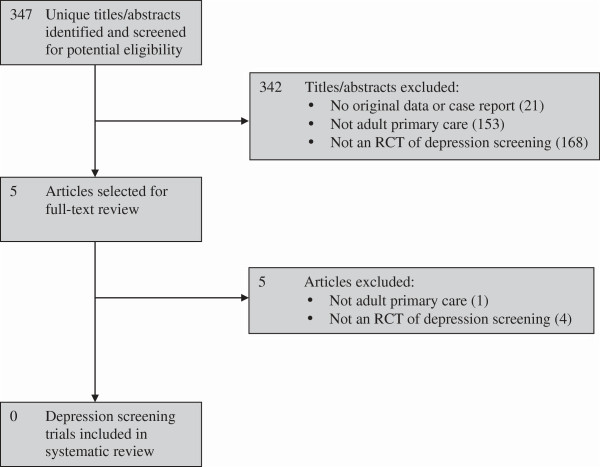
“Of the five studies that underwent full-text review, two studies were clearly not relevant, and three RCTs [30-32] were similar in design to trials included in the USPSTF or Cochrane reviews and met at least one criterion (see Table 1).”
BackgroundMethodROST, K. M., Nutting, P. A., Smith, J. L., & Werner, J. J. (2000) · General Hospital Psychiatry · doi:10.1016/s0163-8343(00)00059-1 · Cited by 105 · cited 1×
“Rost 2001, US [15,28,29] USPSTF 479 Patients with five or more symptoms of current MDD eligible.”
MethodThombs, B. D., Arthurs, E., El-Baalbaki, G., Meijer, A., Ziegelstein, R. C., & Steele, R. J. (2011) · BMJ · doi:10.1136/bmj.d4825 · Cited by 104
Self-citationRubenstein, L. Z., Alessi, C. A., Josephson, K. R., Trinidad Hoyl, M., Harker, J. O., & Pietruszka, F. M. (2007) · Journal of the American Geriatrics Society · doi:10.1111/j.1532-5415.2007.01044.x · Cited by 103 · cited 7×
“As shown in Table 1, there were five RCTs [14-18] included in only the USPSTF review, four [19-22] included in both the USPSTF and Cochrane reviews, and two [23,24] included in at least one version of the Cochrane”
BackgroundMethodInfluentialMojtabai, R. (2013) · Psychotherapy and Psychosomatics · doi:10.1159/000345968 · Cited by 101 · cited 1×
“Over-diagnosis and over-treatment of depression are common in community and primary care settings in the US [66-68], and there is a real risk that depression screening could exacerbate this problem without contributing to better mental health.”
BackgroundRoutine Screening for Depression in Patients With Coronary Heart Disease
Ziegelstein, R. C., Thombs, B. D., Coyne, J. C., & de Jonge, P. (2009) · Journal of the American College of Cardiology · doi:10.1016/j.jacc.2009.01.082 · Cited by 91 · cited 1×
“However, these recommendations are controversial [57,58] and not supported by evidence of benefit from RCTs [59-62].”
BackgroundSelf-citationSurveillance search techniques identified the need to update systematic reviews
Sampson, M., Shojania, K. G., McGowan, J., Daniel, R., Rader, T., Iansavitchene, A., Ji, J., Ansari, M. T., & Moher, D. (2008) · Journal of Clinical Epidemiology · doi:10.1016/j.jclinepi.2007.10.003 · Cited by 86 · cited 1×
“systematic reviews in a comparison of several different methods [13].”
BackgroundSchelleman, H., Brensinger, C. M., Bilker, W. B., & Hennessy, S. (2011) · PLoS ONE · doi:10.1371/journal.pone.0021447 · Cited by 86
Kozhimannil, K. B., Adams, A. S., Soumerai, S. B., Busch, A. B., & Huskamp, H. A. (2011) · Health Affairs · doi:10.1377/hlthaff.2009.1075 · Cited by 80 · cited 2×
“Although no depression outcomes have been reported, a study of the first of these programs to be initiated, the New Jersey Postpartum Wellness Initiative, which has required postpartum depression screening since 2006, did not find any increase in depression treatment or follow-up care following implementation [64].”
BackgroundResultComputerized assessment of common mental disorders in primary care: effect on clinical outcome
Lewis, G., Sharp, D., Bartholomew, J., & Pelosi, A. J. (1996) · Family Practice · doi:10.1093/fampra/13.2.120 · Cited by 73 · cited 4×
“[20,22-24] provided similar depression management op-”
BackgroundMethodInfluentialScreening for Depression in Adults and Older Adults in Primary Care: An Updated Systematic Review
Ea, O., Whitlock, E., Gaynes, B. N., & Beil, T. L. (2009) · Europe PMC (PubMed Central) · Cited by 70
Whooley, M. A. (2009) · Journal of the American College of Cardiology · doi:10.1016/j.jacc.2009.05.034 · Cited by 65
Hewitt, C., & Gilbody, S. (2009) · BJOG: An International Journal of Obstetrics & Gynaecology · doi:10.1111/j.1471-0528.2009.02148.x · Cited by 62 · cited 1×
“However, these recommendations are controversial [57,58] and not supported by evidence of benefit from RCTs [59-62].”
BackgroundZagorodnikova, K., Burbello, A., Афанасьевна, Б. С., Babak, S., Bergman, U., & Bertilsson, L. (2007) · European Journal of Clinical Pharmacology · doi:10.1007/s00228-007-0404-3 · Cited by 51 · cited 1×
“tions [50,51].”
Does testing for depression influence diagnosis or management by general practitioners?
Dowrick, C. (1995) · Family Practice · doi:10.1093/fampra/12.4.461 · Cited by 46
Effectiveness of screening and treatment for depression in ambulatory indigent patients
Jarjoura, D. G., Polen, A., Baum, E. E., Kropp, D., Hetrick, S., & Rutecki, G. W. (2004) · Journal of General Internal Medicine · doi:10.1111/j.1525-1497.2004.21249.x · Cited by 46 · cited 7×
“As shown in Table 1, there were five RCTs [14-18] included in only the USPSTF review, four [19-22] included in both the USPSTF and Cochrane reviews, and two [23,24] included in at least one version of the Cochrane”
BackgroundMethodInfluentialBurton, C., Simpson, C., & Anderson, N. (2013) · Psychological Medicine · doi:10.1017/s0033291712001481 · Cited by 46 · cited 1×
“An analysis of more than a million patient records from Scottish primary care practices, however, found that almost 1,000 screens were necessary for a new depression diagnosis and almost 700 for a new antidepressant prescription [63].”
BackgroundScreening for depression in high-risk groups: prospective cohort study in general practice
Baas, K. D., Wittkampf, K. A., van Weert, H. C., Lucassen, P., Huyser, J., van den Hoogen, H., van de Lisdonk, E., Bindels, P. E., Bockting, C. L., Ruhé, H. G., et al. (2009) · British Journal of Psychiatry · doi:10.1192/bjp.bp.107.046052 · Cited by 43 · cited 2×
“Healthcare practitioners should be particularly vigilant among patients who may be at high risk of depression, including patients with a chronic medical condition, a past history of depression, a pattern of unexplained somatic symptoms and frequent use of medical services, or substance abuse [9,10,32,65].”
BackgroundGoodyear-Smith, F. A., van Driel, M. L., Arroll, B., & Del Mar, C. (2012) · BMC Medical Research Methodology · doi:10.1186/1471-2288-12-76 · Cited by 42 · cited 1×
“Existing systematic reviews on depression screening have been criticized for not defining the characteristics of depression screening trials [11,12].”
BackgroundBosmans, J. E., de Bruijne, M. C., van Hout, H. P. J., van Marwijk, H., Beekman, A. T. F., Bouter, L. M., Stalman, W. A. B., & van Tulder, M. W. (2006) · Journal of General Internal Medicine · doi:10.1111/j.1525-1497.2006.00555.x · Cited by 40 · cited 6×
“As shown in Table 1, there were five RCTs [14-18] included in only the USPSTF review, four [19-22] included in both the USPSTF and Cochrane reviews, and two [23,24] included in at least one version of the Cochrane”
BackgroundMethodInfluentialRomera, I., Montejo, A. L., Aragonès, E., Arbesú, J. Á., García, C. I., López, S. L., Lozano, J. A., Pamulapati, S., Yruretagoyena, B., & Gilaberte, I. (2013) · BMC Psychiatry · doi:10.1186/1471-244x-13-83 · Cited by 34 · cited 8×
“The only RCT in the present review that screened high-risk patients [32] did not find that screening reduced the presence of depression, although it is not known what proportion of patients in the trial were receiving treatment for depression pre-trial.”
BackgroundMethodInfluentialWhy screening for depression in primary care is impractical
Bland, R. C., & Streiner, D. L. (2013) · Canadian Medical Association Journal · doi:10.1503/cmaj.130634 · Cited by 33 · cited 1×
“Existing systematic reviews on depression screening have been criticized for not defining the characteristics of depression screening trials [11,12].”
BackgroundThe Limited Effect of Screening for Depressive Symptoms With the PHQ-9 in Rural Family Practices
Bergus, G. R., Hartz, A. J., Noyes, R., Ward, M. M., James, P. A., Vaughn, T., Kelley, P. L., Sinift, S. D., Bentler, S., & Tilman, E. (2005) · The Journal of Rural Health · doi:10.1111/j.1748-0361.2005.tb00099.x · Cited by 29 · cited 4×
“[20,22-24] provided similar depression management op-”
BackgroundMethodInfluentialVasiliadis, H.-M., Latimer, E., Dionne, P.-A., & Préville, M. (2013) · The Canadian Journal of Psychiatry · doi:10.1177/070674371305800405 · Cited by 17 · cited 1×
“Nonetheless, a recent population-based study from the province of Quebec found that overall healthcare costs were approximately $2,000 (CAD) higher for patients prescribed antidepressants, with a large proportion of increased costs attributed to patients without a recent history of depression or anxiety [54].”
BackgroundHewitt, C. E., & Gilbody, S. M. (2010) · Obstetric Anesthesia Digest · doi:10.1097/01.aoa.0000370515.08609.8d · Cited by 15
Research works printed but not linked: 3
- 9. National Collaborating Center for Mental Health: The NICE guideline on the management and treatment of depression in adults (Updated edition). Manchester, UK: NICE; 2010.
- 55. National Institute for Clinical Excellence: Antenatal and postnatal mental health: clinical management and service guidance. London, UK: NICE; 2007.
- 57. Hill C: An evaluation of screening for postnatal depression against NSC criteria. UK: UK National Screening Committee; 2010.
Cited by
Malhi, G. S., & Mann, J. J. (2018) · The Lancet · doi:10.1016/s0140-6736(18)31948-2 · Cited by 4,099
Otte, C., Gold, S. M., Penninx, B. W., Pariante, C. M., Etkin, A., Fava, M., Mohr, D. C., & Schatzberg, A. F. (2016) · Nature Reviews Disease Primers · doi:10.1038/nrdp.2016.65 · Cited by 2,269
Levis, B., Benedetti, A., & Thombs, B. D. (2019) · BMJ · doi:10.1136/bmj.l1476 · Cited by 1,718
Self-citationLevis, B., Sun, Y., He, C., Wu, Y., Krishnan, A., Bhandari, P. M., Neupane, D., Imran, M., Brehaut, E., Negeri, Z., et al. (2020) · JAMA · doi:10.1001/jama.2020.6504 · Cited by 577
Self-citationNegeri, Z. F., Levis, B., Sun, Y., He, C., Krishnan, A., Wu, Y., Bhandari, P. M., Neupane, D., Brehaut, E., Benedetti, A., et al. (2021) · BMJ · doi:10.1136/bmj.n2183 · Cited by 364
Self-citation
Metadata
- Authors
- Thombs, B. D., Ziegelstein, R. C., Roseman, M., Kloda, L. A., & Ioannidis, J. P.
- Affiliations
- McGill University (CA)
- Johns Hopkins University (US)
- Jewish General Hospital (CA)
- Stanford Medicine (US)
- Corresponding author
- Thombs, Brett D
- Venue
- BMC Medicine
- Published
- 2014-01-28
- Volume
- 12
- Issue
- 1
- Pages
- 13-13
- ISSN
- 1741-7015 (ISSN-L)
- PMC
- PMC3922694
- OpenAlex
- W2005732471
- Semantic Scholar
- a52be8593d7f23d8bc03075f841a537d521f55f1
- Cited by
- 100
- References
- 66
- Citations by year
- 2025: 4 · 2024: 4 · 2023: 2 · 2022: 3 · 2021: 14 · 2020: 6 · 2019: 15 · 2018: 10 · 2017: 16 · 2016: 13 · 2015: 4 · 2014: 9
- FWCI
- 2.00
- Type
- journal article
- Language
- en
- Open access
- gold
- doi.org
- Licence
- Locations
- BMC Medicine (publishedVersion, cc-by)
- Europe PMC (PubMed Central) (publishedVersion, cc-by)
- PubMed Central (publishedVersion, cc-by)
- PubMed (publishedVersion)
- eScholarship@McGill (McGill) (submittedVersion, cc-by)
- Funders
- Johns Hopkins University
- Canadian Institutes of Health Research
- Center for Innovative Medicine
- Topics
- Health Sciences › Medicine › Psychiatry and Mental health › Mental Health Treatment and Access
- Health Sciences › Medicine › Public Health, Environmental and Occupational Health › Health Promotion and Cardiovascular Prevention
- Social Sciences › Psychology › Experimental and Cognitive Psychology › Anxiety, Depression, Psychometrics, Treatment, Cognitive Processes
- Keywords
- depression screening, primary care, USPSTF recommendations, randomized controlled trials, guideline evaluation
- MeSH terms
- Depressive Disorder, Humans, Mass Screening, Primary Health Care, United States, Randomized Controlled Trials as Topic, Practice Guidelines as Topic, Advisory Committees
About these checks
Registry, retraction, Cites and statistics results are computed, not judged, with one exception: a printed reference that no index lists is read once by a model before it counts as a citation error. Claims are extracted by a model and kept only when their quote appears verbatim in the text; each cited source is then checked, with a model’s help, for whether it says what the claim relies on. Those verdicts can be wrong — read the claim’s quote and the cited source before relying on one.
Statistics and arithmetic are recomputed, not judged.
Confidence bands are shown only for fields calibrated on our annotated test set. None is calibrated yet, so no band is shown.
What counts as a claim ›How we measure confidence ›How we check this ›
Are you an author, or do you see a problem with this page? Request a review
Data sources
Bibliographic data: Semantic Scholar, OpenAlex, Crossref.
Contains information from the Semantic Scholar Academic Graph Datasets, made available under the ODC Attribution License (ODC-BY 1.0).
Semantic Scholar’s data is described in: Kinney, R., et al. (2023). The Semantic Scholar Open Data Platform. arXiv:2301.10140.
