

Performance criteria for verbal autopsy-based systems to estimate national causes of death: development and application to the Indian Million Death Study
Open accessThe DOI matches its Crossref record; 47 of the 47 references it cites were found in a registry or an index.
Abstract
Background: Verbal autopsy (VA) has been proposed to determine the cause of death (COD) distributions in settings where most deaths occur without medical attention or certification. We develop performance criteria for VA-based COD systems and apply these to the Registrar General of India’s ongoing, nationally-representative Indian Million Death Study (MDS). Methods: Performance criteria include a low ill-defined proportion of deaths before old age; reproducibility, including consistency of COD distributions with independent resampling; differences in COD distribution of hospital, home, urban or rural deaths; age-, sex- and time-specific plausibility of specific diseases; stability and repeatability of dual physician coding; and the ability of the mortality classification system to capture a wide range of conditions. Results: The introduction of the MDS in India reduced the proportion of ill-defined deaths before age 70 years from 13% to 4%. The cause-specific mortality fractions (CSMFs) at ages 5 to 69 years for independently resampled deaths and the MDS were very similar across 19 disease categories. By contrast, CSMFs at these ages differed between hospital and home deaths and between urban and rural deaths. Thus, reliance mostly on urban or hospital data can distort national estimates of CODs. Age-, sex- and time-specific patterns for various diseases were plausible. Initial physician agreement on COD occurred about two-thirds of the time. The MDS COD classification system was able to capture more eligible records than alternative classification systems. By these metrics, the Indian MDS performs well for deaths prior to age 70 years. The key implication for low- and middle-income countries where medical certification of death remains uncommon is to implement COD surveys that randomly sample all deaths, use simple but high-quality field work with built-in resampling, and use electronic rather than paper systems to expedite field work and coding. Conclusions: Simple criteria can evaluate the performance of VA-based COD systems. Despite the misclassification of VA, the MDS demonstrates that national surveys of CODs using VA are an order of magnitude better than the limited COD data previously available.
Overview
The claims and statistics of this paper haven’t been checked yet.
Free: it reads the open-access text and checks the first 5 claims that cite a source we can check. Create a free account to check every claim.
Integrity signals
Registry
Cites
Statistics
Figures
Verification
Claims the paper makes
The claims and statistics of this paper haven’t been checked yet.
Free: it reads the open-access text and checks the first 5 claims that cite a source we can check. Create a free account to check every claim.
Claims other papers make about this one
Each is checked against this paper’s own text: does it say what the citing paper says it does?
The cited source says what the claim attributes to it.
In the citing paper
“attributions to senility and uncategorized causes pose particular risks of inaccuracy33,60.”
From Attributed causes of excess mortality during the COVID-19 pandemic in a south Indian city (2023) · cites this paper as [60]
Self-check
Percentages, sums and reported differences re-computed from the paper’s own numbers.
The self-check needs the paper’s full text.
Citations
Cites
Lozano, R., Naghavi, M., Foreman, K., Lim, S., Shibuya, K., Aboyans, V., Abraham, J., Adair, T., Aggarwal, R., Ahn, S. Y., et al. (2012) · The Lancet · doi:10.1016/s0140-6736(12)61728-0 · Cited by 14,070
The Causes of Cancer: Quantitative Estimates of Avoidable Risks of Cancer in the United States Today
Doll, R., & Peto, R. (1981) · JNCI: Journal of the National Cancer Institute · doi:10.1093/jnci/66.6.1192 · Cited by 3,927 · cited 1×
“Indeed, misclassification is common at older ages even for medically certified deaths occurring in hospitals in high-income countries [38,39].”
The Causes of Cancer: Quantitative Estimates of Avoidable Risks of Cancer in the United States Today
Peto, R. (1983) · The Use of Human Cells for the Evaluation of Risk from Physical and Chemical Agents · doi:10.1007/978-1-4757-1117-2_30 · Cited by 3,501
Global, regional, and national causes of child mortality in 2008: a systematic analysis
Black, R. E., Cousens, S., Johnson, H. L., Lawn, J. E., Rudan, I., Bassani, D. G., Jha, P., Campbell, H., Walker, C. F., Cibulskis, R., et al. (2010) · The Lancet · doi:10.1016/s0140-6736(10)60549-1 · Cited by 3,058 · cited 1×
“The MDS child classification conforms mostly to that recommended by the Child Health Epidemiology Reference Group (CHERG) [36].”
Self-citation(2005) · Europe PMC (PubMed Central) · Cited by 1,975
Suicide mortality in India: a nationally representative survey
Patel, V., Ramasundarahettige, C., Vijayakumar, L., Thakur, J., Gajalakshmi, V., Gururaj, G., Suraweera, W., & Jha, P. (2012) · The Lancet · doi:10.1016/s0140-6736(12)60606-0 · Cited by 936 · cited 3×
“Road traffic injuries are more common in men than in women [32], but suicide at younger ages is more common in women [16].”
Self-citationChanges in Rates of Autopsy-Detected Diagnostic Errors Over Time: A Systematic Review
Shojania, K. G., Burton, E. C., McDonald, K. M., & Goldman, L. (2003) · JAMA · doi:10.1001/jama.289.21.2849 · Cited by 703 · cited 1×
“Indeed, misclassification is common at older ages even for medically certified deaths occurring in hospitals in high-income countries [38,39].”
Snakebite Mortality in India: A Nationally Representative Mortality Survey
Mohapatra, B., Warrell, D. A., Suraweera, W., Bhatia, P., Dhingra, N., Jotkar, R. M., Rodriguez, P. S., Mishra, K., Whitaker, R., Jha, P., et al. (2011) · PLoS Neglected Tropical Diseases · doi:10.1371/journal.pntd.0001018 · Cited by 661 · cited 3×
“The MDS design and methods [6], and results for priority diseases [9-19] and risk factors (most importantly smoking [20]), have already been published.”
Self-citationA Nationally Representative Case–Control Study of Smoking and Death in India
Jha, P., Jacob, B., Gajalakshmi, V., Gupta, P. C., Dhingra, N., Kumar, R., Sinha, D. N., Dikshit, R. P., Parida, D. K., Kamadod, R., et al. (2008) · New England Journal of Medicine · doi:10.1056/nejmsa0707719 · Cited by 554 · cited 1×
“The MDS design and methods [6], and results for priority diseases [9-19] and risk factors (most importantly smoking [20]), have already been published.”
Self-citationCauses of neonatal and child mortality in India: a nationally representative mortality survey
(2010) · The Lancet · doi:10.1016/s0140-6736(10)61461-4 · Cited by 550
Cancer mortality in India: a nationally representative survey
Dikshit, R., Gupta, P. C., Ramasundarahettige, C., Gajalakshmi, V., Aleksandrowicz, L., Badwe, R., Kumar, R., Roy, S., Suraweera, W., Bray, F., et al. (2012) · The Lancet · doi:10.1016/s0140-6736(12)60358-4 · Cited by 532
Self-citationCivil registration systems and vital statistics: successes and missed opportunities
Mahapatra, P., Shibuya, K., Lopez, A. D., Coullare, F., Notzon, F. C., Rao, C., & Szreter, S. (2007) · The Lancet · doi:10.1016/s0140-6736(07)61308-7 · Cited by 352
Prospective Study of One Million Deaths in India: Rationale, Design, and Validation Results
Jha, P., Gajalakshmi, V., Gupta, P. C., Kumar, R., Mony, P., Dhingra, N., Peto, R., & Collaborators, R.-C. P. S. (2005) · PLoS Medicine · doi:10.1371/journal.pmed.0030018 · Cited by 323 · cited 10×
“This suggests stability and reproducibility of the RHIME method, but does not itself prove validity.”
InfluentialSelf-citationAdult and child malaria mortality in India: a nationally representative mortality survey
Dhingra, N., Jha, P., Sharma, V. P., Cohen, A. A., Jotkar, R. M., Rodriguez, P. S., Bassani, D. G., Suraweera, W., Laxminarayan, R., & Peto, R. (2010) · The Lancet · doi:10.1016/s0140-6736(10)60831-8 · Cited by 284 · cited 3×
“For example, malaria is observed mostly among rural, unattended deaths [11].”
Self-citationSample Registration System Statistical Report 2010Preprint
General, I. R. (2012) · RePEc: Research Papers in Economics · Cited by 221
Gupta, P. C. (1996) · Tobacco Control · doi:10.1136/tc.5.2.114 · Cited by 193 · cited 1×
“The use of electronic data entry [53] with time- and GPS-tracking of fieldwork, as well as the important feature of resampling deaths, can further improve field quality.”
Self-citationMeasuring mortality in developing countries
Adjuik, M. (2006) · Bulletin of the World Health Organisation · doi:10.2471/blt.05.026492 · Cited by 168
Interim measures for meeting needs for health sector data: births, deaths, and causes of death
Hill, K., López, A. D., Shibuya, K., & Jha, P. (2007) · The Lancet · doi:10.1016/s0140-6736(07)61309-9 · Cited by 165 · cited 4×
“Discussion The major global gap in knowledge of causes of death, particularly for adult mortality in LMICs, might be filled by adopting nationally-representative VA surveys [1-5].”
InfluentialSelf-citationVerbal autopsies for adult deaths: their development and validation in a multicentre study
Chandramohan, D., Maude, G. H., Rodrigues, L. C., & Hayes, R. J. (1998) · Tropical Medicine & International Health · doi:10.1046/j.1365-3156.1998.00255.x · Cited by 163 · cited 1×
“Moreover, there are differences in the distribution of CODs, treatment patterns, and underlying pathogens for infectious causes between hospital deaths (mostly urban) and rural, unattended deaths in the home [1,40-44].”
The University of North Carolina at Chapel Hill University Libraries (2020) · PubMed · doi:10.17615/8k7j-7g38 · Cited by 155
Hsiao, M., Malhotra, A., Thakur, J. S., Sheth, J. K., Nathens, A. B., Dhingra, N., Jha, P., & Collaborators, F. T. M. D. S. (2013) · BMJ Open · doi:10.1136/bmjopen-2013-002621 · Cited by 125 · cited 1×
“Road traffic injuries are more common in men than in women [32], but suicide at younger ages is more common in women [16].”
Self-citationVerbal autopsy of 80,000 adult deaths in Tamilnadu, South India
Gajalakshmi, V., & Peto, R. (2004) · BMC Public Health · doi:10.1186/1471-2458-4-47 · Cited by 125
Reliable direct measurement of causes of death in low- and middle-income countries
Jha, P. (2014) · BMC Medicine · doi:10.1186/1741-7015-12-19 · Cited by 120 · cited 2×
“However, it would be unrealistic to suggest that MDS-type systems are the only way to improve information on CODs [51].”
Self-citationAnker, M. (1997) · International Journal of Epidemiology · doi:10.1093/ije/26.5.1090 · Cited by 119 · cited 2×
“The overall CSMF of the top 10 CODs was similar across high- and lowquality narratives (data not shown), emphasizing the point that plausible and replicable population distribution of CODs is possible despite misclassification at the individual level [6,28,31].”
Quigley, M. (1999) · International Journal of Epidemiology · doi:10.1093/ije/28.6.1081 · Cited by 114 · cited 2×
“The overall CSMF of the top 10 CODs was similar across high- and lowquality narratives (data not shown), emphasizing the point that plausible and replicable population distribution of CODs is possible despite misclassification at the individual level [6,28,31].”
Evaluating national cause-of-death statistics: principles and application to the case of China.
Rao, C., López, A. D., Yang, G., Begg, S. J., & Ma, J. (2005) · Europe PMC (PubMed Central) · Cited by 109
Leitao, J., Desai, N., Aleksandrowicz, L., Byass, P., Miasnikof, P., Tollman, S., Alam, D., Lu, Y., Rathi, S. K., Singh, A., et al. (2014) · BMC Medicine · doi:10.1186/1741-7015-12-22 · Cited by 95 · cited 1×
“Moreover, there are differences in the distribution of CODs, treatment patterns, and underlying pathogens for infectious causes between hospital deaths (mostly urban) and rural, unattended deaths in the home [1,40-44].”
Self-citationJagnoor, J., Suraweera, W., Keay, L. J., Ivers, R., Thakur, J., Jha, P., & Collaborators, M. D. S. (2012) · BMC Public Health · doi:10.1186/1471-2458-12-487 · Cited by 81 · cited 3×
“The MDS design and methods [6], and results for priority diseases [9-19] and risk factors (most importantly smoking [20]), have already been published.”
Self-citationMorris, S. K., Awasthi, S., Khera, A. K., Bassani, D. G., Kang, G., Parashar, U. D., Kumar, R., Shet, A., Glass, R. I., & Jha, P. (2012) · Bulletin of the World Health Organization · doi:10.2471/blt.12.101873 · Cited by 70 · cited 2×
“The MDS design and methods [6], and results for priority diseases [9-19] and risk factors (most importantly smoking [20]), have already been published.”
Self-citationDiarrhea, Pneumonia, and Infectious Disease Mortality in Children Aged 5 to 14 Years in India
Morris, S. K., Bassani, D. G., Awasthi, S., Kumar, R., Shet, A., Suraweera, W., Jha, P., & Collaborators, F. T. M. (2011) · PLoS ONE · doi:10.1371/journal.pone.0020119 · Cited by 63 · cited 2×
“The MDS design and methods [6], and results for priority diseases [9-19] and risk factors (most importantly smoking [20]), have already been published.”
Self-citationJha, P., Kumar, R., Khera, A., Bhattacharya, M., Arora, P., Gajalakshmi, V., Bhatia, P., Kam, D., Bassani, D. G., Sullivan, A., et al. (2010) · BMJ · doi:10.1136/bmj.c621 · Cited by 60
Self-citationCause of death reporting systems in India: a performance analysis.
Mahapatra, P., & Rao, C. (2001) · PubMed · Cited by 56
Desai, N., Aleksandrowicz, L., Miasnikof, P., Lu, Y., Leitao, J., Byass, P., Tollman, S., Mee, P., Alam, D., Rathi, S. K., et al. (2014) · BMC Medicine · doi:10.1186/1741-7015-12-20 · Cited by 53 · cited 1×
“The debate about physician versus machine coding is somewhat misleading [52], as it misses the key point that far more nationally-representative studies are needed.”
Self-citationValidation of the Diagnosis of Childhood Morbidity Using Maternal Health Interviews
KALTER, H. D., GRAY, R. H., BLACK, R. E., & GULTIANO, S. A. (1991) · International Journal of Epidemiology · doi:10.1093/ije/20.1.193 · Cited by 52 · cited 1×
“Moreover, there are differences in the distribution of CODs, treatment patterns, and underlying pathogens for infectious causes between hospital deaths (mostly urban) and rural, unattended deaths in the home [1,40-44].”
Validity of verbal autopsy in determining causes of adult deaths.
Kumar, R., Thakur, J., Rao, B. T., Singh, M., & Bhatia, S. P. S. (2006) · PubMed · Cited by 48
Self-citationSystematic archiving and access to health research data: rationale, current status and way forward
Rani, M., & Buckley, B. S. (2012) · Bulletin of the World Health Organization · doi:10.2471/blt.12.105908 · Cited by 41
Maternal mortality inquiry in a rural community of North India
Kumar, R., Sharma, A. K., Barik, S., & Kumar, V. (1989) · International Journal of Gynecology & Obstetrics · doi:10.1016/0020-7292(89)90355-x · Cited by 36 · cited 1×
“Moreover, there are differences in the distribution of CODs, treatment patterns, and underlying pathogens for infectious causes between hospital deaths (mostly urban) and rural, unattended deaths in the home [1,40-44].”
Self-citationCounting the dead is one of the world’s best investments to reduce premature mortality
Jha, P. (2012) · Hypothesis · doi:10.5779/hypothesis.v10i1.254 · Cited by 32 · cited 8×
“They have increasingly been recommended to determine national COD distributions [1-5], which requires VA on a random sample of deaths.”
InfluentialSelf-citationMorris, S. K., Bassani, D. G., Kumar, R., Awasthi, S., Paul, V. K., & Jha, P. (2010) · PLoS ONE · doi:10.1371/journal.pone.0009583 · Cited by 31 · cited 2×
“Physician coding patterns in the MDS Almost two-thirds of deaths at ages 5 to 69 years had immediate agreement on the COD by two independent physicians (Additional file 5a) [33-35].”
Self-citationReliable mortality data: a powerful tool for public health.
Jha, P. (2001) · PubMed · Cited by 29
Self-citationVogel, G. (2012) · Science · doi:10.1126/science.336.6087.1372 · Cited by 28 · cited 4×
“Discussion The major global gap in knowledge of causes of death, particularly for adult mortality in LMICs, might be filled by adopting nationally-representative VA surveys [1-5].”
InfluentialAvoidable mortality in India: past progress and future prospects.
Jha, P. (2002) · PubMed · Cited by 22
Self-citationMontgomery, A. L., Morris, S. K., Bassani, D. G., Kumar, R., Jotkar, R., & Jha, P. (2012) · PLoS ONE · doi:10.1371/journal.pone.0033075 · Cited by 18 · cited 2×
“Physician coding patterns in the MDS Almost two-thirds of deaths at ages 5 to 69 years had immediate agreement on the COD by two independent physicians (Additional file 5a) [33-35].”
Self-citationGlobal health: One million deaths
Westly, E. (2013) · Nature · doi:10.1038/504022a · Cited by 13
Factors Associated with Physician Agreement on Verbal Autopsy of over 11500 Injury Deaths in India
Hsiao, M., Morris, S. K., Bassani, D. G., Montgomery, A. L., Thakur, J. S., & Jha, P. (2012) · PLoS ONE · doi:10.1371/journal.pone.0030336 · Cited by 12 · cited 2×
“Physician coding patterns in the MDS Almost two-thirds of deaths at ages 5 to 69 years had immediate agreement on the COD by two independent physicians (Additional file 5a) [33-35].”
Self-citationState Differences in the Reporting of ‘Unspecified Stroke’ on Death Certificates
Cheng, T., Chang, C., Lin, C., Ke, D.-S., Lu, T., & Kawachi, I. I. (2012) · Stroke · doi:10.1161/strokeaha.112.670877 · Cited by 11 · cited 1×
“In most VA studies (such as by the INDEPTH network [48,49]), and indeed in the United States [50], I64 constitutes the majority of the cerebrovascular ICD10 codes (I60-I69) on death certificates.”
Complementary and alternative medicine: how safe is it?
Khaitan, B. K., & Prasad, H. R. Y. (2002) · PubMed · Cited by 8
Research works printed but not linked: 8
- World Health Organization (WHO) International statistical classifications of diseases and related health problems. 10th rev. Volume 1 2008 Geneva, Switzerland: World Health Organization
- Registrar General of India & Centre for Global Health Research Causes of death in India, 2001–2003 Sample Registration System 2009 New Delhi: Government of India
- Sinha DN Dikshit R Kumar V Gajalakshmi V Dhingra N Seth J Technical document VII: Health care professional’s manual for assigning causes of death based on RHIME household reports 2006 Toronto: Centre for Global Health Research, University of Toronto
- UN Population Division World population prospects: 2012 revision. Extended dataset DVD (Excel and ASCII formats) 2013 New York, USA: United Nations
- Anker M Black RE Coldham C Kalter HD Quigley MA Ross D Snow RW A Standard Verbal Autopsy Method for Investigating Causes of Death in Infants and Children. (WHO/CDS/CSR/ISR/99.4) 1999 Geneva: World Health Organization
- Registrar General of India Survey of causes of death (rural) India: annual report 1998 2002 New Delhi: Government of India
- World Health Organization (WHO) Global health estimates: methods and data sources for global causes of death, 2000–2011 2013 Geneva: World Health Organization
- INDEPTH Network Population and Health in Developing Countries: Population, Health and Survival at INDEPTH Sites 2002 Ottawa: International Development Research Centre (IDRC) http://www.idrc.ca/EN/Resources/Publications/Pages/IDRCBookDetails.aspx?PublicationID=243
Cited by
Dandona, L., Dandona, R., Kumar, G. A., Shukla, D. K., Paul, V. K., Balakrishnan, K., Prabhakaran, D., Tandon, N., Salvi, S., Dash, A. P., et al. (2017) · The Lancet · doi:10.1016/s0140-6736(17)32804-0 · Cited by 1,059
Self-citationTrends in snakebite deaths in India from 2000 to 2019 in a nationally representative mortality study
Suraweera, W., Warrell, D., Whitaker, R., Menon, G., Rodrigues, R., Fu, S. H., Begum, R., Sati, P., Piyasena, K., Bhatia, M., et al. (2020) · eLife · doi:10.7554/elife.54076 · Cited by 305
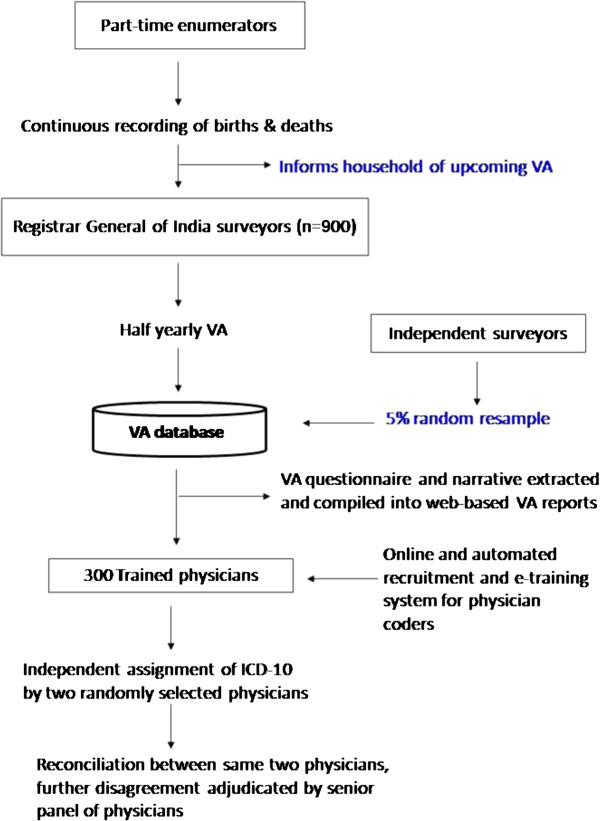
“Two of 404 independent physicians coded each death to the International Classification of Diseases-10th revision (ICD10), reconciling (anonymously) any coding differences with a senior physician adjudicating any persistent disagreements (Gomes et al., 2017; Aleksandrowicz et al., 2014; Menon et al., 2019).”
InfluentialSelf-citationTrends in maternal mortality in India over two decades in nationally representative surveys
Meh, C., Sharma, A., Ram, U., Fadel, S., Correa, N., Snelgrove, J., Shah, P., Begum, R., Shah, M., Hana, T., et al. (2022) · BJOG: An International Journal of Obstetrics & Gynaecology · doi:10.1111/1471-0528.16888 · Cited by 234
“25 However, we minimised such misclassification by having a central panel with at least two skilled obstetrical experts re-review all maternal deaths.”
Self-citationFadel, S. A., Rasaily, R., Awasthi, S., Begum, R., Black, R. E., Gelband, H., Gerland, P., Kumar, R., Liu, L., Mathers, C., et al. (2017) · The Lancet · doi:10.1016/s0140-6736(17)32162-1 · Cited by 207
Self-citationFu, S. H., Gasparrini, A., Rodriguez, P. S., & Jha, P. (2018) · PLOS Medicine · doi:10.1371/journal.pmed.1002619 · Cited by 161
“We performed analyses for stroke, IHD, respiratory diseases, malaria, and cancers for ages 30– 69 years and ages 70 years and above (see Table A in S1 Appendix for ICD-10 codes and death counts) [15].”
Self-citation
Metadata
- Authors
- Aleksandrowicz, L., Malhotra, V., Dikshit, R., Gupta, P. C., Kumar, R., Sheth, J., Rathi, S. K., Suraweera, W., Miasnikof, P., Jotkar, R., Sinha, D., Awasthi, S., Bhatia, P., & Jha, P.
- Affiliations
- St. Michael's Hospital (CA)
- Tata Memorial Hospital (IN)
- Healis Sekhsaria Institute For Public Health (IN)
- Post Graduate Institute of Medical Education and Research (IN)
- Smt. N.H.L. Municipal Medical College (IN)
- Government of Maharashtra (IN)
- World Health Organization (CH)
- King George's Medical University (IN)
- Apollo Institute of Medical Sciences & Research (IN)
- Corresponding author
- Jha, Prabhat
- ORCID
- Venue
- BMC Medicine
- Published
- 2014-02-04
- Volume
- 12
- Issue
- 1
- Pages
- 21-21
- ISSN
- 1741-7015 (ISSN-L)
- PMC
- PMC3912490
- OpenAlex
- W1970372231
- Cited by
- 74
- References
- 47
- Citations by year
- 2026: 4 · 2025: 2 · 2024: 1 · 2023: 5 · 2022: 3 · 2021: 11 · 2020: 4 · 2019: 9 · 2018: 9 · 2017: 9 · 2016: 5 · 2015: 7 · 2014: 5
- FWCI
- 24.05
- Type
- journal article
- Language
- en
- Open access
- gold
- doi.org
- Licence
- Locations
- BMC Medicine (publishedVersion, cc-by)
- Europe PMC (PubMed Central) (publishedVersion, cc-by)
- PubMed Central (publishedVersion, cc-by)
- PubMed (publishedVersion)
- LSHTM Research Online (London School of Hygiene and Tropical Medicine) (acceptedVersion)
- TSpace (University of Toronto) (submittedVersion)
- Greater South Information System
- Funders
- World Health Organization
- Topics
- Social Sciences › Demography › Insurance, Mortality, Demography, Risk Management
- Health Sciences › Medicine › Public Health, Environmental and Occupational Health › Global Health and Epidemiology
- Health Sciences › Medicine › Pediatrics, Perinatology and Child Health › Global Maternal and Child Health
- Keywords
- verbal autopsy, cause of death estimation, cause-specific mortality fractions, resampling, low- and middle-income countries
- MeSH terms
- Adolescent, Adult, Aged, Autopsy, Cause of Death, Child, Child, Preschool, Data Collection, Female, Humans, India, Male, Middle Aged, Registries, Reproducibility of Results, Program Development, Young Adult
About these checks
Registry, retraction, Cites and statistics results are computed, not judged, with one exception: a printed reference that no index lists is read once by a model before it counts as a citation error. Claims are extracted by a model and kept only when their quote appears verbatim in the text; each cited source is then checked, with a model’s help, for whether it says what the claim relies on. Those verdicts can be wrong — read the claim’s quote and the cited source before relying on one.
Statistics and arithmetic are recomputed, not judged.
Confidence bands are shown only for fields calibrated on our annotated test set. None is calibrated yet, so no band is shown.
What counts as a claim ›How we measure confidence ›How we check this ›
Are you an author, or do you see a problem with this page? Request a review
Data sources
Bibliographic data: Semantic Scholar, OpenAlex, Crossref.
Contains information from the Semantic Scholar Academic Graph Datasets, made available under the ODC Attribution License (ODC-BY 1.0).
Semantic Scholar’s data is described in: Kinney, R., et al. (2023). The Semantic Scholar Open Data Platform. arXiv:2301.10140.
