

Reporting methods in studies developing prognostic models in cancer: a review
Open accessThe DOI matches its Crossref record; 88 of the 88 references it cites were found in a registry or an index.
Abstract
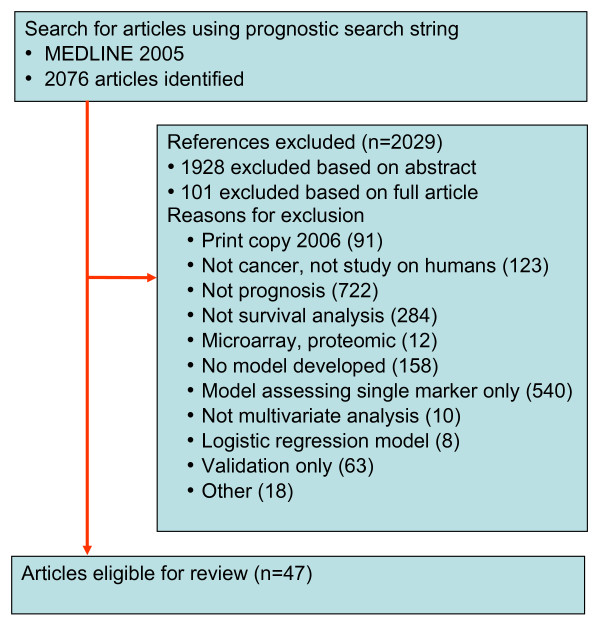
BACKGROUND: Development of prognostic models enables identification of variables that are influential in predicting patient outcome and the use of these multiple risk factors in a systematic, reproducible way according to evidence based methods. The reliability of models depends on informed use of statistical methods, in combination with prior knowledge of disease. We reviewed published articles to assess reporting and methods used to develop new prognostic models in cancer. METHODS: We developed a systematic search string and identified articles from PubMed. Forty-seven articles were included that satisfied the following inclusion criteria: published in 2005; aiming to predict patient outcome; presenting new prognostic models in cancer with outcome time to an event and including a combination of at least two separate variables; and analysing data using multivariable analysis suitable for time to event data. RESULTS: In 47 studies, prospective cohort or randomised controlled trial data were used for model development in only 33% (15) of studies. In 30% (14) of the studies insufficient data were available, having fewer than 10 events per variable (EPV) used in model development. EPV could not be calculated in a further 40% (19) of the studies. The coding of candidate variables was only reported in 68% (32) of the studies. Although use of continuous variables was reported in all studies, only one article reported using recommended methods of retaining all these variables as continuous without categorisation. Statistical methods for selection of variables in the multivariate modelling were often flawed. A method that is not recommended, namely, using statistical significance in univariate analysis as a pre-screening test to select variables for inclusion in the multivariate model, was applied in 48% (21) of the studies. CONCLUSIONS: We found that published prognostic models are often characterised by both use of inappropriate methods for development of multivariable models and poor reporting. In addition, models are limited by the lack of studies based on prospective data of sufficient sample size to avoid overfitting. The use of poor methods compromises the reliability of prognostic models developed to provide objective probability estimates to complement clinical intuition of the physician and guidelines.
Overview
The claims and statistics of this paper haven’t been checked yet.
Free: it reads the open-access text and checks the first 5 claims that cite a source we can check. Create a free account to check every claim.
Integrity signals
Registry
Cites
Statistics
Figures
Verification
Claims the paper makes
The claims and statistics of this paper haven’t been checked yet.
Free: it reads the open-access text and checks the first 5 claims that cite a source we can check. Create a free account to check every claim.
Claims other papers make about this one
Each is checked against this paper’s own text: does it say what the citing paper says it does?
The source backs part of the claim, not all of it — or backs it for a different population, condition or comparison.
In the citing paper
“Many reviews have showed that the quality of reporting in published articles describing the development or validation of multivariable prediction models in medicine is poor [23–27,29].”
From Transparent reporting of a multivariable prediction model for individual prognosis or diagnosis (TRIPOD): the TRIPOD Statement (2015) · cites this paper as [26]
Experimental — accuracy not yet measuredThe source backs part of the claim, not all of it — or backs it for a different population, condition or comparison.
In the citing paper
“Good reporting of how candidate predictors were pre-selected in our review compares favourably with other reviews [15],[20],[21],[29],[33],[35],[36],[48].”
From Reporting and Methods in Clinical Prediction Research: A Systematic Review (2012) · cites this paper as [21]
Experimental — accuracy not yet measuredThe source backs part of the claim, not all of it — or backs it for a different population, condition or comparison.
In the citing paper
“Many reviews have showed that the quality of reporting in published articles describing the development or validation of multivariable prediction models in medicine is poor.23–27,29”
From Transparent Reporting of a Multivariable Prediction Model for Individual Prognosis or Diagnosis (TRIPOD): The TRIPOD Statement (2015) · cites this paper as [26]
Experimental — accuracy not yet measuredThe cited source says what the claim attributes to it.
In the citing paper
“Many reviews have showed that the quality of reporting in published articles describing the development or validation of multivariable prediction models in medicine is poor (23)(24)(25)(26)(27)29).”
From Transparent Reporting of a multivariable prediction model for Individual Prognosis Or Diagnosis (TRIPOD): The TRIPOD Statement (2015) · cites this paper as [25]
The cited source says what the claim attributes to it.
In the citing paper
“However, the overwhelming evidence shows that the quality of reporting of prediction model studies is poor.”
From Transparent Reporting of a Multivariable Prediction Model for Individual Prognosis or Diagnosis (TRIPOD): The TRIPOD Statement (2015) · cites this paper as [26]
3 more claims about this paper
Create a free account to see every claim other papers make about this one.
Self-check
Percentages, sums and reported differences re-computed from the paper’s own numbers.
The self-check needs the paper’s full text.
Citations
Cites
Harrell, F. E. (2001) · Springer Series in Statistics · doi:10.1007/978-1-4757-3462-1 · Cited by 9,195
Clinical Prediction Models: A Practical Approach to Development, Validation, and Updating
Steyerberg, E. W. (2019) · Statistics for Biology and Health · doi:10.1007/978-3-030-16399-0 · Cited by 3,281
The cost of dichotomising continuous variables
Altman, D. G., & Royston, P. (2006) · BMJ · doi:10.1136/bmj.332.7549.1080 · Cited by 2,688
Self-citationDichotomizing continuous predictors in multiple regression: a bad idea
Royston, P., Altman, D. G., & Sauerbrei, W. (2006) · Statistics in Medicine · doi:10.1002/sim.2331 · Cited by 2,312 · cited 2×
“The practice of dichotomising continuous variables is not recommended, as it is an extreme form of rounding that causes loss of information and statistical power, equivalent to losing a third of the data [70].”
BackgroundSelf-citationPeduzzi, P., Concato, J., Feinstein, A. R., & Holford, T. R. (1995) · Journal of Clinical Epidemiology · doi:10.1016/0895-4356(95)00048-8 · Cited by 2,154 · cited 2×
“on estimates of the stability of coefficient estimates for individual variables in prognostic model [61-66].”
BackgroundChan, A.-W., Hróbjartsson, A., Haahr, M. T., Gøtzsche, P. C., & Altman, D. G. (2004) · JAMA · doi:10.1001/jama.291.20.2457 · Cited by 1,845 · cited 1×
“A review of randomized controlled trials identified selective outcome reporting where the prespecified primary outcome of event -free survival was omitted from published reports [69].”
Self-citation(2012) · Hepatogastroenterology · doi:10.5754/hge12404 · Cited by 1,825
Regression modelling strategies for improved prognostic prediction
Harrell, F. E., Lee, K. L., Califf, R. M., Pryor, D. B., & Rosati, R. A. (1984) · Statistics in Medicine · doi:10.1002/sim.4780030207 · Cited by 1,798 · cited 1×
“on estimates of the stability of coefficient estimates for individual variables in prognostic model [61-66].”
BackgroundSteyerberg, E. W. (2009) · Statistics for Biology and Health · doi:10.1007/978-0-387-77244-8 · Cited by 1,491
Prognosis and prognostic research: validating a prognostic model
Altman, D. G., Vergouwe, Y., Royston, P., & Moons, K. G. M. (2009) · BMJ · doi:10.1136/bmj.b605 · Cited by 1,436 · cited 1×
“In any case, all newly proposed models need independent validation before being considered for clinical use [76].”
BackgroundSelf-citation
Cited by
Moons, K. G. M., Altman, D. G., Reitsma, J. B., Ioannidis, J. P. A., Macaskill, P., Steyerberg, E. W., Vickers, A. J., Ransohoff, D. F., & Collins, G. S. (2015) · Annals of Internal Medicine · doi:10.7326/m14-0698 · Cited by 5,147
Self-citationCollins, G. S., Reitsma, J. B., Altman, D. G., & Moons, K. G. M. (2015) · BMJ · doi:10.1136/bmj.g7594 · Cited by 4,388
“For example, Mallett and colleagues (26) examined 47 reports published in 2005 presenting new prediction models in cancer.”
Self-citationCollins, G. S., Moons, K. G. M., Dhiman, P., Riley, R. D., Beam, A. L., Van Calster, B., Ghassemi, M., Liu, X., Reitsma, J. B., van Smeden, M., et al. (2024) · BMJ · doi:10.1136/bmj-2023-078378 · Cited by 4,718
Collins, G. S., Reitsma, J. B., Altman, D. G., & Moons, K. G. M. (2015) · British Journal of Cancer · doi:10.1038/bjc.2014.639 · Cited by 3,293
“For example, Mallett and colleagues (26) examined 47 reports published in 2005 presenting new prediction models in cancer.”
InfluentialSelf-citationCollins, G. S., Reitsma, J. B., Altman, D. G., & Moons, K. G. M. (2015) · Annals of Internal Medicine · doi:10.7326/m14-0697 · Cited by 3,267
“For example, Mallett and colleagues [26] examined 47 reports published in 2005 presenting new prediction models in cancer.”
BackgroundSelf-citationPROBAST: A Tool to Assess the Risk of Bias and Applicability of Prediction Model Studies
Wolff, R. F., Moons, K. G. M., Riley, R. D., Whiting, P. F., Westwood, M., Collins, G. S., Reitsma, J. B., Kleijnen, J., Mallett, S., & for the PROBAST Group† (2019) · Annals of Internal Medicine · doi:10.7326/m18-1376 · Cited by 2,984
“Round 6 refined the domains and introduced further optional guidance for the use of PROBAST.”
InfluentialSelf-citationMoons, K. G. M., de Groot, J. A. H., Bouwmeester, W., Vergouwe, Y., Mallett, S., Altman, D. G., Reitsma, J. B., & Collins, G. S. (2014) · PLoS Medicine · doi:10.1371/journal.pmed.1001744 · Cited by 2,018
“Recent systematic reviews have found the reporting of performance measures to be poor, with reliance on measures of discrimination [2,15,60].”
BackgroundMethodInfluentialSelf-citationTowards better clinical prediction models: seven steps for development and an ABCD for validation
Steyerberg, E. W., & Vergouwe, Y. (2014) · European Heart Journal · doi:10.1093/eurheartj/ehu207 · Cited by 1,928
“least reported poorly (4) (5) (6) (7).”
Collins, G. S., Reitsma, J. B., Altman, D. G., & Moons, K. (2015) · BMC Medicine · doi:10.1186/s12916-014-0241-z · Cited by 1,927
“For example, Mallett and colleagues [26] examined 47 reports published in 2005 presenting new prediction models in cancer.”
InfluentialSelf-citationMoons, K. G. M., Wolff, R. F., Riley, R. D., Whiting, P. F., Westwood, M., Collins, G. S., Reitsma, J. B., Kleijnen, J., & Mallett, S. (2019) · Annals of Internal Medicine · doi:10.7326/m18-1377 · Cited by 1,669
Self-citationPrognosis Research Strategy (PROGRESS) 3: Prognostic Model Research
Steyerberg, E. W., Moons, K. G. M., van der Windt, D. A., Hayden, J. A., Perel, P., Schroter, S., Riley, R. D., Hemingway, H., Altman, D. G., & for the PROGRESS Group (2013) · PLoS Medicine · doi:10.1371/journal.pmed.1001381 · Cited by 1,508
“Published models have often been developed using inferior statistical methods [8,15,46,61,66].”
MethodSelf-citationExternal validation of a Cox prognostic model: principles and methods
Royston, P., & Altman, D. G. (2013) · BMC Medical Research Methodology · doi:10.1186/1471-2288-13-33 · Cited by 911
“Nowadays, researchers predominantly use the Cox proportional hazards model to analyse time to event data [13,14].”
MethodSelf-citationMoons, K. G. M., Kengne, A. P., Woodward, M., Royston, P., Vergouwe, Y., Altman, D. G., & Grobbee, D. E. (2012) · Heart · doi:10.1136/heartjnl-2011-301246 · Cited by 889
Self-citationCollins, G. S., Reitsma, J. B., Altman, D. G., & Moons, K. G. M. (2015) · British Journal of Surgery · doi:10.1002/bjs.9736 · Cited by 889
Self-citationCollins, G. S., Dhiman, P., Andaur Navarro, C. L., Ma, J., Hooft, L., Reitsma, J. B., Logullo, P., Beam, A. L., Peng, L., Van Calster, B., et al. (2021) · BMJ Open · doi:10.1136/bmjopen-2020-048008 · Cited by 852
Collins, G. S., Reitsma, J. B., Altman, D. G., & Moons, K. G. M. (2015) · Circulation · doi:10.1161/circulationaha.114.014508 · Cited by 793
Self-citationA guide to systematic review and meta-analysis of prognostic factor studies
Riley, R. D., Moons, K. G. M., Snell, K. I. E., Ensor, J., Hooft, L., Altman, D. G., Hayden, J., Collins, G. S., & Debray, T. P. A. (2019) · BMJ · doi:10.1136/bmj.k4597 · Cited by 742
Self-citationCollins, G. S., de Groot, J. A., Dutton, S., Omar, O., Shanyinde, M., Tajar, A., Voysey, M., Wharton, R., Yu, L.-M., Moons, K. G., et al. (2014) · BMC Medical Research Methodology · doi:10.1186/1471-2288-14-40 · Cited by 729
“The data extraction form for this review was based largely on previous systemic reviews of studies describing the development of multivariable prediction models [1,2,22,23,27] and can be found in Additional file 2.”
BackgroundMethodResultSelf-citationReporting and Methods in Clinical Prediction Research: A Systematic Review
Bouwmeester, W., Zuithoff, N. P. A., Mallett, S., Geerlings, M. I., Vergouwe, Y., Steyerberg, E. W., Altman, D. G., & Moons, K. G. M. (2012) · PLoS Medicine · doi:10.1371/journal.pmed.1001221 · Cited by 600
“Good reporting of how candidate predictors were pre-selected in our review compares favourably with other reviews [15,20,21,29,33,35,36,48].”
BackgroundResultSelf-citationCollins, G. S., Mallett, S., Omar, O., & Yu, L.-M. (2011) · BMC Medicine · doi:10.1186/1741-7015-9-103 · Cited by 484
“Regardless of the approach used, the practice of artificially treating a continuous risk predictor as categorical should be avoided [67], yet this is frequently done in the development of risk prediction models [4,5,68-74].”
MethodResultSelf-citationSiontis, G. C. M., Tzoulaki, I., Castaldi, P. J., & Ioannidis, J. P. A. (2015) · Journal of Clinical Epidemiology · doi:10.1016/j.jclinepi.2014.09.007 · Cited by 459
“Currently, numerous prediction models have been developed for a variety of clinical conditions, settings, and outcomes [2,82e86], but few such models have been properly derived, validated, reported in medical literature, and finally implemented in clinical practice [87,88].”
BackgroundCollins, G. S., Reitsma, J. B., Altman, D. G., & Moons, K. G. M. (2015) · European Urology · doi:10.1016/j.eururo.2014.11.025 · Cited by 439
Self-citationPeters, S. A. E., den Ruijter, H. M., Bots, M. L., & Moons, K. G. M. (2012) · Heart · doi:10.1136/heartjnl-2011-300747 · Cited by 415
Collins, G. S., Reitsma, J. B., Altman, D. G., & Moons, K. G. M. (2015) · Journal of Clinical Epidemiology · doi:10.1016/j.jclinepi.2014.11.010 · Cited by 324
“For example, Mallett and colleagues [26] examined 47 reports published in 2005 presenting new prediction models in cancer.”
Self-citationNaggara, O., Raymond, J., Guilbert, F., Roy, D., Weill, A., & Altman, D. G. (2011) · American Journal of Neuroradiology · doi:10.3174/ajnr.a2425 · Cited by 322
Self-citationMarsh, N., Webster, J., Larsen, E., Cooke, M., Mihala, G., & Rickard, C. M. (2018) · Journal of Hospital Medicine · doi:10.12788/jhm.2867 · Cited by 267
“Skin integrity good fair poor 606 (61) 322 (32) 72 (7) 96 (16) 62 (19) 11 (15) 135 (22) 63 (20) 11 (15) 66 (11) 54 (17) 17 (24)”
InfluentialCowley, L. E., Farewell, D. M., Maguire, S., & Kemp, A. M. (2019) · Diagnostic and Prognostic Research · doi:10.1186/s41512-019-0060-y · Cited by 263
Collins, G. S., & Altman, D. G. (2010) · BMJ · doi:10.1136/bmj.c2442 · Cited by 249
Self-citationDiagnostic and prognostic prediction models
Hendriksen, J. M. T., Geersing, G. J., Moons, K. G. M., & de Groot, J. A. H. (2013) · Journal of Thrombosis and Haemostasis · doi:10.1111/jth.12262 · Cited by 229
Sutcliffe, P., Connock, M., Shyangdan, D., Court, R., Kandala, N.-B., & Clarke, A. (2013) · Health Technol Assess · doi:10.3310/hta17420 · Cited by 217
Prognostic models for breast cancer: a systematic review
Phung, M. T., Tin Tin, S., & Elwood, J. M. (2019) · BMC Cancer · doi:10.1186/s12885-019-5442-6 · Cited by 209
“Similar to the previous systematic reviews [8, 77, 80, 81], we found that most studies (59%) did not report, or did not satisfy the suggested minimum requirements for the numbers of events, i.”
ResultPrognostic models in acute pulmonary embolism: a systematic review and meta-analysis
Elias, A., Mallett, S., Daoud-Elias, M., Poggi, J.-N., & Clarke, M. (2016) · BMJ Open · doi:10.1136/bmjopen-2015-010324 · Cited by 211
Self-citationRisk factors for intensive care unit-acquired weakness: A systematic review and meta-analysis
Yang, T., Li, Z., Jiang, L., Wang, Y., & Xi, X. (2018) · Acta Neurologica Scandinavica · doi:10.1111/ane.12964 · Cited by 202
Reporting performance of prognostic models in cancer: a review.
Mallett, S., Royston, P., Waters, R., Dutton, S., & Altman, D. G. (2010) · BMC Medicine · doi:10.1186/1741-7015-8-21 · Cited by 195
“Details of the literature search, inclusion criteria and methods in data extraction are reported in the companion paper (Mallett et al [7]).”
MethodInfluentialSelf-citationPrognostic models in obstetrics: available, but far from applicable
Kleinrouweler, C. E., Cheong-See, F. M., Collins, G. S., Kwee, A., Thangaratinam, S., Khan, K. S., Mol, B. W. J., Pajkrt, E., Moons, K. G. M., & Schuit, E. (2016) · American Journal of Obstetrics and Gynecology · doi:10.1016/j.ajog.2015.06.013 · Cited by 193
Collins, G. S., Omar, O., Shanyinde, M., & Yu, L.-M. (2013) · Journal of Clinical Epidemiology · doi:10.1016/j.jclinepi.2012.06.020 · Cited by 192
Collins, G. S., Ogundimu, E. O., Cook, J. A., Manach, Y. L., & Altman, D. G. (2016) · Statistics in Medicine · doi:10.1002/sim.6986 · Cited by 185
“As studies developing new prognostic models are already generally quite small, it seems unwise to discard any information [6,8].”
BackgroundSelf-citationMeads, C., Ahmed, I., & Riley, R. D. (2012) · Breast Cancer Research and Treatment · doi:10.1007/s10549-011-1818-2 · Cited by 177
“have been found by prediction model articles in other fields [40, 41].”
Poor performance of clinical prediction models: the harm of commonly applied methods
Steyerberg, E. W., Uno, H., Ioannidis, J. P. A., van Calster, B., Ukaegbu, C., Dhingra, T., Syngal, S., & Kastrinos, F. (2018) · Journal of Clinical Epidemiology · doi:10.1016/j.jclinepi.2017.11.013 · Cited by 168
McLernon, D. J., Giardiello, D., Van Calster, B., Wynants, L., van Geloven, N., van Smeden, M., Therneau, T., Steyerberg, E. W., Initiative, T. G. 6. A. 8. O. T. S., McLernon, D. J., et al. (2023) · Annals of Internal Medicine · doi:10.7326/m22-0844 · Cited by 164
Peat, G., Riley, R. D., Croft, P., Morley, K. I., Kyzas, P. A., Moons, K. G. M., Perel, P., Steyerberg, E. W., Schroter, S., Altman, D. G., et al. (2014) · PLoS Medicine · doi:10.1371/journal.pmed.1001671 · Cited by 152
“Most do not explicitly build on previous findings, are often too small to answer the research question, and typically do not provide sample size calculations [24,25].”
BackgroundSelf-citationRisk factors for invasive fungal disease in critically ill adult patients: a systematic review
Muskett, H., Shahin, J., Eyres, G., Harvey, S., Rowan, K., & Harrison, D. (2011) · Critical Care · doi:10.1186/cc10574 · Cited by 150
“Adequacy of sample size was established using the generally held rule of ten events per variable [25].”
MethodDhiman, P., Ma, J., Andaur Navarro, C. L., Speich, B., Bullock, G., Damen, J. A. A., Hooft, L., Kirtley, S., Riley, R. D., Van Calster, B., et al. (2022) · BMC Medical Research Methodology · doi:10.1186/s12874-022-01577-x · Cited by 140
Mahar, A. L., Compton, C. C., Halabi, S., Hess, K. R., Weiser, M. R., & Groome, P. A. (2017) · Journal of Surgical Oncology · doi:10.1002/jso.24774 · Cited by 152
Collins, G. S., Reitsma, J. B., Altman, D. G., & Moons, K. G. M. (2015) · BJOG An International Journal of Obstetrics & Gynaecology · doi:10.1111/1471-0528.13244 · Cited by 207
Self-citationSTRengthening Analytical Thinking for Observational Studies: the STRATOS initiative
Sauerbrei, W., Abrahamowicz, M., Altman, D. G., le Cessie, S., Carpenter, J., & initiative, O. B. O. T. S. (2014) · Statistics in Medicine · doi:10.1002/sim.6265 · Cited by 135
“An approach that is not recommended, namely, using statistical significance in univariate analysis as a pre-screening test to select variables for inclusion in the multivariate model, was applied in 48% (21/43) of a sample of multivariable models in oncology studies [22].”
MethodSelf-citationPrognostic models for predicting mortality in elderly ICU patients: a systematic review
Minne, L., Ludikhuize, J., de Jonge, E., de Rooij, S. E., & Abu–Hanna, A. (2011) · Intensive Care Medicine · doi:10.1007/s00134-011-2265-6 · Cited by 140
“These imply the following prerequisites for useful models as reported elsewhere [17–19]: clinical credibility and clinical effectiveness, good methodological quality, external validation, and good performance.”
MethodAlaref, S. J., Singh, G., van Rosendael, A. R., Kolli, K. K., Ma, X., Maliakal, G., Pandey, M. K., Lee, B. C., Wang, J., Xu, Z., et al. (2019) · Journal of the American Heart Association · doi:10.1161/jaha.118.011160 · Cited by 127
“To this end, numerous risk scores and prediction models have been developed using traditional statistical approaches that involve the inclusion of limited, single-center cohorts, the application of numerous exclusion criteria, inclusion of prespecified variables expected to be related to the outcome, and do not addres…”
BackgroundGill, P. J., Ashdown, H. F., Wang, K., Heneghan, C. J., Roberts, N. W., Harnden, A., & Mallett, S. (2014) · The Lancet Respiratory Medicine · doi:10.1016/s2213-2600(14)70252-8 · Cited by 130
Self-citationDhiman, P., Ma, J., Navarro, C. A., Speich, B., Bullock, G., Damen, J. A., Kirtley, S., Hooft, L., Riley, R. D., Van Calster, B., et al. (2021) · Journal of Clinical Epidemiology · doi:10.1016/j.jclinepi.2021.06.024 · Cited by 110
“Results from several systematic reviews informally assessing reporting quality and TRIPOD adherence, in on-cology and otherwise, are comparable with our findings [ 6 , 8 , 22 , 24 , 25 , 36–38 ].”
BackgroundMethodResultGoode, E. C., Clark, A. B., Mells, G. F., Srivastava, B., Spiess, K., Gelson, W. T. H., Trivedi, P. J., Lynch, K. D., Castren, E., Vesterhus, M. N., et al. (2019) · Hepatology · doi:10.1002/hep.30479 · Cited by 106
“We selected variables for the final risk score using backward elimination, with removal of risk factors not significant at the 10% level.(27) Continuous variables were assessed for nonlinear association using cubic splines.”
MethodWessler, B. S., Lai YH, L., Kramer, W., Cangelosi, M., Raman, G., Lutz, J. S., & Kent, D. M. (2015) · Circulation: Cardiovascular Quality and Outcomes · doi:10.1161/circoutcomes.115.001693 · Cited by 105
Hodgson, L. E., Sarnowski, A., Roderick, P. J., Dimitrov, B. D., Venn, R. M., & Forni, L. G. (2017) · BMJ Open · doi:10.1136/bmjopen-2017-016591 · Cited by 100
Which Models Can I Use to Predict Adult ICU Length of Stay? A Systematic Review*
Verburg, I. W. M., Atashi, A., Eslami, S., Holman, R., Abu–Hanna, A., de Jonge, E., Peek, N. B., & de Keizer, N. F. (2016) · Critical Care Medicine · doi:10.1097/ccm.0000000000002054 · Cited by 110
Key steps and common pitfalls in developing and validating risk models
Wynants, L., Collins, G. S., & CALSTER, B. V. (2016) · BJOG An International Journal of Obstetrics & Gynaecology · doi:10.1111/1471-0528.14170 · Cited by 106
Tackling COVID-19 through Responsible AI Innovation: Five Steps in the Right Direction
Leslie, D. (2020) · Harvard Data Science Review · doi:10.1162/99608f92.4bb9d7a7 · Cited by 94
Systematic review of prediction models for gestational hypertension and preeclampsia
Antwi, E., Amoakoh‐Coleman, M., Vieira, D. L., Madhavaram, S., Koram, K. A., Grobbee, D. E., Agyepong, I. A., & Klipstein‐Grobusch, K. (2020) · PLoS ONE · doi:10.1371/journal.pone.0230955 · Cited by 115
Studerus, E., Ramyead, A., & Riecher-Rössler, A. (2017) · Psychological Medicine · doi:10.1017/s0033291716003494 · Cited by 91
“The results of this review are therefore consistent with reviews of prediction modeling studies in other medical fields (Mushkudiani et al. 2008; Mallett et al. 2010; Collins et al. 2011; Bouwmeester et al. 2012; Collins et al. 2013).”
BackgroundResultInfluentialVernooij, L. M., van Klei, W. A., Moons, K. G. M., Takada, T., van Waes, J. A. R., & Damen, J. A. (2021) · Cochrane Database of Systematic Reviews · doi:10.1002/14651858.cd013139.pub2 · Cited by 113
Nixdorf, D. R., Law, A., Lindquist, K., Reams, G. J., Cole, E., Kanter, K., Nguyen, R. H. N., & Harris, D. R. (2015) · Pain · doi:10.1097/j.pain.0000000000000343 · Cited by 101
“makes it difficult to includemore predictors within the model even if using 10 outcome events per predictor rule-of-thumb for modeling.(18) Third, the pain being reported at baseline may not have originated from the tooth that was treated (eg, reversible pulpitis in the adjacent tooth) or was originally nonodontogenic…”
MethodRisk Prediction Models for Incident Primary Cutaneous Melanoma: A Systematic Review
Vuong, K., McGeechan, K., Armstrong, B. K., & Cust, A. E. (2014) · JAMA Dermatology · doi:10.1001/jamadermatol.2013.8890 · Cited by 81
Warfarin dosing algorithms: A systematic review
Asiimwe, I. G., Zhang, E. J., Osanlou, R., Jorgensen, A., & Pirmohamed, M. (2020) · British Journal of Clinical Pharmacology · doi:10.1111/bcp.14608 · Cited by 94
“In the context of not adhering to current methodological recommendations, warfarin dosing algorithms may not be unique.(50,51) The consequences of most of the design flaws have been previously described in detail.”
BackgroundMa, J., Dhiman, P., Qi, C., Bullock, G. S., van Smeden, M., Riley, R. D., & Collins, G. S. (2023) · Journal of Clinical Epidemiology · doi:10.1016/j.jclinepi.2023.07.017 · Cited by 96
“These reviews also observed inadequate sample sizes when developing prediction models based on the number of candidate predictors and the number of available events [20,63,64].”
Systematic review of predictive risk models for adverse drug events in hospitalized patients
Falconer, N., Barras, M. A., & Cottrell, N. (2018) · British Journal of Clinical Pharmacology · doi:10.1111/bcp.13514 · Cited by 88
Carluccio, E., Dini, F. L., Biagioli, P., Lauciello, R., Simioniuc, A., Zuchi, C., Alunni, G., Reboldi, G., Marzilli, M., & Ambrosio, G. (2013) · European Journal of Heart Failure · doi:10.1093/eurjhf/hft038 · Cited by 86
“At this step, to avoid loss of information and preserve statistical power, continuous rather than dichotomized variables were used.(34) Collinearity diagnostics were performed to look for multicollinearity between the independent predictors.”
MethodCritical review of reporting of the data analysis step in metabolomics
Considine, E. C., Thomas, G. R., Boulesteix, A., Khashan, A. S., & Kenny, L. C. (2017) · Metabolomics · doi:10.1007/s11306-017-1299-3 · Cited by 83
Kobayashi, T., Ito, K., Kojima, T., Kato, M., Kanda, S., Hatakeyama, S., Matsui, Y., Matsushita, Y., Naito, S., Shiga, M., et al. (2020) · Cancer Science · doi:10.1111/cas.14762 · Cited by 76
A secure distributed logistic regression protocol for the detection of rare adverse drug events
Emam, K. E., Samet, S., Arbuckle, L., Tamblyn, R. M., Earle, C. C., & Kantarcıoğlu, M. (2012) · Journal of the American Medical Informatics Association · doi:10.1136/amiajnl-2011-000735 · Cited by 67
Venema, E., Wessler, B. S., Paulus, J. K., Salah, R., Raman, G., Leung, L. Y., Koethe, B. C., Nelson, J., Park, J. G., van Klaveren, D., et al. (2021) · Journal of Clinical Epidemiology · doi:10.1016/j.jclinepi.2021.06.017 · Cited by 65
Jeurkar, N., Farrington, S., Craig, T. R., Slattery, J., Harrold, J. K., Oldanie, B., Teno, J. M., & Casarett, D. J. (2012) · Journal of Clinical Oncology · doi:10.1200/jco.2011.41.5711 · Cited by 64
Prediction models for the risk of gestational diabetes: a systematic review
Lamain – de Ruiter, M., Kwee, A., Naaktgeboren, C. A., Franx, A., Moons, K. G. M., & Koster, M. P. H. (2017) · Diagnostic and Prognostic Research · doi:10.1186/s41512-016-0005-7 · Cited by 62
“Correspond-ingly, other systematic reviews on prognostic models in different fields (i.e., cancer prognosis, low back pain prognosis, and prognosis of pregnancy complications) also report the frequent occurrence of inadequate methods for development of prediction models [43 – 45].”
Comparison of all 19 published prognostic scores for intracerebral hemorrhage
Satopää, J., Mustanoja, S. M., Meretoja, A., Jukka Putaala, A., Kaste, M., Niemela, M. R., Tatlisumak, T., & Strbian, D. (2017) · Journal of the Neurological Sciences · doi:10.1016/j.jns.2017.05.034 · Cited by 61
“Choosing variables only based on univariate analyses can also lead to statistical over-fitting – the regression model may suggest leaving out covariates that are generally significant but not so for the derivation cohort [31].”
BackgroundCollins, G. S., Reitsma, J. B., Altman, D. G., & Moons, K. G. M. (2015) · European Journal of Clinical Investigation · doi:10.1111/eci.12376 · Cited by 58
Self-citationHalligan, S., Menu, Y., & Mallett, S. (2021) · European Radiology · doi:10.1007/s00330-021-07971-1 · Cited by 63
“significance in univariable analysis, followed by retaining those that remain significant within the model [18, 19].”
BackgroundSelf-citationStebbing, J., Sharma, A., North, B. V., Athersuch, T. J., Zebrowski, A., Pchejetski, D., Coombes, R. C., Nicholson, J. K., & Keun, H. C. (2011) · Annals of Oncology · doi:10.1093/annonc/mdr347 · Cited by 62
“used 10 events per candidate variable recommended for stable estimates [25, 26]; five candidate risk factors were selected a priori as those used in the definition of metabolic syndrome in order to test the hypothesis of”
MethodHarrison, D. A., Muskett, H., Harvey, S. E., Grieve, R., Shahin, J., Patel, K., Sadique, Z., Allen, E., Dybowski, R., Jit, M., et al. (2013) · Health Technology Assessment · doi:10.3310/hta17030 · Cited by 56
“82% beta (2151; 34,790) After end of calendar day 3 8.”
Fracture Risk Assessment: State of the Art, Methodologically Unsound, or Poorly Reported?
Collins, G. S., & Michaëlsson, K. (2012) · Current Osteoporosis Reports · doi:10.1007/s11914-012-0108-1 · Cited by 51
Prognostic models in COVID-19 infection that predict severity: a systematic review
Buttia, C., Llanaj, E., Raeisi‐Dehkordi, H., Kastrati, L., Amiri, M., Meçani, R., Taneri, P. E., Gómez‐Ochoa, S. A., Raguindin, P. F., Wehrli, F., et al. (2023) · European Journal of Epidemiology · doi:10.1007/s10654-023-00973-x · Cited by 69
“Data in the registries are usually collected for many purposes other than development of the prognostic models [320].”
BackgroundLarsen, E. N., Marsh, N. M., O’Brien, C., Monteagle, E., Friese, C. R., & Rickard, C. M. (2020) · Supportive Care in Cancer · doi:10.1007/s00520-020-05643-2 · Cited by 73
“The sample size was determined by calculating the number of anticipated failure events, to ensure a minimum of ten events per variable (twenty possible risk factors) used in model development [18]; this practice is recommended for observational studies in cancer research employing multivariable modelling.”
MethodUllmann, T., Heinze, G., Hafermann, L., Wallisch, C., Dunkler, D., & initiative, F. T. O. T. S. (2024) · PLoS ONE · doi:10.1371/journal.pone.0308543 · Cited by 54
Critical Assessment of Clinical Prognostic Tools in Melanoma
Mahar, A. L., Compton, C. C., Halabi, S., Hess, K. R., Gershenwald, J. E., Scolyer, R. A., & Groome, P. A. (2016) · Annals of Surgical Oncology · doi:10.1245/s10434-016-5212-5 · Cited by 51
Lindroth, H. L., Bratzke, L. C., Twadell, S., Rowley, P. A., Kildow, J., Danner, M., Turner, L., Hernandez, B. A., Brown, R., & Sanders, R. (2019) · International Journal of Geriatric Psychiatry · doi:10.1002/gps.5104 · Cited by 49
Maillard, J., Elia, N., Haller, C. S., Delhumeau, C., & Walder, B. (2015) · Health and Quality of Life Outcomes · doi:10.1186/s12955-014-0194-0 · Cited by 56
“Given that our sample consisted of 100 patients, we were able to fulfill the power requests and additionally account for potential losses to follow-up (estimation was about 15%), uncompleted questionnaires (estimation was about 10%) and avoidance of overfitting related to insufficient intraoperative and postoperative…”
BackgroundDamen, J. A., Debray, T. P. A., Pajouheshnia, R., Reitsma, J. B., Scholten, R. J. P. M., Moons, K. G. M., & Hooft, L. (2019) · BMJ Open · doi:10.1136/bmjopen-2018-026160 · Cited by 50
A systematic review of case-mix adjustment models for stroke
Teale, E. A., Förster, A., Munyombwe, T., & Young, J. B. (2012) · Clinical Rehabilitation · doi:10.1177/0269215511433068 · Cited by 50
The Role of Risk Prediction Models in Prevention and Management of AKI
Hodgson, L. E., Selby, N. M., Huang, T., & Forni, L. G. (2019) · Seminars in Nephrology · doi:10.1016/j.semnephrol.2019.06.002 · Cited by 45
Carroll, L. J. (2011) · Spine · doi:10.1097/brs.0b013e31823881a4 · Cited by 40
Refining Prognosis in Lung Cancer
Mahar, A. L., Compton, C. C., McShane, L. M., Halabi, S., Asamura, H., Rami–Porta, R., & Groome, P. A. (2015) · Journal of Thoracic Oncology · doi:10.1097/jto.0000000000000652 · Cited by 43
“TABLE 3 A Description of Quality Criteria of Prognostic Tools Targeting Prognosis for Patients with Lung Cancer (n = 32) Quality Criteria N (%) Prognostic factor selection method Literature-based/clinical reasoning 8 (25) Screened using univariate analysis 4 (13) Available in existing data set 2 (6) Not reported 18 (5…”
MethodSenior, M., Fanshawe, T. R., Fazel, M. S., & Fazel, S. (2021) · JCPP Advances · doi:10.1002/jcv2.12034 · Cited by 40
Thompson, D. D., Murray, G. D., Dennis, M. S., Sudlow, C. L. M., & Whiteley, W. N. (2014) · BMC Medicine · doi:10.1186/1741-7015-12-58 · Cited by 41
“We adapted quality items from similar systematic reviews [6,7,9-13] (Table 1) as no recommended tool for the appraisal of quality of prediction models currently exists.”
MethodComposite Outcomes in Clinical Prediction Modeling: Are We Trying to Predict Apples and Oranges?
Dash, K., Goodacre, S. W., & Sutton, L. (2022) · Annals of Emergency Medicine · doi:10.1016/j.annemergmed.2022.01.046 · Cited by 41
Review article: delivering precision oncology in intermediate‐stage liver cancer
Pinato, D. J., Howell, J. A., Ramaswami, R., & Sharma, R. (2017) · Alimentary Pharmacology & Therapeutics · doi:10.1111/apt.14066 · Cited by 34
Gass, J. S., Mitchell, S. D., & Hanna, M. (2019) · BMC Cancer · doi:10.1186/s12885-019-5553-0 · Cited by 37
Predicting Depression and Quality of Life among Long‐term Head and Neck Cancer Survivors
Moubayed, S. P., Sampalis, J. S., Ayad, T., Guertin, L., Bissada, É., Gologan, O., Soulières, D., Lambert, L., Filion, É., Nguyen‐Tan, P. F., et al. (2014) · Otolaryngology · doi:10.1177/0194599814557772 · Cited by 36
“The validity of the study lies in the fact that the identification of our predictors was systematic and done according to previously published methodologies on multivariate analyses in cancer.(29,30) The large sample size and high participation rate contributed to this fact, although this patient population should sti…”
Jinks, R. C., Royston, P., & Parmar, M. K. (2015) · BMC Medical Research Methodology · doi:10.1186/s12874-015-0078-y · Cited by 32
“[2] found that although 96 % of studies in their review of survival models reported the number of patients included in analyses, only 70 % reported the number of events – a key quantity for time-to-event data.”
BackgroundInfluentialSelf-citationde Wit, K., Mercuri, M., Clayton, N., Mercier, É., Morris, J., Jeanmonod, R., Eagles, D. A., Varner, C. E., Barbic, D., Buchanan, I. M., et al. (2023) · Canadian Medical Association Journal · doi:10.1503/cmaj.230634 · Cited by 34
Pinart, M., Kunath, F., Lieb, V., Tsaur, I., Wullich, B., & Schmidt, S. (2018) · World Journal of Urology · doi:10.1007/s00345-018-2574-2 · Cited by 36
“Model performance Candidate prognostic factors for inclusion in multivariate models were mainly selected using statistical significance in univariate analysis, which is not particularly recommended in small studies [14].”
MethodResultInfluentialAcute kidney injury risk prediction score for critically-ill surgical patients
Trongtrakul, K., Patumanond, J., Kongsayreepong, S., Morakul, S., Pipanmekaporn, T., Akaraborworn, O., & Poopipatpab, S. (2020) · BMC Anesthesiology · doi:10.1186/s12871-020-01046-2 · Cited by 29
Luu, J. H., Борисенко, Е. А., Przekop, V., Patil, A., Forrester, J. D., & Choi, J. (2024) · Trauma Surgery & Acute Care Open · doi:10.1136/tsaco-2023-001222 · Cited by 34
Metadata
- Authors
- Mallett, S., Royston, P., Dutton, S., Waters, R., & Altman, D. G.
- Affiliations
- University of Oxford (GB)
- MRC Clinical Trials Unit at UCL (GB)
- Corresponding author
- Mallett, Susan
- Venue
- BMC Medicine
- Published
- 2010-03-30
- Volume
- 8
- Issue
- 1
- Pages
- 20-20
- ISSN
- 1741-7015 (ISSN-L)
- PMC
- PMC2856521
- OpenAlex
- W2133103557
- Cited by
- 206
- References
- 88
- Citations by year
- 2026: 6 · 2025: 10 · 2024: 8 · 2023: 14 · 2022: 12 · 2021: 13 · 2020: 11 · 2019: 15 · 2018: 12 · 2017: 16 · 2016: 10 · 2015: 22 · 2014: 19 · 2013: 12 · 2012: 12
- FWCI
- 1.70
- Type
- journal article
- Language
- en
- Open access
- gold
- doi.org
- Licence
- Locations
- BMC Medicine (publishedVersion, cc-by)
- PubMed Central (publishedVersion, cc-by)
- PubMed (publishedVersion)
- DOAJ (DOAJ: Directory of Open Access Journals) (submittedVersion)
- UCL Discovery (University College London) (submittedVersion)
- University of Birmingham Research Portal (University of Birmingham) (submittedVersion, other-oa)
- Funders
- Cancer Research UK
- Medical Research Council (MC_EX_G0800814, U.1228.06.001.00002.01)
- Topics
- Physical Sciences › Mathematics › Statistics and Probability › Statistical Methods in Epidemiology
- Social Sciences › Decision Sciences › Statistics, Probability and Uncertainty › Meta-analysis and systematic reviews
- Physical Sciences › Mathematics › Statistics and Probability › Statistical Methods and Inference
- Keywords
- prognostic model, cancer, reporting quality, feature selection, time to event, overfitting, prospective cohort, randomized controlled trials, variable coding
- MeSH terms
- Humans, Neoplasms, Prognosis, Statistics as Topic, Multivariate Analysis
About these checks
Registry, retraction, Cites and statistics results are computed, not judged, with one exception: a printed reference that no index lists is read once by a model before it counts as a citation error. Claims are extracted by a model and kept only when their quote appears verbatim in the text; each cited source is then checked, with a model’s help, for whether it says what the claim relies on. Those verdicts can be wrong — read the claim’s quote and the cited source before relying on one.
Statistics and arithmetic are recomputed, not judged.
Confidence bands are shown only for fields calibrated on our annotated test set. None is calibrated yet, so no band is shown.
What counts as a claim ›How we measure confidence ›How we check this ›
Are you an author, or do you see a problem with this page? Request a review
Data sources
Bibliographic data: Semantic Scholar, OpenAlex, Crossref.
Contains information from the Semantic Scholar Academic Graph Datasets, made available under the ODC Attribution License (ODC-BY 1.0).
Semantic Scholar’s data is described in: Kinney, R., et al. (2023). The Semantic Scholar Open Data Platform. arXiv:2301.10140.
