

A systematic review on the effect of sweeteners on glycemic response and clinically relevant outcomes
Open accessThe DOI matches its Crossref record; 82 of the 84 references it cites were found in a registry or an index.
Abstract
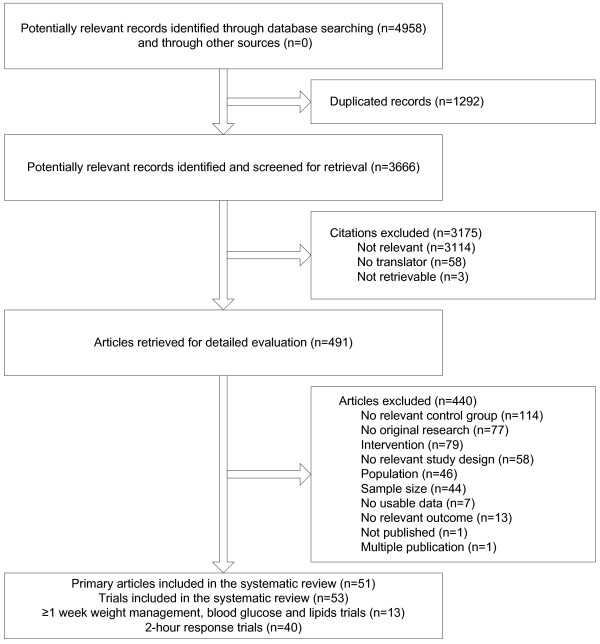
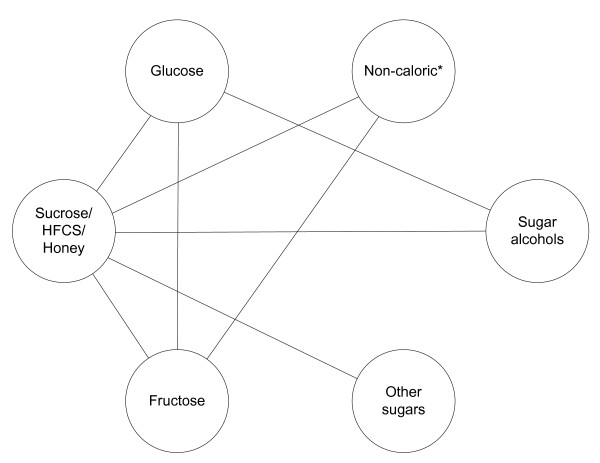
Background: The major metabolic complications of obesity and type 2 diabetes may be prevented and managed with dietary modification. The use of sweeteners that provide little or no calories may help to achieve this objective. Methods: We did a systematic review and network meta-analysis of the comparative effectiveness of sweetener additives using Bayesian techniques. MEDLINE, EMBASE, CENTRAL and CAB Global were searched to January 2011. Randomized trials comparing sweeteners in obese, diabetic, and healthy populations were selected. Outcomes of interest included weight change, energy intake, lipids, glycated hemoglobin, markers of insulin resistance and glycemic response. Evidence-based items potentially indicating risk of bias were assessed. Results: Of 3,666 citations, we identified 53 eligible randomized controlled trials with 1,126 participants. In diabetic participants, fructose reduced 2-hour blood glucose concentrations by 4.81 mmol/L (95% CI 3.29, 6.34) compared to glucose. Two-hour blood glucose concentration data comparing hypocaloric sweeteners to sucrose or high fructose corn syrup were inconclusive. Based on two ≤10-week trials, we found that non-caloric sweeteners reduced energy intake compared to the sucrose groups by approximately 250-500 kcal/day (95% CI 153, 806). One trial found that participants in the non-caloric sweetener group had a decrease in body mass index compared to an increase in body mass index in the sucrose group (-0.40 vs 0.50 kg/m 2, and -1.00 vs 1.60 kg/m 2, respectively). No randomized controlled trials showed that high fructose corn syrup or fructose increased levels of cholesterol relative to other sweeteners. Conclusions: Considering the public health importance of obesity and its consequences; the clearly relevant role of diet in the pathogenesis and maintenance of obesity; and the billions of dollars spent on non-caloric sweeteners, little high-quality clinical research has been done. Studies are needed to determine the role of hypocaloric sweeteners in a wider population health strategy to prevent, reduce and manage obesity and its consequences.
Overview
The claims and statistics of this paper haven’t been checked yet.
Free: it reads the open-access text and checks the first 5 claims that cite a source we can check. Create a free account to check every claim.
Integrity signals
Registry
Cites
Statistics
Figures
Verification
Claims the paper makes
The claims and statistics of this paper haven’t been checked yet.
Free: it reads the open-access text and checks the first 5 claims that cite a source we can check. Create a free account to check every claim.
Self-check
Percentages, sums and reported differences re-computed from the paper’s own numbers.
The self-check needs the paper’s full text.
Citations
Cites
Preferred Reporting Items for Systematic Reviews and Meta-Analyses: the PRISMA statement
Moher, D., Liberati, A., Tetzlaff, J., Altman, D. G., & for the PRISMA Group (2009) · BMJ · doi:10.1136/bmj.b2535 · Cited by 83,823
Bias in meta-analysis detected by a simple, graphical test
Egger, M., Smith, G. D., Schneider, M., & Minder, C. (1997) · BMJ · doi:10.1136/bmj.315.7109.629 · Cited by 56,722 · cited 1×
“with weighted regression [16], however the available”
Preferred reporting items for systematic reviews and meta-analyses: the PRISMA Statement.
(2009) · PubMed Central · Cited by 44,859
Reduction in the incidence of type 2 diabetes with lifestyle intervention or metformin
(2002) · New England Journal of Medicine · doi:10.1056/nejmoa012512 · Cited by 19,011 · cited 1×
“The main metabolic complications of obesity and type 2 diabetes may be prevented and managed in full or in part with dietary modification, including the use of sweeteners that provide little or no calories (hypocaloric sweeteners) [7-10].”
BackgroundAssessing the quality of reports of randomized clinical trials: Is blinding necessary?
Jadad, A. R., Moore, R. A., Carroll, D., Jenkinson, C., Reynolds, D. J. M., Gavaghan, D. J., & McQuay, H. J. (1996) · Controlled Clinical Trials · doi:10.1016/0197-2456(95)00134-4 · Cited by 17,582 · cited 2×
“participants would have been impossible in many of the trials due to taste differences between sweeteners [63], the reporting of important design descriptors were largely absent, indicating a substantial risk for bias [12,13].”
BackgroundMethodBorenstein, M., Hedges, L. V., Higgins, J. P. T., & Rothstein, H. R. (2009) · doi:10.1002/9780470743386 · Cited by 14,225
Tuomilehto, J., Lindström, J., Eriksson, J. G., Valle, T. T., Hämäläinen, H., Ilanne-Parikka, P., Keinänen-Kiukaanniemi, S., Laakso, M., Louheranta, A., Rastas, M., et al. (2001) · New England Journal of Medicine · doi:10.1056/nejm200105033441801 · Cited by 10,873
Borenstein, M., Hedges, L. V., Higgins, J. P. T., & Rothstein, H. R. (2021) · doi:10.1002/9781119558378 · Cited by 9,799
Bariatric Surgery: A Systematic Review and Meta-analysis
Buchwald, H., Avidor, Y., Braunwald, E., Jensen, M. D., Pories, W., Fahrbach, K., & Schoelles, K. (2004) · JAMA · doi:10.1001/jama.292.14.1724 · Cited by 6,800 · cited 1×
“Since even small reductions (as little as 6%) in body-weight can prevent chronic disease [81,82], hypocaloric sweeteners could play an important role in a wider population health strategy to prevent, reduce and manage obesity-related comorbidities.”
BackgroundSchulz (1995) · doi:10.1001/jama.1995.03520290060030 · Cited by 5,634
Research works printed but not linked: 4
- Freedonia Freedonia focus on food and beverage additives 2010 The Freedonia Group I
- Bowker SL Majumdar SR Johnson JA Systematic review of indicators and measurements used in controlled studies of quality improvement for type 2 diabetes Can J Diabetes 2005 29 230 238
- Gougeon R Spidel M Lee K Field CJ Canadian Diabetes Association National Nutrition Committee Technical Review: Non-nutritive Intense Sweeteners in Diabetes Management Can J Diabetes 2004 28 385 399
- Wolever T Barbeau M Charron S Harrigan K Leung S Madrick B Taillefer T Seto C Guidelines for the nutritional management of diabetes mellitus in the new millennium: A position statement by the Canadian Diabetes Association Can J Diabetes Care 1999 23 56 69
Cited by
Items 101–119 of 119
Potential of Natural Sweetener in Indonesia: A Systematic Review
Islamy, M. A. (2024) · Media Gizi Indonesia · doi:10.20473/mgi.v19i3.234-242 · Cited by 1
“Based on the analysis of two trials conducted by Wiebe et al. (2011) found that the use of sweeteners in the diet resulted in lower energy intake compared to carbohydrate groups such as sucrose, which was about 500 kcal/day lower for or 250 kcal/day.”
Voeding bij diabetes mellitus type 2
van Wijland, H. (2013) · TvPO · doi:10.1007/s12503-013-0063-z · Cited by 1
Death by Sugar: The Impact of Sugar on Acutely Ill Patients
Schultze, B., & Ridner, S. H. (2015) · The Journal for Nurse Practitioners · doi:10.1016/j.nurpra.2015.01.025
A critical, updated overview of the role of sugar in our diet
Candela, C. G., & Milla, S. P. (2013) · LA Referencia (Red Federada de Repositorios Institucionales de Publicaciones Científicas)
Evans, R. A., Lithander, F. E., Frese, M., Cunningham, J. H., Mills, K., & Romero, J. (2016) · Cochrane Database of Systematic Reviews · doi:10.1002/14651858.cd011840.pub2
BIOCHEMICAL EFFECT OF A HIGH DOSE OF THAUMATIN IN WISTAR RATS
Khayata, W., Kamri, A., & Alsaleh, R. (2016) · International Journal of Pharmacy and Pharmaceutical Sciences · doi:10.22159/ijpps.2017v9i1.15042
Ernährungsempfehlungen bei Diabetes mellitus (Update 2019)
Schindler, K., Brix, J. M., Dämon, S., Hoppichler, F., Kautzky‐Willer, A., Kruschitz, R., Toplak, H., & Ludvik, B. H. (2019) · Wiener klinische Wochenschrift · doi:10.1007/s00508-019-1470-0
Pehlivan, M., & Köksal, E. (2019) · Mersin üniversitesi sağlık bilimleri dergisi/Mersin üniversitesi sağlık bilimleri dergisi · doi:10.26559/mersinsbd.624135
Non-nutritive Sweetened Beverages and Cardiometabolic Risk
McGlynn, N. D. (2020) · TSpace (University of Toronto)
Optimizing Diet in Patients with Diabetes
Shah, M. (2021) · Wiley eBooks · doi:10.1002/9781119603207.ch10
García, A. I. L., Samaniego-Vaesken, M. D. L., Puga, A. M., Partearroyo, T., & Varela‐Moreiras, G. (2022) · Nutrition Bulletin · doi:10.1111/nbu.12583 · Cited by 2
Dioscoreophyllum cumminsii (Stapf) Diels., an African underutilised indigenous fruit
Oselebe, H. O., Nnamani, C. V., Degbey, H., & Achigan-Dako, G. E. (2024) · Nigerian Journal of Botany · doi:10.4314/njbot.v36i1.3 · Cited by 1
STRUCTURAL-THERMODYNAMIC MODEL OF THE MIXTURE
NIKOLAEVA, S. V., & Krasnikov, S. A. (2024) · International Conference Process Management and Scientific Developments · doi:10.34660/inf.2020.49.83.023
CONSTITUTIONAL FEATURES OF THE HEAD AND NECK AND RELATED ANATOMICAL VARIABILITY OF THE ORGANS
Туратбековна, О. А., & Izranov, V. A. (2024) · International Conference Process Management and Scientific Developments · doi:10.34660/inf.2020.66.20.014
HOLOGRAPHIC PROPERTIES OF CHALCOGENIDE GLASSY SEMICONDUCTOR (CGS) FILMS
Azamatov, Z. T., Bekchanova, M. R., & Bakhromov, A. B. (2024) · International Conference Process Management and Scientific Developments · doi:10.34660/inf.2020.22.18.021
Rawal, R., Klurfeld, D. M., Yerke, A., Klurfeld, D., Kramer, M., & Higgins, K. (2025) · OSF Preprints (OSF Preprints)
Köpsel, M., Kostka, T., & Esatbeyoglu, T. (2026) · ACS Omega · doi:10.1021/acsomega.5c06005
Ernährungsempfehlungen für Menschen mit Diabetes (Update 2026)
Klammer, C., Schindler, K., Bugl, R., Plazek, D., Vötter, M., Kirchner, T., Martino, C., Klammer-Martin, J., Huber, J., Krzizek, E.-C., et al. (2026) · Wiener klinische Wochenschrift · doi:10.1007/s00508-025-02676-7
Feeding the estrobolome with sweet prebiotics?
Agoni, L., Martinelli, C., Cortellino, S., Giordano, A., & Seta, F. D. (2026) · Frontiers in Nutrition · doi:10.3389/fnut.2026.1957439
Metadata
- Authors
- Wiebe, N., Padwal, R., Field, C., Marks, S., Jacobs, R., & Tonelli, M.
- Affiliations
- University of Alberta (CA)
- Corresponding author
- Tonelli, Marcello
- Venue
- BMC Medicine
- Published
- 2011-11-17
- Volume
- 9
- Issue
- 1
- Pages
- 123-123
- ISSN
- 1741-7015 (ISSN-L)
- PMC
- PMC3286380
- OpenAlex
- W2022894997
- Cited by
- 118
- References
- 84
- Citations by year
- 2026: 5 · 2025: 5 · 2024: 7 · 2023: 5 · 2022: 4 · 2021: 7 · 2020: 14 · 2019: 12 · 2018: 6 · 2017: 13 · 2016: 9 · 2015: 11 · 2014: 7 · 2013: 10 · 2012: 3
- FWCI
- 0.76
- Type
- journal article
- Language
- en
- Open access
- gold
- doi.org
- Licence
- Locations
- BMC Medicine (publishedVersion, cc-by)
- PubMed Central (publishedVersion, cc-by)
- PubMed (publishedVersion)
- DOAJ (DOAJ: Directory of Open Access Journals) (submittedVersion)
- Funders
- Fondation pour la Recherche Médicale
- Alberta Heritage Foundation for Medical Research
- Topics
- Health Sciences › Nursing › Nutrition and Dietetics › Biochemical Analysis and Sensing Techniques
- Health Sciences › Medicine › Endocrinology, Diabetes and Metabolism › Diet, Metabolism, and Disease
- Health Sciences › Medicine › Public Health, Environmental and Occupational Health › Nutritional Studies and Diet
- Keywords
- sweeteners, artificial sweeteners, glycemic response, fructose, high fructose corn syrup, sucrose, energy intake, weight change, body mass index, insulin resistance, HbA1c, obesity, type 2 diabetes, cholesterol, dietary change
- MeSH terms
- Blood Glucose, Cholesterol, Diabetes Mellitus, Type 2, Diet, Humans, Sweetening Agents, Body Mass Index, Randomized Controlled Trials as Topic, Treatment Outcome
About these checks
Registry, retraction, Cites and statistics results are computed, not judged, with one exception: a printed reference that no index lists is read once by a model before it counts as a citation error. Claims are extracted by a model and kept only when their quote appears verbatim in the text; each cited source is then checked, with a model’s help, for whether it says what the claim relies on. Those verdicts can be wrong — read the claim’s quote and the cited source before relying on one.
Statistics and arithmetic are recomputed, not judged.
Confidence bands are shown only for fields calibrated on our annotated test set. None is calibrated yet, so no band is shown.
What counts as a claim ›How we measure confidence ›How we check this ›
Are you an author, or do you see a problem with this page? Request a review
Data sources
Bibliographic data: Semantic Scholar, OpenAlex, Crossref.
Contains information from the Semantic Scholar Academic Graph Datasets, made available under the ODC Attribution License (ODC-BY 1.0).
Semantic Scholar’s data is described in: Kinney, R., et al. (2023). The Semantic Scholar Open Data Platform. arXiv:2301.10140.
