

The DOI matches its Crossref record; 33 of the 33 references it cites were found in a registry or an index.
Tauroursodeoxycholic acid reduces glial cell activation in an animal model of acute neuroinflammation
Open accessAbstract
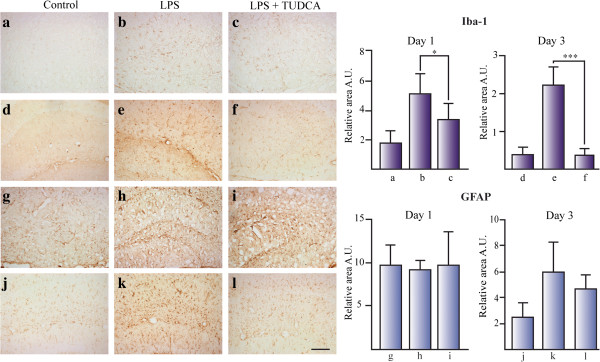
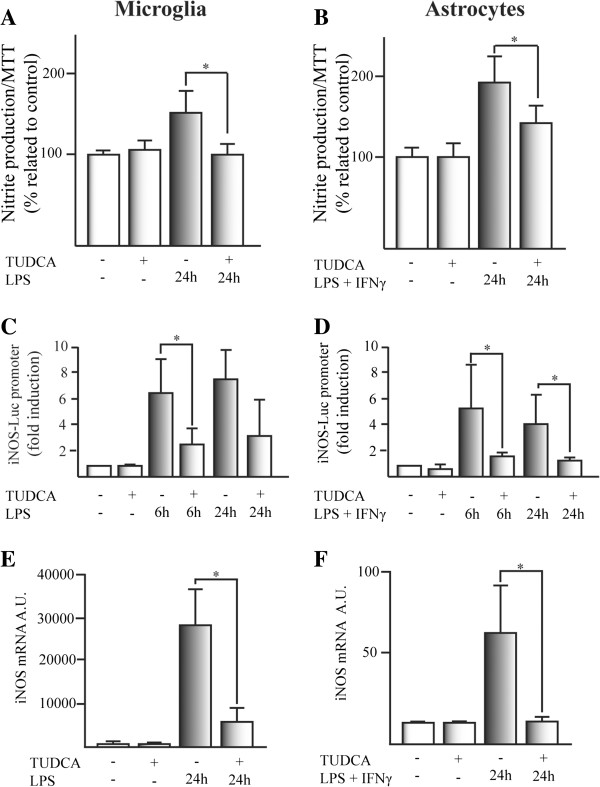
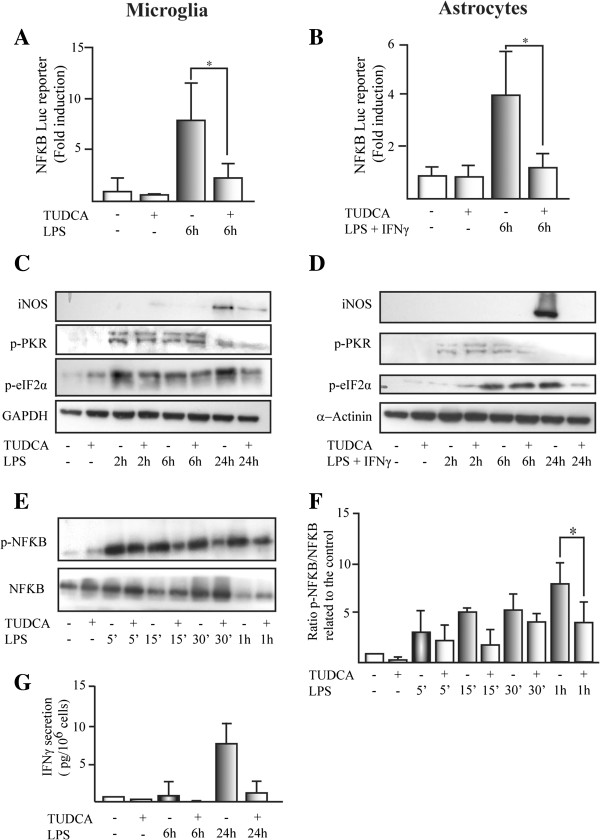
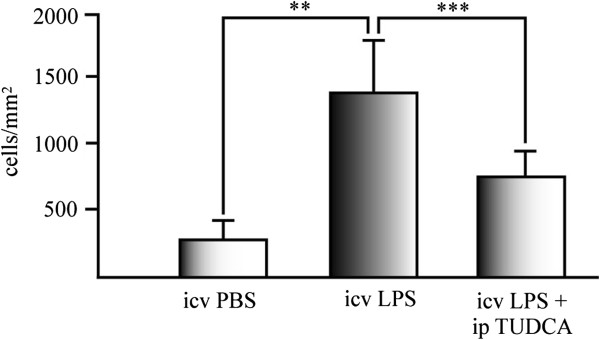
BACKGROUND: Bile acids are steroid acids found predominantly in the bile of mammals. The bile acid conjugate tauroursodeoxycholic acid (TUDCA) is a neuroprotective agent in different animal models of stroke and neurological diseases. However, the anti-inflammatory properties of TUDCA in the central nervous system (CNS) remain unknown. METHODS: The acute neuroinflammation model of intracerebroventricular (icv) injection with bacterial lipopolysaccharide (LPS) in C57BL/6 adult mice was used herein. Immunoreactivity against Iba-1, GFAP, and VCAM-1 was measured in coronal sections in the mice hippocampus. Primary cultures of microglial cells and astrocytes were obtained from neonatal Wistar rats. Glial cells were treated with proinflammatory stimuli to determine the effect of TUDCA on nitrite production and activation of inducible enzyme nitric oxide synthase (iNOS) and NFκB luciferase reporters. We studied the effect of TUDCA on transcriptional induction of iNOS and monocyte chemotactic protein-1 (MCP-1) mRNA as well as induction of protein expression and phosphorylation of different proteins from the NFκB pathway. RESULTS: TUDCA specifically reduces microglial reactivity in the hippocampus of mice treated by icv injection of LPS. TUDCA treatment reduced the production of nitrites by microglial cells and astrocytes induced by proinflammatory stimuli that led to transcriptional and translational diminution of the iNOS. This effect might be due to inhibition of the NFκB pathway, activated by proinflammatory stimuli. TUDCA decreased in vitro microglial migration induced by both IFN-γ and astrocytes treated with LPS plus IFN-γ. TUDCA inhibition of MCP-1 expression induced by proinflammatory stimuli could be in part responsible for this effect. VCAM-1 inmunoreactivity in the hippocampus of animals treated by icv LPS was reduced by TUDCA treatment, compared to animals treated with LPS alone. CONCLUSIONS: We show a triple anti-inflammatory effect of TUDCA on glial cells: i) reduced glial cell activation, ii) reduced microglial cell migratory capacity, and iii) reduced expression of chemoattractants (e.g., MCP-1) and vascular adhesion proteins (e.g., VCAM-1) required for microglial migration and blood monocyte invasion to the CNS inflammation site. Our results present a novel TUDCA anti-inflammatory mechanism, with therapeutic implications for inflammatory CNS diseases.
Overview
The claims and statistics of this paper haven’t been checked yet.
Run the check — free, no account needed. It reads the open-access text and checks the sources it cites.
Integrity signals
Registry
Cites
Statistics
Figures
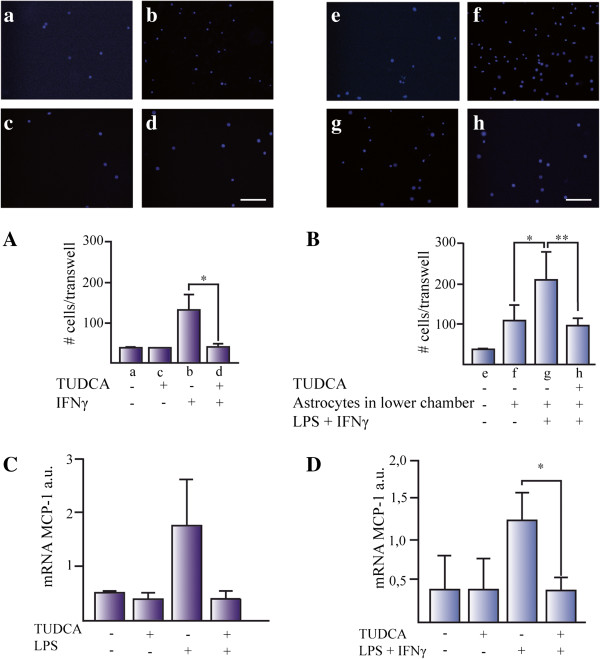
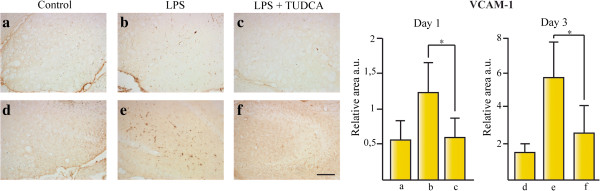
Verification
Claims the paper makes
The claims and statistics of this paper haven’t been checked yet.
Run the check — free, no account needed. It reads the open-access text and checks the sources it cites.
Claims other papers make about this one
Each is checked against this paper’s own text: does it say what the citing paper says it does?
In the citing paper
“In addition, TUDCA is effective in attenuating microglial reactivity in LPS-treated mice.367,370,371”
From Microbiota–gut–brain axis and its therapeutic applications in neurodegenerative diseases (2024) · cites this paper as [370]
Self-check
Percentages, sums and reported differences re-computed from the paper’s own numbers.
The self-check needs the paper’s full text.
Citations
Cites
The Mouse Brain in Stereotaxic Coordinates
Paxinos, G. (2001) · Cited by 12,859
Analysis of nitrate, nitrite, and [15N]nitrate in biological fluids
Green, L. C., Wagner, D. A., Glogowski, J. A., Skipper, P. L., Wishnok, J. S., & Tannenbaum, S. R. (1982) · Analytical Biochemistry · doi:10.1016/0003-2697(82)90118-x · Cited by 12,061
Pathobiology of ischaemic stroke: an integrated view
Dirnagl, U., Iadecola, C., & Moskowitz, M. A. (1999) · Trends in Neurosciences · doi:10.1016/s0166-2236(99)01401-0 · Cited by 3,943
Preparation of separate astroglial and oligodendroglial cell cultures from rat cerebral tissue.
McCarthy, K. D., & de Vellis, J. (1980) · The Journal of Cell Biology · doi:10.1083/jcb.85.3.890 · Cited by 3,845
mouse brain in stereotaxic coordinates
Franklin, K. B. J., & Paxinos, G. (1997) · Cited by 3,258
Toll-like Receptor-4 Mediates Lipopolysaccharide-induced Signal Transduction
Chow, J. C., Young, D. W., Golenbock, D. T., Christ, W. J., & Gusovsky, F. (1999) · Journal of Biological Chemistry · doi:10.1074/jbc.274.16.10689 · Cited by 1,924
Dong, Y., & Benveniste, E. N. (2001) · Glia · doi:10.1002/glia.1107 · Cited by 1,325
Aloisi, F. (2001) · Glia · doi:10.1002/glia.1106 · Cited by 1,310
MCGEER, P., & MCGEER, E. (1995) · Brain Research Reviews · doi:10.1016/0165-0173(95)00011-9 · Cited by 1,287 · cited 1×
“This chronic neuroinflammation causes the loss of white and grey matter that leads to functional deficits [6,7] that characterize the pathology of neurodegenerative diseases [8,9], stroke [10], and traumatic brain injuries [11].”
BackgroundThe role of inflammation in CNS injury and disease
Lucas, S., Rothwell, N. J., & Gibson, R. M. (2006) · British Journal of Pharmacology · doi:10.1038/sj.bjp.0706400 · Cited by 1,272
Inflammation in Neurodegenerative Disease—A Double-Edged Sword
Wyss-Coray, T., & Mucke, L. (2002) · Neuron · doi:10.1016/s0896-6273(02)00794-8 · Cited by 1,235
The Blood-Brain Barrier in Brain Homeostasis and Neurological Diseases
Weiss, N., Miller, F., Cazaubon, S., & Couraud, P.-O. (2009) · Biochimica et Biophysica Acta (BBA) - Biomembranes · doi:10.1016/j.bbamem.2008.10.022 · Cited by 731
Inflammatory response in acute traumatic brain injury: a double-edged sword
Morganti-Kossmann, M., Rancan, M., Stahel, P., & Kossmann, T. (2002) · Current Opinion in Critical Care · doi:10.1097/00075198-200204000-00002 · Cited by 702
Deng, J., Lu, P. D., Zhang, Y., Scheuner, D., Kaufman, R. J., Sonenberg, N., Harding, H. P., & Ron, D. (2004) · Molecular and Cellular Biology · doi:10.1128/mcb.24.23.10161-10168.2004 · Cited by 665
Post-traumatic inflammation following spinal cord injury
Hausmann, O. N. (2003) · Spinal Cord · doi:10.1038/sj.sc.3101483 · Cited by 622
Ursodiol for the Long-Term Treatment of Primary Biliary Cirrhosis
Poupon, R. E., Poupon, R., & Balkau, B. (1994) · New England Journal of Medicine · doi:10.1056/nejm199405123301903 · Cited by 497
Inflammation in central nervous system injury
Allan, S. M., & Rothwell, N. J. (2003) · Philosophical Transactions of the Royal Society B Biological Sciences · doi:10.1098/rstb.2003.1358 · Cited by 353
Keene, C. D., Rodrigues, C. M. P., Eich, T., Chhabra, M. S., Steer, C. J., & Low, W. C. (2002) · Proceedings of the National Academy of Sciences · doi:10.1073/pnas.162362299 · Cited by 306
The Neuropathological and Behavioral Consequences of Intraspinal Microglial/Macrophage Activation
Popovich, P. G., Guan, Z., McGaughy, V. M., Fisher, L. C., Hickey, W. F., & Basso, D. M. (2002) · Journal of Neuropathology & Experimental Neurology · doi:10.1093/jnen/61.7.623 · Cited by 295
PKR Stimulates NF-κB Irrespective of Its Kinase Function by Interacting with the IκB Kinase Complex
Bonnet, M., Weil, R., Dam, E., Hovanessian, A. G., & MEURS, E. F. (2000) · Molecular and Cellular Biology · doi:10.1128/mcb.20.13.4532-4542.2000 · Cited by 234
Rodrigues, C. M. P., Solá, S., Nan, Z., Castro, R. E., Ribeiro, P. S., Low, W. C., & Steer, C. J. (2003) · Proceedings of the National Academy of Sciences · doi:10.1073/pnas.1031632100 · Cited by 210
Neuroprotection by a Bile Acid in an Acute Stroke Model in the Rat
Rodrigues, C. M. P., Spellman, S. R., Solá, S., Grande, A. W., Linehan-Stieers, C., Low, W. C., & Steer, C. J. (2002) · Journal of Cerebral Blood Flow & Metabolism · doi:10.1097/00004647-200204000-00010 · Cited by 160
T-Cell Cytokines in Injury-Induced Neural Damage and Repair
Schroeter, M., & Jander, S. (2005) · NeuroMolecular Medicine · doi:10.1385/nmm:7:3:183 · Cited by 89
Inflammation in the nervous system: The human perspective
Bauer, J., Rauschka, H., & Lassmann, H. (2001) · Glia · doi:10.1002/glia.1112 · Cited by 88
PKR Regulates TLR2/TLR4-Dependent Signaling in Murine Alveolar Macrophages
Cabanski, M., Steinmüller, M., Marsh, L. M., Surdziel, E., Seeger, W., & Lohmeyer, J. (2007) · American Journal of Respiratory Cell and Molecular Biology · doi:10.1165/rcmb.2007-0010oc · Cited by 81
Gaspar, J. M., Martins, A., Cruz, R., Rodrigues, C. M. P., Ambrósio, A. F., & Santiago, A. R. (2013) · Neuroscience · doi:10.1016/j.neuroscience.2013.08.053 · Cited by 78
Mecha, M. (2011) · Protocol Exchange · doi:10.1038/protex.2011.218 · Cited by 65
Joo, S. S., Won, T., & Lee, D. I. (2004) · Archives of Pharmacal Research · doi:10.1007/bf02975850 · Cited by 53
Intracerebral regulation of immune responses
Aloisi, F., Ambrosini, E., Cabezas, S. C., Magliozzi, R., & Serafini, B. (2001) · Annals of Medicine · doi:10.3109/07853890108995960 · Cited by 46
Carrigan, S. O., Pink, D., & Stadnyk, A. W. (2007) · Journal of Leukocyte Biology · doi:10.1189/jlb.0806528 · Cited by 44
Tauroursodeoxycholic acid and secondary damage after spinal cord injury in rats
Çolak, A., Kelten, B., Sağmanligil, A., Akdemir, O., Karaoğlan, A., Şahan, E., Çelik, Ö., & Barut, Ş. (2008) · Journal of Clinical Neuroscience · doi:10.1016/j.jocn.2007.06.002 · Cited by 36
Saura, M., Zaragoza, C., Dı́az-Cazorla, M., Hernández‐Perera, O., Eng, E., Lowenstein, C. J., Pérez‐Sala, D., & Lamas, S. (1998) · Kidney International · doi:10.1046/j.1523-1755.1998.00725.x · Cited by 36
Yin, J., Tu, J., Lin, H.-J., Shi, F., Liu, R.-L., Zhao, C., Coons, S. W., Kuniyoshi, S. M., & Shi, J. (2010) · PLoS ONE · doi:10.1371/journal.pone.0012400 · Cited by 32
Cited by
Sorted by citations
Microbiota–gut–brain axis and its therapeutic applications in neurodegenerative diseases
Loh, J. S., Mak, W. Q., Tan, L. K. S., Ng, C. X., Chan, H. H., Yeow, S. H., Foo, J. B., Ong, Y. S., How, C. W., & Khaw, K. Y. (2024) · Signal Transduction and Targeted Therapy · doi:10.1038/s41392-024-01743-1 · Cited by 1,193
Neuroinflammation in Alzheimer disease
Heneka, M. T., van der Flier, W. M., Jessen, F., Hoozemanns, J., Thal, D. R., Boche, D., Brosseron, F., Teunissen, C., Zetterberg, H., Jacobs, A. H., et al. (2025) · Nature Reviews Immunology · doi:10.1038/s41577-024-01104-7 · Cited by 638
Inflammogenesis of Secondary Spinal Cord Injury
Anwar, M. A., Shehabi, T. S. A., & Eid, A. H. (2016) · Frontiers in Cellular Neuroscience · doi:10.3389/fncel.2016.00098 · Cited by 450
Nam, H. Y., Nam, J. H., Yoon, G., Lee, J., Nam, Y., Kang, H., Cho, H.-J., Kim, J., & Hoe, H. (2018) · Journal of Neuroinflammation · doi:10.1186/s12974-018-1308-0 · Cited by 271
Kusaczuk, M. (2019) · Cells · doi:10.3390/cells8121471 · Cited by 250
Metadata
- Authors
- Yanguas-Casás, N., Barreda-Manso, M. A., Nieto-Sampedro, M., & Romero-Ramírez, L.
- Affiliations
- Instituto Cajal (ES)
- Venue
- Journal of Neuroinflammation
- Published
- 2014-03-19
- Volume
- 11
- Issue
- 1
- Pages
- 50-50
- ISSN
- 1742-2094 (ISSN-L)
- PMC
- PMC4000131
- OpenAlex
- W2119521536
- Cited by
- 103
- References
- 33
- Citations by year
- 2026: 7 · 2025: 7 · 2024: 12 · 2023: 6 · 2022: 13 · 2021: 13 · 2020: 3 · 2019: 7 · 2018: 6 · 2017: 8 · 2016: 7 · 2015: 8 · 2014: 5
- FWCI
- 4.86
- Type
- journal article
- Language
- en
- Open access
- gold
- doi.org
- Licence
- cc-by
- Locations
- Journal of Neuroinflammation (publishedVersion, cc-by)
- Europe PMC (PubMed Central) (publishedVersion, cc-by)
- PubMed Central (publishedVersion, cc-by)
- PubMed (publishedVersion)
- DIGITAL.CSIC (Spanish National Research Council (CSIC)) (submittedVersion, cc-by)
- Funders
- Ministerio de Ciencia e Innovación (SAF2009-11257, SAF2012-40126)
- Topics
- Life Sciences › Neuroscience › Neurology › Neuroinflammation and Neurodegeneration Mechanisms
- Health Sciences › Medicine › Clinical Neurology › Traumatic Brain Injury and Neurovascular Disturbances
- Life Sciences › Neuroscience › Biological Psychiatry › Tryptophan and brain disorders
- Keywords
- tauroursodeoxycholic acid, bile acids, neuroinflammation, glial activation, microglial activation, astrocytes, lipopolysaccharide, NF-κB signaling, nitric oxide synthase, MCP-1, VCAM-1, microglial migration, hippocampus, anti-inflammatory activity, neuroprotection, blood-brain barrier
- MeSH terms
- Animals, Animals, Newborn, Calcium-Binding Proteins, Cell Movement, Cells, Cultured, Cholagogues and Choleretics, Disease Models, Animal, Encephalitis, Gene Expression Regulation, Glial Fibrillary Acidic Protein, Hippocampus, Injections, Intraventricular, Lipopolysaccharides, Mice, Inbred C57BL, Microfilament Proteins, Neuroglia, Nitrites, Taurochenodeoxycholic Acid, Rats, Wistar, Vascular Cell Adhesion Molecule-1, Cell Proliferation
About these checks
Registry, retraction, Cites and statistics results are computed, not judged, with one exception: a printed reference that no index lists is read once by a model before it counts as a citation error. Claims are extracted by a model and kept only when their quote appears verbatim in the text; each cited source is then checked, with a model’s help, for whether it says what the claim relies on. Those verdicts can be wrong — read the claim’s quote and the cited source before relying on one.
Statistics and arithmetic are recomputed, not judged.
Confidence bands are shown only for fields calibrated on our annotated test set. None is calibrated yet, so no band is shown.
What counts as a claim ›How we measure confidence ›How we check this ›
Are you an author, or do you see a problem with this page? Request a review
