

The DOI matches its Crossref record; 34 of the 34 references it cites were found in a registry or an index.
Microglial inflammation in the parkinsonian substantia nigra: relationship to alpha-synuclein deposition
Open accessAbstract
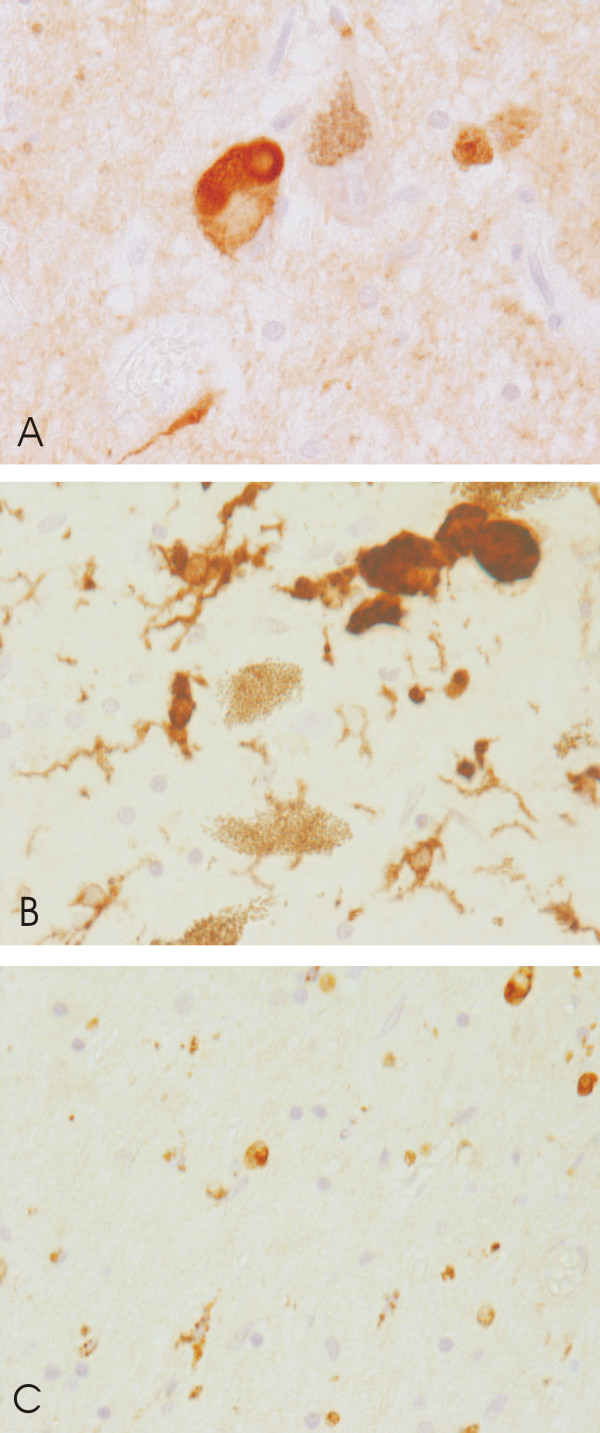
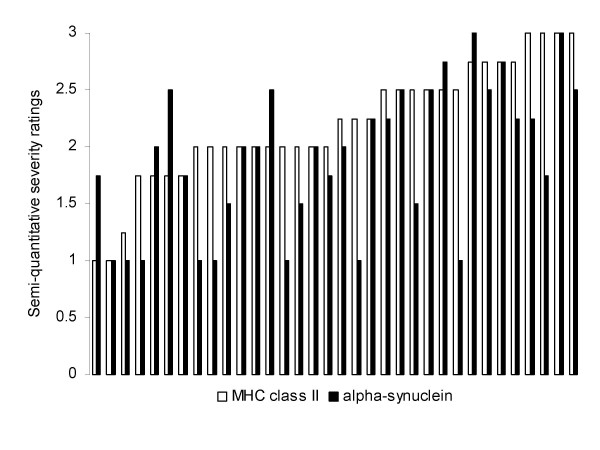
Background: The role of both microglial activation and alpha-synuclein deposition in Parkinson's disease remain unclear. We have tested the hypothesis that if microglia play a primary role in Parkinson's disease pathogenesis, the microglial "activated" phenotype should be associated with histopathological and/or clinical features of the disease. Methods: We have examined microglial MHC class II expression, a widely used marker of microglial activation, the occurrence of CD68-positive phagocytes and alpha-synuclein immunoreactivity in post-mortem human substantia nigra affected by idiopathic Parkinson's disease (PD). Using semi-quantitative severity ratings, we have examined the relationship between microglial activation, alpha-synuclein deposition, classical neuropathological criteria for PD, subtype of the disease and clinical course. Results: While we did not observe an association between microglial MHC class II expression and clinical parameters, we did find a correlation between disease duration and the macrophage marker CD68 which is expressed by phagocytic microglia. In addition, we observed a significant correlation between the degree of MHC class II expression and alpha-synuclein deposition in the substantia nigra in PD. Conclusion: While microglia appeared to respond to alpha-synuclein deposition, MHC class II antigen expression by microglia in the substantia nigra cannot be used as an indicator of clinical PD severity or disease progression. In addition, a contributory or even causative role for microglia in the neuronal loss associated with PD as suggested by some authors seems unlikely. Our data further suggest that an assessment of microglial activation in the aged brain on the basis of immunohistochemistry for MHC class II antigens alone should be done with caution.
Overview
The claims and statistics of this paper haven’t been checked yet.
Run the check — free, no account needed. It reads the open-access text and checks the sources it cites.
Integrity signals
Registry
Cites
Statistics
Figures
Verification
Claims the paper makes
The claims and statistics of this paper haven’t been checked yet.
Run the check — free, no account needed. It reads the open-access text and checks the sources it cites.
Claims other papers make about this one
Each is checked against this paper’s own text: does it say what the citing paper says it does?
The source backs part of the claim, not all of it — or backs it for a different population, condition or comparison.
In the citing paper
“Dysregulation of microglia functions contribute to the pathogenesis of neurodegenerative diseases, including Alzheimer’s disease (AD) (6–8), Parkinson’s disease (PD) (9–12) and Huntington’s disease (HD) (13–15).”
From An environment-dependent transcriptional network specifies human microglia identity (2017) · cites this paper as [10]
Experimental — accuracy not yet measuredIn the citing paper
“Microglia accumulate near α-synuclein deposits and become proinflammatory in a manner dependent on receptors that also bind Aβ, such as CD36 and TLR263–65.”
From Microglia in neurodegeneration (2018) · cites this paper as [63]
In the citing paper
“Microglia also phagocytose α-synuclein, the constituent protein of Lewy bodies in Parkinson’s and Lewy Body dementias, and become pro-inflammatory in the process, expressing cytokines (IL1β, IL6, TNFα), reactive oxygen species (ROS) and prostaglandin synthesising cyclooxygenase 2 (COX2) [24,25,26].”
From ROS Generation in Microglia: Understanding Oxidative Stress and Inflammation in Neurodegenerative Disease (2020) · cites this paper as [24]
Self-check
Percentages, sums and reported differences re-computed from the paper’s own numbers.
The self-check needs the paper’s full text.
Citations
Cites
Staging of brain pathology related to sporadic Parkinson’s disease
Braak, H., Tredici, K. D., Rüb, U., de Vos, R. A. I., Jansen Steur, E. N. H., & Braak, E. (2003) · Neurobiology of Aging · doi:10.1016/s0197-4580(02)00065-9 · Cited by 10,777
Spillantini, M. G., Schmidt, M. L., Lee, V. M.-Y., Trojanowski, J. Q., Jakes, R., & Goedert, M. (1997) · Nature · doi:10.1038/42166 · Cited by 8,382
Mutation in the α-Synuclein Gene Identified in Families with Parkinson's Disease
Polymeropoulos, M. H., Lavedan, C., Leroy, E., Ide, S. E., Dehejia, A., Dutra, A., Pike, B., Root, H., Rubenstein, J., Boyer, R., et al. (1997) · Science · doi:10.1126/science.276.5321.2045 · Cited by 8,240
α-Synuclein Locus Triplication Causes Parkinson's Disease
Singleton, A. B., Farrer, M., Johnson, J., Singleton, A., Hague, S., Kachergus, J., Hulihan, M., Peuralinna, T., Dutra, A., Nussbaum, R., et al. (2003) · Science · doi:10.1126/science.1090278 · Cited by 4,383
AlaSOPro mutation in the gene encoding α-synuclein in Parkinson's disease
Krüger, R., Kuhn, W., Müller, T., Woitalla, D., Graeber, M., Kösel, S., Przuntek, H., Epplen, J. T., Schols, L., & Riess, O. (1998) · Nature Genetics · doi:10.1038/ng0298-106 · Cited by 3,836
Self-citationMcGeer, P. L., Itagaki, S., Boyes, B. E., & McGeer, E. G. (1988) · Neurology · doi:10.1212/wnl.38.8.1285 · Cited by 2,990
The new mutation, E46K, of α‐synuclein causes parkinson and Lewy body dementia
Zarranz, J. J., Alegre, J., Gómez‐Esteban, J. C., Lezcano, E., Ros, R., Ampuero, I., Vidal, L., Hoenicka, J., Rodriguez, O., Atarés, B., et al. (2004) · Annals of Neurology · doi:10.1002/ana.10795 · Cited by 2,737
α-synuclein locus duplication as a cause of familial Parkinson's disease
Chartier-Harlin, M.-C., Kachergus, J., Roumier, C., Mouroux, V., Douay, X., Lincoln, S., Levecque, C., Larvor, L., Andrieux, J., Hulihan, M., et al. (2004) · The Lancet · doi:10.1016/s0140-6736(04)17103-1 · Cited by 2,029
Liu, B., & Hong, J.-S. (2003) · The Journal of Pharmacology and Experimental Therapeutics · doi:10.1124/jpet.102.035048 · Cited by 1,095
Imamura, K., Hishikawa, N., Sawada, M., Nagatsu, T., Yoshida, M., & Hashizume, Y. (2003) · Acta Neuropathologica · doi:10.1007/s00401-003-0766-2 · Cited by 791
Dystrophic microglia in the aging human brain
Streit, W. J., Sammons, N. W., Kuhns, A. J., & Sparks, D. L. (2004) · Glia · doi:10.1002/glia.10319 · Cited by 705
Wilms, H., Rosenstiel, P. C., Sievers, J., Deuschl, G., Zecca, L., & Lucius, R. (2003) · The FASEB Journal · doi:10.1096/fj.02-0314fje · Cited by 337
α‐Synuclein pathology does not predict extrapyramidal symptoms or dementia
Parkkinen, L., Kauppinen, T., Pirttilä, T., Autere, J. M., & Alafuzoff, I. I. (2004) · Annals of Neurology · doi:10.1002/ana.20321 · Cited by 328
An inflammatory review of Parkinson's disease
Orr, C. F., Rowe, D. B., & Halliday, G. M. (2002) · Progress in Neurobiology · doi:10.1016/s0301-0082(02)00127-2 · Cited by 309
Rozovsky, I., Finch, C. E., & Morgan, T. E. (1998) · Neurobiology of Aging · doi:10.1016/s0197-4580(97)00169-3 · Cited by 252
Aging-associated Changes in Human Brain
Mrak, R. E., Griffin, W. S. T., & Graham, D. I. (1997) · Journal of Neuropathology & Experimental Neurology · doi:10.1097/00005072-199712000-00001 · Cited by 229
Ishizawa, K., & Dickson, D. W. (2001) · Journal of Neuropathology & Experimental Neurology · doi:10.1093/jnen/60.6.647 · Cited by 209
Barcia, C., Sánchez-Bahíllo, A., Fernández‐Villalba, E., Bautista‐Hernández, V., Poza, M., Fernández-Barreiro, A., Hirsch, É. C., & Herrero, M. T. (2004) · Glia · doi:10.1002/glia.20015 · Cited by 206
Microglial Activation Parallels System Degeneration in Multiple System Atrophy
Ishizawa, K., Komori, T., Sasaki, S., Arai, N., Mizutani, T., & Hirose, T. (2004) · Journal of Neuropathology & Experimental Neurology · doi:10.1093/jnen/63.1.43 · Cited by 172
Sugama, S., Yang, L., Cho, B. P., DeGiorgio, L. A., Lorenzl, S., Albers, D. S., Beal, M. F., Volpe, B. T., & Joh, T. H. (2003) · Brain Research · doi:10.1016/s0006-8993(02)04085-4 · Cited by 153
On the question of apoptosis in the parkinsonian substantia nigra
Kösel, S., Egensperger, R., Eitzen, U. V., Mehraein, P., & Graeber, M. B. (1997) · Acta Neuropathologica · doi:10.1007/s004010050590 · Cited by 145
Self-citationAn Improved Approach to Prepare Human Brains for Research
Vonsattel, J. P., Aizawa, H., DiFiglia, M., McKee, A. C., MacDonald, M. E., Gusella, J. F., Landwehrmeyer, G. B., Bird, E. D., Richardson, E. P., & Hedley‐Whyte, E. T. (1995) · Journal of Neuropathology & Experimental Neurology · doi:10.1097/00005072-199501000-00006 · Cited by 134
In vivo imaging of neuroinflammation
Cagnin, A. (2002) · European Neuropsychopharmacology · doi:10.1016/s0924-977x(02)00107-4 · Cited by 110
Taupenot, L., Ciesielski-Treska, J., Ulrich, G., Chasserot‐Golaz, S., Aunis, D., & Bader, M. F. (1996) · Neuroscience · doi:10.1016/0306-4522(96)83172-1 · Cited by 94
Neuroprotective Strategies in Parkinson's Disease Using the Models of 6‐Hydroxydopamine and MPTPa
Grünblatt, E., Mandel, S. A., & Youdim, M. B. H. (2000) · Annals of the New York Academy of Sciences · doi:10.1111/j.1749-6632.2000.tb06192.x · Cited by 92
Deficient activation of microglia during optic nerve degeneration
Reichert, F., & Rotshenker, S. (1996) · Journal of Neuroimmunology · doi:10.1016/s0165-5728(96)00112-9 · Cited by 91
α‐Synuclein pathology is highly dependent on the case selection
Parkkinen, L., Soininen, H. S., Laakso, M., & Alafuzoff, I. I. (2001) · Neuropathology and Applied Neurobiology · doi:10.1046/j.0305-1846.2001.00342.x · Cited by 86
Hurley, S. D., O'Banion, M., Song, D. D., Arana, F. S., Olschowka, J., & Haber, S. (2003) · Experimental Neurology · doi:10.1016/s0014-4886(03)00273-5 · Cited by 69
Togo, T., Iseki, E., Marui, W., Akiyama, H., Uéda, K., & Kosaka, K. (2001) · Journal of the Neurological Sciences · doi:10.1016/s0022-510x(00)00498-6 · Cited by 67
Towards a transcriptome definition of microglial cells
Moran, L. B., Duke, D. C., Turkheimer, F., Banati, R. B., & Graeber, M. B. (2004) · Neurogenetics · doi:10.1007/s10048-004-0172-5 · Cited by 59
Self-citationYasuhara, O., Kawamata, T., Aimi, Y., McGeer, E. G., & McGeer, P. L. (1994) · Neuroscience Letters · doi:10.1016/0304-3940(94)90227-5 · Cited by 58
Activated microglial cells and complement factors are unrelated to cortical Lewy bodies
Rozemuller, A. J. M., Eikelenboom, P., Theeuwes, J. W., Jansen Steur, E. N. H., & de Vos, R. A. I. (2000) · Acta Neuropathologica · doi:10.1007/s004010000225 · Cited by 50
Kösel, S., Egensperger, R., Bise, K., Arbogast, S., Mehraein, P., & Graeber, M. B. (1997) · Acta Neuropathologica · doi:10.1007/s004010050747 · Cited by 43
Self-citationGlobal democratic consensus on neuropathological disease criteria
Achim, C. L., Auer, R. N., Bergeron, C., Cardozo, A., Deprez, M., de Vos, R., Duyckaerts, C. J., Egensperger, R., Esiri, M. M., Frosch, M. P., et al. (2002) · The Lancet Neurology · doi:10.1016/s1474-4422(02)00156-4 · Cited by 4
Self-citation
Research works printed but not linked: 1
- Graeber MB: Glial inflammation in neurodegenerative diseases. 8th Annual Congress of the British Society for Immunology, Harrogate, 5–8 December 2000, Immunology. 2000, Oxford: Blackwells, Abstract, Supplement
Cited by
Sorted by citations
The Role of Oxidative Stress in Parkinson's Disease
Dias, V., Junn, E., & Mouradian, M. M. (2013) · Journal of Parkinson’s Disease · doi:10.3233/jpd-130230 · Cited by 1,845
Microglia in neurodegeneration
Hickman, S., Izzy, S., Sen, P., Morsett, L., & El Khoury, J. (2018) · Nature Neuroscience · doi:10.1038/s41593-018-0242-x · Cited by 1,710
-Synuclein in Parkinson's Disease
Stefanis, L. (2012) · Cold Spring Harbor Perspectives in Medicine · doi:10.1101/cshperspect.a009399 · Cited by 1,446
An environment-dependent transcriptional network specifies human microglia identity
Gosselin, D., Skola, D., Coufal, N. G., Holtman, I. R., Schlachetzki, J. C. M., Sajti, E., Jaeger, B. N., O’Connor, C., Fitzpatrick, C., Pasillas, M. P., et al. (2017) · Science · doi:10.1126/science.aal3222 · Cited by 1,220
Simpson, D. S. A., & Oliver, P. L. (2020) · Antioxidants · doi:10.3390/antiox9080743 · Cited by 1,044
Metadata
- Authors
- Croisier, E., Moran, L. B., Dexter, D. T., Pearce, R. K., & Graeber, M. B.
- Affiliations
- Imperial College London (GB)
- Corresponding author
- Graeber, Manuel B
- ORCID
- Dexter, David T
- Venue
- Journal of Neuroinflammation
- Published
- 2005-06-03
- Volume
- 2
- Issue
- 1
- Pages
- 14-14
- ISSN
- 1742-2094 (ISSN-L)
- PMC
- PMC1177985
- OpenAlex
- W1822935226
- Cited by
- 414
- References
- 34
- Citations by year
- 2026: 15 · 2025: 18 · 2024: 44 · 2023: 24 · 2022: 25 · 2021: 38 · 2020: 44 · 2019: 18 · 2018: 22 · 2017: 15 · 2016: 13 · 2015: 19 · 2014: 18 · 2013: 19 · 2012: 11
- FWCI
- 7.36
- Type
- journal article
- Language
- en
- Open access
- gold
- doi.org
- Licence
- cc-by
- Locations
- Journal of Neuroinflammation (publishedVersion, cc-by)
- PubMed Central (publishedVersion, cc-by)
- PubMed (publishedVersion)
- DOAJ (DOAJ: Directory of Open Access Journals) (submittedVersion)
- Funders
- Parkinson's UK (G-4028)
- Topics
- Health Sciences › Medicine › Clinical Neurology › Parkinson's Disease Mechanisms and Treatments
- Life Sciences › Neuroscience › Neurology › Neuroinflammation and Neurodegeneration Mechanisms
- Life Sciences › Biochemistry, Genetics and Molecular Biology › Molecular Biology › Nuclear Receptors and Signaling
- Keywords
- Parkinson's disease, microglial activation, substantia nigra, MHC class II expression, CD68, microglial phagocytosis, neuroinflammation, disease duration, neuronal loss, postmortem brain
About these checks
Registry, retraction, Cites and statistics results are computed, not judged, with one exception: a printed reference that no index lists is read once by a model before it counts as a citation error. Claims are extracted by a model and kept only when their quote appears verbatim in the text; each cited source is then checked, with a model’s help, for whether it says what the claim relies on. Those verdicts can be wrong — read the claim’s quote and the cited source before relying on one.
Statistics and arithmetic are recomputed, not judged.
Confidence bands are shown only for fields calibrated on our annotated test set. None is calibrated yet, so no band is shown.
What counts as a claim ›How we measure confidence ›How we check this ›
Are you an author, or do you see a problem with this page? Request a review
