

CAR/FoxP3-engineered T regulatory cells target the CNS and suppress EAE upon intranasal delivery
Open accessThe DOI matches its Crossref record; 41 of the 42 references it cites were found in a registry or an index.
Abstract
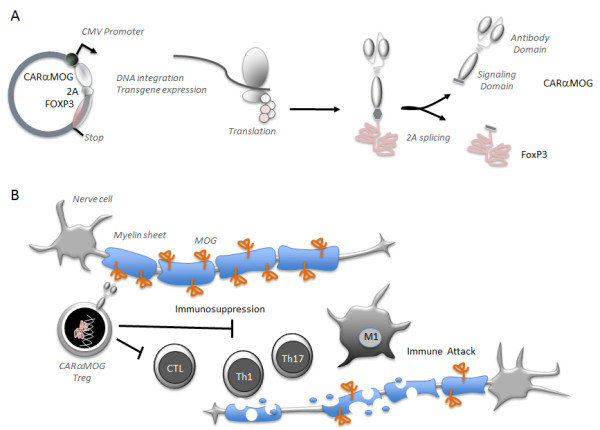
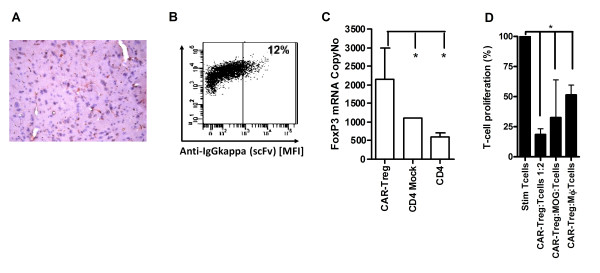
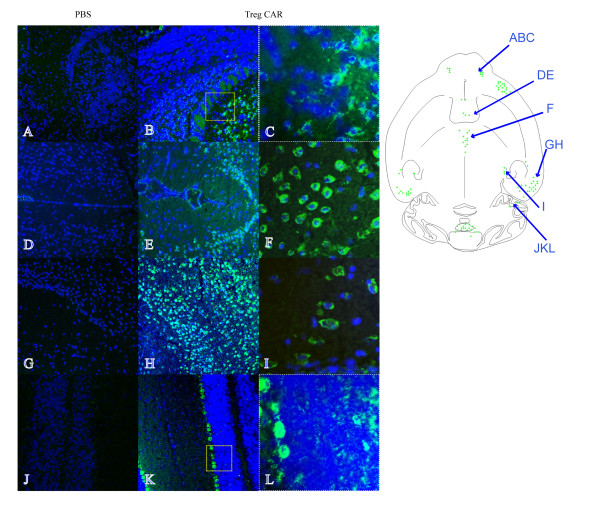
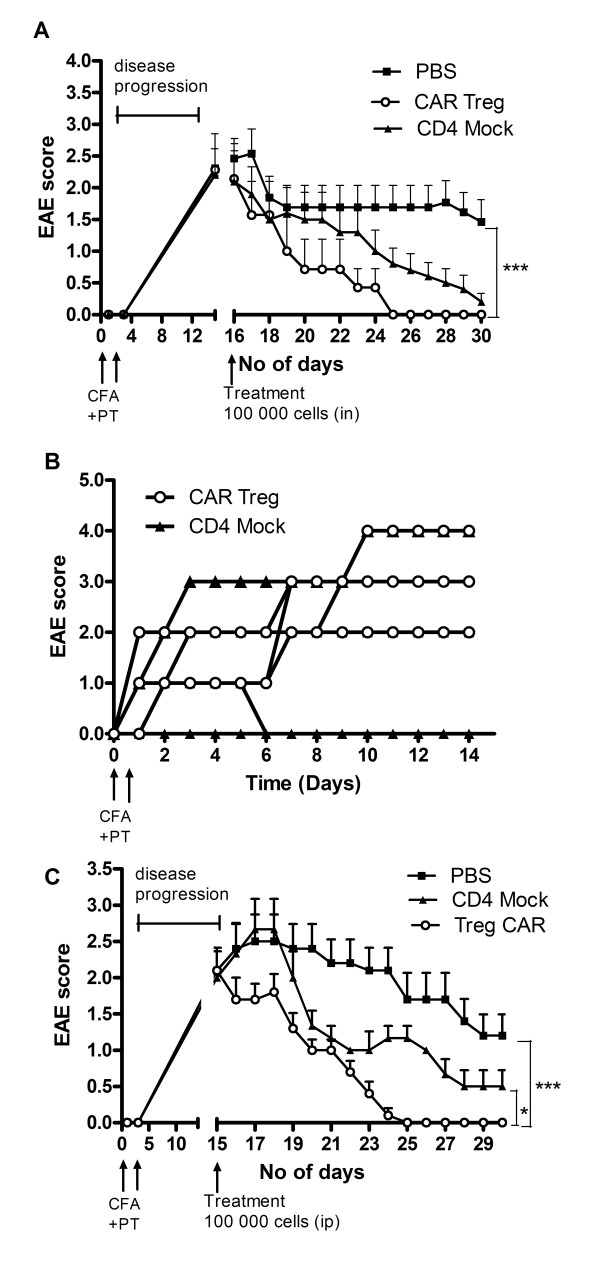
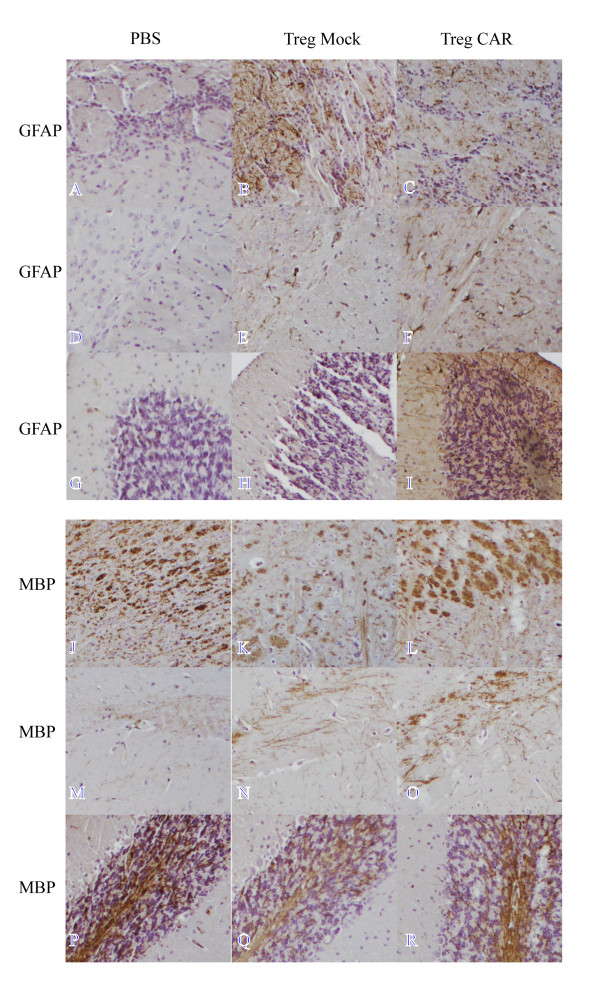
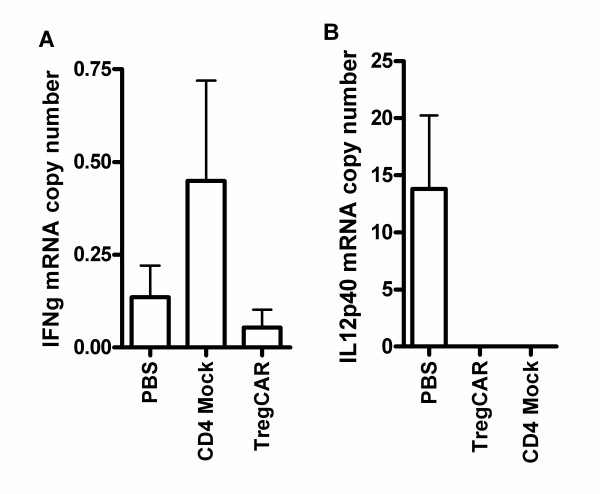
BACKGROUND: Multiple sclerosis (MS) is an autoimmune disease of the central nervous system (CNS). In the murine experimental autoimmune encephalomyelitis (EAE) model of MS, T regulatory (Treg) cell therapy has proved to be beneficial, but generation of stable CNS-targeting Tregs needs further development. Here, we propose gene engineering to achieve CNS-targeting Tregs from naïve CD4 cells and demonstrate their efficacy in the EAE model. METHODS: CD4+ T cells were modified utilizing a lentiviral vector system to express a chimeric antigen receptor (CAR) targeting myelin oligodendrocyte glycoprotein (MOG) in trans with the murine FoxP3 gene that drives Treg differentiation. The cells were evaluated in vitro for suppressive capacity and in C57BL/6 mice to treat EAE. Cells were administered by intranasal (i.n.) cell delivery. RESULTS: The engineered Tregs demonstrated suppressive capacity in vitro and could efficiently access various regions in the brain via i.n cell delivery. Clinical score 3 EAE mice were treated and the engineered Tregs suppressed ongoing encephalomyelitis as demonstrated by reduced disease symptoms as well as decreased IL-12 and IFNgamma mRNAs in brain tissue. Immunohistochemical markers for myelination (MBP) and reactive astrogliosis (GFAP) confirmed recovery in mice treated with engineered Tregs compared to controls. Symptom-free mice were rechallenged with a second EAE-inducing inoculum but remained healthy, demonstrating the sustained effect of engineered Tregs. CONCLUSION: CNS-targeting Tregs delivered i.n. localized to the CNS and efficiently suppressed ongoing inflammation leading to diminished disease symptoms.
Overview
The claims and statistics of this paper haven’t been checked yet.
Free: it reads the open-access text and checks the first 5 claims that cite a source we can check. Create a free account to check every claim.
Integrity signals
Registry
Cites
Statistics
Figures
Verification
Claims the paper makes
The claims and statistics of this paper haven’t been checked yet.
Free: it reads the open-access text and checks the first 5 claims that cite a source we can check. Create a free account to check every claim.
Claims other papers make about this one
Each is checked against this paper’s own text: does it say what the citing paper says it does?
In the citing paper
“studies have shown that transfection of T cells with FoxP3 induces regulatory activity.”
From Modulating immune responses to AAV by expanded polyclonal T-regs and capsid specific chimeric antigen receptor T-regulatory cells (2021) · cites this paper as [17]
Self-check
Percentages, sums and reported differences re-computed from the paper’s own numbers.
The self-check needs the paper’s full text.
Citations
Cites
Control of Regulatory T Cell Development by the Transcription Factor Foxp3
Hori, S., Nomura, T., & Sakaguchi, S. (2003) · Science · doi:10.1126/science.1079490 · Cited by 8,187
The Role of Tumoral FOXP3 on Cell Proliferation, Migration, and Invasion in Gastric Cancer
Zhang, L., Xu, J., Zhang, X., Zhang, Y., Wang, L., Huang, X., & Xu, Z. (2017) · Cellular Physiology and Biochemistry · doi:10.1159/000479442 · Cited by 4,088
In Vitro–expanded Antigen-specific Regulatory T Cells Suppress Autoimmune Diabetes
Tang, Q., Henriksen, K. J., Bi, M., Finger, E. B., Szot, G., Ye, J., Masteller, E. L., McDevitt, H., Bonyhadi, M., & Bluestone, J. A. (2004) · The Journal of Experimental Medicine · doi:10.1084/jem.20040139 · Cited by 1,221 · cited 1×
“Genetically engineered and cultured Tregs have been evaluated for treatment efficacy in a wide variety of adoptive transfer models of autoimmune diseases [9,23,25-27].”
BackgroundRegulatory T cells in the control of immune pathology
Maloy, K. J., & Powrie, F. (2001) · Nature Immunology · doi:10.1038/ni0901-816 · Cited by 1,175 · cited 2×
“; licensee BioMed Centr Commons Attribution License (http://creativec reproduction in any medium, provided the or regulate ongoing immune reactions and are important in the control of autoimmunity [2,3].”
BackgroundHori, S., Nomura, T., & Sakaguchi, S. (2017) · The Journal of Immunology · doi:10.1093/jimmunol/198.3.981 · Cited by 1,066
Szymczak, A. L., Workman, C. J., Wang, Y., Vignali, K. M., Dilioglou, S., Vanin, E. F., & Vignali, D. A. A. (2004) · Nature Biotechnology · doi:10.1038/nbt957 · Cited by 1,059 · cited 1×
“gene transfer of murine FoxP3 into CD4CD25 T cells, Chai and coworkers generated Tregs and used them in an animal model for transplantation with promising results [23], and this was later confirmed using a lentiviral vector system [24].”
BackgroundZiegler, S. F. (2006) · Annual Review of Immunology · doi:10.1146/annurev.immunol.24.021605.090547 · Cited by 922 · cited 1×
“Furthermore, Tregs block T cell activation indirectly via their interaction with antigen-presenting cells (APCs), preventing APC maturation and consequently downregulate their expression of costimulatory molecules and cytokine secretion [4,5].”
BackgroundTransport of drugs from the nasal cavity to the central nervous system
Illum, L. (2000) · European Journal of Pharmaceutical Sciences · doi:10.1016/s0928-0987(00)00087-7 · Cited by 907 · cited 1×
“The olfactory pathways have been extensively investigated as potential entry for pharmaceutical drugs into the brain [35,36].”
BackgroundMyelin-specific regulatory T cells accumulate in the CNS but fail to control autoimmune inflammation
Korn, T., Reddy, J., Gao, W., Bettelli, E., Awasthi, A., Petersen, T. R., Bäckström, B. T., Sobel, R. A., Wucherpfennig, K. W., Strom, T. B., et al. (2007) · Nature Medicine · doi:10.1038/nm1564 · Cited by 811 · cited 1×
“Hence the effector cell resistance to Treg suppression demonstrated by Korn and coworkers [34] may not occur using engineered Tregs.”
BackgroundKohm, A. P., Carpentier, P. A., Anger, H. A., & Miller, S. D. (2002) · The Journal of Immunology · doi:10.4049/jimmunol.169.9.4712 · Cited by 782
Cited by
Sun, L., Su, Y., Jiao, A., Wang, X., & Zhang, B. (2023) · Signal Transduction and Targeted Therapy · doi:10.1038/s41392-023-01471-y · Cited by 1,014
Mechanism of intranasal drug delivery directly to the brain
Crowe, T. P., Greenlee, M. H. W., Kanthasamy, A. G., & Hsu, W. H. (2018) · Life Sciences · doi:10.1016/j.lfs.2017.12.025 · Cited by 721
Alloantigen-specific regulatory T cells generated with a chimeric antigen receptor
MacDonald, K. G., Hoeppli, R. E., Huang, Q., Gillies, J., Luciani, D. S., Orban, P. C., Broady, R., & Levings, M. K. (2016) · Journal of Clinical Investigation · doi:10.1172/jci82771 · Cited by 494
The Emerging Landscape of Immune Cell Therapies
Weber, E. W., Maus, M. V., & Mackall, C. L. (2020) · Cell · doi:10.1016/j.cell.2020.03.001 · Cited by 446
“Similar results were observed in murine models of multiple sclerosis and transplant rejection (Boroughs et al., 2019; Fransson et al., 2012; MacDonald et al., 2016).”
Expression and Function of the Cholinergic System in Immune Cells
Fujii, T., Mashimo, M., Moriwaki, Y., Misawa, H., Ono, S., Horiguchi, K., & Kawashima, K. (2017) · Frontiers in Immunology · doi:10.3389/fimmu.2017.01085 · Cited by 374
“Studies examining the effects of adoptive transfer of antigenspecific Tregs have demonstrated their contribution to the protection and recovery of an animal model of autoimmune EAE (144).”
Background
Metadata
- Authors
- Fransson, M., Piras, E., Burman, J., Nilsson, B., Essand, M., Lu, B., Harris, R. A., Magnusson, P. U., Brittebo, E., & Loskog, A. S.
- Affiliations
- Uppsala University (SE)
- University of Pittsburgh (US)
- Karolinska Institutet (SE)
- Corresponding author
- Fransson, Moa
- Piras, Elena
- Loskog, Angelica SI
- ORCID
- Venue
- Journal of Neuroinflammation
- Published
- 2012-05-30
- Volume
- 9
- Issue
- 1
- Pages
- 112-112
- ISSN
- 1742-2094 (ISSN-L)
- PMC
- PMC3403996
- OpenAlex
- W2149184543
- Semantic Scholar
- 18bee0cf8a5a2439df63b51185e4704ca9f003c0
- Cited by
- 372
- References
- 42
- Citations by year
- 2026: 36 · 2025: 41 · 2024: 46 · 2023: 39 · 2022: 40 · 2021: 34 · 2020: 29 · 2019: 29 · 2018: 18 · 2017: 25 · 2016: 11 · 2015: 9 · 2014: 8 · 2013: 5 · 2012: 2
- FWCI
- 5.24
- Type
- journal article
- Language
- en
- Open access
- gold
- doi.org
- Locations
- Journal of Neuroinflammation (publishedVersion, cc-by)
- Europe PMC (PubMed Central) (publishedVersion, cc-by)
- PubMed Central (publishedVersion, cc-by)
- PubMed (publishedVersion)
- D-Scholarship@Pitt (University of Pittsburgh) (acceptedVersion)
- Uppsala University Publications (Uppsala University) (submittedVersion, other-oa)
- DOAJ (DOAJ: Directory of Open Access Journals) (submittedVersion)
- Funders
- Vetenskapsrådet
- Uppsala Universitet
- Topics
- Health Sciences › Medicine › Clinical Neurology › Multiple Sclerosis Research Studies
- Life Sciences › Immunology and Microbiology › Immunology › T-cell and B-cell Immunology
- Health Sciences › Medicine › Oncology › CAR-T cell therapy research
- Keywords
- regulatory T cells, chimeric antigen receptor, Foxp3, myelin oligodendrocyte glycoprotein, experimental autoimmune encephalomyelitis, multiple sclerosis, lentiviral transduction, adoptive immunotherapy, immunosuppression, myelination, reactive astrogliosis, IL-12, interferon-gamma
- MeSH terms
- Administration, Intranasal, Animals, Cell Line, Central Nervous System, Encephalomyelitis, Autoimmune, Experimental, Female, Genetic Vectors, Mice, Inbred C57BL, Receptors, Antigen, T-Cell, Genetic Therapy, Lentivirus, Gene Transfer Techniques, T-Lymphocytes, Regulatory, Mice, Forkhead Transcription Factors, Cell Engineering
About these checks
Registry, retraction, Cites and statistics results are computed, not judged, with one exception: a printed reference that no index lists is read once by a model before it counts as a citation error. Claims are extracted by a model and kept only when their quote appears verbatim in the text; each cited source is then checked, with a model’s help, for whether it says what the claim relies on. Those verdicts can be wrong — read the claim’s quote and the cited source before relying on one.
Statistics and arithmetic are recomputed, not judged.
Confidence bands are shown only for fields calibrated on our annotated test set. None is calibrated yet, so no band is shown.
What counts as a claim ›How we measure confidence ›How we check this ›
Are you an author, or do you see a problem with this page? Request a review
Data sources
Bibliographic data: Semantic Scholar, OpenAlex, Crossref.
Contains information from the Semantic Scholar Academic Graph Datasets, made available under the ODC Attribution License (ODC-BY 1.0).
Semantic Scholar’s data is described in: Kinney, R., et al. (2023). The Semantic Scholar Open Data Platform. arXiv:2301.10140.
